Thursday, July 31, 2025


With 15% tariffs locked in, Hyundai and Kia face tough road in U.S.

  • SARAH CHEA
Player Image
Korea JoongAng Daily
With 15% tariffs locked in, Hyundai and Kia face tough road in U.S.
5 min
Audio report: written by reporters, read by AI


U.S. President Donald Trump, the U.S. flag and the word ″Tariffs″ are depicted in an illustration. [REUTERS/YONHAP]

U.S. President Donald Trump, the U.S. flag and the word ″Tariffs″ are depicted in an illustration. [REUTERS/YONHAP]

 
[NEWS ANALYSIS]
 
The United States’ 15 percent tariffs on Korean goods have helped it avoid the worst but still diminished its FTA-derived edge, leaving the industries at a disadvantage against its foremost rival, Japan and the European Union.
 
Perhaps most consequentially, Korean automakers like Hyundai Motor and Kia have lost their 2.5 percent tariff advantage, undermining their competitiveness against Japanese and European brands — the three big auto exporters competing in the United States. 
 
Korea had long enjoyed zero tariffs under the FTA. Japan and the EU had a 2.5 percent rate, but the three now must endure a uniform 15 percent.
 

Related Article

  
“We strongly argued that, given the FTA, Korea should receive a 12.5 percent auto tariff to be on equal footing with Japan and the EU, but failed to persuade them,” Trade Minister Yeo Han-koo said during a press briefing Thursday, describing the outcome as “regrettable.”
 
Korea exported some 1.43 million vehicles to the U.S. market as of last year, ranking second after Mexico, narrowly ahead of Japan’s 1.37 million. The EU followed at around 758,000 units. The United States accounts for 20 percent of Korea’s exports, with more than half of that being automobiles.
 
From left, Minister of Trade, Industry and Energy Kim Jung-kwan; Deputy Prime Minister and Finance Minister Koo Yun-cheol; and Trade Minister Yeo Han-koo talk about the results of their trade talks with the United States during a press briefing in Washington on July 31. [NEWS1]

From left, Minister of Trade, Industry and Energy Kim Jung-kwan; Deputy Prime Minister and Finance Minister Koo Yun-cheol; and Trade Minister Yeo Han-koo talk about the results of their trade talks with the United States during a press briefing in Washington on July 31. [NEWS1]


Dodging the bullet, but losing the price war
Hyundai and Kia, facing fierce competition from Toyota Motor and Volkswagen Group in the U.S. market, are left to absorb losses that are projected to exceed some 6 trillion won ($4.3 billion) annually.
 
Hyundai shares shrank 4.5 percent to close at 213,000 won on Thursday while Kia dropped 7 percent to 102,700 won, pressured by significant sell-offs from foreign and institutional investors.
 
Thanks to a 2.5 percent tariff advantage, Hyundai was able to maintain slightly lower prices than competitors in the U.S. market — a factor that propelled Hyundai to gain a foothold in the U.S. market and rise to become the third largest automaker globally.
 
The sticker price of the Hyundai Elantra sedan, known as the Avante in Korea, starts at $22,125 in the United States, slightly undercutting its rival, the Toyota Corolla, which is priced from $22,325, and the Volkswagen Jetta at $22.995.
 
The Genesis GV70 has a sticker price of $48,000, roughly 10 percent lower than the BMW X3’s $52,075 and Mercedes GLC’s $51,000.
 
Hyundai Motor cars await export at a port in Pyeongtaek, Gyeonggi, on July 31, the day when the United States cut its tariffs on Korean goods to 15 percent. [YONHAP]

Hyundai Motor cars await export at a port in Pyeongtaek, Gyeonggi, on July 31, the day when the United States cut its tariffs on Korean goods to 15 percent. [YONHAP]
 
“Hyundai will have to freeze the prices to defend its market share in the U.S. market, meaning it's the company that has to shoulder the losses,” said Kim Pil-soo, a professor of automotive engineering at Daelim University College.
 
“This negotiation is tantamount to a failure, from the perspective of automobile tariffs,” Kim added. “Increasing U.S. production seems inevitable, which aligns with what [U.S. President Donald] Trump intended.”
 
With the 15 percent tariff, Hanwha Investment & Securities projected that Hyundai and Kia's profit would deteriorate by some 5.6 trillion won. Eugene Investment & Securities similarly estimated losses of around 7.5 trillion won under the scenario.
 
Hyundai and Kia’s combined profit has already shed by 19.6 percent, or 1.6 trillion won, in the second quarter, impacted by 25 percent tariffs imposed in April.
 
“Enhancing the competitiveness of Korean-made vehicles has become increasingly important at the moment,” said a spokesperson for Hyundai Motor, adding that the firm would make “every effort to minimize the impact.”
 
General Motors now sees diminishing strategic value in its Korean plants. The company exports more than 87 percent of its Korean production to the U.S. market.
 
Ministry of Trade, Industry and Energy Kim Jung-kwan, left, greets U.S. Commerce Secretary Howard Lutnick for a tariff meeting in Washington, on July 25. [NEWS1]

Ministry of Trade, Industry and Energy Kim Jung-kwan, left, greets U.S. Commerce Secretary Howard Lutnick for a tariff meeting in Washington, on July 25. [NEWS1]


Did Korea overcommit?
Given the size of Korea’s economy, some experts argue that its $450 billion offer was disproportionately generous compared to what Japan and the EU committed.
 
The $350 billion includes a massive $150 billion shipbuilding project spanning shipbuilding, equipment and maintenance, repair and overhaul, and $200 billion worth of investment funds that include direct investment, loans and guarantee programs.
 
That’s around 18.7 percent of its GDP and higher than Japan’s $550 billion pledge, which is just 13.7 percent of its $4.02 trillion economy.
 
“Japan’s GDP is more than twice the size of ours, and, by simple calculation, Korea’s commitment should have maxed out at around $250 billion — yet we went $100 billion over that,” said Joo Won, head of economic research at the Hyundai Research Institute.
 
A large crane stands at Hanwha Ocean’s headquarters in Geoje, South Gyeongsang, on July 31, the day when the United States cut its tariffs on Korean goods to 15 percent. [YONHAP]

A large crane stands at Hanwha Ocean’s headquarters in Geoje, South Gyeongsang, on July 31, the day when the United States cut its tariffs on Korean goods to 15 percent. [YONHAP]
 
U.S. Commerce Secretary Howard Lutnick said, regarding Korea's investment, that “90 percent of the profits will go to the American people” on X. 
 
The 50 percent tariffs on steel and aluminum remain unchanged, and sectoral tariffs on chips and biopharmaceuticals are still to be announced.
 
The Korean government, however, said the amount of direct investment and the relevant timeline have not been discussed yet. Details will be specified during the bilateral meeting between Trump and President Lee Jae Myung that is scheduled to take place within the next two weeks. 
 
Steel awaits export at a port in Pyeongtaek, Gyeonggi, on July 31, the day when the United States cut its tariffs on Korean goods to 15 percent. [YONHAP]
Steel awaits export at a port in Pyeongtaek, Gyeonggi, on July 31, the day when the United States cut its tariffs on Korean goods to 15 percent. [YONHAP]

BY SARAH CHEA [chea.sarah@joongang.co.kr]

Macron Says EU Was ‘Not Feared Enough’ In EU-US Trade Deal Talks


By 

By Elisa Braun


(EurActiv) — French President Emmanuel Macron sharply criticised the newly signed EU-US trade deal on Wednesday, telling ministers the European Union had not “been feared enough” during negotiations.

“To be free, you have to be feared, and we haven’t been feared enough,” he told the Council of ministers on Wednesday morning, according to two attendees.

The President, who had remained noticeably silent since the deal was signed on Sunday, also regretted that “Europe does not yet see itself sufficiently as a power” and called on the EU to “work tirelessly” to rebalance the relationship with the US.

“France has always maintained a firm and demanding stance. This is not the end of the story, the negotiation has to continue,” the French president also reportedly told ministers.

The spokesperson for the French government, Sophie Primas, later confirmed at a press conference on Wednesday afternoon that Macron welcomed a deal that would give French businesses greater visibility, but stressed that he considered the agreement incomplete and still subject to further negotiation.


The president also reportedly called to “accelerate the European agenda on sovereignty and competitiveness,” a remark widely seen as indirect criticism of Commission President Ursula von der Leyen’s implementation of her own priorities.

Unusual golf negotiations

Macron’s comments add to a growing chorus of European criticism against the deal and reflect mounting frustration at home. Prime Minister François Bayrou on Monday describedthe deal as a “submission,” while other cabinet members have questioned its content and the process that led to its conclusion.

“We would have preferred that these negotiations take place in an official setting and not in a private golf course in Scotland,” said Primas, describing the location as “unusual.”

In Paris, the government is convening a high-level meeting Wednesday afternoon with seven ministers and representatives of major business federations, reflecting the political heat the deal has stirred domestically.

While Paris has welcomed the Commission’s efforts to secure tariff exemptions for key export sectors such as aerospace, it has also voiced strong concerns over what it views as imbalances in the agreement. As the EU’s leading exporter of wine and spirits, France sees the treatment of these sectors as a growing point of contention.

Business heavyweights like Bernard Arnault, head of luxury conglomerate LVMH, which includes several spirits brands, are urging both the Commission and the French government to secure a clear exemption on spirits and wine, alongside the powerful wine sector.


EurActiv

EurActiv publishes free, independent policy news and facilitates open policy debates in 12 languages.

 EU-US tariff deal not finished yet, say Europeans unhappy with Trump's terms


Laura Gozzi
BBC News
Published on 

Getty Images
Since the deal was announced criticism of European Commission chief Ursula von der Leyen


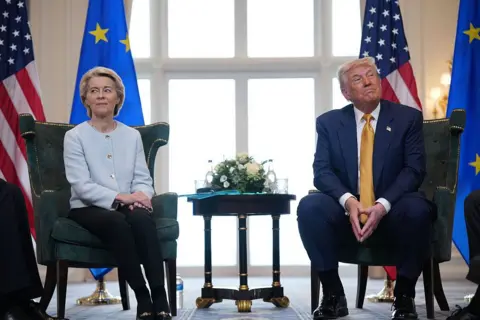
It was all handshakes and smiles when European Commission chief Ursula von der Leyen and US President Donald Trump announced that a EU-US trade agreement had been reached after months of wrangling - beating Trump's deadline of 1 August to make a deal.

Many across Europe breathed a sigh of relief that European negotiators had avoided 30% tariffs threatened by Trump months ago. Other countries are still racing to finalise deals with the US to avoid sweeping levies.

But since news of the US-EU deal was announced last weekend, not only has criticism mounted, but it has become clear many details are yet to be ironed out, there are several discrepancies between the two sides and some EU countries will be disproportionately affected.

Only a first step?


Few European leaders rejoiced at the announcement that a 15% tariff would be applied on most EU exports to the US - an improvement on the 30% tariff initially threatened by Trump, but still a substantial hike from the former 4.8% average rate.

Yet, while expressing regret that the EU had not adopted a tougher negotiating stance, many begrudgingly agreed the deal had at least brought a semblance of certainty and predictability to Europe's businesses after a number of fraught months.

"I would have wished for a different outcome," Germany's finance minister Lars Klingbeil said. "Still, all in all, it is good that there is an agreement with the US, that there are no further escalations."

As of Thursday, a joint statement had yet to be released, although the Commission has emphasised it will not be a legally binding document but a "set of political commitments".

"From there will flow the additional negotiated exemptions that we're looking to bake into our agreement with the US," Commission trade spokesperson Olof Gill said.

The Commission's general outline of the deal stressed it was not legally binding.

The White House fact sheet on the agreement presents none of these caveats and says it achieves "historic structural reforms", but US Commerce chief Howard Lutnick admitted on Wednesday that talks would continue and that EU and US officials were still discussing some aspects of the framework.

"This isn't the end of the story and we won't leave it at that," French President Emmanuel Macron said. "It's the first step in a negotiation process that will continue."

Trade agreements usually take between 18 and 24 months of bilateral negotiations, says Cinzia Alcidi of the Centre for European Policy Studies in Brussels. "To give some certainty to the industry and private sectors now, the 15% blanket tariff will apply – but then there will be efforts to get some goods a different deal," she says.

Key discrepancies and interpretations


According to the White House, pharmaceuticals and semiconductors will fall under the 15% tariff, with no mention of that number being the upper limit.

But the EU says the two sectors will remain on the current 0% rate for now and until new global tariff rates are agreed. Any future tariffs, according to the EU, will be capped at 15%.

Tariffs on steel and aluminium, according to the US, will remain at 50%. The EU says Brussels and Washington will work to cut that number and that they will be replaced by a quota system to come beyond 1 August.

Some of the most glaring discrepancies can be found in the language used by the two sides to describe the EU's investment commitments.

Where the US statement says the EU "will" purchase $750bn (£568bn) in US oil, liquefied natural gas (LNG) and nuclear energy products, the EU says only that it "intends" to do so as it weans itself off Russian gas and oil.

Not only is it unclear whether the US can even provide such amounts to the EU, says Cinzia Alcidi, but the EU cannot decide purchases on behalf of the private sector.

Similarly, the US says the EU will invest $600bn by the end of Trump's second term – but the EU states simply that "companies have expressed interest" in investing that sum by 2029. As Brussels cannot force private firms to invest in the US, there is technically no guarantee that amount can or will be reached.

According to the US, the EU has "agreed to purchase significant amounts" of US military equipment. There is no mention of this in the EU statement.

Nearly 80% of the EU's defence investment already goes to the US, and scaling up further may not be possible; besides, such a commitment would be at odds with von der Leyen's recent ReArm Europe plan, which calls for investments in Europe's domestic defence industry.

And while negotiations continue, the US will also apply a 15% tariff on wine and spirits, the Commission said on Thursday, adding it would continue to try and achieve a carve-out.

On Wednesday, Macron said the agreement had the merit of offering "predictability in the short term" - but also called for Europe to be firmer with the US.

"In order to be free you have to be feared. We weren't feared enough," he said.

Given the amount of detail that still needs hammering out, the next phase of negotiations is set to continue for some time - and after the backlash the Commission received this week, European negotiators may feel under greater pressure to stand their ground.


Getty Images
The German automotive industry will face billions in extra costs from the new tariffs

Which countries will be worse off?

Although the 15% tariffs will hit all European countries, they will affect them in different ways.

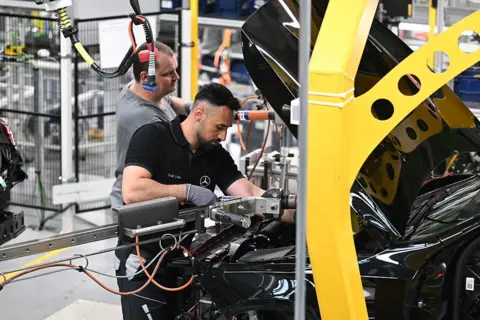
Germany, Ireland and Italy are particularly exposed due to the nature of their partnerships with the US. For Germany's carmakers, the US represents 13% of their exports worth €34bn (£29bn). Hildegard Müller, president of the German Association of the Automotive Industry, said the new tariffs would be a costly burden.

Among EU countries, Ireland is the most reliant on the US as an export market. In particular it manufactures and exports pharmaceuticals worth $50bn a year – so Dublin welcomed the EU-US agreement through gritted teeth. "It is what it is and we move on," said Neale Richmond, a minister of state in Ireland's foreign affairs department.

Italy's agricultural, pharmaceutical and automotive sectors will also suffer and the country's gross domestic product (GDP) could take a 0.2% hit as a result of the 15% levy, according to the Italian Institute of International Political Studies.

Cristiano Fini of the Italian Confederation of Farmers said the deal with the US felt more like "a surrender" than an agreement. Several Italian trade associations are now already clamouring for compensation from the EU to make up for the predicted losses.

But that is exactly what the EU needs to resist, says Cinzia Alcidi.

Blanket compensation for EU exporters would end up costing taxpayers, she believes, "and that would constitute a great victory for Trump because it would mean that, ultimately, Europeans are paying the price of his tariffs".


Trump’s gangsterism towards the EU is working

The US-EU tariff deal is a disaster for the European economy.


By Bruno Maçães
International Politics
29 July 2025
NEW STATESMAN 
Photo by Thierry Charlier/AFP

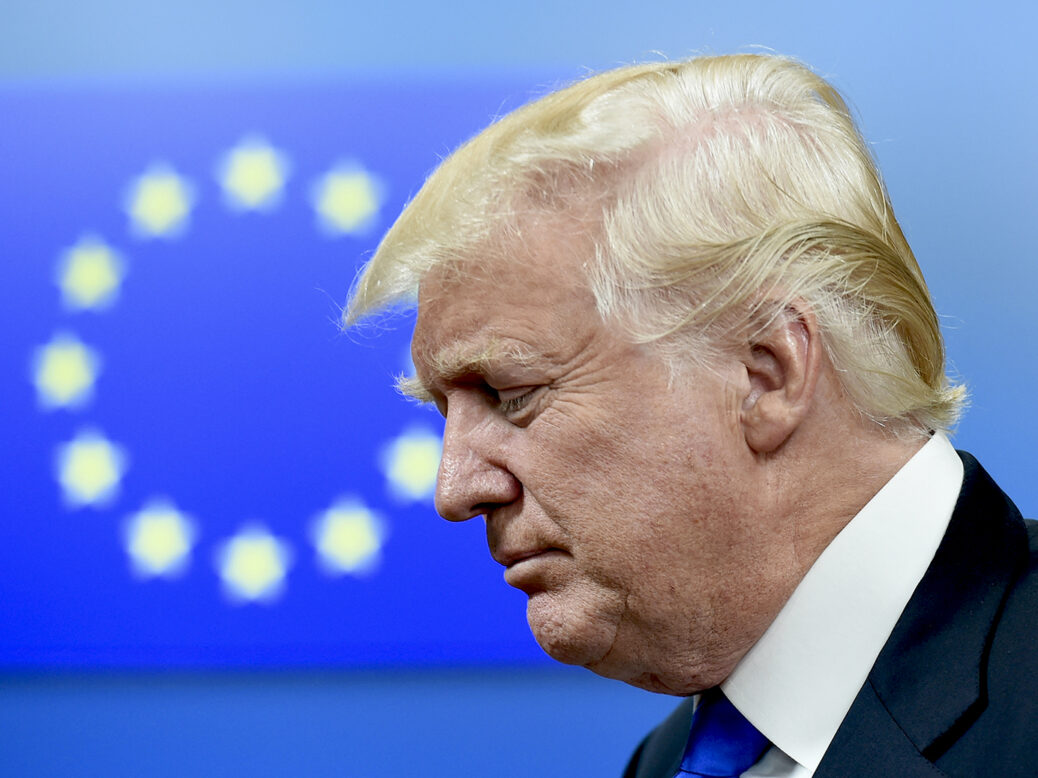
In 2018, when Donald Trump threatened to impose tariffs on European cars, then-president of the European Commission, Jean-Claude Juncker, responded: “We can also do stupid.” When Trump then imposed steel and aluminium tariffs, the EU responded by targeting Harley-Davidson motorbikes and bourbon. It wasn’t long before the two economic blocs agreed to put further tariffs on hold. It was a different time.

Juncker, of course, was cut from a different cloth from today’s Commission president Ursula von der Leyen and many of the current European leaders. He had not danced the night away in Berlin in November 1989, as the Wall fell, and was not too inclined to believe in teenage ideas such as the end of history or America as a force for good in the world. He knew, as former French president François Mitterrand once put it, that between America and Europe there is a bloody economic war going on at all times, and there has been one for more than a century.

But let us be fair to von der Leyen. There is another difference between today and 2018: the war in Ukraine. For all the pablum about how the war has awakened Europe from its geopolitical slumber, the truth is very different. The war has made Europe entirely dependent on the US — even as it continues to pay for most of the war expenses — because of the belief that without American weaponry Ukraine would sooner or later be defeated.

It is a wonderful position for Donald Trump to be in. He can effectively threaten Ukraine with a tragic defeat and the EU with the consequences of such an outcome by simply allowing the withdrawal of all support for Kyiv to hover above the economic negotiations. “What a nice country Ukraine is,” he says ominously to Europeans, “it would be terrible if something happened to it.” There are no economic discussions taking place at the moment; rather, it’s the logic of military force supplanting every economic discussion.

The gangsterism has been effective. Terribly effective in fact as evidenced by the bizarre deal announced by von der Leyen over the weekend: for the privilege of paying tariffs of 15 per cent to export to the American market, the EU will reduce its own tariffs and prepare significant transfers of funds to the US energy and defense industries, themselves an informal part of the American state. I have to confess I have never seen a trade deal quite like this one where European concessions were seemingly exchanged for… more European concessions.

It’s a catastrophic outcome for a series of reasons. First, more than any other crisis in my lifetime, the deal undermines the very raison d’etre for the European Union. If the EU is after all too weak, too divided, too timid to defend European interests on the global stage, what exactly is it for? The individual states can surely be weak on their own.

Second, while European leaders have often expressed their distaste for the kind of politics Donald Trump represents, they are also the best possible argument for Trump: after all, if he can extract significant tribute from wealthy European societies, in a way his predecessors could not, why should Americans vote for anyone else? And in fact, after the deal was announced, social media was flooded by Maga accounts celebrating a victory, even turning it into a battle of the sexes, with von der Leyen coming out defeated and humiliated. Good job, everyone in the Berlaymont, you made us proud.

Third, the deal is a disaster for the European economy. We saw the impact the day after the announcement: investment banks are revising their growth forecasts for Europe and the euro fell steeply against the dollar. This is particularly hard to take because it reverses very positive dynamics after Trump returned to the White House and global investors started to look at Europe as a more predictable place to park their money. Why should they do that now that exports to the US market may fall by about 30 per cent as a result of the tariffs and investment in European technology looks doomed with the necessary funds going to buy American weapons and natural gas instead of European weapons and wind turbines.

Note how the deal determines that Europe continues to subsidise the military industrial complex in North Virginia instead of investing in its own military technology. Such investment would help Ukraine survive, but it would also reduce Europe’s vulnerability and create a level playing field for transatlantic relations. That’s the last thing Trump wants. This deal is disastrous on its own terms and doubly disastrous for creating the conditions for many similar deals in the future.

The irony is that Europeans spend an enormous amount of time discussing among themselves why their economies are falling behind the boisterous US economy. One American company, Nvidia, may soon be worth more than the 50 largest European companies. What explains this? Might it be an excess of regulation, as Mario Draghi likes to say? A taste for la dolce vita? Too much wine? Too much espresso? Perhaps Europeans lack the entrepreneurial drive of Americans, the typical justification of every colonised mind and yet not uncommon in parts of Europe. What a mystery.

Unless, of course, it has something to do with Europe’s extreme vulnerability and America’s willingness to use its unmatched military power to shape economic outcomes. Yes, it might be that.


Mexico expects to reach tariff agreement with US this week

Mexico expects to reach tariff agreement with US this week
Mexico hopes to reach agreement on tariffs with US. / bne IntelliNews

By bnl Mexico City bureau July 30, 2025

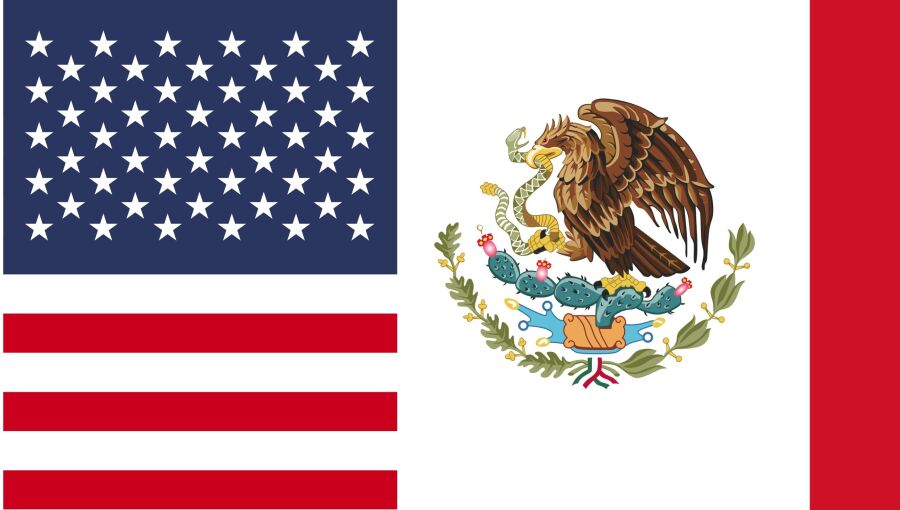
Mexican President Claudia Sheinbaum stated on July 28 that she expects to reach an agreement with the United States this week, days before new tariffs take effect on August 1. The Mexican leader expressed optimism during her regular press conference whilst acknowledging differing positions between both nations.

"There is an agreement that they (United States) signed with Japan, with the European Union yesterday, with other countries, and we expect an agreement this week. So, we will continue reporting," Sheinbaum declared during her morning briefing.

US President Donald Trump announced on July 12 his intention to impose 30% tariffs on Mexican products from August 1, citing the "fentanyl crisis" as justification. However, American institutions report a 50% reduction in synthetic opioid flows into US territory during Sheinbaum's administration, which began on October 1, linked to increased seizures on Mexico's side of the border.

The president categorically denied media reports of US "pressure" to extradite alleged politicians linked to drug trafficking, describing such claims as "absolutely false." She attributed these reports to columnists seeking to project privileged access to information, dismissing them as falsehoods.

Sheinbaum emphasised that no telephone conversations with Trump or other bilateral official communications have requested specific individual extraditions related to political connections or current politicians. The president reiterated the main topics discussed with the American government, including migration policy.

"They have a migration policy. Mexico has developed different actions with respect to human rights to prevent the arrival of people of other nationalities to the northern border. I repeat: within the framework of mobility and respect for human rights," she stated.

Her administration has also requested US recognition for Mexican workers whilst seeking mechanisms for undocumented labourers supporting America's economy to access development opportunities.

Mexican cartels exploit Ukraine war to acquire military drone technology

Mexican cartels exploit Ukraine war to acquire military drone technology
The revelations cement Ukraine’s inadvertent role as a premier training ground for modern asymmetric warfare techniques amid its conflict with Russia. / unsplash
By bne IntelliNews July 30, 2025

Ukrainian counterintelligence has discovered that criminal organisations from Mexico and Colombia have been exploiting the country's volunteer recruitment programme to acquire advanced military drone capabilities for use in narcotics trafficking operations.

The scheme, first reported by French publication Intelligence Online, came to light following intelligence sharing between Mexico City and Kyiv, revealing that individuals with suspected cartel connections had deliberately enlisted in Ukraine's International Legion under false pretences to gain access to cutting-edge unmanned aerial vehicle training.

Unlike genuine volunteers motivated by solidarity with Ukraine's defensive struggle, these operatives reportedly sought specific technical instruction in First-Person View drone operations – skills highly valued by criminal networks seeking tactical advantages in territorial disputes and enforcement activities.

The discovery has prompted Ukrainian authorities to reassess screening procedures for foreign recruits, particularly those from regions with significant organised crime presence.

The infiltration effort demonstrates remarkable sophistication, with suspects employing false identities, forged documentation and front companies to facilitate their passage into Ukrainian territory and military structures.

Intelligence analysts have identified a network of private security firms across Latin America that appear to have coordinated these placements. Companies operating from Mexico, Colombia and other regional centres allegedly provided fraudulent credentials and logistical support to enable suspect individuals to reach Ukrainian training facilities.

One particularly concerning case involved an operative codenamed Aguila-7, who successfully embedded within a specialised Ukrainian unit for several months whilst maintaining a humanitarian cover story. He joined the International Legion in March 2024 using false Salvadoran documentation and completed comprehensive training at facilities in Lviv.

His exceptional pre-existing technical knowledge, including familiarity with electronic warfare countermeasures and thermal detection avoidance, eventually aroused instructor suspicion. Background investigations later revealed probable connections to Mexico's elite GAFE special forces, some of whose former personnel have historically transitioned to cartel employment, notably through the ultra-violent Zetas organisation.

Additional cases have emerged involving former FARC guerrillas who infiltrated the system using Panamanian and Venezuelan identity documents, with at least one individual identified through distinctive tattoos and accent patterns captured in internal training videos.

The revelations cement Ukraine’s inadvertent role as a premier training ground for modern asymmetric warfare techniques amid its conflict with Russia. The country's unique operational environment has fostered rapid innovation in low-cost, high-impact military technologies that could prove highly attractive to non-state actors worldwide.

Ukrainian facilities have developed comprehensive curricula covering drone manufacturing, tactical deployment, electronic warfare resistance and real-time battlefield coordination. These capabilities represent exactly the type of force multiplication that criminal organisations seek to enhance their operational effectiveness.

Speaking anonymously to Intelligence Online, an SBU official summarised the gravity of the situation: "We welcomed volunteers in good faith. But we must now recognise that Ukraine has become a platform for the global dissemination of FPV tactics. Some come here to learn how to kill with a $400 drone, then sell this knowledge elsewhere to the highest bidder."

Security experts warn that the knowledge transfer could significantly alter criminal conflict dynamics across Latin America, where cartels already employ increasingly sophisticated military-style tactics and equipment in their operations.

The concerns stretch well past regional boundaries, as similar infiltration attempts could theoretically originate from other areas with substantial organised crime presence or hostile state actors seeking access to battlefield-tested technologies.

Since the start of Russia’s full-scale invasion in February 2022, Ukrainian security services have implemented enhanced vetting procedures in coordination with international partners, including expanded background checks and closer monitoring of volunteer activities within sensitive training programmes.

The investigation has been elevated to specialised counterintelligence units typically reserved for protecting critical state assets and preventing technology transfer to unauthorised recipients. Since 2023, these divisions have worked closely with military intelligence structures to filter foreign access to sensitive training modules and prevent doctrine transfer to unauthorised actors.

Spanish-speaking volunteers suspected of ulterior motives have had their data cross-referenced with Interpol and US Drug Enforcement Administration databases, with several individuals flagged for potential criminal backgrounds or connections to narco-paramilitary organisations.

Officials acknowledge the challenge of balancing legitimate international support for Ukraine's defensive efforts against the risk of exploitation by criminal elements. But the volunteer programme has provided valuable personnel and expertise to Ukrainian forces, making wholesale restrictions problematic.

The broader implications extend to other conflict zones where similar technology transfer risks might emerge, adding pressure to the need for coordinated international approaches to preventing criminal exploitation of military training opportunities.