Saturday, August 30, 2025


DOT and MARAD Pull Nearly $700M in Port and Wind Terminal Grants
CUTTING NOSE TO SPITE FACE

port terminals for offshore wind
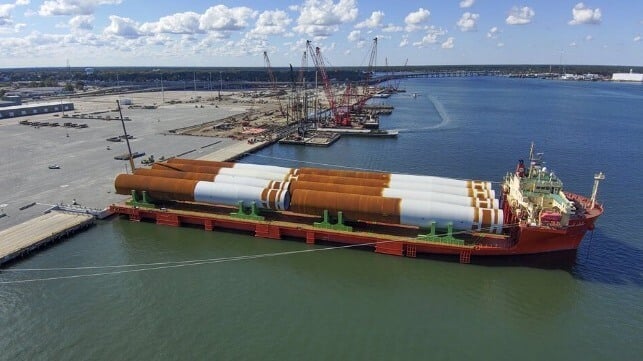
Ports received grants for improvements to accommodate wind projects such as the monopiles arriving in Virginia at Portsmouth Marien Terminal (Dominion)

Published Aug 29, 2025 2:13 PM by The Maritime Executive


The efforts to detail the U.S. offshore wind power industry are continuing with the US Department of Transportation and the Maritime Administration (MARAD) terminating and withdrawing nearly $700 million in grants made by the Biden administration for wind ports and terminals. In total, they identified 12 offshore wind grants and project selections in discretionary grant programs to be canceled.

The press statement references “doomed offshore wind projects,” saying the funding will be prioritized toward restoring America’s maritime dominance. They report that DOT and MARAD are refocusing on “rebuilding America’s shipbuilding capacity, unleashing more reliable, traditional forms of energy, and utilizing the nation’s bountiful natural resources.”

DOT has withdrawn one project from the Nationally Significant Freight and Highways Projects program, saving they report roughly $427 million. MARAD has withdrawn six projects, retracting $177 million, and terminated six projects in the Port Infrastructure Development Program, saving roughly $75 million. It totals $679 million in grants.

“The Trump administration is weakening our country’s national security and destroying good-paying jobs by pulling critical funding designed to update our aging maritime infrastructure," said Liz Burdock, CEO of Oceantic Network, a nonprofit supporting offshore wind and ocean energy. "Offshore wind port development upgrades facilities and capabilities that serve multiple industries; however, by selectively limiting infrastructure investments and removing mandated agreements in energy and shipyards, the administration is stalling essential development that delivers on shared priorities of national security and energy dominance, and signals to the investment community the U.S. is not safe place for investment."

The largest project included in the list is California’s Humboldt Bay Offshore Wind, which loses roughly $427 million in grants. The list also includes major wind projects including the Salem Wind Port in Massachusetts which was terminated at a saving of roughly $33.8 million, the Norfolk (Virginia) Offshore Wind Logistics Port ($39 million), Sparrows Point (Maryland) Steel Marshalling Port ($47 million), New Jersey’s Wind Port at Paulsboro ($20 million), Arthur Kill (New York) Terminal ($48 million) and the Redwood (California) Marine Terminal ($8.7 million). It also includes $10.5 million for the Bridgeport Port Authority (Connecticut) for the Operations and Maintenance Wind Port Project.

The Port of Davisville (Rhode Island) loses $11.25 million. The Lake Erie Renewable energy project ($11 million), Radio Island Rail Improvements (North Carolina) loses $1.7 million, and Portsmouth Marine Terminal (Virginia) loses $20 million.

The statement says that, where possible, funding from these projects will be "recompeted" to address critical port upgrades and other core infrastructure needs of the United States.

“Wasteful wind projects are using resources that could otherwise go towards revitalizing America’s maritime industry,” said U.S. Transportation Secretary Sean Duffy. “Joe Biden and Pete Buttigieg bent over backwards to use transportation dollars for their Green New Scam agenda while ignoring the dire needs of our shipbuilding industry.”

The accusations from Duffy and the Trump administration ignore the extensive investments made by the offshore wind industry into shipbuilding and the revitalization of ports such as Salem, Bridgeport, Norfolk, and Portsmouth. In 2023, President Joe Biden highlighted that companies had announced 18 offshore wind shipbuilding projects as well as investments of nearly $3.5 billion across 12 manufacturing facilities and 13 ports to strengthen the American offshore wind supply chain. The vessels ranged from the first Jones Act-compliant installation vessels to SOVs and crew transfer vessels. They were being built at shipyards ranging from Florida to Louisiana, New York, Massachusetts, Michigan, Rhode Island, Wisconsin, and Pennsylvania.

Many of the projects went to smaller shipyards to build crew transfer vessels. Among the large projects were SOVs built by Edison Chouest Offhore in Louisiana and Fincantieri Bay in Wisconsin. Seatrium AmFELS shipyard in Brownsville, Texas, is completing the massive turbine installation vessel Charybdis, the first of its kind in the United States, for Dominion, and Hanwha Philly Shipyard recently floated a rock installation vessel being built for Great Lakes Dredge & Dock Company.


Australia Awards More Preliminary Feasibility Licenses for Offshore Wind
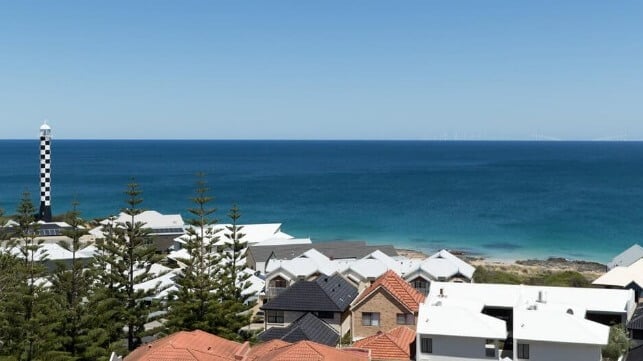
Australia offshore wind energy
Australia issued additional preliminary feasibility licenses for offshore wind in the Bunbury region south of Perth (DCCEEW)

Published Aug 28, 2025 5:58 PM by The Maritime Executive


The Australian government reports it is continuing to push forward with efforts to spur development for offshore wind energy. In its latest step, it awarded two additional preliminary feasibility licenses, both going to groups backed by European majors, for what could become the first offshore wind farms in the Indian Ocean.

The move comes as some of the major European corporations have stalled their efforts in Australia or withdrawn. Last week, it was revealed that Equinor will not be accepting its feasibility license for a proposed project that would have involved floating wind turbines off the Hunter coast of New South Wales. The company reportedly could not reach an agreement with its local partner Oceanex, while last month it also withdrew from a project planned for the Bass Strait.

Minister for Climate Change and Energy, Chris Bowen, called the new licenses being awarded another important step for the industry in Western Australia. He highlighted that “Western Australia needs some 50 GW of additional generation by 2042.”

The zone located south of Perth was declared in September 2024, with the government saying it could provide as much as 11.4 GW of renewable energy. The first of the licenses was awarded to Oceanex Energy, which is planning a project in the northern part of the zone, but awards for the southern portion of the zone were delayed while two developers could resolve an overlap between their plans.

One of the new licenses went to a group backed by France’s EFP Group. It is planning the Bunbury Offshore Wind South project. Ocean Winds, a partnership between Spain’s EDP Renewables and France’s ENGIE is also receiving a preliminary license for its Westward Wind project.

The preliminary licenses permit the companies to continue planning efforts. They are also required to meet with the indigenous people, which Australia calls “traditional owners.” The companies will later apply for the full feasibility permits.

A third project, called Wind With Purpose, is still pursuing discussions with a potential Tier 1 partner, it told ABC News Australia. The government deferred granting it a preliminary feasibility license.

Minister Bowen said in a statement, “Australia’s offshore wind industry is progressing, with feasibility licenses granted for projects targeting a total of 24.21 GW of renewable energy and preliminary offers for another 4 GW.” He told ABC News that there is more to come, referencing the ongoing efforts to push forward the offshore wind industry.


North Carolina Utility Cites Costs Deferring Offshore Wind Power for Solar
solar energy
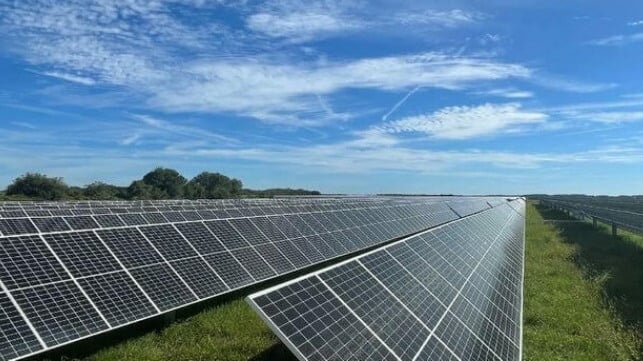
Duke's Duette Solar Power Plant (Duke Energy)

Published Aug 28, 2025 6:55 PM by The Maritime Executive


Duke Energy, which is one of the United States’ largest energy companies, has determined that offshore wind energy does not offer a cost advantage over solar power for North Carolina. The determination came as the utility was planning its long-term power sources and is based on proposals from the current leaseholders for offshore wind in North Carolina.

Headquartered in North Carolina, the company operates utilities in the Southeast as well as the Midwest. Its North Carolina utility was directed by the state's Utilities Commission last fall to explore offshore wind energy. As part of this review, it was instructed to request estimates from the three leaseholders for the development of up to 2.4 GW of offshore wind energy.

Duke, through its non-regulated subsidiary Cinergy, holds one of the leases that it was awarded in 2022. The project known as Carolina Long Bay is 22 miles south of Bald Head Island and could support up to approximately 1.6 GW. Neighboring Carolina Long Bay is TotalEnergies, which has the potential for 1.6 GW, and the two companies have explored collaborations.

A third offshore site available to Duke is Avangrid’s Kitty Hawk South, which was awarded in 2017. The company originally said it could produce up to 2.4 GW, but in 2022 sold the northern portion of its lease to Dominion Energy. 

The three developers submitted a total of eight proposals, Duke reports in a filing to the Utilities Commission. It was looking for the projects to be developed by 2035. 

In the filing submitted on August 11, Duke informed the commission that, based on its review, it determined solar and battery storage was cheaper in every instance. The company reports it was comparing the cost of building 3,576 MW of solar panels and 3,440 MW of battery storage capacity.

A spokesperson for the company told North Carolina Public Radio that they determined “offshore wind is not cost-competitive at this time.” The commission had instructed Duke that if the proposals were cost-competitive, to proceed with a binding request for proposals.

Supporters of wind energy were quick to criticize the review, noting that solar only provides power 30 to 40 percent of the time, whereas wind energy can generate between 80 and 90 percent of the time. They said they were “disappointed” that Duke was not proceeding, highlighting that it would require at least a decade before construction and commercial operations could be realized. 

“The cost of wind being compared to solar and storage is one thing, but the efficiency of offshore wind being compared to solar and storage is a completely different thing because there are just fundamentally so many key differences between the technologies," Karly Brownfield, a senior program manager with the Southeastern Wind Coalition, told the public radio station WUNC.

Duke Energy is aggressively pursuing solar energy in Florida. The company reported last month that it currently owns, operates, and maintains a portfolio of more than 25 solar sites across Florida that generate approximately 1.5 GW, and between 2025 and 2027, the company plans to build 12 new solar sites, adding 900 megawatts. By the end of 2033, Duke Energy Florida projects it will have over 6.1 GW of utility-scale solar generating capacity online.

The company is reviewing its North Carolina plans. In a 2024 plan, it showed up to 1.6 GW of offshore wind energy by 2035. Another model included as much as 2.4 GW of offshore wind energy.

The planning study was undertaken before the Trump administration’s latest moves against the offshore wind energy sector. In addition to its ending leasing, the administration is now starting a national security review. It has also curtailed tax credits and other incentives for offshore wind energy development.

 

USCG Lifts Hatch Cover as It Investigates Baltimore Bulker Explosion

coal explosion on laden bulker
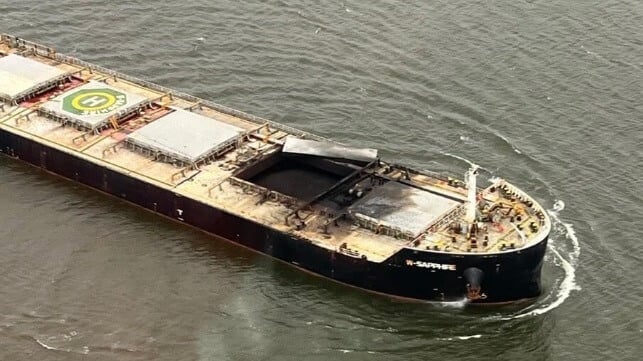
Half of the hatch cover is missing and went overboard after the explosion (North Point - Edgemere Volunteer Fire Department)

Published Aug 29, 2025 5:21 PM by The Maritime Executive


The hatch cover that was blown overboard during the explosion on the bulker W-Sapphire was retrieved from the Baltimore shipping channel on Thursday, August 28. It is part of the ongoing investigation into the incident 10 days ago, on August 18, shortly after the vessel departed the coal terminal in Baltimore.

The Fort McHenry Federal Channel leading into and out of the Port of Baltimore was closed to vessel traffic on Thursday from 0730 to 1500 local time. A 500-yard safety zone radius was established around the location of the hatch cover at the northern end of the Chesapeake Bay. 

Dive and salvage operations were undertaken. By mid-afternoon, the USCG posted that the 30-ton hatch had been successfully retrieved from the Patapsco River. The safety zone restriction was removed and the channel reopened.


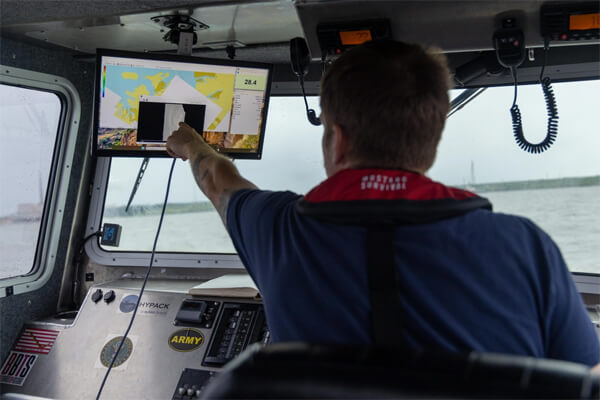
Army Corps surveying the harbor area after the explosion (U.S. Army Corps of Engineers, Baltimore District)


The U.S. Army Corps of Engineers Baltimore District had assisted the USCG and deployed its survey vessel Buck to conduct sonar surveys around Baltimore's Fort McHenry Channel on August 19, the day after the explosion. Captain Jake Tuer, who conducted the survey, reported that the data collected during this process would help determine the operational plan moving forward, including reopening the channel that day and yesterday’s recovery.

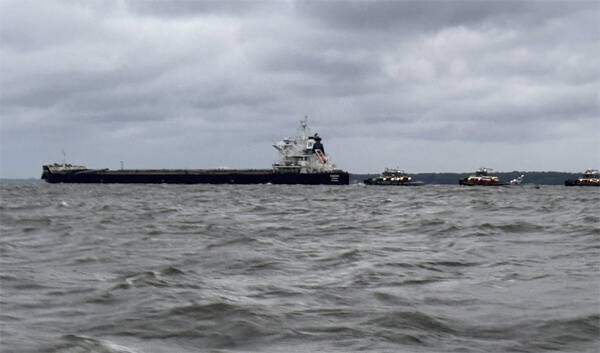
The 751-foot bulker W-Sapphire remains anchored in the channel near Sandy Point State Park and north of the Chesapeake Bay Bridge. The ship had been escorted into the anchorage shortly after the explosion and will remain there while the USCG and state authorities are investigating the cause of the explosion. Initial radio calls from the vessel said there was possibly water intake into the hold, but the force of the explosion appears to have mostly been driven upward, breaking through the hatch cover.


Bulker being escorted out of the channel after the explosion on August 18  (North Point - Edgemere Volunteer Fire Department)


Investigators are looking into the cause of the explosion, which ripped the hatch cover off the vessel’s number 2 hold. One leaf remained on deck while the other went overboard. There was a massive fireball, which observers said went several hundred feet into the air, followed by a smoke plume. Coal dust explosions are typically a secondary result of another trigger and require a mix of fuel, heat, and oxygen with the dust suspended in the air. They are reported to be considering spontaneous combustion as well as an external source of heat or fire that contributed to the explosion. 


Malfunction on Research Vessel Falkor (too) Stops Uruguay's Expedition

research vessel Falkor (too)
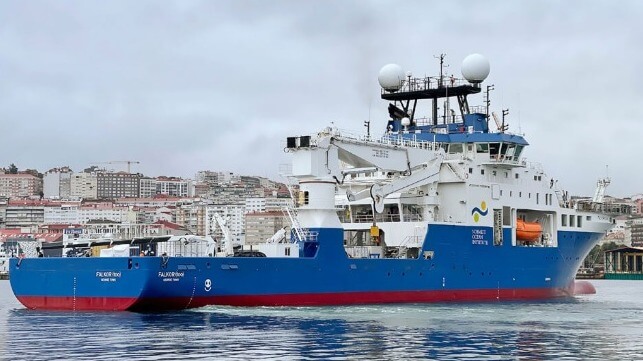
Falkor (too) is based on a converted offshore service vessel (Schmidt Ocean Institute)

Published Aug 29, 2025 7:10 PM by The Maritime Executive


A high-profile research expedition to explore the deep sea in Uruguayan sovereign waters has suffered a setback after the research vessel Falkor (too) suffered technical issues. The vessel was forced to return to port for repairs.

The Universidad de la República (Udelar) announced that only days after embarking on August 22 for the much-publicized ‘Uruguay SUB 200’ expedition, the vessel was returning to the Port of Montevideo. The expedition had received the attention of President Yamandú Orsi.

The ship, which is owned by the Schmidt Ocean Institute (SOI) and is highlighted as one of the most advanced research vessels, is said to have suffered issues with the main structure that is used to deploy and recover heavy underwater equipment. The A-frame structure malfunctioned as it was being raised from its stowed position to vertical, forcing a return to port for repairs.  

“It's with great sadness that we inform you that we're returning to port to fix some technical issues. We hope it's resolved soon and we can get back to exploring our ocean,” said the University in an alert.

The vessel had departed for the mission to explore the deep sea in Uruguayan waters with a team of 37 scientists and technicians from 18 institutions in six countries. Dubbed ‘Uruguay SUB 200: Journey into the Unknown,’ the month-long expedition was aimed at studying marine ecology, underwater archaeology, deep-sea mapping, and marine geophysics, among others.

The mission would have seen Falkor (too) sail about 200 to 300 kilometers off the Uruguayan coast to explore 50 points of interest on the seabed, from 200 to 3,500 meters deep. Of critical importance was the fact that the scientific team was expected to share the mission’s experience through live broadcasts from high-quality images taken on the seabed by the vessel’s suBastian remotely operated vehicle that is capable of reaching depths of 4,500 meters.

Built in 2011 as the offshore industry vessel Polar Queen, SOI acquired Falkor (too) from Norwegian shipping company GC Rieber Shipping ASA. The 110-meter vessel was refitted to become a state-of-the-art mobile research facility with modern laboratories, tools, equipment, and a high-performance computing system for ocean exploration and study. The vessel has an endurance of 60 to 120 days. 

The name was chosen to continue the tradition of an earlier vessel. The original Falkor was donated to Italy’s science agency National Research Council (CNR), in 2022.

Earlier this month, Falkor (too) completed a three-week Argentinian-led expedition that studied the Mar del Plata Canyon, one of the country’s largest underwater canyons that is located 300 kilometers offshore. Early this year, the Class C polar certified vessel also completed its first science expedition to Antarctica.


TSB: Fuel Leak Due to Casual Repair Caused Fire on Canada’s Oldest Laker

Great Lakes bulker
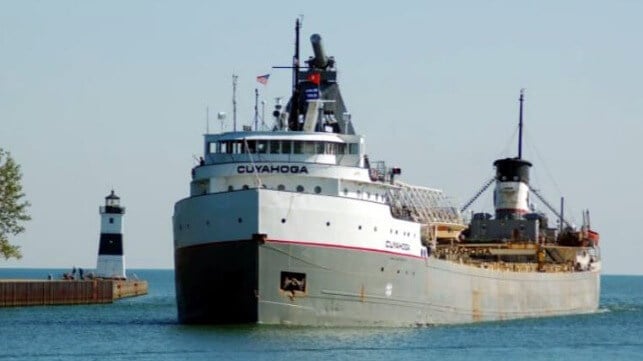
Operating for over 80-yearso n the Great Lakes, Cuyhoga was Canada's oldest ship (Rand Logisitcs)

Published Aug 29, 2025 7:47 PM by The Maritime Executive


The fire that broke out in the engine room of Canada’s oldest vessel operating on the Great Lakes in 2023, the Cuyaoga, was a disaster waiting to happen, according to a new report from the Transportation Safety Board of Canada (TSB). The report cites a history of repeated fuel leaks and dangers that were often resolved with casual repairs on fuel injection pipes.

Built in 1943 in Ohio by the American Ship Building Company, Cuyahoga was a historic bulk freighter launched as the J. Burton Ayers to transport iron ore during World War II. She was later converted into a self-unloading ship and was renamed Cuyahoga in 1995 by Lower Lakes Towing, part of Rand Logistics. Her original steam plant was finally converted to diesel in 2000, and she continued to maintain seasonal services on the Lakes transporting dry bulk commodities like coal, salt, grain, and crushed stone.

On May 23, 2023, the Cuyahoga left Marblehead, Ohio, on a regular voyage bound for Kingsville. Three hours into the voyage, a fire ignited in the engine room, forcing the 20 crewmembers to initiate emergency responses. The 620-foot (189-meter) vessel was loaded with 11,400 metric tonnes of granular crushed stone.

To avert a disaster, the crew responded by cutting the fuel supply to the main engine before attempting to activate the vessel’s carbon dioxide (CO2) fixed fire suppression system remotely, which was without success. An attempt to locally activate the system also failed and resulted in the cylinder room flooding with CO2. However, due to the cessation of fuel flow, the engine stopped, and the fire extinguished itself soon after as the vessel was anchored north of Pelee Island, Ontario.

TSB investigators established that the fire was caused by fuel spraying from a disconnected injection line onto exposed hot surfaces of the engine’s exhaust gas piping. It emerged that after an earlier repair, the retaining clamps were not reinstalled on the fuel injection lines, increasing the effects of engine vibration, something that made the lines susceptible to loosening. TSB terms it one of the many casual repairs that were undertaken on the aging bulker.

Following the earlier engine repair, recurring minor leaks were addressed as routine maintenance without investigating the underlying cause. Although the practice deviated from the manufacturer's specifications, the crew was unaware as they lacked regular access to updated maintenance and torque specifications from the engine manufacturers.

The investigation established that while vibration is inherent in all diesel engines due to various factors, the Cuyahoga’s main engine systems showed the effects of excessive engine vibration. To reduce the effects of vibration on the fuel injection line fittings, retaining clamps had been added to secure the fuel injection lines to the cylinder heads, making the lines more rigid and reducing mechanical vibration in the fuel injection lines.

TSB writes in its report that Cuyahoga's fuel injection return line for cylinder 7 was disconnected, which resulted in a spray of marine diesel oil. They believe all the retaining clamps on the fuel injection lines were most likely removed in 2021 when the crew replaced the fuel supply and return manifolds.

The CO2 fire suppression system failed due to several factors, reports TSB. The remote release cables had been routed through the engine room and were damaged by the fire, rendering them inoperative. When the crew attempted a manual release, TSB reports the system discharged CO2 into the cylinder room instead of the engine room, due to incorrect activation instructions and loose or missing components.

Two days after the fire, the vessel was towed to Kingsville. No injuries or pollution were reported, but the bulker’s engine room and associated machinery sustained heat and smoke damage. The main engine and various electrical cables and equipment also sustained moderate to severe fire damage.

Although the aged vessel returned to service following the incident, another fire broke out while she was docked in Ashtabula, southwest of Erie, Ohio, on Lake Erie, in March 2024. That fire occurred while the vessel was being prepared after winter layup, but it ended her long career. In July, Cuyahoga was towed into the IMS Docks for scrapping.

TSB warns that the issues raised in this investigation, particularly around emergency procedures and the use and maintenance of fixed fire suppression systems, are not unique and affect the safety of marine transportation across Canada. The safety organization reports it started a more wide-reaching national safety issue investigation in July 2025 after having raised concerns about these issues for years. TSB says it is in the process of building a clearer understanding of how vessel fires are currently managed and identifying the gaps in Canada’s preparedness for marine emergencies.

 Nearly 1,000 'Workers Over Billionaires' Protests Planned Across US for Labor Day

Thousands of labor union members and activists march in Philadelphia for May Day, on May 1, 2025.

 (Photo by the Philadelphia Democratic Socialists of America)

Nearly 1,000 'Workers Over Billionaires' Protests Planned Across US for Labor Day

"This is about workers showing up and demanding what workers deserve all across the country," said Randi Weingarten, president of the American Federation of Teachers.

Unions and progressive organizations are planning nearly 1,000 "Workers Over Billionaires" demonstrations across the United States this Labor Day to protest President Donald Trump's assault on workers' rights.

The day of national action has been organized by the May Day Strong coalition, which includes labor organizations like the AFL-CIO, American Federation of Teachers, and National Union of Healthcare Workers, as well as advocacy groups like Americans for Tax Fairness, Indivisible, Our Revolution, and Public Citizen.

"Labor and community are planning more than a barbecue on Labor Day this year because we have to stop the billionaire takeover," the coalition says. "Billionaires are stealing from working families, destroying our democracy, and building private armies to attack our towns and cities."

Since coming into office, the Trump administration has waged war on workers' rights. Among many other actions, his administration has stripped over a million federal workers of their right to collectively bargain in what has been called the largest act of union busting in American history and dramatically cut their wages.

He has also weakened workplace safety enforcement, eliminated rules that protected workers against wage theft, and proposed eliminating the federal minimum wage for more than 3.7 million childcare and home workers.

Despite Trump's efforts, Americans still believe in the power of collective action. According to a Gallup poll published Thursday, 68% of Americans say they approve of labor unions, the highest level of support since the mid-1960s.

"Just like any bad boss, the way we stop the takeover is with collective action," the coalition says on its website.

The May Day Strong coalition previously organized hundreds of thousands of workers to take to the streets for International Workers Day, more commonly known as "May Day." On Monday, rallies are once again expected across all 50 states.

Four months later, their list of grievances has grown even longer, with Republicans having since passed a tax cut expected to facilitate perhaps the largest upward transfer of wealth in US history, featuring massive tax breaks for the wealthy paid for with historic cuts to the social safety net.

"There are nearly 1,000 billionaires in the country with a whopping $6 trillion, and that is still not enough for them," said Saqib Bhattie, executive director of the Action Center on Race and the Economy, another group participating in the protests. "They are pushing elected officials to slash Medicaid, [Supplemental Nutrition Assistance Program] benefits, and special education funding for schools in order to fund their tax breaks. We need to claw back money from the billionaire. We need to push legislation to tax billionaires at the state and local levels. We need to organize to build the people power necessary to overcome their money."

The group also plans to respond to Trump's lawless attacks on immigrants and his militarized takeovers of American cities.

"This Labor Day," said Lisa Gilbert, co-president of Public Citizen, "we continue the fight for our democracy, the fight for the soul of our nation, the fight against the vindictive authoritarian moves Trump and the billionaire class aimed at stealing from working people and concentrating power."

"This is about workers showing up and demanding what workers deserve all across the country," said Randi Weingarten, president of the American Federation of Teachers. "This Labor Day is really different, because it's not just labor unions, as important as we may be to the workers we represent. It has to be all workers and all working families saying enough. Workers and working families deserve the bounty of the country."

May Day Strong will host a national "mass call" online on Saturday. The locations of the hundreds of protests on Monday can be found using the map on May Day Strong's website.

Can a giant seawall save Indonesia’s disappearing coast?


By AFP
August 27, 2025


Climate experts warn a plan to build a 700-kilometre seawall along Java's coast could make matters worse by pushing erosion elsewhere and disrupting ecosystems - Copyright AFP BAY ISMOYO


Jack MOORE, Taris IMAN

The encroaching ocean laps against a road in Karminah’s village, threatening her home on Indonesia’s Java island, where the government says it has a plan to hold back the tide.

It wants to build an $80-billion, 700-kilometre (435-mile) seawall along Java’s coast to tackle land loss as climate change lifts sea levels and groundwater extraction prompts land to sink.

For residents who have seen the tide come more than a kilometre inland in parts of Java, the plan sounds like salvation.

But with a timeline of decades and uncertain financing, it looks unlikely to arrive quickly enough, and climate experts warn it could make matters worse by pushing erosion elsewhere and disrupting ecosystems.

For Karminah, 50, those concerns feel distant.

“What’s important is that it doesn’t flood here. So that it’s comfortable,” she told AFP in Bedono village, referring to a coastal road that disappears almost daily.

“School can’t happen, the children can’t play, they can only sit on the pavement staring at the water.”

The government calls the colossal wall one of its “most vital” initiatives to help coastal communities in Java, which houses more than half of Indonesia’s 280 million citizens, as well as fast-sinking capital Jakarta.

Bedono residents like village chief Muhammad Syarif currently elevate their homes with clay soil but say a seawall is “very much needed” to avert disaster.

“It is the right solution because the coastline needs wave management,” he said.

Funding remains uncertain, though President Prabowo Subianto has urged Asian and Middle Eastern investment.

This week, he inaugurated a new agency to oversee the project.

“I don’t know which president will finish it, but we will start it,” Prabowo said in June.


– Abandoned villages –


Seawalls and other coastal fortifications have been used globally to keep damaging tides at bay.

In Japan, fortress-like barriers were installed in some places after the 2011 earthquakes and tsunami, while the Netherlands relies on a system of hill-like dikes to stay dry.

Such fortifications absorb and deflect wave energy, protecting coastal infrastructure and populations.

But Indonesia’s needs are urgent, with one to 20 centimetres (0.4 to eight inches) of land disappearing along Java’s northern coast annually.

Large areas will vanish by 2100 on the current climate change trajectory, according to environmental non-profit Climate Central.

The fortifications can also have negative consequences, destroying beaches, pushing erosion seaward, and disrupting ecosystems and fishing communities.

In places like Puerto Rico and New Caledonia, seawalls have collapsed under the constant beat of waves, which also erode sand below.

“They come at considerable environmental and social cost,” said Melanie Bishop, professor at Australia’s Macquarie University.

“Their construction leads to loss of shoreline habitat and they impede movement of both animals and people between land and sea,” the coastal ecologist said.

A 2022 UN report warned seawalls only offer a temporary fix and can even worsen climate change effects.

For Indonesian crab farmer Rasjoyo, coastal erosion is not a theoretical problem.

He and hundreds more once lived in now-abandoned Semonet village, where seawater laps into evacuated homes. It now lies a 20-minute boat ride from land.

“The floods were getting worse. The house was sinking. Every month, the change was drastic,” the 38-year-old told AFP.

He says the seawall — first proposed in 1995 — will come too late.

“If it happens, when will it arrive here? In what year?” he asked.

“It might not be very effective either, because the land has already subsided.”


– ‘Find a solution’ –


Some climate experts believe nature-based solutions like mangroves and reefs would be better alternatives.

“Unlike seawalls that would need to be upgraded as sea levels rise, these habitats accrete vertically,” said Bishop.

“In some instances this vertical accretion can keep pace with sea level rise.”

Another alternative could be a mixture of relocations and more targeted, limited seawalls, said Heri Andreas, a land subsidence expert at the Bandung Institute of Technology.

“The win-win solution is a partial or segmented seawall,” he said, describing the current proposal as like “killing a duck with a bazooka”.

“It is more effective if we do relocation. And then in some parts, maybe only a coastal dike or elevating the coastal infrastructure would be enough.”

He hopes to persuade Prabowo’s administration to switch course before the mega-project begins.

“We need more listening,” he said. “It’s a bit better than before, but it’s not enough yet.”

In Bedono, where a cemetery was recently relocated to save it from the waves, residents simply want a fast fix.

“The solution is to build something, I don’t know, just build a road, a dike or a coastal belt so it doesn’t keep happening,” said Karminah.

“What can we do?” she added. “Please help me find a solution so the water doesn’t rise.”

Trump son hypes bitcoin on Hong Kong leg of Asia trip


By AFP
August 29, 2025


Eric Trump, son of the US president, urged a Hong Kong crowd to buy bitcoin during a trip to Asia where his crypto company is reportedly seeking acquisitions - Copyright AFP Vernon Yuen

Eric Trump, son of the US president, urged a crowd in Hong Kong on Friday to buy bitcoin during a trip to Asia where his crypto company is reportedly seeking acquisitions.

US cryptocurrency investors were major supporters of Donald Trump’s presidential campaign, contributing millions of dollars toward his victory in hopes of reversing the government’s scepticism toward the sector under his Democrat predecessor Joe Biden.

The US House of Representatives passed three landmark cryptocurrency bills last month, with Trump, 79, making several other moves to bolster the sector.

These regulatory changes have caused the value of bitcoin to soar, with the digital currency hitting a new peak above $124,500 in mid-August before retreating.

Eric Trump, 41, told a Hong Kong conference hall packed with crypto afficionados that bitcoin is the “greatest asset in the world”.

“There’s no question in my mind that bitcoin hits a million dollars,” he said at the Bitcoin Asia conference.

“The bitcoin community embraced my father unlike anything I had ever seen before, and I hope that’s paid off in spades, because we love this community, we believe in this community,” he added.

American Bitcoin, the bitcoin miner backed by Eric Trump and Donald Trump Jr., is seeking acquisitions in Asia, the Financial Times reported this month.

“We’re about to go public on the NASDAQ very soon, coming up,” Eric Trump said on Friday.

Asked about US-China competition in digital assets, he said China was “a hell of a power” in the sector.

Eric Trump is set to attend a shareholder meeting of Japanese bitcoin treasury company Metaplanet on September 1, according to Bloomberg News, citing people familiar with the matter.

The US president and his family have been involved in a number of crypto endeavours that have inflated his wealth as his administration lends support to the sector.
Austria orders YouTube to give users access to their data


By AFP
August 29, 2025


Australia's Communications Minister Anika Wells said four-in-ten Australian children have reported viewing harmful content on YouTube, one of the most visited websites in the world. © AFP/File Lionel BONAVENTURE

Austria’s data protection authority said Friday that it has ordered YouTube to comply with EU regulations and respond to requests by users for access to data that it holds on them.

In 2019, prominent Austria-based privacy campaign group Noyb (None of Your Business) lodged complaints against eight online streaming services, including YouTube and Netflix, accusing them of “structural violations” of EU data regulations.

The complaint against YouTube was filed on behalf of an Austrian user with the country’s Data Protection Authority.

The regulator confirmed to AFP on Friday that it has “issued a decision… against Google LLC (YouTube)” regarding the suit brought by Noyb.

In their complaints, Noyb said the services violated the EU’s landmark General Data Protection Regulation (GDPR) by not granting users access to data that companies store on them or information about how the data is used.

Google, which owns YouTube, “now has four weeks to comply with the decision but also has the option appeal it”, the NGO said in a statement Friday.

Noyb called the authority’s decision a “win” but regretted that it took the country’s regulator “five and a half years”.

“Making an access request should enable (users) to exercise… rights, such as the right to erasure or rectification” of their data, the group said, but due to delays that “becomes impossible”.

Google did not immediately responded to a request for comment from AFP.

Noyb has launched several legal cases against US technology giants such as Meta, which owns Facebook and Instagram, and Google, often prompting action from regulatory authorities over violations of the GDPR.

It has filed more than 800 complaints in various jurisdictions on behalf of internet users.
US Spirit Airlines files for bankruptcy again


By AFP
August 29, 2025


Spirit Airlines has filed for bankruptcy again, its second restructuring in 2025
 - Copyright AFP/File Brendan SMIALOWSKI

Budget US carrier Spirit Airlines said Friday that it will file for bankruptcy for the second time in a year, but will continue to fly, sell tickets and operate.

Spirit first filed for bankruptcy in November and announced in March that it had completed a restructuring deal with creditors to trim its debt by nearly $800 million.

With the new filing, the Florida-based company said it “expects to double down on its efforts to” redesign its network, “rightsize its fleet,” and pursue further cost efficiencies.

“The Chapter 11 process will provide Spirit the tools, time and flexibility to continue ongoing discussions with all of its lessors, financial creditors and other parties to implement a financial and operational transformation of the Company,” Spirit said in a statement.

In April, former CEO Ted Christie was replaced by Dave Davis, who joined Spirit from Sun Country Airlines.

“As we move forward, guests can continue to rely on Spirit to provide high-value travel options and connect them with the people and places that matter most,” said Dave Davis, Spirit’s president and CEO.

Discount airline Spirit boosted its capacity and market share in the post-Covid aviation market, but has faced increased competition from other carriers.

In 2022, competitor Frontier Airlines attempted a $2.9 billion merger with Spirit. Another rival, JetBlue, then made a potentially more lucrative offer, but the deal fell through after authorities cited antitrust concerns.