Sunday, October 19, 2025

Heat Pumps Face Their Toughest Test Yet

  • After years of rapid growth, global heat pump sales are falling.

  • Lower gas prices, reduced subsidies, and installation bottlenecks are leading to lower sales.

  • The technology’s efficiency remains strong, but challenges now lie in integration.


For years, I have followed the rise of heat pumps as one of the central technologies for decarbonising heating. The numbers have been impressive, the policy support has been strong, and the narrative has been almost unstoppable. But as with so many technologies that capture political and public imagination, there comes a moment when promises have to turn into results. For heat pumps, that moment is now.

After several years of double-digit growth, the global market is showing signs of fatigue. Sales have dropped sharply in some of the key European markets, with declines of up to 40 percent compared to the previous year. The causes are familiar: lower gas prices have weakened the cost advantage, consumers are confused by shifting subsidy regimes, and supply chains are struggling to deliver affordable installations. A shortage of skilled technicians has also slowed deployment.

This slowdown doesn’t mean the end of the story. It marks the start of what I would call the “reality phase” of the heat pump rollout, a stage where the technology must prove itself not in theory or in targets, but in practice, across diverse climates, building types, and customer segments.

The fundamentals still work

Despite the short-term turbulence, the underlying case for heat pumps remains extremely strong. The technology is both elegant and efficient. By transferring heat rather than generating it, heat pumps can deliver three to five units of heat for every unit of electricity consumed. That kind of performance is hard to match by any other heating technology.

In colder regions, technical advances are also closing the performance gap. The new generation of “cold-climate” heat pumps can operate efficiently even at temperatures well below freezing. That changes the economics for markets like Northern Europe, Canada, and parts of the U.S., where conventional wisdom once held that heat pumps simply wouldn’t work

For homeowners and businesses, the long-term economics can be compelling. As electricity grids increasingly draw on renewable power, the carbon footprint of electric heating continues to decline. And in markets where heat pump adoption is combined with improved insulation and energy-efficiency upgrades, energy bills are already falling.

A system challenge, not a product rollout

Where the story gets more complicated is at the system level. Installing a heat pump is not like swapping out an old boiler for a newer model. It often requires upgrades to insulation, radiators, and sometimes the grid connection itself. That means the real challenge isn’t just selling more units, it’s integrating heat pumps into a much broader ecosystem of building renovation and power-system planning.

In many cases, performance shortfalls have more to do with poor installation than with the technology itself. Field studies have shown that badly configured systems can wipe out much of the theoretical efficiency advantage. I’ve spoken to installers who admit that, under pressure to meet demand, they’ve had to cut corners or rely on limited training. If governments truly want to accelerate deployment, they need to invest as much in building a skilled workforce as they do in subsidising the hardware.

There’s also the issue of grid readiness. Heat pumps add significant new electrical load, especially in colder months. In areas where electricity infrastructure is already strained, this could cause problems unless grid reinforcement and smart-load management are rolled out in parallel. Policymakers love to quote the potential of electrified heating, but many have yet to grapple with the practical consequences of shifting millions of buildings to electric systems that will peak just when everyone needs heat the most.

The investment gap

The financial picture also needs realism. Many early adopters benefitted from generous subsidies and low financing costs. Those conditions are no longer guaranteed. Rising interest rates and budget constraints have forced many governments to trim support programs. For households facing tighter finances, the upfront cost of a heat pump, often two to three times that of a gas boiler, remains a significant barrier.

Private finance can play a bigger role, but only if projects are de-risked and performance is verified. Too often, investors lack reliable data on how heat pumps actually perform in real-world conditions. That creates hesitation and higher risk premiums. Creating transparent, standardised performance metrics could unlock a new wave of investment in building-scale electrification.

A question of momentum

What matters now is not whether heat pumps work, they do, but whether the sector can build the credibility and consistency needed for mass adoption. This is the same transition dynamic I’ve seen in other technologies: an early boom, a period of reality testing, then a second wave of disciplined, professional growth.

That second wave will depend on coordination. Manufacturers must focus on quality and after-sales service, not just volume. Governments must maintain stable, long-term policy frameworks instead of stop-start incentives that confuse consumers. Utilities need to plan ahead for flexible demand management so that electrified heating becomes part of the solution, not another strain on the grid.

Above all, the industry needs to shift its mindset from hype to performance. The promise of heat pumps will not be measured in units shipped or subsidies distributed, but in comfort delivered, emissions reduced, and trust earned.

Looking ahead

I believe the current slowdown is less a sign of failure than of growing pains. We are learning what works, what doesn’t, and where the bottlenecks really are. Technologies that change entire systems always go through this phase. The same thing happened with solar power and electric vehicles: a burst of optimism, followed by a tough adjustment, and then a period of steady, scaled growth.

If that pattern holds true, the next few years could define the place of heat pumps in the global energy transition. The fundamentals remain too strong for them to disappear. But turning those fundamentals into reliable, large-scale deployment will require competence, patience, and policy stability.

Heat pumps are past the phase of promise. They are in the phase of proof. Whether they become the quiet workhorse of the decarbonised home, or the next victim of premature hype, depends on how we manage that proof from here.

By Leon Stille for Oilprice.com

Why Microgrids Are the Backbone of the Next Energy Revolution

  • Microgrids provide flexible, decentralized power solutions that can operate independently from national grids, boosting access in remote and underserved areas.

  • Global initiatives are using microgrids to empower communities and expand clean energy access.

  • In the U.S., utilities like PG&E are deploying microgrids to reduce wildfire risks and enhance grid resilience, aided by emerging AI tools that optimize energy balance and efficiency.

Microgrids are becoming an increasingly attractive means of supplying rural areas with energy, particularly as renewable energy sources can be used to power small grids in unconventional energy-producing regions. These small grids can be developed alongside a comprehensive transmission network or in parts of the world where electricity access is limited, to boost access. microgrid is a group of interconnected loads and distributed energy resources within clearly defined electrical boundaries that acts as a single controllable entity with respect to the grid. It can operate in connection to a broader electricity grid or independently. Microgrids vary significantly in size, from small applications, such as rooftop solar power, to wide-scale (often renewable) energy projects. Some incorporate battery storage to ensure a stable energy supply, while others may rely entirely on the energy source, such as solar panels that only work when the sun is shining.

Microgrids can be beneficial as they can operate independently from the main grid, meaning that they can be used to connect hard-to-reach areas, such as rural regions, to electricity sources. They can also be used independently in the case of a power outage on the main supply. This can make them useful to critical infrastructure, such as medical facilities and grocery stores, to ensure they do not lose power during a blackout.

More companies are now exploring the potential of developing microgrids as higher investment is being seen in renewable energy projects worldwide, signalling a new era of energy infrastructure development. In addition, many now view microgrids as useful for supplying energy in unserved or underserved areas, particularly in developing countries.

In regions of Yemen that have long experienced regular blackouts, leading them to rely on diesel-fuelled generators, the UNDP has invested in “Renewable Energy to Improve Access to Health Services and Livelihood Opportunities” (HEAL) Project across five governorates, with funding from the Kuwait Fund for Arab Economic Development. The agency has developed solar microgrids to “provide energy to low-income youth and marginalized individuals who are the primary breadwinners for their families” to encourage economic empowerment. Beneficiaries are expected to reach around 205,000 individuals.

In the Democratic Republic of Congo (DRC), most electricity comes from hydropower, and despite government efforts to expand the national grid, it has not kept pace with population growth. In 2020, around 1.6 million of the DRC’s 10 million households had access to electricity. The Multilateral Investment Guarantee Agency (MIGA), the International Finance Corporation, and the International Development Association have partnered with the private sector to develop Africa’s largest mini-grid project to accelerate access to electricity. MIGA has provided a guarantee of $50.3 million to Congo Energy Solutions Limited, which is expected to expand its operations to provide energy to up to five million people by 2025.

In the United States, some companies are developing microgrids to decrease risks associated with energy delivery. For example, the U.S. utility Pacific Gas and Electric Company (PG&E) is increasingly developing remote grids in wildfire-prone regions to reduce the risk of fire associated with main transmission lines. As the price of solar panels, batteries, and backup generators declines, microgrids are becoming more accessible. To date, the utility has installed just around a dozen systems in the Sierra Nevada high country, however this could provide the blueprint for future development in certain regions of the U.S. PG&E aims to develop over 30 remote grids by the end of 2027.

The region’s energy regulator approved the development of remote grids by the utility in 2023, which could potentially spur a new era of microgrid development. However, at present, the cost of installing and operating the solar panels and batteries and maintaining and fuelling the generators must be lower than what the firm would have spent on conventional power lines for PG&E to consider installing a microgrid.

The move follows the forced bankruptcy of the utility in 2019, after its transmission lines were linked to the starting of California’s deadliest-ever wildfire, as the state has mandated PG&E to prevent future disasters. California’s utilities have spent billions on burying key power lines, clearing trees and underbrush, and protecting overhead lines to prevent wildfires. However, this investment has forced utilities to increase consumer costs. This has led several utilities to seek out alternative ways to deliver clean, safe power to consumers, such as through the rollout of microgrids.

The new generation of technology is expected to improve microgrid efficiency. For example, artificial intelligence (AI) can help manage the balance between different energy sources, such as solar, battery storage and generators. AI can be used to analyse current and projected energy production and demand to optimise energy flows and ensure efficient energy distribution. This is expected to reduce waste and ensure a stable supply of energy. It can also be used to improve microgrid sustainability to optimise the use of renewable energy sources.

By Felicity Bradstock for Oilprice.com


Mega-Batteries Are Powering the Clean Energy Revolution

  • Grid-scale energy storage, particularly mega-batteries, is essential for the global clean energy transition by balancing the variable nature of renewable energy sources like solar and wind.

  • The scale of these projects is rapidly expanding due to decreasing technology costs, policy urgency, and volatile energy prices, with Europe projected to see a significant increase in utility-scale battery storage capacity by 2030.

  • These advanced battery technologies not only contribute to more stable energy pricing and security but also create new lucrative opportunities for energy traders to profit from market fluctuations.

Grid-scale energy storage may not be flashy, but it’s the backbone of the global clean energy transition. As more and more of the world’s electric grids are increasingly powered by variable energy sources such as solar and wind power, energy storage becomes ever more vital to energy security. As such, these projects are ramping up in scale, with mega-batteries becoming the new normal for energy infrastructure projects around the globe.

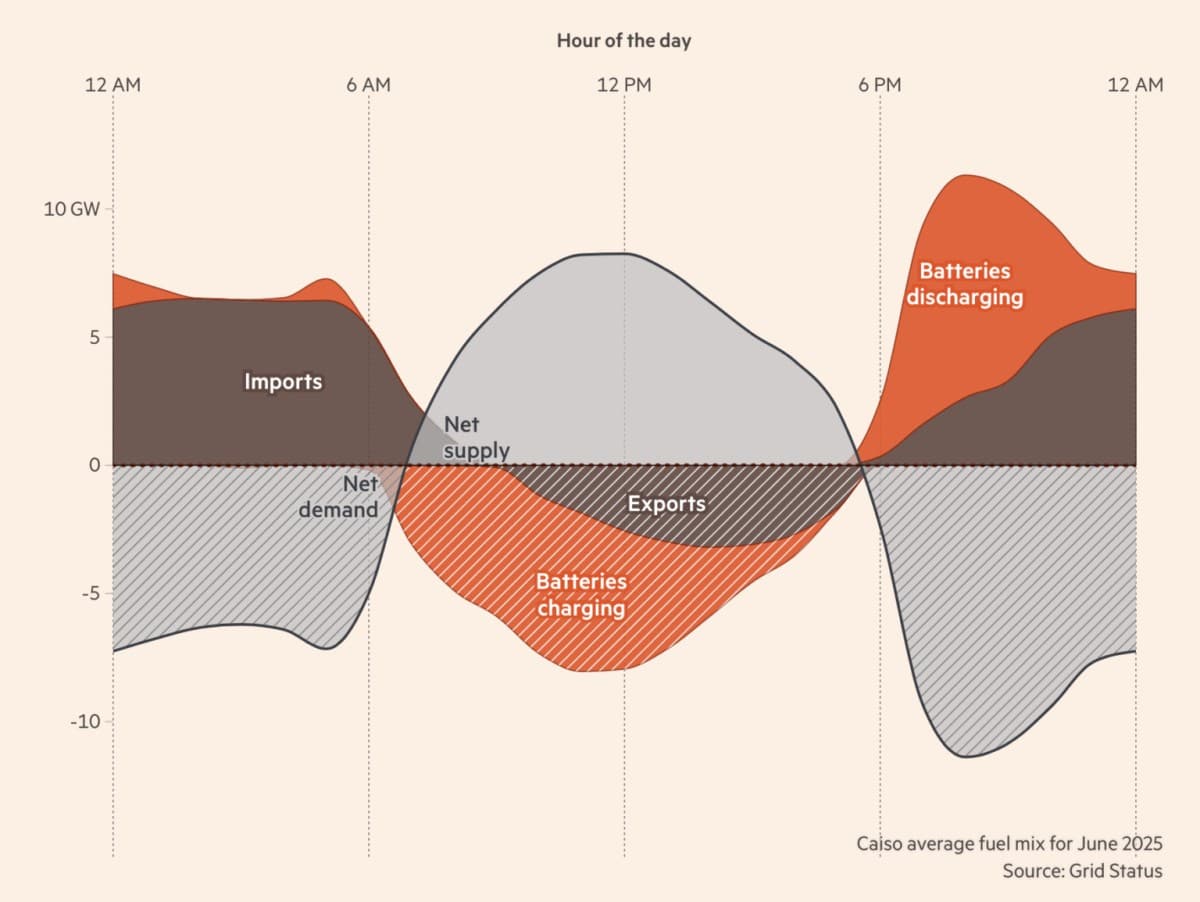
Production rates of variable renewable energies like wind and solar fluctuate according to the weather, the time of day, and the season. This can lead to a major mismatch between energy supply and demand. When the sun is shining and solar panels are producing the most energy, for example, also happens to be when the lights are switched off and relatively few people are home using appliances. When everyone gets home and fires up their ovens, lights, and heaters in the winter, the sun is setting on those solar panels. 

FT
Image source: Financial Times

At peak production hours, renewable energy prices can even plunge below zero as producers essentially pay their customers to take excess energy off their hands, wreaking market havoc and disincentivizing further clean energy investing in the long run. Energy storage, therefore, plays a critical role in countering this variability and makes a 100% renewable grid a practical and economically viable possibility. Energy storage – which can take many forms – acts to balance supply and demand by capturing excess energy at peak production hours and feeding it back into the grid as needed. Without these technologies, rolling blackouts would be a cripplingly common phenomenon.

And the scale of energy storage projects is expanding exponentially as utility-scale solar and wind farms become increasingly common. “Once a niche technology, grid-scale batteries have become the hidden enablers of the energy transition,” states a recent European Business Magazine report. “For years, the economics looked impossible. But a mix of plunging technology costs, policy urgency, and volatile energy prices has tipped the balance,” the article goes on to say.

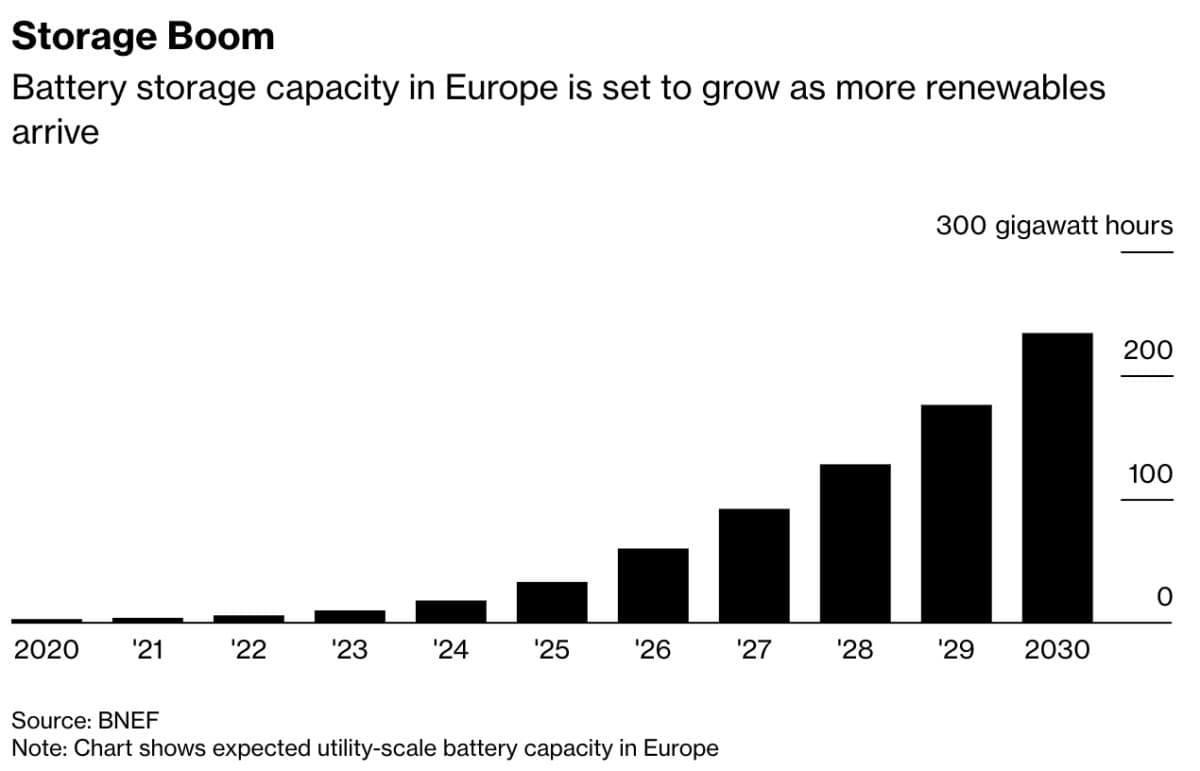
In Europe, mega-batteries are gaining serious ground as the continent’s energy grids start to tip toward majority-renewable energy sources. Analysis from Bloomberg NEF projects that Europe will have 130 gigawatt-hours (GWh) of utility-scale battery storage capacity by 2030. That marks an incredible increase from the 17 GWh installed as of today.

Bloom

Tesla is vying to place itself at the technological forefront of the mega-battery boom. Just last month, the company launched a new Megablock battery, which combines four Megapack batteries and a transformer all in one package for more efficient scaling and streamlined installation processes. One Megablock can store up to 20 megawatt-hours of power for up to four hours at peak capacity. “Scaled up for a large project, 248 megawatt-hours can fit into an acre,” reports Canary Media. Perhaps even more importantly, the technology allows developers to build up energy storage capacity very, very quickly. Tesla claims that the Megablock allows users to build up 1 gigawatt-hour’s worth of storage in as little as 20 business days – no mean feat.

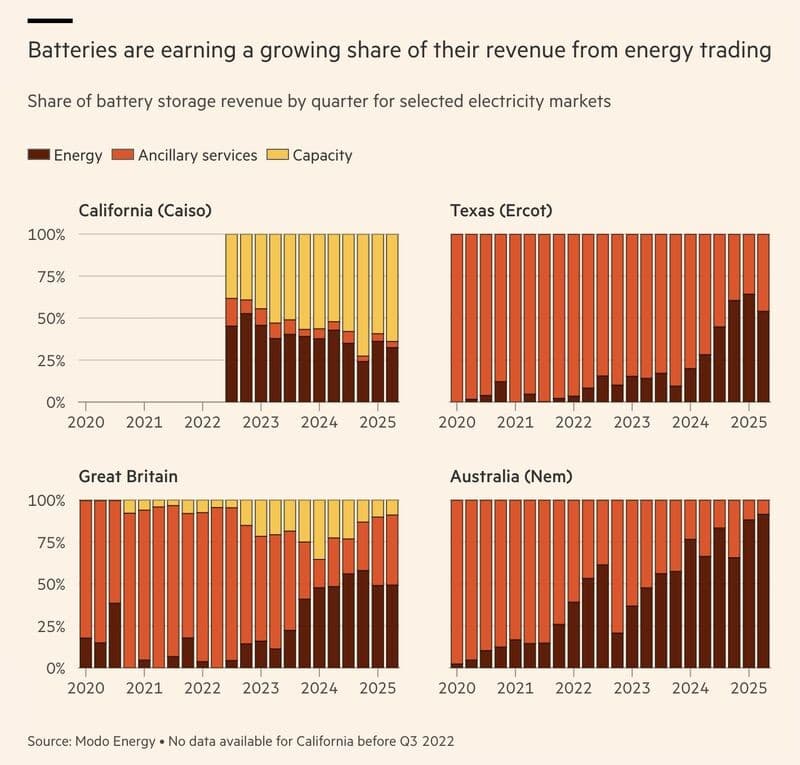
Not only will these and other grid-scale battery storage technologies allow for more stable energy pricing and better energy security over the course of the clean energy transition, they also offer energy traders a new way to cash in on energy market fluctuations. Traders can

“Traders can profit by simply selling stored power for more than they paid for it,” Bloomberg writes. “They can also make money in the ancillary services market, where mechanisms are used to maintain grid stability.” Indeed, battery operators are receiving a growing portion of their earnings through energy trading, completely changing the economics of the booming energy storage market through increased monetization. This development is perhaps a predictable one, as energy trading has become an increasingly central and lucrative part of the unfolding clean energy landscape.

FT

Image source: Financial Times

By Haley Zaremba for Oilprice.com


Europe’s Aging Grids Buckle Under Renewable Energy Demands

  • The world's power grids require significant upgrades and expansion to meet growing electricity demands and integrate renewable energy sources effectively.
  • Insufficient investment in grid modernization is already causing issues like critical congestion and blackouts in Europe, hindering the clean energy transition.
  • Countries like the Netherlands are experiencing power cuts and energy consumption austerity measures due to rapid clean energy adoption without commensurate grid infrastructure development.

The world’s power grids need a major upgrade to keep pace with growing rates of electrification and the ever-increasing energy demands of big data. A cleaner energy landscape means a whole lot more electricity demand, as we switch from gas-powered vehicles and appliances to newer, cleaner models that need to plug into the grid to charge. This means that expanding grid capacity and making our aging grids smarter and more flexible will be essential to maintaining energy security for the future – but grid infrastructure remains woefully neglected, and we’re already starting to see some of the fallout.

“To achieve countries’ national energy and climate goals, the world’s electricity use needs to grow 20% faster in the next decade than it did in the previous one,” states a 2023 report from the International Energy Agency. As a result, grids need to expand at an unprecedented rate. “Reaching national goals also means adding or refurbishing a total of over 80 million kilometres of grids by 2040, the equivalent of the entire existing global grid,” the report goes on to say.

Failure to prioritize investing in grid modernization and expansion poses a major threat to the clean energy transition and to energy security as grids become increasingly reliant on renewable energy sources. Solar and wind energy are variable, meaning that their production levels wax and wane according to factors that have nothing to do with demand trends. Plus, energy production is increasingly dispersed, especially so thanks to the proliferation of residential solar panels. These factors introduce an extra level of complexity for grids that were designed with just a few major utilities in mind, and with only one direction of energy flow. 

All of this is already leading to some hiccups for grid stability. In Europe, where renewable expansion and EV adoption have soared, critical grid congestion and catastrophic blackouts have become an increasing issue. At the end of April, cascading grid failures in Spain and Portugal resulted in the worst blackout in European history, and highlighted how woefully insufficient grid investment has been to date. At the time,  Eurelectric reported that the “extraordinary event” in Iberia served as “a stark reminder that the grid is the backbone of our society. With electricity playing an increasingly important role in our society, we need to create all the conditions to enable a secure electricity supply.”

Unfortunately, many countries are now facing the consequences of failing to create all of those conditions. In the Netherlands, massive success with clean energy capacity installation and EV adoption without commensurate grid infrastructure expansion has resulted in a new norm of power cuts and energy consumption austerity measures. And it’s going to take a lot of money and time to fix the issue. 

"They have a grid crisis because they haven't invested enough in their distribution networks, in their transmission networks, so they are facing bottlenecks everywhere, and it will take years and billions of dollars to solve this," Damien Ernst, professor of electrical engineering at Belgium's Liege University, recently told the BBC. The problem is causing ripples throughout the Netherlands economy. New housing, for example, is now facing long waiting lists in order to connect to grids that are already operating over maximum capacity. 

But the issue is not limited to the Netherlands. Much of Europe has neglected to properly invest in grid infrastructure as a part of national clean energy planning. "We have an enormous amount of solar panels being installed, and they are installed at a rate that is much, much too high for the grid to be able to accommodate," Ernst went on to say.

By Haley Zaremba for Oilprice.com


Inside Ethiopia’s Aggressive EV Revolution

  • In 2024, Ethiopia became the world’s first country to ban petrol and diesel vehicle imports to curb fuel dependency and pollution.

  • Supported by hydropower and government incentives, EV adoption is growing rapidly despite limited electricity access and charging infrastructure.

  • The ban positions Ethiopia as a model for other African nations aiming to expand clean transport and local EV manufacturing.

As the first country in the world to ban the import of petrol and diesel vehicles, Ethiopia is creating the blueprint for electric vehicle (EV) uptake, supported by favourable government policies. It is one of several African countries to be introducing incentives to encourage EV uptake as a means of reducing fuel dependency and supporting green transport growth.

In January 2024, Ethiopia became the first country in the world to ban the import of petrol and diesel vehicles, in a bid to reduce its fuel dependence and pollution. The government aims to import 500,000 EVs by 2030 as it encourages greater uptake across the country. While many Ethiopians were initially reluctant to switch to EV, they are becoming a much more common sight in the capital of Addis Ababa, and public perception is slowly shifting.

In Africa, the EV market size is approximately $450 million in 2025, and it is forecast to reach $4.2 billion by 2030, growing at a CAGR of 56.3 percent between 2025 and 2030. China is expected to become a major exporter of EVs to Africa as it continues to grow its presence in the global EV market. Although the African EV market remains small, government incentives and the growing need for more sustainable transport options are gradually leading to increased uptake across the region.

Chinese, European, and African companies are investing in regional battery and vehicle assembly capacity to drive down costs and encourage uptake across the region. Meanwhile, several national policies, such as Ethiopia’s internal combustion engine (ICE) vehicle ban, Ghana’s eight-year zero-tariff window, and South Africa’s production rebates, are encouraging more consumers to invest in EVs in certain parts of the continent.

To date, passenger cars have led Africa’s EV market, with a 61.81 percent share in 2024. However, there is a growing interest in two- and three-wheelers, with the market expected to grow at a CAGR of 59.72 percent between 2025 and 2030. While Ghana was the leader for EV uptake in 2024, with a 29.31 percent share of the continent’s EV revenue, Ethiopia is now the fastest-growing country for EV uptake, with an anticipated CAGR of 58.92 percent through 2030.

Before the introduction of the ICE vehicle import ban, EVs were extremely uncommon in Ethiopia. As uptake increases, it is becoming more common to see China’s BYD brand, the current market leader, dotted around Addis Ababa. There are also a range of well-known European EV brands making their way to the Ethiopian market. There are now around 115,000 EVs in Ethiopia, out of a total of 1.5 million cars across the country.

When the ICE import ban was initially proposed, many were sceptical as around half of all Ethiopians still do not have access to electricity, and just 20 percent of households have access for at least 23 hours a day. Only a third of households have access through the national electric grid and the country is plagued with regular power cuts.

The situation is expected to improve following the opening of the Ethiopian Grand Renaissance Dam in September, 14 years after it began being developed and following several delays. The dam has a maximum capacity of 5,150 MW, doubling the country’s current electricity output, of which around 97 percent comes from hydropower. However, enhancing access is a complex issue as Ethiopia requires billions of dollars in investment to improve its electric grid to the standard needed to provide both urban and rural areas with a stable supply of electricity.

Nevertheless, the government decided that banning ICE vehicles in favour of EVs would help reduce pollution as well as significantly reduce the country’s fuel dependency, with Ethiopia spending around $4.5 billion a year on fuel imports. For a country that relies heavily on cheap, green hydropower for fuel, its dependency on fuel imports to power transport is economically unsustainable.

The government has introduced a range of financial incentives to encourage EV uptake. Including sweeping tax exemptions. While the upfront cost remains extremely high for most Ethiopians, the cost of second-hand ICE vehicles has also soared since the import ban. The government also hopes to encourage the development of domestic EV production and assembly, although this is in the nascent stage. 

To support the switch, the government must now invest in the rollout of charging stations and other critical infrastructure. Ethiopia currently has around 100 charging stations, most of them in Addis Ababa, with the government hoping to increase this figure to 2,300. This limits uptake outside of the capital, where electricity access is more limited.

The introduction of an ICE vehicle import ban has drawn attention to Ethiopia, as the first country in the world to introduce a measure that many governments are targeting for the 2030s. While infrastructure remains a major constraint to EV uptake, it demonstrates how favourable policies, financial incentives and investment in infrastructure could spur rapid change in auto-markets worldwide.

By Felicity Bradstock for Oilprice.com

Texas’ Orphaned Well Count Reaches Highest Level in Nearly Two Decades

Texas’ inventory of orphaned oil and gas wells has climbed to its highest level in nearly two decades, with the Railroad Commission reporting 10,029 orphaned wells — the most since August 2006, according to watchdog group Commission Shift.

Commission spokesperson Bryce Dubee confirmed the figure, noting that orphan well numbers fluctuate due to market conditions, such as the fallout from the COVID-19 pandemic. He added that the agency “aggressively plugs high-risk wells first” under its prioritization system. The Commission typically seals about 1,300 wells annually, though that pace lags behind the number of new wells added to the list each year.

Critics say the backlog has real consequences. “We’re still hearing from people who report leaking wells that the Commission deems not bad enough yet,” said Virginia Palacios, executive director of Commission Shift. “These sites often worsen because the Railroad Commission can’t get to them fast enough.”

In response, the Texas Legislature passed Senate Bill 1150 this summer, signed by Gov. Greg Abbott, tightening rules for inactive wells more than 15 years old. Operators seeking deadline extensions must now prove financial hardship, demonstrate a history of reactivating wells, or submit a compliance plan to plug or restore wells by 2040

The law also directs the Railroad Commission to scrutinize well transfers and penalize “bad-faith” deals that shift liabilities to smaller, underfunded operators. “A well-crafted rule can identify questionable transfers,” said Julie Range, policy director at Commission Shift, who urged the agency to set clear enforcement criteria.

Commission Shift called SB 1150 a “step forward” but warned of loopholes that could weaken enforcement. The group continues to advocate for stricter bonding requirements, ensuring operators can afford the $40,000+ average cost of plugging a well before drilling or acquiring new ones.


MONOPOLY CAPITALI$M

Hindustan Zinc posts quarterly profit rise on strong metal prices

Credit: Hindustan Zinc Ltd.

India’s Hindustan Zinc reported a nearly 14% rise in second-quarter profit on Friday, as silver prices hit record high levels and zinc prices climbed steadily, amid resilient demand.

India’s top refined zinc producer said consolidated net profit rose to 26.49 billion rupees (about $301 million) in the quarter ended September 30 from 23.27 billion rupees a year ago.

Hindustan Zinc is the world’s third-largest silver producer and the largest integrated silver player in India, which is the world’s biggest consumer of silver.

Demand for the precious metal in the country shot up in the September quarter as consumers looked to silver as an investment alternative for gold after silver prices hit record highs, and due to industrial needs.

Analysts had estimated that the price rise could be between 32% and 39% on a year-on-year basis.

Meanwhile, zinc prices are could have risen close to 2% in the period, as per analysts’ estimates.

Local demand for zinc, which is commonly used to coat steel to prevent corrosion, remained strong as manufacturing activity in the country advanced.

Hindustan Zinc, which has cornered nearly three-fourths of the domestic zinc market, said revenue from its zinc operations grew about 2% and that from silver operations rose 10% during the quarter.

Total revenue from operations rose 3.6% to 85.49 billion rupees.

($1 = 87.9300 Indian rupees)

(By Manvi Pant; Editing by Janane Venkatraman)