Friday, November 21, 2025


Peru’s broken regulatory system is enabling illegal mining networks

Peru’s broken regulatory system is enabling illegal mining networks
Peru on November 18 passed a bill to extend temporary permits for informal miners until the end of 2027 through a controversial programme known as Reinfo. / unsplash
By Alek Buttermann November 19, 2025

Peru’s latest decision to prolong the Integrated Registry for Mining Formalisation (Reinfo), a controversial scheme granting temporary permits to informal miners, is the clearest indication that the state has lost control over its primary tool for regulating small-scale mining. Despite nearly a decade of repeated extensions and minimal results, Congress has now approved another prolongation of the regime until December 31, 2027, a move defended by some lawmakers but widely denounced by business associations, technical experts and environmental specialists.

The Energy and Mines Commission endorsed the extension with 17 votes in favour, three against and one abstention, approving a text “con cargo a redacción”, meaning the final wording still remains unclear. This ambiguity has triggered further concern, as it allows sensitive provisions to be altered before the proposal reaches the plenary.

What distinguishes this latest expansion from previous ones is not just the additional two years, but the political struggle around the possible reinstatement of more than 50,000 Reinfo registrants removed in June for inactivity. Though congresswoman Patricia Juárez (Fuerza Popular) insisted that the decision “will not automatically” reintegrate them, other actors interpreted the draft differently. Gestión reported that representatives of the artisanal mining federation Confemin celebrated the vote precisely because they believe it opens the door for those exclusions to be overturned.

This lack of clarity is the result of a decade of systemic failures. Only 2% of the 87,000 operators ever registered have reached full formalisation, while 78% were suspended for administrative breaches or omissions. Even those who remained active advanced slowly: technical expert Iván Arenas told El Comercio that of the 31,000 miners that the state was supposed to formalise this year, only 64 actually completed the process.

The Reinfo’s dysfunction is no longer merely a matter of bureaucratic inefficiency. It has become a structural weakness feeding criminal economies. Peru’s illegal mining sector is now recognised as the country’s largest illicit industry, a point repeatedly emphasised by the country’s main business guilds. In a joint statement, 56 business associations—including Confiep, SNI and the SNMPE—warned that this extension “promotes illegality and puts the Peruvian industry and exports at risk.”

This warning reflects a broader pattern. Organised crime has expanded aggressively in regions where informal mining dominates, such as Madre de Dios, Pataz, Nasca and parts of the Amazon. In these areas, the boundary between informal and illegal operators has largely eroded. CONFIEP president Jorge Zapata told Canal N that the distinction between the two is now “difficult to determine”, as the same networks often operate under both labels while using the Reinfo as a façade.

The security implications are equally stark. In recent years, regions under intense informal mining activity have seen escalating violence, territorial disputes and the infiltration of criminal gangs. This trend was brutally illustrated in Pataz, where miners linked to the informal sector have been targeted, extorted or murdered by armed groups—an environment shaped by weak state enforcement and permissive regulation. The state’s persistent reliance on transitory regimes like the Reinfo has allowed these conditions to harden.

The new extension also places Peru in direct conflict with its international commitments. The Comunidad Andina (CAN) has repeatedly warned that the country risks trade consequences if it continues to provide regulatory shelter to operators involved in illegal activity. The Constitutional Court itself ruled in April that maintaining a transitory regime enabling “activities without control” violates the constitutional obligation to protect the environment.

Environmental specialists argue that the latest draft intensifies these contradictions. Lawyer César Ipenza told El Comercio that allowing the return of previously excluded miners amounts to “impunity”, as it reopens cases that were already deemed non-compliant. He stressed that the text even proposes halting suspension procedures against Reinfo-registered miners, effectively neutralising sanctions for environmental, tax or administrative violations.

Yet perhaps the most alarming development is the progressive political penetration of groups linked to informal and illegal mining. Technical expert Iván Arenas warned that numerous “Reinfo candidates” are now embedded in multiple parties ahead of the 2026 elections. Their influence is visible in Congress, where congressmen such as Víctor Cutipa—president of the Energy and Mines Commission—publicly supported the extension without modifications, as reported by El Comercio.

The political dynamics surrounding the vote further highlight institutional fragility. Gestión described the session as “chaotic”, with contradictory interpretations of the reincorporation clause and last-minute adjustments driven by Juárez to avoid the appearance of automatic reinstatement. Even legislators within the commission expressed confusion about what had actually been approved.

The prolonged survival of the Reinfo has entrenched a cycle in which thousands of operators delay compliance until the final months of each extension, then demand new prolongations. As CONFIEP noted, this pattern is likely to repeat in 2026 and 2027, leaving Peru trapped in a perpetual transitional regime with almost no incentive for miners to regularise their position.

By prolonging a mechanism that the state demonstrably cannot oversee, Congress has reinforced the very conditions that enable illegal economies to expand. Whether the plenary introduces stronger safeguards remains uncertain, but the structural reality remains: Peru’s regulatory apparatus is being outpaced, outmanoeuvred and increasingly overshadowed by mining networks that thrive in the grey zones of weak governance.


Google stakes its AI future on Taiwan

Google stakes its AI future on Taiwan
/ Unsplash - BoliviaInteligente
By bno - Taipei Office November 20, 2025

Google (GOOGL) has inaugurated its largest artificial intelligence (AI) infrastructure hardware engineering centre outside the United States, in Taipei, underscoring Taiwan’s growing importance in the global tech ecosystem, The Times of India reports.

Aamer Mahmood, vice-president of Platforms Infrastructure Engineering at Google Cloud, framed the opening not merely as a building but as “an investment in an ecosystem, a testament to Taiwan’s place as an important centre for global AI innovation” according to Reuters.

The new facility has been built to a backdrop of some local opposition though as political parties in Taiwan squabble over whether or not it should be moved.

The newly opened centre in the Shilin district of north Taipei will host several hundred employees, according to local media reports. The technologies developed and tested on site — including advanced AI-chip integration on motherboards and servers — are intended for deployment across Google’s global data-centre network. “The technology developed and tested in Taipei is deployed in Google data centres around the world, which in turn power Google devices that billions of people rely on everyday,” Mahmood is reported as saying by Reuters.

Taiwanese president, Lai Ching-te, speaking from the capital described the opening as a clear signal of long-term commitment from Google. “This also allows the world to see that Taiwan is not only a vital part of the global technological supply chain, but also a key hub for building secure and trustworthy AI,” he said at the ceremony.

 Monitoring Hidden Processes Beneath Kīlauea Could Aid Eruption Forecast


The glow of Kīlauea Volcano erupting is visible at night. 

CREDIT: Sin-Mei Wu/ UH


November 18, 2025 
By Eurasia Review


The massive 2018 eruption of Kīlauea Volcano on Hawai‘i Island lasted for months, destroyed neighborhoods, and was associated with 60,000 earthquakes. A new study led by researchers at the University of Hawai‘i (UH) at Mānoa revealed Kīlauea’s magma system started behaving anomalously about a year before the eruption began. This discovery, made using a unique seismic monitoring method, suggests that tracking these hidden processes could aid eruption prediction and volcanic hazard mitigation.

Scientists have long understood that magma moves within Kīlauea’s complex plumbing system, but this study revealed a subtle, long-lasting change that may signal future events. Sin-Mei Wu, assistant professor in the Department of Earth Sciences in the UH Mānoa School of Ocean and Earth Science and Technology (SOEST), collaborated with a team of scientists that included colleagues from the University of Miami and the University of California, San Diego to investigate Kīlauea’s internal dynamics leading up to the 2018 eruptions. The team found that about a year before the 2018 eruption, the normal upward flow of magma from the mantle to the summit’s shallow reservoirs was disrupted.

“Our hypothesis is that a blockage formed between the volcano’s two summit magma reservoirs, impeding the flow, and pressure began to build beneath Kīlauea’s East Rift Zone,” said Wu.

The team also observed that the lava lake inside Halema‘uma‘u crater dropped by about 30 meters–nearly the height of a 10-story building–while pressure in the deeper magma system remained stable.

“It remains unclear whether the unusual behavior we identified was a singular event or part of a recurring pattern that could influence future eruptions,” Wu added. “However, as continuous monitoring data accumulate, we expect to gain increasingly detailed insights into Kīlauea’s inner workings and its long-term behavior.”

After analyzing the data, Wu and colleagues hypothesize that magma was being diverted sideways from the summit and into the horizontal dike system leading toward the rift zone. This atypical pattern lasted for months until a magnitude 5 earthquake on the volcano’s flank likely released the blockage, sending more pressure into the shallow summit system for the subsequent months. From that point, the Kīlauea summit remained disturbed until the start of the massive 2018 eruption.


Using ocean waves to listen to Kīlauea

The team’s discovery was made possible by continuously monitoring Kīlauea with seismic instruments. Seismic waves are vibrations that travel through Earth, carrying information about the material they pass through. Instead of relying on energy from earthquakes, the team utilized seismic energy from a constant, natural source: ocean waves.

“The ocean provides a constant supply of seismic energy, allowing us to track the status of Kīlauea’s magma plumbing system over time, even when there are no noticeable earthquakes or ground deformation,” Wu explained. “When magma moves underground, it changes the pressure within the system and alters the surrounding rock, which we can detect with our monitoring tools.”

The study highlights the importance of the silent processes occurring beneath the surface, which can be revealed by combining seismic analysis with other geological and geophysical observations.

“As a UH Mānoa faculty member dedicated to understanding Kīlauea, my goal is to contribute to volcanic hazard mitigation and support the safety of Hawaiʻi’s residents,” Wu added. “We hope this study, and our future work, will help unravel these fascinating processes.”


Eurasia Review is an independent Journal that provides a venue for analysts and experts to publish content on a wide-range of subjects that are often overlooked or under-represented by Western dominated media.

Why some volcanoes don’t explode


ETH Zurich


The explosiveness of a volcanic eruption depends on how many gas bubbles form in the magma – and when. Until now, it was thought that gas bubbles were formed primarily when the ambient pressure dropped while the magma was rising. Gases that were dissolved in the magma in lower strata – due to the higher pressure – escape when the pressure drops and form bubbles. The more bubbles there are in the magma, the lighter it becomes and the faster it rises. This can cause the magma to tear apart, leading to an explosive eruption. 

This process can be likened to a bottle of champagne: while the bottle is closed and therefore pressurised, the carbon dioxide remains in solution. When the cork is removed from the bottle, the pressure drops and the carbon dioxide forms bubbles. These bubbles draw the liquid upwards with them and cause it to spray out of the bottle explosively.  

However, this explanation is incomplete – because the lava from some volcanoes, such as Mount St. Helens in the state of Washington, USA, or the Chilean volcano Quizapu, has sometimes flowed out gently despite the presence of highly explosive magma with a high gas content. Now, an international research team including a scientist from ETH Zurich has provided a new explanation for this riddle, which has puzzled volcanologists for a long time.  

Shear as a new factor 

In a recent article in the journal Science, the researchers show that gas bubbles can form in the rising magma not only due to a drop in pressure but also due to shear forces. If these gas bubbles grow deep in the volcanic conduit, they can combine with one another and therefore form degassing channels. Gas can then escape at an early stage, and the magma flows out calmly.  

We can imagine the shear forces in the magma as being like stirring a jar of honey: the honey moves faster where it is being stirred with the spoon. At the edge of the jar, where the friction is higher, it moves slower. A similar process is taking place in volcanic conduits: the magma moves more slowly at the edge of the conduit, where the friction is greatest, than it does in the interior. This essentially “kneads” the molten rock, producing bubbles of gas. 

“Our experiments showed that the movement in the magma due to shear forces is sufficient to form gas bubbles – even without a drop in pressure,” explains Olivier Bachmann, Professor of Volcanology and Magmatic Petrology at ETH Zurich and one of the co-authors. The researchers’ experiments show that bubbles are formed primarily near the edges of teh conduit, where the shear forces are strongest. Existing bubbles further strengthen this effect. “The more gas the magma contains, the less shear is needed for bubble formation and bubble growth,” says Bachmann. 

Why explosive volcanoes sometimes don’t explode 

According to the new findings, magma with a low gas content that seems not to be explosive could nevertheless lead to a powerful explosion if a large number of bubbles form due to pronounced shear and the magma therefore shoots upwards quickly.  

Conversely, shear forces can also cause bubbles to develop and combine at an early stage in gas-rich and potentially explosive magma, leading to the formation of degassing channels in the magma that bring the gas pressure down. “We can therefore explain why some viscous magmas flow out gently instead of exploding, despite their high gas content – a riddle that’s been puzzling us for a long time,” says Bachmann.  

One example is the eruption of Mount St. Helens in 1980. Although the magma was gas-rich and therefore potentially explosive, the eruption began with the emplacement of a very slow lava flow inside the volcanic cone. The strong shear forces acting on the magma produced additional gas bubbles that initially allowed a release of gas. It was only when a landslide opened the volcanic vent further and there was a rapid drop in pressure that the volcano exploded. The study’s results suggest that many volcanoes with viscous magma allow gases to escape more efficiently than previously thought.  

Special laboratory experiment 

In order to visualise the processes inside a volcano, the researchers developed a special experiment: they took a viscous liquid resembling molten rock and saturated it with carbon dioxide gas.  

Then they observed what happened if the lava-like liquid was set in motion by shear forces. As soon as the shear forces exceeded a certain threshold, gas bubbles suddenly formed in the liquid. The higher the initial gas supersaturation, the less shear was needed to form further gas bubbles. The researchers also found that the presence of existing bubbles favoured the formation of further bubbles in their immediate environment. 

The researchers combined these observations with computer simulations of volcanic eruptions. By doing so, they showed that the effect is particularly likely to occur in areas where viscous magma flows along the walls of a conduit and therefore experiences strong shear forces. 

With their work, the researchers provide a vital new piece of the puzzle when it comes to better understanding processes taking place inside active volcanoes and more precisely assessing how volcanoes will erupt. “In order to better predict the hazard potential of volcanoes, we need to update our volcano models and take shear forces in conduits into account,” says study co-author Bachmann. 

Thursday, November 20, 2025


Video: Florida Reefs Abandoned Cargo Ship Used by Smugglers

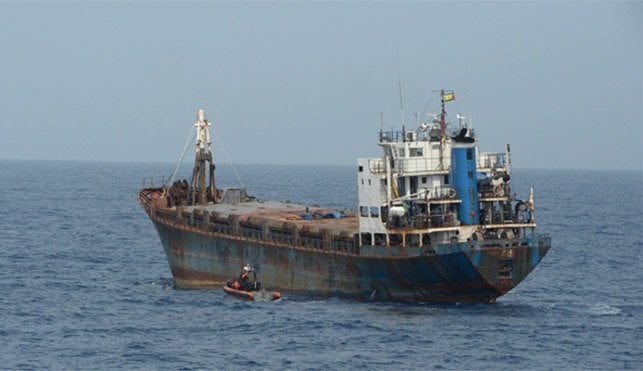
derelict cargo ship used for drug smuggling
The derelict cargo ship was disposed of through Florida's reefing program (USCG 2014)

Published Nov 18, 2025 8:06 PM by The Maritime Executive


Officials in Florida came up with a novel way to dispose of a small cargo ship that was seized more than a decade ago while smuggling cocaine. The vessel, which was last known as the Borocho, was added to the state’s artificial reef program.

The saga of the vessel, which was built in 1977 in Japan, began in September 2014 when the U.S. Coast Guard cutter Bear was on patrol in the Caribbean. The USCG identified the vessel as “suspicious” and ordered it to stop for a boarding and inspection. A search of the vessel turned up 719 kilograms of cocaine worth an estimated wholesale value of more than $23 million.

The United States seized the vessel, and it was taken to a backwater along the Miami River in Miami, Florida. The owners of the vessel appeared to have abandoned it, and over the years, its condition declined. The ship’s last known registry was in São Tomé & Principe, but abandoned, the federal and state government had to figure out how to dispose of the 226-foot (69-meter) vessel.


Martin County, Florida, has been part of a state-sponsored reefing program, sinking its first artificial reefs in the 1970s. A group of retirees and sport fishing enthusiasts, calling themselves the “Reeftirees,” began the movement to create self-sustaining marine habitats. The county has participated in the reefing of eight large vessels, the last of which was completed in 2018.

The Florida Fish & Wildlife Conservation Commission was able to obtain the Borocho and, in May 2025, put out for bids the work to remediate and prepare the vessel for reefing. It paid the estimated $500,000 to clean and prep the vessel and made it available to Martin County for reefing.

The final voyage began early Tuesday morning, November 18, as the vessel was towed approximately 9 miles offshore to a position near St. Lucie inlet. It was positioned offshore from Stuart, Florida, on the state’s east coast. 

The reefing took a little more than an hour, according to local media reports. By about 1:20 pm, the vessel had come to rest in about 180 feet of water. The spot was selected because it was a sandy bottom ideal for the reefing. The vessel became the newly christened Boo McCulley Reef, named in honor of John McCulley, a local contractor who was a strong supporter of the program and instrumental in the reefing efforts. He spent 20 years developing the artificial reef before his passing in November 2020.


Royal Navy's Bahrain-Based Frigate Slinks Back Home Silently

HMS Lancaster frigate
HMS Lancaster appears to have departed Bahrain likely on its way back to the UK (Royal Navy)

Published Nov 18, 2025 1:02 PM by The Maritime Executive


Without any announcement, and with a dearth of official information concerning its whereabouts, the Royal Navy appears to have withdrawn its permanently deployed frigate in the Gulf, HMS Lancaster (F229).

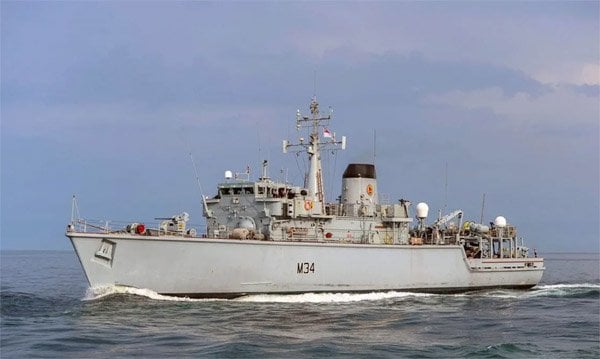
The last public appearance of HMS Lancaster (F229), a Type 23 frigate, was when carrying out yet another successful drug smuggling interdiction in the Gulf of Oman on October 12. A Royal Marine sniper on board HMS Lancaster's Wildcat helicopter disabled the motor of a skiff travelling at 40 knots, and the ship's crew was then able to recover heroin, crystal meth, and hashish worth $45 million. Since then, HMS Lancaster has not been sighted, and the only vessel alongside at the HMS Juffair base in Bahrain has been the Hunt-class minesweeper HMS Middleton (M34), which, with its trusty 30mm cannon, is now the Royal Navy's Middle East flagship.

HMS Lancaster is likely to be returning to the United Kingdom, in company for logistic support with RFA Tidespring (A136). Tidespring was last spotted in Cape Town on November 12, and although HMS Lancaster was not seen alongside, both vessels are likely to be back in the UK at the beginning of December, possibly joining up with the HMS Prince of Wales (R09) carrier strike group as it too returns home after its deployment to the Far East.

The Royal Navy has not announced whether HMS Lancaster is to be replaced, either in the short term by one of the two offshore patrol boats, HMS Tamar (P233) and HMS Spey (P234), based in Singapore, or in the longer term by one of the Type 31 frigates yet to be launched. 

In the meantime, with the internal security situation in Iran deteriorating and tensions rising, the Royal Navy's presence in the region will be maintained by HMS Middleton. Once one of three vessels in the 9th Mine Counter Measures Squadron, Middleton provides a base afloat for a valuable mine counter-measures capability should trouble arise in the Straits of Hormuz area, as tends to occur when Iran goes through a period of tension.


HMS Middleton (M34) (Royal Navy)


The Royal Navy is currently suffering significant shortages, caused by shortages of budget, manpower, and replacements for obsolescent ships, and has been reluctant to acknowledge that these are affecting operational requirements. 

Of six Type 45 destroyers, only two are operational - HMS Dauntless (D33) and HMS Dragon (D35), with HMS Daring (D32) returning to service after a refit lasting over 3,000 days. Of the eight remaining Type 23 frigates, HMS Richmond (F239) and HMS Somerset (F82) are active, with HMS Lancaster (F229) on its way home to be retired shortly. The Type 23s are being replaced by Type 31s, with HMS Venturer due in service by 2027, and by Type 26s, with HMS Glasgow due in service in 2028. 

The Royal Navy now appears to be without its amphibious warfare capability entirely. All three Royal Fleet Auxiliary Bay Class amphibious warfare vessels are inactive, for manpower or budgetary reasons:  RFA Lyme Bay (L3007), RFA Mounts Bay (L3008), and RFA Cardigan Bay (L3009). Albion Class assault ships HMS Albion (L14) and HMS Bulwark (L15) are being decommissioned, and the hospital ship RFA Argus (A135) has been condemned as being insufficiently seaworthy to prevent even a move from its berth in the Portsmouth Naval Base.

Without RFA Fort Victoria (A387), the fleet does not have a single vessel able to supply ammunition and food at sea. On its Far East cruise, HMS Prince of Wales (R09) was dependent for such support on the Norwegian logistics vessel HNoMS Maud (A530).


RFA Fort Victoria has been laid up in Liverpool (Royal Navy)


The submarine service is also under pressure. Cruises by the Dreadnought Class nuclear ballistic missile submarines, one of which is always on patrol, are having to be extended to record durations because of the lack of serviceable boats to maintain the rotation. Of the seven Astute Class nuclear attack submarines, two are still to enter service, and none of the five active boats are currently believed to be operational. The HMS Prince of Wales carrier strike group is believed to have been deployed without a submarine escort, contrary to standard practice.

Faced by these issues, the response of the UK's Ministry of Defence has been to highlight what the future procurement program will deliver, without acknowledging that short-term problems exist. There has, however, been no significant uplift to the defense budget in the interim, which is at the heart of the operational issues facing the Royal Navy.


Mexican National Charged for Death of Migrants in Capsizing off San Diego

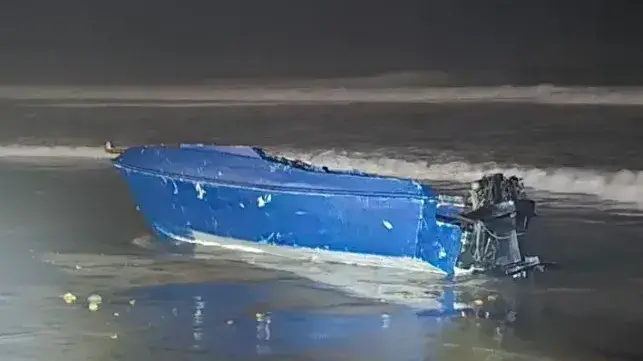
Capsized panga after its recovery on Imperial Beach (USCG)

Published Nov 18, 2025 5:51 PM by The Maritime Executive


The skipper of the small boat that capsized off Imperial Beach, California last Friday has been charged in connection with the casualty, according to prosecutors. The capsizing resulted in at least four deaths, and other passengers may have been lost at sea.  

Mexican national David Alfonso Barrera, 37, has been charged with smuggling resulting in death and smuggling immigrants for financial gain. He was detained on Saturday in connection with the case. 

According to survivors, the boat departed Rosarito, Mexico on Friday night and headed north for the maritime boundary line. The boat had engine trouble, but Barrera decided to keep going, despite objections from some of the others on board, according to prosecutors. The boat capsized when it was approaching Imperial Beach, putting the occupants into the water. Four bodies were recovered, five people were rescued, and a large-scale search operation was mounted to look for any further survivors.  

In interviews with U.S. authorities, Barrera reportedly denied that he was the captain and said that it was another individual, who was not among the nine identified occupants of the boat (deceased or surviving).

"This event underscores the very real danger and consequences of crossing the border illegally," said San Diego Sector Chief Border Patrol Agent Justin De La Torre. "The decision of this smuggling organization to carelessly risk the lives of everyone involved is truly inexcusable. We will ensure full accountability for anyone who chooses to violate our Nation’s laws."

The charge of smuggling in aliens resulting in death is a capital offense, punishable by life in prison or the death penalty. 


Fire Extinguished on LPG Carrier Hit During Russian Attack on Ukraine

firefight on LPG carrier Ukraine
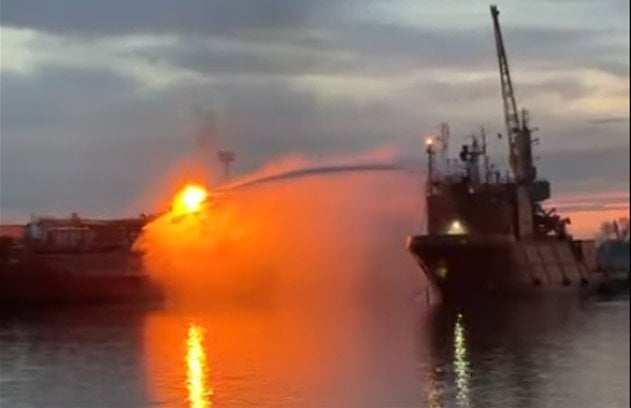
Ukraine extinguished the fire on the LPG carrier started by the Russian attack on Izmail (ISU Tulcea)

Published Nov 18, 2025 2:34 PM by The Maritime Executive


The fire on the Turkish-flagged LPG carrier Orinda, sparked by a Russian attack on the port of Izmail, has been extinguished. While the danger to the area has been abated, concerns are growing about a potential energy crisis this winter in Ukraine as Russia continues its attacks on the ports.

The 9,352 dwt vessel was alongside at Izmail offloading a cargo of liquified petroleum gas when the attack occurred early on November 17. Ukrainian port officials reported that the gas pumping equipment caught fire. The vessel, built in 2002, immediately commenced a shutdown operation, and the 16 crewmembers were safely evacuated. 

Ukrainian firefighters were working to put out the blaze. Images show a fire boat positioned alongside the vessel, and by this morning, the fire was largely extinguished. The Turkish General Directorate of Maritime Affairs said it had been informed that the cooling effort had been completed and there was no more risk.


A portion of the gas cargo burned off during the fire, according to reports from Romania, which was closely monitoring the operation as the vessel was just 200 meters from one Romanian village. They reported that Ukraine had brought in a large vessel to refill the water tanks overnight, helping to reduce the danger of an explosion. More than 230 people had self-evacuated or were moved by the Romanian officials from two Romanian villages as a precaution. They were being permitted to return to their homes.

The vessel will be towed away from the dock to an anchorage on Wednesday, November 19, the Turkish Directorate reports. A full survey will be conducted to determine the level of damage to the 23-year-old ship. 

While the danger has been reduced from this vessel, the concern remains high about a looming energy crisis as Russia continues its attacks on Ukraine’s ports and energy infrastructure. Ukrainian officials reported Izmail was one of several port areas struck in the latest round of attacks.

Ukraine, on Sunday, November 16, concluded an agreement involving the U.S., EU, and Greece for the import of American LNG as the country heads into winter. Starting in December, American LNG will be purchased with funds from the Europeans and Ukraine’s accounts to make up for the lost supplies from Russia. For the past decade, Ukraine has been supplied with gas from various EU states.

Due to the dangers of further attacks, the agreement calls for the gas to be shipped to Greece and offloaded. They will use a Soviet-era Balkan pipeline running from Greece via Moldova, Romania, and Bulgaria to get the LNG to Ukraine. 

Speaking in Greece, Ukraine’s President Volodymyr Zelenskiy told reporters that Ukraine continues to rebuild after the Russian attacks. He said the new agreement would help to fill the void and ease the burden of time and effort required to repair the damage from the Russian attacks.