Wednesday, December 17, 2025

Subsurface modelling has become the ‘confidence infrastructure’ of CCS projects worldwide


ByPramod Jain
DIGITAL JOURNAL
December 17, 2025


Generated by Google AI

Pramod Jain is a thought leader in Digital Journal’s Insight Forum (become a member).

If you were asked to put 1 million tonnes of CO₂ into the ground every year for the next few decades, how confident would you be that you understand what will happen to it?

If you had to insure that storage, would you be comfortable signing the policy?

If you were financing the project, would you be satisfied that the risk is priced properly?

If you were the operator, would you be ready to explain your confidence to a regulator, an insurer, and a board?

These questions once belonged to a small group of technical reviewers. Today, they sit at the centre of decisions being made by regulators, insurers, lenders, commercial partners, and operators involved in carbon capture and storage (CCS).

CCS is drawing attention because the energy transition conversation is everywhere, and more companies are preparing to return significant volumes of CO₂ to the subsurface instead of releasing it into the atmosphere.

To do that, carbon dioxide must be transported, injected underground into the right geological formation, and stored in a way that keeps it contained for decades. And because it’s underground, none of it can be observed directly, which introduces challenges.

Once CO₂ is injected, it moves through porous rock, changes state under pressure, and interacts with the reservoir in ways that depend on geology.

The only practical way to understand that behaviour is through modelling.
A turning point for evidence in CCS

CMG has been modelling subsurface behaviour since 1978, drawing on decades of injection work across oil and gas, geothermal projects, and other subsurface disciplines. The physics are not new, but the expectations around the evidence are.

Storage decisions have become simultaneous and multi-institutional, bringing insurers, lenders, regulators, and commercial partners, each assessing the same evidence through a different lens.

As more institutions participate in CCS, the expectations placed on modelling have expanded and become more specific. Simulation has always been essential, but more institutions now depend on it, and the consequences of their decisions are larger than before.

Storage projects also differ widely in their geology, operating plans, and injection rates, which means the model must reflect the specific conditions of each reservoir rather than a generic template. This shift is happening as activity accelerates.

The Global CCS Institute reports there are now 77 operating CCS facilities globally, with 47 in construction, and 610 in development. That brings the total pipeline to 734 projects.

More proposals mean more decisions. More decisions mean more scrutiny. And more scrutiny means higher expectations for the quality, transparency, and discipline behind the model.

A simple but meaningful reality is taking shape: subsurface modelling has now become the confidence infrastructure of CCS.

It’s evolving into the foundation on which regulatory approval, financial risk, commercial agreements, and insurance coverage are based.

Other sectors rely on audited financial statements and system-wide stress tests to support decisions made by institutions with different mandates. In CCS, the subsurface model increasingly plays this role.

The companies that understand this shift, and that build evidence systems strong enough to support it, will gain an unfair advantage as hundreds of CCS projects move into construction.
What this shift requires from companies

The next phase of CCS will be defined not only by how well operators model the subsurface, but by how effectively they build trust in the evidence that surrounds it.

This change requires different choices than the sector has made in the past.

1) Companies need to align modelling with insurability, not just permitting

Permitting focuses on whether storage is safe and stays contained.

Insurers look at financial risks, including the chance that storage might not meet its expected performance. For example, injecting less CO₂ than planned, failing to store the required volume, or losing credits if the storage fails to meet regulatory conditions.

A subsurface model can’t guarantee outcomes, but it can clarify the conditions under which those outcomes become more or less likely.

Companies that present this evidence clearly, and that map their risk register to the exposures insurers actually underwrite, will negotiate better terms and face fewer delays.

2) Companies need to understand and model the risks that come from how capture, transport, and storage systems interact

CCS hubs and clusters introduce new dependencies between capture, transport, and storage.

CO₂ does not behave the same way coming out of every facility, and variations in impurities, temperature, and pressure can affect both surface equipment and reservoir performance.

Simulation can’t eliminate that risk, but it can show how sensitive the system is to specific conditions and where flexibility exists.

This helps companies design stronger commercial agreements, clarify responsibilities between partners, and avoid operational disputes that erode trust.

2) Companies need to treat the model as a living governance asset, not a static report

With simulation, early models establish a baseline understanding, but real confidence comes from what happens after injection begins.

Operating data will strengthen or challenge assumptions, narrow uncertainty, and improve decisions over time.

Companies that show how they will update evidence and refine uncertainty build credibility with regulators, insurers, and lenders who reassess risk across the project life.

Simulation does not replace monitoring or engineering judgement — it provides a disciplined way to integrate learning into decisions that carry financial and regulatory consequences.

These three capabilities don’t ask companies to do more modelling. They ask them to treat modelling differently.

Simulation does not remove all risk, but it clarifies it. It doesn’t eliminate uncertainty, but it shows where uncertainty matters and where it does not. And it can’t guarantee performance, but it can establish a shared basis for decisions among institutions that evaluate the same project through different lenses.

Companies that understand this will be the ones that move faster, because they can demonstrate something the market increasingly values when certainty is not possible — well-founded confidence.
What trusted evidence looks like in CCS, and what’s next

The companies that advance storage fastest will be those that produce evidence others can trust. That requires clarity about reservoir behaviour across the range of conditions that matter.

Good subsurface modelling and simulation reflects the physics that govern how CO₂ moves, how pressure evolves, and how operating conditions influence stability. It incorporates geomechanics, caprock integrity considerations, pressure buildup, and fluid interactions where they play a meaningful role. These risks can’t be evaluated without physics-based modelling.

Trusted evidence also requires clear assumptions, transparent methods, and uncertainty expressed through probability ranges rather than single forecasts. Reviewers need to understand what the model predicts, and also why it predicts it, how sensitive outcomes are to different conditions, and which uncertainties matter most.

As projects move from construction into operation, data refines the model. The ability to update the evidence and narrow uncertainty is essential for maintaining confidence, and regulators, insurers, and lenders increasingly expect this discipline.

Evidence quality will increasingly determine which projects reach major commitments and which ones stall.

As storage becomes a more visible part of decarbonization strategies, the expectations placed on modelling will continue to rise. The companies that recognize this moment, and that treat modelling as confidence infrastructure rather than a technical formality will be in the strongest position to advance projects, secure capital, and build trusted partnerships.

Trusted evidence, not technical novelty, will determine which projects advance. Companies that deliver it will shape the future of CCS and build momentum as the energy transition accelerates.


Written ByPramod Jain

Pramod Jain is a software executive and professional engineer with over 15 years of international leadership experience focused on corporate growth and innovation. Joining CMG as CEO in 2022, he brings a strategic mind and proven track record of successfully building strong, customer-focused global B2B product organizations. Pramod has a unique ability to calibrate technology corporations for growth through effective leadership, innovation, and communications. Pramod holds a Master of Science Degree in Industrial Engineering from Mississippi State University, a Bachelor of Technology, Electrical and Electronics Engineering Degree from Kurukshetra University, in India and a diploma in Corporate Finance from INSEAD in France. Pramod is a member of Digital Journal's Insight Forum.
Opinion: Adult AI, AI eroticism — This is what you’re investing billions in?


By Paul Wallis
EDITOR AT LARGE
DIGITAL JOURNAL
December 16, 2025


While OpenAI does not expect to be profitable before 2029, the startup's valuation keeps climbing in funding rounds baffling some financial analysts - Copyright AFP Kirill KUDRYAVTSEV

The slop is about to expand its horizons into people’s shabby sex lives with the mediocrely named “Adult AI” — Soon you’ll be able to watch non-existent people having sex, at a price. We’ve already got non-existent lesbians, featuring Wednesday and Enid deepfakes on Facebook. Soon all your other favorites will be devalued, too, you lucky people, you.

This is very probably just a commercialization of what’s already there. It’s unlikely to stop there. Maybe Flipper, Lassie, and Rin Tin Tin will make a comeback? Maybe standup comedians will find something to talk about?

AI has a gruesome habit of turning everything it does into lowest common denominator garbage. From autoslop content to autoslop “eroticism” can’t be too far to go. Can anyone visualize the sheer lack of passion of an AI porn movie?

“You’re gorgeous.”

“I know.”

That’ll be the whole script, with the obligatory 5000 words of AI filler and repetitions. Really something to make you look for a cave somewhere.

There is a market for this trash, which will be coming to you in 2026 presumably with a hike in subscription prices. Better still, everyone in the porn sector will probably also be unemployed, just in case they were thinking of having lives. The Send Everyone Broke motif is obviously doing well.

The AI will verify your age, too, to ensure you’re old enough to watch futile, febrile, infantile, garbage. Ask your AI friends if they think it’s OK.

The likely security risks are just an added bonus. AI is now flagging art as porn, so you’re pretty safe from absolutely nothing on either end. Google’s porn ban is floundering along nicely, so the AI will ensure that you and your media-driven neuroses and psychoses are fully occupied.

Let’s get down to cases:

This is the fabulous future?

This is all you meaningless losers can think of to do with a whole new class of top-tier tech?

Isn’t the online world sleazy enough?

This tech is incredibly useful in so many ways, if not as chatbots, agents, or hallucinating third-rate calculators. Scientific AI, the real AI, is highly efficient and productive.

This idea isn’t and can’t be productive. The opportunities for malware, fraud, crime, and a whole spectrum of personalized disasters are off the scale. Even VPNs aren’t safe anymore, and you want to hype up the risks with this total waste of tech, time, money, and resources?

And you’re investing billions in it? How stupid are you? Is there a stone tablet somewhere to define your sheer ignorance and lack of comprehension? (I just wrote “How stupid are you?” and it corrects to “How stupid is you?” This is the standard of actual tech you’re using.

While we’re blissfully contemplating all this wonder:

What about AI porn nasties? What about AI-generated kiddie porn and other cash cows? What about the massive liabilities? Possessing these things is illegal. What do you think making them might be?

There’s dumb, dumber, and way out in front, you. Of all the idiotic things to do.

______________________________________________________

Disclaimer
The opinions expressed in this Op-Ed are those of the author. They do
 not purport to reflect the opinions or views of the Digital Journal or its members.


Ukraine’s lost generation caught in ‘eternal lockdown’

By AFP
December 16, 2025


Growing up amid the ruins:Bohdan Levchykov, 15, in his hometown Balakliia
 - Copyright AFP OLEKSII FILIPPOV

Boris BACHORZ

With his shadow of a moustache and baseball cap, Bohdan Levchykov would be your typical teenager anywhere if he didn’t embody the tragedy of what has happened to a generation of young Ukrainians after nearly four years of war.

His father Stanislav, a career soldier, was killed defending the country’s second city Kharkiv just weeks after Russia invaded in 2022. On top of all they have been through, his mother Iryna, 50, was recently diagnosed with stage-three cancer of the uterus.

Bohdan no longer knows anyone his age in his battered hometown of Balakliia, which was occupied by the Russian army from March to September 2022. It was later retaken by Ukrainian forces, but being only 70 kilometres (43 miles) from the front, is still regularly shelled.

“My mother and I came back a few days after the city was liberated, and there were no children left, no shops open, nothing,” he recalled. Only a fraction of the pre-war population of 26,000 have trickled back, and most of them are old.

The skate park and the banks of the Balakliika River where young people used to hang out were mined by the Russians. They have been demined since, “but rumour has it it’s still not safe,” the 15-year-old said.

All Bohdan’s schooling is online, his days punctuated by air raid alerts. The nine flights of stairs down to the basement is more than his sick mother can manage, so they lay a mattress in the small entry to their apartment, the only room without a window. “We’ve gotten used to getting by on our own. We’re a tight team,” Bohdan smiled.

“It’s not just Bohdan. All the children adapted so quickly,” his mother said. “This generation — I don’t know what to make of them…”

She is not the only one to wonder what the war has done to Ukraine’s children.

Nearly a million young Ukrainians are still living in an eternal lockdown, doing either all or part of their lessons online. First there was the pandemic in March 2020, then the invasion — six years of spending most of their time in front of the family computer to study and unwind.

This isolation is particularly felt in the Kharkiv region bordering Russia, which is the target of daily attacks.

A few bars and restaurants stay open until the 11 pm curfew before night brings the inevitable Russian drone and missile attacks. Mornings echo with the sound of volunteer teams repairing whatever can be salvaged.

Some 843 educational establishments have been either destroyed or damaged in the region — a fifth of the national toll, according to the Ukrainian government’s saveschools.in.ua. site.

The online investigative site Bellingcat — with whom AFP journalists in Kyiv and Paris worked on this special report — has logged more than 100 video or photo testimonies on social media of Russian strikes on or close to educational institutions or youth leisure facilities in and around Kharkiv.

Children in tears were evacuated when a city centre daycare was hit on October 22. “We’re going to find your mother right away,” a rescuer told a little girl he was carrying out of the smoke and debris, according to police footage.


– Underground schools –


More and more children are going to underground schools in the city. Yevenhelina Tuturiko has been attending one since September, several metres below the street with no natural light.

“I really love it,” the lanky 14-year-old said, “because I can talk in person with my classmates again.”

Ironically, Yevenhelina had to cross Europe to “meet most of my current friends” in Kharkiv after being invited on a “respite trip” organised by the city of Lille in northern France to give Ukrainian kids a taste of normality.

Kharkiv will have 10 underground schools open by the end of the year, the city hall said.

Priority is given to classes where most of the children remained in Kharkiv during the heaviest of the fighting at the start of the invasion, when Russian forces pushed into the suburbs of the city. Some 70 percent of the city’s children were evacuated at one time or another, either abroad or to the west of Ukraine.

The children spend only half their school day in the bunkers to make room for others, finishing their classes online.

The school AFP visited was built to nuclear shelter standards, with a heavy armoured door. “We are probably one of the safest shelters in all of Ukraine,” its principal Natalia Teplova said proudly.


– ‘Children going mad’ –


All outdoor school sports are banned in the Kharkiv region for fear of Russian strikes. But outside school it’s a little more hazy.

“Official competitions are banned, but we’re not state-run, so we make do on our own,” said football coach and former soldier Oleksandr Andrushchenko as he roared on his young players.

The handful of well-wrapped up parents on the sidelines “understand that their children haven’t developed at all (athletically) since the Covid years. And that it’s better for them to play football… than stay glued to their phones,” he said.

Inside Kharkiv’s largest swimming pool complex, educator Ayuna Morozova agrees: “You can’t live in constant fear.”

The huge Soviet-era brutalist building shut after being hit in two heavy strikes in March 2022, then reopened in May 2024. Now when windows are blown out from the shock waves of nearby bombing, they are just boarded up with plywood or plastic.

“Water and swimming cure everything,” Morozova firmly believes. “First two years of Covid, then four years of war — children are going mad,” she said. The complex is now also home to a water therapy space for amputee soldiers.

With her flame-red hair and warm manner, Ayuna lives up to her Tatar-origin first name, which means “Great Bear”. But like almost everyone AFP met, the wounds of war surface quickly. She was buried under rubble after an airstrike on a public building in 2022. “I still have nightmares,” she said. “I avoid confined spaces and lifts. And yes, I did see a psychologist.”

Ukraine lacks the resources to measure the war’s impact on the young.

“We don’t have enough psychologists,” admitted Oksana Zbitneva, head of the government’s coordination centre for mental health. To try to make up for that, “130,000 frontline health professionals — nurses, paediatricians, family doctors — have received World Health Organization-certified training in mental health,” she said.

While “some countries have been building their (mental health) systems for 50 years, we were the last to get started because of our Soviet legacy,” she added.

The government has opened 326 “resilience centres” for children and parents across the country, and “300 more” should be built next year, according to Social Affairs Minister Denys Ulyutyn.


– Self-harm –


When AFP met psychologist Maryna Dudnyk amid the sunflower fields of Khorosheve, 15 kilometres south of Kharkiv, she had just led three hours of play workshops with around 50 children aged six to 11 to help them express their feelings.

As her team packed away the bulletproof vests — security protocol demands they bring them — she said “the war has had a huge impact on the emotional state of young people, we all live under stress.”

In her consulting room, she hears “a lot of fear and anxiety in children… Teenagers suffer from self-harm, from suicidal thoughts.”

Dudnyk, 50, who works for the Ukrainian NGO “Voices of Children”, also carries her own wounds — fleeing from her hometown Mariupol, which was occupied by the Russian army after a brutal siege. “We no longer have a home, nothing. Everything was destroyed.”

Some teenagers have grown a kind of emotional armour. Illia Issaiev hated it when his family fled the fighting by crossing over into Russia. The months they spent there before returning made him even more of a Ukrainian nationalist.

The lean 18-year-old with steel-blue eyes claims to be a Kharkiv leader of the ultra-nationalist group Prav Molod (“The Right Youth”).

We met him as he trained a group of young men in handling military drones, his speciality. “Hard times make people stronger. Our era is producing strong people who will build a good country,” he declared.

It’s not so simple for Kostiantyn Kosik, who is on medication for his tics, faintness and migraines. “I’m constantly nervous, on edge. It’s because of the war. It has a huge effect on my health,” said the bearded 18-year-old, who was dressed in black.

Kostiantyn is from the Donetsk region, which has been ravaged by fighting since a Russia-backed separatist revolt in 2014. He grew up in Avdiivka, a martyr city now in ruins which fell under Russian control after months of grinding battles.

“I have known war since the age of six. At first it was very interesting for a little boy — the tanks, soldiers, automatic weapons. When I was old enough to understand, it became much less fun,” he said.

He spent weeks sheltering in the basement of his house as it was rattled by explosions, all the neighbours gone.

“In one way it toughened me. But I would have preferred a normal childhood, with friends, with joy,” he said, his room decorated with a large painting of his hometown.


– ‘They continue to dream’ –


Like most of the nearly four million displaced people within Ukraine, Kostiantyn’s family are just about hanging on. They rent a house with no heating in Irpin near Kyiv. Kostiantyn’s mother spends her days caring for his bedridden stepfather who has had a series of heart attacks linked to the conflict.

Kostiantyn is proud to be studying international law at Irpin University and — despite his broken English — wants to be able to work “protecting human rights, in Ukraine and elsewhere in the world”.

Researchers for the WHO who questioned 24,000 young Ukrainians from 11 to 17 at the end of 2023 found a “deterioration in the psychological wellbeing” and “significant” decrease in the happiness they felt.

But there was also a “fairly high level of resilience… to wartime adversity”.

So much so that a UNICEF study in August reported that exams were more a source of stress to them than air raid sirens, which “worryingly suggest that war has become part of everyday life for many children.”

“Children have lost their parents, their friends and are sleeping in air raid shelters,” said Social Affairs Minister Ulyutyn. “And yet they continue to live, to dream.”

When Bohdan, the teenager from Balakliia, is not drawing he plays and chats with his “new friends”, all online. He spends a lot of time chatting with a girl called Lana, with whom “he has many things in common”.

Bohdan also has a dream. “I really want to meet up with Lana. I talked to my mother about it. Maybe our parents can arrange something.” But Lana lives in Dnipro, more than 400 kilometres to the southeast, another world in wartime Ukraine.

In the meantime, Balakliia suffered another strike that killed three people on November 17, 300 metres from Bohdan’s building.
‘Extremely exciting’: the ice cores that could help save glaciers


By AFP
December 16, 2025


A researcher at Japan's Hokkaido University Institute of Low Temperature Science cuts a slice from an ice core sample taken from a glacier in the Pamir mountain range in Tajikistan - Copyright AFP GREG BAKER


Hiroshi Hiyama

Dressed in an orange puffer jacket, Japanese scientist Yoshinori Iizuka stepped into a storage freezer to retrieve an ice core he hopes will help experts protect the world’s disappearing glaciers.

The fist-sized sample drilled from a mountaintop is part of an ambitious international effort to understand why glaciers in Tajikistan have resisted the rapid melting seen almost everywhere else.

“If we could learn the mechanism behind the increased volume of ice there, then we may be able to apply that to all the other glaciers around the world,” potentially even helping revive them, said Iizuka, a professor at Hokkaido University.

“That may be too ambitious a statement. But I hope our study will ultimately help people,” he said.

Thousands of glaciers will vanish each year in the coming decades, leaving only a fraction standing by the end of the century unless global warming is curbed, a study published in the journal Nature Climate Change showed Monday.

Earlier this year, AFP exclusively accompanied Iizuka and other scientists through harsh conditions to a site at an altitude of 5,810 metres (about 19,000 feet) on the Kon-Chukurbashi ice cap in the Pamir Mountains.

The area is the only mountainous region on the planet where glaciers have not only resisted melting, but even slightly grown, a phenomenon called the “Pamir-Karakoram anomaly”.

The team drilled two ice columns approximately 105 metres (328 feet) long out of the glacier.

One is being stored in an underground sanctuary in Antarctica belonging to the Ice Memory Foundation, which supported the Tajikistan expedition along with the Swiss Polar Institute.

The other was shipped to Iizuka’s facility, the Institute of Low Temperature Science at Hokkaido University in Sapporo, where the team is hunting clues on why precipitation in the region increased over the last century, and how the glacier has resisted melting.

Some link the anomaly to the area’s cold climate or even increased use of agricultural water in Pakistan that creates more vapour.

But the ice cores are the first opportunity to examine the anomaly scientifically.


– ‘Ancient ice’ –


“Information from the past is crucial,” said Iizuka.

“By understanding the causes behind the continuous build-up of snow from the past to the present, we can clarify what will happen going forward and why the ice has grown.”

Since the samples arrived in November, his team has worked in freezing storage facilities to log the density, alignment of snow grains, and the structure of ice layers.

In December, when AFP visited, the scientists were kitted out like polar explorers to cut and shave ice samples in the comparatively balmy minus 20C of their lab.

The samples can tell stories about weather conditions going back decades, or even centuries.

A layer of clear ice indicates a warm period when the glacier melted and then refroze, while a low-density layer suggests packed snow, rather than ice, which can help estimate precipitation.

Brittle samples with cracks, meanwhile, indicate snowfall on half-melted layers that then refroze.

And other clues can reveal more information — volcanic materials like sulfate ions can serve as time markers, while water isotopes can reveal temperatures.

The scientists hope that the samples contain material dating back 10,000 years or more, though much of the glacier melted during a warm spell around 6,000 years ago.

Ancient ice would help scientists answer questions such as “what kind of snow was falling in this region 10,000 years ago? What was in it?” Iizuka said.

“We can study how many and what kinds of fine particles were suspended in the atmosphere during that ice age,” he added.

“I really hope there is ancient ice.”


– Secrets in the ice –


For now, the work proceeds slowly and carefully, with team members like graduate student Sora Yaginuma carefully slicing samples apart.

“An ice core is an extremely valuable sample and unique,” said Yaginuma.

“From that single ice core, we perform a variety of analyses, both chemical and physical.”

The team hopes to publish its first findings next year and will be doing “lots of trial-and-error” work to reconstruct past climate conditions, Iizuka said.

The analysis in Hokkaido will uncover only some of what the ice has to share, and with the other samples preserved in Antarctica, there will be opportunities for more research.

For example, he said, scientists could look for clues about how mining in the region historically affected the area’s air quality, temperature and precipitation.

“We can learn how the Earth’s environment has changed in response to human activities,” Iizuka said.

With so many secrets yet to learn, the work is “extremely exciting,” he added.
Donald Trump claims Liz Truss as ‘voice of authority’ as part of his $10bn claim against BBC

Yesterday
Left Foot Forward


Someone should remind Trump that Truss has no credibility in the UK.


U.S. President Donald Trump has claimed that disgraced former Prime Minister Liz Truss is a ‘voice of authority’ as part of his defamation lawsuit against the BBC.

Trump wants to sue the BBC after Panorama broadcast a misleading edit of a speech he made before the Capitol riots on January 6, 2021.

During the speech, before a riot at the US Capitol, Trump told a crowd: “We’re going to walk down to the Capitol, and we’re going to cheer on our brave senators and congressmen and women.”

More than 50 minutes later in the speech, he said: “And we fight. We fight like hell.”

In the edited Panorama clip, it showed him as saying: “We’re going to walk down to the Capitol… and I’ll be there with you. And we fight. We fight like hell.”

The BBC has apologised with two of its top figures, including the director-general, resigning amid concerns about impartiality.

Truss, an ally of Trump, accused the BBC of peddling ‘fake news’ and of being ‘left leaning’.

Legal experts have said that Trump’s lawsuit is unlikely to succeed, given the high bar Trump would have to meet to prove that there was intentional malice, and given that the Panorama documentary is not available in the U.S., Trump would also have a difficult time proving reputational harm.

Nonetheless, Trump has followed through on his legal threat and on Monday evening filed a lawsuit against the BBC totalling up to $10bn (£7.5bn).

Trump reckons the voice of Britain’s shortest serving prime minister, Truss, is proof that the BBC needs to be ‘held accountable.’ The same Liz Truss whose disastrous mini-budget led to market turmoil and the pound collapsing, resulting in her being booted from office after just 45 days.

The lawsuit states: “No less an authority than the United Kingdom’s former Prime Minister, Liz Truss, discussed this bias, the need to hold the BBC accountable, and the BBC’s pattern of actual malice.”

Someone should remind Trump that Truss has no credibility in the UK.


What we know about Trump’s $10 billion BBC lawsuit

ByAFP
December 16, 2025


Image: - © AFP/File Justin TALLIS
Akshata Kapoor and Chris Lefkow in Washington

US President Donald Trump has filed a defamation lawsuit against the BBC, seeking $10 billion in damages over a misleading edit of his 2021 speech before the US Capitol riot.

Here’s what we know about the row:

– Why Florida? –

Trump filed the lawsuit in a federal court in Miami, Florida, the state where he is a legal resident and where he has filed previous lawsuits against US media outlets.

His lawyers argue that many of the scenes in the Panorama documentary — which aired in Britain in October 2024 — were shot in Florida, including around Trump’s Mar-a-Lago resort.

He was too late to file a libel claim in the UK, which generally has a one-year time limit to bring such cases.

– What are the arguments? –

The documentary spliced together two separate sections of Trump’s speech on January 6, 2021 in a way that made it appear he explicitly urged supporters to attack the Capitol, where lawmakers were certifying Joe Biden’s 2020 election win.

The lawsuit alleges that the edit was a deliberate attempt to give a “false, defamatory, deceptive, disparaging, inflammatory, and malicious depiction” of Trump to try to “interfere and influence” the 2024 presidential election.

They say it harmed Trump’s reputation as a “politician, leader, and businessman”, even though he went on to win the election and his team was apparently unaware of the broadcast for about a year.

– Can Trump win? –

While the BBC has previously apologised for its “mistake”, it insists there is no basis for a defamation case and said on Tuesday it would fight the lawsuit.

The broadcaster contends that the documentary did not air in the United States and its streaming platform cannot be accessed outside the UK.

Trump is arguing that people in Florida would have been able to view the documentary through the use of VPNs and the broadcaster’s US distributor.

But Canadian company Blue Ant, which owns the rights to the documentary outside the UK, told AFP on Tuesday that “none” of its buyers “have aired it in the US”.

Legal experts say the BBC has a strong case.

“Defamation cases are difficult to win,” University of Richmond law professor Carl Tobias told AFP, noting a 1964 Supreme Court ruling that “requires plaintiffs to prove actual malice, which is an onerous proof burden”.

Trump has launched several recent legal actions against media companies, including CNN and The New York Times, but these have not yet gone to court.

The BBC could choose to settle, but Mark Damazer, a former BBC Radio 4 controller, said it would be “damaging” to the BBC’s reputation not to fight the case.

– Could it cost the British public? –

British taxpayers largely fund the cash-strapped broadcaster through an annual licence fee that is mandatory for anyone in the country who watches television.

Some commentators in the UK have speculated that the legal costs of fighting or settling the defamation case could result in an increase to the £174.50 pound ($234) annual license.

In December 2024, ABC News agreed to pay $15 million in a defamation case brought by Trump. In July, CBS forked out $16 million to settle another case.

– Why it’s bad timing for the BBC –

The lawsuit coincides with the launch in the UK of a politically sensitive review of the BBC’s Royal Charter, which outlines the corporation’s governance.

The current charter ends in 2027 and will need to be renewed, with the BBC’s funding model and editorial priorities up for debate.

It also comes as the broadcaster seeks a replacement for outgoing director general Tim Davie who announced his resignation over the edit.

In the decade to 2020, the BBC’s income overall fell by about 30 percent in real terms, Davie said last year.

Last month, lawmakers revealed that the BBC is losing more than £1 billion a year from households evading the licence fee.

Liz Truss claims that living in the UK is now like ‘East Germany’ in latest bizarre rant
15 December, 2025

Truss is totally deluded

.

Liz Truss could do with some quiet self-reflection after her disastrous time in office that resulted in her being booted out after just 45 days, yet the disgraced former Prime Minister continues to make bizarre and ludicrous claims.

After repeatedly claiming that her premiership fell apart because of the ‘deep state’ rather than her own disastrous policies contained in the mini-budget, which sent mortgage bills soaring and the pound collapsing, Truss now says that living in the UK is like living in East Germany with free-speech under attack.

Despite the fact that Truss was able to reach the highest office in the land, say what she liked and push her flawed policies which ultimately resulted in her downfall, Truss claims that free speech has been eroded and that you can now be arrested for “expressing perfectly normal views online”.

In the latest instalment of the weekly ‘The Liz Truss Show’ on Youtube, the former Tory leader claimed that foreigners were “afraid to step onto our shores for fear of being arrested”, and that “hate crime cases and cracking down on free speech” was being prioritised by police “over burglary and rape”.

She was joined on her latest episode by three guests, Allison Pearson, Graham Linehan, and Lucy Connelly.

Connolly was sentenced in October 2024 to two and a half years behind bars after admitting to inciting racial hatred. She took to X to urge people to “set fire” to hotels housing asylum seekers during the Southport riots last summer. She pleaded guilty to the offence of distributing material with the intention of stirring up racial hatred.

Yet despite her breaking the law and pleading guilty, Truss and others have sought to portray her as a free speech martyr.

Truss says in her video: “It does feel like we’re living in East Germany.”

“Laws have been passed which are now being used against ordinary citizens expressing perfectly normal views online.”

Truss’ latest bizarre rant, will only add to the feeling that she’s completely out of touch with reality.


Basit Mahmood is editor of Left Foot Forward


The Trump Cabal’s “Apocalypse Again”


In Francis Ford’s Coppola’s brilliant 1979 film Apocalypse Now, we have the CIA ordering the assassination of a renegade colonel. Colonel Kurtz, played by Marlon Brando, rambled “Off the reservation” and simply went too far, even for the genocide loving US government in Vietnam. When the assassin, played by Martin Sheen, gets too close to Kurtz at his deep jungle compound, Kurtz, dying, shouts out “Kill ’em. Kill ’em all” referring to his Cambodian army of followers.

Fast forward to our horrific current era of outright (and I will say it) Fascist Amerika. The Trump Cabal obviously took the mantle in spades from the war mongering Bush 1 and Bush 2 administrations. Bush 1 used the lies about Saddam Hussein’s attack on Kuwait (read the transcript of the meeting between US Ambassador April Glaspie and Iraq President Saddam Hussein about Kuwait and it’s illegal drilling of Iraqi oil); Bush 2 ( with Cheney pulling the strings) using WMD lies to illegally invade and occupy Iraq. The Trump Cabal, let’s give them credit here, are great students of their predecessors. They just take it on steroids with the disgraceful missile attacks blowing up Venezuelan speedboats. Trump’s handlers obviously viewed the massacre of the fleeing Iraqi Revolutionary Guards in Iraq War 1, blowing them into dust. They also obviously watched documentary footage of the Nazis grabbing up Jews, packing them into trucks and speeding off to the concentration camps. Not a bad preface to what occurs in places like Alligator Alley and a myriad of our current ICE detention centers.

The hope all good and decent Americans are pining for is official resistance. We need our military personnel to say NO when ordered to do any such illegal or immoral action. We need our Congress to finally stand together and say NO to the sociopaths running this fascist enterprise. Yes, call it what it is folks.

Philip A Farruggio is regular columnist on itstheempirestupid website. He is the son and grandson of Brooklyn NYC longshoremen and a graduate of Brooklyn College, class of 1974. Since the 2000 election debacle Philip has written over 500 columns on the Military Industrial Empire and other facets of life in an upside down America. He is also host of the It’s the Empire… Stupid radio show, co produced by Chuck Gregory. Philip can be reached at paf1222@bellsouth.netRead other articles by Philip.

It’s Time For America to Indict Itself: Cruelty and Dehumanization Never End Well

Source: Originally published by Z. Feel free to share widely.

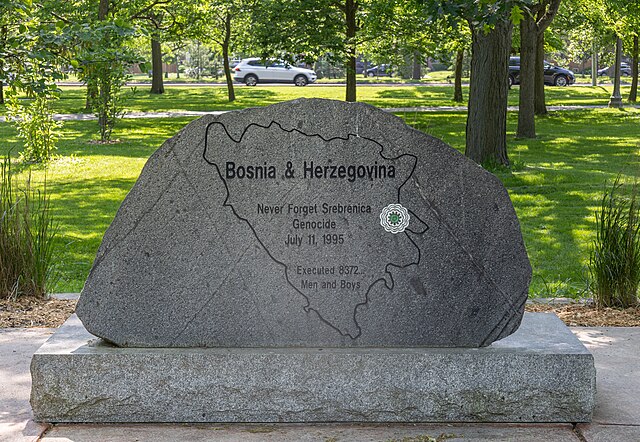
This week marks the 30th anniversary of the war in Bosnia and Herzegovina. On December 14,1995 leaders from Bosnia and Herzegovina, Croatia, and the former Yugoslavia signed the Dayton Peace Agreement, ending a ferocious three-and-a-half-year war that claimed around 100,000 lives, left thousands missing, and reduced entire communities to rubble.

But the war in Bosnia did not begin with bombs or snipers. It began with cruelty and dehumanization, with the deliberate turning of neighbors against neighbors.

Over the last few weeks to mark the impending anniversary of Dayton, social media is filled with images and videos recalling the horrors of that war. More disturbingly, recent reporting has revealed that some tourists came to Sarajevo and other cities not as witnesses, but as participants, joining sniper attacks against Bosniaks (Bosnian Muslims) for sport. These are not grotesque curiosities from the past. They are warnings. Violence does not erupt spontaneously. It is cultivated, normalized, and enabled when dehumanization hardens into practice.

Having lived and worked in Bosnia and Herzegovina for six years, I have seen this reality up close. I lived in an apartment building where chunks of the facade were still missing from sniper fire, silent reminders embedded into everyday life. I walked streets scarred by shelling, listened to survivors carry grief that never fully leaves, and witnessed the enduring physical and psychological toll the war continues to exact.

Maybe it is cheeky to use this moment, and I will take the criticism. Dehumanization and cruelty never end well. Ever. History makes that clear, yet its warnings are lost in the noise of daily chaos. What once shocked us or was unacceptable now barely registers and is casually shrugged off. Cruelty becomes banal. Dehumanization becomes routine. And people grow dangerously accustomed to both.

Recent survey data underscore this normalization. A 2025 Pew Research Center study found that large majorities of Americans say racial, ethnic, and religious minorities, including Black Americans, Muslims, Jews, Hispanics, and Asian Americans, face discrimination in the United States. Yet the same data reveal sharp partisan divides over how serious that discrimination actually is, with many respondents acknowledging bias in the abstract while minimizing its real-world impact. This gap, recognition without urgency, helps explain how dehumanization becomes tolerable. When harm is acknowledged but downplayed, it becomes easier to excuse, ignore, or rationalize. Over time, cruelty does not disappear. It becomes administratively acceptable.

We see this in the way entire communities are spoken about and treated as problems to be managed rather than people to be protected. Somali and Afghan communities are routinely cast under a cloud of suspicion, framed as perpetual outsiders or security threats rather than neighbors who have fled war and displacement, often shaped by U.S. policy itself. We see it in the rise of Islamophobia, where Muslim identity is conflated with extremism, surveillance is normalized, and ordinary expressions of faith are treated as something dangerous or foreign.

This dehumanization is no longer abstract. Muslim women are harassed for wearing hijab. Mosques are vandalized or threatened. Muslim students face intimidation, and communities confront demonstrations that frame Islam as an existential threat. Political rhetoric and online disinformation recast Muslims not as citizens or neighbors, but as enemies within.

At the same time, antisemitism is rising openly and violently, met too often with selective outrage or cynical political instrumentalization rather than moral clarity. What we are witnessing goes far beyond criticism of Israeli or U.S. policy in Gaza. It is the resurgence of conspiratorial antisemitism, assigning collective guilt to Jews, casting them as shadowy manipulators, and blaming them for imagined schemes designed to inflame fear and hostility.

Alongside it all is the quiet whitewashing of overt racism, where racial resentment is softened, excused, or even rewarded. Avowed white supremacist rhetoric, once confined to the margins, now circulates openly with alarming legitimacy, shielded by appeals to free speech. When whole communities are labeled as garbage, it is not a metaphor. It is permission to ostracize, harm, or worse.

This logic becomes most dangerous when it is absorbed into state power. The weaponization of ICE is one of the clearest examples of dehumanization made operational. Raids, workplace sweeps, and neighborhood operations punish entire communities rather than address individual wrongdoing. Families are torn apart without warning. Parents disappear on the way to work or school. Asylum seekers are treated as criminals for exercising a legal right. When enforcement is untethered from proportionality, due process, and dignity, it ceases to be about law and order and becomes collective terror.

Bosnia is not our only warning. We do not need to look abroad or far back to understand the consequences of dehumanization. The United States has its own record. Jim Crow. The internment of Japanese Americans. The dispossession of Indigenous peoples. Redlining and housing segregation. Mass incarceration. And moments when fear of communists, Muslims, or immigrants transformed into surveillance, blacklists, and collective punishment.

It is time America indicts itself. It is time to look honestly in the mirror and decide what it wants to be. The growing cruelty we are witnessing is not the work of one party or one individual. Complicity can’t be ignored. These impulses are older, deeper, and far more bipartisan than we care to admit. We did not arrive here by accident. Some seek an America built on exclusion, nostalgia for eras when inequality was enforced by law and belonging narrowly defined. America has postponed this reckoning far too long.

The reckoning that follows an honest indictment will be difficult, uncomfortable, and unavoidable. It will require drilling into a national psyche shaped from its inception by racial hierarchy and sanctioned violence, a society that too often defends guns over lives, punishment over prevention, and power over accountability. Without that reckoning, the cycle simply continues.

Indictment is not about self-destruction. It is about deciding whether the country is finally willing to tell the truth about itself. Without that truth, America cannot get better. Cruelty has never delivered justice, stability, or peace, and history makes that plain. From the war in Bosnia and Herzegovina, to the atrocities of Nazi Germany, to the sanctioned injustices of Jim Crow, cruelty has only deepened suffering and delayed reckoning. These are not the foundations of national greatness. They are the very forces that eroded America’s moral standing to begin with. Campaigns of intimidation, collective punishment, and dehumanization directed at immigrant communities will not make America great again. They do the opposite, accelerating moral decline and weakening the democratic values they claim to defend.

Racism, xenophobia, cruelty, and dehumanization function like a cancer within the body politic, and truth is the only treatment capable of stopping their spread. A society can deny the diagnosis for only so long before the consequences become irreversibly devastating.


Jared O. Bell, syndicated with PeaceVoice, is a former U.S. diplomat and scholar of human rights and transitional justice, dedicated to advancing global equity and systemic reform.


Email


Trumpist Geopolitics in Western Balkans – How a Heritage Ideologue Sells “Third Entity” in Bosni

Source: Originally published by Z. Feel free to share widely.

Bosnia and Herzegovina is usually introduced to foreign readers as a “post-war success story” held together by the 1995 Dayton Peace Agreement — a fragile compromise that ended the bloodshed by freezing the country into a constitutional maze. Two entities, three “constituent peoples,” a rotating tripartite Presidency, layers of vetoes and international supervision: Dayton didn’t build a shared political community so much as it administered a ceasefire in legal form, turning everyday life (jobs, schools, hospitals, housing) into collateral damage of permanent ethnic bargaining.

But in recent years, a different vocabulary has been gaining ground — one that reframes BiH not as a society in need of reconstruction, equality, and economic renewal, but as a border problem. In this language, the country is no longer a place where people live; it is a sanitary cordon. Its institutions become a guardhouse for the EU and NATO, and its internal arrangement is treated as something to be “adjusted” to the needs of frontier management. That is how calls for constitutional and territorial “reform” are increasingly sold: not as democratic repair, but as security engineering.

This is where Trumpist ideology enters the picture.

A policy analyst at the conservative U.S. think tank The Heritage Foundation, Max Primorac — the son of Croatian right wing immigrants from Herzegovina and a man well placed within Trumpist circles — has articulated a view that has largely slipped under the radar in Serbia, Montenegro, and Bosnia and Herzegovina, even though it neatly distills the dynamics now unfolding on the ground.

Starting from the familiar narrative of the “sad fate” of Croats in BiH and the demographic decline afflicting both Bosnia and Croatia — a downturn driven, to a significant extent, by prolonged post-Yugoslav social unraveling and economic out-migration — Primorac immediately translates the issue into the language of geopolitics and security borders. In that context, he said the following:

“The last thing Croatia needs right now — or NATO, or the EU, because it’s the same border — is for (the Croatian people in BiH, author’s note) to be left with yet another pro-Kremlin-oriented Serb entity and a radicalized Muslim entity. At this moment, I think the only way to prevent that, and to secure the Croatian and European border, is for there to be a third entity. Otherwise, the Croatian community will disappear.”

What matters most in this statement is neither any real concern for the “Croatian people,” nor the performative anxiety over their alleged endangerment, but the way Bosnia and Herzegovina is coolly reduced to a sanitary cordon and a “border”: as if people, institutions, and an entire political space were nothing more than the EU’s and NATO’s guardhouse. From there, it becomes “logical” to tune the country’s internal architecture to the needs of border patrols, rather than to any idea of coexistence among three indigenous peoples, their equality, or economic renewal.

In that framing, a “third entity” does not appear as a remedy for any concrete, lived problem (wages, schools, hospitals, housing, safety for Croats), but as a geopolitical prosthesis within a new redistribution of power.

The pairing of “a pro-Kremlin entity” with “radicalized Islam” is no accident. It is a textbook example of political racism in the contemporary idiom of the “civilized world”: you don’t need to declare anyone an inferior race to turn them, in public discourse, into a permanent threat — a “security problem” to be handled not through politics and law, but through quarantine and partition. The Serb political space is essentialized as Moscow’s fifth column (even when the reality is that both Belgrade and Banja Luka kneel, as submissively as possible, before Washington and the European Union, offering up territory and resources for next to nothing in exchange for keeping ruling clans in power), while the Muslim political space is cast as naturally prone to extremism — as if the mere existence of a community were itself grounds for suspicion.

The paradox is that both the Serb and Bosniak political establishments actively court precisely that security-racist image of themselves, because in the short term it generates political rent.

The former president of Republika Srpska (the Serb entity in Bosnia) and the self-styled leader of Bosnia’s Serbs Milorad Dodik, has built his power on the nonstop manufacture of an existential threat (“the Islamic danger,” “the Muslim menace”), while simultaneously presenting himself as a geopolitical exception with a “patron” in Moscow — even though this is, in realpolitik terms, largely marketing without backing. Draško Stanivuković, the current mayor of Banja Luka, also stays inside that same frame because he survives on the same electoral market in RS: he criticizes Dodik, yet takes care never to undermine the basic template of “defending the entity” and the supposedly anti-NATO reflex, even though — like Dodik — he ultimately benefits from it.

On the other side, Dino Konaković, as BiH’s pro-Western foreign minister, tries to sell international partners the simplest possible storyline: Republika Srpska as a Russian outpost (“a Russian submarine”). In doing so, he effectively reinforces Primorac’s racist shorthand of a “pro-Kremlin entity,” in which European politics collapses into border security. Konaković’s opposition — the Young Muslim SDA and the ostensibly civic DF — performs essentially the same function: by backing the obscure figure Slaven Kovačević as a candidate for the Croat member of the BiH Presidency in the 2026 elections — a candidate who, if the already familiar pattern of electoral engineering repeats itself, would be elected by Bosniak votes — they produce a new, media-fresh version of the “Željko Komšić case” as proof that the Croatian position can once again be “outvoted.” That, in turn, makes the whole story about imposed changes to the election law by the High Representative — and, ultimately, about a third entity — easier to market as a necessity of self-defense.

The reference is to the recurring controversy around Željko Komšić, who has repeatedly won the seat reserved for the “Croat member” of Bosnia and Herzegovina’s tripartite Presidency thanks largely to votes from Bosniak-majority areas, prompting many Croat parties to argue that the position can be effectively decided by the larger Bosniak electorate rather than by Croat voters themselves; supporters of this arrangement counter that the Presidency is elected on a civic, territory-based ballot and that any candidate who wins under the law has full democratic legitimacy — a dispute that has since become a symbolic shorthand for the broader fight over electoral rules, “legitimate representation,” and demands for a separate Croat political unit (a “third entity”).

It turned out to be the perfect game for mapping out the Trumpist agenda.

When Croatian Prime Minister Andrej Plenković — following right-wing attacks on Serbs in Croatia — came to Banja Luka, the administrative center of Republika Srpska, he was welcomed by virtually the entire political “front row” of Serb politicians. Both Milorad Dodik and Draško Stanivuković were present, and that is symbolically crucial: it shows how internal feuds are instantly suspended the moment it is time for “inter-state” photo ops and for legitimacy brokered through Zagreb. In TV studios they call each other traitors, foreign mercenaries, and grave-diggers of the nation; but when the Croatian prime minister arrives — the financial inspector, not to say the gauleiter of the Balkan tavern — everyone leaps to their feet: “Welcome, please, just tell us where to stand so it shows up on the evening news.”

We witnessed the identical pattern in Zagreb, at the conference marking 30 years since Dayton (“30 Years After Dayton: Seeking Local Solutions”), where the host axis of Plenković and Grlić Radman convened the regional elite, and Konaković appeared as the “constructive partner,” advancing the thesis of the biggest crisis since Dayton and “Russian influence” as the principal obstruction.

In other words: at home, inside the humiliating Dayton protectorate, Bosniaks and Serbs accuse and smear one another, turning the other side into an apocalypse in human form — but when it is time to demonstrate seriousness and “stability” before the external arbiter, they all collectively switch into a mode of theatrical, almost pathetic submission.

What is really unfolding is a slightly revised version of the 1990s script, with the same underlying logic of “using one side to break the whole.” Just as Croatian policy in the early phase of Yugoslavia’s disintegration primarily capitalized on Bosniak interests and energy directed against Yugoslavia — thereby strengthening its own position in the wider process of dismantling and redefining the political space — today, under new circumstances, it is capitalizing on the Serb factor as a lever for reengineering the Dayton protectorate.

The Serb “disruptive” role — whether real or amplified through media framing — becomes a convenient argument for presenting demands for a deeper internal redesign of Bosnia and Herzegovina as a matter of “stability” and “border protection.” And once that redesign is set in motion, it can easily slide into a process that, in practice, undermines the existing order and leads either to its breakdown or to a radical transformation.

How Serbs might fare in such an outcome is hardly a mystery: it is enough to look closely at the fate of Bosniaks who, in 1992–1993, largely counted on Croatian and broader European partnership as protection from the “barbarians from the East,” only to discover later that an alliance lasts precisely as long as its usefulness within the broader strategy of breaking and redrawing the map.

When it comes to Montenegro, the fit into Zagreb’s racist templates works in exactly the same way.

Over the past few years, Croatia has dealt with Podgorica from the position of an EU member state armed with a veto — and willing to wield it as a disciplinary baton. Already during the debate over the Jasenovac resolution, signals from Zagreb warned that this would “certainly slow down” Montenegro’s European integration; and Croatia then did, in fact, block the closing of Chapter 31 (foreign, security and defence policy). Throughout, the handy pretext is the current Serbian president Aleksandar Vučić’s warped Radical-style caricature of aggressive “Serbdom” — which, in reality, is little more than a reality-show paper tiger, perfectly prepared to carry out whatever tasks are demanded: from opening lithium mines to erasing the last traces of Serbian statehood in Kosovo, while Republika Srpska and Serbs in Montenegro are treated as small change.

In that atmosphere, a segment of anti-Serb Montenegrin nationalists and self-declared “anti-fascists” instinctively go looking for an external patron and a stamp of symbolic verification in Zagreb (as the “European address”). They accept a language and a frame in which Montenegro is useful as the antithesis of the “Serb World” and as a bridge to Croatian interests in the region. At times this spills into caricature: Croatian far-right figures (such as Velimir Bujanec) openly call for an alliance of “true Montenegrins” and Croats against the “Serb World” — a reminder of how easily ideological labels (“anti-fascism”) can be converted into geopolitical cheerleading for someone else’s interests.

Paradoxically, this lands them on the same objective side as Dodik. He manufactures and feeds the narrative of a “Russian/Serb disruptive zone” inside Bosnia; they amplify it as a regional “threat”; and Zagreb, in both cases, constructs the same conclusion — that new mechanisms of control and redesign (electoral, constitutional, territorial) are needed in order to “secure the border.” However much they despise one another inside the region, their moves fit perfectly into the same external template of pressure and reengineering.

The way out of this nightmare labyrinth is not another “salvational” Croat entity in Bosnia, nor a fresh round of mutual accusations, but a conscious break with the racist imposition — both external and internal — that reduces Serbs to a “pro-Kremlin zone” they are not, Bosniaks to a “radicalized Islam” that scarcely exists in BiH, and Montenegro to a protectorate disciplined through vetoes and brutal humiliation. In terms of imperial strategies, it is a classic method of managing the periphery: the center produces caricatures, local elites accept them as a currency of legitimacy, and politics is reduced to who can play their assigned role more skillfully in someone else’s script.

As long as Serbian, Bosniak, and Montenegrin politics (whether led by Serbs or by national Montenegrins) accept that language and that borrowed frame — and then quarrel inside it — they work together toward the same outcome: the abdication of real politics and the preparation of terrain for “solutions” that, when needed, will be delivered from outside — in the form of a ‘joint investigation,’ a formulation that functions here as a euphemism for extermination.