Saturday, December 27, 2025

UN Security Council to hold emergency meeting over Israel’s Somaliland recognition

Session set for Monday as Israel says it will not 'shy away' from political debate, pledges responsible engagement

Fatma Zehra Solmaz |28.12.2025 - TRT/AA


ISTANBUL

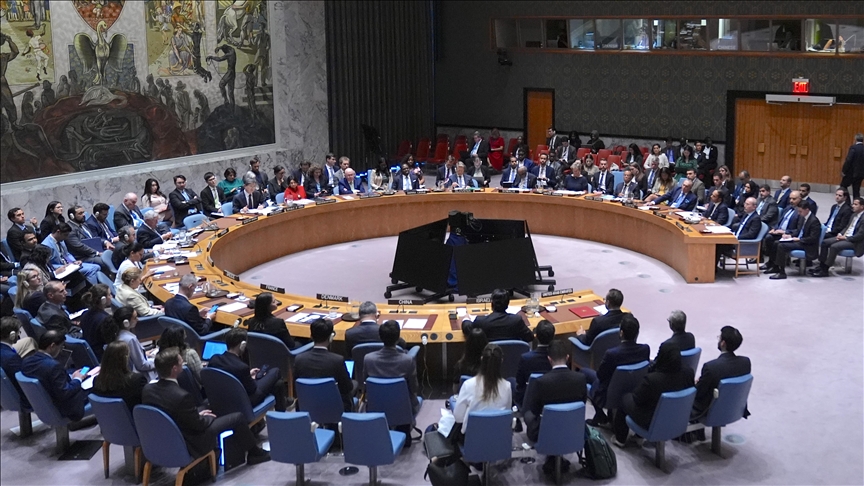
The UN Security Council is set to convene an emergency session to discuss Israel’s recognition of Somaliland amid expectations that several members will criticize the move.

"The UN Security Council will convene on Monday for an urgent session following Israel's recognition of the Republic of Somaliland," Israel's Ambassador to the UN Danny Danon said on US social media company X Saturday.

"We will not shy away from political discussions," he added.

He said Israel would "continue to act responsibly and with discretion, in order to strengthen cooperation with partners who contribute to regional stability."

The move has drawn widespread criticism from countries in Africa, Middle East, as well as Türkiye, Pakistan. The Organization of Islamic Cooperation and African Union have also censured the move as a violation of Somalia's sovereignty.

Somalia, African nations denounce Israeli recognition of Somaliland

Mogadishu (AFP) – Somalia and the African Union reacted angrily Friday after Israel became the first country to formally recognise the northern region of Somaliland as an independent state.


 27/12/2025 - RFI

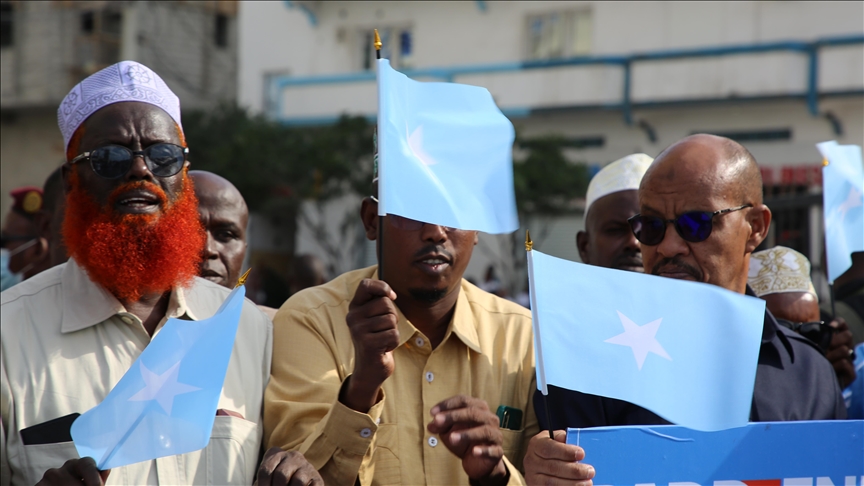
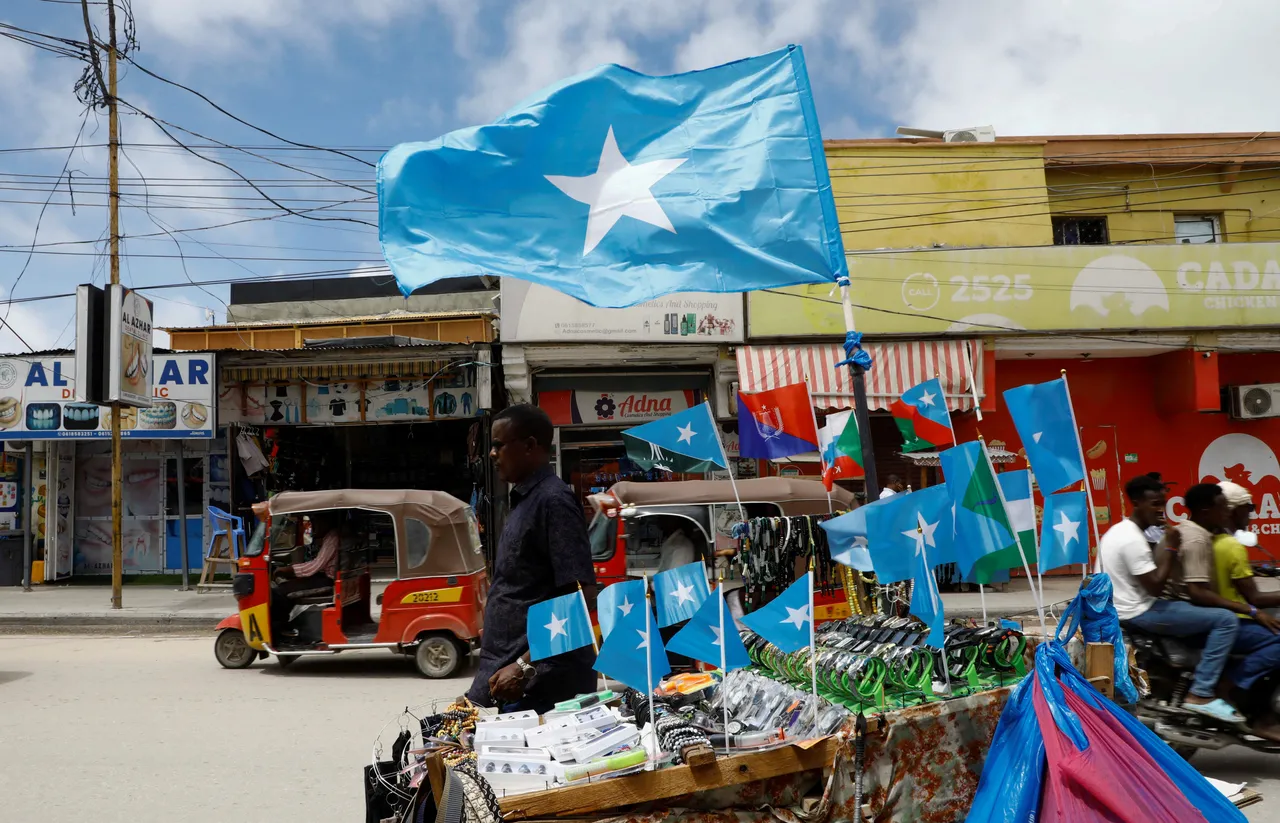
In Hargeisa, crowds took to the streets to celebrate, many carrying the flag of the breakaway state © LUIS TATO / AFP

Somaliland declared independence from Somalia in 1991 and has pushed for international recognition for decades, with president Abdirahman Mohamed Abdullahi making it a top priority since taking office last year.

Israel announced Friday that it viewed Somaliland as an "independent and sovereign state", prompting Somalia to call the decision a "deliberate attack" on its sovereignty that would undermine regional peace.

Several other countries condemned Israel's decision. The African Union (AU) rejected the move and warned that it risked "setting a dangerous precedent with far-reaching implications for peace and stability across the continent".

Somaliland "remains an integral part" of Somalia, an AU member, said the pan-African body's head Mahamoud Ali Youssouf.

Israeli Prime Minister Benjamin Netanyahu's office said the decision was "in the spirit of the Abraham Accords", referring to a series of agreements brokered by US President Donald Trump in his first term that normalised ties between Israel and several Arab nations.

Netanyahu had invited Abdullahi to visit, the Israeli leader's office said.

Asked by the New York Post newspaper whether the United States planned to also recognise Somaliland, Trump said "no".

"Does anyone know what Somaliland is, really?" he added.

With a new president, Somaliland seeks international recognition

Hailing Israel's decision as a "historic moment", Abdullahi said in a post on X that it marked the beginning of a "strategic partnership".

The Palestinian Authority rejected Israel's recognition of Somaliland.

It said on X that Israel had previously named Somaliland "as a destination for the forced displacement of our Palestinian people, particularly from the Gaza Strip", and warned against "complicity" with such a move.

In Hargeisa, the capital of Somaliland, crowds of people took to the streets to celebrate, many carrying the flag of the breakaway state, said sources.
'Overt interference'

Turkey, a close ally of Somalia, also condemned the move.

"This initiative by Israel, which aligns with its expansionist policy... constitutes overt interference in Somalia's domestic affairs", a foreign ministry statement said.

A video showed Netanyahu speaking to Abdullahi by telephone to confirm the recognition © Ariel Schalit / POOL/AFP


Egypt said its top diplomat had spoken with counterparts from Turkey, Somalia and Djibouti, who together condemned the move and emphasised "full support for the unity, sovereignty and territorial integrity of Somalia".

In a video showing Netanyahu speaking to Abdullahi by telephone, the Israeli leader said that he believed the new relationship would offer economic opportunities.

"I am very, very happy and I am very proud of this day and I want to wish you and the people of Somaliland the very, very best," Netanyahu said.

A self-proclaimed republic, Somaliland enjoys a strategic position on the Gulf of Aden and has its own money, passports and army.

But it has been diplomatically isolated since unilaterally declaring independence.
Strategic move

Israel's regional security interests may lie behind the move.

"Israel requires allies in the Red Sea region for many strategic reasons, among them the possibility of a future campaign against the Houthis," said the Institute for National Security Studies in a paper last month, referring to Yemen's Iran-backed rebels.

Israel repeatedly hit targets in Yemen after the Gaza war broke out in October 2023, in response to Houthi attacks on Israel that the rebels said were in solidarity with Palestinians in the Gaza Strip.

The Houthis have halted their attacks since a fragile truce began in Gaza in October.

Somaliland's lack of international recognition has hampered access to foreign loans, aid and investment, and the territory remains deeply impoverished.

A deal between landlocked Ethiopia and Somaliland last year to lease a stretch of coastline for a port and military base enraged Somalia.

Israel has been trying to bolster relations with countries in the Middle East and Africa.

Historic agreements struck late in Trump's first term in 2020 saw several countries including the Muslim-majority United Arab Emirates and Morocco normalise relations with Israel.

But wars that have stoked Arab anger, particularly in Gaza, have hampered recent efforts to expand ties further.

(AFP)


Arab and Islamic states reject Israel’s recognition of Somaliland


Israeli Prime Minister Benjamin Netanyahu’s office said earlier that the country formally recognized Somaliland, which declared independence from Somalia in 1991, as an “independent and sovereign state.” (AFP)

Arab News
December 28, 2025

Israel formally recognized Somaliland as an “independent and sovereign state” on Friday
Saudi Arabia on Friday expressed full support for the sovereignty, unity, and territorial integrity of Somalia

A group of foreign ministers from Arab and Islamic countries, alongside the Organisation of Islamic Cooperation (OIC), have firmly rejected Israel’s announcement of its recognition of the Somaliland region within Somalia.

In a joint statement issued on Saturday, the ministers condemned Israel’s decision, announced on December 26, warning that the move carries “serious repercussions for peace and security in the Horn of Africa and the Red Sea region” and undermines international peace and security, the Jordan News Agency reported.

The statement described the recognition as an unprecedented and flagrant violation of international law and the charter of the United Nations, which uphold the principles of state sovereignty, unity and territorial integrity, JNA added.

Israel formally recognized Somaliland as an “independent and sovereign state” and signed an agreement to establish diplomatic ties, as the region’s leader hailed its first-ever official recognition.

The ministers reaffirmed their full support for the sovereignty of Somalia, rejecting any measures that would undermine its unity or territorial integrity.

They warned that recognizing the independence of parts of states sets a dangerous precedent and poses a direct threat to international peace and security.

The statement also reiterated categorical opposition to any attempt to link the move with plans to displace the Palestinian people outside their land, stressing that such proposals are rejected “in form and substance.”

Alongside the Jordanian foreign ministry, the joint statement was issued by the foreign ministers of Egypt, Algeria, Comoros, Djibouti, The Gambia, Iran, Iraq, Kuwait, Libya, Maldives, Nigeria, Oman, Pakistan, Palestine, Qatar, Somalia, Sudan, Turkiye and Yemen, as well as the OIC.

Saudi Arabia on Friday expressed full support for the sovereignty, unity, and territorial integrity of Somalia, and expressed its rejection of the declaration of mutual recognition between Israel and Somaliland.


Israel’s recognition of Somaliland slammed across world capitals

Regional blocs join nations in condemning Israel’s move to formally recognise breakaway Somali region as independent.

A man holds a flag of Somaliland in front of the Hargeisa War Memorial monument in Hargeisa in November 2024 [File: AFP]


By Al Jazeera and News Agencies
Published On 27 Dec 2025

The Arab League, the Gulf Cooperation Council (GCC), the African Union (AU), and the Organization of Islamic Cooperation (OIC) have joined numerous countries and foreign ministers in decrying Israel’s formal recognition of the Somali breakaway region of Somaliland as an independent state.

Somaliland, a region in the Horn of Africa, declared independence from Somalia in 1991 and has pushed for international recognition for decades, with President Abdirahman Mohamed Abdullahi making it a top priority since taking office last year.

Israel announced on Friday that it viewed Somaliland as an “independent and sovereign state”, becoming the first country to make such a declaration.

The announcement prompted Somalia to call the decision a “deliberate attack” on its sovereignty that would undermine regional peace.

In a statement on Friday, the AU continental bloc rejected Israel’s move and warned that it risked “setting a dangerous precedent with far-reaching implications for peace and stability across the continent”.

The AU Commission chair, Mahmoud Ali Youssouf, said the institution “firmly rejects any initiative or action aimed at recognising Somaliland as an independent entity, recalling that Somaliland remains an integral part of the Federal Republic of Somalia”.
‘Dangerous precedent’

Arab League Secretary-General Ahmed Aboul Gheit called Israel’s action “a clear violation of international law and a flagrant infringement of the principle of the unity and sovereignty of states”.

“Any attempt to impose unilateral recognitions constitutes an unacceptable interference in Somalia’s internal affairs and sets a dangerous precedent that threatens regional and international security and stability,” he warned.

The GCC called the development “a grave violation of the principles of international law and a blatant infringement” of Somalia’s sovereignty.

“This recognition represents a dangerous precedent that will undermine the foundations of stability in the Horn of Africa region and open the door to further tensions and conflicts, contradicting regional and international efforts aimed at strengthening international peace and security in the region,” GCC Secretary-General Jasem Albudaiwi said in a statement.

The European Union said it respected Somalia’s territorial integrity and sovereignty, calling for dialogue between the Somali national government and Somaliland.

The OIC issued a joint statement together with the foreign ministers of several countries including Algeria, Comoros, Djibouti, Egypt, Gambia, Iran, Iraq, Jordan, Kuwait, Libya, Maldives, Nigeria, Oman, Pakistan, Palestine, Qatar, Saudi Arabia, Somalia, Sudan, Turkiye, and Yemen.

The group issued its “unequivocal rejection of Israel’s recognition of the ‘Somaliland’ region … given the serious repercussions of such unprecedented measure on peace and security in the Horn of Africa, the Red Sea, and its serious effects on international peace and security as a whole”.

They criticised “Israel’s full and blatant disregard to international law” and expressed full support for the sovereignty of Somalia.

The group also rejected “any potential link between such measure [Somaliland recognition] and any attempts to forcibly expel the Palestinian people out of their land”.

Earlier this year, reports emerged linking potential recognition of Somaliland to plans for ethnically cleansing Palestinians in Gaza and forcibly moving them to the African region.
Somalia demands reversal of recognition

Qatar, Iran, Saudi Arabia, Pakistan, China and Nigeria were among the other countries that condemned Israel’s move in separate statements.

The Palestinian Authority and Hamas also rejected Israel’s recognition of Somaliland.

On Friday, Somalia demanded Israel reverse its recognition of Somaliland as independent, condemning the move as an act of “aggression that will never be tolerated”.

However, Somaliland leader Abdullahi hailed Israel’s decision as a “historic moment” and said in a post on X that it marked the beginning of a “strategic partnership”.

As world leaders weighed in, Somalia’s al-Qaeda-linked armed group al-Shabab pledged on Saturday to fight any attempt by Israel “to claim or use parts of Somaliland”.

“We will not accept it, and we will fight against it,” the group that has waged a decades-long armed rebellion in the region said in a statement.
Advertisement

United States President Donald Trump also commented on the issue.

Asked by the New York Post newspaper whether Washington planned to also recognise Somaliland, Trump said “no”.

“Does anyone know what Somaliland is, really?” he added on Friday.


Iran slams Israel’s recognition of Somaliland as ‘flagrant violation’ of Somalia’s sovereignty

Tehran says move part of Israel’s broader policy to exacerbate insecurity in Red Sea and Horn of Africa

TRT/AA
Syed Zafar Mehdi 
 |27.12.2025 


TEHRAN, Iran

Iran strongly condemned on Saturday Israel’s recognition of the breakaway region of Somaliland as a “flagrant violation of Somalia’s sovereignty and territorial integrity.”

Criticizing the Israeli move as “malicious,” Foreign Ministry spokesperson Esmail Baghaei emphasized the importance of “preserving the national sovereignty, unity, and territorial integrity” of Somalia.

Baghaei asserted that the recognition aligns with Israel’s broader policy “to destabilize countries in the region and exacerbate insecurity in the Red Sea and the Horn of Africa.”

Expressing support for the firm condemnation by the Organization of Islamic Cooperation (OIC) and the African Union (AU), Baghaei called on the international community to take “decisive action” to “neutralize this expansionist and threat-creating move by the occupying regime.”

On Friday, Israel became the first country to officially recognize Somaliland, with Prime Minister Benjamin Netanyahu announcing that the two sides had signed a joint declaration establishing full diplomatic relations “in the spirit of the Abraham Accords.”

In response, Somalia’s government denounced the move as an “attack” on its sovereignty and an “unlawful action,” reaffirming Somaliland as an “inseparable” part of its territory.

The Israeli move has been widely condemned by several countries, including Türkiye, Saudi Arabia, Egypt, and Qatar.

Notably, Somalia was among the countries that severed diplomatic ties with Iran in January 2016 following a mob attack on the Saudi embassy in Tehran.

In March 2024, a year after Iran and Saudi Arabia restored diplomatic relations through a China-brokered deal, Somalia announced its readiness to mend ties with Iran.

In August of the same year, the top diplomats of Somalia and Iran met on the sidelines of the OIC summit in Jeddah and agreed to revive and deepen diplomatic relations.


Palestine reaffirms support for Somalia's unity and rejects recognition between Israel and Somaliland


27/December/2025

RAMALLAH, December 27, 2025 (WAFA) — The State of Palestine affirmed its full support for the unity, sovereignty, and territorial integrity of Somalia, and rejected any mutual recognition between Israel and the Somaliland region.

President Mahmoud Abbas expressed his firm rejection of any steps that would undermine Somali sovereignty or destabilize the country, stressing Palestine's support for Somalia's legitimate state institutions and its rejection of any attempts to impose parallel entities that contradict the unity of the Somali state.

President Abbas also praised the Arab and fraternal positions rejecting this move, which he said aims at desperate attempts to displace Palestinians to Somalia.

Trump says not ready to follow Israel recognizing Somaliland: Report


December 27, 2025 
Middle East Monitor

US President Donald Trump said Friday he did not intend to immediately follow Israel in recognizing Somalia’s breakaway region of Somaliland as an independent country, Anadolu reports.

“Everything is under study … We’ll study it. I study a lot of things and always make great decisions and they turn out to be correct,” Trump told the New York Post in a phone interview.

“Does anyone know what Somaliland is, really?” he asked.

On Somaliland’s proposal to provide the US with access to a port on the strategically significant Gulf of Aden, Trump responded dismissively, saying: “Big deal.”

Israel on Friday became the first country to formally recognize Somaliland’s separation from Somalia, and Prime Minister Benjamin Netanyahu said he would convey the development to Trump during a planned meeting scheduled for Monday.

Speaking during a video call with Somaliland President Abdirahman Mohamed Abdullahi to mark the diplomatic move, Netanyahu said he would inform Trump of Somaliland’s interest in joining the Abraham Accords.

Trump underlined that he was not swayed by the proposal and that the upcoming talks with Netanyahu would prioritize issues related to the Gaza Strip, particularly the ceasefire he brokered in October and ongoing reconstruction efforts under a UN-approved framework

Somalia’s Al-Shabab vows to fight any Israeli use of Somaliland
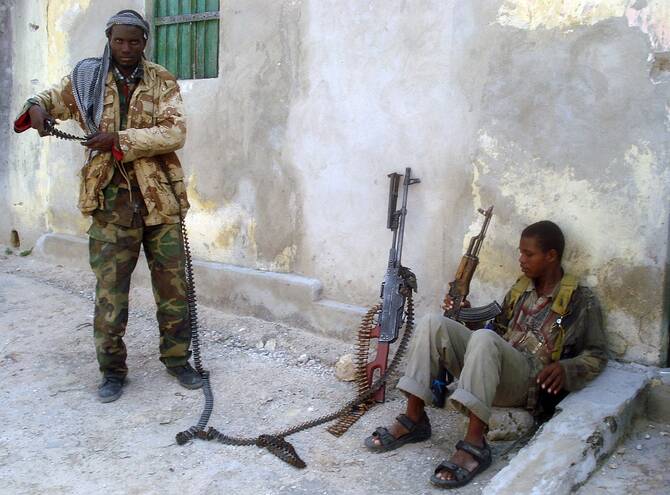

A photo dated 2010 shows an Al-Qaeda linked Shabab militant straps ammunition around his waist in Mogadishu, Somalia. (AFP)

AFP
December 27, 2025

MOGADISHU: Somalia’s Al-Qaeda-linked militant group Al-Shabab vowed Saturday to fight any attempt by Israel “to claim or use parts of Somaliland” following its recognition of the breakaway territory.

“We will not accept it, and we will fight against it,” Al-Shabab said in a statement.

It said Israel’s recognition of Somaliland as a sovereign state showed it “has decided to expand into parts of the Somali territories” to support “the apostate administration in the northwest regions.”

Pakistan slams Israel’s recognition of Somaliland as 'illegal and provocative'

"Such illegal and provocative actions constitute a flagrant violation of international law and not only threaten the peace and stability of the brotherly country of Somalia, but also that of the entire region," says Foreign Ministry.
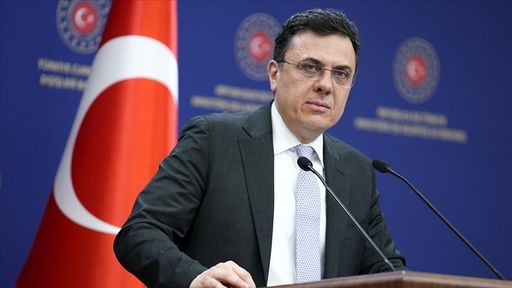
Islamabad also expressed its "complete support for the sovereignty, unity, and territorial integrity" of Somalia. / Reuters

Pakistan condemned Israel’s recognition of the breakaway Somaliland region, calling the move "provocative and illegal."

Islamabad "strongly condemns any attempts to undermine the sovereignty, unity, and territorial integrity of Somalia" and rejects Israel recognising the independence of "the so-called Somaliland region of the Federal Republic of Somalia," said a statement from the Foreign Ministry on Saturday.

"Such illegal and provocative actions constitute a flagrant violation of international law and not only threaten the peace and stability of the brotherly country of Somalia, but also that of the entire region," the ministry added.

The ministry urged the international community to step in to reject any such actions and "prevent and deter Israel from undermining the ongoing efforts for peace and stability in the broader region."


RelatedTRT World - Türkiye denounces Israel's Somaliland recognition as unlawful, destabilising


Islamabad also expressed its "complete support for the sovereignty, unity, and territorial integrity" of Somalia.

The remarks follow an announcement on Thursday, in which Israel became the first UN member state to formally recognise Somaliland as an independent state.

Israeli Prime Minister Benjamin Netanyahu said the move was in the “spirit of the Abraham Accords,” citing cooperation in agriculture, technology, and regional security.

Somaliland declared independence from Somalia in 1991 and has operated as a de facto state for more than three decades but had not previously received formal recognition from any UN member state.
In Mizoram, Programmes for Myanmar Refugees Struggle to Survive Amid US Aid Cuts


The Trump administration’s decision to abruptly end US support for refugees is dramatically reshaping the humanitarian landscape along the Indo-Myanmar border.


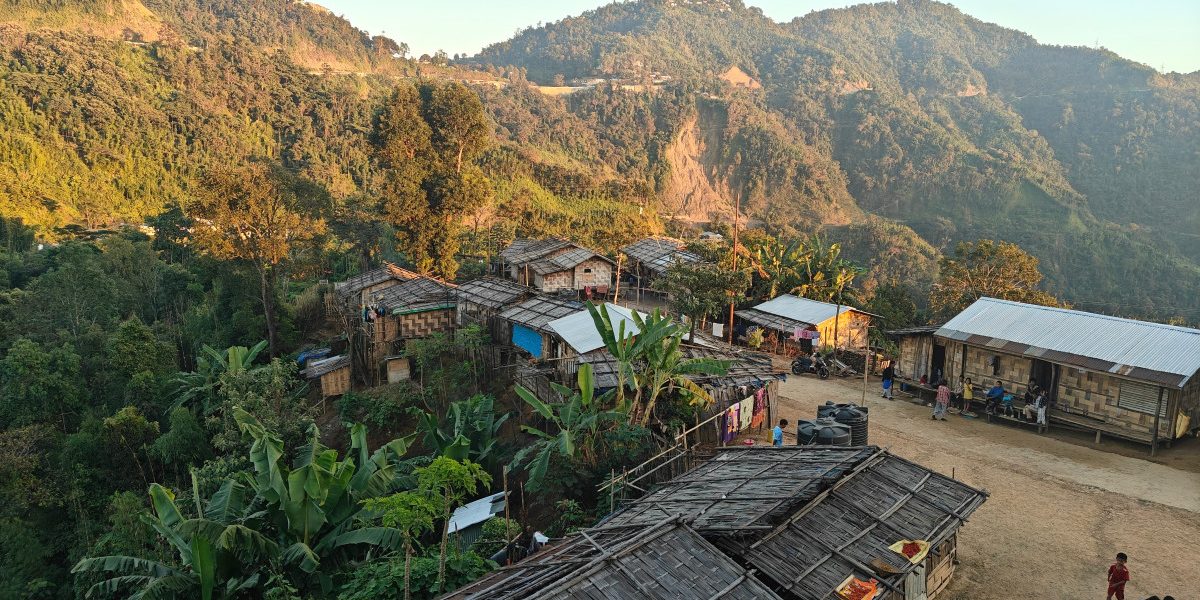
A view of Chandmari Kanan camp, located approximately 2 km from Lawngtlai. 
Photo: Atreyee Dhar


LONG READ

Until Myanmar’s military seized power in February 2021, Lianbawih (name changed) led a comfortable life as a doctor in Yangon. But because he was strongly opposed to the takeover, he decided to join the Civil Disobedience Movement against the newly installed regime. He remained in Yangon, working under a pseudonym at a private hospital, but was forced to hide every time junta soldiers arrived to carry out one of their routine inspections.

Finally, after three years of living in the shadows, he decided it was time to leave. This came in February 2024, as the junta imposed conscription on men aged 18 to 35 and women aged 18 to 27.

“The letter calling for my mandatory service came just a week after I left Yangon,” said Lianbawih, 33, who asked that only his first name be used for safety reasons.

He fled to Mizoram, a state in India’s remote Northeast bordering Chin State. There he joined an organisation—which he did not want to be identified for security reasons—that provides free consultations and medicines to refugees. He also worked at a clinic offering free check-ups three times a week.

But the clinic was forced to shut down this year following cuts to the United States Agency for International Development (USAID) by the administration of President Donald Trump. The agency has long been a core funder of projects on both sides of the border.

In Rihkhawdar, a border town in Chin State controlled by resistance forces, around 70 percent of USAID-linked programs at the Rih Hospital have been indefinitely suspended. The hospital serves residents of more than 100 villages across the Chin Hills as well as refugees arriving from Mizoram.

Dr. Lalzauva, one of 11 doctors at the hospital, told Myanmar Now that they were preparing to shut down a crucial project that provides free healthcare and medicine to pregnant women and children under the age of five. “All our funding has stalled since Trump came to power,” he said.

Further complicating the situation is the tightening of movement along the Indo-Myanmar border by the Assam Rifles (India’s paramilitary force operating in border areas) amid plans to put up a fence between the two countries.

“People in Chin State cannot easily cross into India to get treatment,” said Dr. Lalzauva, adding that the junta has also heavily restricted access to other parts of Myanmar. “So the majority of the population depend on our hospital.”

First established in 2001, the hospital’s operations first came to a grinding halt after the 2021 coup. It reopened on March 15, 2023, after anti-junta resistance forces captured the area from the military. “We were so happy that we could re-open. But now we are facing money troubles,” Dr. Lalzauva said.

Non-profit network supporting refugees crumbles

Soon after assuming office in January, Trump issued an executive order pausing all US foreign aid for 90 days, reflecting his long-held view that the country spends too much on international assistance. His administration soon pushed for deeper cuts: a roughly 92 percent reduction in USAID funding that would remove nearly US$60 billion from aid programs worldwide, according to the State Department.

In 2024, the United States spent $128.6 million for humanitarian initiatives in Myanmar and an additional $111 million in foreign assistance that supported education, agriculture and governance programs in the war-torn country, according to ReliefWeb.

The agency was projected to deliver $259 million in aid to Myanmar in 2025, with about $172 million, or 72 percent, allocated to humanitarian aid and social programs. But the bulk of that funding has been halted, in a major blow to local providers of basic services to vulnerable populations. If the termination of this assistance continues throughout Trump’s second term, Myanmar stands to lose close to $1.06 billion in American financial aid by 2029, deepening the humanitarian crisis in the country and weakening US influence across the region.

On the Indian side of the border, these cuts have crippled an entire ecosystem of nongovernmental organisations (NGOs) supporting refugees, including those not directly funded by the US government.

Even groups that get most of their support from private donors, like Medecins Sans Frontiers (MSF), or Doctors Without Borders, are impacted by the sharp decline in USAID funding because of the effect of these cuts on the humanitarian system as a whole.

“For example, when food aid is cut, MSF’s clinics are filled with malnourished children. When shelter programs are cut, MSF does not have anywhere to refer vulnerable patients after they’re discharged from the hospital,” the group said in a statement.

In Mizoram, MSF provides health care to Myanmar refugees, particularly in border areas like Zokhawthar and Lawngtlai District, offering specialist care, running clinics, and distributing aid while also addressing broader health gaps for vulnerable groups in India.


A view of Chandmari Kanan camp, located approximately 2 km from Lawngtlai.
 Photo: Atreyee Dhar

Dr. Rodinga, a spokesperson for Myanmar’s parallel National Unity Government (NUG), told Myanmar Now that USAID cuts have severely impacted healthcare along the India-Myanmar border. He noted that the agency provided substantial support to organisations like the Chin Health Organization and the Chin Human Rights Organisation, both of which have played a key role in supporting refugees in Mizoram and Myanmar’s Chin State.

“In India, the biggest impact is on the health of refugees,” he said.

USAID funded two major health projects in Mizoram—one implemented by Jhpiego, an international non-profit health organisation affiliated with Johns Hopkins University, and another centred on tuberculosis surveillance and community mobilisation, run by Piramal Swasthya, a not-for-profit public health organisation supported by the Piramal Group, an Indian conglomerate with interests in healthcare and financial services.

Major projects under Jhpiego in Mizoram have been shut down, with only a few initiatives continuing, after John Hopkins University scaled back USAID-supported programs following US federal funding cuts. Piramal Swasthya also closed its Mizoram project after the withdrawal of donor funding. Attempts to contact Jhpiego officials in Mizoram were unsuccessful, and the report will be updated once a response is received.

Lalbiakengi Chawhte, the state programme coordinator for Piramal Swasthya, told Myanmar Now that the TB project began in January 2023 and was closed in February 2025, just a month after Trump assumed office.

“Our focus was on tuberculosis, and we covered eight districts in Mizoram. With the stoppage of USAID funding, our entire staff of 52 people were laid off, and our work came to an abrupt halt,” she said.


Reduced rations, inflation hits refugees

When Hrea Thlarea, 46, fled military violence with his wife and four children in January 2022, he sold all the furniture in his carpentry workshop for 800,000 kyat ($380) to hire an SUV to the Indian border. Now, he lives in a refugee camp atop a hill near Champhai in Mizoram, where diminishing international aid has forced families like his to choose between basic necessities.

“In 2022, organisations such as Zoram Entu Pawl, ADRA [the Adventist Development and Relief Agency] and Action Aid would frequently visit,” he said, referring to the relief groups that once brought truckloads of supplies at least twice a month. “Only ADRA visits us now, and that’s just once a year.”

The sharp decline in assistance reflects a broader crisis rippling through refugee camps along the Indo-Myanmar border, where cuts to USAID are worsening an already dire humanitarian crisis of dwindling ration supplies and almost no regular income sources.

In March, the United Nations refugee agency UNHCR announced it had been forced to freeze $300 million in planned activities worldwide following the elimination of USAID programmes. From 2020 through 2024, the US contributed nearly $10 billion to the agency, making it one of the top three donors. That funding included $75 million in flexible reserves, which allowed the agency to deploy resources for crisis response within 72 hours.

In Asia and the Pacific, expenditure fell to $478 million in 2024, a decrease of 17 percent from $575 million in 2023, according to the agency’s global report. “Brutal funding cuts in the humanitarian sector are putting millions of lives at risk,” Filippo Grandi, the UN high commissioner for refugees, said in a statement at the time. “The consequences for people fleeing danger will be immediate and devastating.”

The impact on the ground was swift. The one time ADRA visited Thlarea’s camp in 2025, they brought two kilograms of rice, four kilograms of soybeans, a kilogram of sugar and four packets of oil per family—a fraction of what was once provided.

He supports his family by working as a day labourer, clearing fields during harvest season or assisting the forest department, earning him Rs 500 to 600 (roughly $7) a day. He sometimes buys potatoes from local vendors and resells them in the camp for extra income.

“Now I have to spend my daily wage to buy the ration on my own,” he said. “I cannot spend on meat. We also have to spend a lot on charcoal to boil and grill our food.”


Hrea Thlarea, a former carpenter from Lungpui, now sheltering at Zote hostel camp. Photo: Atreyee Dhar

An employee working in one of the few non-profits still operating along the border said that while her organisation had previously been supplying dry food rations, November marked the final month of distribution.

“Earlier, we implemented projects across several districts in Mizoram, supporting both refugee and host communities. However, after Donald Trump came to power, continuing these activities became impossible,” she said.

The NGO had been working in several districts, including Aizawl, Siaha, and Lawngtlai, but this year its operations were scaled down to Champhai district alone, where it targeted beneficiaries with health and sanitary kits along with dry food rations.

The dry food rations included rice, lentils, and chickpeas. “From December, we can no longer continue the distribution of dry food rations,” she added.
Operations scale down, staff laid off

Several local NGOs working along the border told Myanmar Now that they relied on annual grants from UNHCR to support refugee-related work. But cuts to UNHCR funding from USAID have significantly reduced their resources, forcing some organisations to halt operations or scale back relief efforts considerably.

UNHCR works with partner organisations, including ADRA and Action Aid, to assist Myanmar refugees in Mizoram. Rama Dwivedi, a spokesperson for the UNHCR in India, said she was unable to provide exact data on the situation in the state because the agency doesn’t have an operational presence in the Northeast. However, she confirmed that its operations in India have been significantly affected by global funding shortfalls.

In 2025, UNHCR needed $17.3 million to protect and assist forcibly displaced and stateless people in India, she said, but as of the end of November, only 51 percent had been funded.

“Like many other international organisations, UNHCR is facing a severe global funding crisis and has been forced to re-prioritise and downsize activities,” she said.

The downscaling of projects has led directly to job cuts at local non-profits working on the ground.

Myanmar Now spoke with former employees of NGOs that had worked on refugee projects along the Indo-Myanmar border, who were laid off following the funding cuts. All requested anonymity because of security concerns.

Aid workers providing assistance to refugees from Myanmar say discussing the current situation is sensitive because of restrictions under India’s Foreign Contribution Regulation Act (FCRA), which imposes strict limits on their activities.

“It is difficult to speak to the media because the FCRA does not allow NGOs to support non-nationals. Unlike in other countries, we cannot publicly discuss the impact of these cuts because whatever work is left could be stopped as a result,” one former NGO employee told Myanmar Now.

Moreover, funding has become increasingly political since, he added, “we are part of an indirect proxy war between the countries surrounding Myanmar”—referring to India and China, whose strategic rivalry is playing out through political influence. Though refugees have been granted safe sanctuary in Mizoram, they are not formally recognised as such since India is not a signatory to international treaties to protect refugees.

Another NGO employee who still had their job at a non-profit in Mizoram said the effects of the aid freeze will be felt next year, as the UNHCR-funded project relies heavily on USAID.

“We’ve been told the scale of programming will be smaller next year,” said the employee, fearing their job could be next in line.

The employee added that the US is not the only country that has changed its stance. European governments, once consistent contributors, no longer view India as a priority for aid. The prolonged conflict in Myanmar, combined with global humanitarian crises, has prompted many donors to reassess their strategies.


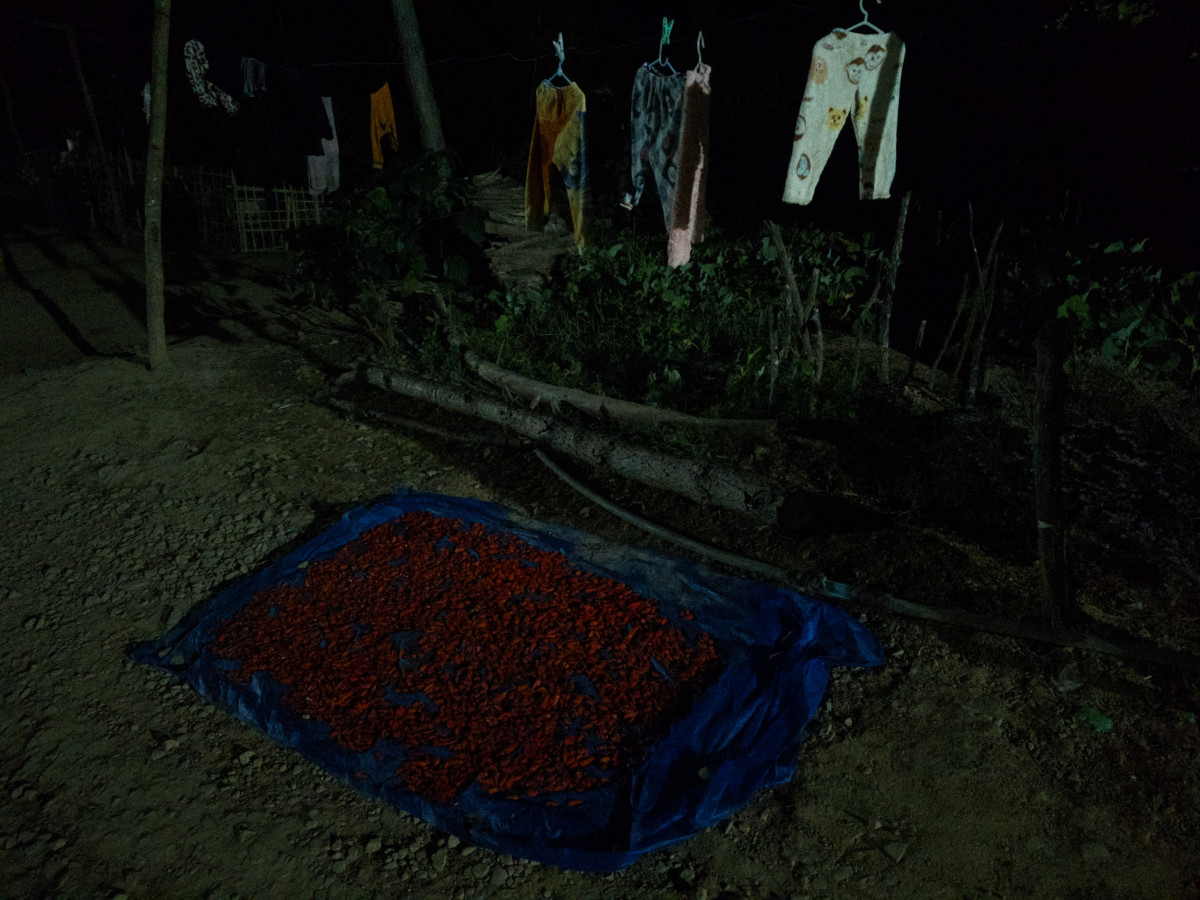
Laundry and chillies laid out to dry at Zote hostel camp. Photo: Atreyee Dhar

A former NGO worker who was laid off due to the USAID cuts agreed with this assessment of the current situation.

“Other donors, such as the EU and the German government, have also reduced their budgets as part of wider austerity measures. Development aid is no longer a priority for many foreign governments,” he said, asking to not be identified.

While the non-profit has not yet been informed whether food distributions will be reduced, the employee said current trends suggest cuts are likely.

“Some families in Aizawl camps have already gone back,” the employee said, noting that approximately 80 percent of the organisation’s work in Mizoram focuses on refugee programsme.
Federal funding challenges

As if funding drying up was not bad enough, local stakeholders alleged that the channelling of funds due to pressure from the federal Indian government has further complicated the situation.

Ruata, who is part of the Zo Indigenous Forum, a local advocacy group, claimed that a federal ministry had blocked the UNHCR funds for refugees. “This is because India is not a signatory to the 1951 Refugee Convention,” he said.

However, when Myanmar Now reached out to UNHCR India inquiring whether the central government had interfered with them releasing grants to their partner organisations in Mizoram, they refused to directly address the claim.

Instead, the UNHCR India spokesperson, Rama Dwivedi, said: “UNHCR operates in India under its mandate and in coordination with the Government of India. Financial arrangements with partners comply with national regulations. UNHCR engages with authorities to ensure that the assistance reaches those in need within the framework of Indian law.”

But despite the lack of obligations under any treaty, New Delhi has reportedly sent funds to Mizoram—one of India’s poorest states in terms of gross domestic product, and heavily dependent on central funding—to help with refugee aid. Last year, Mizoram’s Home Minister K. Sapdanga shared with the legislative assembly that New Delhi had allocated Rs 80 million (around $880,000) for refugee-related support, of which 50 million has not yet been used. He informed the assembly that “the [Rs 30 million] received during the previous administration was utilised for various relief efforts, including support for refugee camps, humanitarian aid for Myanmar nationals, and legal awareness programs.” The remaining Rs 50 million was earmarked for future relief measures, he added.

A senior official from the state Home Department told Myanmar Now it had received Rs 50 million for the distribution of rice, but could not provide specific dates or other details regarding the allocation. Details relating to central funds for humanitarian aid for refugees in Mizoram was sought under India’s Right to Information Act, but no response had been received at the time of reporting. This story will be updated as and when we receive a response.

While Mizoram continues to extend hospitality by allowing them to remain in the state, refugees cannot obtain identification documents that would enable them to travel freely or apply for formal employment. As a result, most are restricted to irregular, low-paying work—which is difficult to find in a sparsely populated state—and remain heavily dependent on NGO and international assistance for survival.
Women and children worst affected

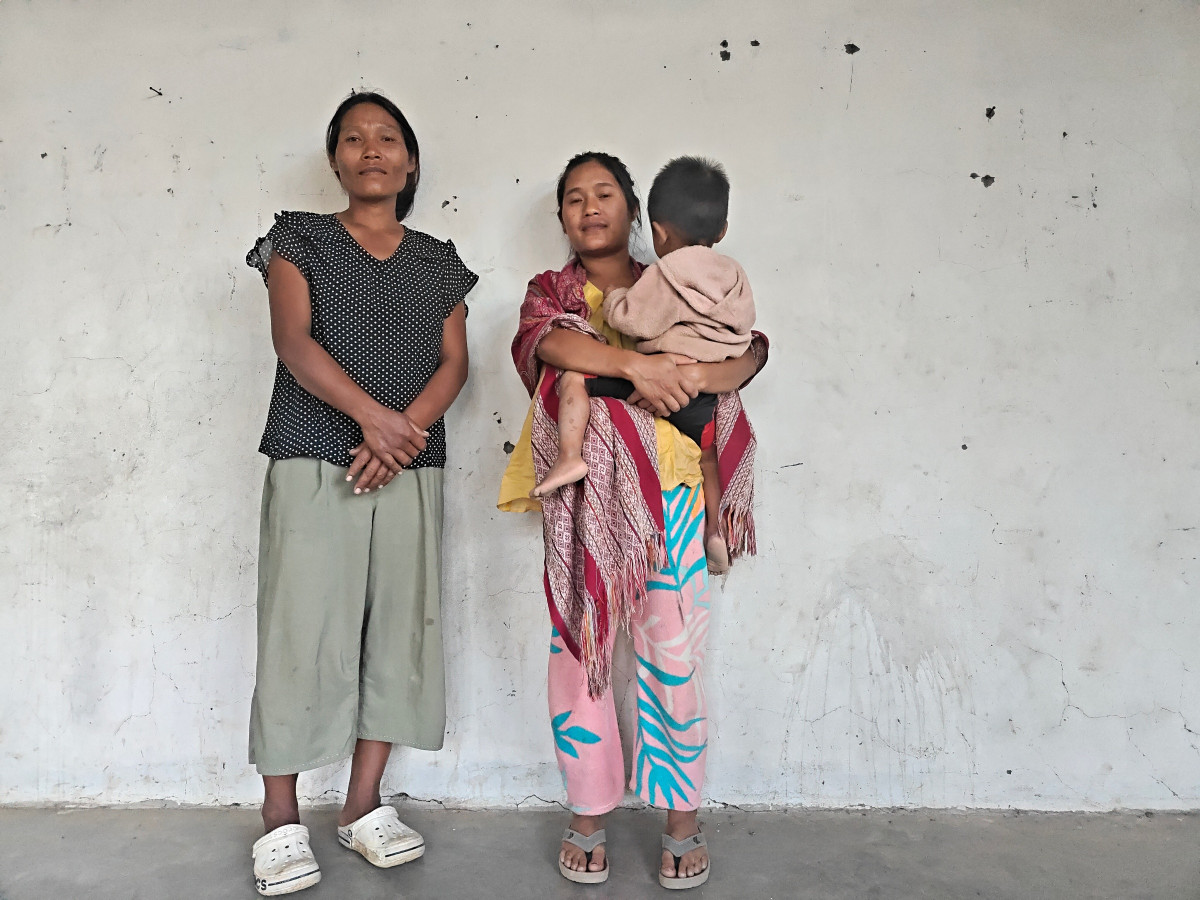
Engmen was pregnant when she crossed into India at the age of 30, fleeing violence between Chin resistance fighters and Myanmar’s military junta in 2022. The decision to seek safety at Chandmari Kanan Refugee Camp meant losing access to the low-cost maternity care that NGOs provided back home.

At first, life in the camp was manageable. Aid organisations delivered rations twice a month, and Engmen taught children in the camp, earning Rs 2,000 to 3,000 ($22-33) monthly. Her husband found seasonal work at Rs 400 to 500 ($4.40-5.50) per day. With steady food supplies, they could afford fresh fruit—apples at 400 rupees per kilogram and bananas at 200 rupees—to supplement her diet during pregnancy.

She gave birth to her first child the next year. Then the aid dried up.

Pregnant again, Engmen stopped teaching. Fruit disappeared from her meals. “Daily wage work is not regular, sometimes only three days a week,” she said. “Apples and bananas are essential for my diet, but I cannot afford them now.”


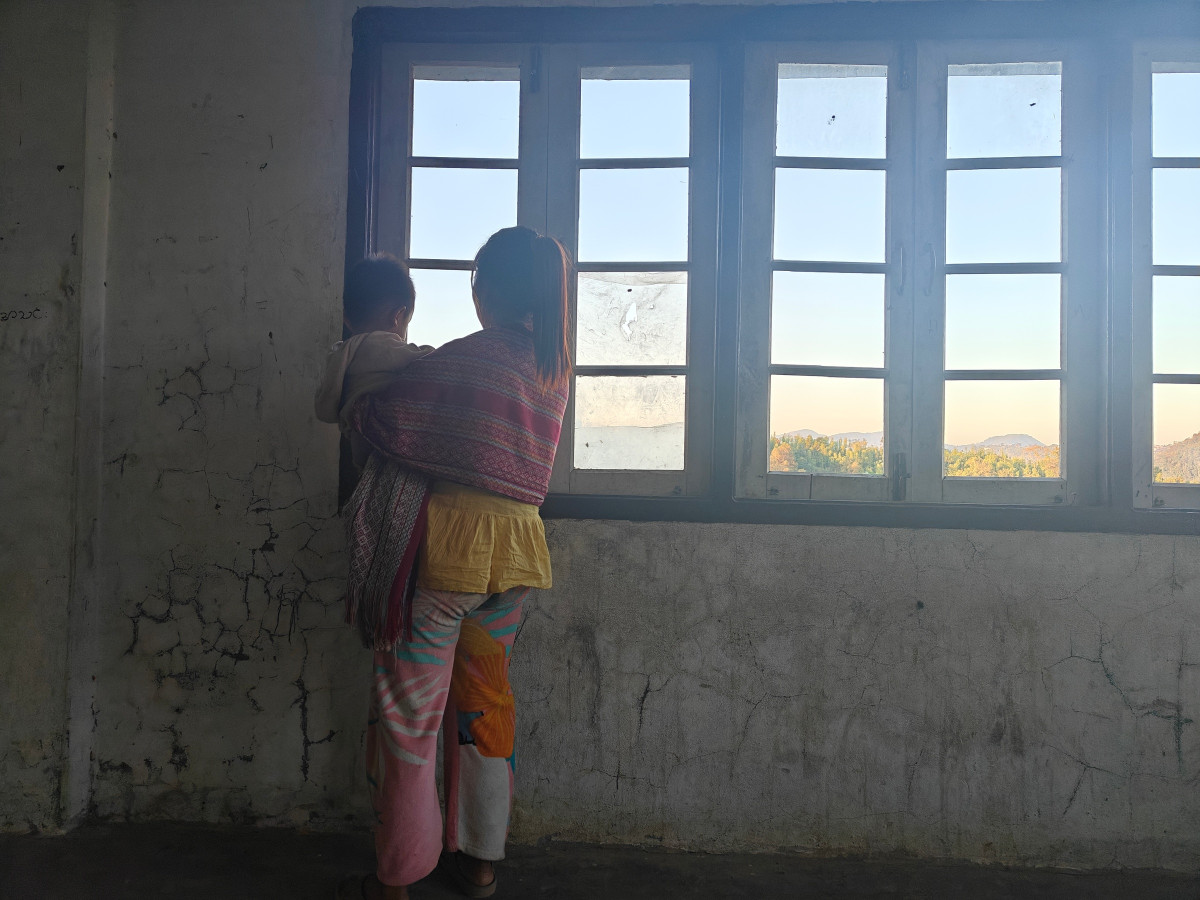
Engmen with her son at dusk, as the sun sets over the hillside. Photo: Atreyee Dhar

Before the military coup, Engmen had never worried about maternity expenses. In Chin State’s Matupi Township, civil society groups gave pregnant women cash assistance to cover medicines and nutritious food. Now, at a sub-centre in Lawngtlai, she could access free antenatal check-ups and consultations. But when it came time to deliver her second child, she had to travel to Lawngtlai Civil Hospital, where the cost reached Rs 15,000 ($165)—nearly half a year’s teaching salary.

“I wish there was some help from the NGOs to ease the financial burden,” she said.

An NGO staff member who requested anonymity said the worst affected are often the wives of resistance soldiers fighting the regime, who are grouped together in camps. With their husbands away, they are left to care for their children alone, leaving them unable to work.

Many of these women live with untreated trauma. “They have nightmares about loud large trucks coming. They struggle to sleep. They need mental and physical support, but they are not receiving it,” he said.

Education in Chin State has also been hit hard. With more than 70% of the region now outside the military control, schools are being run by resistance groups. “Teachers’ wages, children’s books and teaching aids were mostly supported through USAID,” Dr. Rodinga, the NUG spokesperson said. “All of this has stopped.”

The impact extends to refugee children in Mizoram, where the NUG estimates that at least 50,000 Myanmar refugees are currently taking shelter, though the number fluctuates as some return home when fighting stops.

“The schools for refugee children in Mizoram were also supported directly or indirectly by USAID funding,” said Dr. Rodinga.


Engmen with her son at dusk, as the sun sets over the hillside. Photo: Atreyee Dhar

Another major blow came in November, when the Trump administration announced that it would end Temporary Protected Status (TPS) for Myanmar nationals following the announcement of military-backed elections in the country, set to begin at the end of this year and continue into January 2026.

The designation expired on November 25, 2025, after the Department of Homeland Security determined that Myanmar no longer met the required conditions for TPS following a review of country conditions. TPS allows foreign nationals from countries confronting an ongoing armed conflict, environmental disaster, or extraordinary and temporary conditions a work permit in the US and protection from deportation.

“We have done a lot of advocacy with the Trump administration,” said Dr. Rodinga, who has been living in the US for several years now, following a brief period spent in India in the early 2000s. The NUG’s deputy foreign minister in Washington, along with its task force in the United States, has been lobbying lawmakers and organising consultations with Burmese intellectuals abroad.

But Dr. Rodinga said they have not seen much progress so far. Moreover, the administration has also halted asylum and citizenship processing and extended immigration bans that affect Myanmar nationals—a move that would derail refugees who use neighbouring countries like India and Thailand as stop gaps to apply for asylum in the United States.

“We are trying our best, but it is still hard.”

This article was co-published with Myanmar Now.
Myanmar polls open amid civil war, junta-backed party tipped to win

Button LabelListen
By Reuters
Dec 28, 2025 

Members of Myanmar's Union Election Commission (UEC) prepare a polling station during the first phase of Myanmar's general election in Yangon, Dec. 28. AFP-Yonhap

YANGON, Myanmar — Overshadowed by civil war and doubts about the credibility of the polls, voters in Myanmar were casting their ballots in a general election starting on Sunday, the first since a military coup toppled the last civilian government in 2021.

The junta that has since ruled Myanmar says the vote is a chance for a fresh start politically and economically for the impoverished Southeast Asian nation.

But the election has been derided by critics — including the United Nations, some Western countries and human rights groups — as an exercise that is not free, fair or credible, with anti-junta political parties not competing.


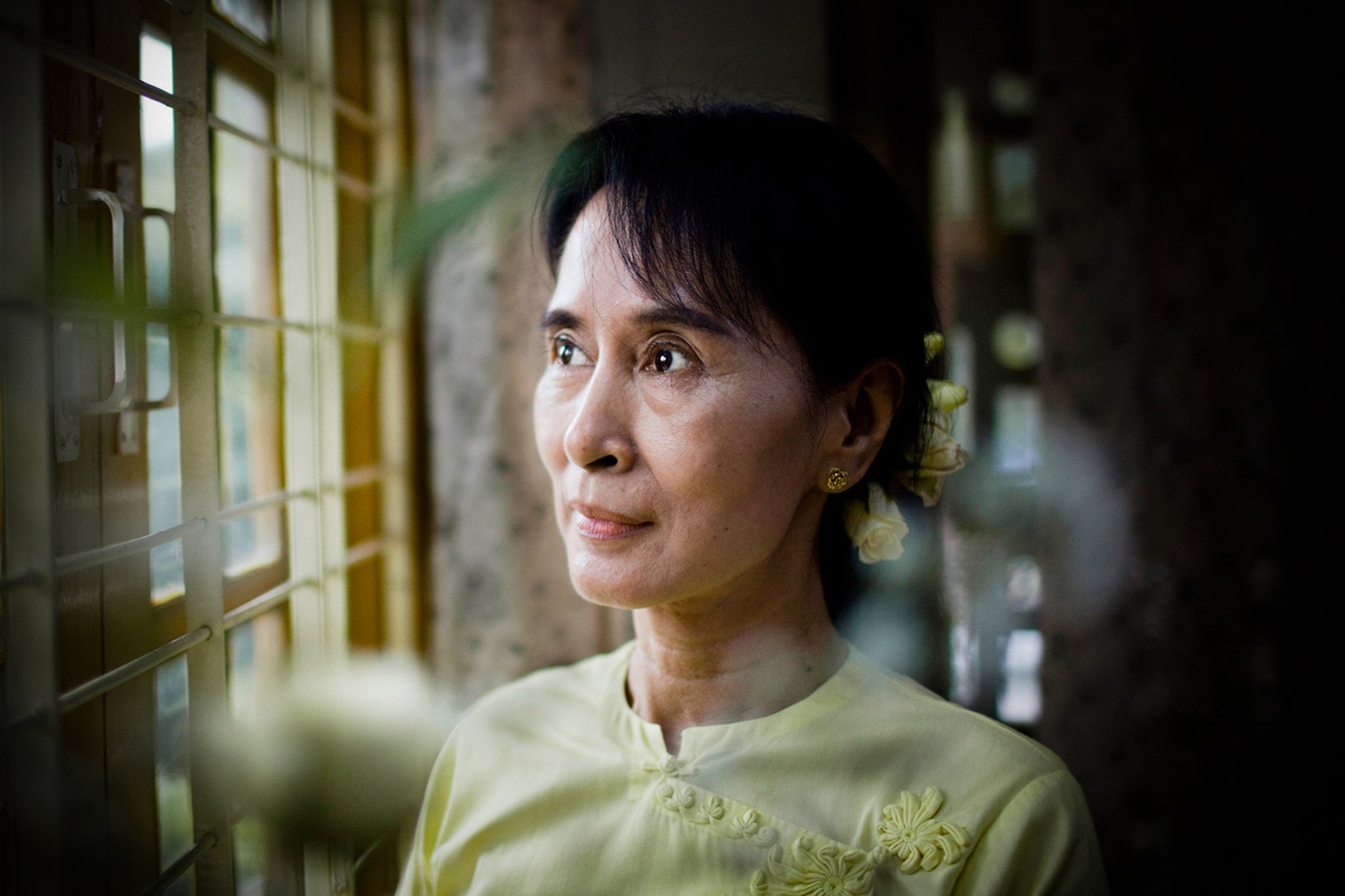
Nobel Peace Prize winner Aung San Suu Kyi, deposed by the military months after her National League for Democracy won the last general election by a landslide in 2020, remains in detention, and the political party she ‍led to power has been dissolved.

Polls to prolong junta's 'power of slavery,' academic says

Mass protests followed the ouster of Suu Kyi's party, only to be violently suppressed by the military. Many protesters then took up arms against the junta in what became a nationwide rebellion.

In this election, the military-aligned Union Solidarity and Development Party, led by retired generals and fielding one-fifth of all candidates against severely diminished competition, is set to return to power, said Lalita Hanwong, a lecturer and Myanmar expert at Thailand's Kasetsart University.

"The junta's election is designed to prolong the military's power of slavery over people," she said. "And USDP ‍and other allied parties with the military will join forces to form the next government."


Following the initial phase on Sunday, two rounds ‍of voting will be held on January 11 and January 25, covering 265 of Myanmar's 330 townships, although the junta does not have complete control of all ‌those areas as it fights in the war that has consumed the country since the coup.

Dates for counting votes and announcing election results have not been ‍declared.

With fighting still raging in parts of the country, the elections are being held in an environment of violence and repression, U.N. human rights chief Volker Turk said last week.

"There are no conditions for the exercise of the rights of freedom ‌of expression, association or peaceful assembly that allow for the free and meaningful participation of the people," said Turk, the high commissioner for human rights.

Voters wait for a polling station to open in Naypyitaw, Myanmar, Dec. 28. AP-Yonhap

Election to 'turn new page for Myanmar,' state media says

The junta maintains that the elections provide a pathway out of the conflict, pointing to previous military-backed polls, including one in 2010 that brought in a quasi-civilian government that pushed through a series of political and economic reforms.

The polls "will ‍turn a new page for Myanmar, shifting the narrative from a conflict-affected, crisis-laden country to a new chapter of hope for building peace and reconstructing the economy," an opinion piece in ‍the state-run Global New Light of Myanmar said on Saturday.

On the streets of Myanmar's largest cities, there has been none of the energy and excitement of previous election campaigns, residents said, although they did not report any coercion by the military administration to push people to vote.

In the lacklustre canvassing, the USDP was the most visible. Founded in 2010, the year it won an election boycotted by the opposition, the party ‍ran the country in concert with its military backers until 2015, when it was swept away by Suu Kyi's NLD.

The junta's attempt to establish a stable administration in the midst of an expansive conflict is fraught with risk, analysts say, and significant international recognition is unlikely for any military-controlled government — even if it has a civilian veneer.

Myanmar's weakened ⁠economy, relentless conflict and a seemingly preordained political route have left some voters dejected, including a 31-year-old man who lives in the commercial capital Yangon.

"No matter who I vote for, the USDP will win," he said, asking not to be named for fear of retribution from junta authorities. "So, I will just vote USDP."

Myanmar votes in sham election under atmosphere of fear and coercion: ‘What will change? Nothing’


With only parties vetted by the military allowed to contest Myanmar’s first election in five years, Sara Perria speaks to people in Yangon and Mandalay who are heading out to vote because they are being forced – not out of any hope for a better future


THE INDEPENDENT
Saturday 27 December 2025 


open image in galleryVolunteers with the junta-backed USDP party out campaigning in Thaketa township, Yangon on Friday morning (Sara Perria)

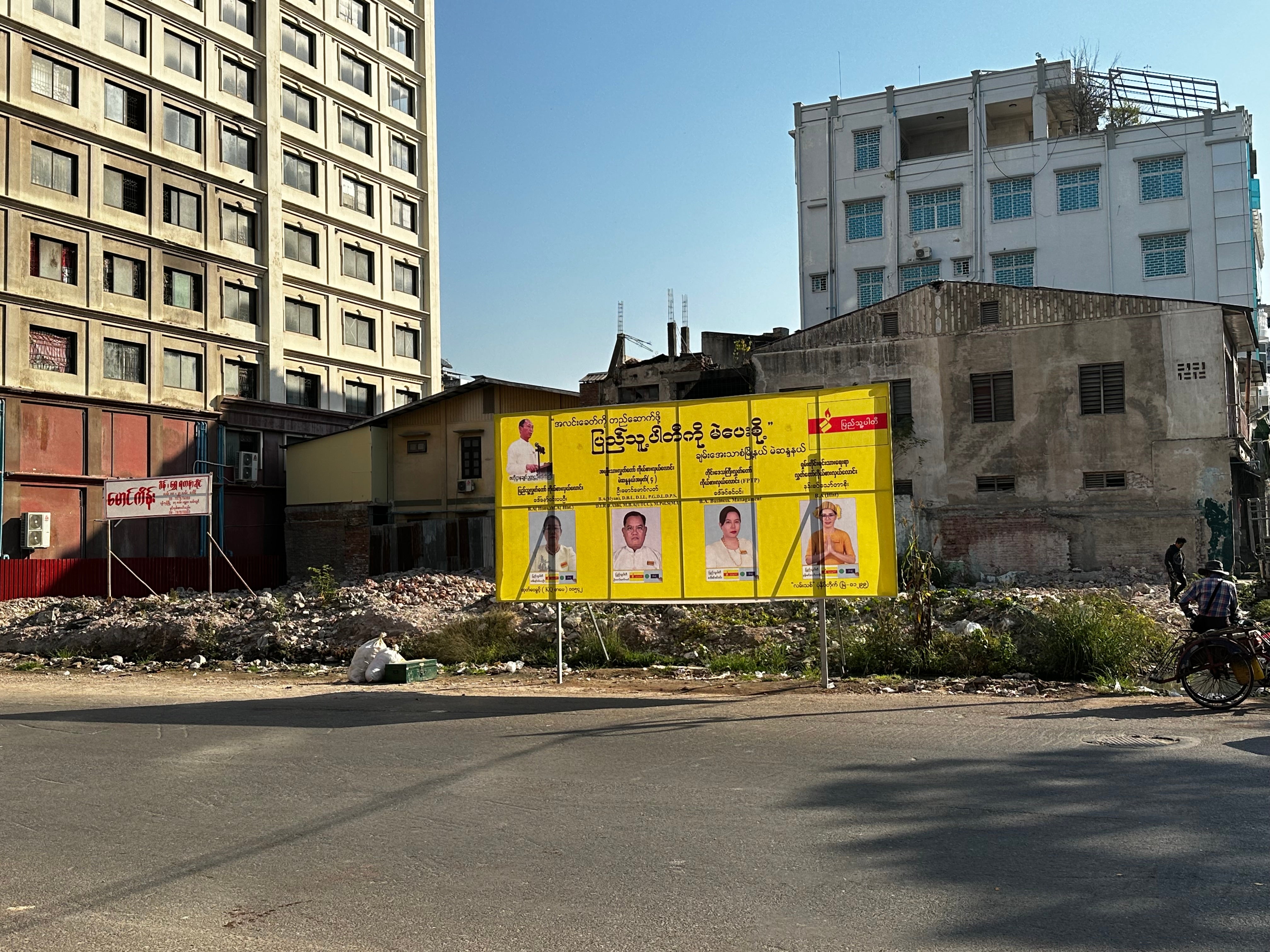
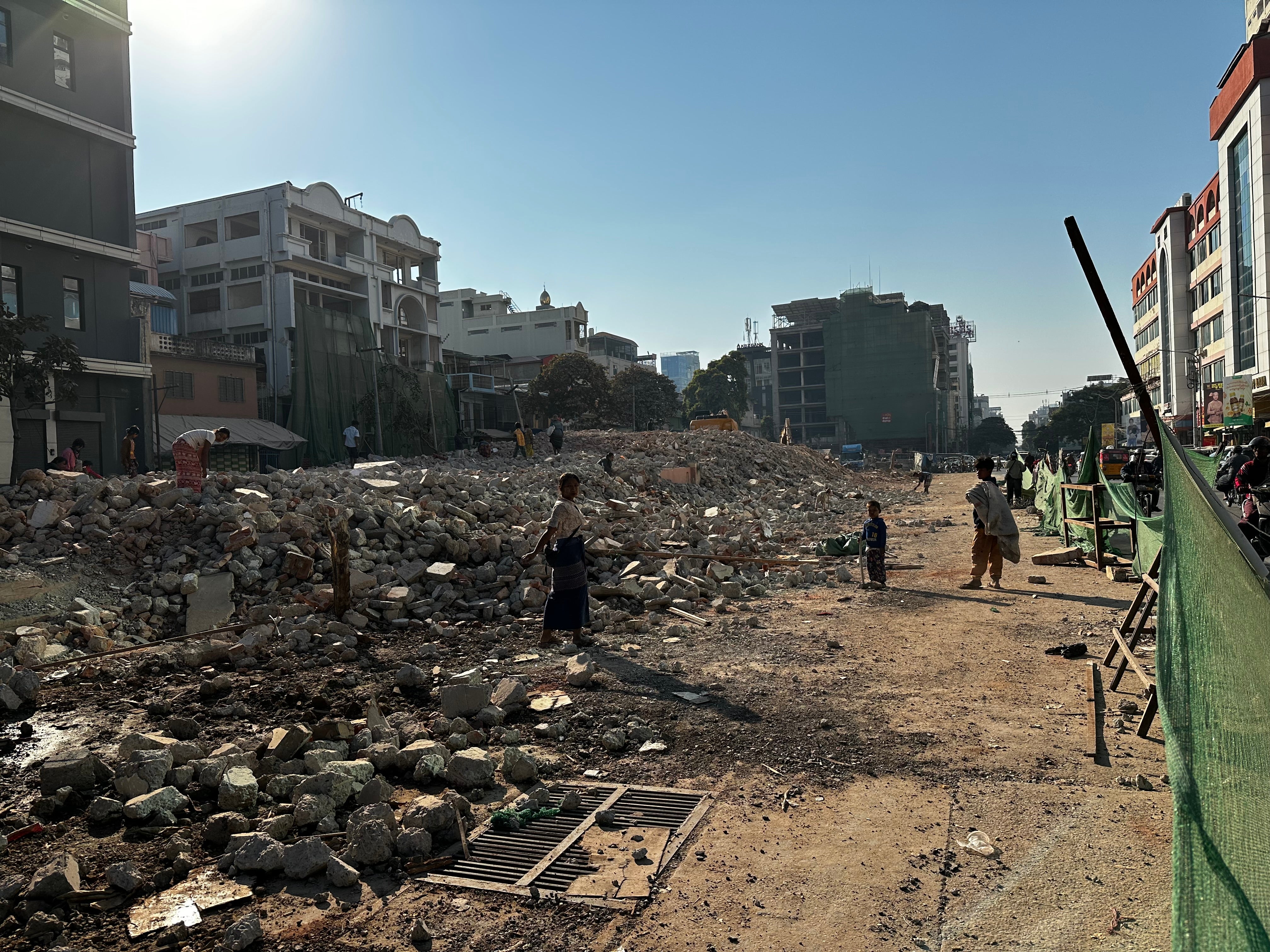
As Myanmar goes to the polls on Saturday in the first of three phases in a tightly controlled election, brightly coloured campaign posters loom over families with children still hacking a living from the rubble of buildings destroyed in Mandalay’s devastating earthquake nine months ago.

People here in Mandalay and in the commercial capital Yangon express a mix of anger and resignation over this so-called democratic exercise, in stark contrast to the enthusiasm seen in the votes of 2020 and 2015, when Aung San Suu Kyi’s National League for Democracy defeated the military’s proxy party and its allies by a landslide.

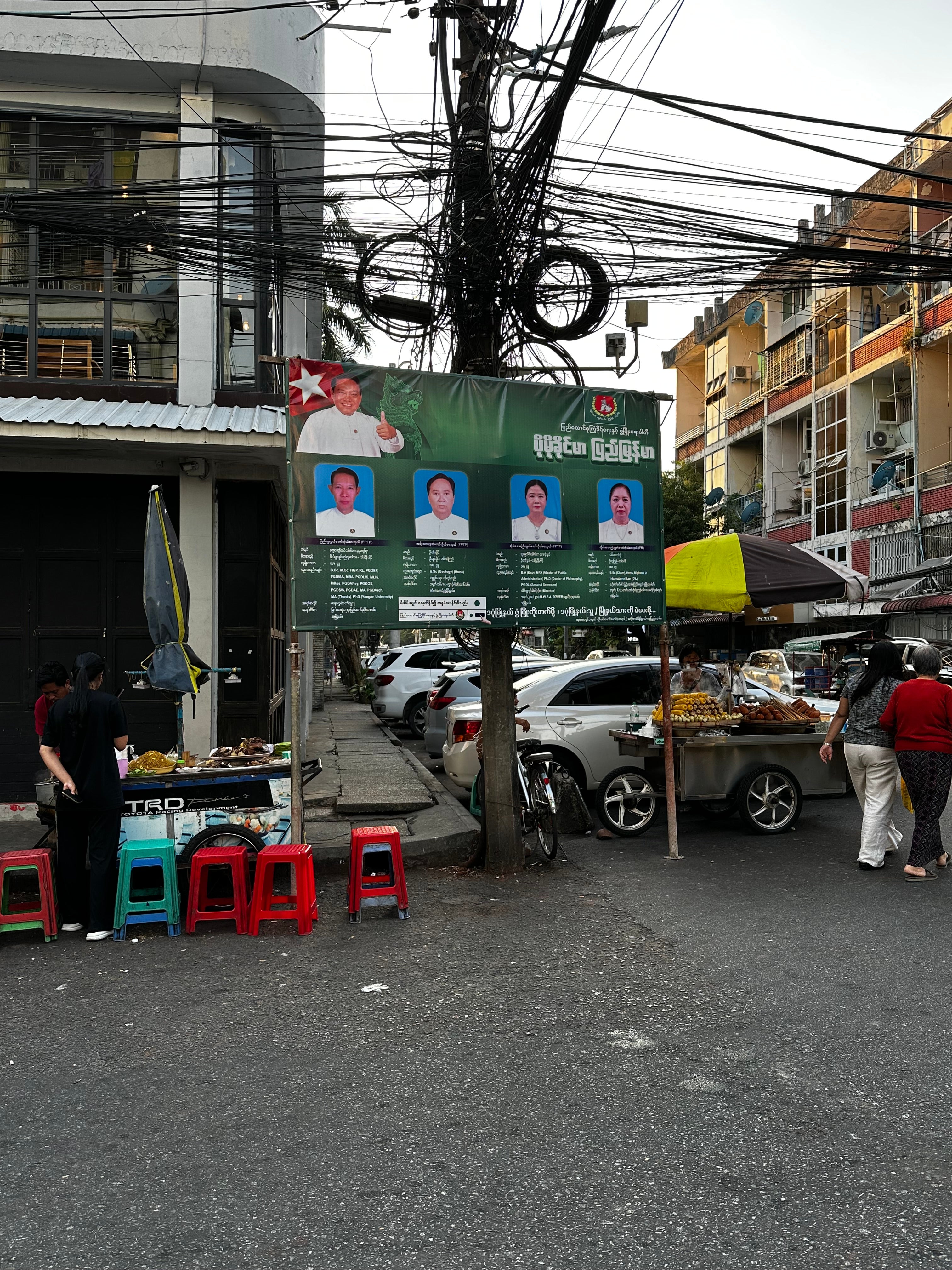
Bulldozers throw up clouds of dust over streets now packed with traffic and people, as well as the billboards advertising the few parties vetted by the junta and allowed to stand in the polls, the first since the generals ousted Aung San Suu Kyi’s elected government in a coup nearly five years ago.

The earthquake killed thousands of people and propelled Myanmar back onto the international stage, as many countries contributed to the regime’s relief efforts. But if the junta thought that spelled its reintegration into the global fold then it was mistaken; many of those same countries, as well as the resistance forces across Myanmar, have denounced these elections as far from free and fair in the midst of civil war.

“We are forced to go and vote this time. We don’t know what could happen to us if we don’t,” says Khin Nang* in Mandalay. Her brother is a political prisoner and she has to be careful. “We hope for an amnesty after the elections,” she says, as she fills a bag with avocados, oranges, biscuits, cooked meat and prawns to take to him. “Prison food is not good,” she adds.


open image in galleryAn election sign in front of a pile of rubble in Mandalay, Myanmar (Sara Perria)

“I’ll go and vote because I have to. The system is electronic for the first time and it’s not even possible to leave a blank,” says Zaw Zaw. “I don’t even know the names of the people running or their parties.”

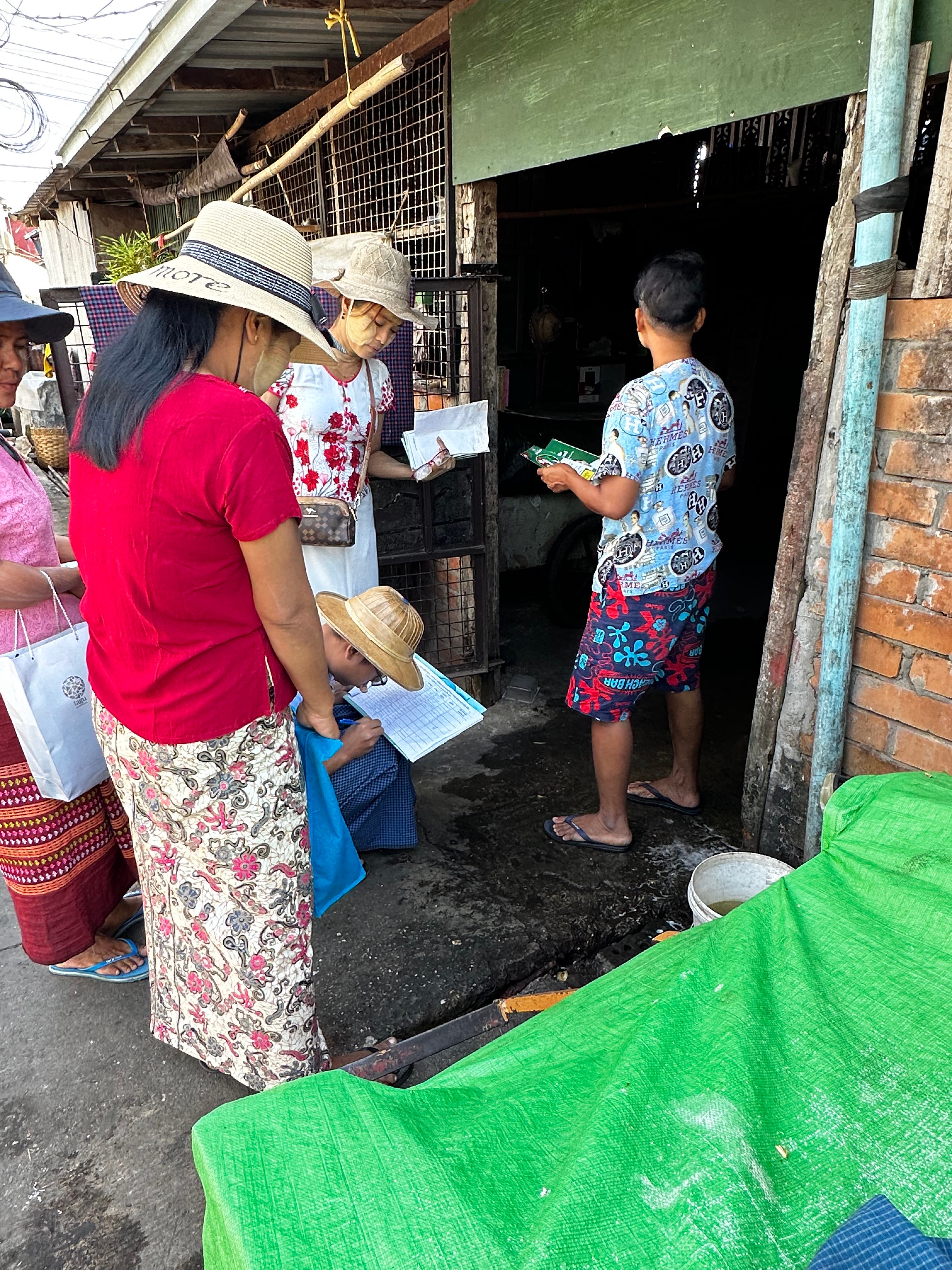
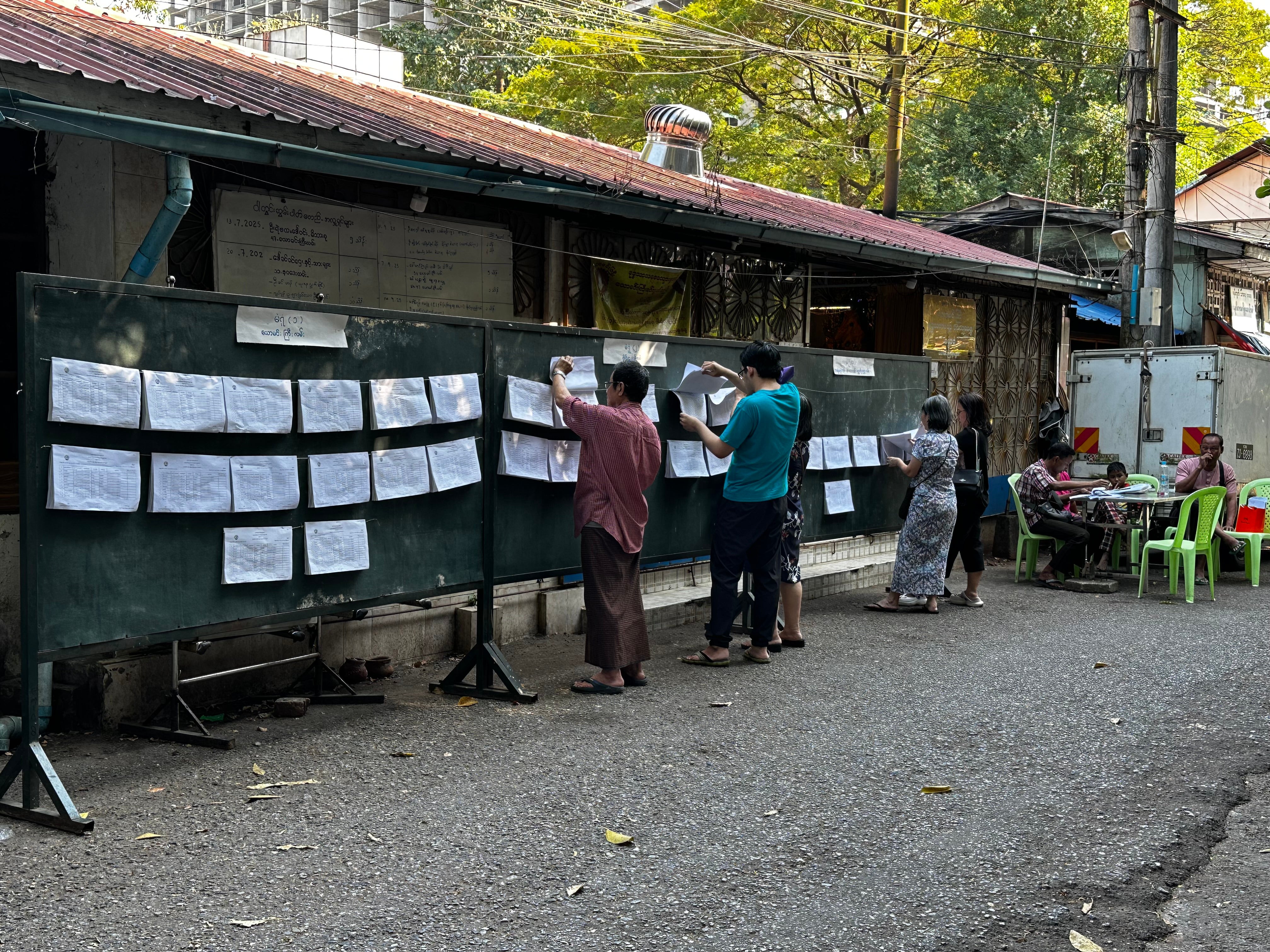
In Yangon, close to Bokyoke Aung San market, named after Aung San Suu Kyi’s father and independence leader, people check their names on electoral lists posted in public.

Many say they will vote out of fear of punishment, others openly declare they will boycott the process. A few families are divided, with some mostly older members saying they will choose the military’s political proxy, the Union Solidarity and Development Party (USDP).


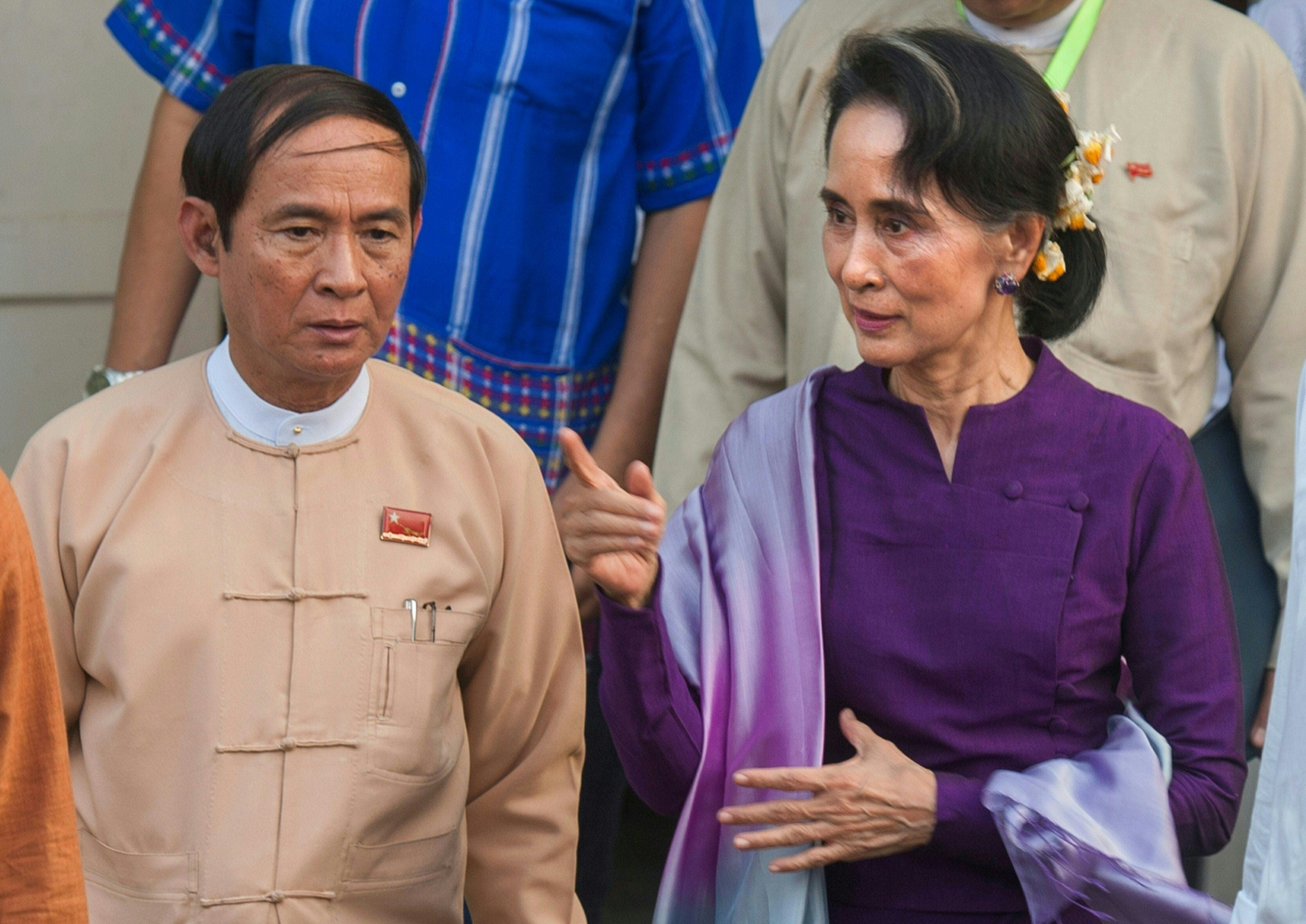
open image in galleryFile: In this photo taken on 14 March, 2016 Myanmar State Counsellor Aung San Suu Kyi (R) is accompanied by Lower House speaker Win Myint (L) after a meeting of National League for Democracy (NLD) members of parliament in Naypyidaw (AFP via Getty Images)

Myanmar’s main regime-controlled cities in the heart of the country are relatively insulated from the conflict that has raged between the military and a combination of long-standing ethnic armed groups and the People’s Defence Forces, which formed after the 2021 coup. The military has been able to hold on in the centre largely thanks to its artillery and air power, often striking civilian targets like hospitals and schools in an attempt to weaken grassroots support for resistance groups.

A heavily weakened economy somehow still functions, but soaring food prices and extreme housing difficulties weigh on the urban centres swollen with people seeking refuge from the fighting and natural disasters. While most of the country struggles, wealthier Burmese can enjoy well-stocked markets, imported food, and a night scene of live music and restaurants, five-star hotels filled with Christmas decorations and few military uniforms in sight.


open image in galleryThe USDP junta-backed party out campaigning in Thaketa township, Yangon on Friday morning (Sara Perria)

Largely thanks to direct intervention by neighbouring China and drone technology and other military support supplied by Russia, the regime has regained substantial territory it lost following an October 2023 offensive launched in Shan State in the west and in eastern Rakhine by an alliance of ethnic groups. The rebel advance was initially endorsed by China, partly with the aim of cracking down on a vast complex of scam centres, some operated by Chinese criminal gangs close to its border and targeting Chinese citizens.

In a clear demonstration of how Beijing is now firmly backing the junta, China in August hosted Myanmar’s coup leader, Senior General Min Aung Hlaing, during 80th anniversary celebrations of victory over Japan, alongside Russia’s Vladimir Putin and North Korea’s Kim Jong Un.

“There has been a turning point in the country, since China’s more explicit siding with the regime,” says a diplomat in Yangon. “They are more in control. With these elections they just want to show their strength.”

Thousands of civilians have died in the conflict – the exact toll is not known – and over 20,000 political prisoners are still held in abysmal conditions, including Aung San Suu Kyi, of whom little information emerges.


open image in galleryA family works on the site of a building destroyed by the earthquake in Mandalay (Sara Perria)

Opposition to the elections is a new crime and more than 200 people have been arrested since July for related offences, such as critical social media posts and distributing anti-vote leaflets. Jail terms over 40 years have been imposed.

Aung San Suu Kyi is serving a 27-year sentence for alleged corruption, charges which have been widely condemned as politically motivated. Her NLD and other anti-regime parties that refused to apply to register for the elections have been dissolved by the regime.

A lawyer in Bangkok familiar with Aung San Suu Kyi’s situation says she recently had dental trouble but does not receive proper medical assistance. There is some speculation that the elections will lead to an amnesty, but few believe her release is on the cards.

And while her reputation has been heavily dented outside Myanmar for defending the military’s onslaught against the Rohingya in 2017 – the subject of an Independent documentary released at this time a year ago – inside Myanmar she remains widely revered.


open image in galleryThe electoral list displayed alongside a poster in Myanmar (Sara Perria)

“We keep praying for her,” said Mya Hlaing, a teacher in Yangon, highlighting widespread affection for their former leader. “People go to Shwedagon Pagoda to pray for her on her birthday and take a red rose. Last time my sister said to be careful, it was too dangerous a political statement.”

There are, however, two factors making it less likely she could regain her pivotal role even if she survives detention: her age – she turned 80 in prison last June – and the emergence of a new generation of the Bamar majority leading the fight against the regime.

“Gen Z still respect her, but they wouldn’t listen to her,” says the lawyer.

“The country has to move on,” says Win Htet, a journalist and analyst in Yangon.


open image in galleryAn election poster on a street in Yangon, Myanmar (Sara Perria)

A garment factory owner in Yangon’s industrial zone hopes the elections will bring stability and more foreign investment. “We had to stop operations last month as all orders were cancelled because people are afraid of what’s happening.”

But few seem to believe that the junta’s installation of a nominally civilian government will put an end to a brutal civil war that involves not just ethnic armed groups concentrated in borderlands but now also the Bamar majority in the heartlands around Mandalay.

“What will change after these elections? Nothing,” replies Thiri.

* Names of people interviewed in Myanmar have been changed to protect their identities

Yvette Cooper leads push to free Aung San Suu Kyi as Myanmar elections begin

The UN has warned the military-controlled election is unfolding amid violence, intimidation and arrests. The country’s former leader has not been heard from in two years
Saturday 27 December 
THE INDEPENDENT 


Watch the trailer for Independent TV’s Aung San Suu Kyi documentary

From reproductive rights to climate change to Big Tech, The Independent is on the ground when the story is developing. Whether it's investigating the financials of Elon Musk's pro-Trump PAC or producing our latest documentary, 'The A Word', which shines a light on the American women fighting for reproductive rights, we know how important it is to parse out the facts from the messaging.

At such a critical moment in US history, we need reporters on the ground. Your donation allows us to keep sending journalists to speak to both sides of the story.

The Independent is trusted by Americans across the entire political spectrum. And unlike many other quality news outlets, we choose not to lock Americans out of our reporting and analysis with paywalls. We believe quality journalism should be available to everyone, paid for by those who can afford it.Your support makes all the difference.Read more

The UK’s foreign secretary, Yvette Cooper, is leading a new push to free Myanmar’s former leader Aung San Suu Kyi as sham elections in the country are set to begin.

The Foreign Office (FCDO) has issued a demand for Ms Suu Kyi to be released as the military junta in the country formerly known as Burma attempts to justify its rule with elections, which have excluded most of the opposition.

It comes as the UN has warned the military-controlled ballot is unfolding amid “intensified violence, intimidation and arbitrary arrests, leaving no space for free or meaningful participation”.

No political parties hostile to the junta have been permitted to run, with Ms Suu Kyi’s National League for Democracy (NLD) banned despite landslide victories in 2015 and 2020.

Ms Suu Kyi is serving a 27-year sentence in Naypyidaw, the junta’s remote capital, on charges including alleged corruption, election fraud and several other charges, which have been widely condemned as politically motivated. A lawyer in Bangkok says she recently had dental trouble but did not receive proper medical assistance.

Her family have not heard from her directly in two years and fear that she may already be dead. The 80-year-old Nobel Peace Prize winner has not been seen in public since the coup that overthrew the government in 2021.


open image in galleryAung San Suu Kyi was jailed after a series of show trials (Getty)

The Independent has been told that Ms Cooper is deeply concerned about the situation in the country and Ms Suu Kyi’s ongoing imprisonment.

An FCDO spokesperson told The Independent: “The UK government continues to condemn the detention of Aung San Suu Kyi. The military regime must release her and all those who are arbitrarily detained.


“The UK continues to shine a spotlight on Myanmar, including through our role at the UN Security Council.”

Sean Turnell, Ms Suu Kyi’s former economic policy adviser, spent 650 days in custody after the coup and branded the election “an utter sham.”


“It’s not even close to being a fair election,” he told The Independent. “I wish we were using a different word than ’election’ – a label that conveys nothing about this act of public intimidation that seeks to put lipstick on a particularly grotesque pig.

“The military are planning to stay absolutely in control. It’s very important for the international community right at the get-go to call the election out for what it is. Because this is really nothing but theatre.”

Ms Suu Kyi was sentenced to 33 years in jail after a series of show trials, later reduced to 27 years, and is being held in solitary confinement. A deeply controversial figure after refusing to speak out against her country’s extreme violence against its Rohingya Muslim minority, she is still seen by some as “Myanmar’s one great hope”.


open image in galleryMyanmar’s military junta will oversee the election (AFP/Getty)

The junta has insisted, without providing evidence, that the former leader “is in good health”, but her family fear the worst.

“She has ongoing health issues,” her son Kim Aris said in a recent interview. “Nobody has seen her in over two years.

“She hasn’t been allowed contact with the legal team, let alone the family. For all I know, she could be dead already. I don’t think she would consider these elections to be meaningful in any way.”

The first phase of the vote, scheduled for 28 December, comes amid a climate of armed conflict, mass displacement and economic collapse, the UN said.

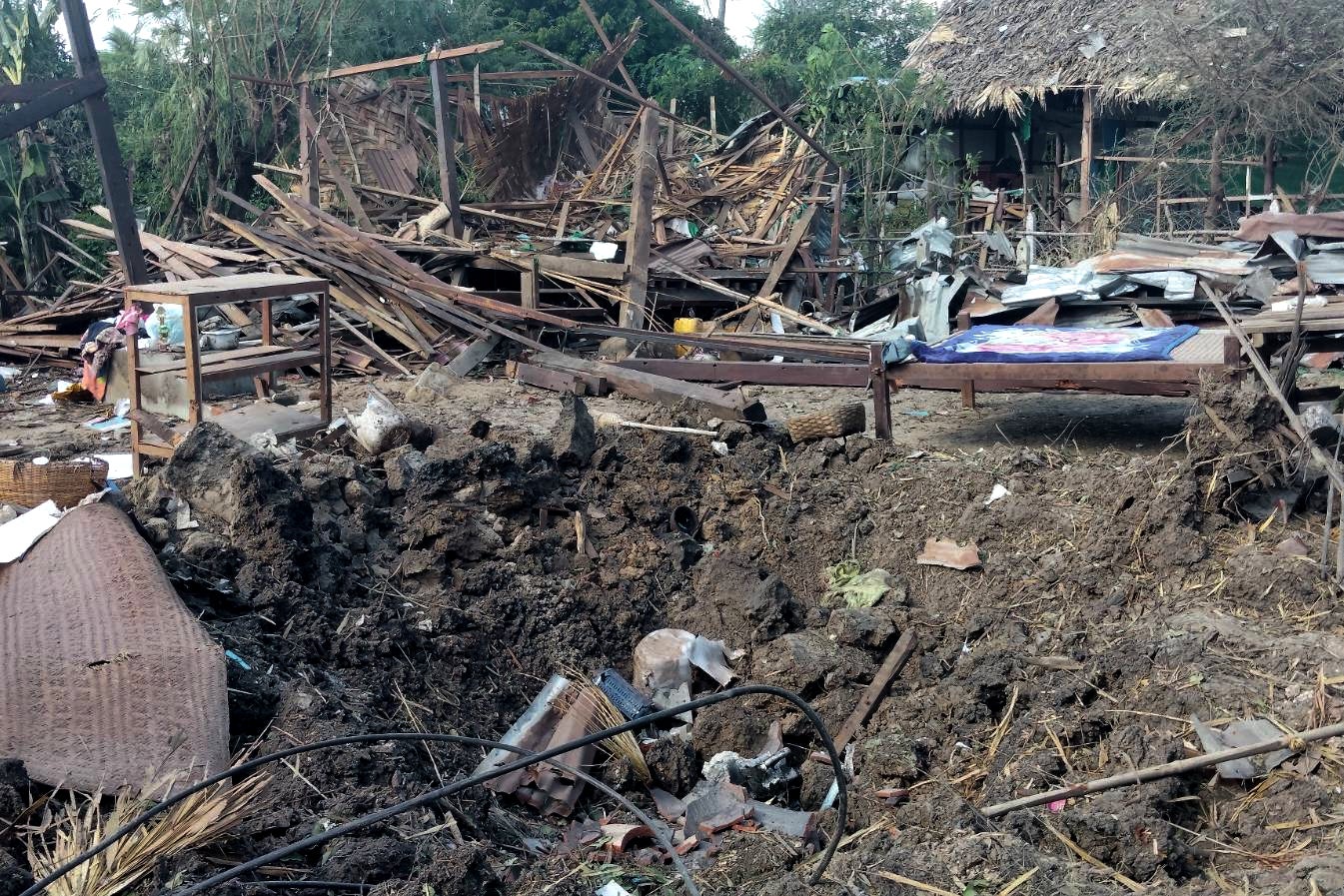
Since 18 August, when the junta announced the election dates, at least 862 airstrikes have been conducted in 121 townships. Most recently, a hospital in Rakhine state was bombed, killing more than 30 people, while 18 more were killed when bombs fell on a teashop in the central Sagaing region while they were watching a football match.


open image in galleryDebris in an area allegedly hit by an airstrike in Mayakan village, Myanmar, in early December (AP)

The official election map shows large areas in the east, west and north where no polls will be held, while the entire map is dotted with large expanses where, the junta claims, “elections will take place at a later date”.

“These elections are clearly taking place in an environment of violence and repression,” the UN’s high commissioner for human rights, Volker Türk, warned this week. “There are no conditions for the exercise of the rights of freedom of expression, association or peaceful assembly.”

Thousands of opponents were jailed after the coup, all protests have been criminalised, and dissenters face harsh punishment.

Three young artists in Yangon who put up anti-election posters were sentenced to 42 and 49 years. Elsewhere, a man who tore down a candidate list was jailed for 17 years.


Ms Suu Kyi’s son Kim Aris has called on the military junta in Myanmar to release his mother (The Independent)

A young man called Ko Nay Thway, in the city of Taunggyi, wrote on Facebook: “If [the junta] want the votes from the people, [they should] think of serving the people”. In response, he was sentenced to seven years under the new Election Protection Law.

Hanthar Nyein, a Myanmar journalist released after four years in jail in Yangon, said: “The military has just three ways of getting and remaining in power: seizing power in a coup, establishing an appearance of legitimacy through a fake party, then ruling permanently from behind the scenes using a puppet parliament.

“The 2008 constitution states that the army must play the leading role in national politics. The army claims that only its ‘guardianship’ prevents the nation, with its numerous ethnic minorities, from disintegrating.”

Critics argue it is military rule itself which has shattered the nation.

Sir John Jenkins, a former UK ambassador to Myanmar, told The Independent: “The generals may think they can solidify their tyranny on the back of a rigged win and perhaps even pretend to be magnanimous in the phoney aftermath.

“I wish it could be an opportunity for international actors to refocus on what matters: justice for all the people of Burma. I’m not holding my breath.”
Nigerian Village Bombed by Trump Has ‘No Known History’ of Anti-Christian Terrorism, Locals Say

“Portraying Nigeria’s security challenges as a targeted campaign against a single religious group is a gross misrepresentation of reality,” said Nigeria’s information minister.


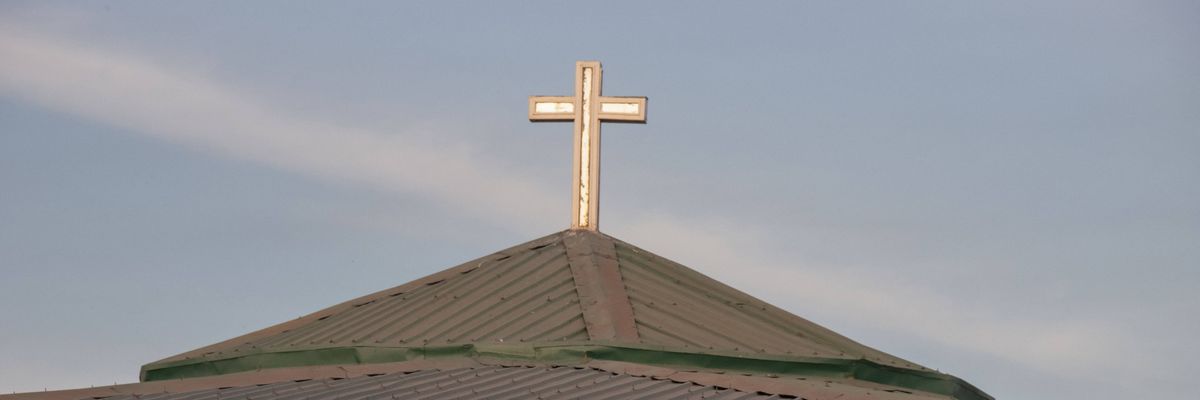
A general view of a cross on the roof of the St Hilary Church Polo in Maiduguri on 
December 27, 2025.
(Photo by Audu Marte/AFP via Getty Images)

Stephen Prager
Dec 27, 2025
COMMON DREAMS


When President Donald Trump launched a series of airstrikes in Nigeria on Christmas, he described it as an attack against “ISIS Terrorist Scum in Northwest Nigeria who have been targeting and viciously killing, primarily, innocent Christians.”

But locals in a town that was hit during the strike say terrorism has never been a problem for them. On Friday, CNN published a report based on interviews with several residents of Jabo, which was hit by a US missile during Thursday’s attack, which landed just feet away from the town’s only hospital.

The rural town of Jabo is part of the Sokoto state in northwestern Nigeria, which the Trump administration and the Nigerian government said was hit during the strike.

Both sides have said militants were killed during the attack, but have not specified their identities or the number of casualties.

Kabir Adamu, a security analyst from Beacon Security and Intelligence in Abuja, told Al Jazeera that the likely targets are members of “Lakurawa,” a recently formed offshoot of ISIS.

But the Trump administration’s explanation that their home is at the center of a “Christian genocide” left many residents of Jabo confused. As CNN reported:
While parts of Sokoto face challenges with banditry, kidnappings and attacks by armed groups including Lakurawa–which Nigeria classifies as a terrorist organization due to suspected affiliations with [the] Islamic State–villagers say Jabo is not known for terrorist activity and that local Christians coexist peacefully with the Muslim majority.

Bashar Isah Jabo, a lawmaker who represents the town and surrounding areas in Nigeria’s parliament, described the village to CNN as “a peaceful community” that has “no known history of ISIS, Lakurawa, or any other terrorist groups operating in the area.”

While the town is predominantly Muslim, resident Suleiman Kagara, told reporters: “We see Christians as our brothers. We don’t have religious conflicts, so we weren’t expecting this.”

Nigeria, Africa’s most populous nation with more than 237 million people, has a long history of violence between Christians and Muslims, with each making up about half the population.

However, Nigerian officials have disputed claims by Republican leaders—including US Sen. Ted Cruz (Texas)—who have claimed that the government is “ignoring and even facilitating the mass murder of Christians.”

The senator recently claimed, without citing a source for the figures, that “since 2009, over 50,000 Christians in Nigeria have been massacred, and over 18,000 churches and 2,000 Christian schools have been destroyed” by the Islamist group Boko Haram.

Cruz is correct that many Christians have been killed by Boko Haram. But according to reports by the US-based Armed Conflict Location and Event Data Project and the Council on Foreign Relations, the majority of the approximately 53,000 civilians killed by the group since 2009 have been Muslim.

Moreover, the areas where Boko Haram is most active are in northeastern Nigeria, far away from where Trump’s strikes were conducted. Attacks on Christians cited in October by Cruz, meanwhile, have been in Nigeria’s Middle Belt region, which is separate from violence in the north.

The Nigerian government has pushed back on what they have called an “oversimplified” narrative coming out of 
Nigerian villagers are rattled by U.S. airstrikes that made their homes shake and the sky glow red


People visit the site of a U.S. airstrike in Northwest, Jabo, Nigeria, Friday, Dec. 26, 2025.
 (AP Photo/ Tunde Omolehin)

By Ope Adetayo and Tunde Omolehin - Associated Press - Friday, December 26, 2025

JABO, Nigeria — Sanusi Madabo, a 40-year-old farmer in the Nigerian village of Jabo, was preparing for bed on Thursday night when he heard a loud noise that sounded like a plane crashing. He rushed outside his mud house with his wife to see the sky glowing a bright red.

The light burned bright for hours, Madabo said: “It was almost like daytime.”


He did not learn until later that he had witnessed a U.S attack on an alleged camp of the militant Islamic State group.

U.S. President Donald Trump announced late Thursday that the United States had launched a “powerful and deadly strike” against IS militants in Nigeria. The Nigerian government has since confirmed that it cooperated with the U.S government in its strike.

Nigerian government spokesperson Mohammed Idris said Friday that the strikes were launched from the Gulf of Guinea in the Atlantic Ocean shortly after midnight and involved “16 GPS-guided precision” missiles and also MQ-9 Reaper drones.


Idris said the strikes targeted areas used as “staging grounds by foreign” IS fighters who had sneaked into Nigeria from the Sahel, the southern fringe of Africa’s vast Sahara Desert. The government did not release any casualty figures among the militants.

PHOTOS: Nigerian villagers are rattled by US airstrikes that made their homes shake and the sky glow red

Residents of Jabo, a village in the northwestern Nigerian state of Sokoto, spoke to The Associated Press on Friday about panic and confusion among the villagers following the strikes, which they said hit not far from Jabo’s outskirts. There were no casualties among the villagers.

They said that Jabo has never been attacked as part of the violence the U.S. says is widespread — though such attacks regularly occur in neighboring villages.

Abubakar Sani, who lives on the edge of the village, recalled the “intense heat” as the strikes hit.

“Our rooms began to shake, and then fire broke out,” he told the AP.

“The Nigerian government should take appropriate measures to protect us as citizens,” he added. “We have never experienced anything like this before.”

The strikes are the outcome of a monthslong tense diplomatic clash between the West African nation and the U.S.

The Trump administration has said Nigeria is experiencing a genocide of Christians, a claim the Nigerian government has rejected.

However, Nigeria’s Ministry of Foreign Affairs now said the strikes resulted from intelligence sharing and strategic coordination between the two governments.

Yusuf Tuggar, Nigeria’s foreign minister, called the airstrikes a “new phase of an old conflict” and said he expected more strikes to follow.

“For us, it is something that has been ongoing,” Tuggar added, referring to attacks that have targeted Christians and Muslims in Nigeria for years.

Bulama Bukarti, a security analyst on sub-Saharan Africa at the Tony Blair Institute, said the residents’ fear is compounded by a lack of information.

Nigerian security forces have since cordoned off the area of the strikes and access was not allowed.

Bukarti said transparency would go a long way to calm the local residents. “The more opaque the governments are, the more panic there will be on the ground, and that is what will escalate tensions.”

Analysts say the strikes might have been intended for the Lakurawa group, a relatively new entrant to Nigeria’s complex security crisis.

The group’s first attack was recorded around 2018 in the northwestern region before the Nigerian government officially announced its presence last year. The composition of the group has been documented by security researchers as primarily consisting of foreigners from the Sahel.

However, experts say ties between the Lakurawa group and the IS are unproven. The Islamic State West African Province — an IS affiliate in Nigeria — has its strongholds in the northeastern part of the country, where it is currently involved in a power struggle with its parent organization, Boko Haram.

“What might have happened is that, working with the American government, Nigeria identified Lakurawa as a threat and identified camps that belong to the group,” Bukarti said.

Still, some local people feel vulnerable.

Aliyu Garba, a Jabo village leader, told the AP that debris left after the strikes was scattered, and that residents had rushed to the scene. Some picked up pieces of the debris, hoping for valuable metal to trade, and Garba said he fears they could get hurt.

The strikes rattled 17-year-old Balira Sa’idu, who has been preparing for her upcoming marriage.

“I am supposed to be thinking about my wedding, but right now I am panicking,” she said. “The strike has changed everything. My family is afraid, and I don’t even know if it is safe to continue with the wedding plan in Jabo.”

• Adetayo reported from Lagos, Nigeria.the White House and from figures in US media, like HBO host Bill Maher, who has echoed Cruz’s overwrought claims of “Christian genocide.”

“Portraying Nigeria’s security challenges as a targeted campaign against a single religious group is a gross misrepresentation of reality,” said Nigerian information minister Mohammed Idris Malagi. “While Nigeria, like many countries, has faced security challenges, including acts of terrorism perpetrated by criminals, couching the situation as a deliberate, systematic attack on Christians is inaccurate and harmful. It oversimplifies a complex, multifaceted security environment and plays into the hands of terrorists and criminals who seek to divide Nigerians along religious or ethnic lines.”

Anthea Butler, a religious scholar at the University of Pennsylvania, has criticized the Trump administration’s attempts to turn the complex situation in Nigeria into a “holy war.”

“This theme of persecution of Christians is a very politically charged, and actually religiously charged, theme for evangelicals across the world. And when you say that Christians are being persecuted, that’s a thing,” she told Democracy Now! in November. “It fits this sort of savior narrative of this American sort of ethos right now that is seeing itself going into countries for a moral war, a moral suasion, as it were, to do something to help other people.”

Nigeria also notably produces more crude oil than any other country in Africa. Trump has explicitly argued that the US should carry out regime change in Venezuela for the purposes of “taking back” that nation’s oil.

Butler has doubted the sincerity of Trump’s concern for the nation’s Christians due to his administration’s denial of entry for Nigerian refugees, as well as virtually every other refugee group, with the exception of white South Africans.

She said: “I think this is sort of disingenuous to say you’re going to go in and save Christianity in Nigeria, when you have, you know, banned Nigerians from coming to this country.”


Nigerian villagers are rattled by U.S. airstrikes that made their homes shake and the sky glow red

People visit the site of a U.S. airstrike in Northwest, Jabo, Nigeria, Friday, Dec. 26, 2025.
 (AP Photo/ Tunde Omolehin)

By Ope Adetayo and Tunde Omolehin - Associated Press - Friday, December 26, 2025

JABO, Nigeria — Sanusi Madabo, a 40-year-old farmer in the Nigerian village of Jabo, was preparing for bed on Thursday night when he heard a loud noise that sounded like a plane crashing. He rushed outside his mud house with his wife to see the sky glowing a bright red.

The light burned bright for hours, Madabo said: “It was almost like daytime.”


He did not learn until later that he had witnessed a U.S attack on an alleged camp of the militant Islamic State group.

U.S. President Donald Trump announced late Thursday that the United States had launched a “powerful and deadly strike” against IS militants in Nigeria. The Nigerian government has since confirmed that it cooperated with the U.S government in its strike.

Nigerian government spokesperson Mohammed Idris said Friday that the strikes were launched from the Gulf of Guinea in the Atlantic Ocean shortly after midnight and involved “16 GPS-guided precision” missiles and also MQ-9 Reaper drones.


Idris said the strikes targeted areas used as “staging grounds by foreign” IS fighters who had sneaked into Nigeria from the Sahel, the southern fringe of Africa’s vast Sahara Desert. The government did not release any casualty figures among the militants.

PHOTOS: Nigerian villagers are rattled by US airstrikes that made their homes shake and the sky glow red

Residents of Jabo, a village in the northwestern Nigerian state of Sokoto, spoke to The Associated Press on Friday about panic and confusion among the villagers following the strikes, which they said hit not far from Jabo’s outskirts. There were no casualties among the villagers.

They said that Jabo has never been attacked as part of the violence the U.S. says is widespread — though such attacks regularly occur in neighboring villages.

Abubakar Sani, who lives on the edge of the village, recalled the “intense heat” as the strikes hit.

“Our rooms began to shake, and then fire broke out,” he told the AP.

“The Nigerian government should take appropriate measures to protect us as citizens,” he added. “We have never experienced anything like this before.”

The strikes are the outcome of a monthslong tense diplomatic clash between the West African nation and the U.S.

The Trump administration has said Nigeria is experiencing a genocide of Christians, a claim the Nigerian government has rejected.

However, Nigeria’s Ministry of Foreign Affairs now said the strikes resulted from intelligence sharing and strategic coordination between the two governments.

Yusuf Tuggar, Nigeria’s foreign minister, called the airstrikes a “new phase of an old conflict” and said he expected more strikes to follow.

“For us, it is something that has been ongoing,” Tuggar added, referring to attacks that have targeted Christians and Muslims in Nigeria for years.

Bulama Bukarti, a security analyst on sub-Saharan Africa at the Tony Blair Institute, said the residents’ fear is compounded by a lack of information.

Nigerian security forces have since cordoned off the area of the strikes and access was not allowed.

Bukarti said transparency would go a long way to calm the local residents. “The more opaque the governments are, the more panic there will be on the ground, and that is what will escalate tensions.”

Analysts say the strikes might have been intended for the Lakurawa group, a relatively new entrant to Nigeria’s complex security crisis.

The group’s first attack was recorded around 2018 in the northwestern region before the Nigerian government officially announced its presence last year. The composition of the group has been documented by security researchers as primarily consisting of foreigners from the Sahel.

However, experts say ties between the Lakurawa group and the IS are unproven. The Islamic State West African Province — an IS affiliate in Nigeria — has its strongholds in the northeastern part of the country, where it is currently involved in a power struggle with its parent organization, Boko Haram.

“What might have happened is that, working with the American government, Nigeria identified Lakurawa as a threat and identified camps that belong to the group,” Bukarti said.

Still, some local people feel vulnerable.

Aliyu Garba, a Jabo village leader, told the AP that debris left after the strikes was scattered, and that residents had rushed to the scene. Some picked up pieces of the debris, hoping for valuable metal to trade, and Garba said he fears they could get hurt.

The strikes rattled 17-year-old Balira Sa’idu, who has been preparing for her upcoming marriage.

“I am supposed to be thinking about my wedding, but right now I am panicking,” she said. “The strike has changed everything. My family is afraid, and I don’t even know if it is safe to continue with the wedding plan in Jabo.”

• Adetayo reported from Lagos, Nigeria.


Washington Post backs Trump's strikes in Nigeria, says he'd 'be wise to stay engaged'

The editorial board praised Trump's 'righteous strikes' in the region and argued that these military efforts must be sustained

Fox News
December 27, 2025 


Nigeria is the world’s 'deadliest place for Christians': Sam Brownback

The Washington Post editorial board said the Trump administration's military strikes on ISIS targets in Nigeria were a "welcome change" and that the president would "be wise to remain engaged" in the region.

In an editorial Saturday, the Post praised President Donald Trump's "righteous strikes" Thursday against the Islamic State’s Sahel Province branch in Nigeria, where Christians and Christian institutions have been under attack in recent months.

"A not insignificant cohort of President Donald Trump’s advisers want the United States to abandon widespread commitments abroad and instead become a regional power focused on the Western Hemisphere. The president’s righteous strike against Islamic State targets in Nigeria is a reminder that America is capable of much more," the editorial board contended.

On Thursday, Trump posted to Truth Social announcing that the U.S. military launched airstrikes in Northwest Nigeria on Christmas night targeting ISIS militants he accused of killing Christians, calling the operation decisive and warning further attacks would follow if the violence continues.

At least 51 Christians were killed in an attack in Nigeria's Plateau state in April 2025. (Reuters)

"Tonight, at my direction as Commander in Chief, the United States launched a powerful and deadly strike against ISIS Terrorist Scum in Northwest Nigeria, who have been targeting and viciously killing, primarily, innocent Christians, at levels not seen for many years, and even Centuries!" Trump wrote Thursday.

Although the Post was supportive of the Trump administration's intervention in the region, the outlet argued that "the question is whether this is a one-off decision or the start of a more consistent and coherent policy."

The editorial board noted that it understands "the desire to want to abandon the entire region" but made its case for why Trump should continue his efforts in the region, a part of the world that the Post claimed "has always been little more than an afterthought for the president."

"The U.S. strikes in Nigeria targeted the Islamic State’s Sahel Province branch, which has clashed violently in recent years for territory with JNIM, an al-Qaeda affiliate that is currently trying to seize control of Mali by blocking fuel from entering the capital city of Bamako," the outlet reported. "If Mali falls, it would mark the first takeover of a country by an anti-Western Islamic terrorist group since the Taliban took Afghanistan.

According to the Post, the Sahel region, which stretches from Mauritania through Chad, has become "the world’s biggest epicenter for global terrorism," where half of the world's deaths due to terrorism take place.


The Washington Post praised Trump's "righteous strikes" against ISIS targets in Nigeria. (Andrew Harnik/Getty Images)

After decades of war pushed many terror groups out of the territories they once controlled in Iraq and Syria, those groups have "found fertile soil in West Africa," the outlet claimed.

"The Islamic State’s history shows that when the group establishes a stable presence, it’s only a matter of time before it looks to wreak havoc around the world," the Post noted. "It’s tempting to want to pretend that the chaos in West Africa isn’t an American problem, but the world isn’t that simple."

The editorial board warned that, without sustained support, the administration's efforts could prove futile.

As reported by the Post, the U.S. once had a regional counterterrorism plan called the Trans-Sahara Counterterrorism Partnership, but a recent audit revealed that the program was "underfunded, leaderless and mostly ineffective." The outlet added that the Pentagon is also considering merging African Command back into European Command, which was separated in 2008.

"This could mean fewer resources and less attention for the region. In addition to the security reasons for continued engagement, the U.S. would be foolish to cede the young and growing continent to China and Russia," the Post warned.

This photo released by the Christian Association of Nigeria shows the dormitories of St. Mary's Catholic Primary and Secondary School after gunmen abducted children and staff in Papiri community in Nigeria Nov. 21, 2025. (Christian Association of Nigeria via AP)

Wrapping up its thoughts, the editorial board reiterated the importance of Trump remaining committed to stopping the slaughter of innocents in the region.

"Nigeria, a relatively wealthy country in the region, is still battling insecurity on several fronts. The central government has been ineffective at restoring security. It’s good that Abuja is willing to work closely with Washington to stop the slaughter, and Trump would be wise to remain engaged," the Post concluded.

Fox News' Greg Wehner contributed to this report.