Wednesday, December 31, 2025

Saudi Aramco Eyes Major Stake in New $11 Billion Indian Refinery

Saudi Aramco is poised to buy a 20% stake in a new refinery that India’s state-owned refiner Bharat Petroleum Corporation Limited (BPCL) plans to build with a total investment of about $11 billion, Indian news outlet Business Standard reports

BPCL plans to have the refinery built at the Ramayapatnam port in the state of Andhra Pradesh on the east coast of southern India. The refinery is planned to have a processing capacity of between 180,000 and 240,000 barrels per day (bpd).  

The Indian company, which is the country’s second-biggest state refiner with 706,000 bpd of crude processing capacity, plans to sell a 30–40% equity stake to outside investors. This stake would include a 20% interest to Saudi Aramco, a nearly 10% stake to Oil India Ltd (OIL), and another 4–5% equity stake to interested banks, according to a senior BPCL official who spoke to Business Standard.  

Earlier this year, BPCL secured the land for the new refinery. The Andhra Pradesh government allocated 6,000 acres for the refinery and petrochemicals project, which is expected to cost about $11 billion (967 billion Indian rupees). The state government has asked BPCL to launch commercial operations at the refinery by January 2029, per the order cited by Reuters.

Currently, BPCL operates three refineries in India. The company and other Indian refiners are looking to boost their crude processing and petrochemicals capacity to meet growing demand in the world’s third-largest crude oil importer. 

Saudi Arabia, for its part, looks to lock in future term sales for its crude in the top Asian markets, which are set to continue driving global demand growth in the coming years. India has even surpassed China as the single biggest driver of demand growth. 

Sources in India told Reuters earlier this year that Aramco was in discussions to invest in two planned refineries in India. 

Saudi Aramco is discussing buying a stake in the BPCL refining and petrochemical complex in south India, and is in separate talks with Oil and Natural Gas Corporation Limited (ONGC) for a proposed refinery in the Gujarat state on India’s west coast, the sources told Reuters.   

By Charles Kennedy for Oilprice.com


Investor Hesitation Stalls India's Offshore Oil Push

India has once again kicked the can down the road on its biggest oil and gas licensing round, extending the deadline for bids under OALP-X to February 18. It is the fourth extension since the round was launched with much fanfare during India Energy Week in February, and it says a lot about the gap between ambition and investor appetite.

OALP-X is not a small offering quietly tucked away in some dark corner of the upstream segment. It is the largest acreage round India has ever put on the table under its Hydrocarbon Exploration and Licensing Policy, covering nearly 192,000 square kilometers across 13 sedimentary basins. The mix is heavily offshore: ultra-deepwater, deepwater, shallow water, and a smaller slice of onshore acreage. In August, New Delhi had already pushed the deadline to October, citing the need to give bidders more time. Then came another extension to December. Now it is February.

Officially, there is no explanation this time around. But unofficially, the reasons are the usual suspects. Investor participation has been lacking, weighed down by regulatory complexity, tax burdens, and lingering uncertainty over drilling rules and fiscal terms. A recent increase in the GST rate on exploration and production inputs did not help, nor did the reality that the government take can reach as much as 60 to 70 percent of upstream revenues.

That is awkward timing for a country that depends on imports for more than 85 percent of its oil and wants that number lower, not higher. India’s crude import dependence hit a record in the last fiscal year, even as demand continues to climb and domestic production stays flat. The government knows this, which is why it has been courting foreign majors and talking up frontier basins like the Andaman offshore, sometimes with Guyana-scale comparisons that raise eyebrows.

There is interest on paper. Petrobras has signed letters of intent with Indian state producers. Exxon, Chevron, BP, and TotalEnergies have all inked cooperation agreements. But interest doesn’t necessarily translate into bids, and bids do not equal rigs in the water.

Repeated deadline extensions are so far managing to keep the round alive, despite signaling hesitation.

By Julianne Geiger for Oilprice.com

US vs China Tech Race 2025: Who Leads in AI, Semiconductors & Robotics

2025 marks a split in the tech race. The US leads in $109B AI investment and frontier models like GPT-5, while China dominates with 2M+ industrial robots and DeepSeek-R1 efficiency

Shashank Bhatt
Updated on: 31 December 2025 
BY Outlook Business Desk


US vs China Tech Race 2025

Summary of this article


US leads in frontier AI research, semiconductors and cloud infrastructure


China dominates robotics deployments, while pursuing self-reliance goals


DeepSeek's release served as wake-up call, showing China can build elite AI models


2025 was an inflection year in the US-China tech rivalry, with competition intensifying across multiple fronts simultaneously.


While the US leads in core technology development, AI frameworks, cloud infrastructure and quantum computing, and continues to attract global technical talent, China leads or is closing the gap rapidly in practical physical AI and robotics deployments such as drone deliveries, uncrewed taxis and large-scale factory automation; in building and installing digital infrastructure worldwide, particularly across the Global South; and in advancing technological self-sufficiency through aggressive industrial policy and state-backed incentives.

2025 was also one of the most active years for new technology launches, major investments and cross-industry collaborations. Beyond innovation and capital flows, the rivalry increasingly extended into geopolitics, with export controls, supply-chain strategy and industrial policy shaping where and how technologies were developed, deployed and commercialised in the race for long-term tech advantage.


US vs China: Head to Head Comparison

Goldman Sachs’ Top of Mind: The US-China Tech Race report argues that the US has maintained an advantage over China in frontier research and platform-level capabilities. This includes advanced semiconductor design and manufacturing know-how, foundational AI research and frameworks, large-scale cloud and datacentre infrastructure and early-stage quantum technologies. This lead is reinforced by a strong talent ecosystem that the US is able to attract.


On the other hand, China is described as moving ahead in large-scale, practical deployment and downstream application. The report highlights rapid rollouts of robotics and autonomous systems such as drones, delivery robots and uncrewed taxis, fast expansion of digital infrastructure at home and across parts of the Global South and a coordinated push for industrial self-reliance backed by state finance, procurement policies and local incentives.


The report notes that US export controls have slowed China’s access to advanced tools (like Nvidia’s H100 chips) but have not stopped technological progress. Instead, restrictions have accelerated domestic substitution efforts, including closer software–hardware co-design, experimentation with alternative chip architectures, indigenous tool development and more efficient use of slightly older semiconductor nodes.


China’s dominance in critical supply-chain segments, particularly rare-earth processing and magnet production, combined with access to abundant, low-cost power for large industrial projects, creates vulnerabilities for the US and complicates efforts by either country to achieve full technological self-sufficiency.


Nvidia Tests Optional Software to Verify Where its AI Chips are Running Amid Smuggling Claims


US Approach To Maintain Lead

Policy choices shaped much of the year. Washington combined Cold War style industrial mobilisation with market incentives. This included continued deployment of CHIPS Act grants, with roughly $50 billion allocated, an expanded Advanced Manufacturing Investment Credit under OBBBA raised to 35 percent, preservation of IRA production credits with tighter rules on Chinese-linked content, and a growing use of direct government equity and loan support, with about $10 billion announced, nearly $9 billion of it tied to Intel.

OBBBA also added a $1.5 billion appropriation that enables up to $200 billion in lending through the DoD’s Office of Strategic Capital, along with targeted funding such as $2 billion for the Defense Innovation Unit and $10 billion for an Industrial Base Fund.


To reduce commercial risk for emerging domestic supply chains, the US increasingly relied on offtake agreements, floor price mechanisms and procurement guarantees, particularly for rare earth downstream processing and magnet production, while signalling faster permitting for data centres and semiconductor fabs. At the same time, export controls, a widening Entity List, Section 232 investigations and outbound investment rules remained core tools to limit the transfer of cutting edge capabilities to China.

China’s Playbook

Beijing’s playbook is highly state-led and coordinated. China has clustered priorities into “chokehold” technologies (integrated circuits, machine tools, basic software, advanced materials, biomanufacturing), “emerging industries” for rapid scale-up (new-energy tech, aerospace, drones, robotics), and “future industries” that receive strategic R&D focus (quantum, brain–computer interfaces, embodied intelligence, 6G).


Local and central incentives, large funds, tax breaks, subsidised land and power, fast-track permitting and talent programmes, have driven fast scale-up but also frequent overcapacity and duplication at the regional level.


Major Moves of 2025

According to Stanford’s AI Index report, 2025 saw the technology race sharpen around inference, infrastructure and industrial policy.


Nvidia doubled down on inference-focused partnerships and licensing strategies to reinforce its advantage in AI compute, while large corporates such as Disney made billion-dollar investments that accelerated the commercial adoption of AI at scale. In China, hyperscalers including ByteDance announced aggressive AI capital-expenditure plans and pursued more compute-efficient model strategies in response to US export restrictions.


At the same time, semiconductor onshoring gathered pace amid record global investment in chipmaking equipment, with China leading in overall investment volume even as US export controls tightened further.


Quantum technologies also moved closer to commercial viability, supported by technical milestones and rising private funding. Across the broader ecosystem, AI-driven mergers, acquisitions and mega funding rounds increasingly concentrated talent and intellectual property among a small number of platform owners, reinforcing scale advantages at the top of the market.

Who’s Leading at the End of 2025?

By the end of 2025 the picture was nuanced rather than binary. The US maintained a lead in top-tier foundation models, cloud-scale AI, and cutting-edge training GPUs, while China gained ground in open-source momentum, domestic-scale deployment, and depth in select supply-chain segments.


On hardware, the US-Taiwan–Korea ecosystem continued to dominate the most advanced nodes and inference stacks, whereas China invested heavily in alternative accelerators and large-scale capacity, but lagged on EUV-dependent toolchains.
Published At: 29 December 2025 8:09 pm
AI-based Jobs Rise Across Sectors, 71% of White-Collar Employees Using AI: Indeed India MD

Data provided by the online jobs platform Indeed show that artificial intelligence opportunities, while still concentrated in the tech sector, are increasingly visible across non-tech industries as well

Vikash Tripathi
Updated on: 29 December 2025
BY Outlook Business Desk


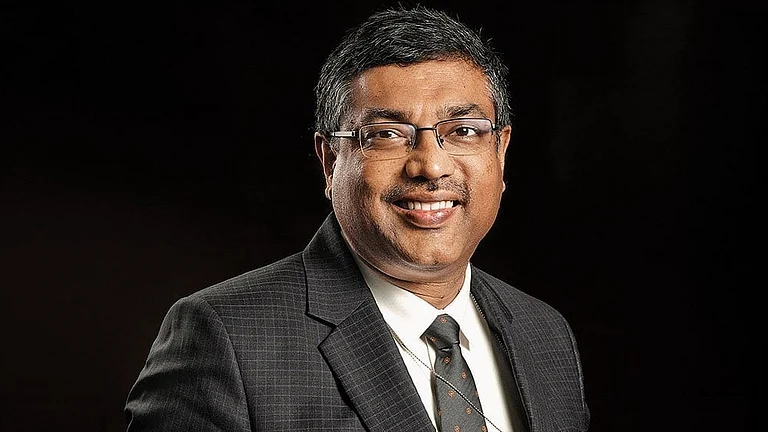
Sashi Kumar, Managing Director of Indeed India

Summary of this article


AI-linked roles are rising across sectors, with an 11% increase in mentions of AI in job descriptions, says Indeed India MD Sashi Kumar.


He said that Indian product companies and global capability centres (GCCs) of multinationals are doing deep AI work.


Indeed data show that while AI opportunities remain concentrated in tech, they are increasingly spreading across non-tech industries.


There has been a rise in roles demanding some sort of artificial intelligence capability across sectors, with an 11% increase in mentions of AI in job descriptions themselves, said Sashi Kumar, Managing Director of Indeed India. Adding to that, almost 71% of all white-collar employees in India reported that they are using AI in some shape or form for their jobs, for their day-to-day work today.


In an interview with Outlook Business, he also noted that many Indian companies that are in the product space and global capability centres (GCCs) operated by multinational companies are doing “some pretty deep work involving AI using some of the latest technologies.”

Data provided by the online jobs platform show that artificial intelligence opportunities, while still concentrated in the tech sector, are increasingly visible across non-tech industries as well.

Related Content


OpenAI Hiring for New Position, Offers $555K Salary to Tackle AI Safety & Cyber Risks


AI poses highest risk to white-collar jobs, focus must be on upskilling: MeitY Secy S Krishnan


Govt to Raise Fixed Costs for Urea Makers by Year-End: Fertilisers Secretary


H-1B Visa Approvals for Indian IT Services Drop to Decade Low Amid Tightened US Scrutiny


In India, 39% of data and analytics roles now mention artificial intelligence, the highest share among job categories, followed by software development at 23%, insurance at 18%, and scientific research at 17%. AI demand is also spreading across engineering disciplines, with industrial engineering at 17%, mechanical engineering at 11% and electrical engineering at 9.2%. Mentions of generative AI also continue to rise, with 1.5% of all job postings in India referencing it as of May 2025, a figure that has doubled since 2024.


Karnataka (2.4%) and Telangana (2.3%) have emerged as leading regional hubs for AI-related jobs, as per the Indeed data. Despite a slight dip in software development roles, the sector remains the largest, accounting for one in five job postings on Indeed India. Additionally, talent flow is increasingly shifting to Tier 2 and Tier 3 cities, reflecting the broader geographic spread of AI opportunities.


The shift comes as Indian IT companies and global capability centres (GCCs) set up by foreign companies try to leverage AI into their products and services to gain productivity improvements and open new avenues of revenue. Earlier, Outlook Business reported that enterprises are ready to pay as much as ₹60 lakh per annum for senior roles related to fields like AI/GenAI, cloud, data engineering, and cybersecurity, but there is a 40% to 53% talent gap.


Kumar says that “there will always be a talent gap, but what is interesting is that many employers are today pivoting to something called skills-based hiring to work up.”


“Employers are working backwards, figuring out what skills are relevant for doing that specific job and looking to hire for those skills so that people can get trained in using some of the newest available AI agents, etc. There is a talent gap. What many companies are doing is resorting to skills-based hiring so that they are able to widen the talent pool,” he added.


Employers Pushing AI Use

While employees are increasingly using AI tools in some form, the push is also coming from the employer side as well, indicating lower stigma around AI use.


“Companies are encouraging people to use AI to simplify tasks, not for anything else, because it boosts productivity,” noted Sashi Kumar, adding that a lot of companies and employees are cognisant that AI is not the end of everything.


“You still need to add the human touch. You still need to make it more human,” Kumar added.


The Indeed India MD also noted that a lot of layoffs in 2025 came from “companies increasingly adopting technology, specifically AI, which is impacting the kind of roles that exist.”


He claimed it was “more of a recalibration of what is available and what companies want to focus on hiring.”


“Many companies are very optimistic about their hiring numbers in the coming year. It’s not like AI has come in and said, you know, 100 people were doing this task and now, because AI is here, 100 becomes zero. I don’t think that has happened. In the next four to five years, that’s unlikely. What we’ve seen is that for those tasks, people who are equipped with AI and technology to do the work better than their counterparts have been able to cope much better than those who have not adopted technology,” he explained.


Indeed is also using AI to improve job matching, with a key initiative being Career Scout, which uses AI to understand a job seeker’s interests, skills, and preferences, helping them discover suitable roles and identify skills they may need to strengthen. It has been launched globally and is expected to roll out in India soon. On the employer side, Indeed is offering Talent Scout, which applies similar AI-driven matching to surface the most relevant candidates for open roles.


Govt May Extend Scope Of PLI Scheme To Job-Creating Sectors: Deloitte


Rising Manufacturing Jobs, but Few Takers

Indeed, which has been working in the Indian market for over a decade, added 310,000 new jobs on its platform each month between July and September 2025. Kumar noted that over the last five years, their traffic has grown by about 59% overall.


“We have a very strong dynamic across both job seekers and jobs. In 2020, five years ago, we used to add about 190,000 new jobs every month. That number has now gone up to around 290,000 to 300,000 jobs every month. There has also been a significant increase in the number of resumes added. We are now seeing about 800,000 resumes every month, which is almost double what it was around four years ago,” he noted.


He also noted that there has been a sharp rise in manufacturing jobs on the platform amid the government’s push in the sector, with several production-linked incentive (PLI) schemes and fiscal incentives for foreign companies to manufacture in India.


According to the Indeed Hiring Tracker, manufacturing hiring intent rose sharply by 80% year-on-year from FY25 to FY26, with the sector accounting for 37% of all employer hiring intentions in FY25.


Hiring activity spans both white-collar and blue-collar roles, though employee preferences continue to lag employer demand, according to Indeed.


Only 13% of employees chose production and manufacturing as their preferred domain in FY24, highlighting a persistent demand–supply mismatch. Blue-collar roles dominate hiring demand, driven largely by shop-floor, production, and operations roles across FY24 to FY26. Meanwhile, white-collar hiring remains selective but steady, with demand focused on areas such as quality control, supply chain, plant management, engineering, and process optimisation.


Published At: 29 December 2025 
From ‘Brain Rot’ To ‘Rage Bait’: Stuck In The Online Loop

'Rage bait’ is Oxford’s Word of the Year for 2025, while the word for 2024 was ‘brain rot’ - both toxic outcomes of banal online experiences. In between the two, we seem to have collectively reached nowhere.

Prof. Feza Tabassum Azmi
Updated on: 14 December 2025
THE OUTLOOK/INDIA


Rage Bait is world of the year 2025 announced by Oxford.
 Photo: IMAGO / Anadolu Agency

Summary of this article


Rage bait thrives on outrage: Deliberately provocative online content exploits anger to drive engagement, visibility, and monetization, reinforced by algorithms that reward extreme reactions.


A vicious cycle with “brain rot”: Rage bait and mind-numbing content feed each other, accelerating misinformation, polarisation, and emotional overstimulation while eroding attention, trust, and intellectual depth.


A deeper societal warning: The rise of these terms reflects a tech-driven ecosystem that manipulates human emotions for profit, raising urgent questions about mental health, public discourse, and what it means to be human online. make this points more crisp


When the rock band Beatles released their song Tomorrow Never Knows, they were probably unaware that the lyrics ‘turn off your mind, relax and float downstream; lay down all thoughts, surrender to the void’ would become symptomatic of a larger societal malaise half a century later.


‘Rage bait’ is Oxford’s Word of the Year for 2025. Oxford University Press (OUP) defines rage bait as “online content deliberately designed to elicit anger or outrage by being frustrating, provocative, or offensive, typically posted to increase traffic or engagement with a particular web page or social media content”. It’s a calculated manoeuvre that exploits human tendencies to react to meaningless controversies, falling in a trap much like “surrendering to the void”, as the Beatles would say.


The term is used to describe online content wilfully designed to provoke anger to create engagement (likes, comments, shares) to generate traffic, often for financial gains through ads, benefiting creators through inflated visibility. Online creators continue to churn out ‘rage bait’ content, where the goal is simple: post content that makes users viscerally angry and then bask in the thousands of shares and views, cashing in on outrage.

As Internet algorithms are designed to reward more provocative content, this has developed into practices such as rage-farming, a more consistently applied attempt to manipulate reactions and to build anger and engagement over time by seeding content with rage bait.


It signals a deeper shift in how we talk about online engagement. Rage bait aims to trigger emotional responses using anger as the ‘bait’. Angry reactions boost the content’s visibility. Such content, which is mainly fabricated, thrives on provocation by manipulating emotions – spreading misinformation, making blatantly incorrect statements, manufacturing unfounded conspiracy theories, posting freakish recipes, attacking pop culture figures or taking controversial political stand.


'Brain Rot' Becomes Oxford's Word Of The Year 2024


By tapping into strong emotional triggers, rage bait content compels people to respond creating a cycle of negativity. It can distract from real issues and polarize audience. The fact that a term like rage bait exists and has seen dramatic surge in usage is an irony in itself. This indicates we’re aware of the manipulation tactics we can be drawn into, and yet we succumb.


Last year Oxford selected ‘brain rot’ as the Word of the Year, amid serious concerns over the perceived dangers of mind-numbing content one is exposed to on social media. Brain rot is defined as ‘the supposed deterioration of a person’s mental or intellectual state as the result of overconsumption of online content, particularly trivial or inconsequential ones”.


The first recorded use of 'brain rot' was found in 1854 in Henry David Thoreau’s book Walden, who criticised society’s tendency to devalue complex ideas in favour of simpler ones, and sees this as indicative of a general decline in mental and intellectual effort.


The term initially gained traction among Gen Z and Gen Alpha who used it in a humorous, self-deprecating manner. It is both interesting and ironical that the term has been popularised by youngsters who themselves are the targets of the ‘brain rot’ phenomenon. As OUP highlights, it demonstrates a somewhat cheeky self-awareness in the younger generations about the harmful impact of social media.


Rage bait and brain rot are both metaphors of the times we’re living in. They have reference to how we are getting impacted by online content which is moving from being informal to becoming egregiously irreverent to often bordering on the bizarre. Together, they form a vicious cycle where the preposterous sparks engagement.


Millions today are spending hours mindlessly scrolling Instagram reels or binge-watching videos or just switching between tabs consuming huge quantities of nonsensical data, negative news, and meaningless updates. At the same time, one might be simultaneously texting and checking messages resulting in digitally inundating oneself with information leading to overstimulating the brain. The brain associates Internet scrolling with a feeling of gratification, even when one is aware of its negative consequences. In a way, mindless Internet scrolling becomes a hedonistic behavioral addiction. These activities affect the brain’s reward system.


So when one is zombie scrolling, one may be vacantly staring at the smart phone while compulsively flitting from one feed to another. Doomscrolling involves an overwhelming desire to be up to date on latest information, even when it’s disturbing and distressing. Indulging in such experiences is seriously damaging collective intellectual growth in the society today.


This brings back sociologist George Ritzer’s ideas, who in his 1993 book The McDonaldisation of Society, described how fast-food restaurant principles were becoming symbolic of a society being driven a very mechanical, fast-paced lifestyle, devoid of emotions and humanness. This was just when the Internet era was beginning to happen.

15 Years Of The Social Network | Revisiting Anxieties Around The Internet & Human Connection


In the free market of language, Ritzer’s analogy was a precursor to an increasingly hollowing societal fabric today. Shallow online interactions build cynicism that hampers public discourse and genuine understanding. It harms users’ mental health, increases polarization, creates divisiveness, desensitizes people, erodes trust and normalizes aggression.


Both brain rot and rage bait are outcomes of engagement-based economic ecosystem for online platforms. The business model is simple - generate outlandish content to be gobbled down by gullible users, amplified through algorithms, resulting in quick monetisation. Generative AI tools make such content easier and faster to produce.


As is said, online content is being engineered to fiddle with emotions. It raises questions of what it means to be human in a tech-driven world - and the extreme perils of online culture.


In our journey from ‘brain rot’ last year to ‘rage bait’ this year, we seem to have collectively reached nowhere.


Dr. Feza Tabassum Azmi
 is Professor of Management Studies & Research at Aligarh Muslim University, Aligarh)

Published At: 14 December 2025 
It’s More Than OK For Kids To Be Bored − It’s Good For Them

Many parents try to shield children from boredom due to work pressures, social expectations and easy access to screens, but research suggests that constant stimulation can hinder children’s ability to cope with negative emotions and build independence.

Outlook News Desk
Updated on: 22 December 2025 


Photo: Tribhuvan Tiwari

Summary of this article


Boredom is a natural and useful experience that encourages reflection, creativity and goal-setting, helping children develop curiosity, emotional regulation and essential life skills such as planning and self-direction.


Allowing short, manageable periods of boredom and unstructured time helps children become more resilient over time.


It also eases parental stress by reducing the pressure to keep children constantly entertained.


Boredom is a common part of life, across time and around the world. That’s because boredom serves a useful purpose: It motivates people to pursue new goals and challenges.


I’m a professor who studies communication and culture. I am currently writing a book about modern parenting, and I’ve noticed that many parents try to help their kids avoid boredom. They might see it as a negative emotion that they don’t want their children to experience. Or they might steer them into doing something that they see as more productive.


There are various reasons they want to prevent their children from being bored. Many parents are busy with work. They’re stressed about money, child care responsibilities and managing other parts of daily life. Making sure a child is occupied with a game, a TV show or an arts and crafts project at home can help parents work uninterrupted, or make dinner, without their children complaining that they are bored.


Parents may also feel pressure for their children to succeed, whether that means getting admitted to a selective school, or becoming a good athlete or an accomplished musician.


Children also spend less time playing freely outside and more time participating in structured activities than they did a few decades ago.

Easy access to screens has made it possible to avoid boredom more than ever before.

Many parents needed to put their children in front of screens throughout the pandemic to keep them occupied during work hours. More recently, some parents have reported feeling social pressure to use screens to keep children quiet in public spaces.

That is to say, there are various reasons why parents shy away from their kids being bored. But before striving to eliminate boredom completely, it’s important to know the benefits of boredom.


Benefits of boredom

Although boredom feels bad to experience in the moment, it offers real benefits for personal growth.


Boredom is a signal that a change is needed, whether it be a change in scenery, activity or company. Psychologists have found that the experience of boredom can lead to discovering new goals and trying new activities.

Harvard public and nonprofit leadership professor Arthur Brooks has found that boredom is necessary for reflection. Downtime leaves room to ask the big questions in life and find meaning.

Children who are rarely bored could become adults who cannot cope with boredom. Boredom also offers a brain boost that can cultivate a child’s innate curiosity and creativity.

Learning to manage boredom and other negative emotions is an important life skill. When children manage their own time, it can help them develop executive function, which includes the ability to set goals and make plans.

The benefits of boredom make sense from an evolutionary perspective. Boredom is extremely common. It affects all ages, genders and cultures, and teens are especially prone to boredom. Natural selection favors traits that offer a leg up, so it is unlikely that boredom would be so prevalent if it did not deliver some advantages.

Parents should be wary of treating boredom as a problem they must solve for their children. Psychologists have found that college students with overly involved parents suffer from more depression.

Other research shows that young children who were given screens to help them calm down were less equipped to regulate their emotions as they got older.

Boredom is uncomfortable

Tolerating boredom is a skill that many children resist learning or do not have the opportunity to develop. Even many adults would rather shock themselves with electricity than experience boredom.


It takes practice to learn how to handle boredom. Start with small doses of boredom and work up to longer stretches of unstructured time. Tips for parents include getting kids outside, suggesting a new game or recipe, or simply resting. Creating space for boredom means that there will be some stretches of time when nothing in particular is happening.


Younger children might need ideas for what they could do when bored. Parents do not need to play with them every time they are bored, but offering suggestions is helpful. Even five minutes of boredom is a good start for the youngest children.


Encouraging older children to solve the problem of boredom themselves is especially empowering. Let them know that boredom is a normal part of life even though it might feel unpleasant.

It gets easier

Children are adaptable.


As children get used to occasional boredom, it will take them longer to become bored in the future. People find life less boring once they regularly experience boredom.


Letting go of the obligation to keep children entertained could also help parents feel less stressed. Approximately 41% of parents in the U.S. said they “are so stressed they cannot function,” and 48% reported that “most days their stress is completely overwhelming,” according to a report from the U.S. surgeon general in 2024.


So the next time a kid complains, “I’m bored!” don’t feel guilty or frustrated. Boredom is a healthy part of life. It prompts us to be self-directed, find new hobbies and take on new challenges.


Let children know that a little boredom isn’t just OK – in fact, it’s good for them.


(This story is by The Conversation)

Published At: 22 December 2025 
FILM

100 Years of Battleship Potemkin | Fascinating Fascism In Films, A Century On

A hundred years later, Sergei Eisenstein’s Battleship Potemkin reminds us that the most effective propaganda does not announce itself. And perhaps that is exactly why, even now, some would rather we didn’t watch it at all.


Debiparna Chakraborty
Updated on: 30 December 2025 
OUTLOOK/INDIA


100 years of Sergei Eisenstein‘s ‘Battleship Potemkin’ (1925) Photo: Illustration

Summary of this article


Russian filmmaker Sergei Eisenstein’s Battleship Potemkin, one of his globally-renowned works, turned 100 this December.


The film was at the centre of a controversy at the recently concluded IFFK, when the Central government objected to its screening at the festival along with 18 other films.


Eisenstein was an innovator of form and his theory and practice of montage reshaped cinema forever.


Sergei Eisenstein’s Battleship Potemkin (1925) is one of the most accomplished propaganda films ever made. For generations, it has been held up as a foundational text in understanding how cinema persuades.


That this century-old silent film was among the titles the central government attempted to prevent the International Film Festival of Kerala (IFFK) from screening this year is proof of its enduring power. The centre’s attempt to ban the screening of Battleship Potemkin, along with 18 other films, inadvertently reaffirmed the relevance of the film—a text that can still teach one to think critically about consuming art.


This move by the Centre uncannily recalls Joseph Goebbels’ 1936 ban on art criticism in Nazi Germany—paradoxically amplifying its significance, just as the regime accelerated the production of totalitarian art in service of the National Socialist Party’s dangerous dystopian morality.


Thankfully the Kerala government took a mostly defiant stance, ordering the State Chalachitra Academy to go ahead with the screenings as scheduled. After protests, the Union Ministry approved 13 of the 19 films, which included Battleship Potemkin—the film that would change the language of cinema in the years to come.


A still from Battleship Potemkin (1925)


Eisenstein was an innovator of form, which is why his work has withstood the scrutiny and test of times. His influence can be traced across the last hundred years of filmmaking, including popular Hindi cinema. The kinetic montage of protest, rage and romance in films like Chandrashekhar Narvekar's Tezaab (1988) owes a debt to Eisenstein’s understanding that movement, repetition and escalation could be political.

With Russian intertitles and orchestral music interspersed between its dramatic images, Battleship Potemkin has been screened in film schools, dissected in theory classes, quoted, parodied, and plagiarised across continents and political systems. Eisenstein’s theory and practice of montage reshaped cinema forever. The Odessa Steps sequence, endlessly referenced, is memorable because of its rhythm. The pram with a young child tumbling down the steps, the marching boots of the soldiers, the screaming faces, the rapid alternation between power and vulnerability—this was cinema discovering that editing could be the most powerful weapon in its arsenal.


A still from Battleship Potemkin (1925) Photo: Mubi


The story of Battleship Potemkin itself was deliberately uncomplicated. Painting the authority figures with broad brushstrokes of oppressive evil and the rebellious workers with that of rousing revolution, Eisenstein ensured there was no confusion among viewers on who deserved our loathing and who was owed our sympathy and support. The sailors and workers were framed as righteous and incandescent with revolutionary zeal and in doing so, Eisenstein left no room for ambiguity. These are the same narrative strokes that continue to structure propaganda cinema today, including in Bollywood, where dissent is regularly demonised and power is aestheticised into muscular righteousness.

In her essay Fascinating Fascism (1975), Susan Sontag was critical of the aestheticisation of fascism and the way Nazi propaganda filmmaker Leni Riefenstahl’s work started accruing admiration despite its ideological decrepitude. Sontag critiqued Riefenstahl’s films (especially Triumph of the Will (1935) and Olympia (1938)) and also argued that defenders who call them aesthetic masterpieces are being duplicitously foolish. This is a lesson we continue to resist learning.


From Uri: The Surgical Strike (2019) to Dhurandhar (2025)—both Aditya Dhar directorials catering to the biases of the saffron government—highly stylised technicality has triumphed over its core divisive messaging. I once asked a colleague what he thought of Uri’s technical aspects. Like most viewers, he was not able to separate form from content, thus unable to grasp the crucial argument Sontag was making: good propaganda is always technically sound. Its polish is what allows it to seduce and bypass skepticism. Like Battleship Potemkin, these films deploy clarity over complexity, affect over nuance. Learning to tell the difference is often the only thing standing between us and propaganda.


Bad propaganda films exist too, but they rarely leave a mark. They fail because they are poorly made, unable to engage even the audience they are designed for. Recent examples like Hamare Baarah (2024), The Bengal Files (2025), or The Taj Story (2025) feel less like cinema and more like rabid WhatsApp forwards—messages you can imagine being typed or forwarded by a neighbourhood uncle frothing with diabolic hatred. They lack cinematic intelligence. And ultimately, no amount of ideological vitriol can compensate for incompetence.

Battleship Potemkin endures because it is the opposite of that. It is propaganda executed with such formal brilliance that it forces us to confront the uncomfortable truth that cinema’s power lies not just in what it says, but in how well it says it. A hundred years later, Eisenstein’s film reminds us that the most effective propaganda does not announce itself as such. And perhaps that is exactly why, even now, some would rather we didn’t watch it at all.


BY Debiparna Chakraborty
Published At: 30 December 2025 
Bangladesh’s Beacon Of Hope Leaves, But Her Legacy Lives On

An inherently soft-spoken woman, Begum Zia, earned the respect of people from all walks of life, and her unifying role during the movement attracted the youth en masse who joined her party’s students’ wing and played an active role in toppling Ershad in 1990.


A K M Wahiduzzaman
Updated on: 31 December 2025 
OUTLOOK/INDIA


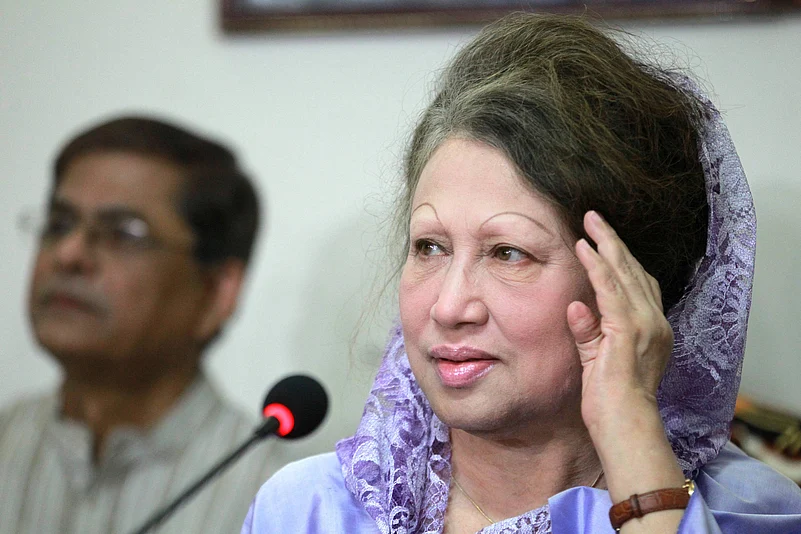
Begum Zia presided over a government in the early 1990s that would shape the country’s next three decades. Photo: IMAGO / ZUMA Press Wire

Summary of this article


Widowed at a young age, Begum Khaleda Zia chose public struggle over private safety, leading an uncompromising movement against Hussain Muhammad Ershad’s military dictatorship and playing a decisive role in restoring democracy in Bangladesh in 1990.


As Bangladesh’s first female prime minister, she shaped the country’s political and economic trajectory through electoral victories, democratic consolidation, women’s education initiatives, economic liberalisation, expansion of the garments industry, and key social and financial reforms.


Despite years of political persecution, imprisonment, and legal harassment, she remained steadfast in advocating democracy, countering extremism, and advancing women’s economic freedom—leaving behind a legacy of courage, reform, and resistance that continues to inspire the nation.

It was never an easy decision for her. After losing her husband in her mid-thirties, any widow with two young children in Muslim-majority Bangladesh would likely find it most comfortable to live a quiet life, focusing on raising her sons to take care of the family in the future. But history will remember her for prioritising her country’s interests over her family. She took up the fight against the dictatorship of Hussain Muhammad Ershad in the early 1980s and led it from the front in an uncompromising manner, which led to the fall of Ershad’s brutal regime in 1990.

Begum Khaleda Zia, Bangladesh’s beacon of hope, the first female prime minister who oversaw the democratic transition after almost a decade of autocracy in the early 1990s, died on December 30th in the Evercare Hospital of Dhaka at the age of 79.


Khaleda Zia's State Funeral Today At 2pm In Dhaka


Khaleda Zia: The End of a Political Legacy


Bangladesh Premier League: December 30 Games Postponed After Ex-PM Khaleda Zia’s Death


Khaleda Zia, Former Bangladesh PM And BNP Chief, Dies At 80


Her political journey began in 1983, when she joined the Bangladesh Nationalist Party (BNP), founded by her husband, President Zia. By then, Ershad, the army chief, usurped the democratically elected BNP government and took over the country. Begum Zia decided to challenge Ershad’s rule and, during her struggle for democracy, unlike her contemporary leaders, never budged or compromised, which earned her the title “Uncompromising Leader” among the masses.


An inherently soft-spoken woman, Begum Zia, earned the respect of people from all walks of life, and her unifying role during the movement attracted the youth en masse who joined her party’s students’ wing and played an active role in toppling Ershad in 1990.


In 1991, her party, the BNP, which was severely attacked by Ershad’s regime during its almost decade-long rule, won a majority of constituencies, thanks to her leadership. She won in all five constituencies she contested, while her Awami League counterpart, Sheikh Hasina, lost in all but one, that too from Gopalganj. Khaleda Zia’s stint as an undefeated leader continued in the next elections; she was never defeated in fair polls.


Begum Zia presided over a government in the early 1990s that would shape the country’s next three decades. Today, Bangladesh has a higher percentage of women in the workforce, universities, and school classrooms; the credit goes to her. After being elected in 1991, her government pushed for mandatory primary schooling, offered generous stipends for female students, and meals for all. By the end of her tenure, the male-to-female ratio in primary schools increased, and in five years, almost 3 million more female students enrolled.


She prioritised economic liberalisation, which led to more women being employed in the country’s burgeoning ready-made garments industry. The number of RMG factories under her tenure increased threefold, and employment in the sector increased by 29%. Her government also implemented some consequential economic reforms. With her support, the finance minister, Saifur Rahman, disciplined the banks, put the stock market in order, and launched a drive to increase tax collections, which contributed to the higher spending in the social safety net.


In her second stint as the prime minister in the early 2000s, her government oversaw the liberalisation of global textile trade, and despite the withdrawal of quotas, Bangladesh’s RMG exports increased. Khaleda Zia rescued Bangladesh from the growing threat of extremists and militant groups who orchestrated several bombings since the late 1990s, almost obliterating their networks within a few years. She was the first prime minister to ban polybags to save the environment and put a stop to cheating during public examinations through strict monitoring. In 2006, when she left the office, Bangladesh marked a 6.7% GDP growth, despite the turbulence on the streets.


After a military-backed caretaker regime took over Bangladesh in 2007, she and her family were implicated in false cases, a practice continued by successive Sheikh Hasina-led governments. Despite the legal harassment, she remained unbowed and mobilised people against the oppression of the Sheikh Hasina regime, for which she was sent to jail in a case that, according to experts cited by the US State Department, lacked evidence. Even from jail, she inspired thousands of her followers to fight for democracy, as reflected in the speeches of the student leaders who became the face of the 2024 July uprising.


Until her death, Begum Khaleda Zia consistently advocated for the restoration of democracy that led to her arrests, and despite these numerous attempts to silence her, she chose not to be quiet. Her determination to stand firm in her pursuit of reforms aimed at enhancing women’s economic freedom and increasing their participation in the workforce — particularly in a Muslim-majority country — serves as a textbook example of empowering women.


Begum Khaleda Zia left a legacy of standing up for rights against all odds. This legacy will inspire the nation for centuries to come.


The author is the Information and Technology Affairs Secretary of the Bangladesh Nationalist Party-BNP.

Published At: 31 December 2025 
BANGLADESH

Protesters Block Key Dhaka Junction Seeking Justice For Sharif Osman Hadi’s Killing

Thousands paralyse central Dhaka demanding arrest of perpetrators in brutal murder of young student; anger mounts over alleged police inaction and political cover-up

Outlook News Desk
Curated by: Pritha Vashishth
Updated on: 26 December 2025 


A girl rescues books from a shop near the premises of the Prothom Alo daily newspaper which was set on fire by angry protesters after news reached the country from Singapore of the death of a prominent activist Sharif Osman Hadi, in Dhaka, Bangladesh. | Photo: AP/Mahmud Hossain Opu

Summary of this article

Protesters block Farmgate junction in Dhaka demanding justice for murdered student Sharif Osman Hadi.

Claim killing was targeted political assassination; accuse police of shielding powerful figures.

Demonstration reflects rising public frustration over political violence and perceived law enforcement inaction.


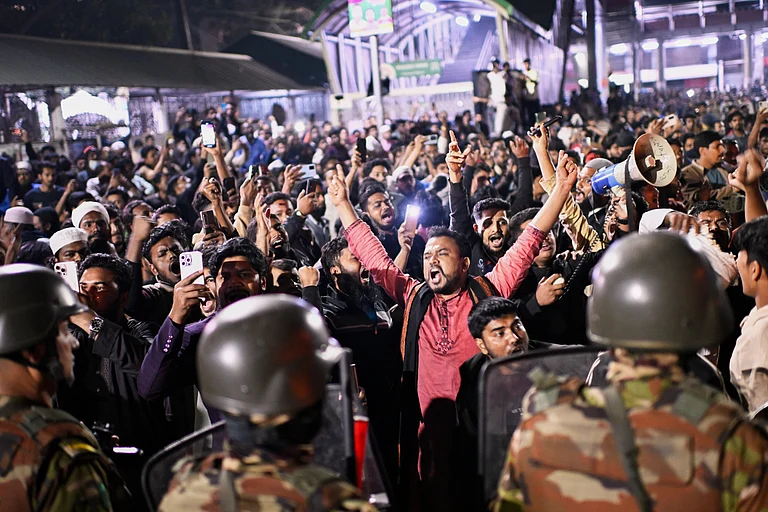
Hundreds of protesters, including students, civil society activists and members of the family of the deceased, blocked the busy Farmgate junction in Dhaka demanding immediate justice for the murder of Sharif Osman Hadi, a 23-year-old university student killed in a suspected targeted attack earlier this month.


The demonstration, which began around midday and continued into the evening, brought traffic to a standstill on one of the capital’s busiest intersections. Protesters carried placards reading “Justice for Hadi”, “End Impunity”, and “Arrest the Killers Now”, while chanting slogans against police negligence and alleged political protection of the culprits.


Sharif Osman Hadi, a student of Dhaka University’s Department of Political Science, was shot dead on December 12, 2025, near his residence in the Mohammadpur area by unidentified assailants on a motorcycle. Police initially registered the case as a mugging attempt gone wrong, but the family and eyewitnesses have consistently claimed it was a premeditated political assassination linked to Hadi’s vocal criticism of local ruling party affiliates and student politics.


The protesters accused the police of deliberately delaying the investigation and failing to arrest any suspects despite clear CCTV footage and witness statements. They also alleged that powerful political figures with links to the ruling party were shielding the perpetrators. The family has publicly named two individuals they believe masterminded the killing.

Related Content


Sharif Osman Hadi Death: Bangladesh Erupts In Violent Protests


Violence Erupts Outside Indian Assistant High Commission In Bangladesh, Several Injured


Who Was Sharif Osman Hadi And Why Has His Death Sparked Protests In Dhaka?


Unrest Erupts in Bangladesh After Killing of Student Leader Sharif Hadi


Addressing the crowd, Hadi’s elder brother said: “My brother was killed because he spoke the truth. The police know who did it, but they are protecting them. We will not leave the streets until justice is served.”


The demonstration was largely peaceful, though police formed barricades and used mild lathi-charge to prevent protesters from marching toward the Prime Minister’s Office. Several student organisations and rights groups, including the Bangladesh Students’ Union and Ain o Salish Kendra, extended support to the protest.


The incident has reignited public anger over rising political violence and law-and-order failures in Bangladesh since the August 2024 change in government. The interim administration has yet to issue an official statement on the protest or the case.

The Politics of Defining Terrorism And Why It Matters

Israel and its allies routinely label all forms of resistance to their brutal occupation as acts of anarchy, and terrorism.


Abdullah M. Abu Shawesh
Updated on: 31 December 2025
THE OUTLOOK/INDIA


 IMAGO / NurPhoto

Summary of this article


Every party adopts its own definition of terrorism, and exploits it for narrow political interests


If the killing of civilians constitutes terrorism, then this principle must be applied universally


It is imperative to ensure that no one exploits human tragedy or manipulates it for selfish political gain

In our lives, we; both as individuals and as groups; have always classified each other. This has occurred throughout history and will likely continue, as it is a natural human tendency. There is no inherent harm in this, as long as such classification is not used to delegitimize or dehumanize others, to erase them from history, or to create a ticking time bomb for future conflict; one that seriously threatens global peace and stability. The danger is especially acute when classifications are based on race, nationality, or religion.

One of the most alarming examples of this misuse of classification is the approach of colonisers and foreign occupying powers toward the resistance of occupied peoples. They routinely label all forms of resistance to their brutal occupation; an occupation and colonisation against which international law explicitly grants peoples the right to resist; as acts of ingratitude, anarchy, and terrorism. This applies regardless of whether the resistance is military or peaceful; all forms are uniformly branded as terrorism, and treated as justification for the killing and annihilation of occupied and oppressed peoples.

One of the most alarming examples of this misuse of classification is Israel’s, backed by its allies, labelling the Palestinian resistance as acts of terrorism. This applies regardless of whether the resistance is military or peaceful; all such acts are treated as justification for killing and annihilation.

In this narrative, terrorism is portrayed as being committed exclusively by Palestinians. Meanwhile, the real terror carried out daily by Israeli soldiers and settlers across the occupied Palestinian territories is, at best, described as “adherence to the rules of engagement” or mere “rioting,” and is rarely, if ever, prosecuted in Israeli courts.

From the Israeli perspective, the killing of more than seventy thousand Palestinians, the famine that has claimed the lives of hundreds of children, the total blockade of Gaza, the daily settler attacks fully backed by the occupation army, the mass arrests of thousands without trial, the deliberate killing of detainees in prisons, and the withholding of Palestinian bodies as bargaining chips; acts that are well documented and represent only the tip of the iceberg; are all justified as “self-defence.”

This reality highlights a fundamental problem: every party adopts its own definition of terrorism, and exploits it for narrow political interests. This should serve as a serious alarm bell, demanding collective attention. The international community must urgently work toward a unified, clear, and universally accepted definition of terrorism. This is in the interest of all, because what one side labels “terrorism,” another may describe as “patriotism,” and the reverse is equally true.

For example, from our perspective, the so-called “Hilltop Youth” constitutes a violent and extremist Jewish terrorist organisation, responsible for numerous acts of terror. Yet this designation is not recognised within Israel. Menachem Begin was internationally wanted as a terrorist prior to 1948, only to later be transformed into a national hero, with public spaces and institutions bearing his name, before becoming Prime Minister in 1977. The same trajectory applies to Yitzhak Shamir, who later also served as Prime Minister.

Another crucial issue is the selective application of standards. If the killing of civilians constitutes terrorism, then this principle must be applied universally and without exception. It cannot be enforced against certain peoples while others are exempted or justified.

Under current double standards, throwing a stone at an armoured military vehicle is labelled terrorism, while the burning of Palestinian homes, assaults on residents, and the killing of civilians by settlers are dismissed as mere “riots,” rather than recognised for what they are; organised terror.

History demonstrates that all occupying powers label resistance movements as anarchist, lawless, violent, and terrorist. The great martyr Bhagat Singh was condemned and executed under the same accusation. Countless similar examples can be found across the world.

Today, even H.E. President Mahmoud Abbas is labelled a terrorist, or a “terrorist diplomat,” by Israeli officials, with some openly calling for his arrest. This further illustrates how the term “terrorism” is routinely weaponised to delegitimize lawful resistance and political leadership under occupation.


Harvesting Death: How Olive Groves Became A Battlefield In Palestine

As long as the international community lacks a unified and clearly defined understanding of terrorism and terrorist acts, every party will continue to claim the right to label others at will. The problem lies not only in the absence of clear definitions, but also in the deepening of divisions among peoples, as well as in the malicious exploitation that such ambiguity enables.

The Zionist movement, through its well-established media arms around the globe, spares no effort to equate Islam as a religion with terrorism worldwide. Many of the movement’s outspoken advocates and amplifiers preach this malicious narrative day and night. Unfortunately, to some extent, they have succeeded, particularly among socialist leaders. This will have a global effect that will spare no one in the future, and could destroy coexistence and the social fabric of many nations around the world.

For the sake of our shared human future, and as long as we believe that the world is one family and that no one is safe until everyone is safe, it is imperative to ensure that no one exploits human tragedy or manipulates it for selfish political gain. It is time for all of us to come together with one loud and clear voice to call for a unified, internationally agreed definition of terror, terrorism, and terrorist acts. Any act or individual falling within the scope and parameters of such a definition must be held accountable.

Leaving the definition of terrorism and terrorists to the discretion of each party is a recipe for the deliberate distortion of terms in the service of narrow and selfish political agendas.

The author is Ambassador of the State of Palestine to India

Views expressed are personal

Published At: 31 December 2025 
India Surpasses Japan To Become World's 4th Largest Economy

India Leaps to Fourth, Surpasses Japan with $4.19 Trillion Economy, Eyes Third Place by 2030 in Defining Year of Robust Growth

Outlook News Desk
Curated by: Pritha Vashishth
Updated on: 31 December 2025 


Summary of this article


India overtakes Japan to become the world’s fourth-largest economy with nominal GDP of - USD 4.187 trillion.


Q2 FY26 real GDP growth hits 8.2% , fastest in six quarters; country remains the world’s fastest-growing major economy.


Government aims to surpass Germany and become third-largest by 2030 with projected USD 7.3 trillion GDP.

India has officially become the world’s fourth-largest economy, overtaking Japan with a nominal GDP of approximately USD 4.187 trillion, the government announced today in its year-end economic stocktake.

The milestone was highlighted by the Press Information Bureau and the Ministry of Finance, which stated that India has moved up from fifth position in 2022 to claim the No.4 spot in 2025, based on the latest IMF and World Bank-aligned estimates. The government described the achievement as a “historic leap forward” and proof of the country’s sustained high-growth trajectory even amid global headwinds.

Key highlights from the official statement include:

Real GDP growth accelerated to 8.2% in Q2 FY 2025-26 — the strongest quarterly expansion in six quarters.


Nominal GDP crossed the USD 4 trillion mark during calendar year 2025.


India remains the fastest-growing major economy, with international forecasts projecting 6.5–6.8% growth in 2026.

The government reiterated its target of reaching the third-largest economy by the end of the decade, with projections placing nominal GDP at USD 7.3–7.5 trillion by 2030, overtaking Germany. Long-term ambition remains to achieve a developed-nation status (high middle-income) by 2047.

While per capita income still lags far behind advanced economies (estimated at -USD 2,900 nominal in 2025), the aggregate size underscores India’s rising global economic weight and its increasing influence in international forums.

Final IMF rankings for calendar 2025 are expected to be published in the April 2026 World Economic Outlook, but government sources said the numbers are already conclusive based on current exchange rates and growth data.