Tuesday, January 27, 2026

European Carmakers Cheer India-EU FTA, But Prices Unlikely to Fall Soon

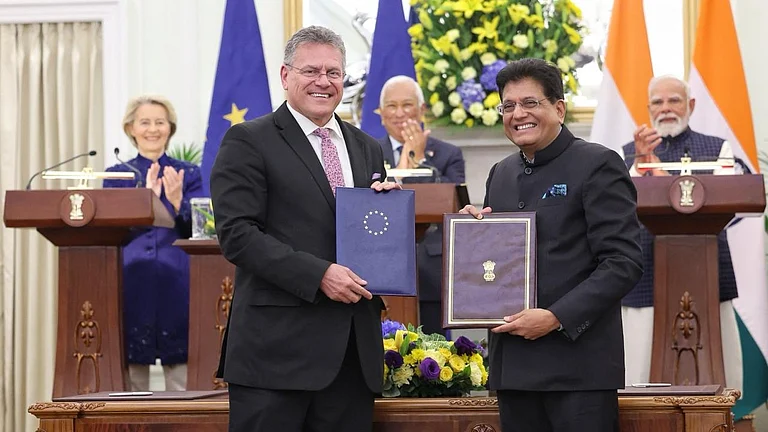
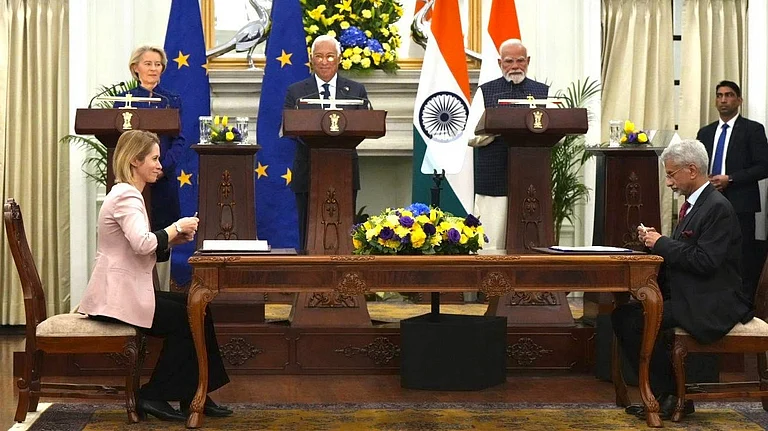
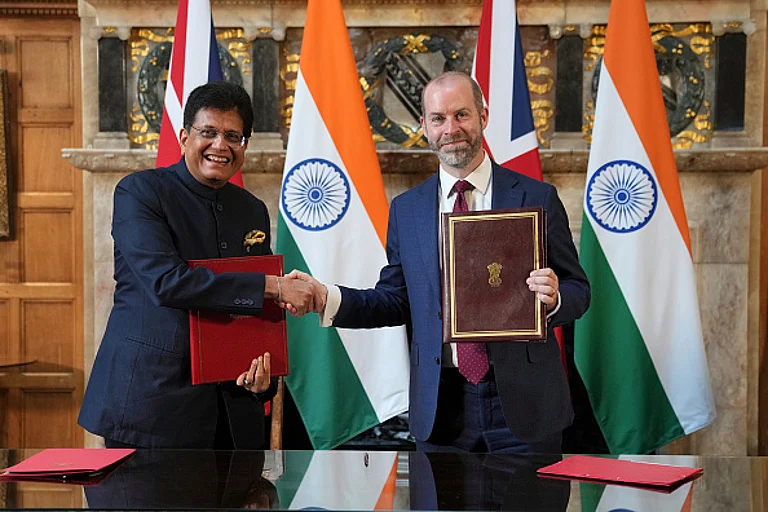
Leaders of both sides exchanged the draft of the finalised agreement on Tuesday in New Delhi. It includes a gradual reduction in import duties on motor vehicles from the current 110% to as low as 10%, subject to an annual quota of 2,50,000 cars

Vikash Tripathi
27 January 2026 
OUTLOOK BUSINESS, INDIA
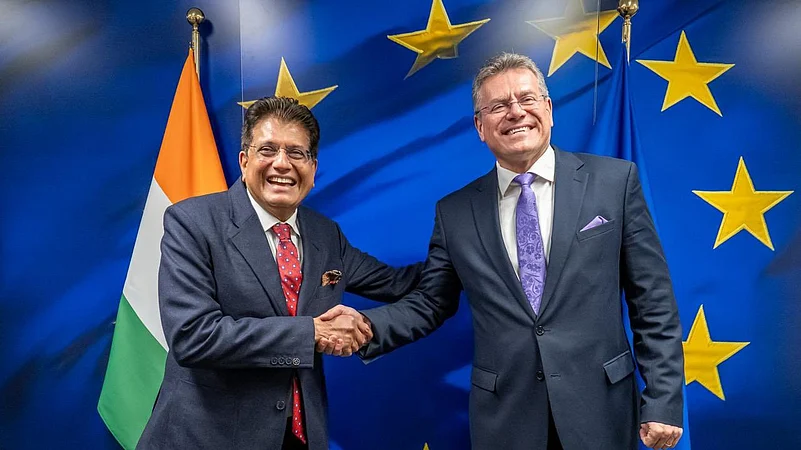

CIM PIyush Goyal meets EU Trade and Economic Security Commissioner, Maros Sefcovic in Brussels Photo: X/@PiyushGoyal


Summary of this article

Luxury European carmakers have welcomed the finalisation of the India–EU Free Trade Agreement (FTA).

The draft of the agreement was exchanged on Tuesday in New Delhi by leaders from both sides.

The deal provides for a gradual reduction of import duties on motor vehicles from 110% to as low as 10%, subject to an annual quota.


Luxury European carmakers, including Mercedes-Benz, BMW and Audi, have welcomed the finalisation of the Free Trade Agreement (FTA) between India and the European Union (EU). However, they do not foresee any immediate reduction in car prices despite lower import duties under the deal.

Leaders of both sides exchanged the draft of the finalised agreement on Tuesday in New Delhi. It includes a gradual reduction in import duties on motor vehicles from the current 110% to as low as 10%, subject to an annual quota of 2,50,000 cars. The trade deal will be implemented after being ratified by legislator of both India and European Commission.
What Major Auto Makers Said?

“Mercedes-Benz welcomes the India-EU FTA as it will have a positive cascading effect on customer sentiment in the luxury segment, supported by overall economic growth. A gradual tariff reduction on vehicles and fully liberalised automotive parts are strategically important decisions in the FTA for the automotive industry,” said Santosh Iyer, MD and CEO, Mercedes-Benz India.

He added that the deal opens new avenues for customers through improved vehicle allocations, faster access to the latest technology and the creation of a stronger luxury car ecosystem. However, he noted that the company will continue to add value for customers through local production.

Mercedes-Benz sold 19,007 cars in the 2025 calendar year and manufactures around 90% of its models in India. This trend is echoed across most European automakers operating in the country, where years of high import duties have driven localisation and reduced dependence on parent companies. In recent years, the premiumisation of Indian market has helped luxury carmakers grow their market shares.

In 2025, India’s luxury car market, comprising vehicles priced above ₹50 lakh, saw modest growth, with total sales estimated at around 52,000 units, up 1.6% from 2024. BMW and Jaguar Land Rover posted solid performances, contributing to a combined total of 48,849 units sold by the top five luxury carmakers in FY25.

“The proposed phased reduction of tariffs on cars and auto components has the potential to positively impact consumer confidence, enable greater product choice, and foster technological innovation and sustainable growth within the Indian automotive sector, particularly in future mobility,” said Hardeep Singh Brar, President and CEO, BMW Group India.

He added that completely built units (CBUs) currently account for about 5% of BMW’s sales in India, and said the deal would allow BMW to broaden its product portfolio, introduce globally popular models and test new offerings.

According to Balbir Singh Dhillon, Brand Director, Audi India, any implications for pricing and the market can only be assessed once the final terms are available and reviewed in detail.

“Until then, it would be premature to draw conclusions on specific commercial or product strategies,” he said, adding that Audi is positive that the India-EU FTA will create a stable and predictable environment for European automakers to invest, innovate and better serve customers in India.

According to Puneet Gupta, Director, S&P Global Mobility, India & ASEAN, the deal will mark the next phase of growth for the Indian auto industry.

“It will create strong business case for OEMs with European parent companies in India. We may see the entry of new brands, including non-European brands manufacturing in Europe. The quota is very attractive at close to 2.5 lakh vehicles, and we could see a significant push for premium cars in India,” said Puneet Gupta, Director, S&P Global Mobility.
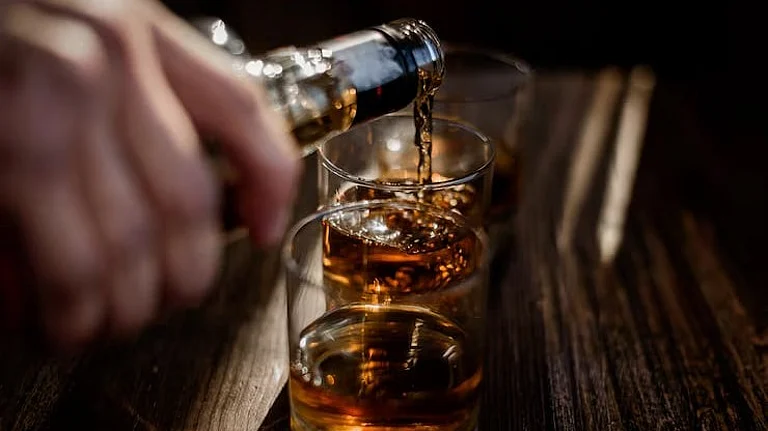


Cheers for Booze! India–EU FTA Brings 20–50% Tariff Cuts on Beers, Spirits


Impact on Indian Carmakers

While European carmakers expect India’s luxury car market to grow, auto industry body FADA said the agreement also opens reciprocal export opportunities for Indian OEMs and strengthens the Make-in-India initiative.

“With over 95% of European OEM sales already locally manufactured, this FTA strengthens Make-in-India, expands consumer choice and opens reciprocal export opportunities for Indian OEMs,” said CS Vigneshwar, President, FADA.

The BMW Group India CEO also noted that luxury vehicles account for only about 1% of India’s passenger vehicle market, adding that the deal would benefit consumers without impacting mass-market players, making it a win-win for both India and the EU.

The agreement does not include duty changes for electric vehicles, which currently attract import duties of up to 100%, depending on price.

“The calibrated tariff glide path, TRQ safeguards and protection for India’s EV trajectory announced today closely reflect the balanced recommendations we had placed on record,” Vigneshwar said.

Meanwhile, Automotive Component Manufacturers Association of India (ACMA) expects the deal to “unlock new opportunities for exports, technology partnerships, and investment-led growth.”

“As global OEMs and suppliers look to build resilient supply chains, a well-balanced and pragmatic FTA can position India as a reliable manufacturing and sourcing partner for Europe, while strengthening our long-standing industrial partnership,” said Vikrampati Singhania, President, ACMA and Vice Chairman & MD, JK Fenner (India).


Trade in auto components between India and the EU has shown steady growth over recent years. India’s exports to the EU rose from $4.30 billion in FY21 to $6.89 billion in FY24, before easing slightly to $6.75 billion in FY25, with exports reaching $3.73 billion in the first half of FY26.

India, EU, Clinch ‘Mother of All Deals’

The FTA will boost investment between India and the European Union and foster new innovation partnerships

Seema Guha
Updated on: 27 January 
BY Outlook News Desk


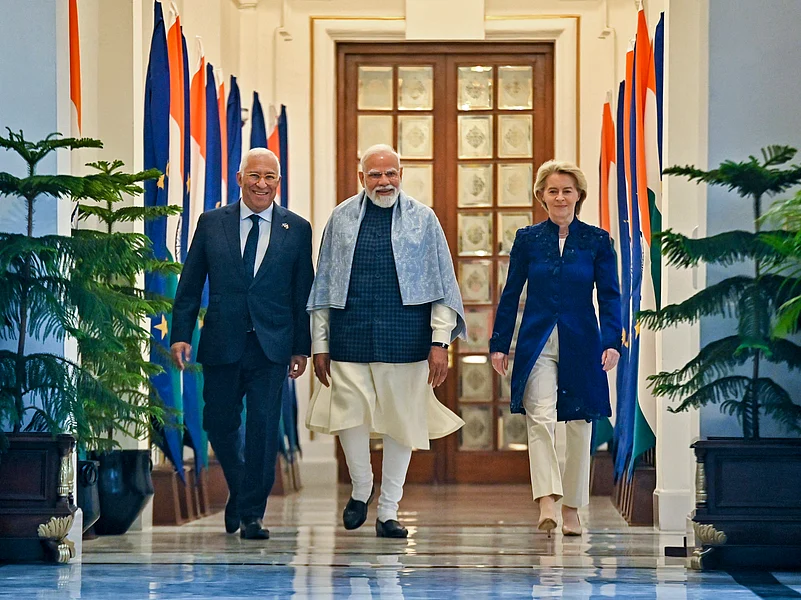
In this image received on Jan. 27, 2026, Prime Minister Narendra Modi with European Council President Antonio Costa, left, and European Commission President Ursula von der Leyen, right, during their meeting at the Hyderabad House, in New Delhi. Photo: | PTI |


Summary of this article


PM Modi called the India-EU relationship a ``partnership for global good’’ and a stabilising force in a ruptured world.


European Council President António Costa called it a new chapter in relations on trade, security and people to people ties


"PM Modi, we did it! We delivered the mother of all deals," beamed European Commission President Ursula von der Leyen

After nearly 18 years of on-again, off-again negotiations, India and the European Union on Tuesday announced a long-awaited free trade agreement, a deal triggered by economic logic and fast-tracked by the disruptive force of US President Donald Trump’s trade war. It would be interesting to see Trump’s reaction to the announcement from New Delhi and Brussels and whether this prompts action from Washington.

Today’s announcement does not mean that tariffs will drop immediately. It marks the political finish line: the whole complicated legal marathon will take more time. By all counts the pact is unlikely to come into force before 2027. But its announcement marks a decisive shift, signalling New Delhi’s deepening turn towards Europe. A security pact has also been signed, as both sides move to insulate themselves from growing uncertainty in the global trading order and put in place a vision for further defence and strategic co operation.

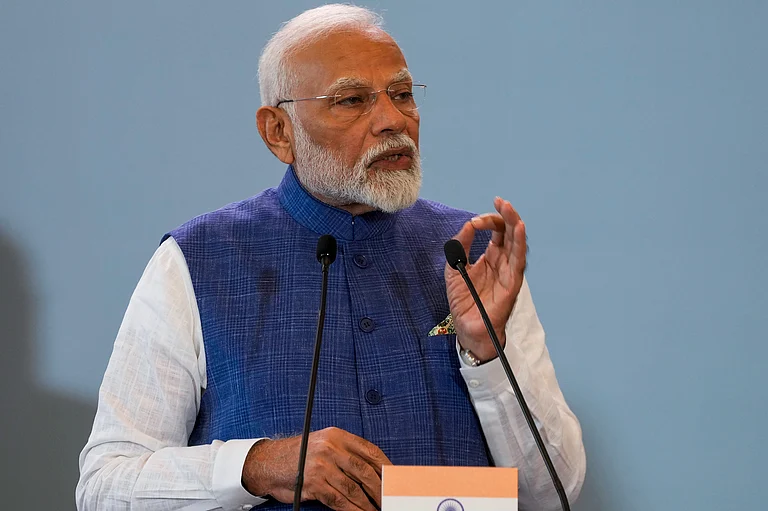
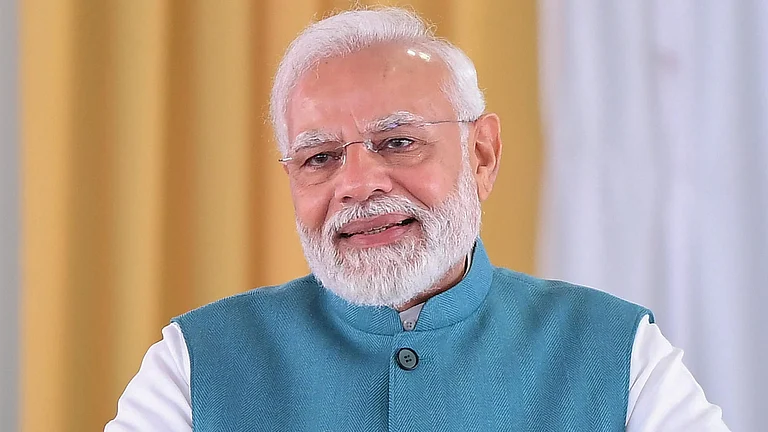
Prime Minister Narendra Modi called the India-EU relationship a "partnership for global good’’ and a stabilising force in a ruptured world. He said the two powers will advance trilateral projects from the Indo-Pacific to the Caribbean and establish the India-Middle East-Europe Economic Corridor (IMEC) as a vital link for global trade.

Related Content


India-EU FTA Blueprint for Shared Prosperity: PM Modi


PM Modi Says EU Agreement Signed, Hails ‘Mother Of All Deals’


EU, India On Verge Of Historic Free Trade Agreement, Says Ursula Von Der Leyen


India, EU Reaffirm Commitment To Early Conclusion Of Free Trade Agreement Talks


"Today, India has concluded the largest Free Trade Agreement in its history. It is a happy coincidence that on the 27th day of the month, India is entering into this FTA with the 27 Member States of the European Union. This historic agreement will facilitate easier access for our farmers and small enterprises to European markets, create new opportunities in manufacturing, and further strengthen cooperation across our services sectors.

Moreover, this FTA will boost investment between India and the European Union, foster new innovation partnerships, and strengthen supply chains at the global level. In other words, this is not merely a trade agreement; it is a new blueprint for shared prosperity.

European Council President António Costa said: “Today is a historic moment, we are opening new chapter in our relations on trade, security and people to people ties.’’ He went on to add, “Our summit sends a clear message to the world when the global order is being fundamentally reshaped that India and the EU stand together as strategic and reliable partners. Today we are taking our partnership to the next level as two largest democracies.’’ Costa, whose family migrated from Goa, also held up his PIO card and said “I am President of the European Council but I am also an Overseas Indian Citizen. As you can imagine, it has a very special meaning. I am very proud of my roots in Goa.”

He highlighted the significance of the newly signed agreement on a security and defence partnership, noting it is the first such overarching framework ever established between India and the European Union to counter the full range of threats across the Indo-Pacific, Europe, and the world.

The bonhomie in the room was evident as Modi, Costa and European Commission President Ursula von der Leyen were all smiles. "PM Modi, we did it! We delivered the mother of all deals," Leyen beamed at the PM as she began her speech.

Slashing of tariffs will give a fillip to trade with EU. India will give market access to European products, including cars and wine, while EU will make exports of textiles and pharmaceuticals among other goods easier.

“The EU stands to gain the highest level of access ever granted to a trade partner in the traditionally protected Indian market,” von der Leyen said on Sunday, adding that she expected exports to India to double. “We will gain a significant competitive advantage in key industrial and agri-good sectors,” Reuters quoted her as saying. Ironically the US is pushing India hard on opening up its agriculture to American exports.

Expected Timeline for the FTA

FTAs take time to implement. After today’s announcement, the next five to six months will be spent on legal scrubbing as lawyers from both sides go into each clause in minute details to ensure it is water tight legally. Ratification by EU parliament is expected mid 2026. The formal signing of the agreement will perhaps be in the middle of the year when Prime Minister Modi visits Brussels and come into effect by 2027. However Commerce Minister Piyush Goyal says India will try to fast-track the deal by the end of this year.

While for India the pact is endorsed by the Cabinet, the EU Parliament will have to endorse the trade part of the pact with a vote. This includes tariffs, services and digital trade. The 27 members do not have to vote in their home Parliaments. Yet there could be domestic pressures from many of the 27-nation groups that are in different levels of development. So far nothing is known on this but will probably surface once the agreement is announced and details known. Legal wrangling will come up for the Investment Protection Agreement which includes dispute settlements and what happens if a company flaunts rules is left for later negotiations.

India already has a $100 billion free trade agreement with the European Free Trade Association nations comprising Norway, Switzerland, Iceland and Liechtenstein, which was signed in 2024.

Besides the announcement of the FTA, a number of other important agreements were signed during the India-EU summit. These include a comprehensive document on strategic partnership that would elevate India’s ties with the EU to another level. But the question remains will this hold if Washington decides to put pressure on both the EU and India? How many nations can withstand American pressure, more so as NATO members?

Several Memorandum of Understanding (MOU) were also signed, one between the Reserve Bank of India and European Securities and Marker Authority, as well as oadministrative arrangement for electronic signatures and seals to help trade and make payments easier. Negotiations for an India-EU security of Information agreement was launched today. This could take a few months to complete. A Mou on mobility was also signed today. Together with this a Legal Gateway Office in India to enhance skill mobility.

A agreement to jointly implement four projects under the India-EU Trilateral Co-operation on Digital Innovation and Skills Hub for Women and Youth. These include Solar-Based Solutions for Empowering Women Farmers in Agriculture and Food Systems; Early Warning Systems; and Solar Based Sustainable Energy Transition in Africa, and Small Island Developing States in the Indo-Pacific and Caribbean.


When children disclose abuse, families in rural Andhra Pradesh, India, often respond with silence


Art depicting protection and care for children. Image via Wikimedia Commons by Sumita Roy Dutta. CC BY-SA 4.0.

Art depicting protection and care for children. Image via Wikimedia Commons by Sumita Roy Dutta. CC BY-SA 4.0.

India has enacted strong child protection laws over the past decade, including the Protection of Children from Sexual Offences (POCSO) Act, 2012, which criminalises sexual abuse of children and mandates child-friendly reporting and judicial procedures.

Yet across many parts of the country, particularly in rural and semi-rural areas, families continue to struggle with how to respond when children disclose abuse. Legal provisions exist, but the moment of disclosure often unfolds inside households shaped by social hierarchy, economic dependence, and community scrutiny.

This article draws on community-level reporting conducted between July 2023 and November 2024 in Andhra Pradesh, a state in southeastern India, across multiple mandals — local administrative units comparable to counties — including Prathipadu, Yeleswaram, Gandepalli, Kirlampudi, Sankhavaram, and Jaggampeta, primarily in and around Kakinada district, a coastal administrative district in the southeastern Indian state of Andhra Pradesh.

The reporting was carried out during child protection awareness sessions facilitated by SafeTalks, a community-based child protection initiative, along with follow-up conversations with children, adolescents, teachers, mothers, caregivers, and adult survivors. These were informal interactions rather than structured interviews, shaped by local language, cultural norms, and the sensitivity around the topic.

Awareness reaches children, but adults remain unprepared

In recent years, awareness about child sexual abuse has expanded in schools and community programs across India. Children are increasingly taught about “good touch” and “bad touch,” personal boundaries, and the importance of speaking up.

However, the reporting found that adult caregivers are rarely included in equal depth. While children may learn how to recognize abuse, families often receive little guidance on how to respond if a disclosure occurs.

Research reflects this gap. A 2024 study conducted in urban slums of Kakinada district found that although some adolescents could identify abusive acts, none of the participants were aware of the POCSO Act, and most did not know where or how to seek help after abuse.

The study also highlighted widespread confusion about disclosure pathways and available support mechanisms, a pattern echoed repeatedly during the field reporting.

When disclosure becomes a family survival decision

In many of the communities observed, families are organized around caste and kinship networks. The Caste system refers to long-standing social groupings in India that influence social authority, marriage practices, and everyday interactions. Within these systems, families often depend on elders, extended relatives, and community leaders for social legitimacy and economic stability.

In such settings, disclosure of abuse was rarely treated as a private interaction between a child and a trusted adult. Instead, it frequently became a family crisis, requiring decisions that weighed social standing, financial dependence, marriage prospects, and community reputation.

Caregivers described how abuse — particularly when the alleged perpetrator was a known individual — triggered fear of social exposure. In communities where families are closely interconnected, even seeking advice could risk becoming public knowledge.

In the study, several caregivers reported not knowing where to report, who to approach, or what consequences would follow if formal systems were engaged. This uncertainty often resulted in delayed responses, internal handling of disclosures, or silence.

The long shadow of adult silence

India has established multiple child protection reporting avenues, including CHILDLINE 1098, a 24-hour toll-free emergency helpline, and the e-Box, an online reporting platform managed by the National Commission for Protection of Child Rights.

Yet awareness of these mechanisms was inconsistent among caregivers interviewed during this reporting process. Some had heard of helplines but were unsure whether they were confidential, whether reporting would involve police action, or whether their child would be exposed to stigma or retaliation.

The reporting also included conversations with adult survivors who reflected on how family responses shaped their long-term well-being.

One woman in her mid-twenties, who asked to remain anonymous, shared that she disclosed abuse during childhood but felt her family struggled to respond protectively. While she is now financially independent and engaged in therapy, she described how unresolved silence continued to affect her sense of safety and relationships.

“I wish my mother had responded differently and trusted me fully when I spoke,” she said.

Her account echoed a broader pattern: families did not necessarily dismiss disclosures out of indifference, but often lacked the tools, confidence, or social permission to respond in ways that centered the child.

Beyond awareness: addressing the adult context of protection

The experiences documented across these mandals suggest that child protection cannot rely solely on educating children. Disclosure occurs within families, and families operate within social systems that shape what responses feel possible.
Without accessible guidance for caregivers — on how to respond, where to seek confidential support, and how to prioritise a child’s safety without triggering social harm — awareness risks stopping at recognition rather than leading to protection.

The study from Andhra Pradesh highlights a critical but often overlooked reality: what happens after a child speaks is determined not only by law but also by the social worlds that families must navigate once silence is broken.

INDIA

‘Fear Sold as Safety’: Domestic Workers’ Groups Slam Hiring Platforms, Seek Regulation

Analysis

Labour

THE WIRE
26/Jan/2026

The criticism follows the release of a public statement by the Bengaluru-based Domestic Workers Rights Union and allied groups, condemning the way platforms were advertising.


Representative image. Photo: mdreza jalali/Unsplash


New Delhi: Domestic workers’ rights organisations, labour law experts and feminist activists have criticised what they describe as a growing trend of fear-based advertising by digital domestic work hiring platforms, warning that such campaigns criminalise an already vulnerable workforce while operating with little regulatory oversight.

The criticism follows the release of a public statement by the Bengaluru-based Domestic Workers Rights Union (DWRU) and allied groups, condemning advertisements and platforms such as BookMyBai that promote paid “background verification” services through claims suggesting domestic workers are disproportionately involved in crime. One widely circulated claim; that “3 out of 10 maids have committed some form of crime”, has been flagged by experts as unsupported by publicly available data, peer-reviewed research or transparent methodology.


BookMyBai App Interface
‘Marketing built on class bias’


“Framed as safety advisories, these claims function as marketing tools that trade on class bias,” Flavia Agnes, senior advocate and women’s rights lawyer, told The Wire. “Portraying domestic workers as potential offenders without credible evidence amounts to defamation.”

Activists argue that such messaging does not enhance safety but instead fuels suspicion against an entire category of workers. According to the statement, these narratives rely on entrenched social hierarchies of class, caste, and gender, turning fear into a business model.

Speaking to The Wire, human rights activist Geeta Menon said, “India’s domestic work sector employs millions of workers, the vast majority of whom are women from migrant, Dalit, Adivasi, and minority communities.”

“Despite their central role in sustaining urban households and care economies, domestic workers remain outside the scope of comprehensive labour protections, leaving them particularly vulnerable to abuse,” added Menon.

Invisible labour, routine abuse

As outlined in the statement, domestic workers routinely face wage theft, excessive working hours, arbitrary termination, and verbal abuse. The risks are significantly higher for live-in domestic workers, many of whom report being denied freedom of movement, prevented from returning home, or having identity documents and wages withheld.

“Live-in domestic workers are among the most invisible workers in this country,” labour researcher Nirmala Banerjee told The Wire. “What we see repeatedly is illegal confinement and unpaid labour, but there is almost no institutional outrage when employers violate the law.”

In contrast, accusations against domestic workers, particularly allegations of theft, often trigger immediate police action.

“The presumption of guilt is automatic,” Menon told The Wire. “Workers are detained, interrogated, and sometimes coerced into confessions without any evidence or due process. This imbalance is core to the structure, not incidental.”

Platforms as informal ‘blacklists’

A major concern flagged in the statement is the role of digital platforms in amplifying this imbalance. Several platforms allow employers to post complaints, upload photographs and circulate allegations against domestic workers without verification. These posts often function as informal “blacklists” that permanently damage workers’ employability.

“Once a worker is labelled ‘unsafe’ online, there is no way back,” Agnes told The Wire. “Even when platforms add disclaimers saying allegations may be unverified, the damage is irreversible. A worker loses income, dignity, and sometimes personal safety.”

Activists also point out the asymmetry built into these systems: while employers are given expansive digital spaces to accuse and warn others, domestic workers have no comparable mechanisms to report wage theft, abuse or unlawful confinement.

“This is a one-way accountability system,” Banerjee told The Wire. “Employers can accuse publicly; workers cannot defend themselves publicly. That asymmetry tells you exactly whose safety matters in these platforms’ business models.”

Verification vs fear

The statement clarifies that background verification itself is not the issue. Instead, the concern lies in how verification is framed and operationalised.

“Verification is not inherently unethical,” human rights advocate Shalini Gera told The Wire. “What is unethical is framing verification through fear, suggesting that domestic workers as a group are dangerous and must be policed.”

Campaigns that portray domestic workers as inherent risks, the statement argues, cross ethical and moral boundaries by normalising suspicion and collective punishment.

Religious filtering and domestic gaps

Experts have also raised alarm over reports that some platforms allow employers to filter domestic workers by religion.

“This is unconstitutional, plain and simple,” constitutional law expert Faizan Mustafa told The Wire. “Filtering workers by religion violates the principles of equality and secularism and normalises discrimination in the labour market.” The practice, activists warn, entrenches social exclusion and further marginalises a workforce that already lacks legal and institutional protection.

The statement draws attention to India’s ratification of the International Labour Organisation’s Convention 189 on Decent Work for Domestic Workers, which mandates legal recognition, fair working conditions and effective grievance redressal mechanisms.

“India has ratified the convention on paper, but not in practice,” Mustafa told The Wire. “Instead of strengthening worker protections, we are allowing private platforms to act as judge, jury, and executioner.”

Union’s demands


The DWRU has called for the immediate withdrawal of misleading and stigmatising advertisements, legal scrutiny of discriminatory hiring practices, and accountability for platforms that publish unverified accusations. The union has also demanded mandatory registration, regulation, and oversight of all placement agencies and digital platforms involved in the recruitment and hiring of domestic workers.

Emphasising the need for a shift in public discourse, the union said domestic workers must be recognised as individuals with enforceable rights, access to grievance redressal mechanisms, and legal protections. It urged policymakers and the public to focus on systemic issues such as wage theft, abuse, and employer violations, rather than relying on fear-driven narratives.

Speaking to The Wire, economist and gender studies scholar Ritu Dewan said: “This is not about denying safety concerns.”

“It is about insisting that safety cannot be built on humiliation, suspicion, and profit-driven fear.”
Film

‘The Last First: Winter K2’ Widens the Emotional and Ethical Frame of the Mountaineering Documentary


Tatsam Mukherjee
26/Jan/2026
THE WIRE

It reminds us that history’s greatest feats are often built on quieter, irreversible losses.


A still from The Last First: Winter K2.

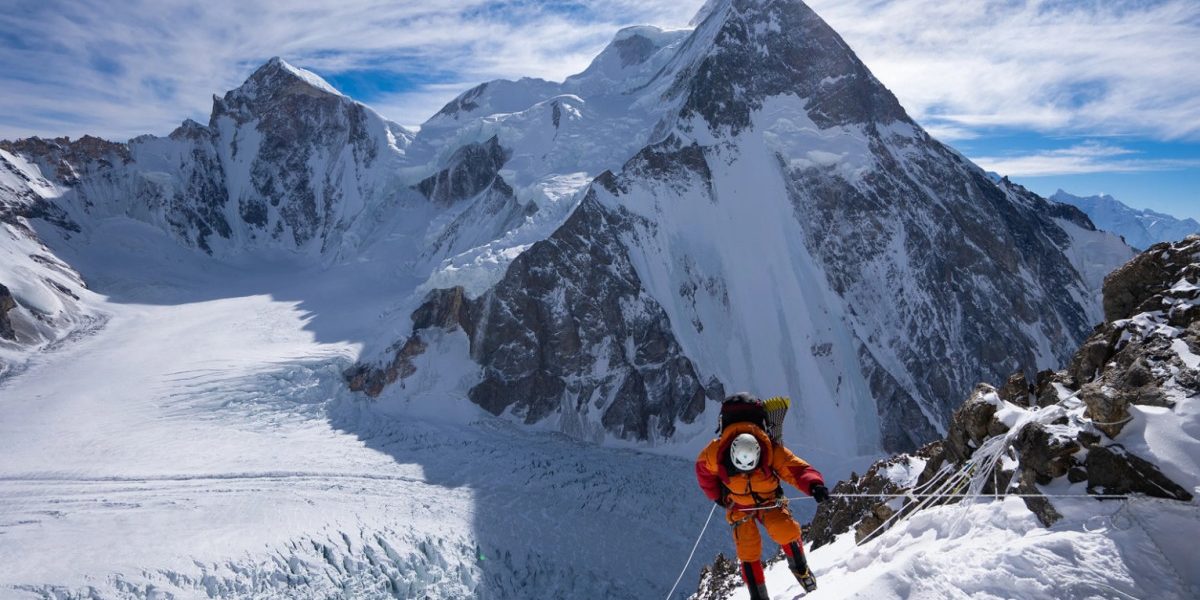
Sometime in December 2020, Icelandic mountaineer John Snorri was on the cusp of making history. He was getting ready to scale the second highest mountain peak, the K2, in the winter. Around then the temperatures go down to -60 degrees celsius near the peak. Compounded with the steep incline of the K2 (part of the Karakoram range) with winds blowing up to 150 mph, even experienced mountaineers dubbed it as a tricky climb. Every other record in the mountaineering world had been achieved. Having arrived in Northern Pakistan a good two months in advance, to help himself acclimatise to the conditions, Snorri – with his Pakistani counterparts, Ali Sadpara and his son Sajid – looked set to take on arguably the most gruelling climb ever attempted.

However, as they prepared themselves at base camp – which had been silent since Snorri’s crew was the only one there – they were surprised to hear other voices. It was a Nepali crew – led by Nirmal Purja and Mingma Gyabu Sherpa – who were attempting for the same record as Snorri. A few days apart, there was also a commercial expedition led by a hiking company called Seven Summits, which brought a dozen climbers with varying skill. Even though it wasn’t how Snorri had intended this to be, the climb had suddenly become a race.

The mountaineering documentary has carved a niche for itself in the recent years, with Alex Honnold-starrer, Free Solo, winning the Academy Award for Best documentary, and climbers like Honnold, Tommy Caldwell becoming worldwide celebrities, thereby influencing more people to take on this extreme sport. Most mountaineering documentaries, are as much thrillers, as also cautionary tales about those testing the limits of one’s hubris. Amir Bal-Lev’s The Last First: Winter K2 offers a sensational, multi-faceted recounting of the tragic climb in 2021 – which resulted in more than half a dozen deaths – thereby revising and expanding the scope of what mountaineering documentaries should cover.


A still from The Last First: Winter K2.

What begins as a film with Snorri as its protagonist, suddenly shoves him off stage, to platform more than half a dozen characters, who are all climbing for their own personal reasons. We learn about Ali Sadpara’s legend in Pakistan (and around the world) while seeing him being jovial and silly, dancing to popular Pakistani songs. We learn about Purja, a Nepali mountaineer who inspired a Netflix documentary, and has gained notoriety in climbing circles in the last few years. And also about filmmaker Elia Saikaly – who wished to film this historic moment, and a company called Seven Summits, which led an expedition of amateur climbers including the likes of pro-endurance athlete, Colin O’Brady.

Bar-Lev’s film does a beautiful dance, shifting the film’s point-of-view several times in the first hour, to showcase the complexity of the dynamic during the climb. There’s an obvious tension between the Westerner Snorri and Purja’s crew of Sherpas. Most mountaineering summits are credited to white-skinned folk, while locals who charted the route for them are left as footnotes. The hiking company, Seven Summits, sees this climb as a way of survival – as the world shut down for several months during the pandemic. They occupy a murky territory during the proceedings, where they fail to convince some of their patrons to descend from the second camp (about 7000m above sea level) – the climb from where could be potentially fatal.

Bar-Lev is also interested in how social media has penetrated and probably contributed to some foolish decisions in mountaineering, where several folks, drunk on their optimism, endanger the lives of other climbers. There’s also the track of nationalistic pride fuelling these climbs, where Purja wants to hoist Nepal’s flag on the peak of K2, and there’s the intrusion of the Pakistani military telling Ali and Sajid Sadapara to continue the climb alongside Snorri, for the sake of the nation’s pride.

Bar-Lev’s film often delves into the ‘bravado’ of extreme sports, where everyone is competing with others, but also with their own mind, trying to explore the limits of their own body. But unlike other documentaries, it isn’t in awe of the daredevilry of its subjects. It understands that these climbers are dangling over the thin crack between bravery and foolishness. It shines a light on the human mind, capable of cut-throat cruelty, greed, overestimating one’s potential, and of grappling with unimaginable grief. The film doesn’t spend more than a few minutes on Purja’s ascent on an early morning, which allowed his crew to win the race and become the first person to conquer the K2 in the winter.

The Last First: Winter K2 doesn’t care so much about this conquest. The film goes on for another half an hour, after the race has seemingly ended. It recounts the reasons behind what propelled some of the other seemingly level-headed folks to keep going, only for some to meet with tragic ends. It underlines a variety of the reasons, proving to be an indictment of the adventure film. In looking beyond the summit, The Last First: Winter K2 widens the emotional and ethical frame of the mountaineering documentary. It reminds us that history’s greatest feats are often built on quieter, irreversible losses.

*The Last Winter: Winter K2 had its world premiere at the 2026 Sundance film festival in Park City, Utah.


Pulling Out All Stops to Keep Colonialism Afloat


Prabhat Patnaik 


The very aggressiveness of capitalism, its very effort to roll back the historical advances made by the people, underscores the necessity of socialism.


Activists participating in the People's Summit for Democracy rallied outside the Los Angeles Convention Center in June 2022 to demand lift sanctions against countries like Cuba and Venezuela. Photo: Midia Ninja

Post-war imperialism was founded upon a basic contradiction, which becomes clear when we compare it with the pre-World War I period. The leader of the imperialist world in any period typically fulfils its leadership role by running an overall balance of payments deficit vis-à-vis other major countries to which capitalism is getting diffused. This is so for several reasons: it has to make capital exports to help the diffusion of capitalism; it has to keep its markets open for goods produced by these newly-industrialising countries to which capitalism is getting diffused; it has to undertake military expenditure to maintain its hegemony; and it has to periodically fight actual wars.

The leader’s running a balance of payments deficit for all these reasons is almost an inexorable law of capitalism. Accordingly, the leading capitalist country of the pre-WWI period, Britain, had an overall balance of payments deficit, taking its current and capital accounts together, vis-à-vis the other emerging capitalist countries of that period, namely, Continental Europe, the United States, Canada, Australia, New Zealand and South Africa. But while running this deficit Britain did not get into any external debt; on the contrary, it had a net creditor’s position vi-a-vis the world as a whole.

This was made possible because of its tropical colonies of conquest (as distinct from its temperate colonies of settlement), and it happened in two ways: first, by Britain selling in these captive colonial markets its goods, which were being increasingly ousted by competition from capitalist producers in the newly-industrialising countries. This ousting occurred both in the markets of the new industrialisers and also in Britain’s own home market.

Second, Britain simply appropriated, without any quid pro quo, the entire net foreign exchange earnings of these colonies, the part that corresponded to their commodity export surplus to these newly-industrialising countries. (This phenomenon was called the “drain of wealth” by the Indian anti-colonial writers and was noted by Karl Marx in a letter to the Russian Narodnik economist N.F. Danielson in 1881).

Britain thus managed to maintain its leadership role without facing any difficulties because it could fall back on its colonial empire to sustain that role. For instance, Britain’s overall balance of payments deficit vis-à-vis Continental Europe and the United States in 1910, taking both current and capital accounts together, was 95 million pounds (out of a total of 145 million pounds with all countries with whom Britain had a deficit); of this as much as 60 million pounds came from only one colony, namely India (see S.B.Saul, Studies in British Overseas Trade); in addition, of course, it had similar extractions from the West Indies, Malaya and other colonies.

Now, the basic contradiction of post-war capitalism consisted in the fact that the leading imperialist country of this period, the United States, did not have any such colonies. It could neither access colonial markets, which constituted, to use S.B. Saul’s words, “markets on tap”, nor use any colonies as sources of loot. Fulfilling its leadership role in the absence of any British-type colonial empire, required therefore its getting increasingly into debt. We thus had this bizarre situation where the leading capitalist country of the world also became over time the most indebted country in the world.

This did not, of course, matter immediately since the rest of the world was perfectly willing to hold on to the IOUs pouring out of the US, namely the American dollars or dollar-denominated assets, as the dollar was considered to be “as good as gold”.

There was a brief setback to this belief when there was a rush to exchange dollars for gold in the early 1970s: the dollar was exchangeable for gold at $35 per ounce of gold under the Bretton Woods system and this provided scope for people to move away from the dollar and move into gold when there was an upsurge of inflation all across the world.

But after the gold convertibility of the dollar was officially ended and the Bretton Woods system abandoned because of this, the confidence in the dollar gradually returned and wealth-holders once again went on holding American dollars without any complaints. The US leadership of the capitalist world thus remained intact even after the end of the Bretton Woods system.

While this meant avoidance of any crisis arising from the basic contradiction of functioning without colonies, there always remained, however, the possibility of a future crisis, since this contradiction itself persisted. The confidence in the dollar arose among other things from the belief that the inflation rate within the US would never be so high as to induce wealth-holders to move away from the dollar to some commodity. And this belief in turn was rooted in the conviction that the dollar price of labour power would always remain within bounds through the existence of sufficient unemployment, and the price of the most important current input, oil, would remain restrained though the imposition of US hegemony over the oil-producing world. The possibility of these conditions getting undermined however always remained.

The US hegemony over the oil producing world became threatened as several oil producers like Iran, Russia and Venezuela got into antagonistic relations with it and even became targets of sanctions by it. Because of the sanctions, they began entering into arrangements with other countries to sell their oil in currencies other than the dollar. This began to erode the dominance of the dollar and portended a possible crisis in the future.

Besides, the very fact of becoming more and more embroiled in debt, even if this debt is readily held, is not a prospect that the US relished. The prevailing situation, therefore, was becoming increasingly unacceptable to the US and the Donald Trump administration finally decided to curtail altogether the balance of payments deficit of the US and hence reduce the debt it incurs at the margin.

Trump’s imposition of tariffs on imports from the rest of the world is one manifestation of this desire to curtail the payments deficit. The decision to sell American energy which earlier used to be stored within the US itself is another manifestation; and the drive to acquire colonies, especially those endowed with rich mineral resources, so that these resources can be looted (as the tropical colonies earlier could be through the “drain”) to pay for the US balance of payments deficit is another. This is not to say, of course, that other motives did not underlie each of these decisions; it is simply to highlight one important common motive.

Liberal opinion tends to blame Trump for the current ultra-aggressive stance of the US and there is no doubt that a major difference exists between Trump and the other Presidents, in so far as Trump is a neo-fascist while the other at worst could be considered only arch-conservative. But to single out Trump as the sole villain is to turn a blind eye to the frailties of the system as a whole.

What Trump’s action against Venezuela demonstrates is not just his aggressive intent, but also the fact that capitalism functions properly only when it is sustained by direct colonies; and Trump understands this in an intuitive manner. Neo-liberalism and other such ways of controlling the world’s resources by the metropolis, which have been the instruments used until now, are not half as effective as direct colonial rule.

This indeed is the exact opposite of what liberalism believes, which is that the subjugation of people through colonial oppression might have occurred in the past but is not intrinsic to capitalism, that capitalism can function in a peaceful manner through international cooperation, just as it can maintain class cooperation and a welfare state in the metropolis. Trump’s behaviour deviates from this idealised picture of capitalism not because he is a nasty person but, above all, because this idealised picture itself is untenable and Trump’s nastiness fits in with the contemporary requirements of capitalism.

This implies that it is capitalism, not Donald Trump, that is pushing mankind to an extraordinarily dangerous situation. Historical advances such as democracy, decolonisation and the welfare state, which had been made through the struggles of the working people against the system at a time when it was vulnerable because of the socialist challenge, are being sought to be rolled back, now that this challenge appears to have abated. But the very aggressiveness of capitalism, its very effort to roll back the historical advances made by the people, only underscores the necessity of socialism.

Rosa Luxemburg’s assertion that mankind faced a stark choice between socialism and barbarism is being amply vindicated today by Trump’s desperate shenanigans to keep imperialism afloat.


Prabhat Patnaik is Professor Emeritus, Centre for Economic Studies and Planning, Jawaharlal Nehru University, New Delhi. The views are personal.

 INDIA

Maharashtra: 50,000-Strong Adivasi, Farmer March to Palghar on Indefinite Dharna for Land Rights


Sabrang India 


The CPI (M)-led massive long march from Charoti to Palghar in Maharashtra ended with a dharna at the Collector’s office, Palghar.


Demanding community ownership rights under the Forest Rights Act, 2006 and restitution of the Mahatma Gandhi Rural Employment programme (MNREGA), 50,000 women Adivasi and other farmers have been marching from Charoti to Palghar in Maharashtra with their demands. The key demands of this March are as follows: Rigorous implementation of the Forest Rights Act; Vesting of all temple, inaam and govt land in the name of the tillers; Restoration of MNREGA; cancellation of the Smart Metre scheme; Implementation of PESA; Repeal of the Labour Codes; Cancellation of the Wadhwan and Murbe Ports in the Dahanu coastal region; Water for drinking and irrigation; Increased facilities for education, employment, ration, health, and among others.

Protesters are mostly from the tribal communities of Palghar district. They had started their trek towards the collectorate, demanding better implementation of land rights, reinstatement of the MGNREGA, cancellation of the Vadhavan port and availability of water for drinking and irrigation purposes, among others. Accompanied by protest songs on microphones, striding purposefully with CPI-M flags and banners, chanting slogans, protesters reached the Collectorate office of Palghar on the evening of January 20, where they plan to camp until their demands are met – the most longstanding of which is the enforcement of land rights. Adivasis have been tilling forest and grazing land for centuries but still don’t own the plots they cultivate.

The Forest Rights Act, 2006, vests forest land and resource rights in Scheduled Tribes and other traditional forest dwellers who have resided in such areas for generations. Gram sabhas initiate claims, verified through sub-divisional and district committees, protecting dwellers from eviction until their rights are settled. But most of the tribal farmers at the rally have not had their claims approved. The last time that farmers marched in their thousands was from Nashik to Azad Maidan in Mumbai, a stretch of 180 kilometres with several marchers barefoot.

Mass organisations All India Kisan Sabha (AIKS), Centre of Indian Trade Unions (CITU), All India Democratic Women’s Association (AIDWA), Democratic Youth Federation of India (DYFI) and Student’s Federation of India (SFI) and Adivasi Adhikar Rashtriya Manch (AARM) have also joined this March in huge numbers. Beginning the long walk on January 19, the marchers have reached the Palghar Collectorate where they were denied permission for the dharna inside the Collectorate. Undettered they have begun the indefinite protests outside.

Citizens for Justice and Peace has long analysed national and international law on Farmers Rights. Some of these may be read here and here.

The March is being led by CPI (M) Polit Bureau member and AIKS National President Dr Ashok Dhawale, Polit Bureau member and AIDWA National General Secretary Mariam Dhawale, Central Committee member, state secretary and AIKS National Joint Secretary Dr Ajit Nawale, Central Committee member and CITU State Secretary Vinod Nikole, two-term MLA from Dahanu, State Secretariat member and AARM State Convenor Kiran Gahala, and many others. Later CPI (M) Polit Bureau member and AIKS National General Secretary Vijoo Krishnan also joined the March.

According to Palghar Police officials, as reported in The Hindu, around 30,000 protesters joined the long march. The demands include full implementation of the Forest Rights Act, the Panchayats Extension to Scheduled Areas Act PESA, revival of the Jal Jeevan Mission scheme to provide work, cancellation of the smart meter scheme, appointment to all the vacant posts in the government service of Palghar district, providing the benefits of the Gharkul scheme, and cancellation of the development of Vadhavan and Murbe ports.

CPI (M)’s women wing State secretary Prachi Hatiwlekar told the newspaper, “This struggle is age-old, starting from bonded labour to now working for long pending issue of land ownership transfer. Central government is only trying to dilute the Forest Rights Act.”

The protesters are also articulate and vocal against the smart metres, media reports indicate. They want that the government reinstall old meters and instruct their officials not to impose smart meters. Maharashtra State Electricity Distribution Company Limited (MSEDCL) rolled out the smart meters in 2021, which automatically record real-time power consumption and send the data to the electricity distribution company. However, the device has been criticised for bill hike, no consent for installation, and poor awareness about tariff changes.

Read this story on smart metres here

The protest shows discontent among tribal communities over land ownership, large infrastructure projects in the district and changes to MGNREGA. All the protesters unanimously reiterated that unless and until “we don’t get all our papers stamped, we won’t go home”.

Courtesy: Sabrang India

 INDIA

FEMICIDE

Manipur Gang-Rape Death: State Govt Failed us, Centre Must Ensure Swift Justice, says Kuki Zo Community


Ravi Kaushal 


The tribal community demands separate administration to reverse the rift that has ripped apart the North Eastern state.


Members of the Kuki Zo community in Delhi-NCR demanded a separate administration in Manipur and speedy justice for the deceased gang-rape victim, at a press conference held at Delhi's Constitution Club recently.

New Delhi: Following the death of Nintinghang Haokip, rape victim of Manipur violence that shocked the conscience of the nation, the members of Kuki Zo community, under the banner of Kuki Students Organisation Delhi & NCR, have demanded swift action in the case to ensure justice to the bereaved family.

The status of the investigation in the case has not yet been updated by the Manipur government. The members of the community maintained that a separate administration in the state was necessary to reverse the rift that has ripped apart the North Eastern state. They articulated this demand at a press conference held in the Constitution Club of India in the national capital recently.

Background 

Ethnic violence erupted on May 3, 2023 between the Meitei people, who live in the Imphal Valley, and the Kuki-Zo tribal community from the surrounding hills. The proximate cause was a dispute over a Manipur High Court order that recommended Scheduled Tribe status for the dominant Meitei community, which tribal groups opposed. The state effectively split into two ethnic zones, separated by buffer areas. The state is under President’s Rule after Chief Minister Biren Singh resigned in February 2025 after audio tapes allegedly linked him to instigating the violence. Over 50,000 displaced people remain in relief camps with limited access to healthcare, sanitation, and nutrition

Narrating the trauma faced by the girl, Sheila, a relative of late Haokip, said the victim had nightmares and would scream for help. “The memories of the assault haunted her. She would see their faces; she would see the colour of what they were wearing. Until her last breath, she was crying for justice. Nobody could give her justice till today. The state government has completely failed us. She had nobody to ask for justice, so she would always ask her parents for justice. She was already isolated from her friends. She would just stay in a dark place. Sometimes, she would fear her own brothers,” she said.

Describing the trauma of the victim, Sheila added: “For over two years, she was bedridden. Traumas, insomnia, depression—this was her daily routine. Whenever she saw a white Bolero passing, her body would go numb, and she cried out for help. She was haunted by the memory of the assault on her. We had to force her to eat food. Today, we lost her. It's not just our loss; it's a national loss. We say, "Beti Bachao, Beti Padhao" and we hail women as the pride of India, our nation. I want to ask everyone, every media, every Hindustani—was she not my sister, our country’s daughter, a Hindustani daughter? Today, we ask the government of India, every leader: how many more daughters more daughters must we lose to get justice?”

Demanding justice, Sheila said only systemic change can heal the society that lies wounded by mutual distrust and violence. “We are also the Hindustan ki betiBharat ki beti. We do not just mourn for my sister, Nintinghang Haokip; we also mourn for the teachers, the doctors, the social leaders, the politicians. We need systemic change. The state government has failed us. We beg the Central government to give us justice. We will fight for Haokip as she herself fought for justice,” she added.

Glad Vaiphei, an activist who has consistently spoken about the broken trust in Manipuri society, said the relatives of the deceased still await justice. She said she spoke to Haokip’s mother. “I said, "I'm sorry you have to tell this story again and again. I know it's not easy." And her mother said, "My daughter has suffered a lot. In two and a half years of her being in the hospital, not a single government official visited her. The FIR was filed. It must have been kept in some file—nobody took it up." The mother added, "My daughter wants justice." When asked "in what form?" She said, "My daughter has paid the highest price, and I don't want anybody—anybody, any young girl—to go through what she went through."

She said the dead girl’s grandmother was inconsolable. "My grandchild was such a young girl, so promising, only 18, didn't know anything about this world, and she went through this. I want justice," she added.

Vaiphei said she had a list of all the women who had suffered in the Manipur violence—all the women. “And in this, I highlighted it: shot, murdered, raped, assaulted, lynched, dragged out, paraded naked, videotaped—the video went all over the world. If you and I keep silent today, this is going to continue. Manipur is not normal today. Most media have moved on, many of us have moved on, busy with our own work. But in Manipur today, there is a separation between the Kuki-Zo and the Meitei, created by the militia acting like demons.”

She recalled the time when “we were living like friends and family in Imphal Valley. We happily had friendships, and all of a sudden, they attacked us. They chased us out like animals. In a few days, they cleared the entire valley. How can this happen without the state government knowing?”

Vaiphei questioned: “How can all this continue for six days and wipe out every Kuki-Zo in the valley based on three false narratives? How can everyone—the officers, the doctors, the engineers, people working in government sectors, and businessmen of the Kuki-Zo community—be defamed as poppy planters? None of them are farmers in the valley. None of them crossed the border from Burma to come into India. All these three false narratives continue to this day..”

Emphasising the need for a separate administration, Mary Grace Zou, former convenor of the Kuki Zo Women’s Forum said the horrific incidents of May 2023 came as a nightmare for the Kuki people living in Imphal who had lived in the valley for generations. Only, a separate administration can ensure justice.

“Why do the Kuki-Zo need a separate administration? Why do the Kuki-Zo want to be separated from the Meiteis? These are things the nation has to really think about. It's not what we want; it's a need, and this is only for survival. Because the Constitution of India grants that the life of every citizen is precious. The duty of the state, as written in the Constitution, is to protect the lives and property of the citizens. And who allowed a Chief Minister who went on a rampage against a community to rule for more than a year?” she said.

She went on to ask, “Why did the Centre take more than a year to announce President's Rule? So, our question to the nation is: what is going to shake the conscience of the nation? Because I think, if we all recall, on the 19th of July, people thought it was an ethnic conflict between the Kuki-Zo and the Meitei people. One thing the ruling dispensation keeps saying is that there's always a historical context to it—meaning that tribes in Manipur keep fighting among themselves. But today I am here to say—not my words, but what many have already proved—the PUCL tribunal has proved this is state-sponsored and mediated violence.”

Questioning the “dubious” role of N Biren Singh, former Chief Minister, Zou said, “When we go back, we need to know that it didn't happen suddenly. All of you must have known how the houses were marked; I don't have to mention that again. But can you imagine 60,000 people displaced from their settlements in a state, a small state where just 3 to 3.5 million people live? Who is to be blamed for that? Who allowed the Chief Minister to do that? These are things that are disturbing.”

Raising the question on women safety, she said, “We are now in 2026. Why did the Supreme Court drag this on? What has happened to the judiciary? What has happened to the wheels of our democracy? Are they standing still while the people pay the price for all this? I think it's high time that all of us start thinking: it's not just the Kuki-Zo today. If you really analyse the whole of India—I won't quote any names because they all involve high-profile figures—if you go to the Himalayan side, if you go to the UP side, you hear about so many women who have been molested, who have been gang-raped. Is this how we are going to raise our future generations? Is the number of gang rapes, the number of rapes committed, going to qualify someone to be one of the tallest leaders? This is something we have to think about.”

Mercy Kipgen, a researcher at Delhi University, said, ”She (Haokip) did not simply die; she was worn down. The exhaustion was not medical or psychological alone. As her grandmother has said: food could no longer feed her soul. Her exhaustion was not just medical or mental. This is what long-term trauma does. This brings us to the central question we ask: Can her death be understood separately from the trauma she endured and the justice that never arrived?”