Monday, February 09, 2026

Bad Bunny brings Lady Gaga and Puerto Rico pride to Super Bowl, angering Trump

Bad Bunny delivered a vibrant homage to Puerto Rico during Sunday's Super Bowl halftime show, producing a high-energy journey through the island's culture complete with a surprise appearance by Lady Gaga and a tribute ​from reggaeton pioneer Daddy Yankee.


Issued on: 09/02/2026 
By: FRANCE 24
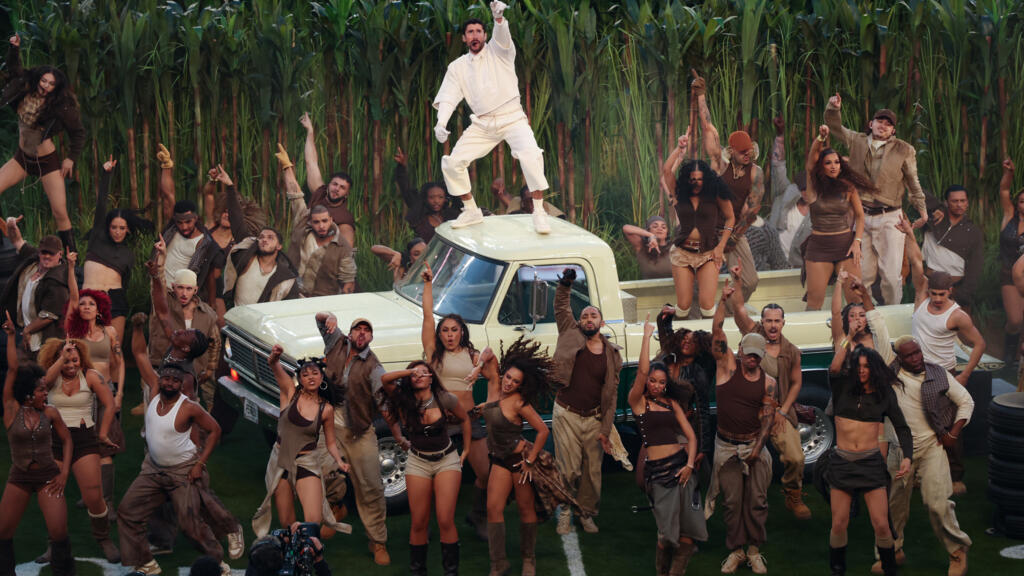
Puerto Rican singer Bad Bunny performs during the Super Bowl halftime show © Patrick T. Fallon / AFP

Puerto Rican superstar Bad Bunny on Sunday turned the Super Bowl into a giant street party, emphasizing unity over division in his groundbreaking Spanish-language set – but still earning President Donald Trump's scorn.

Anticipation was high for the 31-year-old's set, amid rampant speculation about whether he would use his platform to renew his criticism of the Trump administration's immigration crackdown in front of tens of millions of viewers.

But the wildly popular musician, whose real name is Benito Antonio Martinez Ocasio, instead made good on his pre-game promise to joyously share his culture – and largely avoided overt political statements in favor of subtle messaging through symbols.

In a set featuring a sugar cane plantation, a traditional "piragua" cart selling treats, and even a wedding, he opened with "Titi Me Pregunto" and feminist anthem "Yo Perreo Sola," with a cast of dancers fueling the party atmosphere.

Actors Pedro Pascal and Jessica Alba, and rapper Cardi B were among the guest stars vibing in his familiar "La Casita" backdrop, representing a home in Puerto Rico.

Bad Bunny wore an all-white ensemble, with a football jersey featuring the number "64" and "Ocasio," before donning a classy suit jacket.

He delved into more political territory with "El Apagon" (Blackout), which touches on the displacement of Puerto Ricans on their own island, and the constant problems caused by the unreliable power grid. He carried a Puerto Rican flag at one point.

The performance also included a young boy watching the Grammys on an old television set. Bad Bunny, who won the Album of the Year prize a week ago, presented the child – perhaps a younger version of himself – with a golden gramophone.
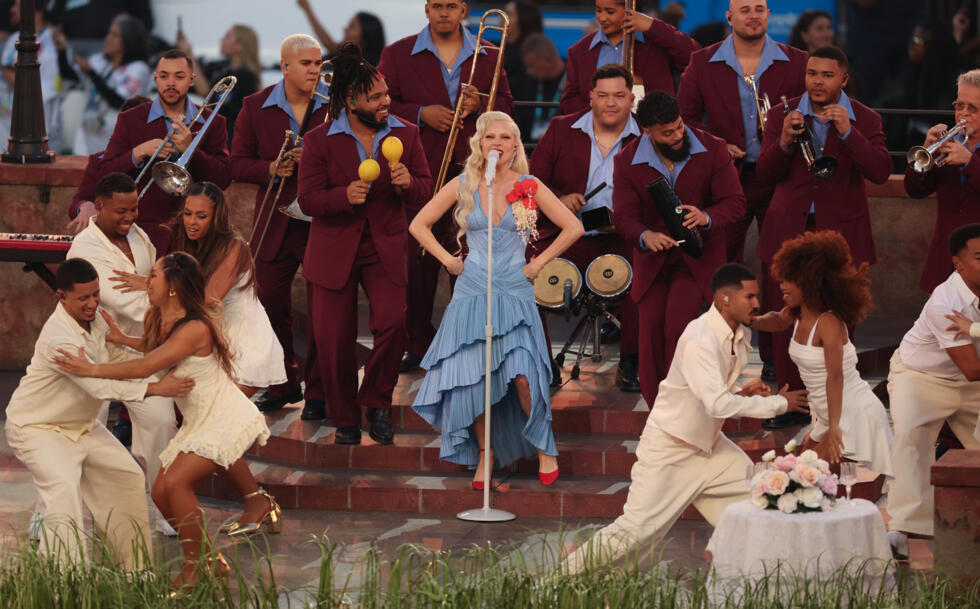
US singer-songwriter Lady Gaga was a surprise guest at the Super Bowl halftime show. 
© Patrick T. Fallon, AFP


The internet went wild with unverified rumors that the child was Liam Conejo Ramos, a five-year-old Ecuadoran boy recently detained by US immigration agents in Minnesota.

An NFL spokesman confirmed to AFP that the boy was an actor, and an Instagram post seemingly from the child in question, Lincoln Fox, was hashtagged #youngbadbunny.

Surprise musical guests included Lady Gaga, who sang a Latin-inflected version of her hit "Die with a Smile" – the only English lyrics in the show – and Puerto Rican singer Ricky Martin.


'Affront'

At the Grammys, Bad Bunny made a searing statement about Trump's sweeping immigration crackdown, earning cheers for saying "ICE out" from the stage.

But on Sunday, he did not call out the Republican president.

At the end of the set, after listing Latin American countries, Puerto Rico, the United States and Canada, Bad Bunny spiked a football that said "Together, we are America."

A giant screen in the stadium read: "The only thing more powerful than hate is love."

Trump nevertheless quickly took issue with the performance, saying: "Nobody understands a word this guy is saying" – even though government data shows more than 41 million Americans speak Spanish.

Posting on his Truth Social account, he called the show "an affront to the Greatness of America."

Early backlash
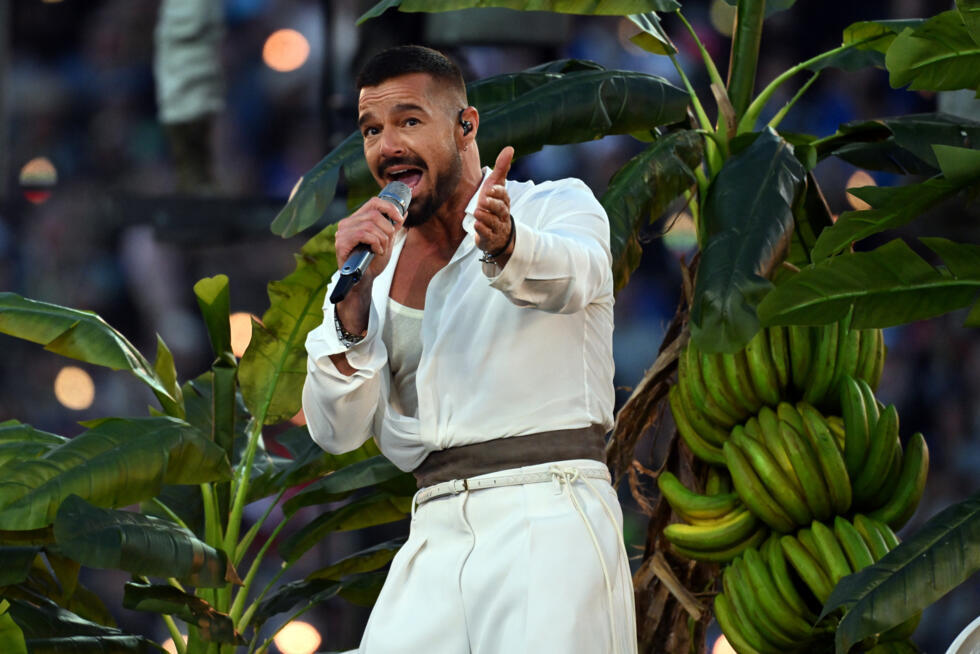
Puerto Rican singer Ricky Martin performs during the Super Bowl halftime show. 
© Josh Edelson, AFP


Bad Bunny has been Spotify's most-streamed artist in the world four separate times, including last year, and won Album of the Year at the Grammys with "Debi Tirar Mas Fotos" – the first Spanish-language work to win music's highest accolade.

But the decision to showcase his work at the Super Bowl in California was met with conservative outrage – specifically about the idea that he would not sing in English.

The NFL entered into an agreement in 2019 with Jay-Z's entertainment company Roc Nation, which leads the league's entertainment strategy.

Since that time, the list of Super Bowl headliners included Jennifer Lopez and Shakira (with a guest spot for Bad Bunny), but the duo did not perform exclusively in Spanish, leaving Bad Bunny to set that benchmark.

From Vega Baja to Super Bowl

Bad Bunny grew up in Vega Baja, a small municipality near Puerto Rico's capital San Juan.

He was working at a supermarket bagging groceries when he got a call from a label over his viral plays on the DIY platform SoundCloud.

Thus began the reggaeton star's rapid explosion to the top of global music.

Late last year, Bad Bunny released "Debi Tirar Mas Fotos," a history lesson in Puerto Rican music that he promoted with a hometown concert residency in San Juan and a world tour.

In Puerto Rico, a US territory since 1898, there was nothing but pride for the island's native son.

"For someone from here to be at one of the most important events in the United States is a source of pride for every Puerto Rican," Olvin Reyes, 39, told AFP.

(FRANCE 24 with AFP)

Bad Bunny calls out ICE in historic Grammy-winning speech


Super Bowl 2026: Cultural takeaways and what it says about the USA today

America’s most-watched television event is not just about sports, it captures the zeitgeist of the nation every year. Here are the top picks of the 2026 Super Bowl entertainment acts and ads, reflecting some of the hopes and anxieties of the times.


Issued on: 09/02/2026 
By: FRANCE 24
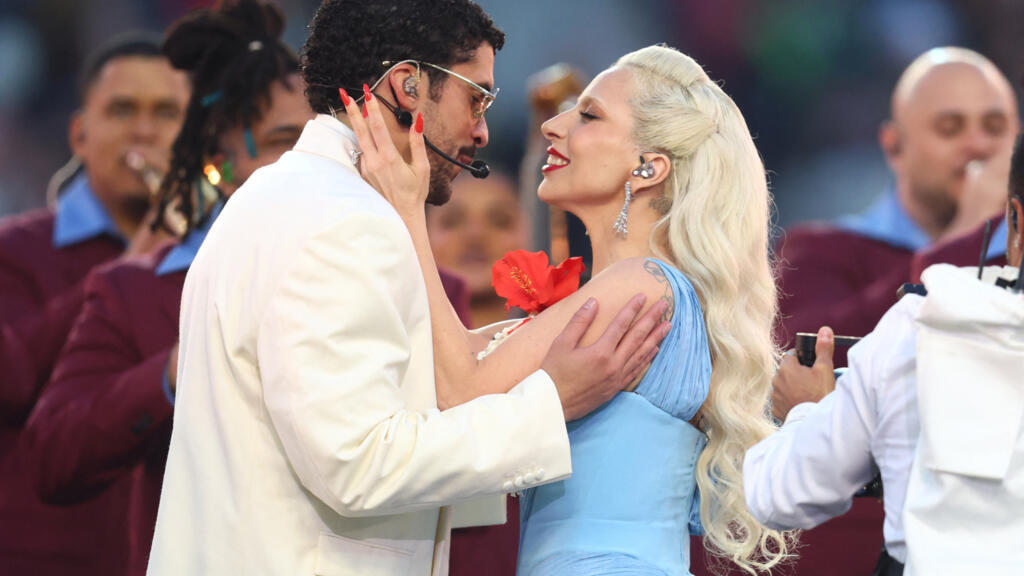
Bad Bunny and Lady Gaga perform the halftime show at the 2026 Super Bowl February 8, 2026. © Mark J. Rebilas, Reuters

Super Bowl, the USA’s biggest annual sporting event, kicked off to a boring start, with NFL fans moaning about a defensive struggle between the Seattle Seahawks and New England Patriots, which saw not a single touchdown in the first half of the game.

But if there was little excitement in the game, there were plenty outside the playing field. America’s most-watched television event is not just about sports, it’s about culture, and the 2026 Super Bowl once again captured the country’s zeitgeist.

Here are some of the non-sporting highlights of the world superpower’s one-night ode to competition, capitalism and entertainment.

Bad Bunny proves not so bad

The top Super Bowl cultural moment is never a rabbit-out-of-a-hat act, and this year, it was a pre-announced big bunny.

Puerto Rican superstar Benito Antonio Martinez Ocasio, aka “Bad Bunny”, took the stage at the Levi’s Stadium on Sunday exactly a week after he delivered his searing Grammy-winning speech blasting ICE and the Trump administration’s immigration policies.

READ MORE Bad Bunny’s 2026 Grammy Awards triumph becomes protest against ICE

But at the Super Bowl, the 31-year-old superstar opted for far more subtle messaging. Instead of calling out the Republican president’s xenophobia, Bad Bunny delivered a triumphant celebration of diversity, love and above all, a tribute to his self-governed Caribbean home that is part of US “commonwealth” territory.

Politics of subtility was on full display as Bad Bunny belted out "El Apagon" (Blackout), a song that underscored the hypocrisy of the term “commonwealth” since Puerto Ricans still face Third World problems of an unreliable energy grid – which powers their displacement to the mainland.
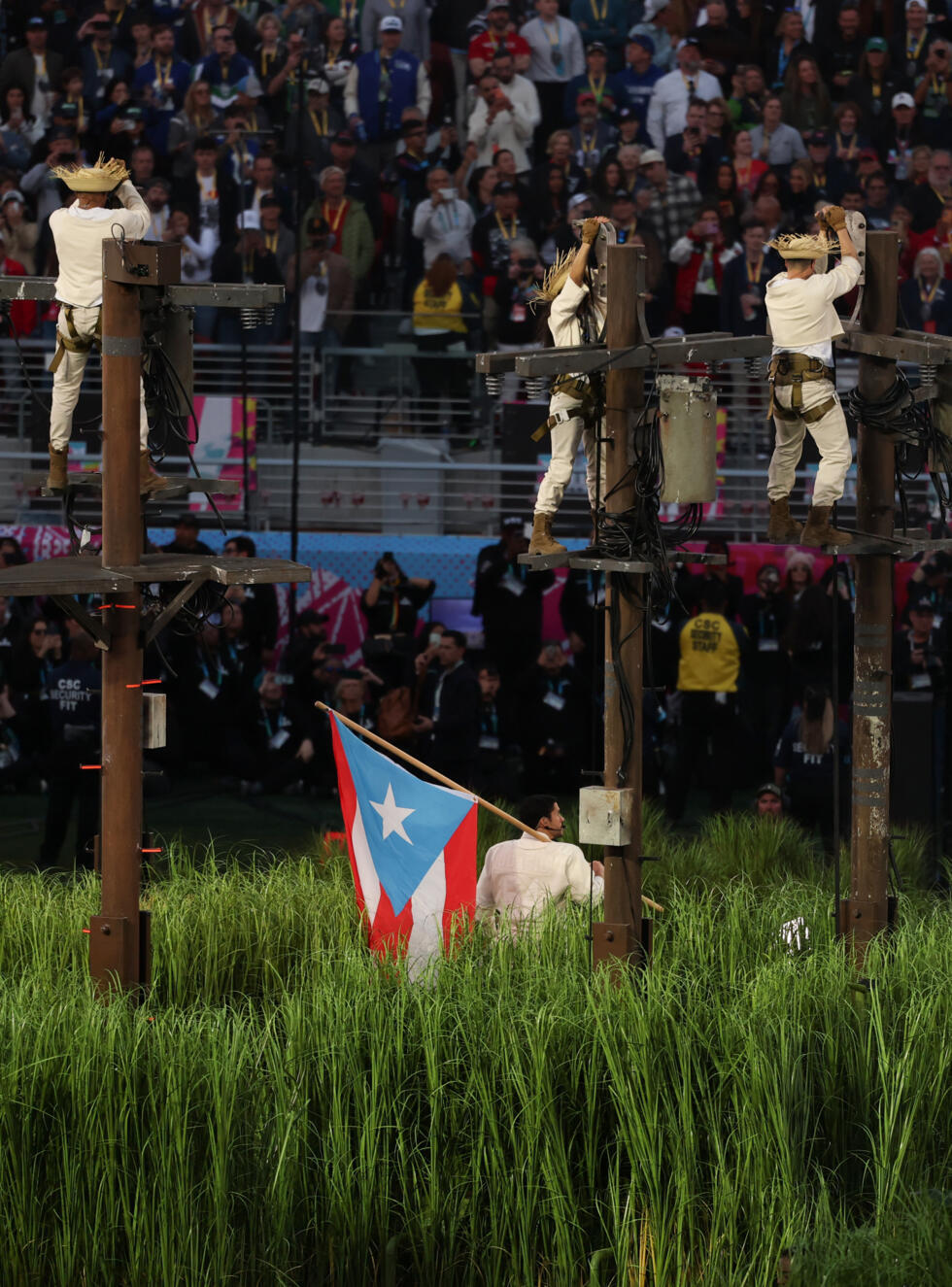
Bad Bunny holds a Puerto Rican flag during the Super Bowl halftime show © Patrick T. Fallon, AFP


On Sunday, Bad Bunny’s surprise star guests included Lady Gaga, whose Latin-inflected version of her hit "Die with a Smile" featured the only English lyrics in the show.

READ MOREBad Bunny brings Puerto Rico pride to Super Bowl, angering Trump

The historic all-Spanish act earned President Donald Trump’s ire. "Nobody understands a word this guy is saying," said Trump on his Truth Social account, putting himself at odds with more than 41 million Americans who speak Spanish. The show, he noted, was “an affront to the Greatness of America".
Green Day has had its day politically

California punk-pop vets Green Day took the pre-game stage this year to render a tribute to the Super Bowl's 60th edition.

Green Day lead singer and guitarist Billie Joe Armstrong has been around since the 1980s and is not one to mince his political words. The expectations were high, particularly since Armstrong, at a San Francisco event just days before the Super Bowl, called on ICE agents to “quit their shitty jobs”.

But on Sunday, Green Day opted to omit their political hard-hitters – much to the delight of Fox News. “Trump critics take issue with Green Day's Super Bowl LX performance,” read a Fox headline above an explanatory, “Trump critics wanted Green Day to criticize the president on the Super Bowl stage".
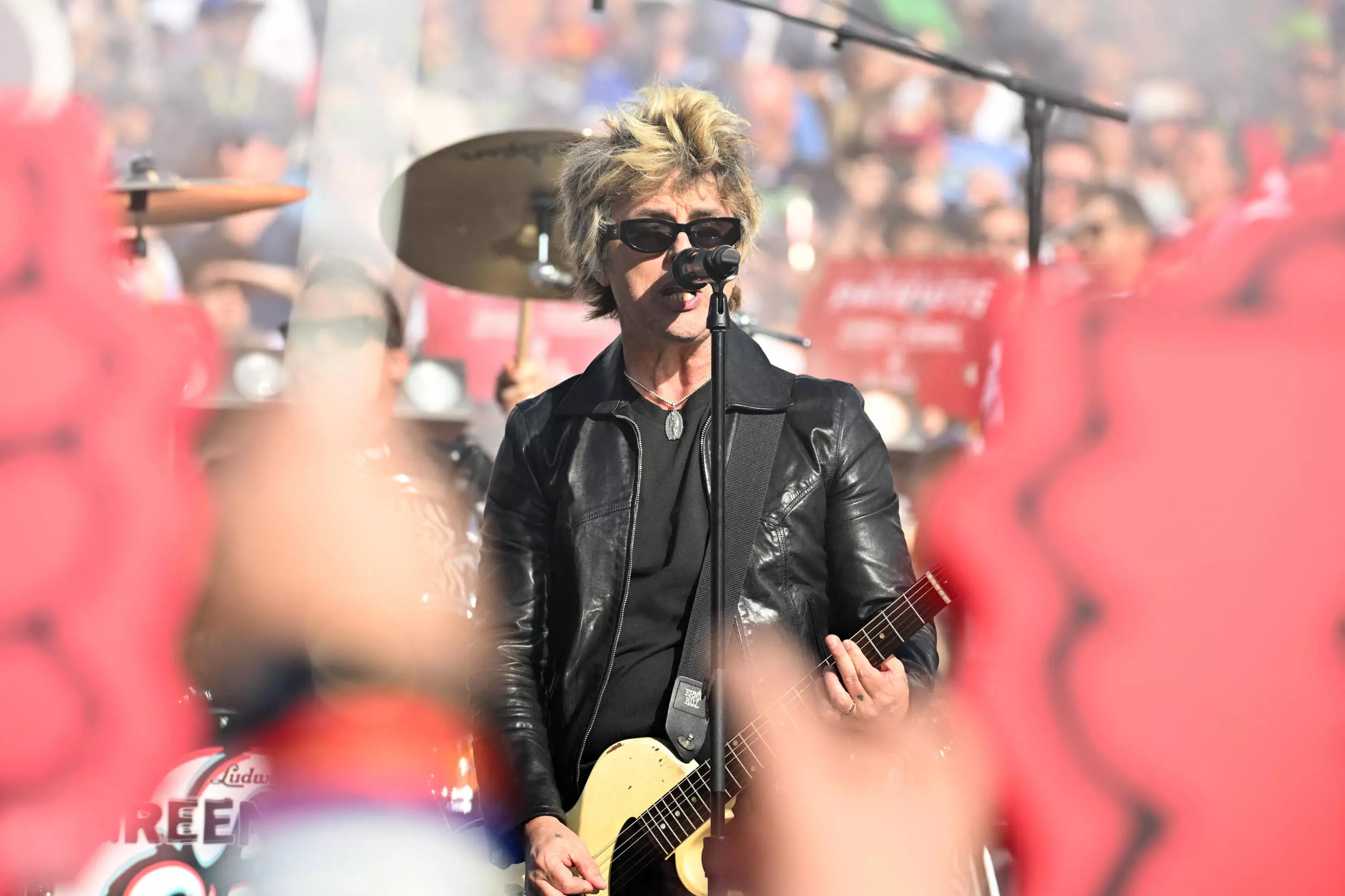
Green Day's Billie Joe Armstrong performs at Super Bowl LX. © Josh Edelson, AFP

When the group launched into “Holiday”, Trump opponents were on alert for the group’s most political bridge, which begins with the line “Sieg Heil to the President Gasman”, a dig at former President George W. Bush, who was president when the song was released in 2004.

But on Sunday, the band just skipped the controversial bridge and wrapped up the song.

“Disappointing show,” said one fan on X. “Pretty cowardly if you ask me. I expected real protest from them.”

For those outside the US awaiting a mass national mobilisation against Trump – and watching the rollover of much of corporate America instead – it was a fitting statement of the current times in the land of the free.
Mad for the ads

The second Sunday of February draws millions of Americans to their TV sets to watch the ads, an important part of the Super Bowl cultural package. In 2025, a record 127.7 million US viewers watched the game across television and streaming platforms, which means advertisers are willing to cough up millions for a Super Bowl spot.

This year's Super Bowl ads cost an average of $8 million per 30-second unit, but a handful of spots sold for a record $10 million-plus, Peter Lazarus, who leads advertising and partnerships for NBC Sports, told AP.

Super Bowl ads generate headlines, data, expert commentary as well as debates about what they say about consumers and markets today.
AI vs. AI

The business pundits were in agreement even before kick-off on Sunday: Artificial Intelligence (AI) would dominate this year’s Super Bowl.

They were not wrong.

Super Bowl 2026 sparked an AI advertising war when Anthropic aired a pair of commercials pointing out that Claude, its chatbot, doesn't have ads.

Humour and wit are important components of American ads and the Anthropic commercial ticked all the boxes in its 30-second spot. The ad features a nerdy young man struggling with pull-ups while a muscular bystander watches. The sweating young man asks the brawny man about achieving “six-pack abs”. But the bystander instead delivers a plug for a product – delivered in soulless, robotic style and content.

The skinny man looks disappointed with the reply before the kicker line fills the screen: “Ads are coming to AI. But not to Claude”.


OpenAI CEO Sam Altman, the whiz behind ChatGPT, hit back at his competitor. In a long post on X, Altman said Anthropic was "clearly dishonest" and employed “doublespeak to use a deceptive ad to critique theoretical deceptive ads”.

Altman’s objections, alas, were not well received, with commentators on X noting that the Anthropic boss didn’t like the taste of his “own medicine” and that his reaction was “the digital equivalent of a toddler throwing a tantrum".


Who’s afraid of…Amazon

Amazon this year struck a nerve with an ad starring actor Chris Hemsworth that pokes fun of people's fears of AI. The ad ticked all the Super Bowl boxes, including a celebrity poking fun at technological anxiety.


But it didn’t go down well since it came days after Amazon founder Jeff Bezos fired journalists at the Washington Post, which he also owns, in addition to laying off 16,000 corporate workers, some of whom may be replaced with AI.

“I suspect this is meant to be funny,” Tim Calkins, a clinical professor of marketing at Northwestern University, told AP. “But it might reinforce some people’s very real concerns about AI.”


Donald Trump slams Bad Bunny's Super Bowl halftime show: “An affront to the Greatness of America”


By David Mouriquand
Published on 

Bad Bunny made history on one of the world’s most coveted stages, while Donald Trump ranted about the artist’s message of unity being “an affront to the Greatness of America”.

Puerto Rican superstar Bad Bunny made history a few hours ago as the first male solo Latin artist to perform the Super Bowl halftime show.

His performance, entirely in Spanish, was an energetic celebration of various musical styles – from reggaeton and salsa to Latin trap – featuring guest spots from Lady Gaga, Ricky Martin, and even cameos from Pedro Pascal, Karol G, Cardi B and Jessica Alba.

Bad Bunny, one of the world’s most streamed artists – went on to expand the meaning of “God Bless America” to include all the nations of the Americas.

“God bless America, whether it’s Chile, Argentina,” Bad Bunny said as he listed more than 20 nations in North and South America.

He ended the show on a message of unity, with “Together, we are America” written on a ball and a huge screen reading: “The only thing more powerful than hate is love.”

Hard sentiments to counter, but that didn’t stop Donald Trump.

Trump and his MAGA crowd have been up in arms about the choice of headliner for months, calling the decision “crazy”, “un-American” and “terrible”. His base also slammed Bad Bunny for being a “massive Trump hater”, an “anti-ICE activist”, and many bemoaned the fact that the artist has “no songs in English.”

Trump’s animosity only grew after Bad Bunny triumphed at the Grammys, with Bad Bunny delivering a message in protest of recent actions of Immigration and Customs Enforcement (ICE): “Before I say thanks to God, I’m gonna say: ICE out! We’re not savage, we’re not animals, we’re not aliens. We are humans and we are Americans.”
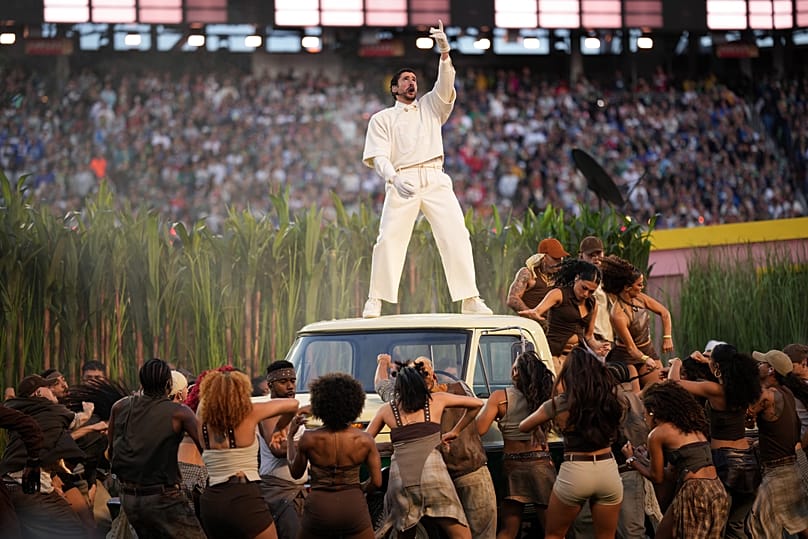
Bad Bunny's Super Bowl halftime show AP Photo

Unsurprisingly, Trump - who was not at the show and attended a watch party in Florida - slammed Bad Bunny’s performance, calling it an “an affront to the Greatness of America” in a lengthy rant on Truth Social.

“The Super Bowl Halftime Show is absolutely terrible, one of the worst, EVER! It makes no sense, is an affront to the Greatness of America, and doesn’t represent our standards of Success, Creativity, or Excellence,” Trump wrote.

“Nobody understands a word this guy is saying, and the dancing is disgusting, especially for young children that are watching from throughout the U.S.A., and all over the World,” he fumed. “This “Show” is just a “slap in the face” to our Country, which is setting new standards and records every single day - including the Best Stock Market and 401(k)s in History! There is nothing inspirational about this mess of a Halftime Show and watch, it will get great reviews from the Fake News Media, because they haven’t got a clue of what is going on in the REAL WORLD.”
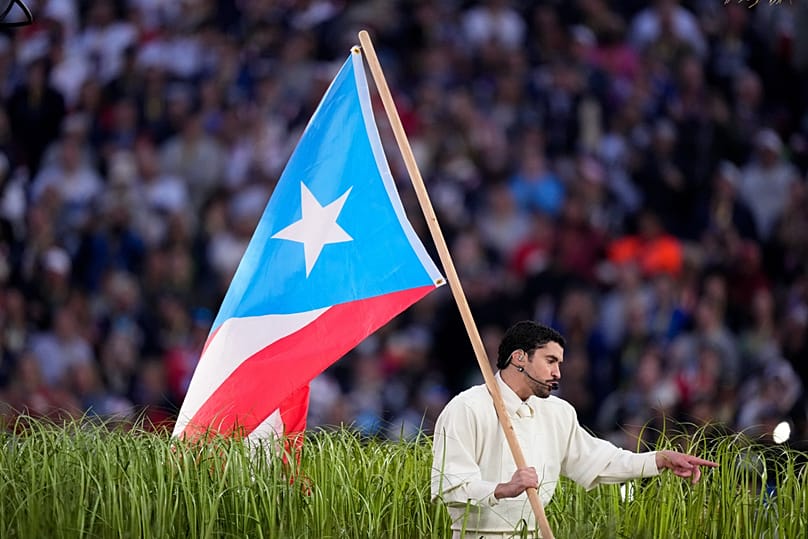
Bad Bunny at the Super Bowl halftime show AP Photo

It’s unclear whether Trump was watching the alternative MAGA show, Turning Point USA’s “All American” halftime show, headlined by Kid Rock and brimming with imagery of Charlie Kirk.

The counterprogramming, which streamed online, garnered roughly four million views - at one point as many as 6 million concurrent views on YouTube.

Meanwhile, every Super Bowl typically pulls in an average of around 127 million – with last year’s set by Kendrick Lamar setting a record with 133.5 million.

Official viewership numbers for Bad Bunny’s show are not out at the time of writing, but will be revealed later today. Preliminary estimates seem to suggest that Bad Bunny may have bested Kendrick Lamar’s numbers last year. Whatever the official numbers are, it’s a done deal that the 2026 Super Bowl halftime show reached a significantly larger audience than the “All American” show.
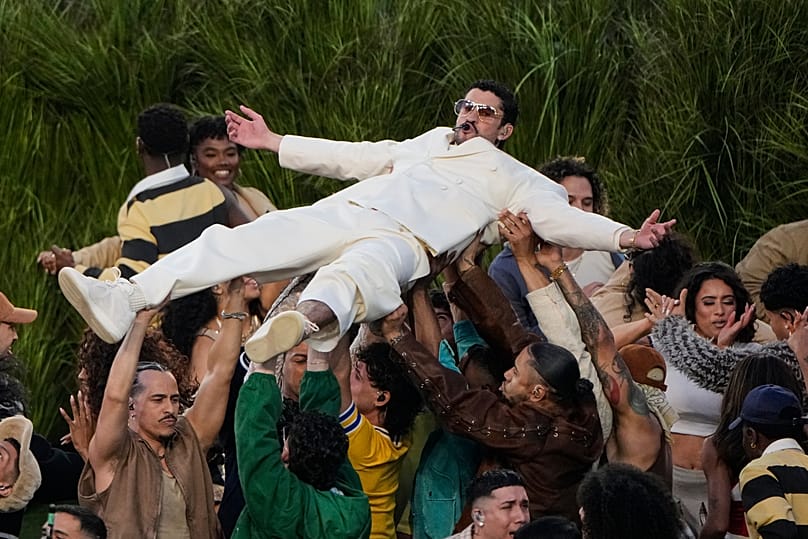
Bad Bunny at the Super Bowl halftime show AP Photo

Shortly after Bad Bunny’s set concluded, California Governor and vcal Trump opponent Gavin Newsom posted: “America, the beautiful. THANK YOU, BAD BUNNY.”

Elsewhere, Green Day, which were opening for Bad Bunny and have never shied away from taking swipes at Trump, kept their show in the same spirit, staying away from overt political statements.

While in keeping with the message of unity, many were disappointed that the band did not make any provocative statements. Frontman Billie Joe Armstrong even refrained from singing the tweaked lyric “I’m not part of the MAGA agenda” when performing the band’s hit song ‘American Idiot’.

Official broadcaster NBC did mute Armstrong when he sang the lyric “The subliminal mindfuck America” during the song, and while some fans were disappointed by the lack of punk spirit, others were more supportive of the band’s performance.


The Spanish Super Bowl: Bad Bunny, language and identity crisis set for collision
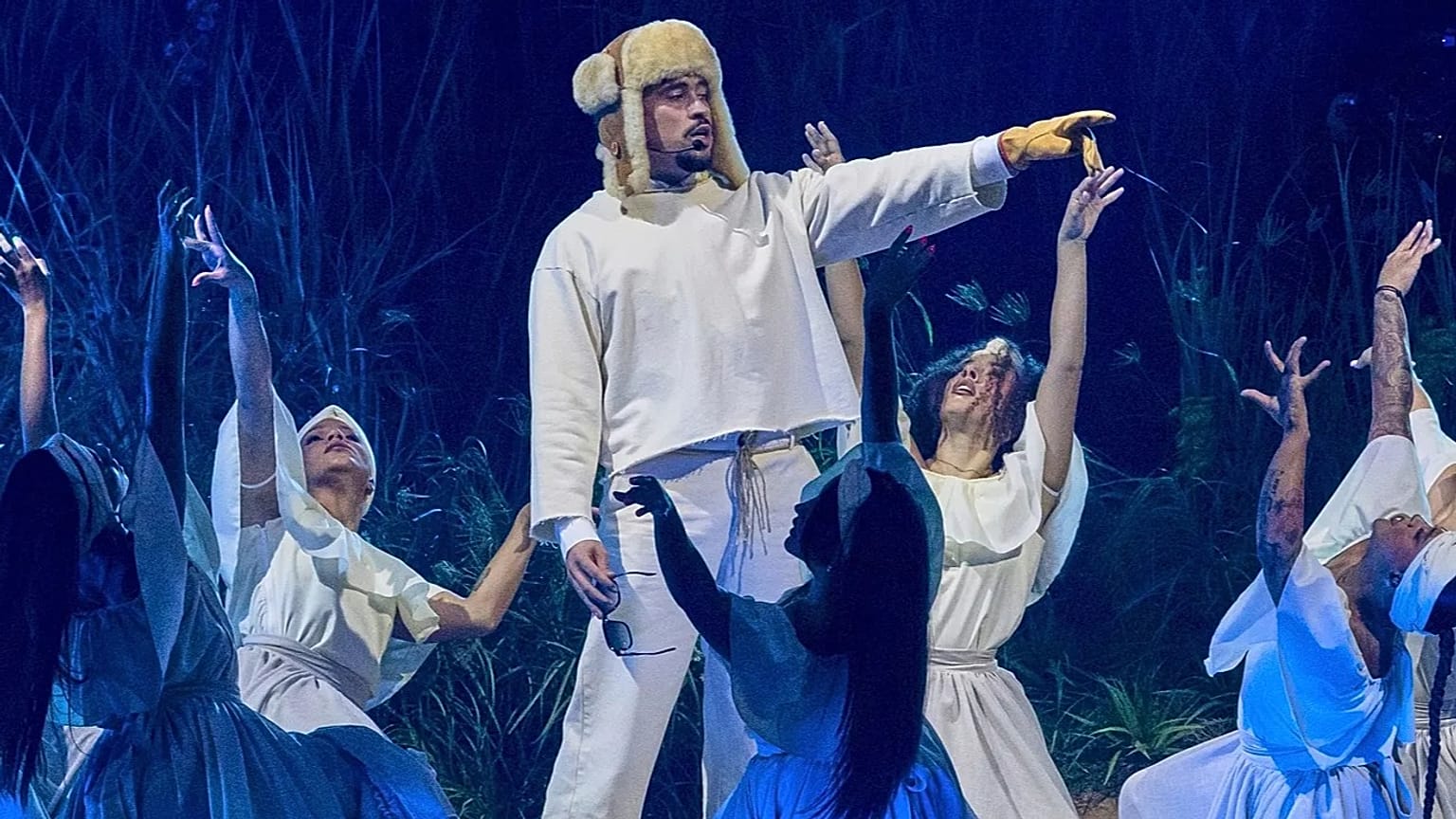
Bad Bunny performs during his first show of his 30-date concert residency at the Coliseo de Puerto Rico José Miguel Agrelot on July 11, 2025.
Copyright Invision

By Cristian Caraballo & Tokunbo Salako
Published on 

Bad Bunny's  all-Spanish performance at the 2026 Super Bowl coincides with a US immigration crackdown and the resurgence of debates over Puerto Rico's sovereignty and possible reintegration into the Spanish kingdom.

The Levi's Stadium in Santa Clara, California, will not only be hosting tonight's Super Bowl, the conclusion of America's NFL season.

The all or nothing match is also the centre of one of the biggest cultural statements of the decade with the Puerto Rican rapper Bad Bunny headlining the world famous half-time show.

He's already ripped up the musical milestone book by becoming the first artist to win Album of the Year at the Grammys with a Spanish-language album.

We know his performance will be entirely in Spanish, and that's no small feat. Never before has anything like this happened in the history of the Super Bowl. It's not just an artistic act. It's a key moment in the midst of a period of US history filled with political and demographic tension.

Right now, speaking Spanish has become a symbol of identity, almost an act of resistance. It is the language that the population uses to challenge border control policies and demand solutions to Puerto Rico's status.

Spanish: a language of power on US soil

With more than 65 million Hispanics, the United States now ranks second in the world to Mexico as the country with the largest number of Spanish speakers. Evidence of the language is everywhere, from billboards, big brand advertising, bilingual schools, and of course in what people can watch or listen to via streaming sites.

The Super Bowl is America's biggest television event - an enormous cultural moment that echoes around the world, attracting an audience of hundreds of millions.

Yes, Hispanic and Latino artists such as Shakira and Jennifer López have already performed on that stage, but none have ever decided to only sing in Spanish at the event that epitomises the pinnacle of American culture and where English has been the norm. Donald Trump has already made clear that he will not attend the match. A counter protest event has also been announced this week with MAGA supporting acts getting together to make noise in celebration of "American faith, family and freedom."
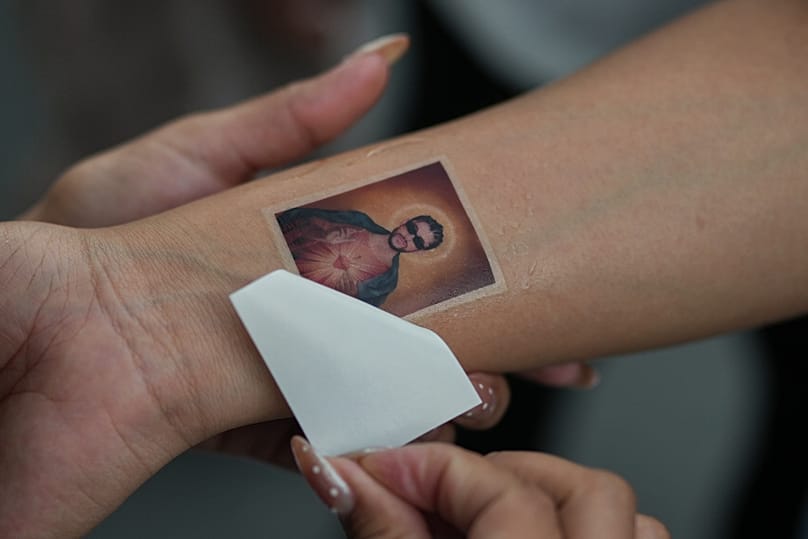
 A person gets a temporary tattoo during one of the artist's concerts. AP Photo

Of course, Spanish taking that space also generates rejection from those who defend 'English Only' as if it were the backbone of the country.

For some, this is the validation they have been waiting decades for. For others, it is a threat, a sign that the country is 'losing' its linguistic identity.

But the figure of Bad Bunny goes beyond music. His voice represents millions of people who have been working and contributing culture for years, even if they're regarded by some as second-class citizens and therefore not a real part of the nation.

The contradiction of visibility: music versus raids

Music connects. It is a way for people to express what they feel, what they think, what hurts or excites them. Many artists use music to protest, to say what others are silent about. Now some musicians are dealing with the harsh reality of immigration raids and police operations that can put an end to both their work and freedom of expression.

The expectation surrounding Bad Bunny's performance coexists with a reality marked by fear, the separation of families and thecriminalisation of undocumented people, many of them part of the same audience that celebrates Latino visibility on global stages.

In contrast, Bad Bunny's presence in one of the most influential media spaces in the world acquires a particular symbolic charge; while Latino culture is exalted and massively consumed, immigration policies continue to put at risk those who sustain it on a daily basis.

The country that idolises an artist who sings in Spanish, that turns him into its pop superstar, is the same country where the authorities have imposed a harsh and violent crackdown on immigration controls.

In the last year, Immigration and Customs Enforcement conducted more operations than ever before, hitting mostly Latino communities in key states. Organisations have reported raids on factories, warehouses and entire neighbourhoods. Fear is spreading, even among legal citizens and families with mixed immigration status. All of this is evidence of a deep problem.

Although millions watch games and programmes in Spanish, there is still a lot of mistrust of the language outside of television, for example in job interviews or at police checkpoints. For many, the fact that Bad Bunny does not translate his songs is a way of protesting, of making clear their disagreement with the treatment of migrants.

As the government tightens laws and closes borders, Caribbean music continues to be heard in every corner of the United States. In politics, the tendency is to divide. Music does just the opposite: it unites. Where politicians put up walls, Caribbean music builds bridges.
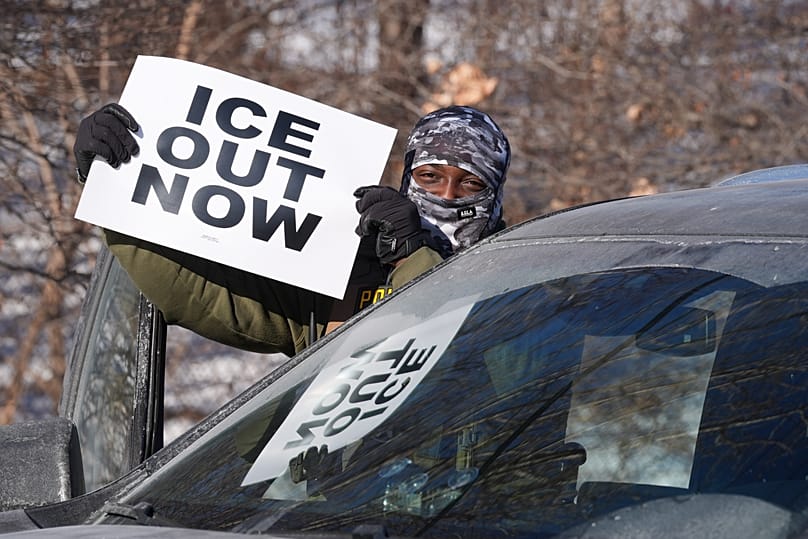
 A federal officer holds up a sign reading "ICE Out Now" during a traffic stop, 27 January 2026 AP Photo/Adam Gray

Puerto Rico's legal and political limbo

Bad Bunny has always had Puerto Rico in his heart. The island has been a commonwealth for decades, and that leaves it in a state of limbo. Puerto Ricans are born US citizens, hold US passports and comply with federal laws, and may even end up in the military.

But, incredible as it sounds, they cannot vote in presidential elections and their representatives in Congress do not even have the right to vote. Puerto Rico is there, forced to comply, but unable to decide. It is a contradiction that weighs heavily.

The reality on the island is complicated, and it doesn't look like it will get better any time soon. Puerto Rico cannot make the most important decisions about its future. This only worsens the economic and infrastructure problems, which were already bad enough. After every hurricane or earthquake, it is clear how vulnerable the island is.

People are tired, they feel used. That contradiction fuels the anger and discourse of artists like Benito, who use their fame to remind people that, in many ways, Puerto Rico is still a colony, even if it flies the US flag.

The historical alternative: the movement for reunification with Spain

In recent years, an idea has emerged that sounds far-fetched to some and logical to others: What if Puerto Rico were once again part of Spain? This is what the Spanish Reunification Movement proposes. It argues that in 1898, when the United States took over the island after the war with Spain, they ignored the will of the Puerto Ricans.

Spain, in fact, had already given them some autonomy in 1897. This movement wants Puerto Rico to return as an autonomous community, like those that already exist in Spain. Their arguments are increasingly appearing in international forums. They argue that the cultural and linguistic connection with Spain would help protect Spanish and prevent it from being diluted by US influence.

Moreover, if Puerto Rico were Spanish, its citizens would gain the rights of any European: mobility, services and labour rights that they cannot even dream of under the American system. Supporters of this plan see an opportunity to right historical wrongs and give Puerto Rico the full political representation it deserves, without sacrificing its Hispanic identity.

Of course, there are those who see it as a nostalgic and unrealistic idea, something impossible to implement. But, one way or another, the movement managed to get the issue onto the UN decolonisation agenda. They insist: Puerto Rico has always been part of the Hispanic family, both legally and spiritually.

A stage that concentrates all tensions

Now, the halftime show must shoulder extra significant weight. When Bad Bunny takes the stage at Levi's Stadium, many people will see more than a show. They will see a symbol of that Puerto Rican identity crisis, a wound that is still raw. The 2026 Super Bowl will be the stage where big issues intersect: the rise of Hispanic culture, the immigration debate and Puerto Rico's political situation.

For many, the moment will provide a moment to think about issues of representation and belonging that are rarely discussed openly. And the simple gesture of singing in Spanish, in front of millions of people, is not just a celebration of an artist's success. It is a declaration: language is a territory that cannot be deported or silenced, regardless of borders or laws.


'All American': Everything we know about MAGA's protest Super Bowl Halftime Show
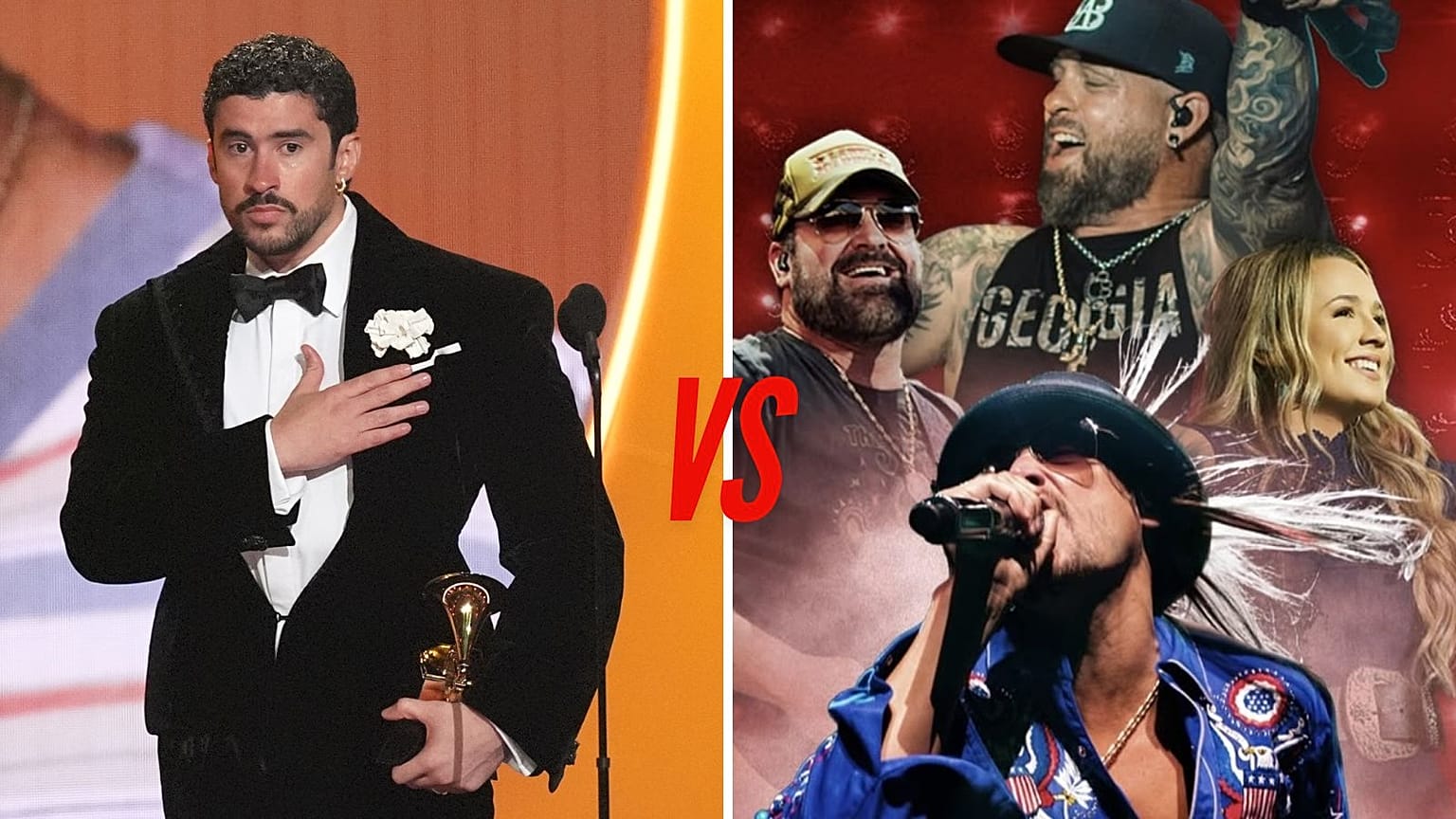
Everything we know about the right-wing protest Super Bowl Halftime Show
Copyright AP Photo - X screenshot

By David Mouriquand
Published on 

MAGA is preparing to hold the All-American Halftime Show in protest of the NFL’s 2026 Super Bowl music acts. Prepare to be underwhelmed.

The NFL's Super Bowl LX takes place this weekend, with multi-Grammy Award winning Puerto Rican rapper Bad Bunny headlining the US' most-watched television event, which attracts more than 100 million viewers every year.

The Halftime Show is a huge and coveted gig, which has a long history of reflecting and influencing cultural trends.

Last year, Kendrick Lamar’s headlining performance shattered all records with 133.5 million viewers tuning in. Bad Bunny is expected to match if not surpass that record, but no thanks to the MAGA crowd.

Diversity-averse rightwing media has been up in arms over the choice of headliner for months now, with many saying that Bad Bunny’s music is "un-American" and “woke”, handily forgetting for the sake of barely concealed racism that the singer is an American citizen, since Puerto Rico is part of the US.

Funny how no one was complaining when Canadian singer Shania Twain or the UK’s The Rolling Stones were headlining...

Bad Bunny was recently described by Donald Trump as a “terrible choice” for the Super Bowl headline slot, with one of his advisors even confirming that ICE would be present at the “shameful” concert.

Despite criticism and plenty of complaining about American football’s biggest night being hijacked by a “left-wing conspiracy”, the NFL did not drop(kick) Bad Bunny. The organisation even appeared to double down in defying Trump, as they added rock band Green Day, who are vocal Trump critics, to the Super Bowl line-up.

There was renewed MAGA outrage when the Puerto Rican superstar blasted the Trump administration and ICE while accepting the top award at this year’s Grammys, saying: “Before I say thanks to God, I’m gonna say: ICE out”, adding, “We’re not savages, we’re not animals, we’re not aliens. We are humans and we are Americans.”
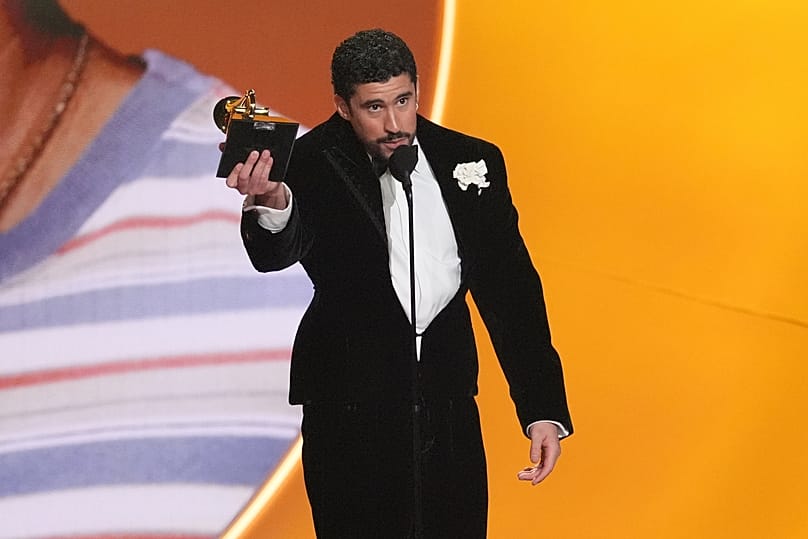
Bad Bunny at the 2026 Grammys AP Photo

The MAGA response? Counterprogramming.

Turning Point USA – the conservative group founded by Charlie Kirk and now helmed by his widow Erika Kirk - has organised an alternative, competing halftime show titled the “All American Halftime Show”.

It will celebrate “American faith, family, and freedom,” the organization said.

So, who’s on the powerhouse and not-at-all-underwhelming line-up?

Trump supporter Kid Rock is headlining, and he will be joined by country singers Brantley Gilbert, Lee Brice, Gabby Barrett.

It’s a veritable Who’s WHO?

“We’re approaching this show like David and Goliath,” Kid Rock said in a statement issued through Turning Point USA. “Competing with the pro football machine and a global pop superstar is almost impossible…or is it?”

The singer, who hasn’t had a hit song since the dire Lynyrd Skynyrd-pilfering ‘All Summer Long’ in 2008, added: “He’s said he’s having a dance party, wearing a dress, and singing in Spanish? Cool. We plan to play great songs for folks who love America.”

Best of luck with that, as the Goliath he mentions dethroned Taylor Swift to become Spotify’s most-streamed artist of 2025 and made history last weekend as the first Spanish-language artist to win the Grammy’s Album of the Year with 'DeBÍ TiRAR MáS FOToS'.
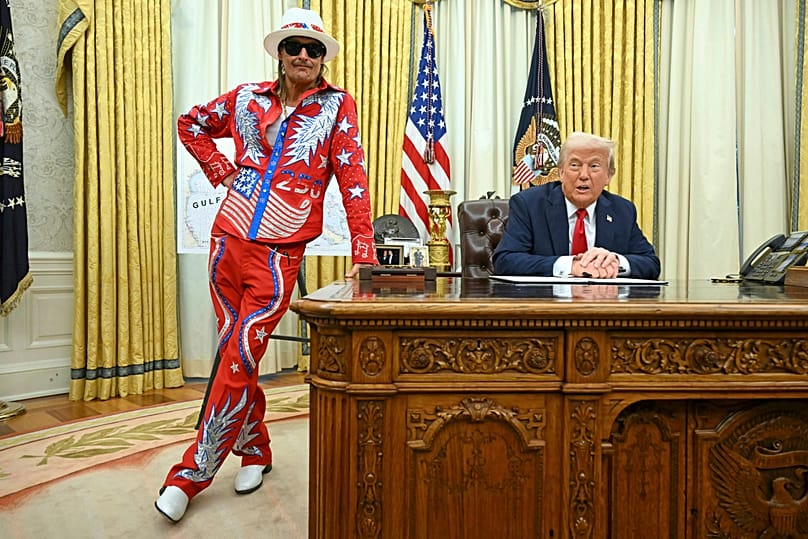
Kid Rock at the White House AP Photo

The All-American Halftime Show is scheduled to take place the same night as the 2026 Super Bowl – Sunday 8 February – at a location that is still unknown. It will broadcast across four conservative networks: DailyWire+, TBN, Charge!, and Real America’s Voice. It will also stream on Turning Point USA’s social media channels.

We’re betting that Bad Bunny won't lose sleep over it – especially since those supposed All-American values Turning Point USA are trumpeting apparently don’t concern themselves with Kid Rock’s unsavoury lyrics.

Indeed, there has been fresh scrutiny online over Mr. Rock’s song ‘Cool, Daddy Cool’ in the lead up to the protest show, with the song’s lyrics featuring the lines: “Young ladies, young ladies / I like 'em underage / See, some say that's statutory / But I say it's mandatory.”

Maybe that’s what “American faith, family, and freedom” sounds like.

The NFL's Super Bowl LX will take place on Sunday 8 February. The NFL chief security officer Cathy Lanier recently said at a security briefing that despite previous comments made by the Trump administration, ICE officers will not be among the federal agencies present at Levi’s Stadium in Santa Clara, California.

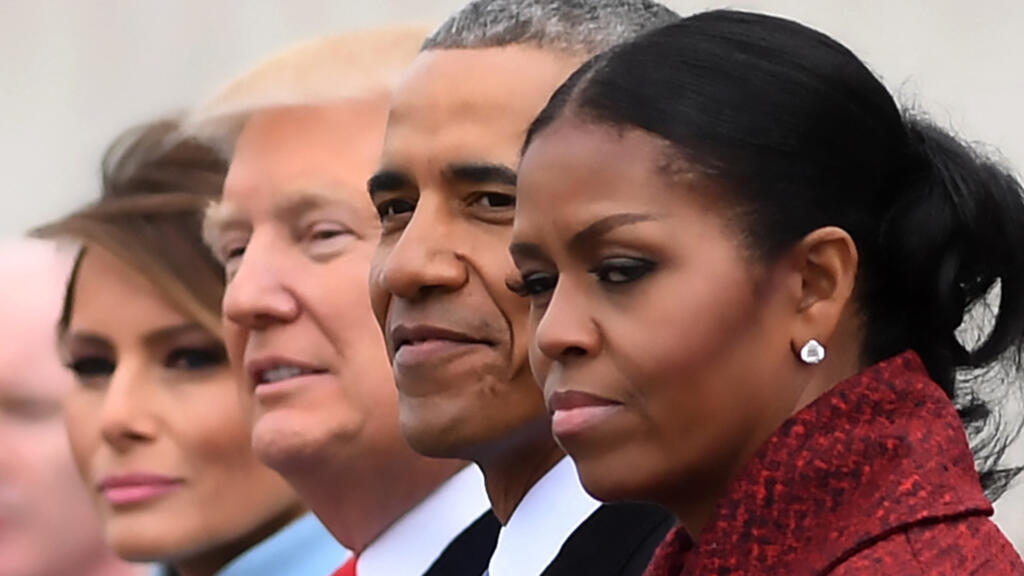
 Trump video showing Obamas as monkeys sparks outrage over 'vile' racist depiction


President Donald Trump posted an election conspiracy video depicting former president Barack Obama and his wife Michelle as monkeys, drawing condemnations over the racist portrayal of America's first and only Black president. The White House on Friday initially dismissed the criticism as "fake outrage" before deleting the post and claiming the video had been “erroneously” made by a staffer.

Issued on: 06/02/2026
By: FRANCE 24


Barack and Michelle Obama attend Donald Trump's first presidential inauguration on January 20, 2017. © Jim Watson, AFP

US President Donald Trump on Thursday posted an election conspiracy video that depicted former president Barack Obama and his wife Michelle as monkeys, drawing condemnation from prominent Democrats.

Near the end of a one-minute-long video posted on Trump's Truth Social platform, the Obamas are shown with their faces on the bodies of monkeys for about one second.

The song "The Lion Sleeps Tonight" plays in the background when the Obamas appear.

The video repeats false allegations that ballot-counting company Dominion Voting Systems helped steal the 2020 election from Trump.

As of early Friday morning, the video had been liked several thousand times on the president's social media platform.

The office of California Governor Gavin Newsom, a potential 2028 Democratic presidential candidate and a prominent Trump critic, slammed the post.

"Disgusting behavior by the President. Every single Republican must denounce this. Now," Newsom's press office account posted on X.

House Democrati leader Hakeem Jeffries on Friday branded Trump's video as "vile, unhinged and malignant".

In a post on X, Jeffries said, "Every single Republican must immediately denounce Donald Trump's disgusting bigotry," calling Trump a "sick individual."

Ben Rhodes, a former top national security advisor and close confidant to Barack Obama, also condemned the imagery.

"Let it haunt Trump and his racist followers that future Americans will embrace the Obamas as beloved figures while studying him as a stain on our history," he wrote on X.

'Fake outrage'


The White House however initially dismissed the condemnations as "fake outrage".

"This is from an internet meme video depicting President Trump as the King of the Jungle and Democrats as characters from the Lion King. Please stop the fake outrage and report on something today that actually matters to the American public," Press Secretary Karoline Leavitt said in a statement to AFP.

But hours later, the White House said a staff member had "erroneously" made the Obama post, which was then deleted.

"A White House staffer erroneously made the post. It has been taken down," a White House official told AFP.


Obama is the only Black president in American history and backed Trump's opponent Kamala Harris on the campaign trail in the 2024 presidential election.

Trump has a long history of intensely personal criticism of the Obamas and of using incendiary, sometimes racist, rhetoric.

When Obama was in the White House, Trump advanced the false claims that the 44th president, who was born in Hawaii, was born in Kenya and was constitutionally ineligible to serve.

Obama eventually released his Hawaii records. Trump finally acknowledged during his 2016 campaign, after having won the Republican nomination, that Obama was born in Hawaii.
AI imagery

In the first year of his second term in the White House, Trump ramped up his use of hyper-realistic but fabricated visuals on Truth Social and other platforms, often glorifying himself while lampooning his critics.

He has used the provocative posts to rally his conservative base.

Last year, Trump posted a video generated by artificial intelligence showing Barack Obama being arrested in the Oval Office and appearing behind bars in an orange jumpsuit.

Later, he posted an AI clip of Jeffries – who is Black – wearing a fake moustache and a sombrero.

Jeffries called the image racist.


Since returning to the White House, Trump has drawn criticism from his opponents for leading a crusade against diversity, equity and inclusion (DEI) programmes.

One of Trump's first acts was to terminate all federal government DEI programmes, including related policies in the military.

The drive to rid the armed forces of what Trump has derided as "woke" initiatives has also seen the removal from some military academy bookshelves of scores of books that cover the US's history of discrimination.

US federal anti-discrimination programs were born of the 1960s civil rights struggle, mainly led by Black Americans, for equality and justice after hundreds of years of slavery, whose abolition in 1865 saw other institutional forms of racism enforced.

(FRANCE 24 with AFP and AP)


'I didn't make a mistake': Trump refuses to apologise for since-deleted racist post about Obamas


By Emma De Ruiter
Published on 


A social media post by US President Donald Trump depicted former President Barack Obama and his wife, Michelle Obama, as primates in a jungle. It was deleted on Friday after a backlash from both Republicans and Democrats.

US President Donald Trump refused to apologise on Friday for a racist video he posted on his social media platform Truth Social, which depicted the former President Barack Obama and his wife Michelle as primates.

Following widespread backlash for its treatment of the nation’s first Black president and first lady, the post was blamed on a staffer and deleted.

Near the end of the one-minute-long video promoting conspiracies about Republican Trump's 2020 election loss to Joe Biden, the Obamas were shown with their faces on the bodies of apes for about one second.

The video repeated false allegations that ballot-counting company Dominion Voting Systems helped steal the election from Trump.

The frames of the Obamas at the end of the clip originated from a separate video, previously circulated by an influential conservative meme maker. It shows a lion Trump as “King of the Jungle” and depicts Democratic leaders as other animals.

A rare admission of a misstep by the White House, the deletion came hours after press secretary Karoline Leavitt dismissed “fake outrage” over the post. After calls for its removal — including by Republicans — the White House said a staffer had posted the video erroneously.

"I didn't make a mistake," Trump said on Air Force One late Friday when asked if he would apologise for the post.

"I just looked at the first part... and I didn't see the whole thing," Trump said, adding that he "gave it" to staffers to post and they also didn't watch the full video.

Asked if he condemns the racist imagery in the video, Trump replied: "Of course I do."

Former vice president Kamala Harris called out the White House's backpedaling in a post on X on Friday.

"No one believes this cover up from the White House, especially since they originally defended this post," she wrote.

"We are all clear-eyed about who Donald Trump is and what he believes."

There is a long history in the US of powerful white figures associating Black people with animals, including apes, in demonstrably false, racist ways. The practice dates to 18th century cultural racism and pseudo-scientific theories used to justify the enslavement of Black people, and later to dehumanise freed Black people as uncivilised threats to white people.

When Obama was in the White House, Trump pushed false claims that the 44th president, who was born in Hawaii, was born in Kenya and constitutionally ineligible to serve. Trump had demanded that Obama prove he was a “natural-born citizen” as required to become president.

The White House explanation also raises questions about control of Trump’s social media account, which he's used to levy import taxes, threaten military action, make other announcements and intimidate political rivals. The president often signs his name or initials after policy posts.

The White House did not immediately respond to an inquiry about how posts are vetted and when the public can know when Trump himself is posting.


Betting on catastrophe: the dizzying rise of prediction markets

ANALYSIS


Bets on the fall of Venezuela's Nicolas Maduro have shed light on the spectacular rise of prediction markets: portals where people place bets on everything from sporting events, to Trump’s next strikes, to the resurrection of Jesus. Some are profiting from the predictions, while others are concerned about real world human and geopolitical impacts of prediction markets.


Issued on: 08/02/2026 
FRANCE24
By: Diya GUPTA


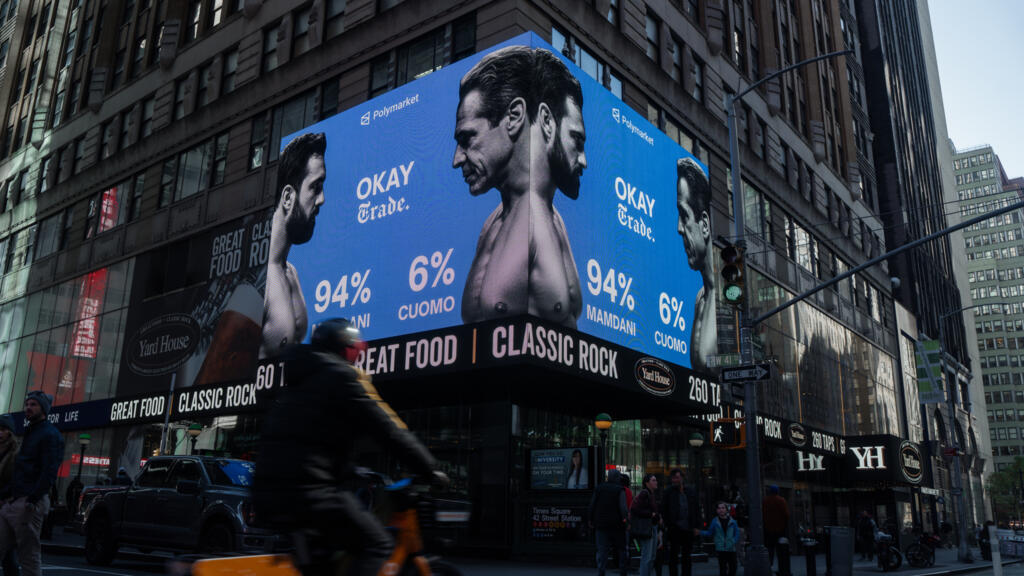
Advertisements by the American company Polymarket predict a victory for Zohran Mamdani in the New York City mayoral election on Tuesday, Nov. 4, 2025, in New York. © Olga Fedorova, AP

Only a handful of people in the world knew what was going to happen in the early hours of January 3, before ‘Operation Absolute Resolve’ was launched. The extraordinary two-hour-and-twenty-minute military intervention by air, land and sea culminated in the capture of Venezuelan President Nicolas Maduro and his wife. It was a top-secret operation, which stunned the world.

But a hint of what was to occur emerged in the online, crypto-based prediction market portal Polymarket, where anonymous users bet on real world events. User 0x31a56e wagered $32,537 that Maduro would be out of power by the end of January when the odds of that happening on the afternoon of January 2 were placed at just 6.5%. By midnight, those odds jumped to 11% and surged just before the operation was executed. The suspiciously timed bet paid off – anonymous user 0x31a56e made a neat profit upwards of $436,000 in just one night. The account has since vanished.

This odd incident pushed the online prediction market – which was growing but still fairly niche – into the mainstream spotlight. These are platforms where people can bet on the outcome of an enormous variety of future events – from the common (who will win the Super Bowl) to the bizarre (will Jesus be resurrected in 2026). These companies insist that they are not gambling portals, but legitimate financial markets, a chimera of a stock exchange and a crypto platform (though some watchdogs disagree).

Two players, Kalshi and Polymarket, have dominated the space in recent years. Of a total volume of $44 billion in prediction markets in 2025, Kalshi and Polymarket were responsible for a combined total of $38 billion: one of the fastest growing financial markets is one that most people ignore, or don’t know about.

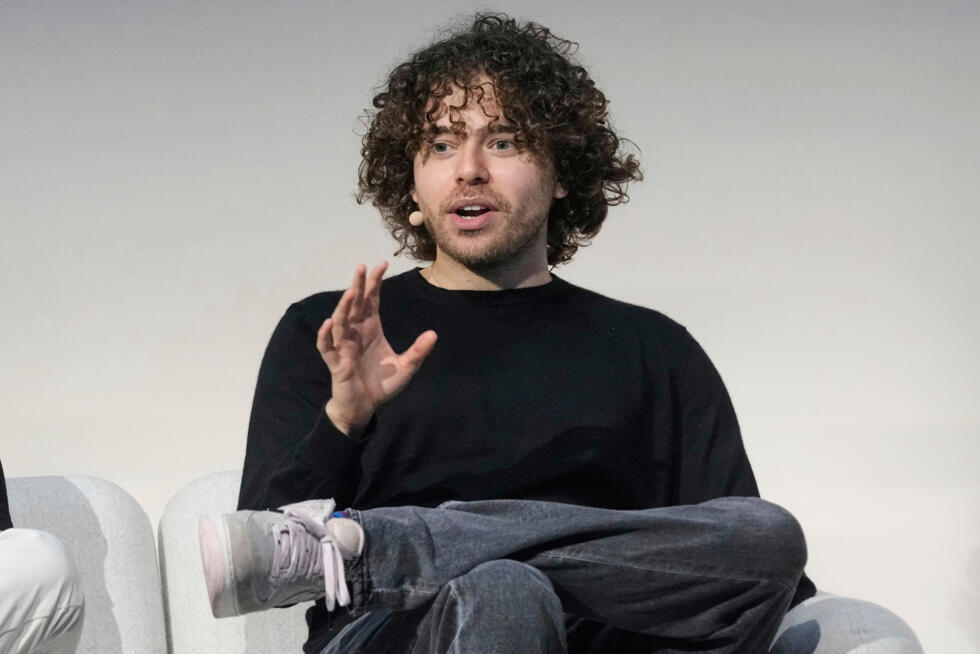
Shayne Coplan, founder and CEO of betting platform Polymarket, participates in the State of Crypto Summit, in New York, Thursday, June 12, 2025. © Richard Drew, AP

Trades on these websites are not to be confused with polls, insists Polymarket’s precocious founder Shayne Coplan, in an interview with 60 Minutes. Coplan, who founded the company in 2020 when he was just 21 years old, said that Polymarket tries to predict actual outcomes – "You make money if you're right. You lose money if you're wrong. And as a result it creates this information that's useful for people."

Some people have profited from making informed wagers – including a prolific, successful Polymarket trader who goes by the name Domer and features in the same 60 Minutes report. The former professional poker player moved to Polymarket because it was ‘more exciting’. He won over $100,000 predicting an American Pope, and even more after he picked JD Vance to be Donald Trump's presidential running mate. Domer went against the odds because he believed US President Donald Trump likes one syllable names because “he (Trump) is very into marketing”.

Even established media outlets like CNN and CNBC have struck deals to incorporate Kalshi prediction markets into coverage.

But prediction markets do not come without an enormous share of criticism. Polymarket, specifically, has been at the root of controversy because it relies on cryptocurrency and blockchain to run.

Users like 0x31a56e, who predicted Maduro’s capture, can trade anonymously, without being traced. While it is possible that they just got very lucky, analysts say it’s far more likely that someone with inside information realised they could make a quick buck. On crypto-native platforms, there’s no real way of knowing.

It’s because of this reason that in most of Europe, where a patchwork of rules must be adhered to, Polymarket is not legal or easily accessible. Some countries treat prediction markets as gambling, and the ones that do not still require licensing. Regulators are wary, with good reason.

Prediction markets were also heavily regulated under the Biden administration, but under President Trump, these sites have profited from deregulation and a huge boom in power.

But critics are concerned about the platforms commodifying real world events and encouraging people to bet on political, military and diplomatic events that have real-world consequences.
The risks of manipulation and insider trading

Maduro is only one example of a litany of shady trades made on prediction markets. Hours before the announcement of Nobel Peace Prize winner María Corina Machado, one user bet thousands in her favour: the likelihood of her winning leapt from 3.75 percent to nearly 73 percent within two hours – prompting authorities in Norway to open an investigation.

Similarly, in early January, White House Press Secretary Karoline Leavitt ended her briefing after 64 minutes and 30 seconds. Her abrupt exit left traders wondering whether Leavitt had deliberately stopped before the 65-minute mark to turn a profit. Polymarket had predicted at 98 percent odds that the briefing would run past 65 minutes.

Alex Goldenberg, an intelligence analyst and fellow at the Miller Center on Policing and Community Resilience at Rutgers University, says the signs are clear: “Across these cases, a consistent pattern emerges: new accounts with no trading history taking high-conviction, low-probability positions hours before those events occur. These aren't gradual market movements reflecting evolving public information. They bear the textbook signatures of insider trading in traditional financial markets.”

The point of these markets is to reward people with superior information i.e., those who collect the right data and analyse accurately could stand to make money. There’s nothing inherently wrong with that, he says, but there’s a fine line between analysis and inside information. “Scale that logic to domains governed by secrecy: military operations, covert action, diplomatic negotiations. In those domains, ‘superior information’ means access to classified or non-public knowledge. The platform architecture doesn't distinguish between a well-informed analyst and someone with a security clearance who just walked out of a briefing.”

Prediction markets’ blurry lines can also create serious problems for national security.
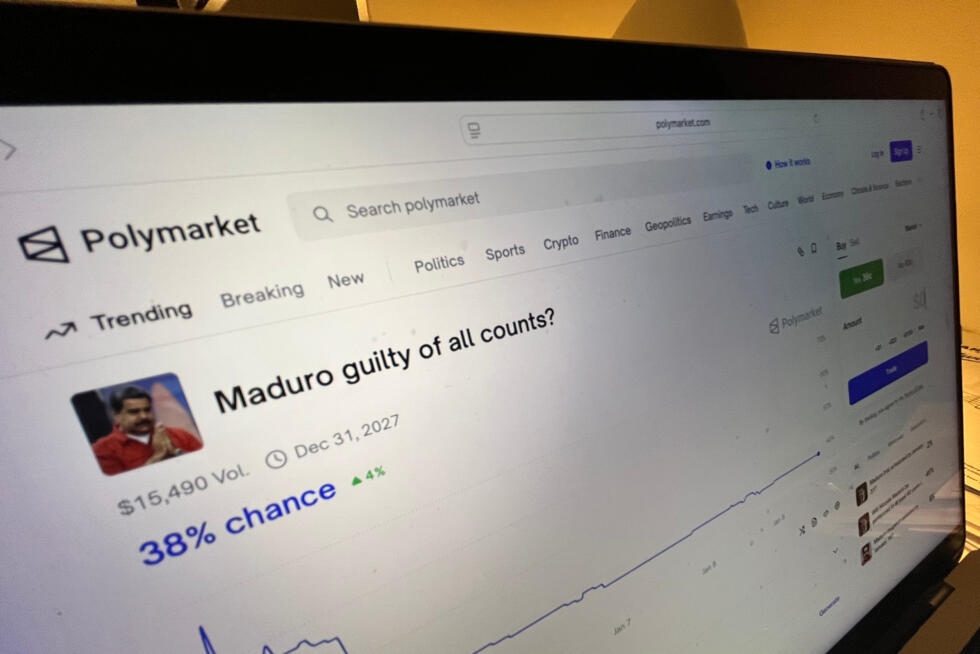
Polymarket prediction market website is displayed on a computer screen Friday, Jan. 9, 2026, in Philadelphia. © Wally Santana, AP

One account, originally named RicoSauve666 and later Rundeep, bet on several operations connected to Israeli military action with extremely consistent outcomes. Israel Defense Forces and the Israel Security Agency (Shin Bet ) ultimately opened an investigation into the user.

“The high-conviction, low-probability trades we saw before the Venezuela operation and Israeli strikes bear the hallmarks of someone with access monetizing what they know,” says Goldenberg. “That's privatizing state secrets. Diplomats, military personnel, intelligence analysts, contractors, and anyone in the national security apparatus now has a potential avenue to monetize non-public, sensitive information for personal profit.”
How prediction influences perception and policy

Dangerous biases can occur when an outcome is presumed – Goldenberg presents a hypothesis: “Suppose the US is about to carry out an operation against Iran and multiple high-conviction, low-probability bets suddenly appear on a prediction market that it's going to happen tomorrow,” he posits. “You've potentially given an adversary advance notice of an operation through publicly visible market activity.

"An adversary placing large bets on specific military outcomes can create a situation where we ask ourselves, does someone know something? That alone sows confusion and distorts decision-making."

The predictions on these platforms are visible to anyone. Diplomatic, geopolitical and military decisions could potentially be made on assumed outcomes – which could be particularly dangerous if these markets can be manipulated.

“When a prediction market shows odds on a US strike suddenly jumping, that movement could become news. Media reports it, policymakers see it. The market doesn't just predict. It shapes perception.”

This is a far greater risk on crypto native platforms like Polymarket, where trades take place anonymously, often in offshore jurisdictions. They are extremely difficult to trace back to an individual. “Who investigates? Which jurisdiction applies?” asks Goldenberg. “Today, the honest answer is that in many cases, they wouldn't be caught. Several countries, including France, have already concluded these platforms can't be adequately regulated and banned them outright.”

There’s also the important question of who runs the market themselves: the US president's son Donald Trump Jr. is an adviser to both Kalshi and Polymarket. His venture capital firm 1789 invested an undisclosed “double-digit millions of dollars” into Polymarket in 2025. Polymarket’s founder sees this as a positive – saying in an interview, “This admin is very pro-innovation, and pro-crypto, and pro-Polymarket, which is amazing… I'm a young entrepreneur. If I have people who believe in what I do, who understand how politics works and can help me… there's nothing wrong about that.”

Furthermore, Trump Media and Technology Group, the owner of the president’s social-media platform, Truth Social, has announced its own platform, Truth Predict.

There are real, human consequences of turning the world into one big casino where serious events with real repercussions are being reduced to a set of numbers. “When you're looking at a screen that says 'Will Country X invade Country Y by March 31? Yes/No', you're interacting with an abstraction. But the underlying event involves air strikes, casualties, displaced populations. The platform strips away human reality and replaces it with a contract and a price,” says Goldenberg.

“It fundamentally changes civic discourse. Instead of asking ‘should we strike’, which is a moral and strategic question, we're asking ‘what are the odds we strike’. We've taken events with real human consequences and made them feel like any other financial instrument. That normalization is worth paying attention to."

Thailand’s ruling Bhumjaithai party tops election amid wave of nationalism

NOT A DEMOCRACY, ITS A JUNTA RUN MONARCHY

Issued on: 09/02/2026 

The Bhumjaithai Party of Prime Minister Anutin Charnvirakul is on track to win the most seats in Thailand’s general election, according to unofficial results released by the state Election Commission after about 94% of polling stations had reported Monday. It’s the first decisive victory of a conservative party in Thailand in years and comes against a backdrop of slow economic growth and heightened nationalist sentiment.

Zelensky French TV interview: 'If Ukraine doesn't stop Putin, he will invade Europe'

Amid a flurry of diplomatic meetings in Moscow and Abu Dhabi, in an interview on TV channel France 2 Ukrainian President Volodymyr Zelensky called on his European partners – as well as United States President Donald Trump – to put more pressure on Russia to end the four-year war.


Issued on: 05/02/2026 - RFI

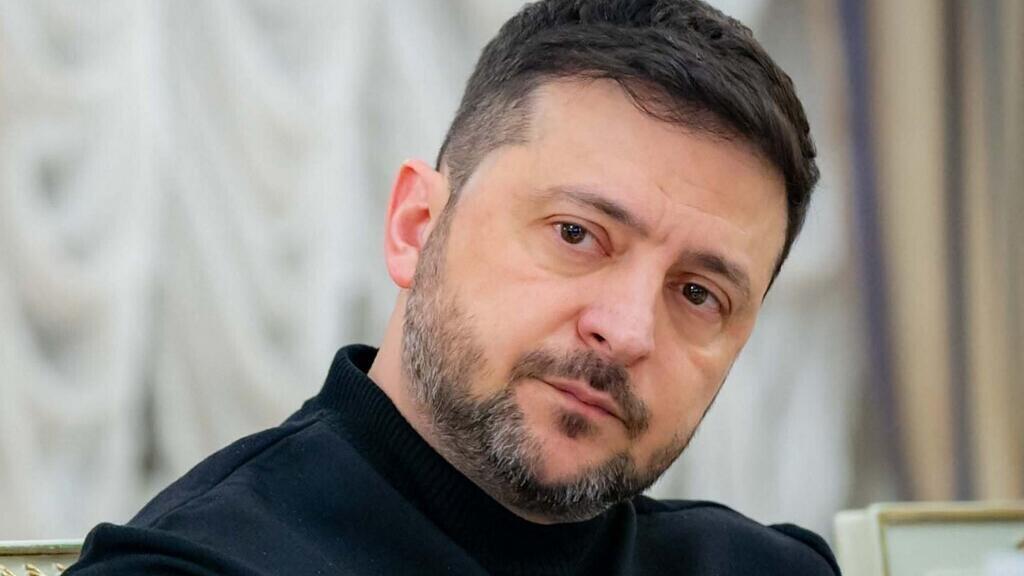
Ukraine's President Volodymyr Zelensky spoke exclusively to French public television channel France 2 on Wednesday. © AFP - UKRAINIAN PRESIDENTIAL PRESS SERVICE


The conflict is Europe's deadliest since the Second World War, with hundreds of thousands of people killed, millions forced to flee their homes and much of eastern and southern Ukraine left decimated.

Underscoring the human toll, Zelensky told France 2 journalist Léa Salamé on Wednesday that 55,000 of his country's troops had been killed, a rare assessment of battlefield losses by either side.

"And there are a great number Ukraine lists as missing," he said, through translated comments.

While denying that he was trying to scare anyone, the Ukrainian leader issued a blunt warning to European countries.

"Life in Europe is cool, it's nice... That's why I say we are all fighting to defend this way of life," he said. "But today, it is very clear that if Ukraine does not stop [Vladimir] Putin, he will invade Europe."

Zelensky is calling on Europeans to review their priorities, which he believes are too focused on "their internal affairs".

"I think the pressure on Putin is not enough... My opinion is that we need to engage in dialogue, but with conditions," he said, asserting that the Russian president's "interest" is "to humiliate Europe".

Putin 'only scared of Trump'


He accused Moscow of taking advantage of the cold weather to try to tip the balance of the war by increasing strikes against energy infrastructure since the beginning of winter. This has left many people, including residents of the capital Kyiv, without power in temperatures as low as minus 20C in recent days.

"Russia wants to inflict more suffering on Ukrainians so that they accept what our American friends call a 'compromise', But in fact, it is an ultimatum."

Zelensky said the US president's role in ongoing peace talks would be crucial, and that "Putin is only scared of Trump".

He suggested that Trump could use economic sanctions against Russia or transfer weapons to Ukraine to "maintain this pressure on Putin", adding that Kyiv would not compromise on sovereignty.

Zelensky's comments came as a second day of trilateral talks gets under way on Thursday in Abu Dhabi.

These US-mediated talks are the latest chapter in the so far unsuccessful diplomatic effort to halt the war, which started on 24 February, 2022 with Russia's full-scale invasion.

The main sticking point in the negotiations is the long-term fate of territory in eastern Ukraine.

Moscow is demanding that Kyiv pull its troops out of swathes of the Donbas region, including heavily fortified cities atop vast natural resources, as a precondition of any deal.

It also wants international recognition that land seized in the invasion belongs to Russia.

Russia occupies around 20 percent of Ukraine. It claims the Lugansk, Kherson and Zaporizhzhia regions as its own, and holds pockets of territory in at least three other Ukrainian regions in the east.

Kyiv still controls around one-fifth of the Donetsk region.

International intervention force

But Zelensky has warned that ceding ground will embolden Moscow, and that it will not sign a deal that fails to deter Russia from invading again.

"We Ukrainians are well aware of the price that every metre and every kilometre of this land costs our army," he told France 2.

"To conquer eastern Ukraine, it would cost them [the Russian army] 800,000 more [soldiers'] lives. It will take them at least two years, with very slow progress. In my opinion, they will not last that long."

Instead he raised the suggestion of a "frozen front line" and the creation of a special economic zone, with international oversight.

"We must be in control of our part. They must control theirs. But, between us, we need an international intervention force, an international presence," he added.

French diplomatic visit

European leaders have balked at their exclusion from peace talks led by Trump’s administration, forced instead to shore up Ukraine’s negotiating position from the sidelines.

France and the United Kingdom have been leading efforts to put together a peacekeeping force that could be deployed to Ukraine after any deal.

On this subject, French President Emmanuel Macron stated in early January that "several thousand" French soldiers could be deployed.

Macron also reiterated this week the importance for Europeans "to restore their own channels of discussion".

He said in December that Europeans would have to re-engage in direct talks with Putin if the latest US-led efforts to broker a Ukraine peace deal were to founder.

In this vein, Macron’s most senior diplomat, Emmanuel Bonne, travelled to Moscow on Tuesday for talks with Russian officials.

"These discussions exist at a technical level, in full transparency and in consultation with President Volodymyr Zelensky and with the main European colleagues," the president's office said on Tuesday.

(with newswires)
Hong Kong sentences pro-democracy mogul Jimmy Lai to 20 years in prison


Former Hong Kong media tycoon Jimmy Lai, a steadfast critic of Beijing, was sentenced to 20 years in prison on Monday in the longest punishment given so far under a China-imposed national security law that has virtually silenced the city’s dissent. The European Union said it "deplored" the ruling, calling for Lai's "immediate and unconditional release".


 09/02/2026 -
By:  FRANCE 24
Video by:  FRANCE 24


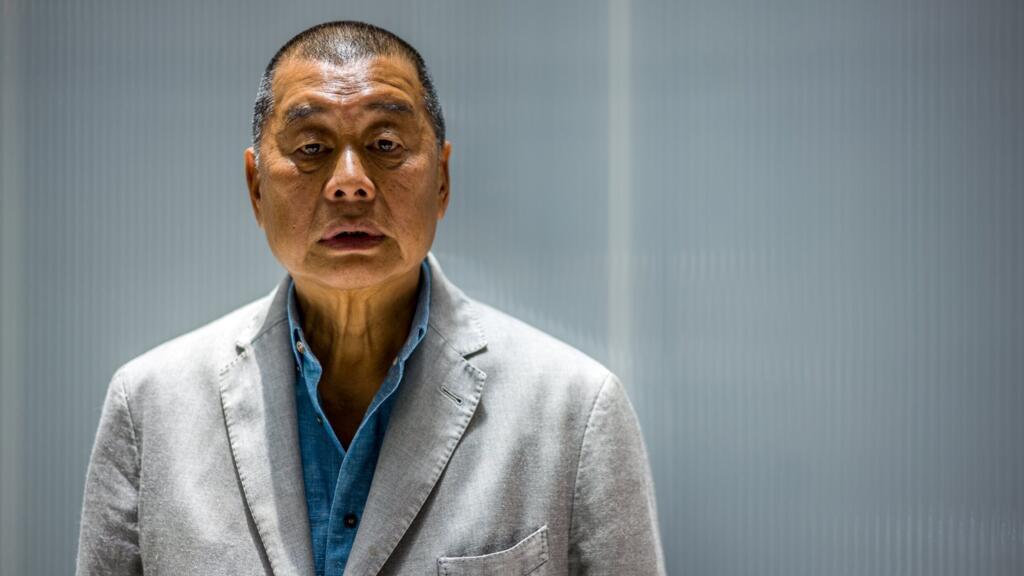
Beijing critic and pro-democracy mogul Jimmy Lai pictured in Hong Kong in June 2020. © Anthony Wallace, AFP file photo
01:37


Hong Kong court sentenced pro-democracy media mogul Jimmy Lai to 20 years in prison on Monday for national security crimes, a punishment rights groups condemned as "effectively a death sentence" and a symbol of the city's shrivelling press freedoms.

Lai, a British citizen and founder of the now-defunct Apple Daily newspaper, was found guilty in December of urging foreign countries to impose sanctions on Hong Kong and for publishing "seditious" articles in his paper.

The 78-year-old's sentence is by far the harshest handed out under the Beijing-imposed national security law, surpassing the previous record of 10 years given to legal scholar Benny Tai in 2024.

A summary document from the judges said they had settled on 20 years' imprisonment "after considering the serious and grave criminal conduct of Lai".

Two of those years will overlap with Lai's existing prison term, meaning that he will serve an additional 18 years, the judges wrote.

Lai, who has been behind bars since 2020, sat impassively in the dock as his sentence was read out, an AFP journalist in the court saw.

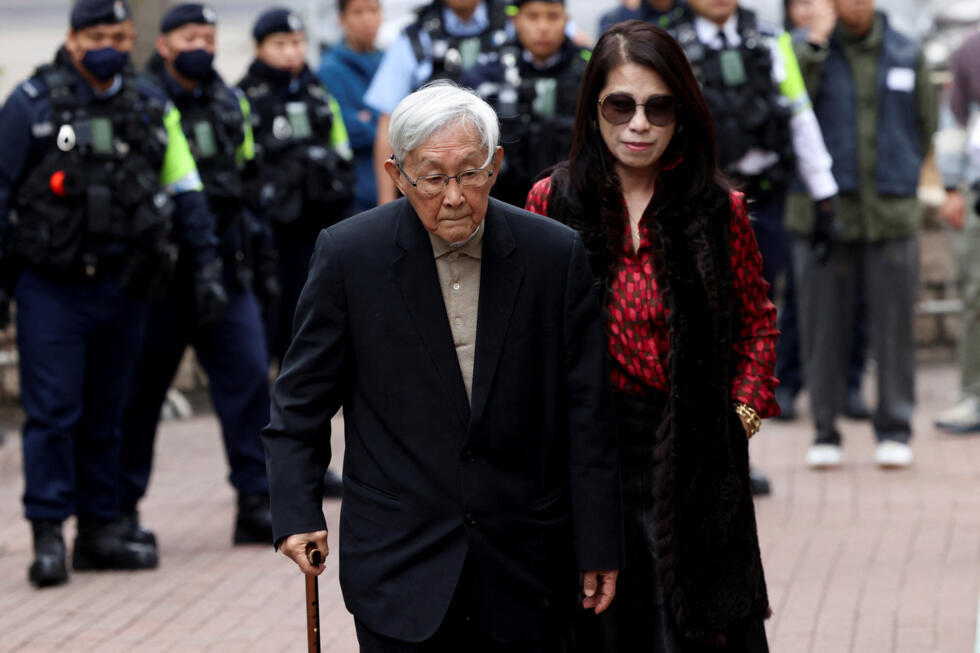
As he was led away, he waved solemnly to people in the public gallery, including his wife Teresa, former Hong Kong bishop Cardinal Joseph Zen, and former Apple Daily reporters.

His defence lawyer Robert Pang declined to comment on whether Lai would lodge an appeal, which can be done in the next 28 days.

Asked if the sentence was in line with expectations, Pang told AFP: "In these times, I don't know what to expect."

Teresa Lai was grim-faced during the hearing and made no comment as she left the court, but their children, who live abroad, condemned the sentence in a statement.

"Sentencing my father to this draconian prison sentence is devastating for our family and life-threatening for my father," Lai's son Sebastien said.

The mogul's daughter Claire called it "a heartbreakingly cruel sentence" given his declining health in prison, and if carried out, "he will die a martyr behind bars".
'Effectively a death sentence'

Rights groups also said Lai's punishment amounted to a grave injustice.

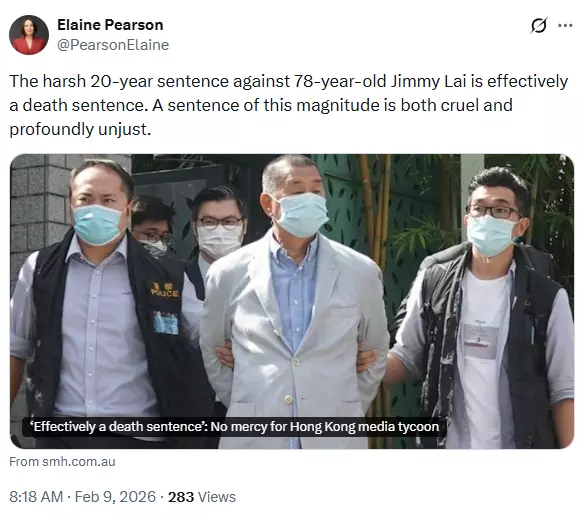
"The harsh 20-year sentence against 78-year-old Jimmy Lai is effectively a death sentence. A sentence of this magnitude is both cruel and profoundly unjust," Elaine Pearson, Asia director at Human Rights Watch, said in a statement.

Amnesty International called the case "another grim milestone in Hong Kong's transformation from a city governed by the rule of law to one ruled by fear".

Jodie Ginsberg, the CEO of the Committee to Protect Journalists, said "today's egregious decision is the final nail in the coffin for freedom of the press in Hong Kong".
Retired bishop Cardinal Joseph Zen Ze-kiun and Teresa Lai, wife of Jimmy Lai, arrive at the West Kowloon Magistrates' Courts building in Hong Kong for sentencing on February 9, 2026. © Tyrone Siu, Reuters

British Prime Minister Keir Starmer previously said he had raised the issue of Lai during his meeting with Chinese leader Xi Jinping in Beijing last month, while US President Donald Trump has also called for his release.

Following Lai's sentencing, British Foreign Secretary Yvette Cooper called on Hong Kong to "end his appalling ordeal" and pledged to "rapidly engage further" with Beijing.

Taiwan said Lai's sentencing created a "chilling effect" across borders and "tramples on freedom of speech".

Beijing again dismissed critics on Monday as smearing Hong Kong's judicial system, calling the sentence "reasonable, legitimate and legal".

Hong Kong's chief executive John Lee lauded the lengthy prison term as "deeply gratifying".
Staunch supporters

Dozens of former Apple Daily employees and others braved the cold to queue overnight outside the West Kowloon court for a spot in court, while journalists gathered outside the building's entrance.

The mood was tense as police deployed dozens of officers, an armoured car and a bomb disposal van to the area.

"I think this is equivalent to sentencing Lai to life imprisonment," Lam Ying-kit, a former history teacher in his 50s, told AFP.

Lai's supporters, children, lawyers and rights groups have all raised concerns about his deteriorating health in prison.

Lai was kept in solitary confinement at his own request to avoid harassment, according to prosecutors, while authorities maintain he receives "adequate" care.

Long a thorn in Beijing's side, Lai was prosecuted under the national security law imposed by China on Hong Kong in 2020 following huge pro-democracy protests.

Apple Daily was forced to close in 2021 after police raids.

Eight other defendants, including six Apple Daily executives, were handed sentences of up to 10 years in jail. All had pleaded guilty.

Hong Kong had arrested a total of 386 people for various national security crimes by the start of this month, with 176 of them being convicted.

(FRANCE 24 with AFP)

'Curtain falls on Hong Kong press freedom': Jimmy Lai prison sentence sparks outcry

Hong Kong's most prominent China critic, media tycoon Jimmy Lai, was sentenced on Monday to 20 years in jail under the city's controversial national security law, in what rights groups condemned as "effectively a death sentence" and a symbol of the city's shrivelling press freedoms.


Issued on: 09/02/2026 
By: FRANCE 24

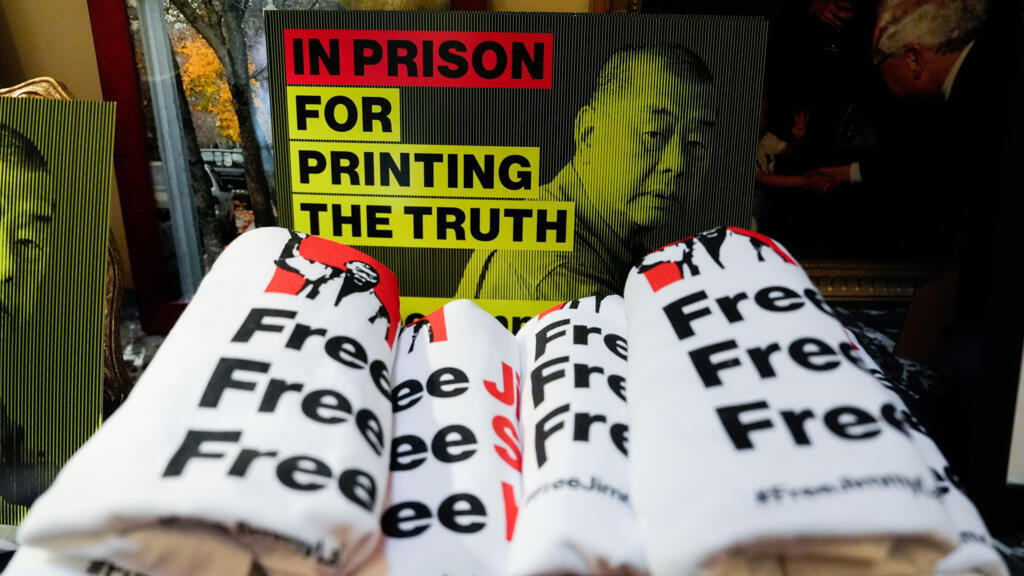
Merchandise in support of Jimmy Lai is displayed before a news conference in Washington on December 15, 2025. © Julia Demaree Nikhinson, AP

Hong Kong pro-democracy media tycoon Jimmy Lai was sentenced on Monday to 20 years in prison for foreign collusion and sedition, the harshest penalty yet under a Beijing-imposed national security law.

The 78-year-old founder of the now-defunct Apple Daily newspaper has been behind bars since 2020.

Here are some key reactions:

Lai's children: 'Cruel'


Jimmy Lai's son Sebastien said in a statement: "Sentencing my father to this draconian prison sentence is devastating for our family and life-threatening for my father."

His daughter Claire added: "This is a heartbreakingly cruel sentence. Over the last five years, I have watched my father's health deteriorate dramatically and the conditions he's kept in go from bad to worse. If this sentence is carried out, he will die a martyr behind bars."

Hong Kong leader: 'Deeply gratifying'

Hong Kong leader John Lee said Lai's crimes were "heinous and evil in the extreme".

"(Lai's) heavy sentence of 20 years' imprisonment demonstrates the rule of law, upholds justice and is deeply gratifying," Lee said in a statement.
Beijing: 'No room for argument'

Lin Jian, spokesperson of China's foreign ministry, said Lai was a Chinese citizen and was "a key planner and participant in a series of anti-China and disruptive activities in Hong Kong".

"This is reasonable, legitimate, and legal; there is no room for argument," Lin said at a press briefing.

UK: 'Rapidly engage further'

Britain's Foreign Minister Yvette Cooper said Lai's penalty was "tantamount to a life sentence" and reiterated calls for the tycoon's release on humanitarian grounds.

"Following today's sentencing we will rapidly engage further on Mr Lai's case. We stand with the people of Hong Kong," Cooper added.

EU: 'Deplores'

The European Union said it "deplores" Lai's sentencing and called for his "immediate and unconditional release".

"The EU calls on the Hong Kong authorities to restore confidence in press freedom in Hong Kong... and to stop prosecuting journalists," EU foreign affairs spokesperson Anitta Hipper said.

Australia: 'Cease suppression of freedoms'

Australian Foreign Minister Penny Wong urged China to "cease suppression of freedoms" and repeal Hong Kong's national security law.

"The Australian Government is gravely concerned by the sentences handed down to Jimmy Lai and his co-defendants in Hong Kong today.

"We continue to call on China to ​cease suppression of freedoms of expression, assembly, media and civil society, consistent with UN Human Rights Committee recommendations, and to call for the repeal of ​the national security law in Hong Kong."

Taiwan: 'Chilling effect'

Taiwan's Mainland Affairs Council said in a statement that China and Hong Kong "have brought media influence and international connections within the scope of national security measures, aiming to create a chilling effect across sectors and borders".
Reporters Without Borders: 'Collapse of press freedom'

Thibaut Bruttin, director general of Reporters Without Borders (RSF), said Lai's case was "nothing more than a sham".

"Today, the curtain falls on press freedom in Hong Kong. We are outraged by the harsh sentences handed down to Jimmy Lai," Bruttin said in a statement.

"Democracies, such as the UK and the US, must stop prioritising the normalisation of relations with China and instead exert pressure on the Chinese regime and Hong Kong authorities to ensure that Jimmy Lai and all other journalists are released from prison," he added.

Human Rights Watch: 'Effectively a death sentence'

Lai's 20-year jail term is tantamount to a death sentence, said Elaine Pearson, Asia Director at Human Rights Watch (HRW).

"The harsh 20-year sentence against 78-year-old Jimmy Lai is effectively a death sentence. A sentence of this magnitude is both cruel and profoundly unjust.

"Lai’s years of persecution show the Chinese government’s determination to crush independent journalism and silence anyone who dares to criticise the Communist Party."

HRW's Elaine Pearson reacted to Jimmy Lai's prison sentence in a post on X. © X

Legal scholar: 'On the high side'


Simon Young, a law professor at the University of Hong Kong, said the parts of Lai's sentencing related to foreign collusion "appear to be on the high side".

"I think the Court is wrong to say that (pre-national security law) conduct can be considered in assessing the gravity of the offences," Young told AFP.

Lai's legal team should consider an appeal of sentence, he added.

(FRANCE 24 with AFP and Reuters)


Nigeria deploys army to Kwara state after deadly mass shootings


Nigeria's President Bola Ahmed Tinubu has deployed an army batallion to the western state of Kwara after gunmen killed at least 162 people in one of the country's deadliest attacks in recent months.


Issued on: 05/02/2026 - RFI


Nigerian soldiers driving in Ngamdu, north-eastern Nigeria, on 3 November 2020. © AFP - AUDU MARTE

Tinubu condemned Tuesday's "beastly attack", which he said was carried out against villagers who had rejected extremist Islamist ideology.

"President Tinubu expressed rage that the attackers killed the community members who rejected their obnoxious attempt at indoctrination," a presidential statement said on Wednesday.

The main attack occured late Tuesday in Woro village, while another attack was reported in Nuku village.

Ayodeji Emmanuel Babaomo, the Red Cross secretary in Kwara State, said the death toll stood at 162, "as the search for more bodies continues".

He told French news agency AFP that gunmen had burned shops and a traditional ruler's home in Woro and that wounded people fled into the bushes.

Babaomo said the organisation has been unable to reach the communities where "scores of people were killed" because of the remoteness of the area – about eight hours from the state capital and near Nigeria’s border with Benin.

Conflicting casualty reports

Residents told Reuters news agency the gunmen, thought to be jihadists who often preached in the village, demanded that locals ditch their allegiance to the Nigerian state and switch to Sharia Islamic law. When the villagers pushed back, the militants opened fire.

Earlier, a local lawmaker in Woro, Sa'idu Baba Ahmed, gave an initial toll of 35 to 40 dead but said he expected more bodies would be found. He later put the death toll at more than 170.

The attack was confirmed by police, who did not give a casualty figure.

While no group has yet claimed responsibility, the Kwara state governor AbdulRahman AbdulRazaq blamed "terrorist cells".

He said their attack as a "cowardly expression of frustration" in response to ongoing military operations against armed extremists in the state.

Mohammed Omar Bio, a member of parliament representing the area, told the Associated Press agency the attacks in Woro and Nuku were carried out by the Lakurawa, an armed group affiliated with the Islamic State group.

President Tinubu blamed the attack on Boko Haram jihadists.

Complex security crisis


Nigeria is in the grip of a complex security crisis, with an insurgency by Islamic militants in the north-east alongside a surge in kidnappings for ransom by gunmen across the north-west and north-central regions over recent months.

Last month, the military said it had launched "sustained coordinated offensive operations against terrorist elements" in Kwara State. Local media reported that the army had "neutralised" 150 bandits.

Jihadist attacks have intensified over the past year in Nigeria. The powerful Al-Qaeda affiliate Group for the Support of Islam and Muslims (JNIM) – which operates across the northern border in Niger – claimed responsibility for its first attack in Nigeria at the end of October, in Kwara State.

Researcher Brant Philip said the latest raid occurred very near the site JNIM attacked, suggesting a "direct overlap" between JNIM and Boko Haram, with the groups appearing to have a "loose alliance".

US involvement

Nigeria is under pressure to restore security since US President Donald Trump accused it last year of failing to protect Christians after numerous Islamist attacks and mass kidnappings.

In response, Trump ordered US air strikes in December on IS group-affiliated militants in Nigeria.

On Tuesday, the head of US Africa Command said the US had sent a small team of military officers to Nigeria.

The Nigerian authorities say they are cooperating with Washington to improve security and have denied there is systematic persecution of Christians.

Experts say Muslims as well as Christians have been killed in the country's violence, often without distinction.

(with newswires)


Sudan conflict worsening with mass killings and famine, HRW warns

Sudan’s war has been marked by mass killings, famine and the deliberate blocking of aid as rival forces carried out war crimes across the country, Human Rights Watch said, while the United Nations warned the conflict has become the world’s worst humanitarian crisis.


Issued on: 04/02/2026 - RFI

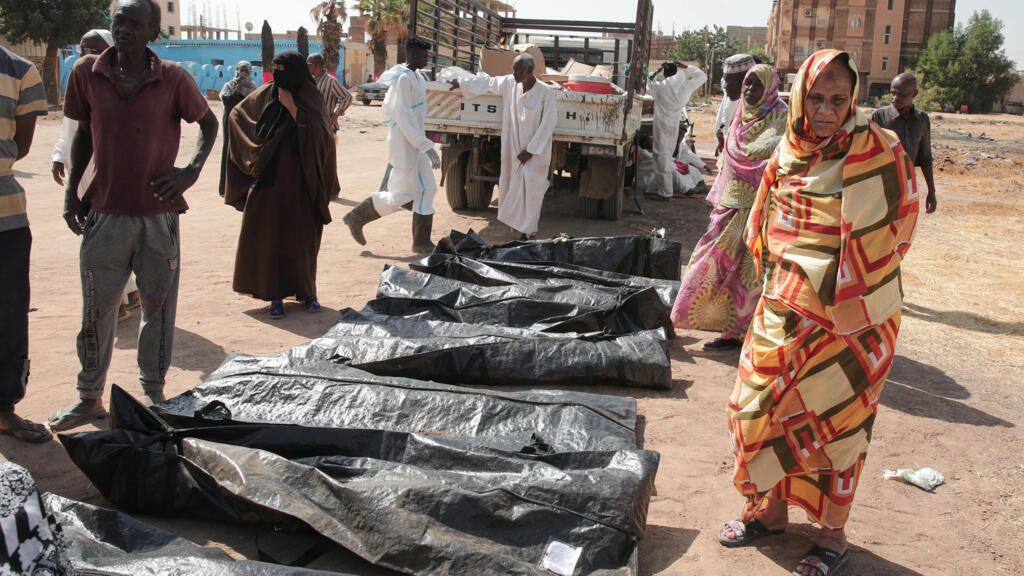
Relatives check the body bags of victims of the Sudanese war after the Sudanese Red Crescent transferred the remains from makeshift graves to a local cemetery in Khartoum on 11 January 2026. AP - Marwan Ali


Fighting between the Sudanese Armed Forces and the Rapid Support Forces has devastated cities, driven millions from their homes and left vast areas facing hunger since April 2023.

Both sides have attacked civilians, obstructed humanitarian assistance and committed serious abuses, the rights group said.

The actions of the warring parties have created the most severe humanitarian emergency globally, Human Rights Watch said in World Report 2026, its annual review of human rights practices and trends around the globe.

The UN World Food Programme reported that 24.6 million people are suffering acute hunger, with 2 million facing famine or the risk of famine. More than 11.8 million people have been displaced, including 7.4 million inside Sudan and 4.2 million who have fled to neighbouring countries.

While the army retook Khartoum and other areas in central Sudan, the RSF captured El Fasher, the capital of North Darfur, on 26 October after a siege that began in May 2024.

There were immediate reports and images of RSF extrajudicial killings and other serious violations against civilians trying to flee, Human Rights Watch said.

Killings, torture, mass graves

In Khartoum, the army uncovered evidence of serious abuses by the RSF as it regained control of the capital in March, particularly in Omdurman, Human Rights Watch said. The army then carried out retaliatory attacks against local volunteers accused of collaborating with the RSF.

Local medical authorities and activists said RSF shelling killed 54 people and wounded more than 100 at a market in Omdurman in February.

Media reported in March that around 500 people may have been buried in mass graves near an RSF base in northern Khartoum, where detainees reported torture and starvation.

The UN Human Rights Office said there were credible reports that RSF and allied forces looted houses in eastern Khartoum and carried out summary killings and arbitrary detentions. It also said SAF-allied fighters were reported to have carried out similar abuses.

Local volunteers said in January that the army carried out indiscriminate airstrikes in southern Khartoum, including on a market, killing and injuring dozens of civilians, Human Rights Watch reported.

The group also said the army bombed a mosque in West Kordofan on June 21, killing 41 and wounding dozens.

Darfur under siege

The fall of El Fasher followed relentless RSF attacks that triggered famine in displacement camps in and around the city, Human Rights Watch said. It said the RSF carried out mass killings of people fleeing as well as sexual violence.

The UN fact-finding mission reported that the RSF damaged water facilities and supply lines in February and that mid-April attacks on Zamzam killed between 300 and 1,500 people and injured more than 157, the majority women and children.

Human Rights Watch said the army shelled and bombed residential areas, including a market north of El Fasher on March 24. It also said the army killed scores of civilians in early February in attacks on residential and commercial neighbourhoods in Nyala, South Darfur.

Both warring parties continue to wilfully obstruct aid despite desperate needs, the report said, and have detained and harassed humanitarian workers and local volunteers.

The UN fact-finding mission concluded that the RSF and allied forces used starvation as a method of warfare, a war crime.

Aid blocked, women and girls targeted

In June, a World Food Programme convoy was attacked in North Darfur, killing five staff members. A drone strike also hit another UN convoy in the same region in August.

An armed attack in August forced Doctors without Borders to suspend operations at Zalingei hospital in central Darfur in the midst of a cholera outbreak.

At least 330 cases of conflict-related sexual violence have been documented, primarily against women and girls, UN experts said in May. The UN Population Fund said cuts to aid funding have forced it to withdraw from more than half of the 93 health facilities it was supporting.

The UN’s top humanitarian official, Tom Fletcher, urged donors and diplomatic partners to act at a donor conference in Washington on Tuesday.

“The horrific humanitarian crisis in Sudan has endured more than 1,000 days – too long,” he said. “Too many days of famine, of brutal atrocities, of lives uprooted and destroyed.”

Fletcher warned that funding alone would not be enough. “The money is not enough,” he said.

“We need the air assets, the security, the medical support for our teams, and the mediation work that has to underpin the access.”

He said the UN was pushing for visible progress toward a humanitarian truce ahead of Ramadan.

In October, ICC judges convicted former Janjaweed militia leader Ali Muhammad Ali Abd-Al-Rahman of war crimes and crimes against humanity in Darfur in 2003-04 and 2013, the first trial arising out of the court’s Darfur investigation, Human Rights Watch said.

The group said the ICC’s mandate remains limited to Darfur, leaving no independent judicial mechanism to prosecute grave crimes committed elsewhere in Sudan.
Migrant rescue vessel Ocean Viking back at sea after Libyan coast guard attacks

After months out of service following an armed attack in international waters, SOS Méditerranée’s migrant rescue vessel, the Ocean Viking, has resumed operations in the central Mediterranean. In an interview with RFI, Claire Juchat, the NGO’s operations manager, described returning to sea as a relief but said that tensions with the Libyan coast guard persist.


Issued on: 04/02/2026 - RFI

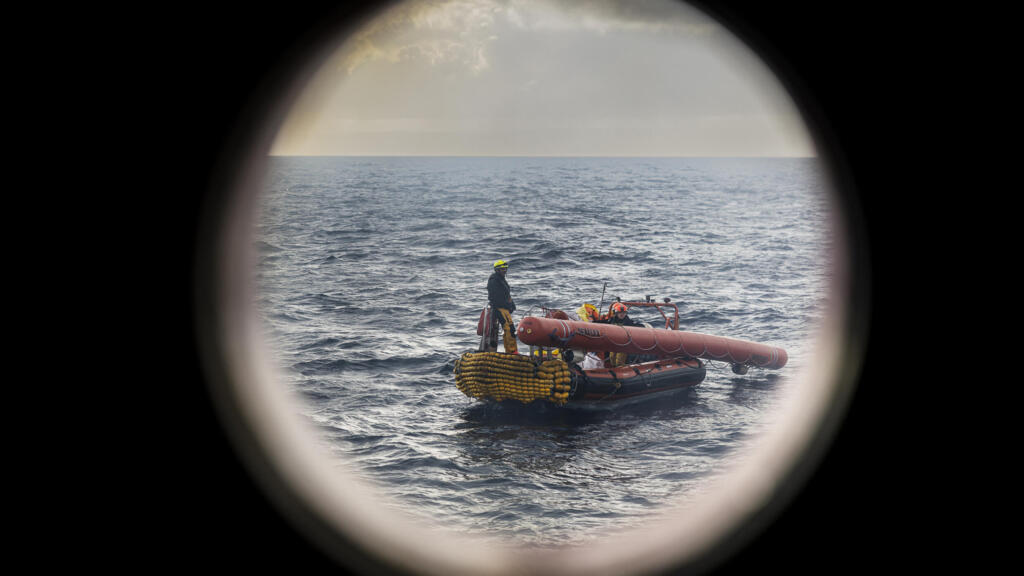
The Ocean Viking, a vessel run by the NGO SOS Méditerranée, patrols a migrant search and rescue zone in international waters between Italy and Malta on January 13th, 2026. © Sameer al Doumy / AFP

By:Alara Koknar

“It’s a relief because we had to stop operations for three months after the attack of the EU-funded Libyan Coast Guard against the Ocean Viking in August” Claire Juchat said. “People are still leaving Libyan shores because they have no other choice.”
A hostile operating zone

The Ocean Viking resumed rescue operations in late December, following the attack in late August 2025. According to the NGO, the vessel was fired upon with 100 bullets for around 20 minutes while carrying survivors and searching for another boat in distress. No one was injured, but the ship was damaged and remained docked for several months. She compared the operating environment to "a war zone".

Italy confines Ocean Viking migrant rescue ship for 20 days

Despite the risks, Juchat says returning to sea was necessary. “We rescued 120 people in the past few weeks,” she said. “Of course, it’s a bit scary to be back at sea because we know that the Libyan Coast Guard are still very active.”

The Libyan coast guard, which is organisationally part of the Libyan navy, acts as a proxy force for the European Union to prevent migrants from reaching Europe’s borders.

The EU has financed Libya's migration policy through the Emergency Trust Fund for Africa, which provided €465 million between 2015 and 2021, and through the NDICI-Global Europe instrument, which allocates €65 million for the 2021-2027 period. It remains unclear how much of that funding reaches the Libyan coast guard.

The crew of the rescue ship Ocean Viking, operated by the NGO SOS Méditerranée, conducts rescue simulation exercises in the Mediterranean Sea, in international waters off the coast of Libya, on 26 December 2025. © Sameer al Doumy / AFP

The European Center for Constitutional and Human Rights says evidence indicates the vessel that attacked the Ocean Viking was handed over by Italy through an EU-funded programme. Following the incident, SOS Méditerranée filed a complaint with French prosecutors in Marseille, southern France.

The EU's response


Critics argue that the EU's policy enables abuse. Libya is not considered a “place of safety” for disembarkation by the United Nations, due to a lack of security and human rights violations.

SOS Méditerranée and 42 other humanitarian and civil society groups have previously urged the European Commission to suspend cooperation with Libya on search and rescue, accusing the EU and Italy of funding of legitimising a “culture of impunity for violence.”

Ocean Viking migrant rescue ship back in the water after 10-day stoppage

The European Commission has said it would maintain its approach. “This is what we have been doing and we keep on doing at different level, and this is our policy for now,” Commission spokesperson Guillaume Mercier responded last year to the concerned parties.

Juchat also criticized Italian policies that require rescue ships to disembark rescued people in distant northern ports.

“Sometimes up to Genova or Ravenna,” Juchat said, noting how this removes rescue vessels from the central Mediterranean for days and increases fuel costs, further limiting the NGO's ability to operate.


Multitude: war and democracy in the Age of Empire /. Michael Hardt and Antonio Negri. p. cm. Sequel to: Empire. Includes index. ISBN 1-59420-024-6. 1 ...

Empire / Michael Hardt and Antonio Negri. p. cm. Includes ... missions of Empire will be constituent assemblies of the multitude, social ...


France calls on EU to set climate 'red lines' as bloc reviews UN goals


As European environment ministers gather for a two-day summit in Cyprus, France has called for the bloc to take a more aggressive stance when it comes to defending global climate goals.


Issued on: 06/02/2026 - RFI

Climate activists protest during the Cop30 UN climate summit in Belem, Brazil, on 15 November 2025. © AP - Andre Penner

The European Union must be "more transactional" in global climate negotiations and consider using financial and trade leverage to assert its position, the French ecology ministry said Tuesday.

The comments came before a meeting of EU environment ministers in Cyprus on Thursday to review last November's UN climate summit, which ended with a watered-down pact that omitted EU demands over fossil fuels.

Monique Barbut, France's minister for ecological transition, had already expressed disappointment over the Cop30 outcome and said the EU must be prepared to "assert its red lines" and reject similar proposals in future.

'Tougher world'


The EU must be "less naive" and "more assertive, more demanding, and more transactional if we want to have an impact in these negotiations", her office said ahead of the meeting.

"We are in a tougher world where the European Union, when it comes to climate negotiations, is more isolated," a senior source from Barbut's office told reporters.

Monique Barbut, French Minister for the Environment and Ecological Transition, on 22 November 2025, during the Cop30 summit in Belém, Brazil. © Géraud Bosman-Delzons/RFI


"States that had previously been somewhat hesitant to speak out are doing so much more freely since the American withdrawal" from the global fight against climate change, the source added.

US President Donald Trump has withdrawn the world's largest economy from the Paris Agreement on global warming and the UN climate treaty that underpins it.

His administration sent nobody to the last UN climate summit in Brazil, where the EU's call for the inclusion of a "roadmap" leading the world away from fossil fuels was left out of the final deal.

The EU ended up accepting that version instead.

Climate finance

The EU is the largest payer of climate finance – money to help developing countries transition to a low-carbon future – and Barbut's office suggested the 27-nation bloc could use this in a more "political" manner.

The source also questioned if the EU should "continue to demonstrate climate and financial solidarity with countries" that have failed to meet their obligations under the Paris Agreement.

These include updating their national pledges for cutting emissions, the latest round of which were due last year.

But more than 60 countries – some of them major climate finance recipients such as India, Egypt, and the Philippines – have still not turned in their latest plans.

"We have tools like trade agreements", whose implementation can be conditional on compliance with the Paris Agreement, the minister's office added.

Cyprus currently holds the rotating presidency of the Council of the European Union.

One of the key issues on the agenda will be implementation of a European strategy for water resilience across key sectors such as agriculture, tourism and energy.

In addition, delegates will discuss challenges related to the circular economy and the plastics recycling market.

(with AFP)