Tuesday, February 10, 2026

More Unions Are Saying ‘ICE Out’

More unions across the country are taking a stand against Immigration and Customs Enforcement since the January 23 mass strike in Minneapolis and the January 24 killing of Alex Pretti, an intensive care nurse and union member.

Pretti was a member of the Government Employees (AFGE) Local 3669, working in the Minneapolis Veterans Affairs Hospital. His death at the hands of Border Patrol agents has shocked and outraged people across the country. Health care and V.A. workers have felt it even more keenly.

National Nurses United, which has 225,000 members, became the first national union to call for the abolition of ICE, holding a week of actions beginning January 26 on that theme.

AFGE held a nationwide day of remembrance for Pretti on February 1, with vigils outside V.A. hospitals in 22 cities. The union called for the resignation of Homeland Security Secretary Kristi Noem and Deputy White House Chief of Staff Stephen Miller for branding Pretti a “domestic terrorist.”

A GROWING CHORUS

The day of Pretti’s killing, the AFL-CIO called “for ICE to immediately leave Minnesota.” The Communications Workers (CWA) soon did too.

They joined unions that have been making similar calls since the January 7 killing of Renee Good, including SEIU, which has called for “ICE out of our communities,” and the Postal Workers (APWU), which has called for “an end to these dangerous and disruptive ICE raids” and objected to the use of postal facilities as ICE staging areas.

Even some more conservative unions felt the need to say something about Pretti’s death. The Electrical Workers (IBEW) condemned the administration’s “excessive use of force and government overreach” in Minnesota. The Building Trades (NABTU) said Pretti’s killing “has raised serious concerns about excessive force, as multiple videos and eyewitness accounts contradict federal claims about the moments leading up to his death.”

Pretti’s union, AFGE, is in a complex position. The National Border Patrol Council is an AFGE affiliate, and put out an immediate statement the morning of his killing falsely claiming that he had been “brandishing” a gun, and asserting that officers had “utilized justifiable force in eliminating the threat.”

AFGE Local 17, which represents workers in the V.A.’s central office, has demanded that the V.A. offer grief counseling and mental health support, lower flags to half-staff, and apologize for blaming Pretti’s death on Minnesota’s insufficient compliance with the deportation machine.

PUTTING WORDS INTO ACTION

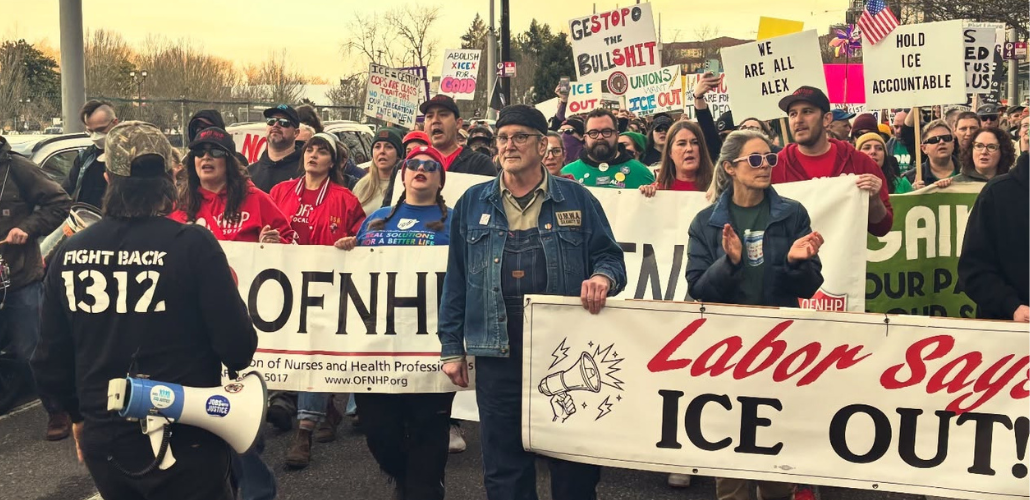
In Portland, Oregon, the state labor council and two dozen unions backed a “Labor Says ICE Out!” march and rally January 31. Thousands of people turned out, many wearing union gear and carrying their union banners. The Northwest Labor Press reported that marchers filled the streets for nine blocks.

Though the march was family-friendly, with plenty of kids and elders participating, when some protesters approached the ICE facility the police attacked with teargas and projectiles. The gassing was so intense that the effects lingered in the air for days, even indoors in nearby buildings, including a hospital.

The same day in Seattle, workers organized three union-backed “ICE out!” rallies—one for educators, one for health care workers, and one for tech workers—and converged for a joint march of thousands.

Some unions, such as the Chicago Teachers, have answered the call from Minneapolis activists to hold protests outside and inside Target stores nationwide. The retail chain Target is one of the biggest companies headquartered in the Twin Cities, and it has been allowing ICE to enter its stores and arrest employees. Other corporate targets are the hardware chain Home Depot, Enterprise car rentals, Hilton hotels, and a home builder called DR Horton.

In Minneapolis, labor solidarity has continued after the monumental strike. Teamsters Local 120 sent its food truck to support AFGE’s vigil at the V.A. At another hospital, nurses and doctors told the press that ICE was clearly lying about how a construction worker got his skull shattered. (ICE claimed he had deliberately run into a brick wall.)

And members of the Letter Carriers (NALC) Branch 9 passed a resolution January 27 declaring that ICE activities on their delivery routes pose a major threat to members’ safety, and encouraging carriers to report it as a safety hazard when management tries to send them out in dangerous conditions.

Under Trump, EPA’s Enforcement of Environmental Laws Collapses, Report Finds

Enforcement against polluters in the United States plunged in the first year of President Donald Trump’s second term, a far bigger drop than in the same period of his first term, according to a new report from a watchdog group. 

By analyzing a range of federal court and administrative data, the nonprofit Environmental Integrity Project found that civil lawsuits filed by the U.S. Department of Justice in cases referred by the Environmental Protection Agency dropped to just 16 in the first 12 months after Trump’s inauguration on Jan. 20, 2025. That is 76 percent less than in the first year of the Biden administration. 

Trump’s first administration filed 86 such cases in its first year, which was in turn a drop from the Obama administration’s 127 four years earlier. 

“Our nation’s landmark environmental laws are meaningless when EPA does not enforce the rules,” Jen Duggan, executive director of the Environmental Integrity Project, said in a statement.

The findings echo two recent analyses from the nonprofits Public Employees for Environmental Responsibility and Earthjustice, which both documented dwindling environmental enforcement under Trump. 

From day one of Trump’s second term, the administration has pursued an aggressive deregulatory agenda, scaling back regulations and health safeguards across the federal government that protect water, air and other parts of the environment. This push to streamline industry activities has been particularly favorable for fossil fuel companies. Trump declared an “energy emergency” immediately after his inauguration. 

At the EPA, Administrator Lee Zeldin launched in March what the administration called the “biggest deregulatory action in U.S. history”: 31 separate efforts to roll back restrictions on air and water pollution; to hand over more authority to states, some of which have a long history of supporting lax enforcement; and to relinquish EPA’s mandate to act on climate change under the Clean Air Act. 

The new report suggests the agency is also relaxing enforcement of existing law. Neither the White House nor the EPA responded to a request for comment. 

A “Compliance First” Approach

Part of the decline in lawsuits against polluters could be due to the lack of staff to carry them out, experts say. According to an analysis from E&E News, at least a third of lawyers in the Justice Department’s environment division have left in the past year. Meanwhile, the EPA in 2025 laid off hundreds of employees who monitored pollution that could hurt human health.

Top agency officials are also directing staff to issue fewer violation notices and reduce other enforcement actions. In December, the EPA formalized a new “compliance first” enforcement policy that stresses working with suspected violators to correct problems before launching any formal action that could lead to fines or mandatory correction measures.

“Formal enforcement … is appropriate only when compliance assurance or informal enforcement is inapplicable or insufficient to achieve rapid compliance,” wrote Craig Pritzlaff, who is now a principal deputy assistant EPA administrator, in a Dec. 5 memo to all enforcement officials and regional offices.

Only in rare cases involving an immediate hazard should enforcers use traditional case tools, Pritzlaff said. “Immediate formal enforcement may be required in certain circumstances, such as when there is an emergency that presents significant harm to human health and the environment,” he wrote.

Federal agencies like the EPA, with staffs far outmatched in size compared to the vast sectors of the economy they oversee, typically have used enforcement actions not only to deal with violators but to deter other companies from breaking the law. Environmental advocates worry that without environmental cops visible on the beat, compliance will erode. 

Pritzlaff joined the EPA last fall after five years heading up enforcement for the Texas Commission on Environmental Quality, where nonprofit watchdog group Public Citizen noted that he was known as a “reluctant regulator.” Public Citizen and other advocacy groups criticized TCEQ under Pritzlaff’s leadership for its reticence to take decisive action against repeat violators.

One example: An INEOS chemical plant had racked up close to 100 violations over a decade before a 2023 explosion that sent one worker to the hospital, temporarily shut down the Houston Ship Channel and sparked a fire that burned for an hour. Public Citizen said it was told by TCEQ officials that the agency allowed violations to accumulate over the years, arguing it was more efficient to handle multiple issues in a single enforcement action.

“But that proved to be untrue, instead creating a complex backlog of cases that the agency is still struggling to resolve,” Public Citizen wrote last fall after Pritzlaff joined the EPA. “That’s not efficiency, it’s failure.”

Early last year, TCEQ fined INEOS $2.3 million for an extensive list of violations that occurred between 2016 and 2021. 

“A Slap on the Wrist”

The EPA doesn’t always take entities to court when they violate environmental laws. At times, the agency can resolve these issues through less-formal administrative cases, which actually increased during the first eight months of Trump’s second term when compared to the same period in the Biden administration, according to the new report. 

However, most of these administrative actions involved violations of requirements for risk management plans under the Clean Air Act or municipalities’ violations of the Safe Drinking Water Act. The Trump administration did not increase administrative cases that involve pollution from industrial operations, Environmental Integrity Project spokesperson Tom Pelton said over email. 

Another signal of declining enforcement: Through September of last year, the EPA issued $41 million in penalties—$8 million less than the same period in the first year of the Biden administration, after adjusting for inflation. This suggests “the Trump Administration may be letting more polluters get by with a slap on the wrist when the Administration does take enforcement action,” the report reads. 

Combined, the lack of lawsuits, penalties and other enforcement actions for environmental violations could impact communities across the country, said Erika Kranz, a senior staff attorney in the Environmental and Energy Law Program at Harvard Law School, who was not involved in the report. 

“We’ve been seeing the administration deregulate by repealing rules and extending compliance deadlines, and this decline in enforcement action seems like yet another mechanism that the administration is using to de-emphasize environmental and public health protections,” Kranz said. “It all appears to be connected, and if you’re a person in the U.S. who is worried about your health and the health of your neighbors generally, this certainly could have effects.” 

The report notes that many court cases last longer than a year, so it will take time to get a clearer sense of how environmental enforcement is changing under the Trump administration. However, the early data compiled by the Environmental Integrity Project and other nonprofits shows a clear and steep shift away from legal actions against polluters. 

Historically, administrations have a “lot of leeway on making enforcement decisions,” Kranz said. But this stark of a drop could prompt lawsuits against the Trump administration, she added. 

“Given these big changes and trends, you might see groups arguing that this is more than just an exercise of discretion or choosing priorities [and] this is more of an abdication of an agency’s core mission and its statutory duties,” Kranz said. “I think it’s going to be interesting to see if groups make those arguments, and if they do, how courts look at them.”


Source: Jonathan Cook Substack

Even before the trial began, the British government had done its utmost to prejudice the proceedings against six Palestine Action activists.

It declared that they belonged to a terrorist organisation and that they were engaged in a terrorist enterprise in breaking into an Israeli weapons factory in Filton, Bristol – one, British officials avoided mentioning, that makes drones used to kill children in Gaza.

In the months before the trial, the home secretary of the time, Yvette Cooper, explicitly said her decision to proscribe Palestine Action as a terrorist organisation was, in part, based on the events that had unfolded at the Filton factory. We were told the logic behind her decision – the first time a non-violent direct-action group has been proscribed in British history – would become clear through the trial.

In the midst of the proceedings, the police released a highly edited – and extremely prejudicial – video clip to present the defendants as bent on violence against the weapons factory’s security guards and police officers who later attended the scene.

Meanwhile, the judge overseeing the trial, Mr Justice Johnson, refused the admission of any testimony relating to the crimes committed by Elbit Systems. He also directed the jury to convict the Filton Six on the charge of criminal damage.

The British establishment wanted one outcome and one outcome only – and it did everything in its power to make sure it got its way.

Yet after eight days of clearly intense deliberation, the jury refused to convict the Filton Six of any of the charges against them.

They were all acquitted of the most serious charge, aggravated burglary, that could have seen them locked up for life. Three were acquitted of violent disorder, while the jury was unable to reach a decision on the other three. The jury was similarly split over the criminal damage charge, despite the extreme pressure put on them to convict by the judge.

Given the highly inflamed and politicised climate surrounding the trial, that decision required extraordinary bravery – a courage some of the jurors presumably found in the inspiring speech delivered by one of the defence barristers, Rajiv Menon. He reminded them of the 350-year-old right established in British law for juries to ignore judicial interference of the kind exercised by Mr Justice Johnson.

You can read part of that astonishing speech in the link here.

On possibly the most significant charge from the government’s point of view – of grievous bodily harm levelled against one defendant, Samuel Corner – the jury was again split. This related to a tussle with one of the sledgehammers that was being used to destroy the Israeli killer-drones. The incident led to a female police officer’s back being injured. More on that injury later.

The highly edited videos of the struggle released by the prosecution – a move that should have been held as contempt of court in a proper trial – were designed to prove the government’s case that Palestine Action is a violent organisation deserving of proscription.

(It seems it needs clarifying here for some observers that violence, in law, refers to attacks on people, not property. If Palestine Action only damages property – weapons being used to kill civilians in Gaza – that makes it a non-violent organisation and one that should never have been proscribed.)

It is important to set out why the jurors reached the decisions they did, given the widespread denunciations that have greeted their findings – not least from former home secretary Suella Braverman, now with Reform, and the current Conservative shadow home secretary, Chris Philp.

It is important to understand why the bar for conviction was never likely to be reached – and why the jury were right in refusing to convict.

The aggravated burglary charge required proving that the six defendants harboured an intention, as they broke into the factory, to use the sledgehammers they had brought with them not only to destroy the killer-drones but additionally to hurt the security guards. The prosecution was unable to provide such evidence because it did not exist. The jury, therefore, had no choice but to acquit.

In fact, it was incredible overreach to imagine that such a charge would ever stick. It was brought for one reason only: because it was critical to building the government’s case that Palestine Action is a terrorist organisation. In other words, it was an entirely politicised charge. The jury saw right through the legal chicanery.

The government’s fallback position was the violent disorder charge, which still suggested violent intent from the activists. The problem once again, however, was that the charge clearly did not fit the events the jury watched for themselves from the much longer video footage.

Violent disorder is a charge usually associated with football hooligans or groups of people who start pub brawls. It is meant to prosecute those who conspire to cause random acts of violence that innocent bystanders believe threaten their safety. However, the longer video footage – or rather the bits that Elbit Systems had not withheld or destroyed – showed that it was actually the security guards who initiated much of the violence.

In violent disorder, there is a defence: of self-defence. In three of the cases, the jury was sure that the defendants had been protecting themselves or their fellow activists from violence being directed at them from the security guards. That is why they acquitted. The video evidence, incomplete as it was, was presumably more ambiguous in the case of the other three, which is why the jury could not reach agreement.

On the least significant charge, criminal damage, the judge had made clear he expected a conviction – and he tried to rig the trial to get that conviction by stripping the defendants of the only defence that was available, of “lawful excuse”. The defendants’ argument was that, yes, they had caused criminal damage but it was justified in stopping a far graver crime, that of genocide.

Despite the huge pressure on them to submit to the judge’s demand, enough of the jury clearly thought that, in this case, criminal damage – in the form of smashing up killer drones – was a reasonable action. It is quite extraordinary that the hill politicians like Braverman and Philp, and sections of the British public, want to die on is defending Israel’s right to make killer-drones on British soil. Thank God, we had people with a moral core, not these ghouls, on the jury.

On the single charge of grievous bodily harm against Corner, the jury could again not reach a decision. He is still on remand, with the danger he will be retried on this charge and possibly others. It is, therefore, difficult to say much beyond the fact that, given the clamour to convict him from politicians, the media and Israel worshippers, there must have been pretty clear extenuating circumstances that led some of the jurors to believe a conviction would be unreasonable.

Unlike much of the public, who have been inflamed by the official story that a “police woman’s back was broken”, the jury heard the actual medical diagnosis. In his closing speech, Corner’s defence barrister set out the facts:

The doctors looking at the first X-rays didn’t identify any bone damage, nor in an MRI later. The injury didn’t require surgery and Sergeant Evans was advised to take painkillers and do physiotherapy. The agreed facts state from medical evidence that you’d expect such a fracture to heal in six to twelve weeks, with full healing in three to six months, and no long-term consequences.

Keir Starmer’s government – a government actively complicit in Israel’s genocide – has every incentive to keep the Palestine Action trials going. It much prefers a public conversation about whether opponents of genocide are violent criminals and terrorists than one about whether British government ministers should be in the dock at the Hague for complicity in crimes against humanity.

It is likely the government will seek at least some retrials in this case and try to secure convictions against other Palestine Action activists whose trials are still pending. It will hope that, sooner or later, it gets the victory it needs to retrospectively justify its proscription and silencing of Palestine Action.

From the government’s point of view, it is a win-win. If it can get a compliant enough jury to win one of these trials, it will say it was right all along to declare Palestine Action a terrorist organisation. If it doesn’t secure any convictions, it will argue that these failed trials prove that juries need abolishing – an agenda it is already pursuing precisely to stop juries acquitting people the government wants convicted for political reasons.

Sadly, too many onlookers are falling for this legal charade, denouncing the jury’s decision in the Filton Six trial as if they know more about what happened at the weapons factory that night than the jurors who sat through 10 weeks of evidence and spent eight days deliberating on that evidence.

That is a strange, unhealthy kind of self-regard – and too many people are currently engaged in it.

A final point. Yes, juries can make mistakes. But that is highly unlikely to have been a problem in this trial.

Miscarriages of justice typically occur when the jury’s own socially conditioned biases, bolstered by judicial and political pressures, take priority over the evidence, or when the evidence is rigged to secure a conviction.

They happen in trials like the Birmingham Six and the Guildford Four in the 1970s, when a series of men were wrongly jailed for IRA-related bombings in UK cities simply because they were Irish. In these cases, the juries assumed that the police had not fabricated evidence and had not coerced confessions through torture. They were wrong. The legal system was more interested in securing a conviction than justice.

The biases we hold as self-evident truths are always socially constructed – and the people who get to construct them are the political and media establishments that dominate the flow of information we receive from cradle to grave.

Those same political and media establishments exert most pressure when they see their own class interests under threat.

In short, the pressures on the jury in this case were in one direction only: to convict the Filton Six.

Transcripts show the judge – the trial’s highest authority figure – barely hiding his own biases in favour of conviction.

In refusing to convict, the jury had to set aside its social conditioning, the natural instinct we all share to defer to authority, and the wider social expectations fomented by the establishment media.

The route of least resistance – the one most people take – would have been to have found all, or at least some, of the Filton Six guilty – not least Corner, who had been turned into a hate figure by the media. It is a sign of how strongly the evidence pointed in a different direction that the jury still refused to do as it was told.Email
avatar

Jonathan Cook is a British independent journalist, who has covered issues of Palestine and Israel for much of his over 20-year career. He formerly wrote for the Guardian and Observer newspapers and is a winner of the Martha Gellhorn Special Prize for Journalism.


On January 6, Israeli and Syrian leaders met in Paris for US-sponsored talks which saw Syria’s Islamist president Ahmed al-Sharaa reach a tentative agreement aimed at a lasting security accord with Tel Aviv. That same day, the first shots were fired in a blitzkrieg offensive that has seen al-Sharaa’s forces seize 80 percent of the territory formerly held by the Kurdish-led Syrian Democratic Forces (SDF). The move has brought war to the gates of the Kurdish regions known as Rojava, and forced the SDF to accept an unfavorable ceasefire and integration agreement.

These two reversals are closely related, Syrian Kurdish political leaders say. Especially since former al-Qaeda affiliate al-Sharaa seized power from Bashar al-Assad in December 2024, Israeli politicians have paid lip service to the plight of two million Kurds now besieged in isolated towns. Meanwhile, certain Syrian Kurdish leaders started to view Israeli opposition to al-Sharaa as a potential counterweight to the Syrian president’s designs on Rojava, issuing Hail Mary appeals to Tel Aviv for support.

But on a geostrategic level, Israel appears cautiously content with al-Sharaa, who is moving toward normalizing the Israeli occupation in his country’s south while positioning himself as a key player in the United States’ anti-Iranian coalition. The new Sunni strongman in Damascus has offered Israel and the West an irresistible combination of acquiescent foreign policy and tight control of domestic politics, leaving the Kurds out in the cold once more.

The Paris Plan

“I’m not saying Israel is working together with al-Sharaa, but what is happening is the result of the understanding reached in Paris between Israel and al-Sharaa, and the victims here are the Kurds,” Syrian Kurdish diplomatic representative Abdulkarim Omar tells Jacobin. “The US was in attendance, as well as [Turkish foreign affairs minister and former intelligence chief] Hakan Fidan . . . They devised a plan to begin attacking Rojava.”

Diplomatic sources repeated similar claims to Reuters, describing a critical meeting last month in which US and Israeli officials both greenlit al-Sharaa’s offensive, which saw government forces rapidly gain control of large Arab hinterlands, including former ISIS capital Raqqa, amid massive Arab defections from the formerly multiethnic SDF.

Omar speaks in QamiÅŸlo, capital of the de facto autonomous region that the Kurdish movement has governed for the past fourteen years on the basis of a nominally feminist, direct-democratic politics inspired and directed by the Kurdistan Workers’ Party (PKK). Government forces have besieged key Kurdish city Kobanê, cutting off medicine and food supplies, while drone strikes and advances by government-allied tribal forces threaten to sever QamiÅŸlo from the sole border crossing linking Rojava to the outside world.

Damascus has deployed Turkmen and Islamist militiamen with long-term anti-Kurdish vendettas, including commanders sanctioned for war crimes against the Kurds. It is also benefiting from Turkish intelligence and technology as it executes Ankara’s long-term goal of liquidating the Kurdish-led autonomous region. Simultaneously, al-Sharaa is effectively using Hasbara-style tactics to discredit the Rojava project as a mere exercise in separatist terrorism. As observers have noted, the Syrian Arab Army produced maps identifying Kurdish-populated districts of Aleppo as terrorist-occupied open-fire zones, while government-affiliated media activists mock the tunnel networks painstakingly dug out by the SDF to shelter them from a years-long campaign of Turkish airstrikes as proof that cowardly Kurdish “terrorists” are sheltering below hospitals in dense urban environments.

“We Have to Protect Ourselves”

Public posturing in support of the Kurds’ secular project by Washington and Tel Aviv, not to mention Moscow, has never translated into material support in the face of Turkey’s prior anti-Kurdish offensives in Syria. This also meant that these latest reversals were met with resignation on the Kurdish street.

When I visited Rojava shortly after Assad’s dramatic 2024 ouster, local civilians and frontline fighters not infrequently expressed unlikely hopes of direct Israeli military support for the Kurdish-led administration, which immediately faced attacks from Turkish-backed militias now directed by al-Sharaa. “The Kurds are like children who grew up without parents, leaving them desperate for love from anyone,” a local journalist told me at the time.

A year on, the mood has shifted. While the United States had long maintained a “tactical, temporary, and transitional” presence in Syrian Kurdish territories on the basis of the US-Kurdish collaboration against ISIS, Donald Trump–appointed envoy to Syria Tom Barrack has made it clear that Washington’s interests now lie with Damascus.

Speaking in the streets of QamiÅŸlo with an AK–47 in his hands, senior Syrian Kurdish politician Gharib Hesso repeats sentiments held by thousands of ordinary Kurds now taking up arms throughout Rojava: “Due to the silence of the international community, we have to protect ourselves,” he says. “The [Syrian] government reaches shady deals under their own initiative: we don’t get to see them, and we don’t accept them.” Soldiers on the front line openly express hopes that the ceasefire and integration deal will collapse as the United States departs, giving them the opportunity to fight mano a mano with forces they view as indistinguishable from the al-Nusra Front militants they first drove out of Kurdish territories in 2013 — prior to any collaboration with the United States.

Ethnic Polarization

Last-ditch appeals to Tel Aviv have naturally disappointed the Kurds’ supporters in the feminist and internationalist left, including international volunteers still on the ground in Rojava. More seriously, they contribute to the ongoing polarization of Syrian politics along ethnic grounds.

Especially following Syrian government massacres which killed over a thousand members each of the Alawite and Druze minorities in 2025 — the latter only halted by direct Israeli intervention — Kurds fear ethnic retribution by Islamist forces ideologically indistinct from the Kurds’ long-term nemesis in the Islamic State. Conversely, overtures to Tel Aviv have only intensified Arab perceptions of the Kurds as Western proxies, fighting for an identitarian cause with no place in a Sunni Arab–majority Syria.

Ugly scenes of government fighters desecrating cemeteries in fact belonging to Kurdish-allied Arab fighters or toppling the statue of an Arab female fighter in the anti-ISIS war, show the depth of this bitter polarization. In QamiÅŸlo, corresponding anti-Arab sentiment runs high, as armed Kurdish youth spend sleepless nights on patrol on the lookout for Arab fifth columnists collaborating with Damascus — inevitably described as “ISIS sleeper cells,” in language picked up from the Kurds’ long-term US partners.

In reality, there was always a deep tension between the Kurds’ stated vision of a multiethnic, federal “brotherhood of peoples” and the reality of their military control over large, restive Arab populations. Though the SDF long offered the most palatable package of basic security and humanitarian provision in Syria’s complex map of control, Arabs nonetheless chafed under heavy-handed security measures and a political project generally viewed as a smoke screen for furthering Kurdish interests.

With Assad’s 2024 defeat, the Kurdish project was no longer the only show in town. The massive Arab defections that accompanied the SDF’s 2026 collapse were thus occasioned by a mix of legitimate Arab grievances, tribal opportunism as al-Sharaa’s rule consolidated, and simple desire to live in a unitary, internationally recognized state. In this context, Israel’s cultivated self-image as a friend to non-Arab minorities has only exposed the Kurds to retributive violence.

Double-Faced Policy

Whether by force of arms or at the negotiating table, those majority-Arab areas were always likely to revert to government control. But it is now the fate of Rojava’s Kurdish heartlands that hangs in the balance — a fate likely to be decided by ongoing shifts in US and Israeli policy, as the region gears up for Washington’s mooted operation against Iran.

An eleventh-hour ceasefire agreement has been reached between Damascus and QamiÅŸlo, with Kurdish divisions expected to integrate into the Syrian army while retaining a limited degree of military and political integrity. But most locals place no more stock in this ceasefire than three recent agreements successively violated by al-Sharaa’s forces as they surged across the Euphrates, treating it with the same derision they now apply to the “brotherhood of peoples” slogan.

Rather, the expectation is the United States will likely stick around for only as long as it takes for their forces to complete a last-minute extradition program, flying thousands of ISIS detainees long held by the Kurds to neighboring Iraq.

These urgent deportations expose a contradiction at the heart of US policy in Syria. If the United States believes al-Sharaa is “willing and positioned” to take over anti-ISIS operations, why is it frantically flying out ISIS members the moment their camps and detention centers risk capture by al-Sharaa’s forces?

This contradiction is deep-rooted in the US security establishment. Whereas the Pentagon followed up on its prior experiences in Iraq to partner with the secular Kurds as part of its war on terror, the CIA backed “moderate Islamists” against Assad in line with its long-term policy against communist states.

The Pentagon’s Central Command currently appears to be slowing down the ISIS deportation program to throw a final bone to their Kurdish partners, but with US escalation against Iran looming, the anti-Iranian tendency is winning out. US policy is aligning behind al-Sharaa, with the White House backing the CIA’s position through its Trump-appointed, pro-Turkish Syria envoy Tom Barrack. The United States appears reassured that the new Sunni strongman in Damascus can secure their interests against the Shia militias now massing along the Syrian-Iraqi border, obviating the key factor that ultimately motivated the United States’ long-term presence in Syria’s Kurdish regions.

Anything for Power

Al-Sharaa is benefiting from these global dynamics to exert total domestic control. “Al-Sharaa is reaching agreements with everyone in order to remain in power,” Kurdish official Omar says. “With Russia, Israel, Turkey, the Gulf states, joining the International Coalition [against ISIS] . . . Anything it takes to remain in power.”

Alongside the ongoing US withdrawal, Russia has also pulled out of its own long-term base in QamiÅŸlo, in a bid to preserve its more strategic military presence on Syria’s Mediterranean coast. Al-Sharaa has warmly returned the favor, flying to Moscow to break bread with Vladimir Putin even though the Russian Air Force had long pounded his forces with air strikes as part of a years-long campaign to keep Assad in power.

Likewise, al-Sharaa is proving himself able to deal with both Israel and Turkey, the two competing regional powers dominant in his new Syria. It would be an exaggeration to say that Damascus and Tel Aviv have put their long-term differences to rest. Israel continues to launch air strikes, conduct land operations, and oppose Turkish expansion elsewhere in Syria even as it ignores the conflict in Kurdish regions, while Damascus is cautious about normalizing relations with Israel given al-Sharaa’s militant Islamist base of support. Nonetheless, Tel Aviv appears cautiously content with the status quo in Syria, as it focuses its attention on Iran and its proxy militias in Iraq.

Turkey and Israel have their differences in Syria, but the two powers will be crucial US allies in any assault on Iran, and each is finding a functional interlocutor in al-Sharaa. The new president is willing to licence both Turkey’s long-term goal of liquidating Kurdish autonomy in the north, and Israel’s de facto occupation in the south. It may even suit Israel’s interests if Turkey is allowed to deepen its already profound security relationship with al-Sharaa, since these realities justify Israel’s own occupation.

The Gaza-ization of Kurdistan

PKK founder Abdullah Öcalan, who will soon enter his fourth decade of captivity in Turkey, has recently been allowed to speak out by his Turkish captors as part of an ongoing peace process in part intended to stymie Israel’s designs on Syria by drawing the SDF toward an accord with Ankara. In published minutes of these discussions, the PKK leader references his historic anti-Zionist position and describes himself as the only person able to prevent the SDF from falling under Israeli dominance. He instead calls for a modus vivendi with Turkey as he warns: “Israel has been at this for thirty years. For three decades, Israel has been secretly promising us a state.” Öcalan goes on to predict the “Gaza-ization” of Kurdish territories across Syria and Iraq as Israel attacks and partitions those countries.

Yet Gaza-ization can occur under both Israeli and Turkish dominance. Even if the latest Kurdish-Damascus ceasefire deal holds, the map of northern Syria proposed under this deal and already implemented in Turkish-occupied zones of the north of the country will closely resemble the occupied West Bank. Kurds and their political leaders are being hemmed into isolated enclaves set to be patrolled by ethnically Kurdish but centrally controlled security forces and systematically denied access to the resources, border crossings, and international political access they need to preserve any meaningful autonomy.

Syria’s Kurds might condemn their former Western backers, and look to their own weapons for protection. But they seem unlikely to be able to withstand Syria’s new Western-backed order for long.