It’s possible that I shall make an ass of myself. But in that case one can always get out of it with a little dialectic. I have, of course, so worded my proposition as to be right either way (K.Marx, Letter to F.Engels on the Indian Mutiny)
Sunday, February 08, 2026
Li
Environmental groups sue EU commission over Portugal lithium mine
Mina do Barroso is set to be Europe’s first significant producer of spodumene. (Image courtesy of Savannah Resources.)
Environmental groups filed a lawsuit on Thursday against the European Commission over its decision to grant preferential “strategic” status to Portugal’s Barroso lithium mine project, developed by London-listed Savannah Resources.
Local residents’ association United in Defence of Covas do Barroso and ClientEarth group said they filed the lawsuit with the EU’s Court of Justice after Brussels refused to reconsider its 2025 decision under the Critical Raw Materials Act.
That was “despite detailed evidence showing the project poses serious environmental, social and safety risks”, they said in a statement.
Projects like Savannah’s in Portugal are seen as a key test of Europe’s ability to produce lithium and other materials seen as essential to the energy transition, but they often face opposition from environmental groups.
Barroso has been a World Heritage site for agriculture since 2018.
The groups said that securing access to critical raw materials “cannot come at the expense of environmental protection, public participation or community rights.”
“The energy transition must be based on law, science and justice – not political shortcuts that turn rural regions into sacrifice zones,” they said.
Savannah is developing the mining project in northern Barroso, which has estimated resources of the spodumene deposit — one of the lithium-bearing minerals — exceeding 39 million metric tons, making it the largest such deposit in Europe.
The Portuguese government hopes to launch a long-delayed tender for lithium prospecting licences this year, seen as key to building a domestic lithium value chain and cutting Europe’s reliance on imports from countries including China.
($1 = 0.8473 euros)
(By Sergio Goncalves; Editing by Andrei Khalip and Susan Fenton)
Codelco forms joint venture with Quiborax for lithium exploration
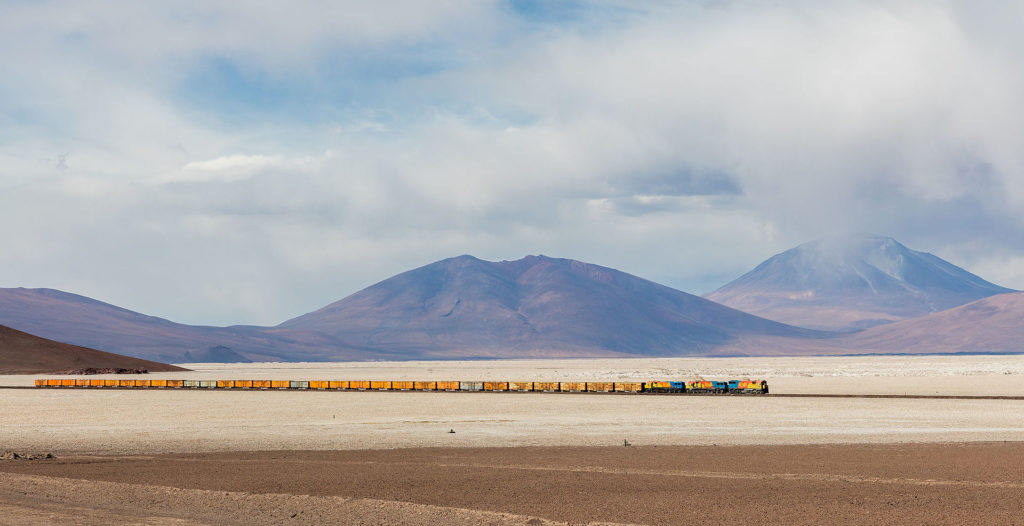
FCAB ore train crossing the Ascotán salt flat at the Collahuasi mine. Credit: Wikipedia
Chile’s state miner Codelco and the Chilean acid producer Quiborax have created a joint venture to secure a special lithium operation contract for the Salar de Ascotan salt flat in northern Chile, the companies said on Thursday.
The partnership, called Minera Ascotan SpA, has an initial 34% stake for Codelco and 66% for Quiborax, but will seek a new majority partner once the contract is obtained.
The companies applied for the contract as a consortium in January 2025. The Mining Ministry is expected to present the new joint venture and its contract terms to Chile’s Comptroller General in coming weeks.
Codelco appointed Jaime San Martin and Felipe Killian as directors, while Quiborax named Allan Fosk, Ignacio Riva Posse and Yatsen Lee. Daniel Ocqueteau will serve as the joint venture’s general manager.
Salary de Ascotan is Chile’s third-largest salt flat by surface area with underground content. The salt flat has not been explored for lithium but has attractive exploration potential.
The venture is part of Chile’s National Lithium Strategy to maintain the country’s role in the global lithium industry.
“Lithium is key to the planet’s energy future, and Chile has a unique opportunity,” Codelco board president Maximo Pacheco said.
(By Iñigo Alexander; Editing by Cassandra Garrison)
CU
Capstone Copper to resume full production at Mantoverde mine as strike ends
Mantoverde is an open-pit mine located in the Atacama region of Chile. Credit: Capstone Copper
Canada’s Capstone Copper said on Friday that the largest union at its Mantoverde copper‑gold mine in Chile had approved a new three‑year labour contract, ending a strike that started on January 2 and paving the way for production to return to normal.
Shares of the miner’s Australia-listed depositary receipts fell as much as 3.9% to A$15.43, their lowest since January 23.
Capstone said it had now negotiated new contracts with all the four unions at the site, allowing the company to resume full operations.
Union No. 2, representing around 645 workers or roughly 50% of Mantoverde’s direct workforce, had led the strike after rejecting a payment offer as labour negotiations broke down.
The company did not disclose details of the new payment offer or any further terms of the agreement.
In 2025, Mantoverde produced 62,308 metric tons of copper concentrate and 32,807 tons of copper cathodes, accounting or about 0.4% of global production.
Capstone owns a 70% stake in Mantoverde, while Japan’s Mitsubishi Materials holds the remaining 30%.
Botswana is the world's second largest diamond producer after Russia
- Copyright AFP/File Monirul Bhuiyan
Hillary ORINDE
Even with its legendary image of glitz and glamour, diamond icon De Beers has struggled to attract a buyer after nearly two years on a market dulled by falling prices and the allure of lab-grown gems.
The seller, mining titan Anglo American, even warned Thursday it may take a third writedown in as many years on the company that was born in South Africa 130 years ago and went on to dominate the global diamond market.
This is after a $2.9 billion drop last year and $1.6 billion charge the year before, bringing its estimated value to about $5 billion, according to company records.
Anglo’s bid to offload its loss-making company is not only being thwarted by the depressed market for mined diamonds, particularly in China, according to analysts.
It is also complicated by a crowded field of suitors circling the sale, including at least three sub-Saharan governments and various private bidders, which makes any deal as political as it is financial, they added.
Botswana has perhaps been the most ardent in its ambition to acquire a controlling stake in the company that oversees the world trade in the stones on which its economy depends.
Botswana and its president, Duma Boko, De Beers’ biggest producer partner with a 15-percent holding, led a determined push to finalise a deal by last year but to no avail.
Other diamond‑rich governments such as Angola and Namibia have also signalled interest, as have various sovereign wealth funds and a consortium led by former De Beers chief executive Gareth Penny.
– ‘For better or worse’ –
It is a complicated sale that — if it goes through — would mark one of the most significant shifts in the diamond industry in a quarter of a century, said independent analyst Paul Zimnisky.
“The new owner will be in a position to fundamentally pave the future of the entire industry, for better or worse,” the diamond industry analyst told AFP.
Botswana’s bid underscores its belief that it must manage the resource, which contributes about a third of its GDP, in order to capture more of the value chain and secure its economic future.
But the International Monetary Fund has cautioned the mostly desert nation that concentrating more of its state resources in the diamond sector could heighten fiscal risks and leave it more exposed to swings in global demand.
Zimnisky was also wary of what could amount to the “nationalisation” of De Beers.
“In general, I think that a more private or capitalistic business model works better than a more government-run or social one,” he told AFP.
“It is pertinent to have some private money involved as well as executives with relevant experience,” said the US-based analyst.
– Patience –
Anglo American has kept details of the sale negotiations under wraps, with chief executive Duncan Wanblad saying on Thursday only that the separation is “progressing”.
The mining giant announced in 2024 — after fending off a hostile takeover bid from Australian rival BHP — that it would sell off De Beers and its coal and nickel operations in order to focus on iron ore and copper.
“De Beers isn’t a single, clean asset, it spans mining, marketing, and retail, and it includes a government partner,” leading diamond industry analyst Edahn Golan told AFP.
“From a buyer’s perspective, this is actually an attractive moment to step in. From a seller’s perspective, there’s a compelling argument for waiting until the market improves and capturing more of the upside,” he said.
Demand for natural diamonds has weakened as younger buyers spend less on traditional jewellery and are drawn to cheaper lab‑grown gems.
US tariffs and shifting trade routes are meanwhile disrupting flows through key cutting and polishing hubs.
As the sector weathers a period of unprecedented uncertainty, retailers and manufacturers are sitting on their biggest polished‑stone stockpiles in years.
Despite the gloomy market, Anglo would not be “interested in fire-selling” De Beers, Zimnisky said. “They can be patient,” he added.
Golan agreed. “My hope is that the outcome is a company that both brings prosperity to the communities in which it operates and succeeds in rebuilding consumer interest in diamonds,” he said.
The Kashiwazaki-Kariwa Nuclear Power Plant in Kashiwazaki City has been offline since the 2011 Fukushima disaster - Copyright JIJI PRESS/AFP/File STR
Japan will switch the world’s largest nuclear power plant back on next week, after a glitch with an alarm forced the suspension of its first restart since the 2011 Fukushima disaster.
Takeyuki Inagaki, the head of the Kashiwazaki-Kariwa plant run by Tokyo Electric Power (TEPCO), told a press conference Friday that they planned “to start up the reactor on February 9”.
The announcement came after TEPCO restarted the reactor on January 21 but shut it off the following day after an alarm from the monitoring system sounded.
Due to an error in its configuration, the alarm had picked up slight changes to the electrical current in one cable even though these were still within a range considered safe, Inagaki said.
The firm has now changed the alarm’s settings as the reactor is safe to operate, Inagaki said.
The commercial operation will commence on or after March 18 after another comprehensive inspection, he said.
Kashiwazaki-Kariwa is the world’s biggest nuclear power plant by potential capacity, although just one reactor of seven will restart.
The facility had been offline since Japan pulled the plug on nuclear power after a colossal earthquake and tsunami sent three reactors at the Fukushima atomic plant into meltdown in 2011.
Resource-poor Japan now wants to revive atomic energy to reduce its reliance on fossil fuels, achieve carbon neutrality by 2050 and meet growing energy needs from artificial intelligence.
Kashiwazaki-Kariwa is the first TEPCO-run unit to restart since 2011. The company also operates the stricken Fukushima Daiichi plant, now being decommissioned.
Public opinion in the area around the plant is deeply divided: Around 60 percent of residents oppose the restart, while 37 percent support it, according to a survey conducted by Niigata prefecture in September.
In January, seven groups opposing the restart submitted a petition signed by nearly 40,000 people to TEPCO and Japan’s Nuclear Regulation Authority, saying that the plant sits on an active seismic fault zone and noted it was struck by a strong quake in 2007.
China calls EU ‘discriminatory’ over probe into Wind energy giant Goldwind
Goldwind is one of the world's biggest wind turbine suppliers, and is looking to boost growth overseas - Copyright AFP/File Hector RETAMAL
Beijing accused the European Union on Wednesday of taking “discriminatory” measures after the bloc opened an investigation into Chinese clean energy giant Goldwind over concerns the firm unfairly benefitted from state subsidies.
Goldwind is one of the world’s biggest wind turbine suppliers, and is looking to boost growth overseas, bringing it into competition with Western companies.
The European Commission, the EU’s competition regulator, announced the probe on Tuesday, saying a preliminary investigation had found the Chinese firm “may have been granted foreign subsidies that distort the internal market” of the 27-nation bloc.
China’s foreign ministry said Wednesday the probe amounted to protectionism and threatened future Chinese investments in Europe.
“The EU’s frequent use of unilateral trade tools and its discriminatory and restrictive measures against Chinese companies send protectionist signals,” foreign ministry spokesman Lin Jian told a regular press conference.
The probe would also “affect the confidence of Chinese companies in investing in Europe”, he added.
Beijing’s commerce ministry said the probe “seriously disrupts mutually beneficial China-EU industrial cooperation”.
Beijing will “resolutely” protect Chinese companies, it added in a statement urging Brussels to “immediately correct its wrong practices”.
Brussels has said the opening of an in-depth investigation does not prejudge its outcome.
But if its competition concerns were to be sustained, the commission could accept remedies proposed by the company or impose redressive measures.
China now dominates the global wind sector in terms of total installed capacity, aided over the years by generous subsidies from Beijing and rapid growth in the vast domestic power market.
GREEN CAPITALI$M
Wind turbine maker Vestas sees record revenue in 2025
The Danish group also said it had a record order backlog worth 71.9 billion euros at the end of 2025 - Copyright Ritzau Scanpix/AFP/File Henning Bagger
Denmark’s Vestas, Europe’s leading wind turbine manufacturer, on Thursday posted an all-time high revenue, but noted that regulatory changes in the United states had made wind power investments less attractive.
Vestas recorded revenue 18.8 billion euros ($22.2 billion) in 2025, up nine percent compared to the year before.
It also posted a net profit of 778 million euros, a 55 percent increase.
The group also said it had a record order backlog worth 71.9 billion euros at the end of 2025.
That corresponds to orders representing 23 gigawatts for onshore wind, its core business, and eight gigawatts for offshore wind. Service orders represented more than half of the total at 38.7 billion euros.
For 2026, Vestas is forecasting revenue between 20 and 22 billion euros, while noting that “ongoing geopolitical and tariff risks are likely to cause uncertainty”.
In the United States, Vestas’s largest market, “regulatory changes made future clean energy investments less attractive compared to previously,” the company noted, and expressed concern that “tariff uncertainty remains”.
Massachusetts Looks to Nova Scotia to Supply Offshore Wind Energy
Nova Scotia looks to become a hub for offshore wind power generation
Faced with the need for more electrical power and a desire to expand renewable energy, Massachusetts is looking toward the import of renewable energy from neighboring Nova Scotia. The first-of-its-kind agreement would present a novel solution to meeting the needs while also addressing the opposition of the Trump administration to the development of offshore wind energy generation.
Massachusetts is a strong supporter of the offshore wind energy industry, with some of the first large projects in the United States. It is just weeks away from the completion of Vineyard Wind 1 and has been at the forefront of the efforts to oppose the Trump administration’s efforts to end the development of offshore wind energy. Massachusetts Attorney General Andrea Joy Campbell in January filed an amicus brief supporting Vineyard Wind in its lawsuit against the Trump Administration, and last year Massachusetts led the state’s suit against the Trump administration’s executive order to review the future of the industry.
Meeting with Nova Scotia Premier Tim Houston, Massachusetts Governor Maura Healey today, February 4, signed a memorandum of understanding to work toward Nova Scotia supplying the state with offshore wind energy. The agreement is being billed as a win-win for the state, which has growing power needs, and will also support Nova Scotia as it works to launch Canada’s first offshore wind projects.
“We’re on the verge of our first call for bids to license the first offshore wind projects in Canada, and we’re advancing Wind West to build the transmission infrastructure to send that clean energy to markets,” said Premier Tim Houston. “Our agreement with Massachusetts signals to developers that markets for their clean energy are solidifying, giving them even more confidence to invest in our new offshore wind industry.”
Canada has historically been a major power exporter to the United States, despite the trade tensions with the Trump administration. Historically it has been between 50 and 60 million megawatthours annually, although it fell to just over 27 million megawatthours in 2024, according to the U.S. Energy Information Administration.
Nova Scotia and the Government of Canada jointly designated the first four offshore wind energy areas in Nova Scotia in July 2025, and the Canada-Nova Scotia Offshore Energy Regulator launched the overall process for the first call for bids to license offshore wind energy in Nova Scotia on October 16. The call for bids is expected in the next few months. After the first four licenses currently in process, the province said it would revisit four to five other areas that had been identified in the regional assessment.
It is part of an ambitious plan outlined by Premier Houston in 2025. He points out that Nova Scotia has some of the strongest and most consistent winds on the planet. The initial plan calls for 5 GW of generation capacity by 2030, while the Premier highlights that the province currently has peak usage of 2.4 GW.
Long-term, Nova Scotia has a vision that says it could potentially produce 66 GW through the development of its offshore capabilities, making it a power hub and key supplier for other parts of Canada and the United States.
Op-Ed: Seafarer Recruitment Should Never Be a Gamble
Recent reports concerning Chinese seafarers who traveled overseas for what they believed were legitimate job opportunities, only to lose contact with their families for weeks or months, have brought renewed attention to a deeply troubling recruitment pattern. In one widely shared case, a seafarer eventually returned home, but his family has since spoken about the severe psychological trauma he is now facing. More concerning still is that this appears not to be an isolated incident.
Families and volunteers have described multiple cases involving similar recruitment methods, including online job advertisements, intermediaries offering above average wages, last minute changes to travel routes and sudden instructions to transit through unfamiliar ports. In several instances, seafarers told relatives that they had boarded vessels and begun work, only for later checks to reveal no record of them ever joining a ship. Contact then ceased entirely.
What makes these cases particularly alarming is how closely they mirror the normal realities of seafaring life. Overseas travel, unfamiliar destinations and unexpected itinerary changes are routine in this industry, which makes deception harder to detect and far easier to exploit. When combined with economic pressure and the promise of higher pay, recruitment becomes a point of real vulnerability rather than a straightforward administrative step.
These incidents unfolded before any vessel was boarded, yet the consequences have been profound. Families were left searching for answers across borders, while those who have returned now face the long and difficult process of recovering from experiences that extend well beyond financial loss. This challenges the industry’s tendency to frame welfare almost exclusively around onboard conditions and operational safety, as though responsibility begins only once a contract is signed.
In response to such cases, industry statements often focus on clarifying that no formal employment existed or that no shipowner connection can be established. While accuracy matters, these responses do little to address the broader issue. For seafarers and their families, the absence of paperwork does not lessen the fear, uncertainty or lasting psychological impact. Responsibility cannot simply dissolve because a recruitment process never reached its final stage.
There is also a notable silence around mental health when it comes to recruitment-related harm. While progress has been made in recognizing the pressures faced at sea, far less attention is given to the emotional and psychological toll of deception, disappearance and prolonged uncertainty that can occur before employment even begins. These experiences can undermine trust in the industry and leave scars that are not easily visible.
If recruitment is the gateway to a maritime career, then it deserves the same level of scrutiny, accountability and duty of care as any other aspect of shipping operations. This includes clearer verification processes, greater oversight of intermediaries and stronger channels for seafarers to share information, compare experiences and raise concerns without fear of losing future opportunities.
Ultimately, this is not just a question of better systems or improved technology. It is a question of culture and collective responsibility. Protecting seafarers cannot start at the gangway. If the maritime industry is serious about welfare and trust, then recruitment should never be a gamble, and safeguarding people must begin long before they are asked to step onboard.
Josephine Le is founder of The Hood.
The opinions expressed herein are the author's and not necessarily those of The Maritime Executive.
As Pentagon Lauds Drug-Boat Strikes, USCG Marks Drug-Bust Milestone
After two more large-scale busts at sea, the U.S. Coast Guard has raised the tally of cocaine seized under its new enhanced patrol campaign to 200,000 pounds - equivalent to 75 million lethal doses. The milestone was announced at about the same time as the latest strike in the Pentagon's parallel, lethal-force campaign against the same drug-boat traffic.
In August, the Coast Guard doubled down on its counternarcotics operation in the Eastern Pacific with a new focused enforcement effort, dubbed Operation Pacific Viper. The region is home to a thriving cocaine trade, carried by go-fast boats and semisubmersibles on short-haul routes from South America to Central America. From origin ports in Colombia and Ecuador, these boats take to the high seas and deliver their valuable cargoes to Honduras, Guatemala and other small Central American nations, sometimes using routes far offshore. From there, the drugs are smuggled overland - either northward to the U.S. land border with Mexico, or to regional seaports for covert shipment to Europe (the destination for the majority of the total volume).
Cocaine is so abundant on these smuggling routes that the Coast Guard's seizures account for 80 percent of all U.S.-bound drugs - far more than any other agency is able to capture.
"Each Coast Guard drug seizure far from our borders prevents deadly drugs from reaching our communities and disrupts the profit that fuels narco-terrorists," said Commandant Adm. Kevin Lunday in a statement. "The success of Operation Pacific Viper proves that we own the sea, and the proficiency, vigilance, and heart of our crews is our greatest strength."
The latest busts included 13,000 pounds of cocaine captured by USCGC Seneca (a medium-endurance cutter built in 1982) and another 13,000 pounds by USCGC Robert Ward (a 350-ton Sentinel-class patrol boat). These large seizures add on to previous successes: the service set a new record in mid-November when USCGC Stone offloaded nearly 50,000 pounds in one delivery at Port Everglades, entirely the product of her crew's efforts.
The Coast Guard's law-enforcement approach contrasts with the Pentagon's controversial program to destroy drug boats and their crews by aerial attack, without boardings or arrests; the latest strike occurred Thursday, killing two suspected smugglers. In a statement Thursday, the Pentagon said that some of the trafficking cartels in the region have decided to indefinitely suspend small-boat smuggling operations because of the lethal strikes, describing the program as "deterrence through strength."
French Navy Seizes Four Tonnes of Cocaine, Releases Smugglers
French Navy RIB boats approach the suspect vessel (French Armed Forces Joint Staff)
Just weeks after a major multitonne drug bust off French Polynesia, the French Navy has again seized a large cargo of cocaine from a passing vessel, the latest capture in the increasingly-active South Pacific corridor.
On February 2, French Navy forces intercepted a small tanker at an unspecified location off French Polynesia, an archipelago of 120-plus islands and atolls. The responders pursued the suspect vessel with RIB boats and conducted a boarding. Upon inspection, they found 4.2 tonnes of cocaine in 174 separate bales. According to the authorities, the drugs were likely destined for South Africa - not a leading consumer market. This voyage would have taken the vessel past Australia, where demand is thriving and prices are high.
The response team destroyed the cocaine at sea, but did not carry out any arrests. The suspects were released and allowed to continue their voyage; according to AFP, local prosecutors did not wish to burden the court system with a smuggling case that did not directly involve French Polynesia, either as the point of origin or as the destination.
The archipelago happens to be located directly between the major cocaine producing nations (Colombia and its neighbors) and two major consumer nations (Australia and New Zealand). This puts its waters on the route for the cocaine supply chain, even if French Polynesia is not itself a significant consumer.
Just three weeks ago, French Navy assets busted another smuggling vessel in the archipelago, capturing nearly five tonnes of cocaine. The High Commission of French Polynesia reported that the small ship - an older offshore supply vessel - was bound for Australia, where each kilo fetches upwards of $100,000.
The Australian Federal Police are actively supporting these law-enforcement efforts in French Polynesia, and are working with French authorities to track down the shoreside elements of the smuggling group within Australia. The AFP has a standing task force dedicated to helping Pacific partners combat cocaine trafficking, a top priority for the Australian government, which is attempting to throttle down the supply lines for the world's biggest per-capita cocaine market.
Report: U.S. Navy is Feeling Out Ship Construction Options in Turkey
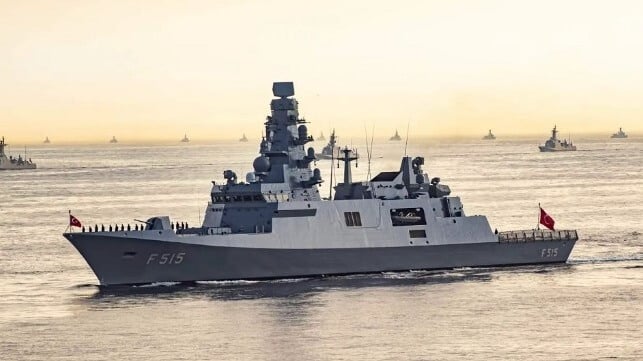
Turkish frigate TCG Istanbul, first in a new class (STM press handout image)
Momentum appears to be building within some corners of the Trump administration to offshore U.S. Navy warship production to yards in U.S. allied nations, where well-developed shipbuilding industries with available capacity can be found. It would require changing U.S. law and longstanding practice, but this has not deterred proponents: South Korea's "Big Three" have openly sought the administration's support for building American warships in Korea, and U.S. officials have recently met with Turkish counterparts to discuss component and frigate construction in Turkey, insiders told Mideast Eye.
"The US shipbuilding industry is in a real crisis, and the Trump administration has talked with Turkey about meeting its needs [for shipbuilding]," an American official told Mideast Eye.
All observers acknowledge that the problem is serious: every U.S. Navy shipbuilding program is behind schedule (as of 2025), according to the Secretary of the Navy, and the Constellation-class frigate was recently scaled back to two hulls over delays and cost overruns. The president himself has acknowledged that "we might have to" begin ordering warships from allied nations in order to make up a domestic capability gap.
In Turkey, the U.S. Navy would have a strong technical partner. Turkish yards are skilled in distributed shipbuilding, series production and short delivery timetables, and they have built export hulls for customers around the world (as well as Turkey's own navy). These experienced builders could ship out blocks and subassemblies for incorporation into American yards' workflows; deliver partially-complete floating hulls; or accept contracts for fully completed vessels.
"The US lacks sufficient manpower, shipyards and dry docks," Turkish defense commentator Kubilay Yildirim told Mideast Eye. "Turkey can help in terms of production volume, timelines, risk sharing and workload distribution."
There are limitations, however. Turkey has cordial relations and certain limited defense contracting ties with Russia. Ankara is still under U.S. sanctions for the purchase of Russian S-400 antiaircraft systems, and it was removed from the F-35 fighter program for this reason during the first Trump administration. Efforts to unwind those sanctions are currently under way.
The second potential speed bump - whether for construction in Turkey or in South Korea - would be the Byrnes-Tollefson Amendment, 10 USC Section 8679, which prohibits construction of U.S. naval vessels and major components in foreign shipyards. The law could be changed, but it would require congressional action to legalize the contract and appropriate funds for a foreign purchase.
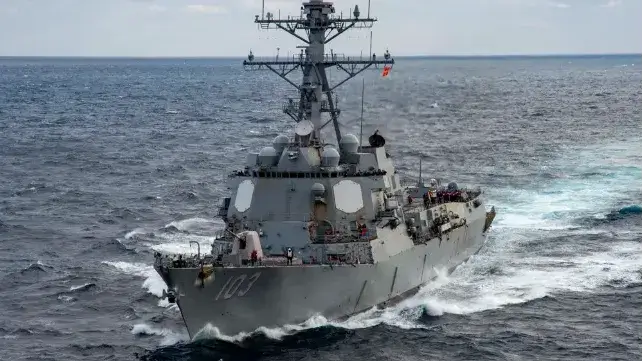
After Swift Turnaround for New Deployment, USS Truxton Returns to the Pier
On February 3, the destroyer USS Truxton conducted a fast turnaround from Naval Station Norfolk in order to redeploy to an unknown destination. The next day, she returned to the pier because of an equipment issue, delaying her departure.
Last year, Truxton spent seven months on deployment in the Middle East. She returned to Norfolk in October for maintenance, training and shore leave. On February 3, after about three months in port, she departed again, with speculation pointing to the Caribbean or the Mideast, where a military buildup is under way amidst tensions with Iran.
Three months is a comparatively short time for a destroyer to spend in port between deployments: For repairs and upkeep, U.S. Navy destroyers typically get months of pierside maintenance or a drydocking, followed by six months or more in homeport for training and certification.
"The Navy's kind of asked more for us and our families," Truxton CO Cmdr. James Koffi told local WHRO about the swift deployment. "My crew has done impeccably well during the short turnaround. So I really don't focus on the number of days. . . . I'm very confident of our abilities to execute."
Truxton sailed from Norfolk at about 1000 hours on Tuesday, headed for the York River naval weapons station to take on stores. A harbor webcam spotted her returning to Norfolk on February 4, and USNI confirmed her return to the pier for maintenance purposes on February 5.
A spokesperson for U.S. Second Fleet told USNI that Truxton had to address an "emergent equipment repair," and the extra time at Norfolk would allow the crew to ensure "maximum operational readiness."
Rapid deployment turnarounds are not unheard-of, but when done, they are often a cause for complaint among the crew - especially if the previous deployment was a long one. Destroyer USS The Sullivans deployed five times in the three years ending 2024, though some of her voyages were comparatively brief.
Photos: Future Carrier USS John F. Kennedy Completes Builder's Trials
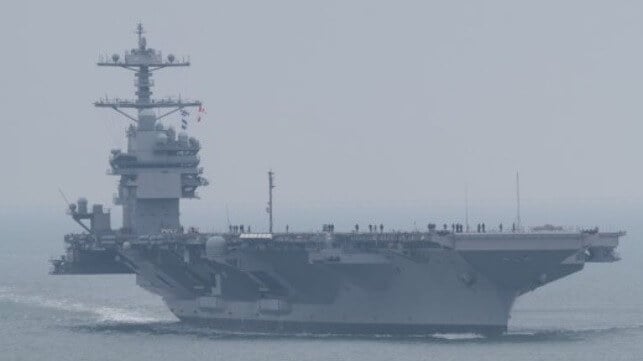
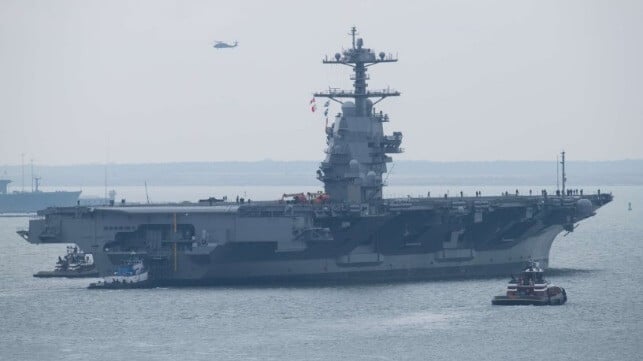
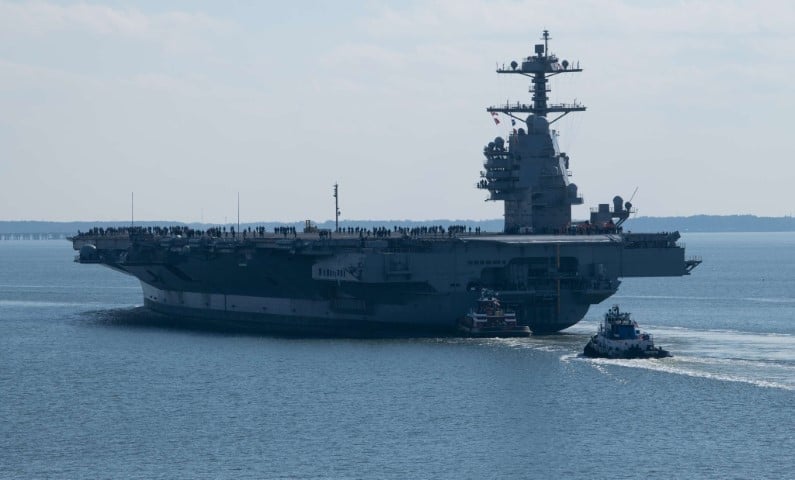
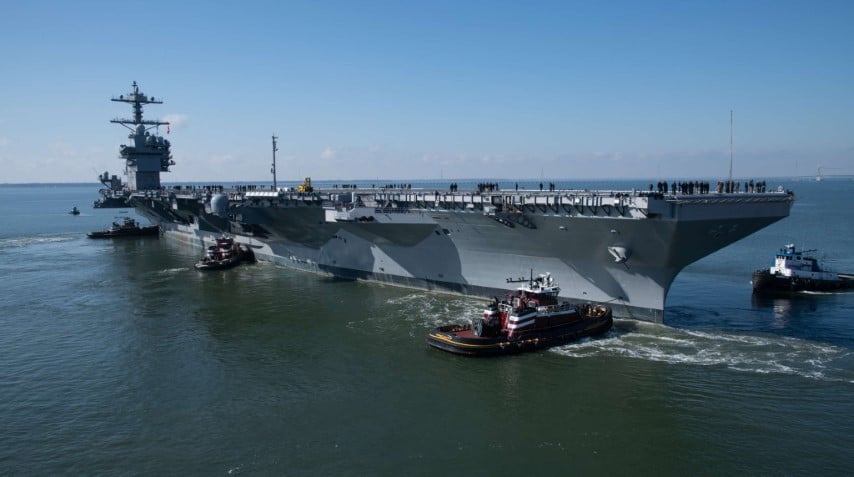
The future USS John F. Kennedy, the second Ford-class carrier for the U.S. Navy, has completed builder's sea trials at Huntington Ingalls Newport News. It has been 17 years since the initial contract award for Kennedy, and more than 10 years since her keel-laying. The test run was the ship's first outing, and it is a milestone towards the high-tech carrier's long-awaited completion.
Kennedy was affected by the same technological issues facing the first-in-class USS Gerald R. Ford, which faced years of delays in bringing its weapons elevators and its launch & recovery deck gear up to standards. The electromagnetic technology behind these devices had never been to sea before, and Ford delivered without any working weapons elevators. To make the time required for repairs, her first major deployment was deferred until mid-2023, six years after commissioning.
Kennedy also encountered issues with electromagnetic systems, causing delays to the second hull in the series. The Navy also added in additional scope of work pre-delivery to integrate the F-35C fighter into Kennedy's air wing. Certain capabilities are needed aboard to support the stealth fighter jet, and Kennedy will be the first in the class to have them.
The builder's trials started in late January and have now concluded successfully, HII said in a statement. Shipbuilding personnel from HII Newport News were on board, along with Kennedy's crew and other Navy personnel.
Courtesy USN
Kennedy is currently on track to deliver by early 2027, nearly two years later than planned. As first-in-class USS Nimitz is set to retire in May 2026, there will be a brief unplanned gap, and the U.S. Navy's carrier fleet will drop to 10 ships instead of 11 until Kennedy is online. By law, the Navy is required to maintain at least 11 carriers in operational condition.
“Taking Kennedy to sea is a testament to the grit and determination of the world’s finest shipbuilders,” said Derek Murphy, NNS vice president of new construction aircraft carrier programs. “Our nation is depending on us to deliver these critical assets that will protect freedom around the world and we’re proud to see CVN 79 take another step toward joining the fleet.”
KR, Korean Govt., and Partner Set Standards for Ammonia Effluent Discharge
As the maritime industry accelerates its transition to zero-carbon fuels in line with the International Maritime Organization (IMO)’s 2050 net-zero target, ammonia-fueled ships are emerging as a promising next-generation solution. While the IMO has established interim guidelines to facilitate the use of ammonia as a marine fuel, international standards governing the safe treatment and discharge of toxic ammonia effluent generated during vessel operations have yet to be developed.
During the operation of ammonia-fueled ships, effluent containing toxic ammonia may be generated. Unlike typical aqueous ammonia, this effluent exhibits different physical and chemical characteristics, and the lack of clearly applicable international standards has created uncertainty for ship design, operation, and environmental management.
In response, KR (Korean Register), in collaboration with the Ministry of Oceans and Fisheries (MOF), five major Korean shipbuilders including HD Hyundai Heavy Industries, HD Korea Shipbuilding & Offshore Engineering, HD Hyundai Samho, Samsung Heavy Industries, and Hanwha Ocean, as well as the Korea Testing & Research Institute (KTR), officially launched an international working group in June 2025 to develop safety management and marine discharge standards for ammonia effluent.
The establishment of this joint working group followed Korea’s proposal at the IMO Sub-Committee on Carriage of Cargoes and Containers (CCC) in 2024, which highlighted the need for dedicated ammonia effluent safety standards. The proposal granted official approval at the 83rd session of the Marine Environment Protection Committee (MEPC) in April 2025.
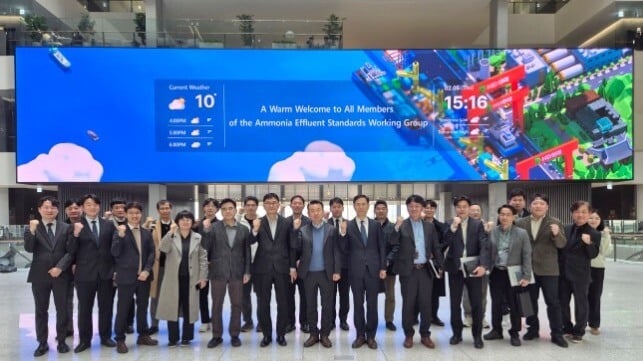
To commence its activities for 2026, the working group convened on February 5 at the HD Hyundai Global R&D Center, reinforcing inter-organizational cooperation on the development of international standards. Over 2026 and 2027, the group plans to submit draft international standards to the IMO Sub-Committee on Pollution Prevention and Response (PPR), positioning Korea at the forefront of global discussions on ammonia effluent management.
At the upcoming 13th session of the IMO PPR, scheduled for later this month, the Korean government delegation will underscore the urgency of establishing guidelines for ammonia effluent management and marine discharge standards, and propose the formation of an Expert Group for in-depth technical discussions. KR is leading these international deliberations by providing technical evidence on safe discharge limits, based on its environmental impact assessment of ammonia effluent.
This international standards development initiative presents a significant opportunity to embed Korea’s shipbuilding technological capabilities and operational experience into global regulations. From a regulation-driven industrial development perspective, this will strengthen the competitiveness of the Korean maritime industry as the market of ammonia-fueled ships expands.
KR’s Executive Vice President, KIM Kyungbok, stated, “This year’s IMO meetings mark the beginning of substantive international discussions on ammonia effluent safety standards. Drawing on KR’s technical and regulatory expertise, we will play a leading role alongside the Korean government and industry to ensure that proven domestic technical standards are effectively incorporated into international rulemaking.”
NUS Project to Advance Near-Zero-Emissions Ammonia Marine Engines
NUS leads an industry-academia collaboration to develop ammonia-fuelled marine engines, paving the way towards a sustainable maritime future.
Industry–academia collaboration to be based at the National University of Singapore’s College of Design and Engineering targets decarbonisation of the global shipping industry through new ammonia-fuelled engine concept
A major new research project to be located on the College of Design and Engineering (CDE) campus at the National University of Singapore (NUS) aims to accelerate the decarbonisation of the global shipping industry through the development of next-generation ammonia-fuelled marine engines with high efficiency and near-zero emissions.
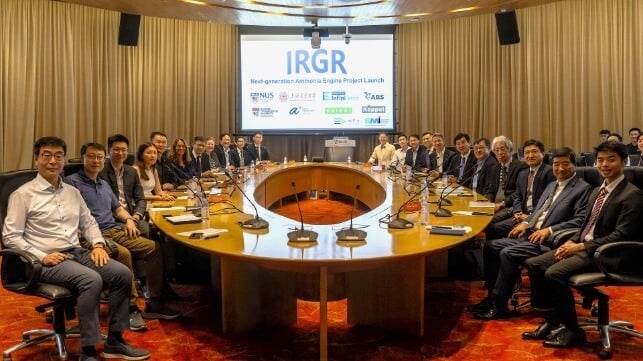
Officially launched on 4 February 2026, the project is led by the NUS Centre for Hydrogen Innovations (CHI) with funding support from the Singapore Maritime Institute (SMI), in collaboration with leading academic and industry partners in Singapore and overseas. The project focuses on a novel in-cylinder reforming gas recirculation (IRGR) engine concept designed to address key limitations that have so far constrained the wider adoption of ammonia as a marine fuel.
“Ammonia has been recognised as one of the most promising fuels for achieving near-zero greenhouse gas emissions in marine transportation, but current ammonia engines face significant challenges in efficiency and emissions,” said Associate Professor Yang Wenming from the Department of Mechanical Engineering at NUS, who leads the project as Principal Investigator. “The IRGR concept is designed to address these limitations by improving combustion efficiency while sharply reducing unburned ammonia and other pollutants.”
“The project will be based in a dedicated laboratory on the CDE campus, featuring an engine test room, control room and facilities for fundamental combustion and systems research,” said Dr Zhou Xinyi, Senior Research Fellow from the Department of Mechanical Engineering. Beyond technical development, the initiative also aims to strengthen Singapore’s position as a hub for maritime innovation and sustainable shipping technologies by anchoring advanced engine research within a broader ecosystem of industry collaboration and talent development.
Speaking at the launch ceremony, Professor Silvija Gradecak, Vice Dean (Research and Technology) at CDE, described the IRGR Ammonia Engine Project as an important milestone for efforts to decarbonise the maritime sector.
“Marine transportation is central to global trade, yet it remains one of the most challenging sectors to decarbonise,” she said. “Through this project, the team aims to develop and demonstrate the world’s first prototype engine based on the IRGR concept, paving the way for the practical adoption of ammonia as a marine fuel.”
Global shipping currently accounts for approximately 3 per cent of global carbon emissions, and the sector faces increasing pressure to reduce its environmental impact in line with international net-zero targets. While ammonia does not produce carbon dioxide at the point of combustion and is easier to store and transport than hydrogen, challenges related to thermal efficiency, combustion stability and pollutant emissions remain critical barriers to commercial deployment.
International collaboration is a central feature of the IRGR project. “The International Maritime Organization’s net-zero emissions target must be achieved by 2050, and the time left is very short,” said Professor Li Tie from Shanghai Jiao Tong University, a key academic partner in the project. “This goal cannot be realised by any single institution or country. It requires disruptive technologies and strong international cooperation, and the IRGR project reflects exactly that kind of collaboration.”
The consortium includes partners from Shanghai Jiao Tong University, Nanyang Technological University, the A*STAR National Metrology Centre and Keppel Energy Nexus, alongside industry partners Daihatsu, a leading global marine engine manufacturer, and the American Bureau of Shipping (ABS). Their involvement is intended to ensure the research remains grounded in practical engineering requirements, safety considerations, certification pathways and commercial relevance.
The launch event at NUS was attended by senior representatives from the government, industry, and academia, including leaders from SMI and the Maritime and Port Authority of Singapore, as well as the President of Daihatsu Infinearth, Mr Yoshinobu Hotta, and Vice President of ABS, Dr Gu Hai. The event also included the formal signing of research collaboration agreements between NUS and Daihatsu, and between NUS and ABS.
Closing the event, Professor Lee Poh Seng, Head of the Department of Mechanical Engineering, emphasised the broader significance of the initiative.
“This project is not merely the start of another research programme, but a deliberate step into one of the hardest and most consequential engineering challenges in the energy transition,” he said. “Decarbonising hard-to-abate sectors like shipping requires technologies that can be validated, scaled and trusted in real-world operations.”
The project is expected to run for three years, with the research team working towards scalable engine concepts that could support the future deployment of low- and zero-emissions vessels worldwide.
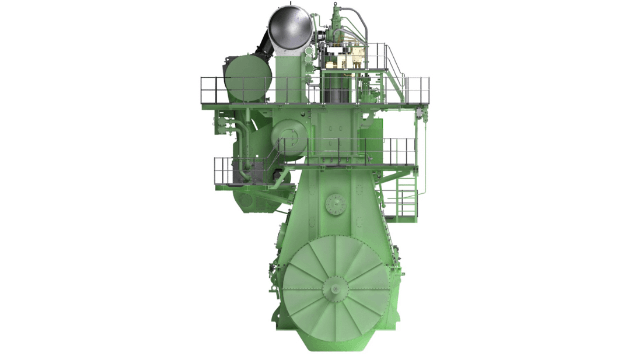
Everllence reports that it has received the 2,000th order for a dual-fuel engine from its two-stroke portfolio. COSCO Shipping Lines Co. Ltd. reached the milestone with an Everllence B&W 8G95ME—GI Mk. 10.5 main engine featuring EcoEGR (Exhaust Gas Recirculation) as part of an order for 12 such engines for a series of 12 x 18,000 teu container vessels currently under construction at Chinese yard Jiangnan Shipyard (Group) Co., Ltd.
Bjarne Foldager – Head of Two-Stroke Business, Everllence – said: “It’s very appropriate that this milestone was reached on the cusp of the Year of the Fire Horse – a particularly auspicious year in the Chinese calendar. China has been a very important market for us for over a century, just as COSCO is a valued customer.”
He continued: “Everllence’s dual-fuel strategy has led to multiple world-firsts in terms of oceangoing ships operating on a variety of alternative, low-emission fuels – confirming our leadership in this crucial marine segment. Our dual-fuel engines are showcases for environmentally friendly, reliable propulsion technology with seamless switching between fuels. On the path to net-zero, the marine industry needs willing partners and our thanks go to COSCO for its custom and friendship.”
Everllence states that, currently, just over half of its order book is dual-fuel measured in engine power. The 2,000-engine figure is a cumulative total for all engine orders from the company’s mature, efficient two-stroke portfolio that includes ME-GI (methane), ME-LGIM (methanol), ME-GIE (ethane), ME-LGIP (LPG), and the recently announced ME-LGIA (ammonia) engines.
Christian Ludwig – Head of Global Sales & Promotion, Two-Stroke Business, Everllence – said: “2025 saw a strong order intake for our two-stroke, dual-fuel engines, especially the ME-GI. Increasingly, decarbonisation and a general desire for fuel-flexibility as a strategic hedge are pushing their adoption. We have now gathered a decade’s worth of invaluable, dual-fuel service experience and operational data with which to further improve the technology. In the same vein, we are also delivering more digitally-connected engines that enable remote monitoring and provide impeccable data, allowing our shore-based engineers to make prompt recommendations on optimising engine performance in real time. We remain convinced that this strategy is the right one on the voyage to a low-emission fleet.”
The products and services herein described in this press release are not endorsed by The Maritime Executive.