Monday, February 09, 2026


Which EU countries could reverse their nuclear energy phaseouts?


By Alessio Dell'Anna & Maud Zaba
Published on 


Governments in Belgium and Italy are trying to lay out plans for a nuclear comeback, while calls to reverse Spain's phaseout remain stark.

Most European countries rely heavily on imports to meet their electricity needs, leaving the continent vulnerable to geopolitical shocks and its consumers and businesses exposed to prices up to three to four times higher than in the US or China.

In recent years, nuclear has subtly resurfaced as an alternative to secure Europe's energy independence, particularly after it received the status of a transitional and sustainable economic activity under the EU's taxonomy regulation, which aims to help mitigate climate change by defining which economic activities are environmentally sustainable.

The move, however, also sparked furious greenwashing accusations over concerns that nuclear energy produces radioactive waste that requires long-term storage.

The EU's relation with the atom remains, therefore, complicated and controversial.

Despite a little short-term growth in nuclear energy production EU-wide (4.8% between 2023 and 2024), mainly driven by France (+12.5%), most countries are actually reducing it, if not phasing it out altogether, such as Germany, and in the near future, Spain

The long-term trend since the turn of the millennium is of a slight but steady decrease.

Is the wind changing?

In its upcoming 2028-2034 budget, for the first time, the European Commission proposed nuclear energy as eligible for EU funding.

The proposal is unlikely to pass; however, countries like Belgium or Italy are looking into keeping nuclear or bringing it back.

Italy, in particular, despite not one but two referendums against nuclear (in 1987 and 2011), has introduced a draft bill to pave the way for a comeback.

The two countries were also among the 11 EU member states that in 2024 signed a joint declaration calling to "fully unlock" the potential of nuclear.
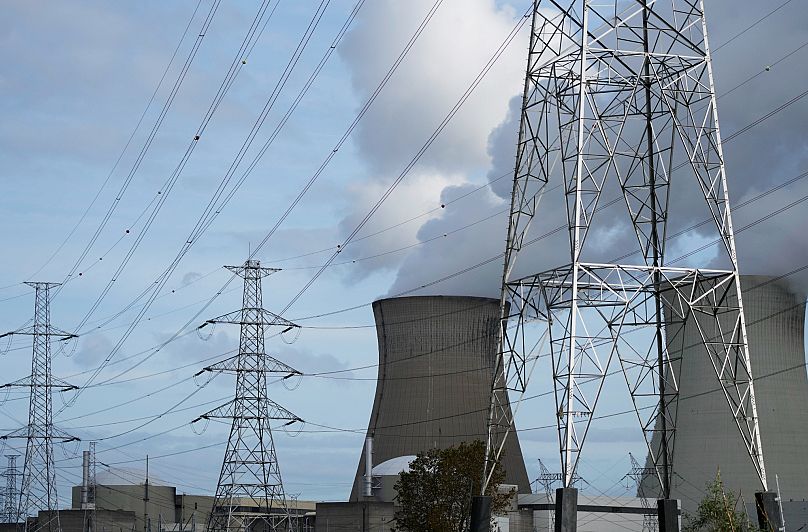
A nuclear power plant in Doel, Belgium
A nuclear power plant in Doel, Belgium AP/Virginia Mayo

In Belgium, where the government is trying to push back the closure of its reactors, the proposal has faced stiff opposition from Engie, the country's leading energy producer, which would rather invest in wind, solar, batteries and gas-powered stations.

The Netherlands, too, despite a drop in electricity generated from nuclear (-10%), is aiming to create two new plants and extend the life of the Borssele reactor.

On the other side, Spain's planned phase-out is also embroiled in controversy. Civil society pro-nuclear organisations have been taking the matter up to the European Parliament Committee of Petitions, warning that the planned shutdowns will "further strain supply networks".

Both Belgium and the Netherlands' plans were criticised by Ausgestrahlt, a Germany-based anti-nuclear organisation, which told Europe in Motion that they are unrealistic and overly expensive.

'Slow recognition' of nuclear trade-offs

Nuclear advocate and expert Zion Lights voiced a similar opinion, stating that a potential increase in nuclear energy production, at least over the next decade, "will come from life extensions, restarts, and policy U-turns rather than a wave of new builds".

"Over the longer term, whether nuclear expands significantly will depend less on public opinion and more on whether Europe can relearn how to build and finance large infrastructure projects," she told Europe in Motion.

Lights believes that nuclear production will increase across the continent, "but not in a straight line. What we're seeing across Europe isn’t a sudden pro-nuclear conversion so much as a slow recognition of trade-offs."

"Countries that once treated nuclear as a political problem are starting to rediscover it as an energy system that already exists, already works, and already delivers large amounts of low-carbon power," she said.
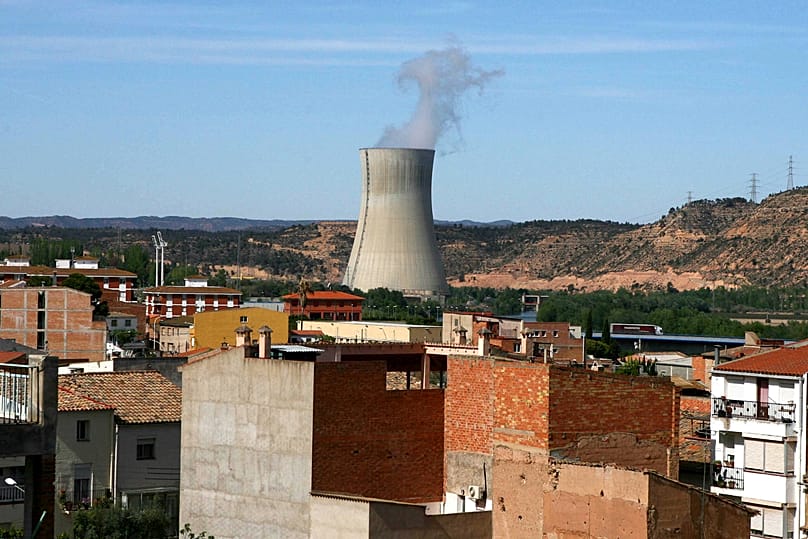
A nuclear power plant in Asco, Spain
A nuclear power plant in Asco, Spain AP/David Ramos

The current picture has Europe divided into two groups

One is the Nuclear Alliance, led by France, and backed by aspiring producers like Poland, Croatia and Estonia, as well as most current nuclear producers.

On the opposite front, a renewables-only group helmed by Germany, and supported by Portugal and Austria, both with a long-standing anti-nuclear national policy.

To reduce the enormous upfront costs and lengthy construction times of traditional nuclear plants, countries such as Estonia, Romania, Sweden and Poland are exploring alternatives like Small Modular Reactors (SMRs), whose advantages have also been laid out by the EU itself.

Their power output is around a third to a fifth of traditional reactors. However, they can be manufactured in factories and deployed later on site, even to remote areas.

At the same time, waste management requirements would be similar to those of a conventional reactor.

Whether nuclear production will increase or not, the energy supply problem remains critical for Europe.

Although renewable energy has advanced dramatically in the past two decades, wind, solar and hydro combined still account for less than half of the EU's electricity consumption.

NAKBA 2.0

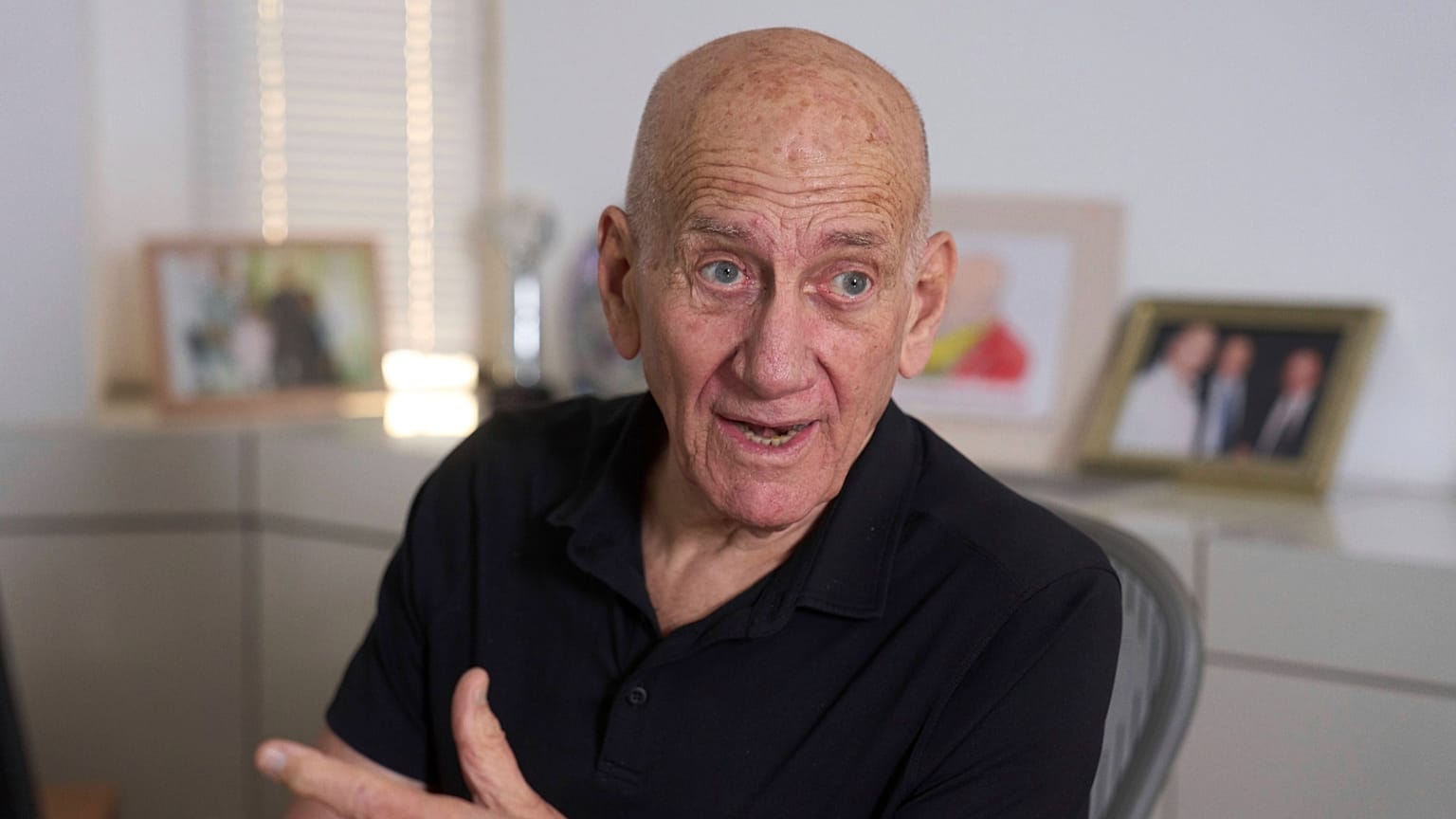
Israeli policy in West Bank 'close to ethnic cleansing', says Ehud Olmert

Former Israeli prime minister Ehud Olmert.
Copyright TARA TODRAS-WHITEHILL/AP

By Shona Murray
Published on 

The former Israeli premier decried his country's actions and policy in the West Bank just as the Israeli government announced radical plans to exert control of even more Palestinian territory.

Former Prime Minister Olmert has told Euronews Israel is responsible for the ongoing violence in the West Bank, where Israeli settlers have attacked and displaced Palestinians from their homes.

“No one can blame anyone else but the Israelis that live in the West Bank and the government that supports them, who are perpetrating the hostilities inhuman against non-involved Palestinians”, Olmert told the Europe Today show from his home in Tel Aviv.

“This is something that comes close to an attempt to make ethnic cleansing", he said. "And I speak up everywhere I can in the loudest voice I have in order to condemn it, because this is not something which is tolerable or which is acceptable by people that have different values of humanity and compassion.”

Settler activities against Palestinians have increased since Hamas launched a massive attack on Israelis from Gaza on 7 October 2023.

In 2025, a total of 240 Palestinians, including 55 children, were killed in the West Bank. According to the UN Office for the Coordination of Humanitarian Affairs (OCHA), 225 were killed by Israeli forces and nine by Israeli settlers; in six cases, the identity of the killers remains uncertain

In its Humanitarian Update on the West Bank, OCHA also reports that in 2025, more than 830 Palestinians were injured by Israeli settlers in settler attacks, an average of two people injured per day.

Israeli authorities also forcibly evicted two Palestinian families from their homes in the Batn al-Hawa neighbourhood in the village of Silwan in East Jerusalem in favour of an Israeli settler organisation.

Meanwhile, the Israeli security cabinet has announced new measures which would “dramatically” change land registration and procedures required to own land in the West Bank in a bid to clear the way for Israeli settlers in the Occupied Palestinian Territories.

The decisions “are intended to remove decades-old barriers, repeal discriminatory Jordanian legislation, and enable accelerated development of settlement on the ground”, Defence Minister Israel Katz and Finance Minister Bezalel Smotrich said in a statement on Sunday.

“We will continue to bury the idea of a Palestinian state”, said Smotrich.


France issues warrants for Franco-Israelis over Gaza 'complicity in genocide'


French judicial authorities have issued warrants for two Franco-Israeli activists accused of trying to block humanitarian aid from entering Gaza, with investigators examining whether the actions could amount to complicity in genocide.


Issued on: 04/02/2026 - RFI

An Israeli soldier stands beside a military jeep in Gaza City on 3 October 2025. A day later, the military said it was pressing on with its offensive and warned residents not to return, despite US President Donald Trump urging a halt to the assault. AFP - JACK GUEZ

The warrants, issued in July last year, target Nili Kupfer-Naouri, linked to Israel is Forever, a pro-Israel advocacy group, and Rachel Touitou, associated with Tsav 9, an activist group opposing the delivery of aid to Gaza.

They require both women to appear before an investigating magistrate but do not order their arrest.

Lawyers for the non-governmental organisations that filed the complaint said the case is the first time a national legal system has examined whether blocking humanitarian aid could qualify as complicity in genocide under international law.

The allegations relate to actions said to have taken place between January and November 2024, including a specific incident in May.

Investigators believe the two activists tried to block aid trucks heading to Gaza at the Nitzana and Kerem Shalom crossings, which are key entry points for humanitarian supplies.

UN investigation labels Gaza violence as genocide prompting Israeli backlash
Legal threshold tested

The warrants followed complaints filed by the Palestinian Centre for Human Rights along with rights groups Al-Haq and Al-Mezan.

Their lawyer, Clémence Bectarte, said the investigation is unprecedented in genocide law and argued that deliberately preventing aid from reaching civilians in a war zone could meet the legal threshold for criminal responsibility.

In addition to the main allegation of complicity in genocide, both activists are also suspected of public provocation to commit genocide after allegedly calling for aid to be stopped from entering Gaza.

Investigators may expand the case, with warrants potentially issued for around 10 other individuals.

Accused deny wrongdoing

Lawyers for the two activists reject the accusations and say their actions have been misrepresented.

Olivier Pardo, who represents Kupfer-Naouri, said she took part in pacifist protests against what she believes is the diversion and resale of humanitarian aid by Hamas and other groups.

Kupfer-Naouri has described the investigation as “anti-semitic madness.” She is currently in Israel and has said she is ready to speak to French investigators.

Touitou has also denied the allegations, writing on social media that peacefully protesting against a terrorist organisation’s handling of aid should not be criminalised.

The case is part of a wider series of legal actions in France linked to the Gaza war.

These include complaints over alleged war crimes and over the Hamas attack that triggered the conflict on 7 October 2023.

(with newswires)

Lords of Gold: the gangs’ grip on Peru’s mines


INVESTIGATION


Issued on: 09/02/2026
7;03 Minutes

In his latest investigation Emmanuel Colombié, journalist at Forbidden Stories, reveals gang's grip on illegal gold mines. In Peru, the gold rush is ravaging the Amazon rainforest. In the department of Madre de Dios, the Guardianes de la Trocha gang has taken over La Pampa, a gold-rich area running alongside the Tambopata National Reserve, one of the most biodiverse regions on the continent. Forbidden Stories and its partner Mongabay Latam reveal how this criminal organization spreads terror, silencing any opposition with the help of rising corruption in the country.


Britain unveils first national plan to curb 'forever chemicals' risks

Britain unveiled its first national plan to curb “forever chemicals,” seeking to cut risks to human health and the environment, the government said. PFAS, used in products from cookware to food packaging, persist for decades and accumulate in nature, posing threats likely to endure for hundreds of years.


Issued on: 03/02/2026
By: FRANCE 24

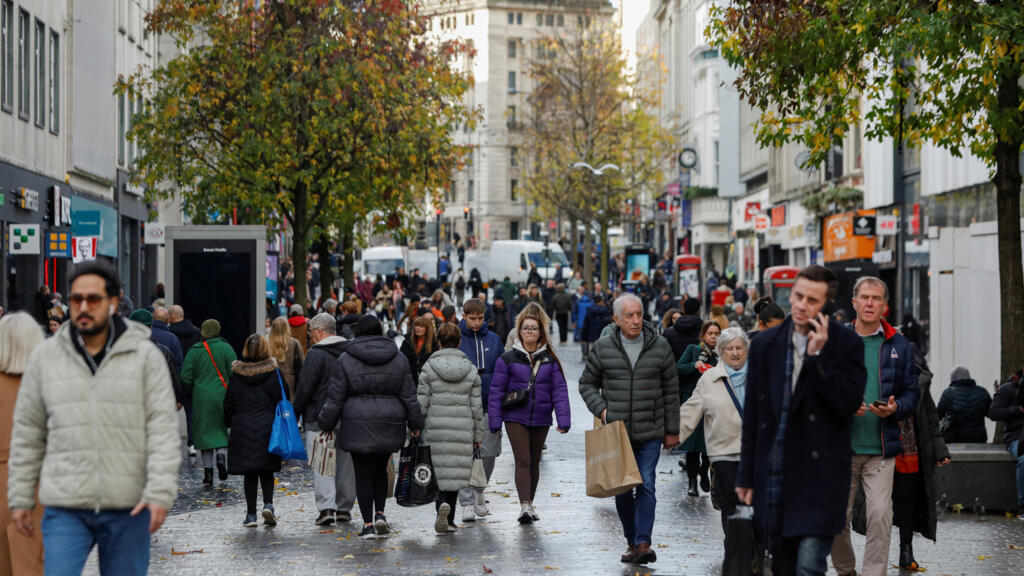
People walk through the city centre in Liverpool, Britain November 27, 2025
 © Temilade Adelaja, Reuters

Britain unveiled Tuesday its first-ever plan to tackle "forever chemicals" and reduce the risks they pose to health and the environment.

PFAs (per- and polyfluoroalkyl substances) are a group of some 10,000 human-manufactured chemicals used in everything from pizza boxes to cookware, to waterproof clothing.

They take an extremely long time to break down -- earning them their "forever" nickname -- and instead build up in the environment.

There is growing evidence their widespread use has created risks that "will likely remain for hundreds of years", according to the UK's Department for Environment Food and Rural Affairs.


It said in a statement the new government plan aims to "understand where these chemicals are coming from, how they spread and how to reduce public and environmental exposure".

The full extent of PFAs in England's estuaries and coastal waters "will be assessed for the first time," it added.

PFAs are present in food and drinking water.

Chronic exposure to even low levels has been linked to liver damage, high cholesterol, reduced immune responses, low birth weights and several kinds of cancer.

Under the plan, "a consultation will be launched later this year on introducing a statutory limit for PFAS in England's public supply regulations."

Should permitted levels be exceeded, this would make it easier for regulators to "enforce against water companies breaking the rules".

"It's crucial that we protect public health and the environment for future generations," said Environment Minister Emma Hardy in the statement.

She noted the government would work with regulators, industry, and local communities "to ensure 'forever chemicals' are not a forever problem".

Safer alternatives to everyday items, such as period pads and waterproof clothing, could also be developed.

Traces of the chemicals have been found everywhere from Tibet to Antarctica and contamination scandals have gripped Belgium and the United States among other nations.

Their use is increasingly being restricted across the world due to adverse health effects.

A handful of US states, including California, implemented a ban on the intentional use of PFAS in cosmetics beginning in 2025, and several other states are slated to follow in 2026.

The European Union has also been studying a ban on the use of PFAs in consumer products.

A report last week said their continued use could cost Europe up to 1.7 trillion euros ($2 trillion) by 2050 because of their impact on people's health.

(FRANCE 24 with AFP)
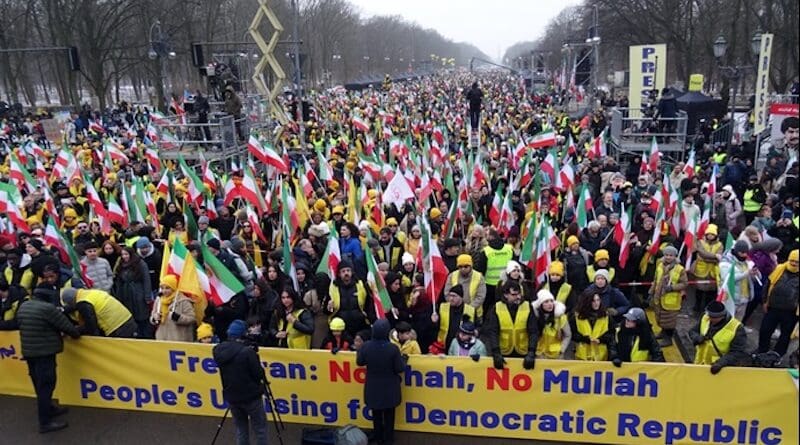
Berlin Rally Backs Iran’s Democratic Revolution, Rejects Dictatorship, Turnout Estimated At Over 100,000 – OpEd


Iranian Resistance Berlin Rally February 7, 2026. Photo Credit: PMOI


February 9, 2026
By Matin Karim

Under the freezing skies of Berlin, with temperatures dropping well below zero, more than 100,000 Iranians and international supporters gathered at the historic Brandenburg Gate, according to the Express. Undeterred by the biting cold and logistical hurdles, including widespread flight and train cancellations, the massive crowd turned the heart of Germany into a resounding stage for the Iranian Resistance.

The rally, held to mark the anniversary of Iran’s 1979 anti-monarchical revolution, took on a distinct and urgent gravity this year. It convened in the immediate aftermath of a nationwide uprising that swept across Iran in late December 2025 and early January 2026. This recent explosion of public anger saw the clerical regime respond with unprecedented brutality, leaving thousands of protesters dead.

Prominent European and American dignitaries joined Mrs. Maryam Rajavi, President-elect of the National Council of Resistance of Iran (NCRI), to declare that the era of theocratic rule in Iran is drawing to a definitive close. The event underscored a shift in global perspective, moving away from appeasement and toward a recognition of the Iranian people’s right to self-defense and regime change.
Maryam Rajavi: The Countdown to Overthrow Has Begun

In her keynote address, Mrs. Maryam Rajavi set the tone for the event by drawing a direct line between the 1979 revolution against the Shah and the current uprising against the mullahs. She described the recent unrest as a turning point that has shattered the regime’s perceived stability.

“The January uprising turned crimson, but with the blood of a galaxy of martyrs and thousands of devoted souls and with the fury of a heroic nation, it shook Iran and the world,” Mrs. Rajavi declared. She emphasized that the sheer scale of the sacrifice has made the regime’s downfall an inevitability visible to the entire world. “For years and years, we said: overthrow, overthrow. And now, everyone sees it is approaching with their own eyes and hears its footsteps.”


Mrs. Rajavi outlined a specific path forward, rejecting both the current theocracy and any return to the monarchical dictatorship of the past. She presented a comprehensive six-point demand to world leaders, calling for the recognition of the Iranian people’s struggle, the prosecution of Supreme Leader Ali Khamenei for crimes against humanity, the closure of regime embassies, and immediate UN action to halt the execution of uprising detainees. Her speech culminated in a vow that the democratic revolution, fueled by the “Resistance Units,” would inevitably triumph where the 1979 revolution was hijacked.
The January Uprising: A Revolution in Blood and Fire

A central theme of the conference was the recognition of the recent December 2025 and January 2026 protests not merely as civil unrest, but as a full-scale revolution. Speakers provided harrowing details regarding the intensity of the conflict and the regime’s lethal response.

Former U.S. Secretary of State Mike Pompeo provided a stark assessment of the death toll, highlighting the severity of the regime’s crackdown. “The massacre of January 8th and January 9th killed at least 20,000, perhaps twice that many,” Pompeo stated, describing the events as a “murderous rampage” by a regime nearing its death. He noted that while protests have occurred before, the recent events represent a “hinge point” in history where the Iranian people have definitively signaled the end of the Islamic Republic.

This sentiment was echoed by Mrs. Rajavi, who lamented the loss of young lives, noting that “14- and 15-year-old girls continue to be gunned down in the streets.” She described the uprising as a “lightning assault” that showed the path to freedom, driven by a generation unwilling to submit to tyranny.

Peter Altmaier, former German Federal Minister for Economic Affairs, addressed the heroes of the uprising directly, acknowledging those who lost their lives or are currently languishing in prisons. He emphasized that the regime has “lost all legitimacy” by treating its citizens with a level of cruelty unmatched globally. “During the various uprisings, the mullahs’ regime shot tens of thousands; tens of thousands were executed, and tens of thousands are sitting in prisons,” Altmaier observed, reinforcing the scale of the humanitarian crisis.
Rejecting the “Hijackers”: No to Shah, No to Mullahs

A significant portion of the rally was dedicated to clarifying the political identity of the uprising. Speakers were unified in their rejection of the “two dictatorships”—the deposed Pahlavi monarchy and the current religious tyranny. This dual rejection was presented as the guiding principle of the current revolution.

Charles Michel, former President of the European Council, delivered a stinging critique of attempts by the remnants of the Shah’s regime to co-opt the current movement. He warned against those seeking to “steal your dreams and aspirations,” specifically pointing to the son of the Shah.

“Being the son of a dictator should inspire shame and humility,” Michel argued. He accused the remnants of the shah regime of using “industrial artificial intelligence bots” and massive financial resources to manufacture a fake image of support. “He seeks to create a fake image of support to manipulate and attempt to hijack the future of the Iranian people once again,” Michel said, drawing a sharp contrast between the “organized resistance” that seeks democracy and those who feel entitled to rule by lineage.

Mrs. Rajavi reinforced this narrative, categorizing the political landscape into three sides: the rebels sacrificing for freedom, the murderous clerics, and the “remnants of the Shah.” She described the slogan “Long Live the Shah” as “ultra-reactionary” and a tool that ultimately serves the current Supreme Leader by dividing the opposition and justifying suppression. “Anyone who imagines they can hijack Iran’s new democratic revolution… are gravely mistaken,” she affirmed.

Mike Pompeo also weighed in, stating that the Iranian people have made their preferences “abundantly clear” through repeated uprisings: “They do not want theocracy, they do not want autocracy, and they do not want a monarchy.”
The Organized Resistance and the “Third Option”

Countering the narrative that the alternative to the Iranian regime is chaos, the speakers highlighted the role of the NCRI and the PMOI/MEK as a viable, organized democratic alternative. They argued that the “Third Option”—neither foreign war nor appeasement—relies on empowering the Iranian people and their organized resistance.

Charles Michel articulated this explicitly: “There is an alternative! There is the mobilization of the people of Iran… The Ten-Point Plan is the right recipe to move from tyranny to democracy.” He praised the plan for its commitment to a secular system, gender equality, and the abolition of the death penalty. “The Ten-Point Plan is a solid bridge from oppression to liberty,” Michel concluded.

Mike Pompeo pointed to the “Resistance Units” inside Iran as the engine of the recent uprisings. “The uprisings that we have seen in these past days didn’t come out of nowhere… They are rooted in a Resistance now four decades in the making,” he said. He emphasized that the NCRI has built the capacity for popular support and laid out a systemic plan for a transition period, stressing that this movement does not ask for foreign soldiers but for recognition.

Mrs. Rajavi detailed the mechanics of the proposed transition, reiterating the NCRI’s commitment to a Constituent Assembly elected within six months of the regime’s overthrow to draft a new constitution. She highlighted the presence of the “National Liberation Army” and the “Resistance Units” as the forces capable of preventing disorder and instability in the post-regime vacuum.
Condemnation of Human Rights Abuses and the “Wall of Fear”

The rally took place in the shadow of the Brandenburg Gate, a location invoked by several speakers to symbolize the breaking of barriers. Charles Michel compared the Berlin Wall to the “wall of fear” in Iran—a divide between oppression and freedom. “It is a reminder that no wall is eternal and that freedom cannot be defeated forever,” he told the crowd.

Sabine Leutheusser-Schnarrenberger, former German Federal Minister of Justice, focused her address on the severe human rights violations occurring inside Iran’s prisons. She reminded the audience of the “torture chambers” and the reality that people are being “arrested, tortured, murdered, and executed” simply for demanding basic rights.

“What this mullahs’ regime is criminally and brutally inflicting on its own citizens in Iran cannot be accepted,” Leutheusser-Schnarrenberger stated. She highlighted the specific plight of women, noting their fight for the right to “go out on the streets without a headscarf—without having to fear disappearing into torture chambers for years.”

The speakers collectively painted a picture of a regime that has resorted to taking foreign hostages and massacring its own youth as a desperate survival tactic. As Michel noted, “Their cruelty is a desperate sign of weakness… This regime is more fragile and isolated than ever.”

Policy Demands: End Appeasement, Sanction the IRGC

A unified demand emerging from the Berlin rally was for Western governments to fundamentally alter their policy toward Tehran. The era of engagement and “appeasement” was declared dead, with speakers calling for tangible, punitive measures against the regime’s apparatus of suppression.

Peter Altmaier was emphatic in his message to Western capitals: “All hopes that this regime would modernize… were false.” He welcomed the EU’s designation of the Islamic Revolutionary Guard Corps (IRGC) as a terrorist organization but termed it “only a first step.” Altmaier called for tougher sanctions and urged the free press to increase its coverage of the atrocities in Iran.

Sabine Leutheusser-Schnarrenberger criticized ongoing diplomatic efforts, specifically mentioning negotiations via Oman regarding the nuclear deal. “What belongs in such talks, if they are already taking place?” she asked. She insisted that no talks should proceed without the primary demand being the release of uprising detainees. “One cannot continue with negotiations and then return to business as usual,” she argued, calling for a halt to financial flows that line the mullahs’ pockets.

Mike Pompeo, drawing on his experience implementing the “Maximum Pressure” campaign, reiterated that the regime is incapable of reform. “We need a policy that is grounded in strategic and moral clarity,” he said. He expressed confidence that the U.S. administration would continue to “cut off the lifelines” of the regime, noting recent sanctions on Iranian crude oil.

Maryam Rajavi provided a specific policy roadmap for the international community. Her demands included referring the regime’s leaders to the UN Security Council for prosecution, completely cutting off the regime’s financial resources, and providing the facilities necessary to ensure the Iranian people have access to a free and open internet to bypass state censorship.

The rally in Berlin concluded with a message of profound optimism despite the grim circumstances of the recent massacres. The speakers concurred that the sheer magnitude of the January 2026 uprising, combined with the organized nature of the resistance, signaled that the clerical regime has entered its final phase.

Mike Pompeo summarized the sentiment of the day: “Today, it is unequivocal and unmistakable that we are at a hinge point in Iran’s history… The Iranian people will prove fearless.”

“The decaying forces will be swept from the stage of history,” Mrs. Rajavi quoted the slain resistance leader Moussa Khiabani, assuring that the revolution would prevail.


Matin Karim

Matin Karim writes for the People's Mojahedin Organization of Iran (PMOI/MEK)


Exclusive: Iran, massacre under a blackout

Issued  08/02/2026 
FRANCE24


In this exclusive documentary, FRANCE 24 retraces the chronology of events that took place in Iran from December 28, 2025, when merchants in Tehran's Grand Bazaar went on strike, to January 18, 2026, when the authorities restored internet access. Behind closed doors, from January 8 to 11, Iran's worst massacre took place since the 1979 establishment of the Islamic Republic. Warning: viewers may find the footage and descriptions in this report upsetting.


In early January, FRANCE 24 assembled a cross-media team of journalists, including senior producer Mariam Pirzadeh, online journalist Bahar Makooi and Ershad Alijani from the FRANCE 24 Observers. They collated and verified the many videos they received from Iran before, after and sometimes during the internet blackout. They also gathered the harrowing testimonies of several participants in, and victims of, the protest movement.

What emerged is a relentless, sometimes painful account of the extreme police brutality used by the Iranian regime from the early days of the protests, which escalated to the use of military methods and weapons from January 8 onwards. Then came the pressure put on victims' families, who were tracked down in hospitals and morgues as they went to collect their injured or dead loved ones, whom they had to pay for.

Our documentary ends on January 18, with undoubtedly tens of thousands of victims. It will be up to history to determine the final toll.

Warning: The report contains disturbing and violent images. Caution is advised for underage viewers.

Illustrations by Adel Gastel.

Iran: France 24 Reporters retrace chronology of deadly crackdown

© France 24
22:45


Iranian Nobel laureate Narges Mohammadi sentenced to seven additional years in prison


By Orestes Georgiou Daniel with AP
Published on 

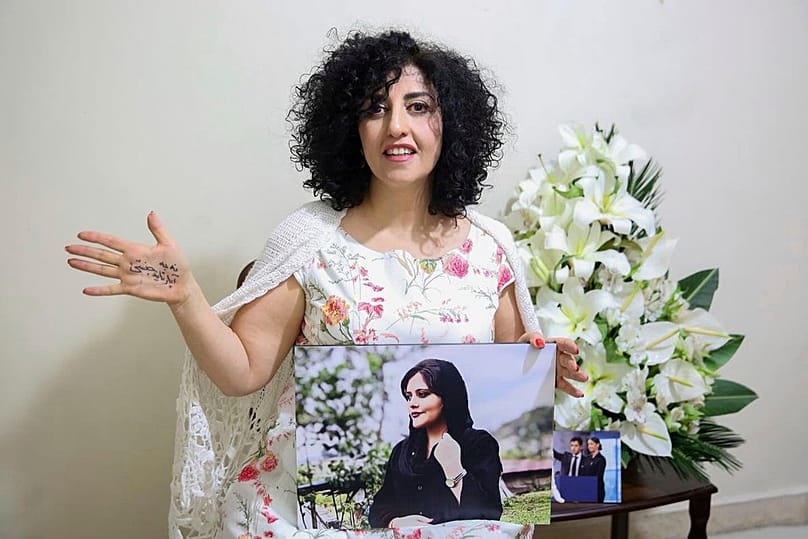
Supporters of Narges Mohammadi, who was awarded the Nobel Peace Prize in 2023, said she had been on hunger strike since 2 February.

Iran has sentenced Nobel Peace Prize laureate Narges Mohammadi to more than seven additional years in prison after she began a hunger strike, supporters of hers said on Sunday.

Mohammadi’s supporters cited her lawyer, who spoke to Mohammadi. The lawyer, Mostafa Nili, confirmed the sentence on X, saying it had been handed down Saturday by a Revolutionary Court in the city of Mashhad.

The Nobel laureate had previously been sentenced to nearly 14-years in prison on other charges. Iranian authorities did not immediately acknowledge the more recent sentence.

“She has been sentenced to six years in prison for ‘gathering and collusion’ and one and a half years for propaganda and two-year travel ban,” Nili said. She received another two years of internal exile to the city of Khosf, some 740 kilometers (460 miles) southeast of Tehran, the capital, the lawyer added.

Supporters say Mohammadi has been on a hunger strike since 2 February. She had been arrested in December at a ceremony honoring Khosrow Alikordi, a 46-year-old Iranian lawyer and human rights advocate who had been based in Mashhad. Footage from the demonstration showed her shouting, demanding justice for Alikordi and others.

The new convictions against Mohammadi come as Iran tries to negotiate with the United States over its nuclear programme to avert a threatened military strike by President Donald Trump. Iran's top diplomat insisted Sunday that Tehran's strength came from its ability to “say no to the great powers," striking a maximalist position just after negotiations in Oman with the US.

Concerns over Mohammadi's health

The Nobel laureate is now in "deteriorating health", her supporters say, after ending her nearly week-long hunger strike.

Mohammadi's supporters had warned for months before her arrest in December that she was at risk of being sent back to prison after having received a furlough in December 2024 over medical concerns.

While that was to be only three weeks, Mohammadi’s time out of prison lengthened, possibly as activists and Western powers pushed Iran to keep her free.

Nobel Peace Prize laureate Narges Mohammad after being released on a medical furlough in Tehran, Iran, 4 Dec, 2024. On her hand written in Farsi is "End gender apartheid." Narges Foundation Archive/AP

Mohammadi still kept up her activism with public protests and international media appearances, including even demonstrating at one point in front of Tehran’s notorious Evin prison, where she had been held.

She had been serving 13 years and nine months on charges of collusion against state security and propaganda against Iran’s government. She also had backed the nationwide protests sparked by the 2022 death of Mahsa Amini, which have seen women openly defy the government by not wearing the hijab.

Mohammadi suffered multiple heart attacks while imprisoned before undergoing emergency surgery in 2022, her supporters say. Her lawyer in late 2024 revealed doctors had found a bone lesion that they feared could be cancerous that later was removed.

Iranian foreign minister strikes hard-line tone

Speaking to diplomats at a summit in Tehran, Foreign Minister Abbas Araghchi signalled that Iran would stick to its position that it must be able to enrich uranium - a major point of contention with US President Donald Trump.

“I believe the secret of the Islamic Republic of Iran’s power lies in its ability to stand against bullying, domination and pressures from others," Araghchi said. "They fear our atomic bomb, while we are not pursuing an atomic bomb. Our atomic bomb is the power to say no to the great powers. The secret of the Islamic Republic’s power is in the power to say no to the powers.”

Israeli Prime Minister Benjamin Netanyahu is expected to travel to Washington this week, with Iran expected to be the major subject of discussion.

The US has moved the aircraft carrier USS Abraham Lincoln, ships and warplanes to the Middle East to pressure Iran into an agreement and have the firepower necessary to strike the country, should Trump choose to do so.


 SPACE/COSMOS


This Student Made Cosmic Dust In Her Lab: What She Found Could Help Us Understand How Life Started On Earth


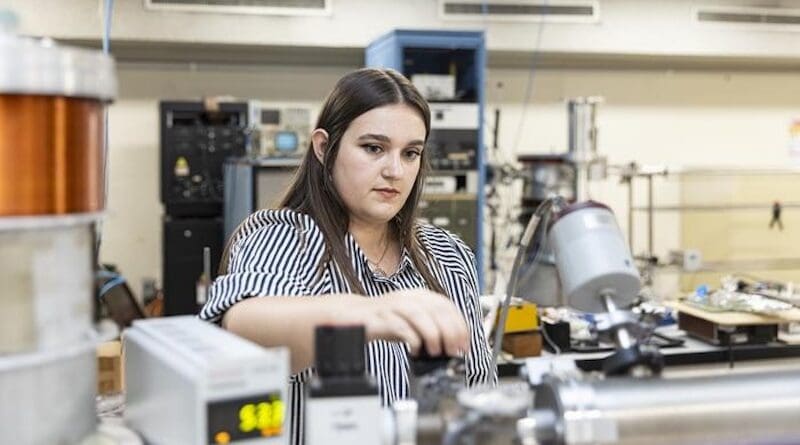
PhD candidate and lead author of the study Linda Losurdo in the plasma physics laboratory at the University of Sydney. CREDIT: Fiona Wolf/The University of Sydney

February 9, 2026 
By Eurasia Review

A Sydney PhD student has recreated a tiny piece of the Universe inside a bottle in her laboratory, producing cosmic dust from scratch. The results shed new light on how the chemical building blocks of life may have formed long before Earth existed.

Linda Losurdo, a PhD candidate in materials and plasma physics in the School of Physics, has used a simple mix of gases – nitrogen, carbon dioxide and acetylene – to mimic the harsh and dynamic environments around stars and supernova remnants.

By subjecting these gases to intense electrical energy, she generated carbon-rich “cosmic dust” similar to the material found drifting between stars and embedded in comets, asteroids and meteorites.

Her results are published in The Astrophysical Journal of the American Astronomical Society.

The dust she created contains a complex cocktail of carbon, hydrogen, oxygen and nitrogen – known collectively as CHON molecules – which are central to many organic substances essential for life.

“We no longer have to wait for an asteroid or comet to come to Earth to understand their histories,” Ms Losurdo said. “You can build analogue environments in the laboratory and reverse engineer their structure using the infrared fingerprints.

“This can give us huge insight into how ‘carbonaceous cosmic dust’ can form in the plasma puffed out by giant, old stars or in cosmic nurseries where stars are being born and distribute these fascinating molecules that could be vital for life.

“It’s like we have recreated a little bit of the Universe in a bottle in our lab.”

Cosmic dust is known to form in extreme astrophysical environments, where molecules are constantly bombarded by ions and electrons. Scientists can identify this dust in space because it emits a distinctive infrared signal – a molecular fingerprint that reveals its chemical structure.

The dust produced in Ms Losurdo’s experiments showed the same tell-tale infrared signatures, confirming the laboratory process closely mirrors what happens in space.

BUILDING BLOCKS OF LIFE

One of the enduring questions in science is how life began on Earth. Researchers are still debating whether the earliest organic molecules formed locally on our young planet, arrived later aboard comets and meteorites, or were delivered during the earliest stages of solar system formation – or some combination of all three.

Between about 3.5 and 4.56 billion years ago, Earth was bombarded by meteorites, micrometeorites and interplanetary dust particles originating from asteroids and comets. These objects are thought to have delivered vast amounts of organic material to the planet’s surface. Yet the origins of that material remain mysterious.

“Covalently bonded carbon and hydrogen in comet and asteroid material are believed to have formed in the outer envelopes of stars, in high-energy events like supernovae, and in interstellar environments,” Ms Losurdo said.

“What we’re trying to understand are the specific chemical pathways and conditions that incorporate all of the CHON elements into the complex organic structures we see in cosmic dust and meteorites.”

HOW THEY DID IT

In the experiment, the team, consisting of Ms Losurdo and her supervisor Professor David McKenzie, used a vacuum pump to evacuate air from glass tubes, recreating the near-empty conditions of space. Nitrogen, carbon dioxide and acetylene were then introduced. The gas mixture was exposed to around 10,000 volts of electrical potential for about an hour, creating a type of plasma known as a glow discharge.

Under this intense energy, molecules broke apart and recombined into new, more complex structures. These compounds eventually settled as a thin layer of dust on silicon chips placed inside the tubes.

The collected dust at times looks like glittering collections of cosmic material.

Professor David McKenzie, co-author on the paper, said the work will allow scientists to probe conditions that are otherwise impossible to study directly.

“By making cosmic dust in the lab, we can explore the intensity of ion impacts and temperatures involved when dust forms in space,” Professor McKenzie said. “That’s important if you want to understand the environments inside cosmic dust clouds, where life-relevant chemistry is thought to be happening.

“This also helps us interpret what a meteorite or asteroid fragment has been through over its lifetime. Its chemical signature holds a record of its journey, and experiments like this help us learn how to read that record.”

Beyond insights into the origins of life, the researchers aim to build a comprehensive database of infrared fingerprints from lab-made cosmic dust. Astronomers could then use this library to identify promising regions of space – in stellar nurseries or the remnants of dead stars – and work backwards to understand the processes shaping them.

By recreating cosmic chemistry on Earth, the research opens a new window onto deep stellar processes – and the ancient steps that may have helped make life on Earth possible.

Ms Losurdo won the best presentation for this research at the international Annual Meeting of the Meteoritical Society late last year.


China develops compact microwave driver that could power a ‘Starlink-killer’ weapon

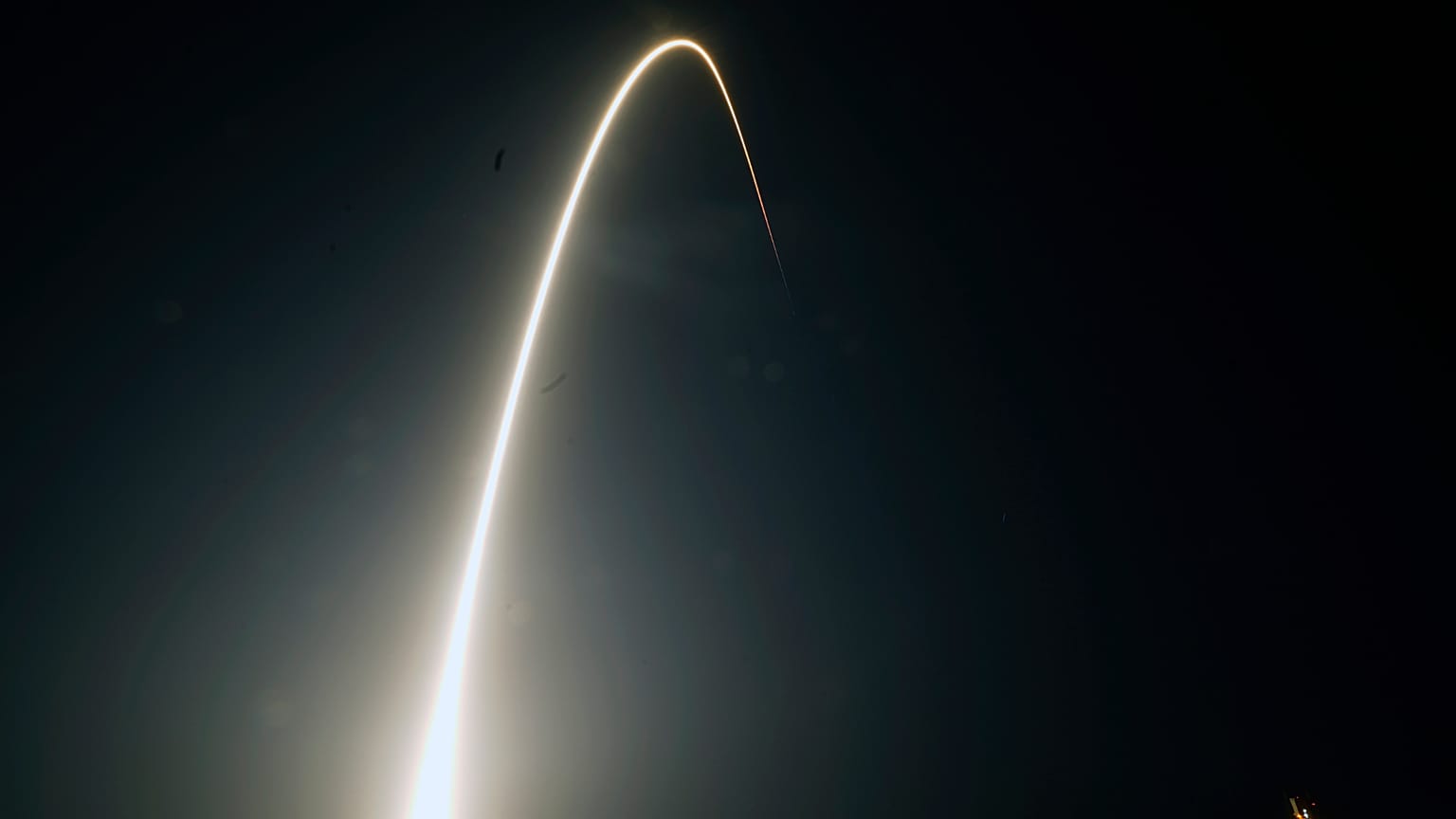
In this time-exposure photograph, a SpaceX Falcon 9 rocket with the 25th batch of approximately 60 satellites for SpaceX's Starlink broadband network lifts off
Copyright AP Photo/John Raoux

By Roselyne Min
Published on 

The compact pulse-power driver could enable high-power microwave attacks that are harder to detect and attribute than conventional anti-satellite weapons, potentially putting China ahead of the United States and Russia in the space-weapons race.

China has developed a new piece of military technology that could one day be used to disrupt satellite networks such as Starlink, according to a study.

Researchers at the Northwest Institute of Nuclear Technology (NINT), a research facility linked to the Chinese military in Xi’an, say they have built the world’s smallest driver for a high-power microwave (HPM) weapon, a system that could potentially be used to disrupt satellite networks such as Starlink.

The device, known as TPG1000Cs, measures about four metres long and weighs roughly five tons, making it significantly smaller than comparable systems.

“The system has demonstrated stable operation over continuous one-minute durations, accumulating approximately 200,000 pulses with consistent performance,” the study said.

Until now, similar known systems could only operate continuously for no more than just a few seconds and were far bulkier, making them difficult to install in smaller weapons systems

The TPG1000Cs system can generate electrical pulses reaching 20 gigawatts, according to the study. This far exceeds the roughly 1 gigawatt output that experts say a ground-based microwave weapon would need to potentially disrupt low-Earth-orbit satellite networks such as Starlink.

How does it work?

The United States, Russia, and China have all been exploring whether high-power microwave technology could be developed into weapons capable of disrupting satellites.

Destroying satellites using conventional weapons can create large clouds of orbital debris that may threaten other spacecraft, including those belonging to the attacking country.

Microwave weapons, in contrast, could theoretically disable electronics without creating significant debris, potentially offering strategic advantages and a degree of plausible deniability.

These weapons store electrical energy and then release it in a sudden, powerful burst. This pulse can produce intense microwave radiation that can disrupt electronics.

Starlink satellite communications have been used to support Ukraine’s communications infrastructure during Russia’s invasion of Ukraine, thanks to demonstrated resilience against jamming attempts.

The study was published in the Chinese journal High Power Laser and Particle Beams on January 13.

China has published a number of studies in recent years discussing the need to develop ways to disrupt large satellite constellations, including Elon Musk’s Starlink network.

Researchers say the breakthrough was made possible by a special liquid insulating material called Midel 7131.

“By adopting a high-energy-density liquid dielectric Midel 7131 and a dual-width pulse-forming line, the study achieved miniaturisation of an integrated Tesla transformer and pulse-forming system,” scientists wrote in the study.

 Trump video showing Obamas as monkeys sparks outrage over 'vile' racist depiction


President Donald Trump posted an election conspiracy video depicting former president Barack Obama and his wife Michelle as monkeys, drawing condemnations over the racist portrayal of America's first and only Black president. The White House on Friday initially dismissed the criticism as "fake outrage" before deleting the post and claiming the video had been “erroneously” made by a staffer.

Issued on: 06/02/2026
By: FRANCE 24


Barack and Michelle Obama attend Donald Trump's first presidential inauguration on January 20, 2017. © Jim Watson, AFP

US President Donald Trump on Thursday posted an election conspiracy video that depicted former president Barack Obama and his wife Michelle as monkeys, drawing condemnation from prominent Democrats.

Near the end of a one-minute-long video posted on Trump's Truth Social platform, the Obamas are shown with their faces on the bodies of monkeys for about one second.

The song "The Lion Sleeps Tonight" plays in the background when the Obamas appear.

The video repeats false allegations that ballot-counting company Dominion Voting Systems helped steal the 2020 election from Trump.

As of early Friday morning, the video had been liked several thousand times on the president's social media platform.

The office of California Governor Gavin Newsom, a potential 2028 Democratic presidential candidate and a prominent Trump critic, slammed the post.

"Disgusting behavior by the President. Every single Republican must denounce this. Now," Newsom's press office account posted on X.

House Democrati leader Hakeem Jeffries on Friday branded Trump's video as "vile, unhinged and malignant".

In a post on X, Jeffries said, "Every single Republican must immediately denounce Donald Trump's disgusting bigotry," calling Trump a "sick individual."

Ben Rhodes, a former top national security advisor and close confidant to Barack Obama, also condemned the imagery.

"Let it haunt Trump and his racist followers that future Americans will embrace the Obamas as beloved figures while studying him as a stain on our history," he wrote on X.

'Fake outrage'


The White House however initially dismissed the condemnations as "fake outrage".

"This is from an internet meme video depicting President Trump as the King of the Jungle and Democrats as characters from the Lion King. Please stop the fake outrage and report on something today that actually matters to the American public," Press Secretary Karoline Leavitt said in a statement to AFP.

But hours later, the White House said a staff member had "erroneously" made the Obama post, which was then deleted.

"A White House staffer erroneously made the post. It has been taken down," a White House official told AFP.


Obama is the only Black president in American history and backed Trump's opponent Kamala Harris on the campaign trail in the 2024 presidential election.

Trump has a long history of intensely personal criticism of the Obamas and of using incendiary, sometimes racist, rhetoric.

When Obama was in the White House, Trump advanced the false claims that the 44th president, who was born in Hawaii, was born in Kenya and was constitutionally ineligible to serve.

Obama eventually released his Hawaii records. Trump finally acknowledged during his 2016 campaign, after having won the Republican nomination, that Obama was born in Hawaii.
AI imagery

In the first year of his second term in the White House, Trump ramped up his use of hyper-realistic but fabricated visuals on Truth Social and other platforms, often glorifying himself while lampooning his critics.

He has used the provocative posts to rally his conservative base.

Last year, Trump posted a video generated by artificial intelligence showing Barack Obama being arrested in the Oval Office and appearing behind bars in an orange jumpsuit.

Later, he posted an AI clip of Jeffries – who is Black – wearing a fake moustache and a sombrero.

Jeffries called the image racist.


Since returning to the White House, Trump has drawn criticism from his opponents for leading a crusade against diversity, equity and inclusion (DEI) programmes.

One of Trump's first acts was to terminate all federal government DEI programmes, including related policies in the military.

The drive to rid the armed forces of what Trump has derided as "woke" initiatives has also seen the removal from some military academy bookshelves of scores of books that cover the US's history of discrimination.

US federal anti-discrimination programs were born of the 1960s civil rights struggle, mainly led by Black Americans, for equality and justice after hundreds of years of slavery, whose abolition in 1865 saw other institutional forms of racism enforced.

(FRANCE 24 with AFP and AP)


'I didn't make a mistake': Trump refuses to apologise for since-deleted racist post about Obamas


By Emma De Ruiter
Published on 


A social media post by US President Donald Trump depicted former President Barack Obama and his wife, Michelle Obama, as primates in a jungle. It was deleted on Friday after a backlash from both Republicans and Democrats.

US President Donald Trump refused to apologise on Friday for a racist video he posted on his social media platform Truth Social, which depicted the former President Barack Obama and his wife Michelle as primates.

Following widespread backlash for its treatment of the nation’s first Black president and first lady, the post was blamed on a staffer and deleted.

Near the end of the one-minute-long video promoting conspiracies about Republican Trump's 2020 election loss to Joe Biden, the Obamas were shown with their faces on the bodies of apes for about one second.

The video repeated false allegations that ballot-counting company Dominion Voting Systems helped steal the election from Trump.

The frames of the Obamas at the end of the clip originated from a separate video, previously circulated by an influential conservative meme maker. It shows a lion Trump as “King of the Jungle” and depicts Democratic leaders as other animals.

A rare admission of a misstep by the White House, the deletion came hours after press secretary Karoline Leavitt dismissed “fake outrage” over the post. After calls for its removal — including by Republicans — the White House said a staffer had posted the video erroneously.

"I didn't make a mistake," Trump said on Air Force One late Friday when asked if he would apologise for the post.

"I just looked at the first part... and I didn't see the whole thing," Trump said, adding that he "gave it" to staffers to post and they also didn't watch the full video.

Asked if he condemns the racist imagery in the video, Trump replied: "Of course I do."

Former vice president Kamala Harris called out the White House's backpedaling in a post on X on Friday.

"No one believes this cover up from the White House, especially since they originally defended this post," she wrote.

"We are all clear-eyed about who Donald Trump is and what he believes."

There is a long history in the US of powerful white figures associating Black people with animals, including apes, in demonstrably false, racist ways. The practice dates to 18th century cultural racism and pseudo-scientific theories used to justify the enslavement of Black people, and later to dehumanise freed Black people as uncivilised threats to white people.

When Obama was in the White House, Trump pushed false claims that the 44th president, who was born in Hawaii, was born in Kenya and constitutionally ineligible to serve. Trump had demanded that Obama prove he was a “natural-born citizen” as required to become president.

The White House explanation also raises questions about control of Trump’s social media account, which he's used to levy import taxes, threaten military action, make other announcements and intimidate political rivals. The president often signs his name or initials after policy posts.

The White House did not immediately respond to an inquiry about how posts are vetted and when the public can know when Trump himself is posting.