DRC probes how 5,000 tonnes of uranium ‘leaked’ into cobalt exports

The Democratic Republic of Congo is investigating uranium contamination in cobalt exports after researchers estimated that thousands of tonnes of the radioactive metal likely left the world’s largest cobalt-producing nation over the past two decades.

The government said it would test cobalt hydroxide exported largely to China and establish a working group to assess findings published July 30 in Nature Communications and examined in a Financial Times and Lighthouse Reports collaborative investigation.
Kinshasa also plans to consult the International Atomic Energy Agency (IAEA) about arranging a technical support mission, while domestic authorities will assess potential health and environmental risks over the next 60 days and make their findings public.
“The government of the Democratic Republic of Congo has taken careful note” of the findings, officials said.
The investigation comes as demand for cobalt, a key material in some lithium-ion batteries, has made DRC’s Copperbelt central to global supply chains. Uranium occurs naturally alongside copper and cobalt ores across the region and can remain attached to cobalt minerals as they move through mining and processing.
Blind spot
Researchers from the University of Wisconsin-Madison and Princeton University estimated that between 2,000 and 5,000 tonnes of natural uranium were exported from the DRC in cobalt-hydroxide shipments between 2000 and 2024, despite the country reporting no official uranium production during that period.
The study combined country-wide mineralization and geochemical data, mine-level trade records and a chemical model of cobalt processing. It also estimated another 1,000 to 4,000 tonnes of uranium may have been discarded in mine tailings, potentially exposing workers and nearby communities to chemically mobile radioactive material.
Less than 10% of the exported material appears to have been publicly declared and placed under international safeguards, according to study co-author Sébastien Philippe, a nuclear security expert and assistant professor at the University of Wisconsin-Madison.
“This quantity of undeclared uranium could be used to produce fissile material for roughly 600 to 1,500 nuclear weapons or fuel a standard light-water nuclear reactor for 10 to 25 years, so it’s quite a large amount,” Philippe said.
He emphasized that the research did not show uranium was deliberately exported through the cobalt supply chain.
“Our scientific research doesn’t show this was done purposefully to get uranium out of the DRC,” Philippe said. “However, one of the things we’re concerned about is that the volumes of exported uranium we’ve quantified are beyond what is supposed to be declared to the IAEA.”
Most cobalt shipments went to China, which the researchers said is home to about 95% of global cobalt refining capacity. Uranium contained in crude cobalt hydroxide must be removed during refining, potentially leaving it as a recoverable byproduct.
The IAEA tracks uranium production worldwide, but DRC’s low-grade uranium-bearing cobalt exports do not require reporting when shipped for non-nuclear purposes. An IAEA expert cited in the reporting said the agency had no indication that DRC was failing to meet its safeguards obligations.

The Congolese government also challenged parts of the study, saying its estimates were not based on direct measurements of exported material and relied instead on modelling that was not specific to individual facilities.
“These methodological limitations call for a counter-verification process, without in any way minimizing the issues raised,” the government said.
Officials said national and international laboratories would participate in the testing, alongside DRC’s nuclear safety and nuclear energy agencies. The country also plans to install radiation detectors for trucks leaving the country.
Miners push back
Chinese mining companies operating in DRC have rejected claims that their cobalt products contain excessive uranium.
The Union of Chinese-Capital Mining Companies in the DRC, known known by its French acronym USMCC, said Aug. 5 that an internal review found no excessive uranium levels in cobalt products mined, processed or exported by its members in southeastern DRC.
“Following an exhaustive verification conducted by the association, no cobalt product extracted, processed or exported by Chinese mining companies operating in southeastern DRC contains excessive levels of uranium,” USMCC said in the statement published on X.
The group acknowledged that cobalt hydroxide can contain very low naturally occurring traces of uranium, but said concentrations remained below levels that would make extraction technically or economically viable.
“There are no economic or technical conditions for recovering, extracting or exploiting this uranium,” it said.
Major Chinese mining companies operating in the DRC include CMOC Group, Zijin Mining and Zhejiang Huayou Cobalt.
USMCC said its members would conduct regular sampling, publish quality-control findings and continue complying with Congolese mining rules and internationally recognized testing standards.
Added pressure
The dispute adds another complication to a cobalt industry already facing pressure over supply-chain transparency, worker safety and local processing. DRC has also prohibited exports of copper and cobalt concentrates as part of efforts to retain more value from its mineral resources.
Researchers said more systematic testing of cobalt-hydroxide shipments, radiation monitoring for workers and better accounting of uranium flows could reduce the risks. Ultimately, they argued that refining cobalt into metal inside DRC would give authorities greater control over uranium before cobalt leaves the country.
The government said uranium has coexisted with cobalt in Congolese ores throughout more than a century of industrial mining and maintained that the issue has been responsibly managed.
It added that DRC “remains committed to fulfilling its international non-proliferation and safeguards obligations.”
Congo bans copper and cobalt concentrates exports, official order says
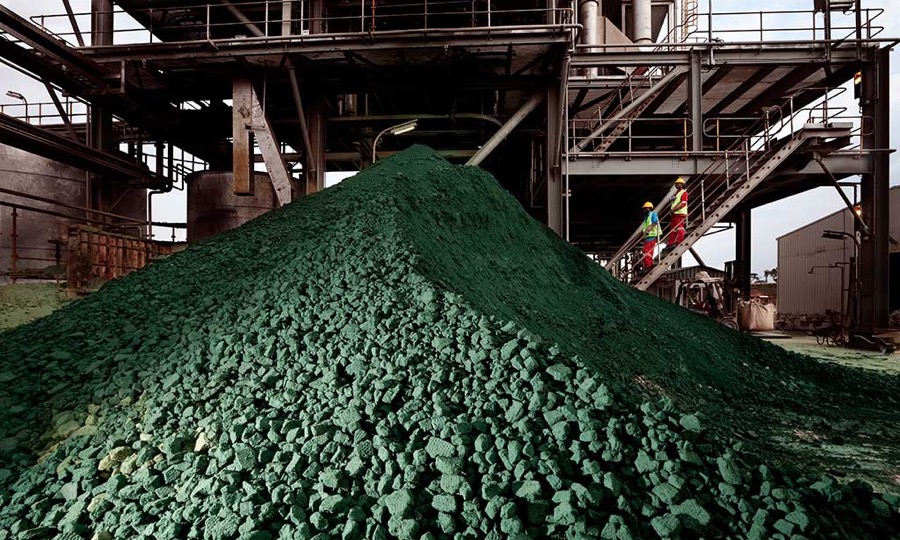
The Democratic Republic of Congo has banned exports of copper concentrate and cobalt concentrate as it escalates efforts to force domestic processing and retain more value from its mineral resources, a government order reviewed by Reuters on Thursday shows.
After Reuters reported the ban, benchmark three-month copper on the London Metal Exchange rose by as much as 1.8% to $14,369.50 a metric ton, the highest since January 29 when the metal hit an all-time peak of $14,527.50.
Congo is seeking to leverage its position as the world’s largest cobalt supplier and a major source of other energy-transition minerals, including copper, to build domestic processing capacity and retain a greater share of the wealth flowing from its mines.
The June 29 order, signed by Mines Minister Louis Kabamba Watum, Foreign Trade Minister Julien Paluku Kahongya and Economy Minister Daniel Mukoko Samba, says “the export of copper and cobalt concentrates is prohibited”.
The ban takes effect immediately, although one-year export waivers may be granted under strategic circumstances, the order said, without explaining further.
It also introduced a tax regime with a three-month transition period for economically significant mining by-products.
In a statement posted on the LSEG platform on Thursday, Ivanhoe Mines (TSX: IVN) said its Kamoa-Kakula copper complex – a joint venture with China’s Zijin Mining and the Congolese government – had received multiple exemptions allowing it to export copper concentrate since production began in 2021.
“Currently, copper concentrate produced by Kamoa-Kakula is smelted at the on-site smelter or at the Lualaba copper smelter, in Kolwezi. In addition, the Kipushi Mine has a derogation in place allowing the export of the operation’s zinc concentrates,” the company said.
Congo pushes for local processing
The ban was motivated by “the need to encourage mining operators to market or export commercial mineral products with high added value,” the order said.
Congo has imposed bans on copper and cobalt concentrate exports in 2013, 2019 and 2023, while granting waivers where domestic smelting capacity was insufficient.
The latest order repeals the 2023 order and its exemptions, and replaces it with a broader framework governing mineral exports and the taxation of economically significant mining by-products.
Congo mostly exports copper in the form of refined metal. It exported 696,725 tons of copper cathodes in the first quarter of 2026, compared with 53,926 tons of copper concentrates containing 18,863 tons of copper metal, according to official data.
It also shipped 51,940 tons of cobalt hydroxides containing 17,054 tons of cobalt metal over the same period.
Christian-Geraud Neema, a mining analyst at non-profit organisation the China-Global South Project, said the latest ban was unlikely to have a severe impact on most operators as the bulk of Congo’s copper and cobalt is already refined domestically.
He said the most affected could be Kamoa-Kakula as it still exports some concentrate under exemptions. Zijin did not immediately respond to a request for comment and neither did the Congolese chamber of mines.
The new tax regime covers a wide range of minerals and says the tax on mining by-products applies to trace and ultra-trace minerals recovered during refining using a 55% valuation coefficient, with royalties charged alongside those on the main mineral.
(Reporting by Ange Adihe Kasongo and Maxwell Akalaare Adombila; additional reporting by Tom Daly in London and Ernest Scheyder in Houston; Editing by Veronica Brown, Louise Heavens and Barbara Lewis)

No comments:
Post a Comment