Performative violence—aka executions without trial at sea—overshadows how the administration is building a new US policy towards the hemisphere: acts of murder as a tool to create permanent structures of dominance and extraction.

A boat burns after being bombed by US forces in the Pacific Ocean on May 29, 2026.
(Photo by US Southern Command/screen shot)
Aug 22, 2026
“American dominance in the Western Hemisphere will never be questioned again,” declared the State Department in a new video tying, somewhat improbably, the Monroe Doctrine of 1823 to killing people on boats in the Caribbean and Pacific 200 years later. Blowing up speedboats supposedly to stop fentanyl smuggling—which notably does not come to the US on speedboats—appears senseless. As a counter-narcotics strategy, it is ineffective, an assessment echoed by the DEA. The performative violence overshadows its role in building a new US policy towards the hemisphere: acts of murder as a tool to create permanent structures of US dominance and extraction.
Laid out in the December 2025 National Security Strategy (NSS), the “Donroe Doctrine” aims to restore US preeminence in a region where it has been eclipsed by China, convert security claims into exceptional military authority against “narco-terrorists,” institutionalize that authority through permanent commands, “enlist and expand” governments aligned with Washington, and use it to secure strategic and commercial access. The desired end: military cooperation, trade agreements, access to critical minerals and rare earths, likely accompanied by shady personal deals for the Trump family. Democratic backsliding, in a region where democracy is still relatively young, is a necessary condition for its success.
The Donroe Doctrine’s architecture is still under construction. Latin American governments can still resist Washington’s pressures, refusing to co-create his transactional order. Greater regional integration would rebalance that bargaining power, helping less powerful countries impose conditions, defend constitutional limits, reject particular operations, and withstand the costs of US pressure. More than 100 legislators, political leaders, and experts from 15 countries are gathering at the Third Pan-American Congress in Montevideo this weekend to strengthen regional collaboration, the basis for an alternate architecture to one premised on US domination.
Resistance to US coercion, however, also depends on democratic repair within the region. Governments captured by authoritarian leaders cannot provide a durable basis for sovereignty. Corruption erodes state capacity and public trust, making foreign military solutions more appealing. The Trump administration is betting on a hemispheric doctrine that favors authoritarian leaders, eager to share in corruption.
The Donroe Doctrine’s highest profile proof of concept began with airstrikes on boats off the coast of Venezuela, to the killing of fishermen in the Pacific—since revealed to be a covert CIA program—to August’s announcement of a new Joint Task Force-Western Hemisphere, establishing a standing headquarters for efforts to turn such extrajudicial killings into joint operations with allied governments. This maps onto the administration’s Shield of the Americas, a coalition of right-wing Latin American governments allied with the Trump administration. From the abduction of Venezuela’s President Nicolás Maduro to the boat strikes murders, all leaned on two forever wars framing and justification that long predated Trump: The War on Drugs and the War on Terror.
The Trump administration is betting on a hemispheric doctrine that favors authoritarian leaders, eager to share in corruption.
Targeting supposed smugglers, many of them probably fishermen, as “narcoterrorists” is a way to move trafficking from the framework of criminal law into the claimed authorities of war. Suspects become targets not of investigation but of immediate execution, secret assessments replacing due process and evidence in courts. The urgency of national security puts executive discretion over judicial authority. The boat strikes publicly declare exceptional authority of the executive. The Pentagon’s and CIA’s programs institutionalize it.
Like the War on Terror, this framing pictures an enemy and creates an industry to manage. It creates quid pro quo partnerships with other governments who leverage military cooperation into access to US foreign assistance, weapons, intelligence, and diplomatic cover for unsavory ends, whether domestic repression, corruption, or state murder of their own. With public opinion showing falling trust in all institutions but the military, stoking fears of all-powerful narcoterrorists serve mutual interests of reactionaries in Washington, Bogotá, and Tegucigalpa. The main risk is that it creates bureaucratic structures that outlive sitting administrations. With multilateral cooperation and institutions on the decline, this new military-industrial complex makes it nearly irreversible.
It also creates tools for meddling in domestic partisan politics. The success of Trump’s “Shield of the Americas” is predicated on Latin America’s continued turn to the right. Ecuador and Colombia have already agreed to “joint” military strikes on their territory, which are likely to become unilateral US strikes. Trump openly intervened in supporting the election of Nasry Asfura in Honduras, as it is currently doing with Flávio Bolsonaro in Brazil. That many of these allies are themselves tied to the drug trade is of little consequence: Colombia’s President de la Espriella made a career as a defense attorney for top narcos, Ecuador’s president Noboa’s family’s fruit business was found to be transporting cocaine, and Honduras’ former president Juan Orlando Hernández won a Trump pardon after his US conviction on drug-trafficking charges.
The project functions more easily where democratic foundations are weak and leaders face fewer constraints from citizens, legislatures, courts, and independent institutions, reflecting Trump’s own effort to weaken checks on executive authority inside the United States. Bukele in El Salvador provides a marquee case for using the specter of crime to consolidate a permanent “state of exception” and authoritarian rule. Such regimes can authorize operations, share intelligence, sign agreements, allocate land, and suppress opposition with less scrutiny.
Democratic scrutiny can expose the climate costs of extraction, contest land allocations and territorial interventions, demand transparency over contracts, and insist that resource wealth benefit the public. Corruption circumvents those checks by connecting external power with local gatekeepers able to transfer public resources and protect the bargain. The lack of transparency surrounding more than $13 billion collected by the United States from Venezuelan oil sales illustrates the scale of the accountability problem.
For the region, the emerging system depends on governments choosing to participate and institutions holding its authority. As progressives in the United States, we must challenge the false counternarcotics claims, unchecked lethal force, and waste of public resources sustaining this project, and hold our government accountable. Regional resistance and democratic repair must proceed together.
Our work is licensed under Creative Commons (CC BY-NC-ND 3.0). Feel free to republish and share widely.
Nancy Okail
Nancy Okail is the president and CEO of the Center for International Policy.
Full Bio >
Michael Paarlberg
Michael Ahn Paarlberg, Ph.D., is an associate professor of political science at Virginia Commonwealth University and an associate fellow with the Institute for Policy Studies who studies migration and security issues in Latin America and the US. He was previously a postdoctoral fellow with the Center for the Study of Ethnicity, Race and Immigration at the University of Pennsylvania. Paarlberg was the Chief Latin America Policy Adviser to the Bernie Sanders campaign in 2020. A former journalist for the Guardian, he regularly publishes his work in news outlets such as Foreign Policy, Slate, El Faro, and the Washington Post.
Full Bio >

The Ugliness of Latin America’s Angry Tide
Vijay Prashad

Photograph Source: Casa Presidencial El Salvador – Public Domain
In August, right-wing billionaire Abelardo de la Espriella took office as Colombia’s president and vowed to move an agenda of the far right even though he won by less than a percentage point over the left-wing candidate Iván Cepeda. It is characteristic of the far right of a special type to adopt any mandate and pretend that they have the authority to transform their society into their toxic swamp. Of the twenty states generally thought of as being part of Latin America, eleven now have governments of the far right: Argentina (Javier Milei since 2023), Bolivia (Rodrigo Paz since 2025), Chile (José Antonio Kast since 2026), Colombia (de la Espriella since 2026), Costa Rica (Laura Fernández since 2026), Ecuador (Daniel Noboa since 2025), El Salvador (Nayib Bukele since 2024), Honduras (Nasry Asfura since 2026), Panama (José Raúl Mulino since 2024), Paraguay (Santiago Peña since 2023), and Peru (Keiko Fujimori since 2026).
Most of these leaders are not from the old conservative bloc but are part of a new generation (Noboa is the youngest of the group, born in 1987) with an average age of 52. These are men and women who represent the old oligarchies of Latin America, the old families with deep colonial roots and with vast properties, but these leaders do not have an aristocratic sensibility or come from the established conservative political parties. They are libertarian in nature with naked fealties to the United States and its agenda. They fashion themselves as patriots, but patriotism is cast aside for absolute loyalty to Washington and its corporations.
Shoot to Kill
The far right emerges out of a long tradition of the oligarchy’s lawless violence, which dates to the genocide against the indigenous through to the military dictatorships of the Operation Condor era. Impunity for violence has been the hallmark of this class and its political representatives, and so the current far right is nothing if not authentic to its class and its forebearers. Laura Fernández was born in 1986 the year before Costa Rica’s president Óscar Arias won the Nobel Prize for Peace for his work in conflict resolution in Central America (Costa Rica rid itself of its military in its 1949 Constitution). At her inauguration in May 2026 Fernández said that she would have an ‘iron-fist response’ to crime and that her ‘hand will not tremble’. After Gustavo Petro’s attempts to bring peaceful resolutions to conflicts in Colombia, de la Espriella came to office with the view that ‘criminals can take bullets too’, suggesting a return to the state of war.
Nayib Bukele’s tough-guy approach to crime has profoundly influenced Latin America’s far right, turning El Salvador’s mass arrests, military deployments, emergency rule, and meg prisons into a regional political model. Leaders and candidates from Ecuador, Colombia, Costa Rica, Peru, Chile, and elsewhere increasingly present crime as a war requiring exceptional state power rather than conventional policing and social policy. Bukele’s popularity has helped normalise promises of militarised streets, harsher sentences, expanded prisons, and weaker procedural protections. Although critics document arbitrary detention and human rights abuses, admirers portray his methods as proof that decisive, authoritarian leadership can restore order where democratic institutions appear ineffective. Thus far, the far right of a special type has portrayed its illiberal approach to criminality, in fact to the neighbourhoods of the poor, as the only effective solution to the narco-mafias and petty criminals of the barrios.
Reversal of Social Gains
Across Latin America, the Angry Tide is attempting to reverse feminist gains by restricting abortion and contraception, dismantling institutions addressing gender violence, attacking sex education, and portraying feminism as a threat to the traditional family. In Argentina, Javier Milei’s government closed the Ministry of Women, stopped distributing abortion medication nationally, and cut contraceptive and teenage-pregnancy programs, thereby leaving formal rights increasingly inaccessible, particularly to poor and working-class women.
In Chile, far-right legislators have proposed forcing women to hear the foetal heartbeat before obtaining one of the country’s narrowly permitted abortions, while several new bills would punish allegedly ‘false’ accusations involving rape, sexual abuse, and domestic violence. These proposals could allow an accused person to pursue a complainant after a case is dismissed and therefore intimidate survivors; in class terms, this threat falls hardest on working-class, rural, migrant, and Indigenous women who lack lawyers, money, and institutional protection, strengthening patriarchal control while making access to justice more dangerous.
Blindness to Genocide
The far right not only sees lawless violence as its currency today, but it routinely celebrates the history of the conquistadors against the native peoples of the Americas as well as the entire panoply of Western civilisation (as Milei did in his speech at Davos in 2024). Blindness to genocide is the habit of the far right, which is why it has absolutely no compunction about close relations with the United States and its policy to seek the subordination of the entire hemisphere of the Americas to Washington’s interest. When Washington says that the road to close ties with itself must go through Tel Aviv, the governments of the far right hasten to forge close relations with Israel – despite the ongoing genocide of the Palestinians.
In June 2025, Argentina’s Ambassador to Israel, Rabbi Shimon Axel Wahnish, announced something called the Isaac Accords, which are designed to bring Latin American countries into a close relationship with Israel. The announcement came nearly two years into the genocide, although the actual Isaac Accords were formally established in April 2026 in Jerusalem. While Argentina and Israel are the only formal signatories, in May, a conference in Buenos Aires brought together officials from Bolivia, Brazil, Chile, Colombia, Costa Rica, Ecuador, El Salvador, Guatemala, Honduras, Panama, Paraguay, and Uruguay who signed a statement calling for the expansion of the Isaac Accords. Short of that, diplomatic relations with Israel have been restored by Bolivia (2025) and Colombia (2026), with Venezuela (2026) renewing consular services.
Development of Underdevelopment
Within presidential palaces and in legislatures, the governments of the far right have been working on economic agendas worked out by the International Monetary Fund (IMF) and the US Treasury Department. The agenda is simple: ensure that Western-based multinational corporations have easy access to raw materials from Latin America, protect the investments of these corporations, allow the oligarchy to participate in the theft of social wealth, and discipline the wider population through the actuality of immediate austerity and the promise of future wealth.
Most of the countries governed by the far right (Argentina, Chile, Ecuador, El Salvador, Honduras, and Paraguay) are under IMF facilities, with other countries on the radar for future programmes of the IMF. What is key is not the IMF programme per se, but a new push by the IMF to ensure investment-oriented deregulation. Argentina’s Large Investment Incentive Regime (RIGI), passed into law in 2024, provides the framework for laws that are being passed across Latin America – with the IMF loan programme, such as in Bolivia, dependent on the passage of these laws to protect (mostly foreign) investment in the country. RIGI, a long-term bargain, attracts large foreign investments by granting corporations sweeping tax, customs, currency, and regulatory privileges for up to 30 years. It socialises environmental and economic risks while privatising profits, weakening public revenue, and limiting future governments’ ability to regulate capital. Workers and citizens receive no equally strong guarantees of stable employment, good wages, local production, or public benefits, while multinational investors gain greater power to extract Argentina’s resources and move profits abroad.
The return of a testosterone leadership will not be able to solve the problems of the people of Latin America; but it has the capacity toxify social relations by turning people against each other and therefore weakening their capacity to build their own society. Their goal is total social transformation, not merely the enactment of this or that legislation. This is a fierce counter-revolution against the gains made by the impact of the Cuban Revolution and by the Bolivarian current. Contradictions will emerge, no doubt, but slowly and cautiously amongst a population divided by precariousness and new forms of social piety.
“We need to build a durable and lasting coalition of progressives that can take on the right-wing forces and answer them with the necessary call of the people,” said Congresswoman Pramila Jayapal.
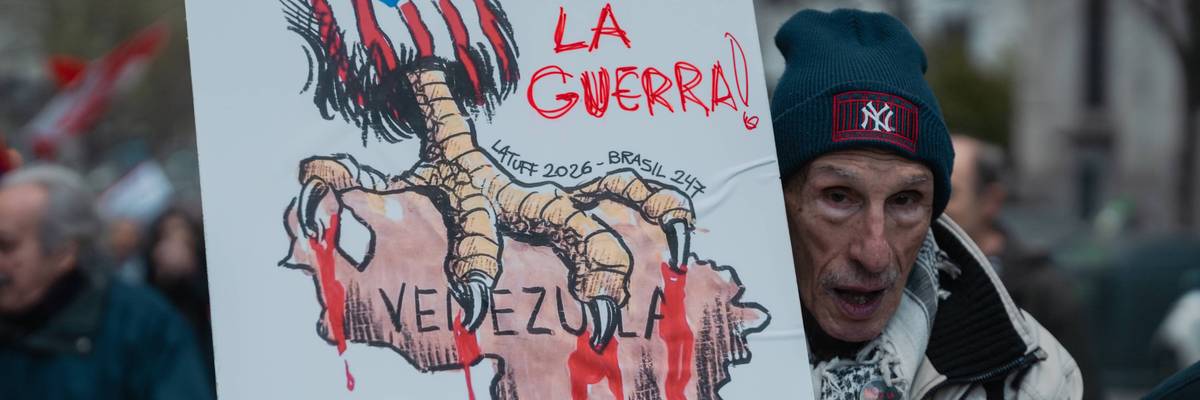
A protester holds a sign denouncing US aggression against Venezuela during a March 14, 2026 demonstration in Madrid.
(Photo by Olmo Blanco/Getty Images)
Brett Wilkins
Aug 17, 2026
COMMON DREAMS
A delegation of progressive congressional lawmakers and candidates is set to head to Uruguay this week to take part in a conference focused on Pan-American solidarity amid the resurgence of both US imperialism and right-wing governments in the hemisphere.
The third Pan-American Congress, to take place in the Uruguayan capital Montevideo, will bring together progressive legislators from North, Central, and South America and the Caribbean to discuss what organizers describe as hemispheric cooperation based on “solidarity between peoples” and “sovereignty among nations”—a vision sharply at odds with what critics have dubbed US President Donald Trump’s “Donroe Doctrine” militant imperialism.
The US delegation will be led by Rep. Pramila Jayapal (D-Wash.), joined by Rep. Jesús “Chuy” García (D-Ill.), Democratic congressional candidate Dr. Adam Hamawy of New Jersey, and three members of Democratic Socialists of America also running for Congress: Claire Valdez and Darializa Avila Chevalier of New York and Chris Rabb from Pennsylvania.
“We need to build a durable and lasting coalition of progressives that can take on the right-wing forces and answer them with the necessary call of the people,” Jayapal said in a video posted to social media.
Sen. Bernie Sanders (I-Vt.) is slated to address the conference remotely. Congressional Progressive Caucus Chair Greg Casar (D-Texas) will not attend but expressed his support for “pushing back against right-wing radicalization, tackling the climate crisis, and addressing our joint economic crisis.”
In an interview with El País published over the weekend, Japayal called the conference “an opportunity to hear from our Latin American counterparts about what is happening on the ground: how US foreign policy is affecting them and how we can work together to build a progressive movement and combat far-right disinformation. The United States is doing a lot of pain with our Donroe Doctrine.”
Jayapal is leading a letter signed by Sanders, Casar, García, and seven other progressive Democrats asking Secretary of State Marco Rubio “to answer for the regional implications of the ‘Trump Corollary’ to the Monroe Doctrine, and ground US foreign policy toward the Western Hemisphere on the principles of mutual respect and advancement of human rights.”
“The interventions conducted under the banner of the ‘Donroe Doctrine’ appear to follow a partisan playbook: the endorsement of favored candidates, the placement of political allies, the weaponization of tariffs and sanctions, and, where those fail, the application of direct military force,” the lawmakers wrote. “These are tactics that destabilize our hemisphere and endanger our neighbors.”
Two of the letter’s signatories, Reps. Nydia Velázquez (D-NY) and Delia Ramirez (D-Ill.), earlier this year introduced the New Good Neighbor Act, a bill inspired by the short-lived period when the Franklin D. Roosevelt administration pursued policies of nonintervention and improved diplomatic relations with Latin America in the 1930s.
Since returning to the White House just last year, Trump—who campaigned as the “peace president”—has bombed and invaded Venezuela to abduct President Nicolás Maduro and his wife, launched airstrikes against what he claims without evidence are drug-smuggling boats in the Caribbean Sea and Pacific Ocean, and deployed troops to Ecuador as part of a joint campaign against alleged drug gangs dubbed Operation Total Extermination.
Trump has also ordered the military to plan an invasion to seize the Panama Canal, threatened to “take” Cuba, possibly attack Mexico and Colombia, invade and annex Greenland, and somehow make Canada the “51st state.”
That’s just in the Western Hemisphere. Overall, Trump has bombed seven countries around the world since returning to the White House and 10 nations over the course of his two terms—including Iran, where he launched an increasingly protracted illegal war in concert with Israel.

Just last week, Ramirez dismissed as a “cheap piece of imperialist propaganda” a video published by the State Department hailing the Monroe Doctrine, which was cited to justify numerous US wars of aggression, conquest, destabilizing invasions, the overthrow of democratically elected governments, and support for pro-Washington military dictatorships.
Issued in December 1823 by President James Monroe as Spanish colonies in the Americas won their independence, the eponymous doctrine states that European powers should not establish new colonies or interfere politically in the independent states of the Western Hemisphere. While it was partly a response to European attempts to restore colonial rule in Latin America, the Monroe Doctrine also asserted US hegemony over the Americas.
According to John Coatsworth, a historian specializing in Latin America, the US has launched at least 41 interventions that successfully overthrew governments in the Americas since 1898. The number of US military interventions in the region is much higher.
Former Colombian President Ernesto Samper, who is attending the conference, told The Hill on Monday that the resurgence of right-wing leaders, including Abelardo de la Espriella in his country, is “leading us toward a form of neofascism.”
Samper said that Trump’s “hegemonic aggression” in the Americas shows that the hemisphere “deserves a progressive and sensible response, which I hope will emerge from this forum.”


No comments:
Post a Comment