Iran Threatens “Additional Punitive Measures” as US Goes Tanker-for-Tanker
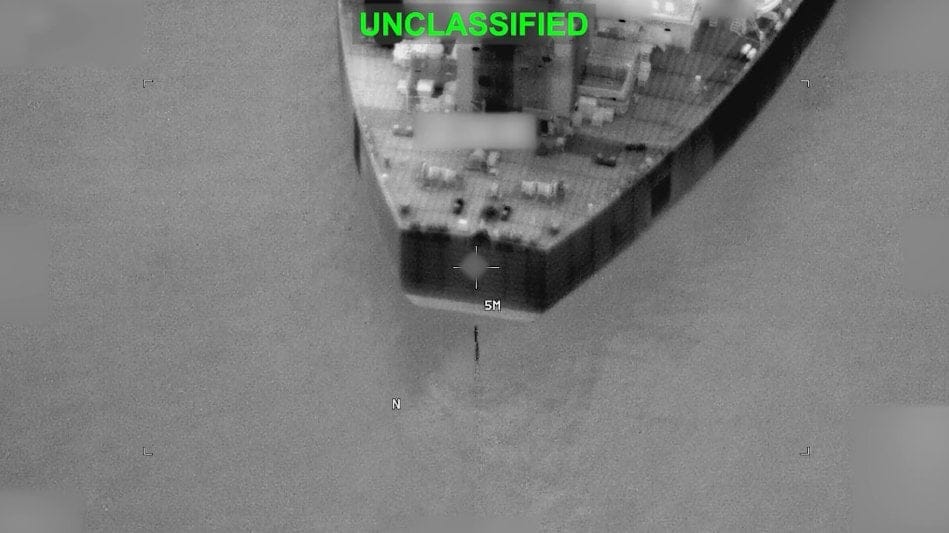
Iran and the United States are further escalating the contest for the Strait of Hormuz and the attacks on tankers. U.S. Central Command included images of two tankers being struck as part of its "highlights" reel from the September 1 retaliation for Iran’s "attempted attacks" on commercial shipping, while the Islamic Revolutionary Guard Corps (IRGC) made further claims of tankers hitting mines in the Strait of Hormuz while threatening increased actions.
CENTCOM reported that it had struck IRGC targets, including air defense sites, radar systems, maritime assets and facilities, mine laying capabilities, and communications sites during strikes that began late on Tuesday, September 1. It came as Donald Trump wrote online, “I’m not trying to force Iran to the bargaining table... I couldn’t care less if they sign a worthless, to them, agreement. I like our position now much better, with almost total control of the Hormuz Strait, and their economy totally collapsing.”
Axios is quoting unnamed U.S. military sources that said the two tankers shown in the video were “anchored off Iran’s north coast of the U.S. naval blockade.” It says U.S. drones launched missiles into the tankers’ engine rooms. No details were supplied on which vessels were struck.
It is reported to be part of a larger “tanker-for-tanker” policy approved by Donald Trump. The sources said it is designed to “further deter Iranian attacks on tankers that move through the Strait.” The sources said the U.S. is trying to reduce the risk for tankers by a strategy to “mow the lawn.”
Officials in the Gulf states and CENTCOM confirmed that Iran had launched retaliatory attacks on U.S. positions in Bahrain, Kuwait, and Jordan. The U.S. asserts that less than half the 25 ballistic missiles fired toward Jordan reached the country’s airspace, with 10 intercepted and three landing without casualties. Iran is claiming mass casualties. Most of the two dozen drones aimed at Bahrain, the U.S. says, were intercepted. Drones and missiles were fired at Kuwait, and drones at the U.S. position in Erbil in the Kurdistan region of Iraq.
Trump posted online Wednesday morning saying, “Now that we have it (Strait of Hormuz) under U.S.A. control, should we change the name Hormuz Strait to TRUMP STRAIT?”
The IRGC, however, issued a new statement today claiming that two “non-compliant oil tankers” had caught fire and were “rendered immobile” after striking naval mines in the Strait of Hormuz. It made a similar claim on Monday, which CENTCOM denied.
There, however, were reports on Monday that Iran struck the South Korean-owned tanker Senegal Prosperity, which the Joint Maritime Information Center said was listing and dead in the water. It said the crew had been evacuated. In addition, Saudi Arabia’s Bahri issued a statement today confirming that its tanker, Sidr, was also struck on August 31, resulting in the death of two Filipino crewmembers. The tanker is reported to be anchored in the Strait, with Bahri saying it remains in continuous contact with the vessel.
The IRGC asserted that the U.S. actions would “not weaken its control over the Strait of Hormuz.” Further, the so-called Persian Gulf Strait Authority increased its list of “non-compliant vessels” to 57 total, up from 46 last week. It continues to say vessels violating Iranian protocols for the Strait of Hormuz shall face restrictions on future passages, including fines, detention, or confiscation. It also continued the warning to charterers to review the list and not become involved with these vessels to “avoid potential issues.”
The IRGC asserted that “additional punitive measures would soon be enforced against maritime companies that violate established legal routes and place their vessels at the disposal of foreign powers.”
The Secretary General of the Gulf Cooperation Council, Jasem Mohamed Albudaiwi, issued statements saying they “condemned in the strongest terms” Iran's attack on the positions in Bahrain, Kuwait, and Jordan and the tanker Sidr. He called the attack on the tanker a “dangerous escalation.” He said it was a grave violation of the principles of international law and a direct threat to the security and safety of international navigation.
Iranian Tankers Wait at Sea Off Sri Lanka and Malaysia Due to U.S. Blockade

It is a challenging time for the crews of Iranian-owned tankers. They are mostly stuck at sea, unable to return to ports in Iran because of the US naval blockade. On Tuesday, the U.S. also reported attacks on two Iranian tankers believed to have been anchored near the port of Bandar Abbas.
There is now a large fleet of empty tankers, which, having discharged their cargos – mostly in China – are now stranded at sea with nowhere to go.
So far the US naval blockade has been operated as a bar on ships of any flag seeking to load or discharge at Iranian ports, enforced from the Gulf of Oman on the approaches to the Strait of Hormuz. As of September 1, CENTCOM reports its forces have redirected 84 commercial vessels, disabled three, and boarded two to ensure compliance. However, there must be some nervousness within the Iranian tanker fleet that US naval action could expand to include the seizure of Iranian vessels elsewhere, as the blockade notification already covers. There previously were long-range actions on ships that have escaped the blockade.
The fraught situation is evident in a cluster of Iranian tankers which has gathered in the Galle Anchorage off the south-west corner of Sri Lanka. The Financial Times estimated that “more than a dozen” of these ships are at anchor just meters outside Sri Lankan territorial waters, within which the seizure of a ship would be a breach of UNCLOS. Sri Lankan port authorities say that the ships are outside their territorial waters, and not therefore under their jurisdiction. But if the masters of the Iranian vessels thought they were under threat, they could quickly move into Sri Lankan territorial waters, not necessarily with any permission, and seek protection by default. These distinctions matter, because the Iranian frigate IRINS Dena (F75) was sunk on March 4 in international waters 40nm south of Galle with the loss of 87 lives, after Sri Lankan President Anura Dissanayake refused the ship refuge in Sri Lankan waters.

Periscope view as the stern of IRINS Dena fractures and lifts out of the water when hit by a Mk 48 torpedo fired by USS Charlotte (SSN-766) off Sri Lanka on March 4 (CENTCOM video)
Satellite imagery shows a large number of tankers at anchor on the territorial waters boundary, and interrogation of the VesselFinder database shows that many of these tankers (indicated by an orange dot) are vessels which are sanctioned by the United States, Canada, and the United Kingdom
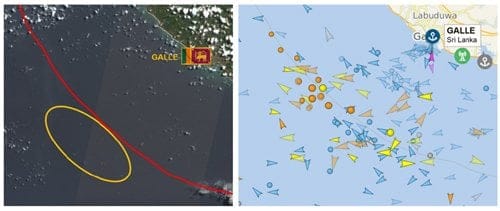
Sentinel-2 imagery and VesselFinder map showing a cluster of sanctioned tankers just outside Sri Lankan territorial waters off Galle, August 29 (Sentinel-2/VesselFinder/©CJRC)
The Financial Times, quoting the NGO UANI (United Against Nuclear Iran), has also identified a further 48 tankers linked to trading in Iranian crude, which are anchored in the long-established ship-to-ship transfer box east of Johore and just outside the Malaysian Exclusive Economic Zone. There appear to be significantly more tankers at anchor in this area currently, and in a bigger box than when The Maritime Executive last looked in June last year.
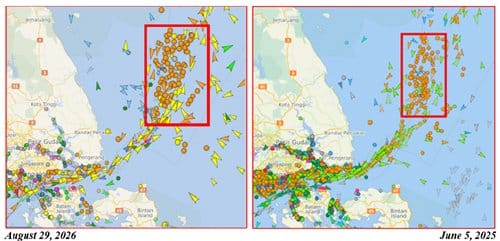
Tankers at anchor off Malaysia but outside its Exclusive Economic Zone (Vesselfinder.com/CJRC)
Kpler currently estimates that Iranian oil stocks held afloat appear to have declined from 192 million barrels in mid-April to about 80 million barrels at the end of August. Most of this stock, however, is already pre-sold and is waiting off Chinese ports for unloading. Where data from Iranian-associated tankers is available on VesselFinder, draught in the water readings suggest that almost all of those off Sri Lanka and most off Malaysia are unladen.

No comments:
Post a Comment