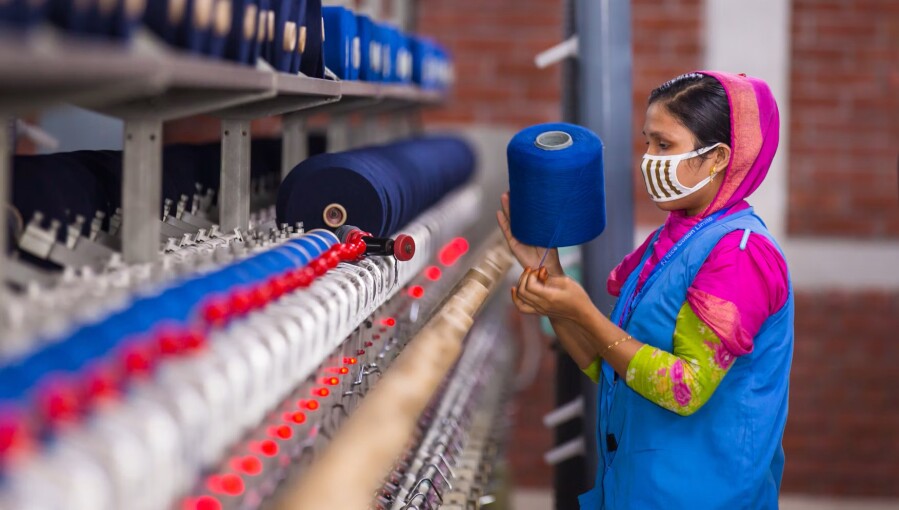
Police have fired tear gas and sound grenades at garment workers around Dhaka, just hours after Bangladesh's government set up a wage board it hoped would end the protests.
Thousands of workers stayed on the streets after Labour and Employment Minister Ariful Haque Chowdhury announced the six-member board, Al Jazeera reported following the protests. They want the industry's monthly minimum lifted to BDT30,000 ($241) from BDT12,500. The walkouts began on October 31, and workers say the cost of food, rent, transport and healthcare has left the current wage far short of what a family needs.
Clashes in Ashulia, the factory belt north-west of the capital, left several people hurt, police officers among them. About 30 factories on Dhaka's outskirts declared holidays, said Mohammad Mominul Islam Bhuiyan, superintendent of the Ashulia Industrial Police.
"The issue of forming the wage board has been resolved. There will be no more problems now," said M Sakhawat Hossain Chowdhury, an adviser at the labour ministry. "The workers should return to work and work smoothly."
Few in the industry's workforce of about 4mn appear to share his confidence, and the arithmetic behind their anger is hard to dispute. Garments earn about four of every five export dollars Bangladesh brings in, so a wage fight on the factory floor quickly becomes a question for the central bank, the budget and the new government of Prime Minister Tarique Rahman, which took office in February promising price stability and a revival of the sector. Owners, battered by an energy crisis and soft orders, say they cannot pay much more.
The board brings together a judge as chair, an independent academic and two representatives each for owners and workers, among them ABM Shamsuddin, a director of the Bangladesh Garment Manufacturers and Exporters Association (BGMEA), and union leader Babul Akhtar, bdnews24.com reported. The government had been preparing a review since early October. An amendment to the Labour Act in late 2025 cut the maximum gap between wage reviews to three years from five, and unions read that as requiring a new rate by December. Setting one usually takes about six months.
Labour groups want the figure fixed in time for January pay packets. Kalpona Akter, executive director of the Bangladesh Centre for Workers Solidarity, said in October that the review should have begun sooner under the three-year rule, and that a higher minimum alone would not ease the squeeze unless the government held down the price of food and housing and exporters won better prices from foreign buyers.
The current floor was itself won in the streets. A government panel announced a 56% rise to BDT12,500 in November 2023, payable from December, after weeks of strikes in which at least three workers died, Al Jazeera reported at the time. Unions had sought BDT23,000, and the then prime minister, Sheikh Hasina, refused to go further.
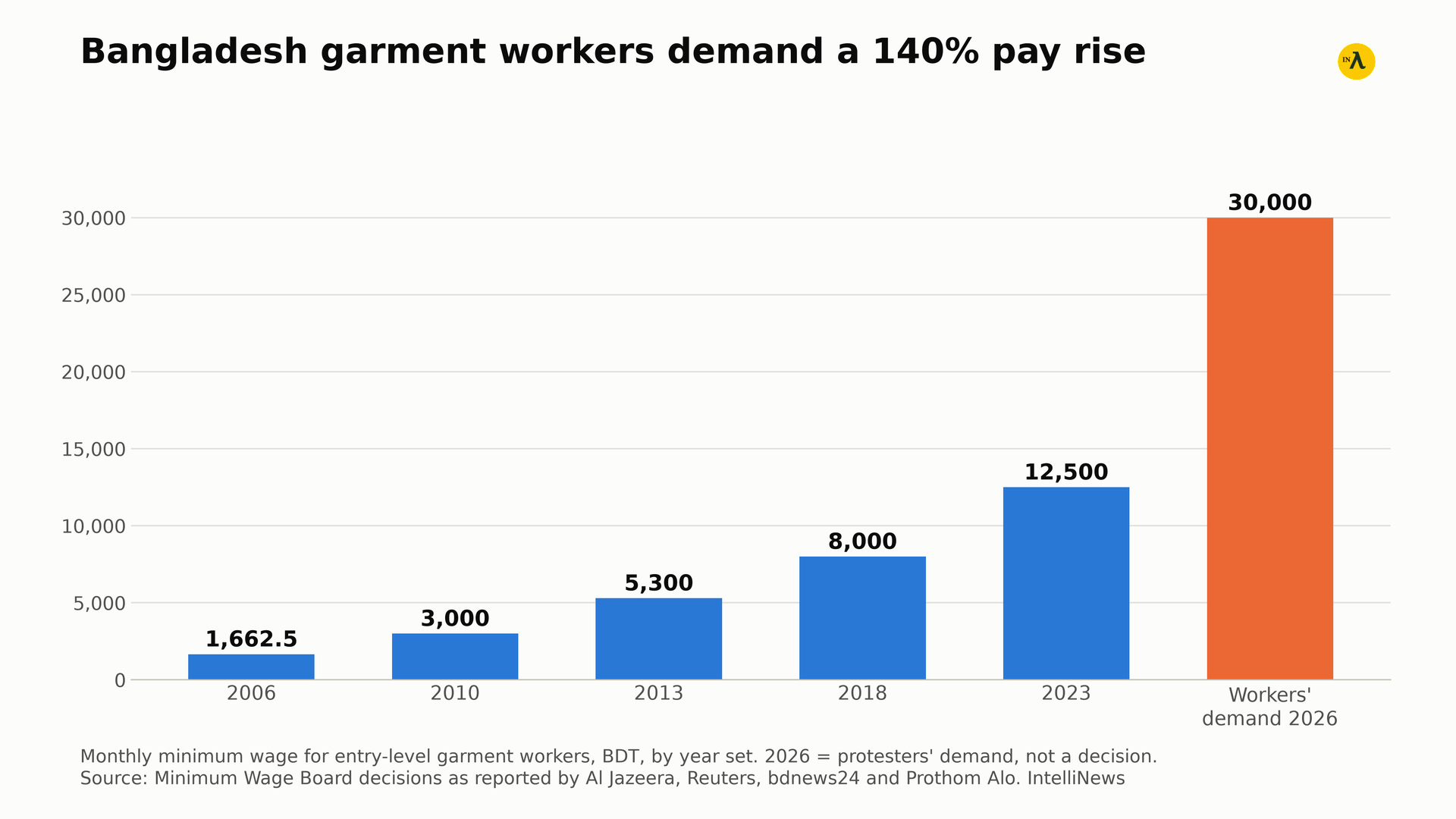
Monthly minimum wage for entry-level garment workers, BDT, by year set; 2026 is the protesters' demand. Source: Minimum Wage Board decisions as reported by Al Jazeera, Reuters, bdnews24 and Prothom Alo. IntelliNews.
Consumer prices have outrun that award, rising 28.7% between November 2023 and September 2026 [2] on a calculation from official monthly data, so BDT12,500 now buys roughly what BDT9,700 bought when the rate was set. Annual inflation has not fallen below 8% in that time and stood at 8.34% in September [2]. The 9% annual increment ordered from December 2024 softened the blow for longer-serving staff without closing the gap.
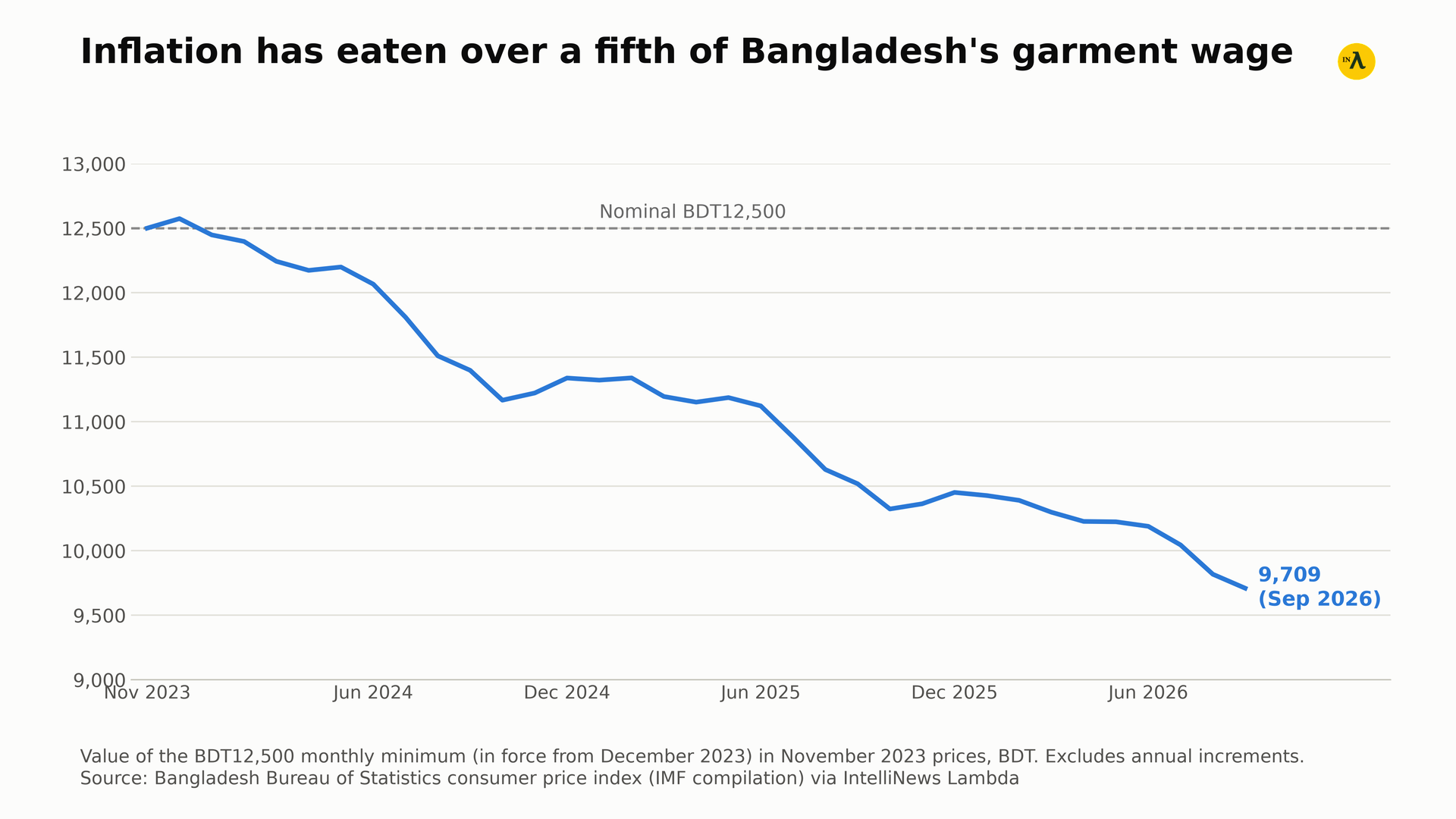
Value of the BDT12,500 monthly minimum in November 2023 prices, BDT, excluding annual increments. Source: Bangladesh Bureau of Statistics consumer price index (IMF compilation) via IntelliNews Lambda.
Factory owners argue that the sums no longer add up on their side either. Mohammad Hatem, president of the Bangladesh Knitwear Manufacturers and Exporters Association, warned in October that orders were shrinking while buyers refused to pay more, and that a bigger wage bill could close more plants. Over the summer a gas shortage cut output in the main industrial districts by 30-40%. QatarEnergy, which supplied close to 60% of Bangladesh's liquefied natural gas before the Gulf war, has pushed back cargoes month after month since declaring force majeure in March.
The export numbers show an industry treading water. Garment shipments slipped 1.64% to $38.7bn in the year to June [1], about 80.6% of total merchandise exports of $48.0bn [1], as demand from the EU weakened. The EU still buys about half of those garments. Shipments recovered by 6.1% to $10.58bn in July-September [1], but in the US market China moved back ahead of Bangladesh in January-August, $5.63bn to $5.39bn [3], even after Washington cut its tariff on Bangladeshi goods to 19% in February.
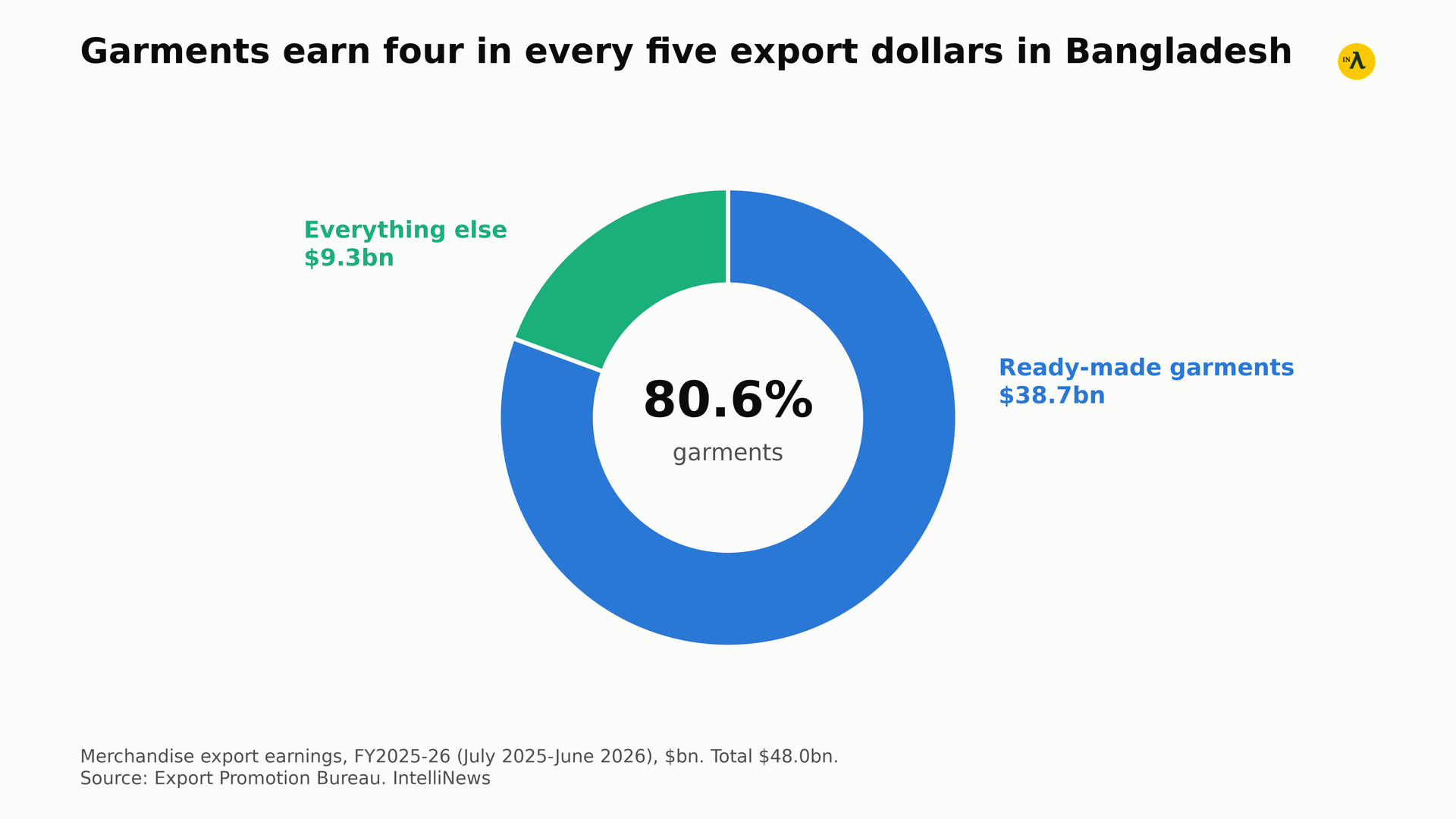
Merchandise export earnings, FY2025-26, $bn. Source: Export Promotion Bureau. IntelliNews.
Chowdhury cautioned that if factories stayed shut for long, export consignments and the money owed by foreign buyers could both be held up, just as Dhaka is trying to win those buyers back. Rahman was in Tokyo on October 28 pressing Uniqlo owner Fast Retailing to invest more in Bangladeshi clothing. The government also secured a reprieve at the UN in late October, when the General Assembly agreed to push the country's graduation from least developed country status back three years to November 24, 2029, bdnews24.com reported. That keeps the trade preferences that come with LDC status in place for longer.
Delay has a price of its own though. Unrest in September and October 2024, after the uprising that toppled Hasina, closed about 100 factories and cost the sector almost $400mn in lost production, by the BGMEA's estimate. A board that may not report until the spring is offering workers a timetable; what they are asking for is a pay packet worth what it was three years ago.
Sources
[1] Export Promotion Bureau, merchandise export data, FY2025-26 (published July 2026) and July-September 2026, published October 1, 2026
[2] Bangladesh Bureau of Statistics, consumer price index, November 2023-September 2026, latest published October 2026
[3] US Department of Commerce, Office of Textiles and Apparel, US apparel imports by country, January-August 2026, published October 2026
This article was produced with the help of IntelliNews Lambda analytical tool

No comments:
Post a Comment