Crew Rescued From Sinking LPG Tanker Off Bulgaria as Pace of Attacks Grows
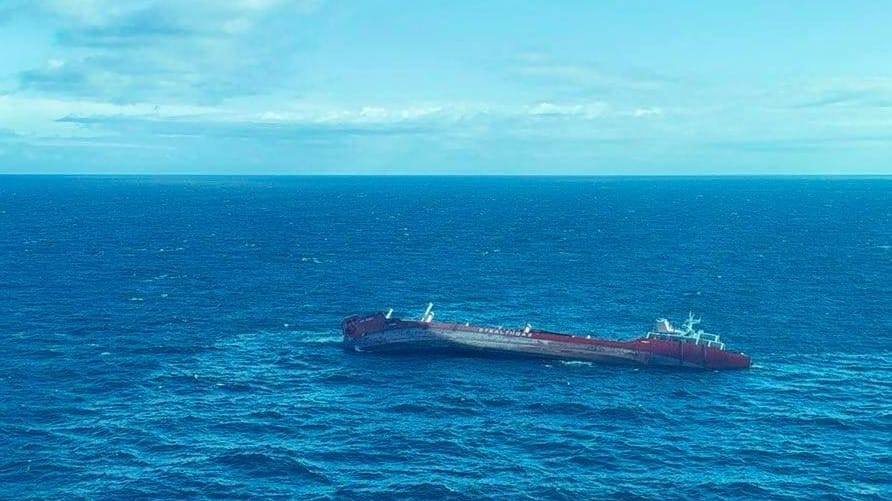
Bulgaria’s Air Force and Maritime Administration coordinated the rescue of the crew from a Greek-owned LPG carrier that went down off the coast on Tuesday, November 17. Bulgarian officials did not comment on the circumstances of the loss, but Romania’s maritime authority quickly reported that it was another suspected drone strike after it had warned ships about the dangers over the weekend.
The Liberian-flagged LPG carrier Gas Husky (7,218 dwt) was inbound for Romania when Bulgaria’s Maritime Administration Agency reports the vessel “disappeared from radar” shortly after midnight local time. It was approximately 50 nautical miles east of Byala on the central Bulgarian coast.
The rescue agency reported it detected an emergency position independent radio beacon (EPIRB) signal around 0800 this morning and requested that the Air Force conduct an aerial survey. The aircraft team detected an overturned vessel, which was believed to be the Gas Husky. About 300 meters from the capsized vessel, a life raft was spotted. The raft fired a flare as the plane approached, signaling there were people aboard.
A rescue helicopter reached the raft at mid-morning and hoisted 19 Filipino crewmembers from the LPG carrier aboard. They were taken to a local hospital and reported to be in good condition. A cutter from the Border Police was also dispatched to survey the area.
Built in 2012, the LPG tanker was operated by Stealth Gas of Greece. Pictures released by the Bulgarian Air Force showed the vessel lying on its side. It was reported to be sinking.
The Gas Husky was in close proximity to where a small cargo ship was sunk yesterday in another suspected drone strike. Bulgaria also successfully rescued the crew from the cargo ship Betul 8. It followed three ships struck to the north in the Romanian zone on Saturday night and one more struck on Friday.
Bulgarian authorities are reporting this was the seventh commercial vessel struck in its EEZ since the beginning of October. The security firm Diaplous reported that at least 17 vessels have been attacked in the western area of the Black Sea since mid-July.
Russian officials have not acknowledged the attacks on vessels off Bulgaria and Romania, while the local authorities have only said they were investigating the attacks and analyzing drone fragments found on the ships. Romania, however, cautioned vessels to avoid the anchorage off the Danube Delta, reporting that the risk remains high in the region.
Bulgaria Rescues 12 Crew as Attacked Cargo Ship Capsizes

Strikes on commercial shipping in the Black Sea east of Bulgaria and Romania have resumed, with the latest incident coming Monday morning, November 16, in the Bulgarian EEZ. The Ministry of Transport reports the Air Force and Navy coordinated to rescue the crew from a small cargo ship without serious injury before it sank.
The 12-member crew of the general cargo ship Betul 8 (3,223 dwt) issued a Mayday call at around 9:15 a.m. local time on Monday, November 16, reporting that their vessel had been struck. They were reported to be abandoning ship approximately 40 nautical miles east of Cape Kaliakra, in the northern portion of Bulgaria.
The Air Force dispatched a plane and two helicopters, which were the first to reach the scene. In addition, four ships from the Black Sea Mine Countermeasures Naval Group, two from Bulgaria, one each from Romania and Turkey, also responded.
When the helicopters reached the scene, they located two liferafts in the water, and one had emitted smoke to signal there were people aboard. The helicopter hoisted eight crewmembers from Turkey and four from Azerbaijan and reported they were in good overall condition with no major injuries. They, however, had been exposed to freezing temperatures and were reported to be suffering from exposure to the cold. They were transported to a hospital in Bulgaria.
The cargo ship Beutal 8 rolled to its side after reports of one or two sea drone strikes. The ship, which was registered in Somalia, had loaded 3,000 tons of wheat in Tulcea, Romania, and was traveling to Egypt. The vessel later capsized and sank in the Black Sea. Details on the ship’s ownership are unclear, as it is registered to a corporation in the Marshall Islands but is possibly linked to Turkish interests.
Today’s attack followed three reported on Saturday night off Romania and another on Friday. There had been a lull in the attacks as NATO increased its presence in the region and France contributed a patrol aircraft. In addition to the five vessel attacks, Romania’s Defense Ministry reported that the French plane spotted two drifting drones on November 15. Today, the Romanian Navy reported it was examining drone debris discovered approximately 45 nautical miles offshore.
Since the start of the war in Ukraine, the Turkish Chamber of Shipping calculates that more than 200 commercial vessels have come under attack. Russia has acknowledged a new campaign targeting shipping that it asserts is transporting military equipment and daily reports attacks in and near Ukraine’s ports while not acknowledging the strikes to the west near Romania and Bulgaria.
The security firm Diaplous is calculating that 17 ships have been attacked in the western Black Sea since mid-July. At least 35 seafarers are reported as either missing or killed in the attacks. A total of approximately 122 seafarers have been rescued, while seven ships have sunk.
Romania’s Prime Minister Luca Niculescu reiterated that the attacks were “unacceptable and constitute a violation of international law.” He confirmed that the Romanian Air Force scrambled fighter jets twice on Saturday in response to the Romanian Ministry of Defense detecting aerial targets in the area. Earlier, it was reported that the French patrol plane had warned of drones, but the forces in the Black Sea had been unable to prevent an attack on another cargo ship. France has already extended the deployment of the plane to aid in increasing Black Sea security.
Romania issued an advisory to shipping recommending that they take alternate routes to avoid the Danube Delta after the four strikes over the weekend. It recommended planning routes avoiding the area where the attacks occurred, warning that additional attacks could come from the north.
Bulgarian media questioned why the Betul 8 was in the region after the warnings. They noted that the ship was navigating in Bulgaria’s EEZ but had not entered the country’s territorial waters.

No comments:
Post a Comment