“Affordability was top of mind for voters last night, and within that, healthcare is an enormous driver.”
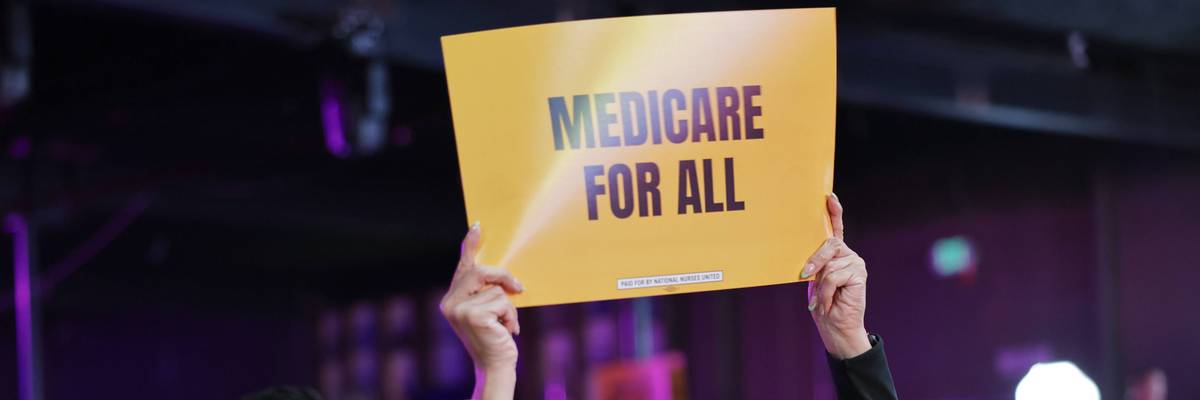
A supporter of Randy Villegas, a Democratic congressional candidate in California, holds a “Medicare for All” sign at his election night party on November 3, 2026 in Bakersfield.
(Photo by Mario Tama/Getty Images)
Jessica Corbett
Nov 04, 2026
COMMON DREAMS
“WHO WANTS MEDICARE FOR ALL?”
US Sen. Ed Markey (D-Mass.) asked that question, in all caps, on social media late Tuesday as he won reelection and joined others from his party in trouncing President Donald Trump’s Republicans across the country, securing majorities in both chambers of Congress thanks to voters frustrated by an affordability crisis under a GOP trifecta.
Although some races haven’t yet been called, and key Democrats such as House Minority Leader Hakeem Jeffries, a New Yorker likely to become the next speaker, don’t support shifting the United States to a universal public healthcare system, the Democratic “tsunami” on Tuesday still revived hope that the results could help the fight for Medicare for All.
Democrats reclaimed both the US Senate and House of Representatives after Trump and congressional Republicans last year used their budget package, the so-called One Big Beautiful Bill Act, to slash Medicaid spending and allow Affordable Care Act subsidies to expire—which has already led to millions of Americans losing health insurance coverage.
The wave of Democratic wins also came nearly five months after a coalition of over 325 organizations argued that “now is the time to organize” for Medicare for All, given that “we may face a once-in-a-generation opportunity to legislate on healthcare in 2029.”
While—as the coalition suggested—passing federal Medicare for All legislation would likely require not only a Democrat-controlled Congress but also replacing Trump with a progressive president in 2028, the midterm results are still being seen by voters and elected officials alike as “a mandate to deliver big change” over the next two years.
“Wins by progressive candidates will jumpstart a national discussion of Medicare for All,” said Larry Levitt, executive vice president for health policy at KFF. “Medicare for All isn’t going to pass in the next two years. But, newly prominent advocates will have a platform to make sure it’s part [of] the discussion, carrying through to the 2028 primaries.”
Even without support from party leaders and the White House, Democrats may still push for congressional hearings or even votes on single-payer policies before the 2028 elections.
Rep. Pramila Jayapal (D-Wash.), lead sponsor of the Medicare for All Act in the House, told Punchbowl News this week that she wants to mark up the bill next year and fight for a vote on the floor: “I want to make sure we have the requisite number of co-sponsors, and I’m hoping that our leadership is part of helping to make that happen.”
As Forbes reported:
Several Democrats who won seats in the US Senate and the US House of Representatives made Medicare for All or a public option key parts of their winning campaigns. Such ideas will likely get more airtime now that Democrats control both houses of Congress in a rebuke of Trump administration policies that have slashed healthcare spending.
Exactly what form a “public option” would take [is] unclear, but such a choice being offered to Americans alongside private and existing health insurance coverage would seem more achievable than replacing the existing health insurance system with Medicare for All.
The American Prospect pointed out that Medicare for All supporters who emerged victorious on Tuesday include Rep.-elects Claire Valdez, Brad Lander, and Darializa Avila Chevalier in New York’s 7th, 10th, and 13th districts, along with “Democratic Georgia state Rep. Dr. Jasmine Clark, who won more than 81% of the vote to represent Georgia’s 13th District; Democrat Melat Kiros, who beat nearly 30-year incumbent Republican US Rep. Diana DeGette to represent Colorado’s 1st District; and Democratic socialist Janeese Lewis George, who will be Washington, DC’s first new mayor in more than a decade.”
Among the victors in the US Senate were Democrats Abdul El-Sayed of Michigan and Troy Jackson of Maine, also both vocal backers of Medicare for All. Jayapal highlighted that “Abdul was up against millions of dollars in dark money from Republican donors—and today Michigan voters sent a clear message that their state and their votes are not for sale.”
“Abdul ran a strong campaign on Medicare for All, refused corporate [political action committee] money, and stayed focused on working families from day one to Election Day,” she added. “I am so proud to have stood with him throughout his campaign and I cannot wait to work with him in Washington to deliver for you.”
The leading voice for Medicare for All in the upper chamber, Sen. Bernie Sanders (I-Vt.), worked to elect both El-Sayed and Jackson, as well as several leftist House candidates who won. He wrote on social media Wednesday that “last night saw some of the greatest progressive victories in modern American history. All across the country, in rural and urban areas, Americans said NO to oligarchy, and YES to an agenda that fights for the working class.”
Sanders, who caucuses with Democrats, is expected to chair the Senate Committee on Health, Education, Labor, and Pensions when the party takes over in January, and Sen. Ron Wyden (D-Ore.), another Medicare for All backer, will likely lead the Finance Committee, as STAT Washington correspondent John Wilkerson noted Wednesday—predicting that “the wins that Democrats amassed on Tuesday night could breathe life into efforts to create some type of a single-payer system.”
Yale University researchers estimated in August that Sanders’ related legislative proposal could save over 114,000 lives and $1 trillion annually. In response to those findings, the senator said that “at a time when 15 million Americans are being thrown off the healthcare they have and 20 million Americans have already seen their premiums double, on average, as a result of Trump’s so-called ‘Big Beautiful Bill,’ we need Medicare for All now more than ever.”
A KFF survey released last month found that 66% of Americans—including 84% of Democrats, 72% of independents, and 34% of Republicans—support Medicare for All, the highest level of support since the organization began tracking the proposal.
Sharing KFF data on how the average US family’s health insurance premium has soared over the past quarter-century, The Tennessee Holler declared on social media Wednesday: “Medicare for All. Now. We can’t afford not to do it. It isn’t radical to support it. It’s radical to oppose it.”

No comments:
Post a Comment