Lawmakers in both parties have a historic opportunity to free millions of workers. Together, they can seize it.
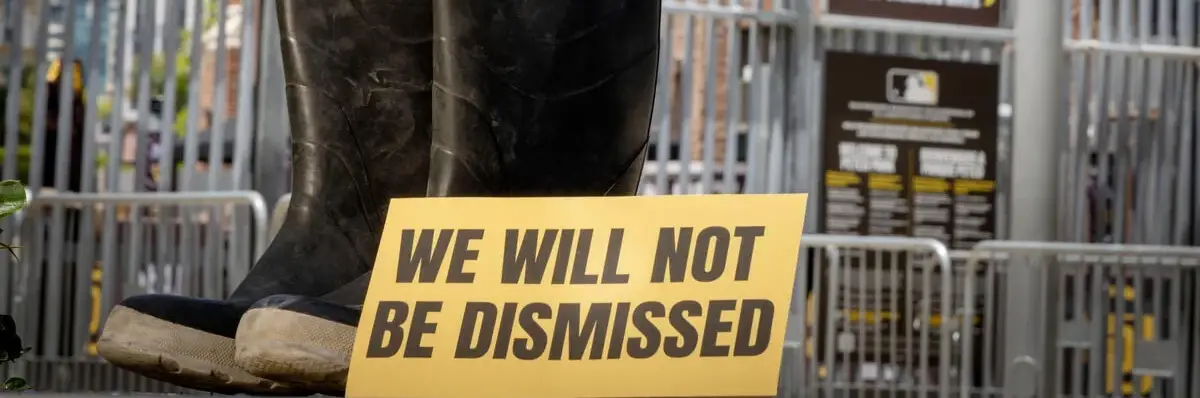
Indonesian fishers who sued Bumble Bee, alleging years of forced labor while catching fish sold by the US tuna brand, responded to the company’s motion to dismiss their suit, arguing in the US legal filing on July 31 that they have a right to have their allegations heard in court.
(Photo by Sandy Huffaker/Greenpeace)
Tara Winter
Nov 17, 2026
Common Dreams
Right now, more than 28 million people are trapped in forced labor, many of them making the clothes we wear, the food we eat, and the products we use every day. For decades, the issue struggled for attention. Today, for the first time in modern history, it sits near the top of the global agenda. That is a rare opportunity, and it will not last forever.
The shift has come fast. In July, after investigating 60 of America’s largest trading partners, the Trump administration imposed tariffs of 10-12.5% on most of their imports for failing to keep goods made with forced labor out of their markets. More than a quarter of the world’s countries now ban forced labor imports, many more are considering it, and US trade agreements increasingly prohibit it.
Those tariffs are being challenged in court, and with a new Democratic majority taking office in Congress in January, they will face fresh scrutiny on Capitol Hill. Critics accuse the Trump administration of using forced labor as a pretext to replace the tariffs the Supreme Court struck down earlier this year.
The fight to end that suffering must not rise or fall with shifts in trade policy.
That debate is legitimate. But it must not become a reason to look away from one of the most horrific human rights abuses of our time. Forced labor is work that people cannot refuse and cannot escape, enforced through debt, deception, threats, and violence. It is a migrant worker who paid a recruiter for a job abroad and now owes more than she can earn in years. It is a fisherman whose passport was taken, trapped at sea for months, beaten if he complains. It is a child in a cotton field instead of a classroom. Nearly 40% of people in forced labor are women and girls, and 12% are children. The products of their labor end up in our closets, our kitchens, and our pockets.
The fight to end that suffering must not rise or fall with shifts in trade policy. The danger is that we squander this moment, and that those of us working on the issue pull in different directions just when it matters most to move together.
I’ve spent 30 years in the leadership of human rights organizations, and I have rarely seen economic, national security, and moral interests line up the way they do on forced labor today. Republicans and Democrats agree that forced labor is morally reprehensible, and that no company should profit from, or be undercut by, a business model built on exploiting trapped workers. Ending it is also a matter of upholding the rule of law, which underpins the democratic principles both parties share. The Uyghur Forced Labor Prevention Act, which bans goods made with state-sanctioned forced labor in China’s Xinjiang region from entering the US, passed Congress with near-unanimous support from both parties.
In our investigations, we find forced labor in almost every country, often deep in supply chains, in cotton fields, mines, and fishing vessels, where visibility is weakest and workers are most vulnerable. Voluntary corporate commitments have not driven nearly enough change.
At Transparentem, we’ve seen import bans work when they’re paired with policies that ensure forced labor is remedied rather than simply shifted. In Mauritius, we found Bangladeshi migrant workers making clothing for the US market who were trapped by huge fees they had paid to get their jobs. Most of the factories we exposed repaid the workers. The one that refused was hit with a US import ban. In Taiwan, following several Transparentem investigations in the manufacturing industry and a parallel investigation by an independent researcher of the bicycle industry, US Customs blocked Giant Bicycles imports. That single action has had tremendous ripple effects in Taiwan and across other countries and industries.
We must continue to build on those successes. The United States has banned imports made with forced labor since 1930, and Congress must give Customs the resources to enforce that ban fully. Trade agreements should keep strong forced labor provisions, and the US should do more to help trading partners adopt and enforce bans of their own. We must also strengthen protections for workers here in the United States who face forced labor.
Crucially, regulation must be developed together with workers and their representatives to ensure that it represents workers’ interests and that it clearly incorporates viable pathways to remedy. We also know that regulation is not sufficient on its own to change workers’ lives. To effectively end forced labor, rather than just shift it or push it deeper into hiding, we must ensure workers can speak up, organize, and bargain collectively without fear. The progress of the next few years will depend on strong worker organizations that represent both domestic and migrant workers, local groups equipped to investigate abuses and press governments to act, governments with the capacity to enforce, and a field coordinated enough to speak with one voice.
Companies and their investors must also keep their commitments to prevent forced labor in their supply chains. Two-thirds of forced labor occurs in private supply chains. Companies can be the driving force behind ending it, and letting it persist carries too great a risk of disruption to ignore.
Moments like this rarely come, and they do not wait. If we act together, we can turn this attention into ending forced labor in our lifetimes. We must not let it slip away.
Update: This piece has been revised by the author.
Our work is licensed under Creative Commons (CC BY-NC-ND 3.0). Feel free to republish and share widely.
Tara Winter
Tara Winter is the executive director of Transparentem and an expert in international human rights and environmental justice. For more than three decades, she has worked to confront labor and environmental abuses by uniting business, governments, civil society, and humanitarian organizations to achieve lasting change.
Full Bio >

No comments:
Post a Comment