“The more states that follow this innovative approach, the more we can make Citizens United irrelevant.”

A sign urging Montana voters to support Constitutional Initiative 194 was pictured on October 26, 2026.
(Photo: The Montana Plan: I-194/Facebook)
Brad Reed
Nov 04, 2026
COMMON DREAMS
Voters in Montana on Tuesday delivered a major blow to big moneyed interests by overwhelmingly passing a ballot initiative barring corporate cash from political campaigns in the state.
With 87% of votes counted as of Wednesday morning, Montana Constitutional Initiative 194 has received support from more than 65% of voters, with just 35% registering opposition.
The initiative prohibits what it describes as “artificial persons”—which includes corporations, nonprofits, trusts, partnerships, and trade associations—from giving money to political campaigns.
Supporters of the initiative have billed it as a way to strike a blow against the Supreme Court’s 2010 ruling in Citizens United v. Federal Election Commission, which opened the door to unlimited campaign spending in US politics.
“A yes vote on I-194 means that only real people—not corporations, unions, trade associations, nonprofits, or groups with anonymous donors—are allowed to spend money in Montana elections,” the Yes on Initiative 194 campaign explained on its website. “It’s time to kick the oligarchs out of Big Sky country.”
The initiative’s overwhelming victory drew praise from Tom Moore, senior fellow at the Center for American Progress, who congratulated the people of Montana for taking “a historic step toward ending the scourge of corporate and dark money in politics.”
Moore noted that the initiative passed by Montana is similar to a law passed in Hawaii earlier this year that classified corporations as “artificial persons” who do not have a constitutional right to make political donations.
Both states, Moore said, are “setting a bold example for other states to follow suit, sending a powerful message that we don’t have to give corporations unlimited power.”
“The more states that follow this innovative approach,” he added, “the more we can make Citizens United irrelevant.”
Stacy Mitchell, co-executive director at the Institute for Local Self-Reliance, hailed the initiative’s passage as a win for democratic governance.
“We’ve largely forgotten that states define what corporations can do,” Mitchell wrote in a social media post. “Yesterday, Montana voters overwhelmingly stripped corporations of the power to spend money influencing elections. Hawaii did the same in May. Both face court fights. Our nascent citizen muscle is coming to life.”
Adam Bojak, a Democrat who on Tuesday won an election in New York State Assembly District 149, said he’d like to see the Empire State follow the trail blazed by Montana and Hawaii.
“Congratulations to the people of Montana!” Bojak wrote. “I can’t wait to bring this legislation to New York in next year’s session.”
‘How Do You Get Money Out of Politics Without Overturning Citizens United?’ Montana Could Have the Answer
Initiative 194 “is not going to stop Elon Musk from writing a big fat check,” explained one backer, but it would prevent “laundering the money through a dark money group.”
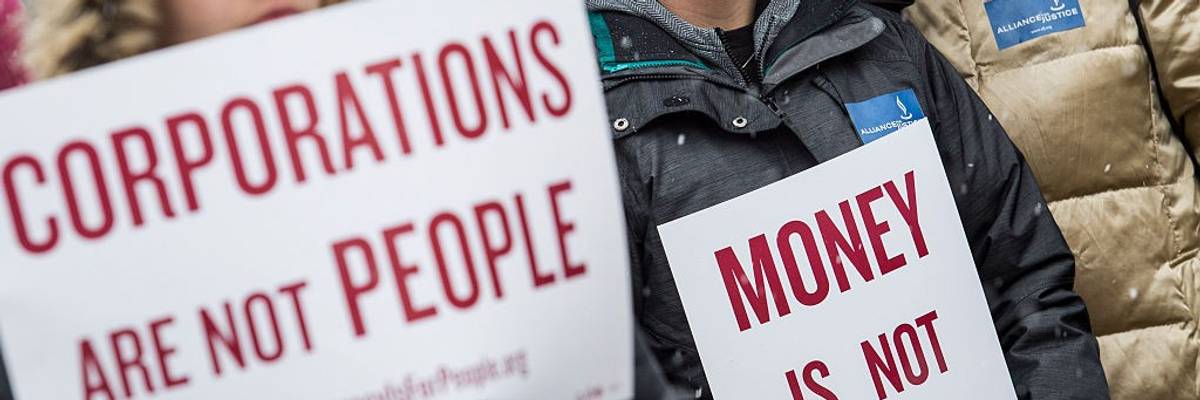
Protesters demand an end to corporate money in politics at a demonstration calling for an end to the US Supreme Court’s Citizens United v. Federal Election Commision ruling on January 21, 2015—its fifth anniversary—in Washington, DC.
(Photo by Drew Angerer/Getty Images)
Brett Wilkins
Nov 03, 2026
COMMON DREAMS
Montanans are voting Tuesday on a potentially groundbreaking ballot initiative that could become a model for how to overturn Citizens United v. Federal Election Commission—the 2010 US Supreme Court decision that ushered in the era of unlimited money in politics—without the near-impossible necessity of a constitutional amendment.
Citizens United established that the government cannot restrict independent political expenditures by corporations, labor unions, and other outside groups on the basis of their corporate or union identity. Simply put, the decision affirmed corporate personhood and, essentially, that money is speech that cannot be restricted.
Since then, super political action committees have proliferated, and corporate spending has exploded from just $12.8 million during the 2010 election cycle to $737 million during the current one.
Initiative 194, also known as the Montana Plan, would prohibit corporations, nonprofits, trade associations, and other artificial entities from spending money to influence elections and ballot measures in the state. Rather than attempting to restrict corporations’ constitutional rights as affirmed by Citizens United, states could simply not give corporations the legal power to spend on politics.
“A yes vote on I-194 means that only real people—not corporations, unions, trade associations, nonprofits, or groups with anonymous donors—are allowed to spend money in Montana elections,” the Yes on Initiative 194 campaign said on its website.
“It’s time to kick the oligarchs out of Big Sky country,” the campaign added.
The proposal’s backers argue that legal entities should not have the same rights as natural persons.
“Each state creates and defines its corporations. It need not permit its creations to consume it,” Tom Moore, a senior fellow at the Center for American Progress (CAP), explained in September, arguing that corporations are legal creations, not natural persons, and that states retain broad authority to determine what powers they exercise.
“When the state creates a corporation, it is starting from nothing and deciding what to give the corporation, and no case has ever held that they have to give local spending power to a corporation,” Moore told Fortune on Tuesday. “It’s not regulation; it’s redefinition.”
Moore stressed that Initiative 194 “is not going to stop Elon Musk from writing a big fat check to some election in Montana.”
“What it will stop them from doing is laundering the money through a dark money group,” he added.
Montana’s former commissioner of Political Practices, Jeff Mangan—who spearheaded Initiative 194—was equally blunt.
“The Montana Plan simply removes the ability for corporations to spend in our politics,” he told Montana PBS. “By removing the corporation’s ability to spend in our politics, we end dark money. Simple as that.”
Initiative 194 has attracted support from Montanans concerned about the growing influence of wealthy donors and anonymous political spending.
“Most people I talk to when they hear about the prospect of getting dark money out of elections are in favor of it,” state resident Nathan Kommers told Montana PBS. “I think that it makes sense to almost everybody.”
Shannon Stober, who lives in the Bozeman area, said: “I think what I’ve observed over the past 15 years is the ways in which money and politics has completely created a decline in civic engagement and participation. A lot of people have just decided that their participation doesn’t matter and they don’t feel like there’s a way out.”
Opponents, including the Montana Chamber of Commerce, argue that Initiative 194 violates the First Amendment by restricting organizations’ political speech. If passed, the measure will surely face legal challenges.
However, former Republican Montana Gov. Marc Racicot, who supports Initiative 194, said the effort is worthwhile regardless of the ultimate outcome.
“You can’t just sit back and curse the darkness,” he told Montana PBS. “You have to try and do something about it.”
Initiative 194 “is not going to stop Elon Musk from writing a big fat check,” explained one backer, but it would prevent “laundering the money through a dark money group.”
Protesters demand an end to corporate money in politics at a demonstration calling for an end to the US Supreme Court’s Citizens United v. Federal Election Commision ruling on January 21, 2015—its fifth anniversary—in Washington, DC.
(Photo by Drew Angerer/Getty Images)
Brett Wilkins
Nov 03, 2026
COMMON DREAMS
Montanans are voting Tuesday on a potentially groundbreaking ballot initiative that could become a model for how to overturn Citizens United v. Federal Election Commission—the 2010 US Supreme Court decision that ushered in the era of unlimited money in politics—without the near-impossible necessity of a constitutional amendment.
Citizens United established that the government cannot restrict independent political expenditures by corporations, labor unions, and other outside groups on the basis of their corporate or union identity. Simply put, the decision affirmed corporate personhood and, essentially, that money is speech that cannot be restricted.
Before Citizens United, Corporations Spent $12.8 Million on 2010 Elections. In 2026? $737 Million
Since then, super political action committees have proliferated, and corporate spending has exploded from just $12.8 million during the 2010 election cycle to $737 million during the current one.
Initiative 194, also known as the Montana Plan, would prohibit corporations, nonprofits, trade associations, and other artificial entities from spending money to influence elections and ballot measures in the state. Rather than attempting to restrict corporations’ constitutional rights as affirmed by Citizens United, states could simply not give corporations the legal power to spend on politics.
“A yes vote on I-194 means that only real people—not corporations, unions, trade associations, nonprofits, or groups with anonymous donors—are allowed to spend money in Montana elections,” the Yes on Initiative 194 campaign said on its website.
“It’s time to kick the oligarchs out of Big Sky country,” the campaign added.
The proposal’s backers argue that legal entities should not have the same rights as natural persons.
“Each state creates and defines its corporations. It need not permit its creations to consume it,” Tom Moore, a senior fellow at the Center for American Progress (CAP), explained in September, arguing that corporations are legal creations, not natural persons, and that states retain broad authority to determine what powers they exercise.
“When the state creates a corporation, it is starting from nothing and deciding what to give the corporation, and no case has ever held that they have to give local spending power to a corporation,” Moore told Fortune on Tuesday. “It’s not regulation; it’s redefinition.”
Moore stressed that Initiative 194 “is not going to stop Elon Musk from writing a big fat check to some election in Montana.”
“What it will stop them from doing is laundering the money through a dark money group,” he added.
Montana’s former commissioner of Political Practices, Jeff Mangan—who spearheaded Initiative 194—was equally blunt.
“The Montana Plan simply removes the ability for corporations to spend in our politics,” he told Montana PBS. “By removing the corporation’s ability to spend in our politics, we end dark money. Simple as that.”
Initiative 194 has attracted support from Montanans concerned about the growing influence of wealthy donors and anonymous political spending.
“Most people I talk to when they hear about the prospect of getting dark money out of elections are in favor of it,” state resident Nathan Kommers told Montana PBS. “I think that it makes sense to almost everybody.”
Shannon Stober, who lives in the Bozeman area, said: “I think what I’ve observed over the past 15 years is the ways in which money and politics has completely created a decline in civic engagement and participation. A lot of people have just decided that their participation doesn’t matter and they don’t feel like there’s a way out.”
Opponents, including the Montana Chamber of Commerce, argue that Initiative 194 violates the First Amendment by restricting organizations’ political speech. If passed, the measure will surely face legal challenges.
However, former Republican Montana Gov. Marc Racicot, who supports Initiative 194, said the effort is worthwhile regardless of the ultimate outcome.
“You can’t just sit back and curse the darkness,” he told Montana PBS. “You have to try and do something about it.”

No comments:
Post a Comment