Russia's Arctic sea route tops 40mn tonnes for first time as energy exports turn east
Cargo on Russia's Northern Sea Route passed 40mn tonnes for the first time on November 17, Rosatom chief Alexei Likhachev said, as Moscow steers Arctic energy exports to Asia.
"Literally yesterday, for the first time in the history of our country, in the history of the Northern Sea Route, we crossed the 40mn tonne mark," Likhachev said, as quoted by TASS and Vedomosti. "For us this is an important event, a serious psychological threshold - our previous record was 37mn tonnes." He expects the full-year total to be noticeably higher. Rosatom is the route's infrastructure operator.
The record ends two years of stagnation. Traffic reached 37.9mn tonnes in 2024 and then slipped 2.3% to 37.02mn tonnes in 2025, according to the Gekon consultancy, cited by Kommersant, as delays to Rosneft's Vostok Oil and Novatek's Arctic LNG 2 held volumes back. Even at 40mn tonnes the route carries half of the 80mn tonnes that Vladimir Putin's May 2018 decree set as the target for 2024.
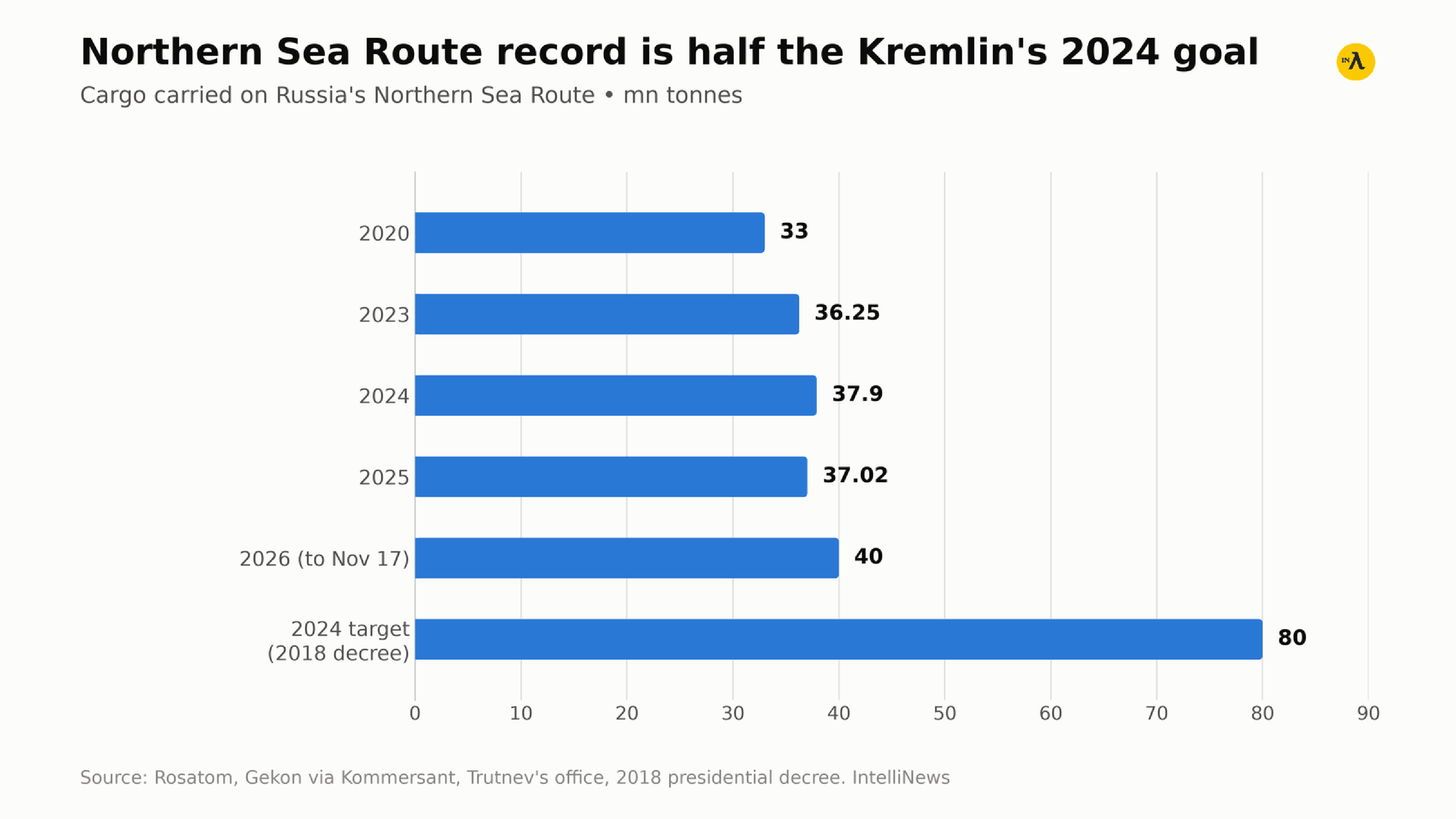
Source: Rosatom, Gekon via Kommersant, Trutnev's office, 2018 presidential decree. IntelliNews
Most of the cargo is Russian energy heading out, and a large part of it comes from sanctioned projects. Russian exports made up 60% of the route's traffic in 2025, or 22.2mn tonnes, and 83% of that was LNG, crude oil and gas condensate from Novatek's Yamal LNG and Arctic LNG 2 and Gazprom Neft's Novy Port field, Gekon calculated. The port of Sabetta, Yamal LNG's terminal, handled 29.1mn tonnes of the 32.5mn tonnes passing through the route's ports. Arctic LNG 2 is under US, EU and UK sanctions and relies on a sanctioned fleet for equipment deliveries; Rosneft, under US sanctions since October 2025, loaded the first Vostok Oil crude at Sever Bay on September 5. Oil sent east along the route is increasingly moved between tankers at sea by ships with their transponders switched off. Rosatom has given no breakdown of this year's 40mn tonnes by cargo or sanctions status.
China is the main foreign customer. Cargo moving between Russian and Chinese ports came to 5.4mn tonnes in 2025, about 15% of the total, Azamat Khochuev, head of Rosatom's Northern Sea Route department, said in August. That is a little over a quarter of the 20mn tonnes a year by 2030 set in the roadmap Rosatom agreed with Chinese partners in 2025. Container volumes have risen 2.6-fold since 2023, but only to 400,000 tonnes, and transit cargo between foreign ports set a record of 3.2mn tonnes last year. Chinese carriers have launched a scheduled container service to Europe that takes 24 days from Qingdao to Felixstowe.
More LNG is about to head the same way. Novatek will send a large share of the Yamal LNG cargoes it now sells in Europe to China once the EU ban takes effect, chief executive Leonid Mikhelson said in Shenzhen on November 18.
That is the cargo year-round navigation would need. Vladimir Panov, Rosatom's director for the route's development, said on October 27 that the route would operate all year from early 2027, when "one of our largest shippers" begins regular deliveries to Asia, FedPress reported. He did not name the shipper. He also expects transit cargo to pass 7mn tonnes this year, more than double the 2025 level.
Ice is the obstacle. The eastern sector of the route is passable only in summer and early autumn, and Russia has no reserve icebreaker fleet, Kommersant has reported. Novatek halted eastbound LNG shipments in November last year as the season closed, and Yamal LNG's deliveries through the eastern sector fell 18% to 1.96mn tonnes in 2025. The nuclear icebreaker Chukotka, due in service in early 2027, will take Rosatom's nuclear fleet to nine vessels, gCaptain reported, which is one more ship for a 5,600 km route that would have to stay open through the Arctic winter.
Other Asian countries are testing the route. India plans its first pilot voyage in 2027 and Indonesia is discussing a trial shipment the same year, but these are single sailings next to the tens of millions of tonnes of Russian oil and gas that make up the record.
This article was produced with the help of the IntelliNews Lambda analytical tool

No comments:
Post a Comment