Wednesday, November 25, 2026


Russian Navy Shut Out of Sea of Azov by Wreckage of the Kerch Bridge

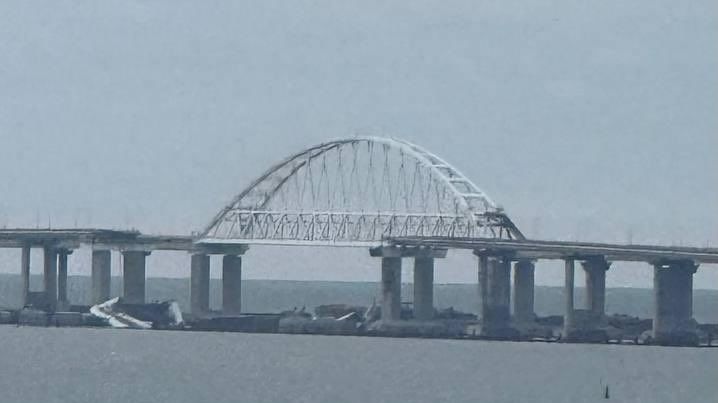
Wreckage of the Kerch Strait Bridge's road span, foreground. The other spans are fenced off with protective structures and are unusually narrow (via Russian social media)

The full strategic implications of the loss of the Kerch Strait road bridge will take time to shake out, but it is already clear that the destruction of the center span will have serious effects for the Russian Navy and Russian shipping. The 6,000-tonne span fell into the only shipping channel in and out of the Sea of Azov, imposing restrictions on navigation until the debris field can be cleared - a task which will have to await the arrival of calmer weather. 

In a recent interview on Ukrainian national television, Ukrainian Navy Spokesperson Dmytro Pletenchuk said that Russian shipping cannot currently pass through the strait because of the underwater wreckage. The control depth of the fairway was only 6.7 meters before the attack, and wreckage now occupies much of the water column. 

While the waters immediately on either side of the navigation span are of equivalent depth or slightly deeper, the tight pier spacing of the rest of the bridge would create allision risks and impose restrictions on vessel size. Russian forces would also have to remove or modify the defensive structures that have been installed along the entire length of the bridge to prevent drone-boat attacks. 

The same physical restrictions also prevent the Russian Navy from moving warships to and from the Sea of Azov. 

"The number of possible options for how things could develop [for the Black Sea Fleet] has decreased, precisely because of the closure of the Kerch Strait. Previously, there was at least some alternative for safely withdrawing the fleet from the Black Sea, but now even that option is no longer available," Pletenchuk said. 

He said that the fleet must now attempt to ensure its own survival with the resources it has at its disposal, like shuffling vessels between piers at Novorossiysk, the Black Sea Fleet's new - and vulnerable - home base.

According to the spokesperson, the activities of the Russian Black Sea Fleet are now effectively limited to measures aimed at ensuring its survival and security under the current circumstances. These include regularly changing the Fleet's berthing locations within the harbor, as well as implementing a range of security and defensive measures. "That is currently all they can afford to do," Pletenchuk said, as transcribed by Ukrinform.

He noted that bad weather will delay the wreck clearance operation, and when it does get under way, the work will be exposed to the hazards of a combat zone. 

Cleanup contractors may have more than one span to address by the time that the weather clears and work gets under way. The road span is in the water, but the rail span stands. It suffered some amount of damage but took fewer hits in the strike; it is a much-discussed candidate for a follow-up attack.  

The loss of the entire bridge would have profound implications for the Russian position in Crimea and southeastern Ukraine, multiple analysts have noted. The adjacent ferry crossing is vulnerable to Ukrainian drone and missile strikes, and the road route overland through Mariupol is within range of "middle strike" attack drones - raising the possibility that Russian forces could get cut off from their supply chain throughout the region, and civilians too. 


Canada to Build New Multimodal Port in the Great Lakes

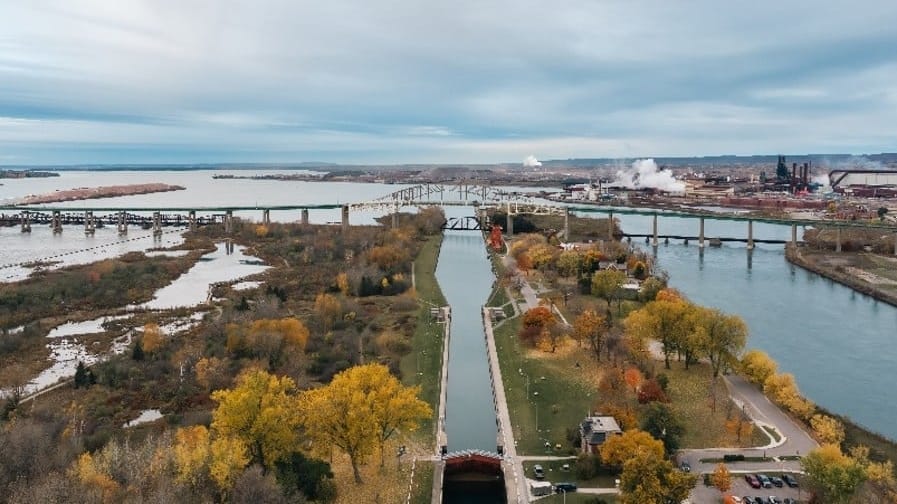
Sault Ste. Marie, Canada
Canada plans a large new port in the heart of the Great Lakes just miles from the US border (HOPA Ports)

Canada’s federal government, along with the provincial government of Ontario, has approved funding for the construction of a new port, which they said will be located in the heart of the Great Lakes. It will be on the Canadian side, at Sault Ste. Marie, which is located at the juncture of Lake Superior and Lake Huron and just miles from the U.S. border and the U.S. city of the same name.

As Canada works to strengthen domestic supply chains, build industrial capacity and diversify export markets, the Port of Sault Ste. Marie will provide critical trade-enabling infrastructure linking Northern Ontario’s resource economy with Southern Ontario’s manufacturing base and customers around the world.

The governments approved a total of C$250 million (US$174 million) to build the new port. The federal government will provide half the money through a trade program, while the Province of Ontario reported its intention to provide a loan for the other half. The project will repurpose 243 acres of unused industrial and brownfield land into the trade hub with marine, rail, and road access.

The officials said it would provide vital access for Northern Ontario industries, including mining and critical minerals, steel, forest products, advanced manufacturing, and construction materials. The new port will include marine berths, rail transload facilities, cargo-handling areas, utilities, and tenant-ready industrial lands designed to attract investment in these sectors.

Once operational, the port is expected to handle more than 2.4 million metric tonnes of cargo annually. Officials said it will give businesses more transportation options and stronger connections among suppliers, processors, manufacturers, and export markets.

“For decades, economic diversification has been the most pressing challenge facing Sault Ste. Marie, and building the Port of Sault Ste. Marie represents a breakthrough in our community’s efforts to create a stronger local economy and brighter future,” said Matthew Shoemaker, Mayor of Sault Ste. Marie. 

Work in 2027 will focus on land arrangements, Indigenous partnerships, environmental and technical investigations, regulatory review, and detailed design. Subject to approvals, site preparation could begin in 2028, followed by major marine, road, rail, and utility construction in 2029. Full buildout is targeted for 2031.

The project comes as Canada is working to reshape its trade and access to international markets. Large investments are also being made in the seaports at Montreal and Vancouver to expand their operations. Upgrades are also happening at Halifax in the east and Prince Rupert in the west, all designed to contribute to Canada’s international trade growth.


Vancouver’s Many Attributes Are Driving Strong Growth in Cruise Operations

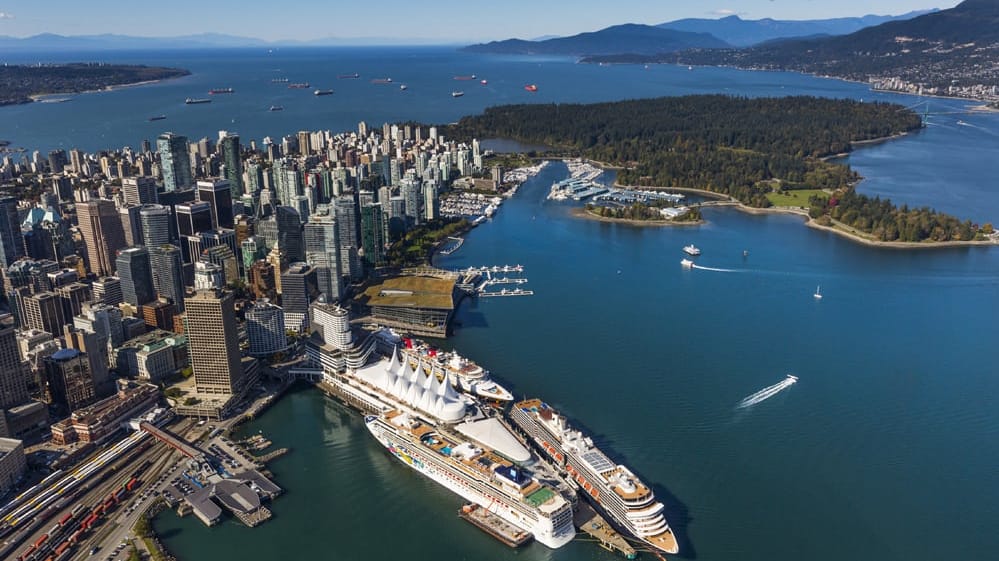
Cruise ships in the Port of Vancouver, Canada
In the hearth of the city and with the majesty of the Pacific Northwest, Vancouver, Canada, had a record cruise season in 2026 (Port of Vancouver)

Vancouver, Canada, continues to experience strong growth as a cruise homeport. The often snow-capped peaks of the Pacific Coast mountain range form a spectacular backdrop to the City of Vancouver, Canada’s gateway to the Pacific, and provide cruise passengers a first taste of the scenery and cultures of the Pacific Northwest.

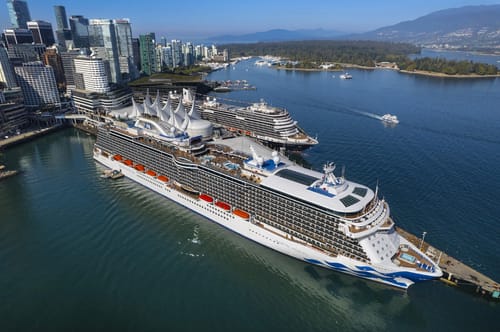
For first-time visitors arriving by cruise ship to the award-winning Canada Place cruise terminal or by airplane to embark on a cruise to Alaska or other destinations, it will likely be the first of many natural highlights on a journey to a region of West Coast North America. Vancouver provides the cruise lines with a strong homeport for an itinerary growing in popularity. In 2026, more ships took advantage of these unique benefits, including the arrival of Virgin Voyages’ Brilliant Lady, Ritz-Carlton Yacht Collection’s Luminara, and Disney Magic, which made her first call and homeported in Vancouver throughout the season. This year also saw Princess Cruises Star Princess (177,882 GT) become the largest cruise ship by tonnage to ever call the Canada Place cruise terminal. 

In its 2026 cruise season, the Port of Vancouver achieved a record year for both passenger numbers and cruise ship calls. Both surged almost 20 percent, driving the port to nearly 1.4 million passenger visits and 358 cruise ship calls. The season saw an early cruise ship visit in February as Disney Wonder repositioned and a steady flow of cruise ships between April and October.

“We are thrilled to celebrate another successful cruise season with more than C$1 billion injected into the local economy as cruise lines and passengers increasingly make Vancouver a core part of their Alaska adventure,” said Jeff Scott, Vice President of Operations and Supply Chain at the Vancouver Fraser Port Authority.

Much of the growth has been attributed to the focus cruise lines have placed on the increasing popularity of the northern state. According to an Alaska travel industry study, in the summer of 2025 and winter of 2026, approximately 57 percent of Alaska visitors arrived on cruise ships.

“For many, it’s a bucket list travel destination (Alaska) with its natural beauty,” says Chance McKee, Port of Vancouver’s Cruise Account Representative. “With what they are able to offer as a tourism destination as well, they are able to draw a lot of people, and when it comes to cruising and traveling to Alaska, I think a lot of folks find it’s an easier way to travel to the state and also easier for multi-generational travel parties, which we are seeing more of,” he said. 

For many of the cruisers seeking a West Coast adventure, their journey either begins or ends in Vancouver.

“Cruise lines and passengers look at where they want to start and end their Alaska cruise. They look at what Vancouver has to offer from a cruise and destination perspective, in and of itself, that is what draws a lot of folks to Vancouver,” McKee says.

Star Princess became the largest cruise ship (by tonnage) to dock at Canada Place in September (Port of Vancouver)

The port spokesman proudly states, “Vancouver is a world-class destination. It has a very diverse population that has lent to the popularity of the destination itself. From cultural and food perspectives, our culinary scene continues to grow and expand. We see more Michelin Star and Michelin recommended restaurants popping up,” he said, adding that there are historical attractions and, from a cultural perspective, three local Indigenous communities, the Musqueam Indian Band, the Squamish Nation and the Tsleil-Waututh First Nations which McKee feels are appealing to a lot of passengers.

Access to and from the port for cruisers arriving or ending their journeys in Vancouver has become paramount, and the Canada Place cruise terminal is easily accessed from Vancouver International Airport.

McKee points out an interesting statistic in that the Alaska destination tends to draw a different demographic than cruising to the Caribbean or Bahamas. “Our passengers tend to be a bit on the older side, typically 45 and older, so just the actual location of the Canada Place terminal, situated in the heart of downtown Vancouver, makes it very easy from a travel perspective. You can fly into Vancouver, get on the Vancouver SkyTrain to your stop, and walk about a block and a half in downtown Vancouver to the terminal. It is so easy to access from the air, and also when you think of actually checking in, and once people have disembarked from an arriving cruise, everything is right there in downtown,” he said.

But with an older cruising population come increasing challenges. Vancouver highlights its ease of travel and accessibility as aiding the cruise industry.

“In a cruise passenger survey we did, about 13 percent of passengers coming through the Port of Vancouver in 2023 had some sort of physical disability,” plus the survey indicated how they traveled from a disability perspective. “We conducted the same survey in 2025, and we found the number grew from 13 percent to 17 percent, so actually what the cruise industry is seeing is a lot more accessibility challenges, so when it comes to travel and from an accessibility perspective, Vancouver has a lot to offer,” McKee said.

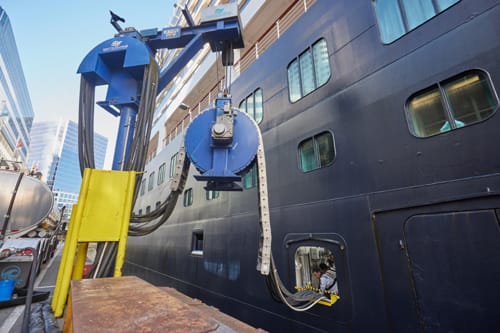
The Port of Vancouver and the federal government are working to expand shore power at Canada Place so that more cruise ships can plug in to B.C.’s low-emission, hydro-powered electrical grid while at berth (Port of Vancouver)

Going forward, McKee anticipates continued growth in cruise for Vancouver.

The port anticipates a seven percent increase in cruise calls, climbing to approximately 383 next year, up from 358 in 2026. It is also forecasting about a six percent increase in total passengers to approximately 1.47 million compared to just over 1.4 million in 2026.

In 2027, the port will welcome additional lines, one being the Japanese luxury line, Asuka. Some of the present lines will also add additional calls in 2027.

McKee says the increased calls add up to thousands of additional passengers visiting Vancouver, many for the first time. According to an industry survey, thousands will return for another visit.

On the infrastructure side, Vancouver has an eye on the environment and sustainability. It is working to create additional shore power capabilities for the cruise ships. Already, about 80 percent of cruise ship calls to Vancouver each year are shore power enabled.

“At Port of Vancouver and Canada Place, we were really a leader when it comes to implementing shore power,” says McKee. “We implemented shore power in 2009. We were the first in Canada and third in the world to offer this technology. But what is really interesting is that only about three percent of world cruise ports have the ability to offer shore power, and what makes Vancouver unique is that it offers electricity that is hydropower. It is low-emission and clean energy that cruise ships are able to access. It adds uniqueness to what Vancouver has to offer, and I think that makes it appealing to cruise lines,” he said.

McKee noted that cruise lines have a mandate from the International Maritime Organization (IMO) to reduce gas emissions to net zero by 2050. “So when they are looking at how they can do this and design itineraries, it helps them meet that goal. By being able to offer shore power, you increase your competitiveness when it comes to cruise line itinerary planning,” he stated.

In summary, McKee says Vancouver has a lot to offer the cruise industry. The natural beauty of Vancouver and onward to Alaska, a terminal in the heart of the city, that is bordered by the sparkling blue waters of the Pacific Northwest and snow-capped m

“I think a lot of cruise passengers maybe don’t know a lot about Vancouver. It is such a spectacular city,” says McKee, supported by cruise lines’ initiatives, port programs, and many other available services.

“Vancouver is attractive to cruise lines, and it is something we are proud of,” he said.


Op-Ed: Ports May Only Have Seconds to React to a Cyber Attack

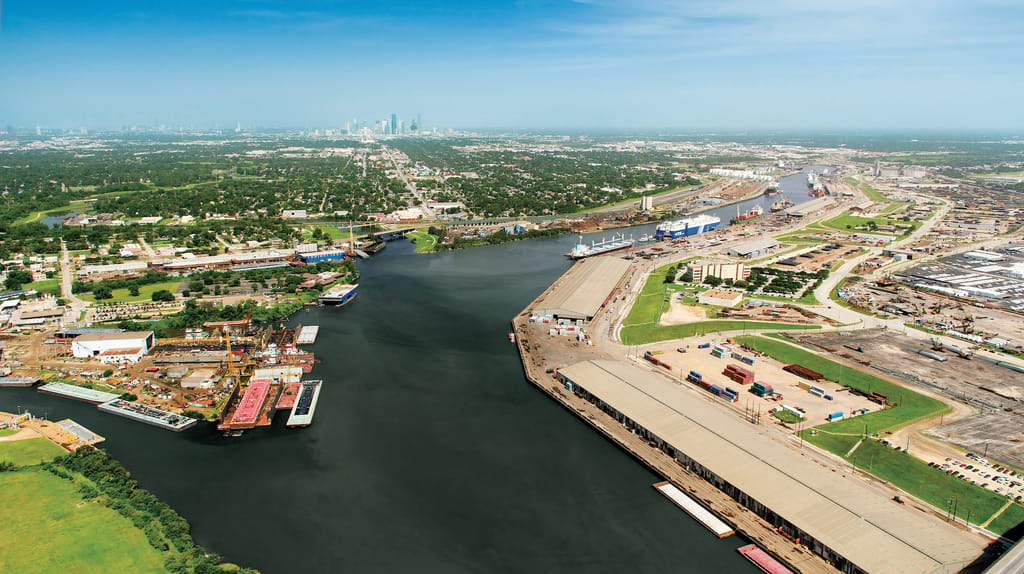
Aerial view of the Houston Ship Channel and port terminals with downtown Houston in the background
Port Houston file image

On August 19, 2021, attackers used a zero-day in a widely used password reset tool to reach a server at Port Houston. I was the Information Security Officer. We detected the intrusion, contained it, and reported it before it touched operations.

At the time, almost nobody knew who was behind it. Nearly two years later, Microsoft and allied agencies identified a PRC state-sponsored group, Volt Typhoon. Microsoft and federal officials have since described the Port Houston intrusion as the initial discovery that started that investigation. CISA has warned that the same group is pre-positioning inside U.S. critical infrastructure.

Five years later, two things have changed for every U.S. port, terminal, and vessel operator regulated under the Maritime Transportation Security Act. Attackers move much faster, and what was guidance in 2021 is now regulation.

CrowdStrike’s 2026 Global Threat Report recorded an attacker moving from a first foothold to other systems in 27 seconds. Two years earlier, the fastest it had seen was just over two minutes. Mandiant’s M-Trends 2026 puts the average time to exploit a vulnerability at negative seven days—meaning the most serious flaws are being used before a patch exists.

Verizon’s 2026 Data Breach Investigations Report found that exploiting vulnerabilities is now the most common way into an organization, ahead of stolen passwords, for the first time in the report’s 19 years. AI is a large part of the reason. It helps attackers find flaws, write exploits, and move through networks faster than a human operator could.

The attack on Port Houston came through a zero-day. For 18 days there was no patch to apply. What carried the day was detection and people who already knew what to do when the alert fired. That is still the only defense on day zero, and the window has shrunk from hours to minutes.

Decide in advance who is authorized to isolate a system, and make sure they know it. If an alert fires at 10:15 on a Thursday morning, the person who sees it should not have to find someone to ask.

In 2021, reporting a contained cyber incident was voluntary for U.S. MTSA-regulated facilities. We reported anyway. Our first call was to the U.S. Coast Guard’s National Response Center, and the report went from there to the FBI and CISA. Within four weeks, it fed a joint federal advisory that warned every organization running the same software.

That report helped far more than one port. It became part of the work that later exposed Volt Typhoon. You rarely know whether your “minor” incident is the missing piece in someone else’s picture.

After the NRC report, call your local Captain of the Port. The NRC puts the report into the system. A direct call makes sure the Coast Guard leader responsible for your port hears it from you, with context.

Write down who makes the NRC call, who approves it, and who calls the COTP right after. Keep those numbers on paper, not only on a network you may have to shut down. In Europe, NIS2 sets the clock outright: an early warning within 24 hours.

For five weeks, the Port Houston incident was not public. Then, on September 23, 2021, it was named in Senate testimony and reported in the press on the same day. There were hours, not days, to respond.

The port’s statement was two sentences: it had defended itself, it had followed its Facility Security Plan, and no operational data or systems were affected. It was short and accurate, and there was nothing to walk back. Your disclosure timeline may not be yours to control. Have a holding statement drafted and approved, and know who signs off on it.

In 2021, U.S. maritime cybersecurity ran on Coast Guard guidance, NVIC 01-20, and MTSA-regulated facilities didn’t have to submit cyber updates to their security plans until that October. The attack arrived first. That has changed.

The U.S. Coast Guard’s rule on cybersecurity in the Marine Transportation System took effect July 16, 2025, for U.S.-flagged vessels, Outer Continental Shelf facilities, and MTSA-regulated facilities. Regulated entities must name a Cybersecurity Officer, report reportable cyber incidents to the National Response Center without delay, train their people, and run cyber drills twice a year and an exercise once a year. Cybersecurity Assessments and Cybersecurity Plans are due by July 16, 2027.

Much of what helped in 2021 is now written into the rule: a known reporting path, a plan people have practiced, and an incident response plan that has been exercised before it’s needed.

European ports face the same shift under the EU’s NIS2 Directive. It covers inland, sea, and coastal passenger and freight water transport companies (not individual vessels), port managing bodies and their port facilities, and vessel traffic service operators.

NIS2 puts the reporting clock in writing: an early warning to the national CSIRT or competent authority within 24 hours of becoming aware of a significant incident, a full notification within 72 hours, and a final report within one month. It also makes management bodies directly accountable for compliance.

The rollout has been uneven. Member states had until October 17, 2024, to write NIS2 into national law. In July 2026, the European Commission referred Ireland, Spain, France, and the Netherlands to the EU Court of Justice for failing to do so.

 U.S. MTSA-regulated entitiesEU ports and water transport (NIS2)
Who’s coveredU.S.-flagged vessels, OCS facilities, MTSA-regulated facilitiesWater transport companies, port managing bodies and port facilities, VTS operators
ReportingReportable cyber incidents to the National Response Center, without delayEarly warning in 24 hours, notification in 72 hours, final report in one month
PlanCybersecurity Plan approved by the Coast Guard, due July 16, 2027No single approved plan: minimum risk-management measures (Art. 21), approved by the entity’s own management, under each member state’s law
AccountabilityA designated Cybersecurity OfficerManagement bodies directly accountable

Volt Typhoon has targeted communications, energy, transportation, and water systems as well as ports. The lessons travel. Any operator of critical infrastructure faces the same shrinking window and the same choice: rehearse the response now, or improvise it later.

Requirements set the minimum, and attackers don’t wait for compliance dates. The most useful preparation costs little: a “what if” discussion with your team. What if the password reset server is compromised? Who pulls it offline? Who calls the Coast Guard? Who speaks to the press?

A cybersecurity plan on paper will satisfy an inspector. A plan your people have already talked through is what stops an attacker.

With July 2027 less than a year away, every U.S. MTSA-regulated facility should be having that conversation now. European operators under NIS2 face the same attackers on the same clock. Whatever the deadline or the regulator, the conversation is the same.

Chris Wolski is founder and CEO of Applied Security Convergence and the former Director of Information Security at the Port of Houston Authority, where he led the response to the 2021 intrusion later linked to Volt Typhoon. He volunteers as Chief of the Houston InfraGard Maritime Cross-Sector Council and co-leads the Security Subcommittee of the Coast Guard Sector Houston-Galveston Area Maritime Security Committee. A U.S. Navy veteran and recipient of a U.S. Coast Guard Meritorious Service Citation, he teaches maritime cybersecurity compliance at Texas A&M University School of Law. 

The opinions expressed herein are the author's and not necessarily those of The Maritime Executive.


Achieving Criticality

Nuclear power for ships reaches a tipping point.

Nuclear Power Center

(Article originally published in Sept/Oct 2026 edition.)

NS Savannah was the world’s first nuclear-powered merchant ship.

Launched in 1959 under President Eisenhower’s Atoms for Peace program, she demonstrated how nuclear energy could power peaceful trade across the world’s oceans. But her bulky reactor installation, extensive shielding, and high construction and operating costs made her commercially uncompetitive.

Seventy-seven years later, the business case for nuclear is changing rapidly.

SMRS

Portable nuclear power has the potential to transform commercial shipping by cutting emissions, increasing cargo capacity and changing the economics of vessel speed. The technology is closer than many assume, but insurance, liability, port access and public perception remain bigger obstacles than reactor design.

The truth is that the design of modern SMRs – or Small Modular Reactors – don’t carry the same level of risk as the large nuclear power plants of yesterday. The technology is right-sized, and the fuel used is far less hazardous.

Yet a small amount of this fuel can deliver tens of thousands of times more energy than traditional marine diesel, gram for gram.

The business case is compelling, and the sector is poised to make the biggest advance towards widespread adoption in a generation – thanks largely to a pro-energy administration in Washington and a group of forward-thinking technology companies aggressively advancing the agenda.

The maritime sector is about to achieve criticality.

NUCLEAR IN A NUTSHELL

In a traditional diesel engine, power is generated when fuel, air and heat are combined. The resulting explosion is harnessed and turned into motion by the pistons, which turn the crankshaft. That final rotation can then be used to turn propellors or spin a generator to produce electricity.

A nuclear reactor is also a power-generating device.

The fuel in this case is uranium, which is formed into pellets and sealed inside fuel rods that are immersed in a cooling fluid. The nuclear reaction starts when a neutron source is introduced to the uranium and strikes a fissile atom, causing the atom to split. This releases heat and more neutrons, which begin striking the available atoms and begin the cycle.

Criticality is achieved when each round of fission produces enough neutrons to drive the next round and the process becomes self-sustaining. It’s like a flywheel that starts slowly but eventually begins to spin smoothly.

This nuclear reaction generates an immense amount of heat using small amounts of fuel that can be used to drive a turbine and generate electricity or propel a ship.

REGULATORY SUPPORT

In May of 2025, President Trump issued an Executive Order titled, “Reforming Nuclear Reactor Testing at the Department of Energy.” In it, he laid out a challenge: Achieve criticality by July 4, 2026, in time for America’s 250th anniversary.

“The renewed momentum behind maritime nuclear comes from the convergence of technology, economics and political appetite,” says Virginia Crosby, CEO of the Nuclear Energy Maritime Organization (NEMO). “Advanced reactors are becoming smaller, safer and more suitable for maritime use. The cost and practical limitations of alternative fuels are becoming clearer, and governments increasingly recognize that maritime decarbonization must also deliver energy security and economic growth. For the first time, these three forces are moving in the same direction.”

Houston-based startup Deployable Energy (“Deployable”) answered the call, achieving criticality in just 155 days. It accomplished this by rethinking system constraints and using readily available supplies in a new and innovative fashion.

HACKING THE SUPPLY CHAIN

There are many ways to split an atom, but most aren’t accessible in the marine space due to fuel availability, size constraints and the economics of building large offshore reactors.

This is where Deployable CEO Bobby Gallagher focused his energy and developed an elegant solution.

A fourth-generation veteran, Gallagher began his adult life in the Australian military at the height of the War on Terror, employing IED countermeasures on the ground to keep the troops safe. Later, he transitioned to the oilfield, building drillships in major yards across Asia and developing a kinetic blowout stopper (K-BOS), which was adopted across five continents in as many years.

He then turned his attention to nuclear power generation, which he saw as the only solution to the increasing power demands offshore. He identified the nuclear supply chain as the existing constraint.

Enriched uranium is incredibly powerful but is intensely controlled and not readily available and requires large freshwater reactors to be forged to contain it. So he looked for inspiration at earlier designs that didn’t require enrichment.

The resulting 1MWe system is similar to a small CANDU (Canada Deuterium Uranium) reactor: a Canadian-designed, pressurized heavy-water reactor that generates electricity using natural, unenriched uranium fuel and heavy water as a coolant and moderator. It’s easily constructed by the existing American workforce using non-exotic materials and leverages the existing light water reactor supply chain to obtain readily available enriched uranium as fuel.

Known as the “Unity Nuclear Battery,” the 1MWe system and its auxiliary systems fit inside a 20-foot container that can be easily fitted to a variety of vessels, making installation, operation and maintenance a relatively simple task.

PARTNERING UP

With the technology firmly in place, the next step was to set sail under nuclear power. For this, Deployable needed a reliable partner.

In August 2026, Hornbeck Offshore Services, Inc. (“Hornbeck”), a leading offshore marine services company, partnered with Deployable to test and use nuclear microreactors for maritime and offshore power. The two companies signed a memorandum of understanding with the goal of lowering operating costs by using clean, reliable nuclear power options.

While on the surface Hornbeck is a vessel operating company, it considers itself a technology company and has a long history of innovation.

“We’ve always been a technology company,” says Jacob Hornbeck, Business Development Manager, “and have led the way in this space. Our engineering teams provide solutions to the most complex marine problems in the world.”

Hornbeck’s September 2026 all-stock merger with Helix Energy Solutions Group expands this technical expertise into the subsea well-intervention and robotics market, supported by Hornbeck’s fleet of high-specification specialty vessels.

Immediately following the merger, Hornbeck returned to the New York Stock Exchange under its former ticker, HOS, unlocking access to capital markets and enabling it to rapidly advance its push into this new, nuclear-powered frontier.

PREPARING FOR SEA TRIALS

The National Reactor Innovation Center (NRIC) is the oversight body that will bridge the gap between nuclear concepts and commercial deployment. It’s selected Deployable and Hornbeck to conduct a Nuclear Energy Launch Pad USA maritime demonstration.

For the first time in over 50 years, a nuclear reactor will set sail on a commercial vessel.

While the exact vessel is not yet identified, Hornbeck and Deployable have targeted five sectors in their MOU: inland waterways, offshore, power barges, floating datacenters and national security logistics/automation.

Watch this space for developments on this historic testing program!

INTO THE FUTURE

The nuclear technology underpinning this accelerated development cycle is well-proven – from the first commercial nuclear-powered ship in the 1960s to the present day. While questions remain around topics like licensing, jurisdiction, classification, crew training, security and safeguards, the time has never been better to bring the international community together and advance the nuclear option. The existing maritime framework, such as SOLAS and MARPOL, provides a firm foundation upon which to build, yet more specific guidance and agreement will be required.

Collaboration between organizations such as NEMO, vessel operators like Hornbeck and mold-breaking technology companies like Deployable will ensure that safe, reliable and efficient nuclear power becomes an integral part of the modern energy mix.

Sean Hogue is Executive Vice President at Baker Marine Solutions.
The opinions expressed herein are the author's and not necessarily those of The Maritime Executive.