Monday, March 09, 2026

Iran denies striking Turkey, Azerbaijan and Cyprus, says 'false flag'

Iran denies striking Turkey, Azerbaijan and Cyprus, says 'false flag'
Drone hit the Nakhchivan area of Azerbaijan. / bne IntelliNews
By bne IntelliNews March 9, 2026

Iran's Foreign Ministry spokesman Esmail Baghaei denied that Iranian forces carried out attacks against Turkey, Azerbaijan or Cyprus, saying no offensive actions were launched from Iranian territory against those countries, he said in his morning presser on March 9. 

Baghaei suggested some of the reported strikes "may have been staged," saying Iranian authorities had already warned about the possibility of such provocations.


"No offensive actions were carried out from Iranian territory against these countries," he said.

The denial covers incidents across all three nations reported in recent days. Azerbaijan said Iranian drones struck Nakhchivan International Airport and a village on March 5, injuring two civilians.

A ballistic missile heading toward Turkish airspace was intercepted on March 4, prompting a phone call between the Turkish and Iranian foreign ministers. Cyprus temporarily closed Larnaca International Airport after an unidentified object was detected in its airspace.

Iran's General Staff had previously blamed Israel for the Nakhchivan strikes, calling them a "false flag" operation designed to damage relations between Muslim nations. Azerbaijan attributed the attacks directly to Iran and said they "will not go unanswered."


Baghaei said Tehran wished to maintain friendly relations with its neighbours but reserved the right to take retaliatory measures if neighbouring states' territories were used for strikes against Iran.

The spokesman accused the United States of sabotaging peace negotiations and said Washington and Israel were violating international law. He claimed the true aim of the US military campaign was to seize Iranian oil resources.

"Their plans are clear, their intentions are completely obvious: they want to divide our country to illegally seize our oil wealth," Baghaei said.

VIDEO: Bahrain’s Bapco halts oil operations following Iranian attack

VIDEO: Bahrain’s Bapco halts oil operations following Iranian attack
The aftermath of a drone strike on Bapco's refinery complex in Sitra, Bahrain. / bne IntelliNews
By bnm Gulf bureau March 9, 2026

Bahrain's national energy company Bapco Energies declared a force majeure on operations following an Iranian drone attack on its refinery complex in Sitra during the early hours of March 9. 

Bahrain's government confirmed that at least 32 people were injured in the strikes, with four in critical condition.

Below is footage of the incident:


The Bapco attack shows the rapid spread of Persian Gulf energy shutdowns as the region remains under fire amid the Iran-Israel-US war.

QatarEnergy previously declared force majeure on LNG deliveries following production suspensions at its facilities, whilst the Kuwaiti National Guard reported intercepting a drone early on March 9.

Bahrain's Defence Force confirmed during the early hours of March 9 that it had so far intercepted 95 missiles and 164 drones from Iran since the outbreak of the current conflict.

The strike on Bapco's refinery poses substantial risks to Bahrain's energy sector, given the national oil company's central role in the country's petroleum industry.

While Bahrain's government maintains that food stocks remain secure despite the escalating regional conflict, the force majeure declaration signals significant operational damage to the energy sector and the economy at large by extension.

The broader impact on Gulf energy production capabilities remains a critical concern as Iranian attacks target key petroleum infrastructure across the region.

The accumulation of force majeure declarations from major Gulf producers threatens global energy supply chains, particularly as refining and LNG export operations face extended disruptions from the ongoing conflict.

Bapco declares force majeure as Iran sets Bahrain's only refinery ablaze
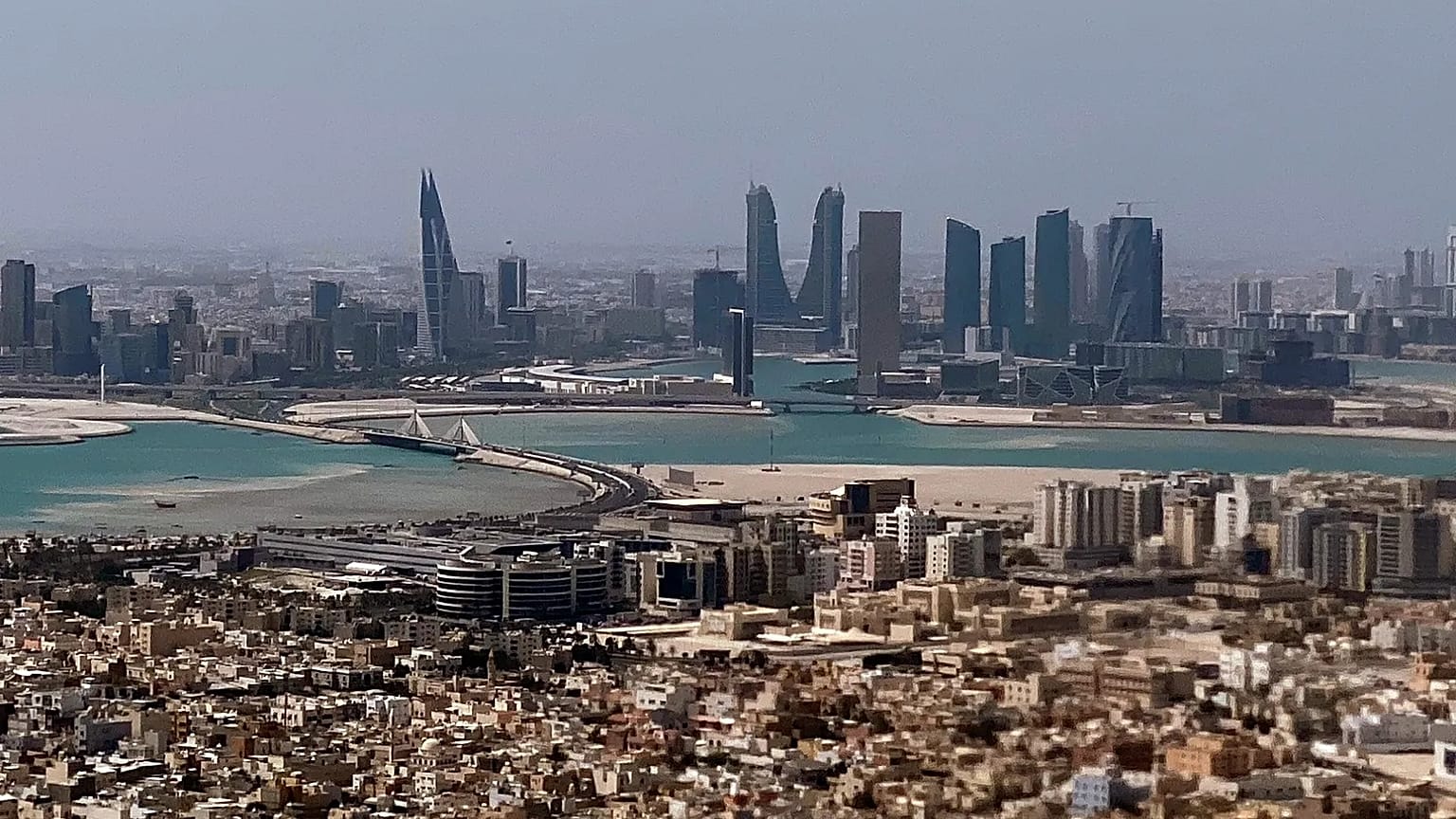
FILE - A general arial view of Bahrain Financial Harbour is seen. 29 March 29 2021
Copyright AP Photo/Kamran Jebreili

By Una Hajdari
Published on 

Bapco Energies invoked force majeure on Monday after a strike set the Al-Ma'ameer facility ablaze, joining Qatar and Kuwait in suspending shipments as Iran escalates its attacks on Gulf energy infrastructure.

Bahrain's state energy company declared force majeure on its oil shipments on Monday after an Iranian attack set its only refinery ablaze, becoming the latest Gulf state to invoke the clause as Iran widens its campaign against regional energy infrastructure.

A strike targeting Bahrain's sprawling Al-Ma'ameer oil facility caused a fire at the complex along with material damage, the Bahrain News Agency reported, though no casualties were recorded and firefighting operations were under way.

Videos widely shared on social media showed thick smoke billowing from the industrial zone housing the refinery.

In its force majeure notice, Bapco Energies said its "group operations have been affected by the ongoing regional conflict in the Middle East and the recent attack on its refinery complex."

Force majeure is a legal provision that frees parties from liability when failure to meet contractual obligations results from events beyond their control.

The company said it could still meet domestic demand.

The 90-year-old refinery was first reported damaged last week.

Bapco had recently modernised the plant and boosted its capacity to up to up to 380,000 barrels per day, upgrading units capable of producing more jet fuel and diesel.

Bahrain is not the first Gulf state to take the step.

QatarEnergy made a similar declaration last Wednesday after two of its liquefied natural gas facilities were struck, forcing a production pause and sending fresh volatility through global energy markets.

Qatar's energy minister had warned that all Gulf exporters would be forced to follow suit within days. Kuwait has also declared force majeure on oil sales after cutting output at its fields and refineries.

The energy shock comes as Iran also targeted a residential area in Bahrain, wounding 32 people including children and as a separate Iranian drone attack damaged one of the kingdom's desalination plants — the first time an Arab country had reported Iran targeting a desalination facility during the nine-day conflict, raising concern across a region that depends on such plants for its water supply.

Bahrain is an archipelago of 33 natural islands spanning approximately 760 square kilometres, roughly the size of Greater London, with a population of about 1.6 million, making it the third-smallest nation in Asia.

It is one of the most densely populated countries on earth, and one of the Gulf's smallest but most strategically significant oil producers.

Brent crude surged above $114 a barrel on Monday, roughly 60% higher than when the US and Israel first struck Iran on 28 February.

President Donald Trump sought to play down the spike, writing on social media that short-term oil prices "will drop rapidly when the destruction of the Iran nuclear threat is over".


From Barrels To Molecules: Gulf’s Emerging Multi-Energy Export Model – Analysis


March 9, 2026 
Observer Research Foundation
By Parul Bakshi

For half a century, the Gulf’s geopolitical influence travelled in tankers of crude oil; today, it is beginning to move in cargoes of liquefied gas, molecules of hydrogen, clean-energy carriers, carbon management solutions, and electrons transmitted across borders. Rather than abandoning hydrocarbons, Gulf states are repositioning themselves as multi-energy exporters, seeking to convert resource endowments, sovereign capital, and strategic geography into long-term influence across the next generation of global energy trade.

This emerging export model rests on three enduring advantages. First, the Gulf combines vast hydrocarbon reserves with some of the world’s most competitive solar and wind resources, enabling parallel investment in both legacy and low-carbon energy systems. Second, sovereign wealth funds and state-owned energy companies provide patient capital capable of financing large-scale infrastructure, from LNG trains and nuclear plants to hydrogen hubs and carbon-capture networks. Third, the region’s geography, situated between Europe, Asia, and Africa, positions it as a natural corridor for energy trade. Together, these allow the Gulf not merely to adapt to the energy transition but to shape its emerging commercial architecture.

LNG: Enduring Baseline of Gulf Energy Exports

LNG remains the most mature and commercially secure pillar of the Gulf’s evolving export model, providing both continuity with the hydrocarbon era and the financial foundation for diversification into lower-carbon energy systems.

Qatar’s North Field expansion is expected to nearly double LNG production capacity from 77 million tonnes per annum (mtpa) to about 142 mtpa by 2030, reinforcing its position among the world’s dominant gas exporters. In parallel, ADNOC’s Ruwais LNG project in the UAE will add about 9.6mtpa, with more than 80 percent of capacity already secured through long-term agreements ahead of its planned 2028 start-up. Designed as one of the region’s lowest-carbon LNG facilities, Ruwais will be powered by clean electricity and advanced digital optimisation.

Together with enduring long-term contracts with major Asian buyers, these developments underscore LNG’s continued role as the Gulf’s most bankable export channel even amid global decarbonisation pressures.

From a feasibility perspective, LNG differs from emerging clean-energy exports in one crucial respect: the infrastructure, shipping networks, and contractual frameworks are already established. This maturity allows Gulf producers to monetise existing gas reserves while financing investments in hydrogen, ammonia, and carbon management. Yet it also exposes LNG to long-term uncertainty. Competition from the United States and Australia, evolving climate policy, and the risk of demand plateauing beyond the 2030s mean that LNG is best understood not as the endpoint of Gulf export strategy, but as the stabilising bridge enabling the transition toward a broader multi-energy portfolio.

Hydrogen: Next Strategic Export Frontier

Hydrogen is being positioned to extend the Gulf’s energy influence into a decarbonising global system. Across the region, governments and state-backed developers are advancing large-scale projects that link abundant renewable resources, existing industrial infrastructure, and export-oriented energy strategy.

Saudi Arabia’s NEOM green hydrogen project is expected to produce around 600 tonnes per day of green hydrogen once operational, supported by more than 4 GW of dedicated solar and wind capacity. In the UAE, Masdar and ADNOC are advancing green and blue hydrogen initiatives tied to domestic industry and future export corridors, while Oman’s Hydrom framework and the Sur hydrogen cluster aim to position the country as a major
 exporter of green fuels to Europe and Asia.

Despite this momentum, hydrogen exports remain structurally more uncertain than LNG. Large-scale deployment depends on falling electrolyser costs, reliable water supply through desalination, and bankable long-term offtake agreements in importing regions. Transport logistics, certification standards, and price competitiveness against alternative decarbonisation pathways will ultimately determine commercial viability. As a result, hydrogen is viewed as a long-term strategic extension of Gulf export capability, one that could reshape global energy trade if technological, financial, and geopolitical conditions align.

Ammonia: First Scalable Hydrogen Export

Ammonia is emerging as the most commercially viable pathway for exporting low-carbon hydrogen from the Gulf, enabling producers to utilise existing global shipping, storage, and industrial-use infrastructure while hydrogen markets mature. Several flagship Gulf projects are therefore structured around ammonia rather than direct hydrogen trade.

Saudi Arabia’s NEOM project is designed to produce roughly 1.2 mtpa of green ammonia, positioning the Kingdom among the earliest large-scale suppliers of hydrogen-derived fuels. It also successfully shipped 40 tonnes of blue ammonia to Japan, marking one of the world’s first cross-border trades in low-carbon ammonia and signalling early demand from Asian importers. In parallel, UAE-linked producer Fertiglobe has secured European offtake through Germany’s hydrogen-import tenders, while Oman is advancing integrated hydrogen-to-ammonia zones such as Hyport Duqm to anchor future clean-fuel exports.

Ammonia, unlike pure hydrogen, has existing transport logistics and end-use markets. Yet long-term competitiveness will depend on falling hydrogen production costs, large-scale renewable deployment, credible certification systems, and sustained import demand. Ammonia could represent a bridge between Gulf hydrocarbons and a future clean-molecule export economy, shaped by global policy and market environment.
Regional Grid: Transmitting Clean Electrons

While still at a nascent stage, clean-power trade represents a potential long-term extension of the region’s energy-export model. The GCC Interconnection Grid already links national power systems, providing resilience, reserve sharing, and a foundation for future electricity trade. Historically used primarily for emergency balancing rather than commercial exchange, the same infrastructure could enable higher penetration of renewables and eventual cross-border clean-power flows as solar and wind capacity expands across Saudi Arabia, the UAE, and Oman.

Looking outward, several concepts under discussion envision high-voltage direct current (HVDC) connections transmitting renewable electricity from the Gulf toward neighbouring regions, including South Asia, North Africa, and potentially Europe. These proposals remain technically feasible but commercially complex, requiring multilateral coordination, long-distance subsea transmission, stable regulatory frameworks, and bankable long-term power-purchase agreements.

Compared with LNG or ammonia, direct electricity export faces higher geopolitical and infrastructure barriers, yet it also offers a compelling strategic logic. Where renewable generation costs are low, exporting electrons rather than fuels could ultimately provide a more efficient decarbonisation pathway for importing regions.

Carbon Management: A Low-Carbon Hedge


Carbon capture, utilisation, and storage (CCUS) is emerging as a parallel export logic for the Gulf, sustaining the competitiveness of hydrocarbon value chains in a carbon-constrained world. Qatar’s large-scale capture facilities at Ras Laffan, the UAE’s operational Al Reyadah and upcoming Habshan project, and Saudi Arabia’s Jubail CCS Hub collectively signal a shift toward embedding carbon management within core export infrastructure.

CCUS builds directly on existing industrial systems, allowing Gulf producers to preserve hydrocarbon revenues while lowering lifecycle emissions. Yet its long-term viability depends on policy credibility beyond the region, robust carbon-pricing mechanisms, trusted monitoring and verification frameworks, and sustained demand for low-carbon fuels in Europe and Asia. If these conditions materialise, carbon management could evolve into a distinct export service, anchoring hydrogen, LNG, and industrial decarbonisation partnerships. In this sense, CCUS represents not a departure from the Gulf’s hydrocarbon foundations, but their strategic adaptation to the economics and geopolitics of deep decarbonisation.

Emerging Multi-Energy Order

Rather than replacing hydrocarbons, the region is layering new export vectors onto an existing foundation, using gas revenues, sovereign capital, and industrial infrastructure to finance entry into lower-carbon energy systems. This transition is therefore evolutionary rather than disruptive, defined by sequencing, scale, and strategic hedging rather than abrupt transformation.

Whether this emerging multi-energy model succeeds will depend on bankable offtake, water and land availability, grid and shipping infrastructure, and credible carbon-accounting frameworks, to determine which export pathways mature commercially. At the same time, geopolitical stability and sustained demand from Europe and Asia remain preconditions for long-term influence.

If realised, the Gulf’s shift from exporting barrels of crude to exporting molecules, electrons, and carbon solutions could reshape the architecture of global energy trade. The question is not whether the Gulf will remain central to the energy system, but how that centrality will be redefined in a decarbonising world.

About the author: Parul Bakshi is Fellow – Energy and Climate at the Observer Research Foundation (ORF) Middle East.

Source: This article was published by the Observer Research Foundation

Observer Research Foundation

ORF was established on 5 September 1990 as a private, not for profit, ’think tank’ to influence public policy formulation. The Foundation brought together, for the first time, leading Indian economists and policymakers to present An Agenda for Economic Reforms in India. The idea was to help develop a consensus in favour of economic reforms.


Oil price spike at over $100 per barrel as market faces possibly worst crisis in history

Oil price spike at over $100 per barrel as market faces possibly worst crisis in history
By Newsbase March 9, 2026

Oil prices surged to over $100 per barrel in early trading on March 9, as the Iranian blockade of the Strait of Hormuz for nearly a week now has led to production shut-ins across the Gulf as storage space for unexported oil runs out.

Brent was trading at over $108 per barrel as of 06:30 GMT, up from the early $90s at the close of trading on March 6 and the early $70s prior to the US and Israel launch of strikes against Iran on February 28.

As NewsBase warned, Gulf producers are now having to shut down wells because of limited oil storage capacity and limited alternative oil export routes to Hormuz, which typically handles 20mn barrels per day (bpd) of oil flow – equivalent to around a fifth of global supply. 

Tehran claims it is only restricting passage through Hormuz for Western nations and Israel rather than completely closing the maritime chokepoint. But many other oil tankers are reluctant to pass through the Strait because of the risk of Iranian strikes – intentional or accidental. Iranian forces already targeted two tankers in the early days of the war.

Iraq has cut production from its southern fields that export via Hormuz by 70% to only 1.3mn bpd, Reuters reported on March 8, after the country’s storage facilities reached maximum capacity. Its exports also fell sharply to 800,000 bpd, from 3.33mn bpd in February, according to the news agency. 

Kuwait and the UAE were next to announce production cuts over the weekend, with even larger producers like Saudi Arabia expected to take similar steps if the crisis is not resolved soon. 

JPMorgan estimated on March 2 that onshore crude storage capacity across Gulf producers amounts to roughly 343mn barrels, equivalent to around 22 days of output that could become stranded if exports are unable to leave the region. In addition, about 60 empty tankers currently in the Gulf could provide temporary floating storage capacity of roughly 50mn barrels

“The market is shifting from pricing pure geopolitical risk to grappling with tangible operational disruption,” Natasha Kaneva, head of global commodities research at JPMorgan, told clients on March 6.

The bank estimates that production cuts could surpass 4mn bpd by the end of this week if Hormuz remains closed. The oil price surge may therefore have only just begun. 

“Every additional day of disruption adds pressure, and in that scenario there is effectively no ceiling to prices in the short term,” Stefano Grasso, senior portfolio manager at Singapore-based fund 8VantEdge, told Bloomberg.

Depending on how it lasts, this may prove to be the biggest disruption in oil markets in history. In comparison to the 20mn bpd of exports affected by the Hormuz blockade, the Iranian Revolution of 1978 only disrupted 5.6mn bpd of supply, while the Yom Kipper war of 1973 hit 4.4mn bpd of exports, the 1990 Iraq-Kuwait war 4.3mn bpd and the Iran-Iraq war of 1980 some 4.0mn bpd.

As noted, the alternative export routes for Saudi Arabia and other producers is limited. As NewsBase has reported, Saudi Arabia possesses the greatest logistical flexibility. Its primary contingency relies on the East-West pipeline, which has around 2mn bpd of spare capacity to deliver oil to the Red Sea. But that would still leave 4mn bpd of Saudi exports trapped. 

Other major producers face significantly shorter timelines. Kuwait lacks any bypass infrastructure, meaning all its exports must transit Hormuz. With limited storage headroom, Wood Mackenzie estimates the country has roughly two weeks of cover before it must slash production. Southern Iraq is similarly exposed; its 3.5mn bpd of exports are entirely dependent on the strait, with storage cover measured in “days, not weeks,” according to Araman.

The UAE maintains partial flexibility through the Abu Dhabi oil pipeline,  which can move 1.8mn bpd to Fujairah, a terminal located outside the strait. Nevertheless, with total exports exceeding 3.4mn bpd, a substantial volume remains bottlenecked. Araman wrote that ADNOC’s Fujairah storage provides a buffer of roughly two to three weeks, after which Murban crude output must adjust.

The $100-per-barrel oil price is perceived as a psychologically significant threshold that when surpassed, could trigger problems for the global economy as well as inflationary pressure. Depending on the duration of Hormuz’s closure, the crisis could erase completely the surplus of global oil supply this year that was anticipated prior to the war. In February, the International Energy Agency (IEA) predicted that global oil production  would rise by 2.4mn bpd in 2026, while demand would only grow by 850,000-930,000 bpd, creating a surplus of 1.47-1.55mn bpd.

Asian stocks slide as oil prices surge past $100 per barrel

Asian stocks slide as oil prices surge past $100 per barrel
/ Marcus Reubenstein - Unsplash
By bno - Surabaya Office March 9, 2026

Equity markets across Asia fell sharply at the week’s opening on March 9, with indices in Japan and South Korea leading regional losses following a steep rise in global oil prices, The Business Times reports.

Singapore’s benchmark Straits Times Index (STI) also opened 1.9% lower at 4,755.91 points. On the island, declining stocks heavily outnumbered gainers, with 249 losers versus 37 advancers, after around 166.9mn securities worth approximately $175.3mn were traded.

In addition, banking stocks in Singapore were among the hardest hit in early trading. Shares of DBS Bank fell 1.6%, declining by about $0.67 to $40.24. Meanwhile, OCBC Bank dropped 1.9%, slipping roughly $0.30 to $15.18, while United Overseas Bank (UOB) lost a full 2.3%, decreasing by $0.61 to $26.19.

The sell-off across Singapore and the region came about as crude oil prices surged above the $100 per barrel mark with West Texas Intermediate rising 20.8% to $109.78 per barrel, while Brent crude climbed 16.3% to hit $101.38 per barrel.

Energy-related stocks - as a result - were among the few gainers in early trading. Rex International jumped 13.3%, rising by about $0.018 to $0.154, while Geo Energy Resources also increased 5.4%, gaining roughly $0.019 to $0.365.

In Southeast Asia, Malaysia’s FTSE Bursa Malaysia KLCI was also down 2% as of 9:30 am local time, despite a research note released on March 6 by BMI ranking Malaysia as having the fifth-lowest risk score among 24 emerging markets in terms of potential exposure to the economic fallout from the US–Israel–Iran conflict.

The assessment evaluated factors such as trade disruption linked to the effectively closed Strait of Hormuz, terms of trade, external balances, as well as fiscal and monetary policy resilience.

The report also noted that energy-exporting countries such as Malaysia, seen as up and coming in the region, could benefit from elevated gas prices. In contrast, dedicated energy importers like the Philippines and South Korea may face pressure on their currencies and increased strain on their balance of payments as oil prices remain elevated.

War In Iran Shocks Markets, Costs U.S. Taxpayers $1 Billion A Day


By Brett Rowland


(The Center Square) – The escalating war in Iran has already rattled global markets and driven oil prices to their highest levels since April 2024. If the conflict persists, the strain on the global economy deepens and the burden on U.S. taxpayers grows.

With U.S. military operations costing more than a billion dollars each day, experts warn that a prolonged war could require a significant increase in defense spending, further affecting the federal budget.

The U.S. and Israel launched attacks on Iran on Feb. 28 after nuclear talks with Islamic Republic failed to produce a deal. President Donald Trump and Secretary of War Pete Hegseth have laid out four military objectives: Destroying Iran’s missile capabilities, neutralizing its navy, preventing the development of nuclear weapons, and ensuring the regime can’t direct terrorism beyond its borders.

Both Trump and Hegseth said the conflict is at the beginning. It’s unclear how long the war could continue, but Trump said it could be several weeks. On Friday, Trump said he would accept nothing less than Iran’s unconditional surrender.

U.S. gas prices surged to an average of $3.45 on Sunday, according to AAA, a $0.47 increase over the week. That’s the sharpest weekly rise since March 2022, when prices jumped $0.60 after Russia invaded Ukraine.

Since the Iran conflict began, oil prices have soared from around $65 to over $90 a barrel as of Friday.

Desmond Lachman, senior fellow at the American Enterprise Institute, said the economic hits could become more severe as the war continues.

He predicted gas prices could climb even higher, potentially exceeding $3.50 or even $3.75 per gallon.

“That has an impact on inflation and could also slow the economy. So it’s quite a big deal,” he said.

Shipping traffic through the critical Strait of Hormuz is nearly at a standstill, according to the Joint Maritime Information Center, an international group that tracks commercial shipping safety. The waterway usually handles about 20% of the world’s crude oil and natural gas shipments.

On average, about 138 vessels pass through the strait each day. That dropped to four earlier this week.

“This represents a near-total temporary pause in routine commercial traffic,” JMIC noted. “While no formal legal closure of the Strait has been universally acknowledged, the reduction stems from a combination of security threats, insurance constraints, operational uncertainty, and effective disruptions rather than a declared blockade.”

Lachman said the Strait of Hormuz is one problem, but Iran is also attacking oil and gas infrastructure, reducing supply.

“They are going after oil refineries and pipelines so there’ll be pressure on the United States to end the war,” he told The Center Square. “What’s happening right now is that those Gulf states are able to intercept the drones that the Iranians are sending, but the Iranians have got more drones than these states have got interceptors.”

Additional disruptions could send oil prices above $100 a barrel, Lachman said.

Goldman Sachs Research economists Jessica Rindels and Pierfrancesco Mei estimated that higher oil prices could hamper the U.S. economy and push up consumer prices. Higher oil prices reduce disposable income, which in turn limits spending, they noted.

“History suggests that oil price spikes driven by geopolitical shocks can be short-lived if markets gain confidence that supply disruptions will be temporary,” they wrote in a report.

How long the war with Iran will last and how far it might spread throughout the Middle East remain unclear, Lachman said.

“The trouble is, nobody really knows how long it will continue,” he told The Center Square.

United Nations Secretary-General António Guterres said Friday that the “situation could spiral beyond anyone’s control.”

“All the unlawful attacks in the Middle East and beyond are causing tremendous suffering and harm to civilians throughout the region – and pose a grave risk to the global economy, particularly to the most vulnerable people,” he said. “It is time to stop the fighting and get to serious diplomatic negotiations. The stakes could not be higher.”

In addition to the global economy, a long and costly war in Iran could hit U.S. taxpayers, Lachman said.

“This is costing over a billion dollars a day,” he told The Center Square. “So if this drags on, the U.S. is going to need a big increase in its defense budget, which can push interest rates up. You’ve just got to hope that this is a very short war; otherwise, there will be serious consequences.”

Trump is already looking to boost military spending. Trump previously proposed a $1.5 trillion budget for the Department of War, a 60% increase over existing levels.

On Friday, the nation’s largest defense contractors agreed to “quadruple Production of the ‘Exquisite Class’ Weaponry,” the president said in a social media post.


Rising US fuel prices risk sparking domestic wildfire for Trump

By AFP
March 6, 2026


In California and across the United States, gas prices are on the rise as the Middle East war begins to affect pocketbooks - Copyright AFP/File Frederic J. BROWN

Asad Hashim, with Sarah Lai in Los Angeles

Sean Robinson, a 54-year-old schoolteacher in the US capital Washington, did not realize how high gas prices had gotten until he arrived at the pump on Friday.

“That is a sizeable jump,” he told AFP, pointing to a neon sign showing $3.27 for a gallon of regular gasoline.

Robinson is among US consumers feeling the sting of a cost surge sparked by the US-Israel war on Iran, which sent oil prices soaring as Tehran effectively blocked the Strait of Hormuz after being attacked.

But the price hike comes at a politically sensitive time for President Donald Trump as midterm elections approach, hitting voters hard.

Expensive gasoline could also prompt the independent central bank to put the brakes on the world’s largest economy as it battles stubborn inflation.

Since last week, US average domestic fuel prices have risen 11 percent, according to the AAA’s fuel price gauge.

It is the kind of move that Robinson said will have him cutting down on all but the essentials.

“It just determines what I’m going to do on a day-to-day basis,” he said. “Pretty much start thinking about (watching) Netflix, staying in the house instead of burning gas.”

Others at the gas station agreed.

“It impacts all areas of life,” said Toloria Washington, 39. “We are in a state of survival mode.”

– ‘It’s the basics’ –

Washington, who works in finance, said fuel expenses are non-negotiable for her. With prices rising at the pump, she had to make cuts elsewhere.

That, she said, is a problem for people already battered by years of high prices post-pandemic.

“That’s the key thing, it’s tapping into everybody’s basics,” she added. “It’s the basics. Daily survival of food, water, housing.”

US inflation hit a peak of 9.1 percent during the pandemic. While it has cooled since then, analysts warn of risks of another pick-up.

“Inflation showed signs of accelerating prior to the jump in energy prices,” said KPMG chief economist Diane Swonk.

“That has left consumers in a sour mood,” she added.

Swonk warned that rising fuel prices added “insult to injury” for low-income Americans, who are already seeing higher healthcare costs and a tightening of welfare benefits under Trump.

Trump, who has bragged about oil prices falling during his term, sought to address the political fallout on Friday, telling CNN he expected prices to come down quickly.

His Republican party holds only a slim majority in both the House and Senate.

With midterm elections due in November, he will be hoping that voters do not let tightening household budgets weaken his political position.

– Fed’s ‘dueling mandate’ –

Trump could see further complications if inflation from gasoline price hikes pushes the Fed to respond by keeping interest rates at a higher level.

The central bank has a dual mandate of maintaining stable prices and maximum employment, but has one main tool to do so — adjusting interest rates.

Raising them generally cools economic activity and reduces inflation while lowering them can spur activity, boosting the weakening employment market.

The prospect of more inflation due to oil prices raises the specter of what some analysts call a nightmare scenario.

“This could not come at a worse time for the Federal Reserve,” said KPMG’s Swonk. “It now has a dueling mandate with the risk that inflation not only lingers but accelerates.”

Fed policymakers remain cautious.

Addressing higher domestic energy prices on Friday, Federal Reserve governor Christopher Waller told Bloomberg TV he considered them “unlikely to cause sustained inflation.”

But this is scant consolation for many Americans hit by even a temporary bout of price increases.

“One thing after another, it’s chaos, you know, every day,” said Lucas Tamaren, 32, at a gas pump in Los Angeles.

“Living in America feels unpredictable and chaotic and it’s hard.”

Robinson, the schoolteacher, said he will be watching gas prices every day now. He expects price pressures will be reflected at the voting booth in November.

“The more you pay higher gas, higher groceries (costs),” he said, voters will “start to see” that the middle class is shrinking.


Oil Price Charts | Oilprice.com

Video Suggests Trump’s ICE Lied About Its First Known Killing of a US Citizen Last March

“He was shot at point-blank range through his side window by an ICE agent who was in no danger,” said lawyers for the family of Ruben Ray Martinez.


Body camera footage shows federal immigration agents and police officers surrounding Ruben Ray Martinez after he was shot on March 15, 2025 in South Padre Island, Texas.
(Image via South Padre Island Police Department)

Julia Conley
Mar 09, 2026
COMMON DREAMS

Materials released over the weekend by the Texas Department of Public Safety regarding a homeland security officer’s killing of 23-year-old Ruben Ray Martinez last March in Texas appeared to provide the latest evidence that federal agents have misled the public about the circumstances surrounding fatal shootings.

American Oversight, a government watchdog group, revealed last month that nearly a year before the fatal shootings of Renee Good and Alex Pretti by federal immigration agents in Minneapolis, Martinez was the first known US citizen to be killed by an agent of the Trump administration who was carrying out official duties.


‘How Many Other Killings Are They Concealing?’ ICE Shot Ruben Ray Martinez in Texas Last March

Since then, a grand jury has declined to indict the accused officer, Homeland Security Investigations agent Jack C. Stevens, and American Oversight as well as Martinez’s family and lawyers have demanded that state authorities release the findings of their investigation into the killing, with the watchdog filing a Freedom of Information Act request.

The body camera footage released on Saturday called into question statements that were made by the Department of Homeland Security after Martinez’s killing was publicly revealed, when a DHS spokesperson said the young man “intentionally ran over” an agent.

Internal documents also claimed officers commanded Martinez to get out of his car after he approached the scene of a vehicle accident and that he “accelerated forward, striking a HSI special agent who wound up on the hood of the vehicle.”

The video that was released came from a body camera worn by a South Padre Island, Texas police officer who was one of a number of local, state, and federal agents securing an area after a car accident.


About 21 minutes into the officer’s footage, someone can be heard saying, “Keep going” as Martinez’s car approaches the scene. The car briefly stops for some pedestrians, and officers soon appear to become concerned, running toward the vehicle and shouting, “Stop him” and, “Get him out.”

Martinez’s car appears to be moving slowly, with the brake lights on, as three gunshots are heard and just after.

The video then shows an officer removing Martinez from the car and throwing him on the ground while his friend who was in the car with him, Joshua Orta, is taken into custody.

The internal DHS documents said a second HSI agent Hector Sosa, was struck by the car in his legs, falling over the hood. The footage is taken from behind the car, making it unclear whether Sosa was hit—but it does not show Martinez accelerating.

If an officer was hit, University of South Carolina criminal justice professor Geoffrey P. Albert told the Washington Post, based on the footage of the car it would have been a case of “officer-created jeopardy.”

“The contradictory orders are confusing and may have been a strong influence,” Alpert told the Post. “The speed is slow and doesn’t appear threatening. Could the officer have moved away? At worst, all he has to do is step aside.”

He added that the body camera video raises “a lot of red flags.”

Lawyers for Martinez’s family, Charles M. Stam and Alex Stamm, said in a statement that the videos confirm the 23-year-old’s car “was barely moving when he was shot.”

“He was shot at point-blank range through his side window by an ICE agent who was in no danger,” said the attorneys.

Orta, who was killed last month in an unrelated vehicle accident in San Antonio, provided a witness statement after Martinez was killed, saying “I state clearly and without hesitation that Ruben did not hit anyone,” Orta wrote. “The trooper seemed to be trying to get in front of the car, like he wasn’t moving out of the way when we tried to turn around and leave like the police officer told us to do.”

More than a dozen people have been killed by federal immigration officers since President Donald Trump took office for his second term in January 2025.

In the case of Good, an independent autopsy was conducted as part of a civil investigation into her killing and found “strong evidence” against the agent who shot her, calling into question the Trump administration’s claim that the officer had killed the 37-year-old in self-defense.

A preliminary government investigation into Pretti’s killing did not find that the legal observer had threatened or attacked the Border Patrol and Customs and Border Protection agents who fatally shot him, as the administration had first claimed.

Both Pretti and Good were immediately denounced as “domestic terrorists” by administration officials.

DHS also claimed that Marimar Martinez, a Chicago resident who was shot several times by a federal agent but survived last October, had “rammed” officers’ vehicles. Body camera footage and text messages from officers later undermined those claims. Federal prosecutors abruptly dropped their criminal case against Martinez weeks after she was shot.

The video of Martinez’s killing in Texas, said columnist Nicholas Kristof, suggests that the DHS account of that incident “may be a lie” as well.


'Ridiculous': DHS deputy blows millions on 'unusable' vehicles that are now in 'hiding'


Masked law enforcement officers, including HSI and ICE agents, walk into an immigration court in Phoenix, Arizona, U.S., May 21, 2025. REUTERS/Caitlin O'Hara/File Photo

March 09, 2026
ALTERNET

The Washington Examiner reports that former DHS head Kristi Noem was not the only division head prone to blow cash on big adventures such as a $220 million series of television advertisements. A former Trump administration official wasted millions of U.S. Immigration and Customs Enforcement taxpayer dollars purchasing thousands of employee vehicles that are now unusable, according to three sources

“ICE’s top brass are quietly searching for a way to amend the remainder of a massive order of pick-up trucks and SUVs that were ordered last year and slated to be wrapped with the agency’s name, logo, and motto, as well as storing away many vehicles that have been delivered to ICE facilities across the country,” reports the Washington Examiner.


“ICE has never had marked vehicles,” one source familiar with the purchases told the Examiner. “In talking to people, they’re like, ‘We don’t want to use these, we can’t.'”

The saga, according to Examiner, “is the latest controversial expenditure of taxpayer money within the Department of Homeland Security and speaks to the different ways political appointees at the department have tried to approach operations versus how career law enforcement officials have historically done so.”

President Donald Trump’s One Big, Beautiful Bill allocated $170 billion over four years for border security and immigration enforcement, and people in charge of purchase orders appear to be giving less thought to how that money is spent. For example, assaults against ICE personnel have risen 8,000 percent over the past year, according to the DHS. The threat is so serious that federal police now opt to hide their faces while conducting business in public. They also frequently resort to rental vehicles, and they switch license plates on rental vehicles to avoid detection by activists, who track the plates of suspected ICE vehicles with crowdsourced databases.


But despite the value of secrecy in today’s hostile environment, ICE’s former deputy director, Madison Sheahan apparently placed an expensive purchase of a bulk order for vehicles marked clearly with ICE’s logo.

Last November, the Examiner reports the agency announced it would spend $2.25 million in a no-bid contract with a prominent Republican donor, Rick Hendrick, to buy 25 Chevrolet Tahoes emblazoned with ICE’s new logo. The Examiner reports the department then spent an additional $174,000 to $230,000 to three companies to wrap the vehicles in their new markings.

“It’s ridiculous because you don’t want to advertise what you’re doing,” the first source said. “We’re just hiding them in a parking garage somewhere because we don’t want to drive them. Who wants to drive the marked vehicles?”


Sheahan was hand-picked by Noem to be the second-in-command of the 20,000-employee federal agency and its $9 billion budget. Her prior experience included serving as a political director when Noem was South Dakota’s governor. She also served as executive director of the South Dakota Republican Party, and as secretary of the Louisiana Department of Wildlife and Fisheries.

A second source said the marked vehicles are now being used for custodial pick-ups, or when ICE retrieves someone from a local jail or state prison — not in general enforcement.