Sunday, September 13, 2026

 Spiritual Politics

Al Mohler signs on to Christian nationalism
(RNS) — Will that make him a Southern Baptist pariah?
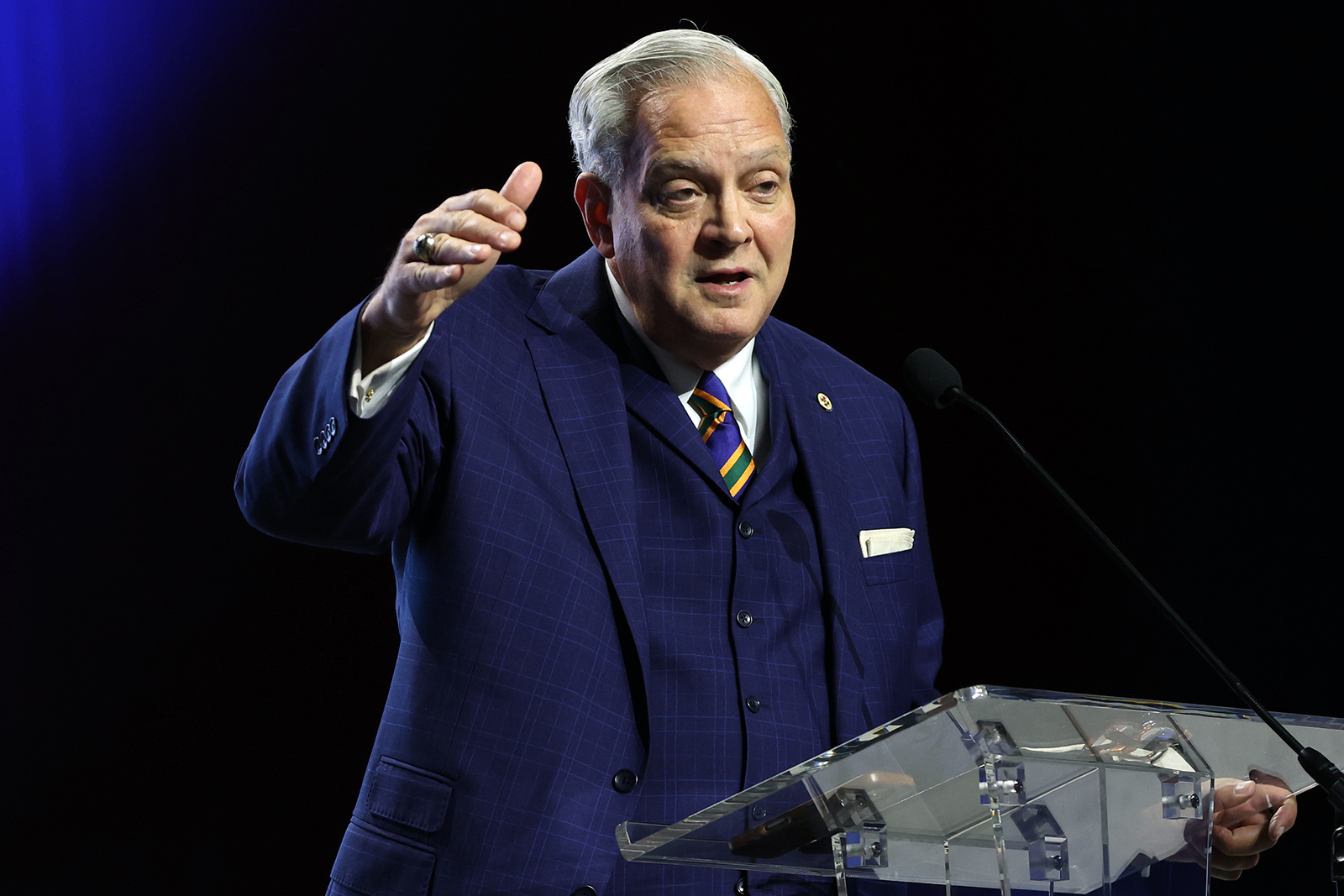
The Rev. Al Mohler addresses the Southern Baptist Convention annual meeting at the Kay Bailey Hutchison Convention Center in Dallas, June 11, 2025. (RNS photo/Tim Heitman)

(RNS) — To the consternation of some pretty conservative Southern Baptists, Al Mohler, the longtime president of Southern Baptist Theological Seminary, has turned away from the traditional Baptist support for church-state separation to embrace Christian nationalism. For a major figure in the country’s largest Protestant denomination and a stalwart of the denomination’s “conservative resurgence,” that’s no small thing. 

Mohler’s embrace has drawn attention because of a talk he gave at a roundtable on Christian nationalism held at the University of Idaho last month. The participants in the roundtable were four of the contributors to “Five Views on Christian Nationalism,” a book recently published by Christian nationalist pastor Doug Wilson’s Canon Press. The book’s editor asked each contributor to propose a place for Christianity in an imagined 2099 constitutional convention for a new United States.

In his talk, Mohler harks back to the longstanding criticism of the U.S. Constitution for failing to recognize God’s role in the American experiment, the way the Declaration of Independence does by stating that people are “endowed by their Creator with certain inalienable rights.” That was, said Mohler, “a constitutional error.”

Let us note that this supposed error was remedied in the Confederate Constitution by “invoking the favor and guidance of Almighty God.” Mohler, a Florida native, asks for a full-fledged acknowledgement:

I’m talking about the historical, legal, consequential affirmation of the fact that the Christian truth claim is the necessary precondition for the American experiment. The necessary precondition for the exercise of religious liberty or for American liberty as a whole. The necessary precondition for our understanding of what it means even to be a nation.

To be sure, the new constitution “would allow non-Christians, specifically Jewish citizens, to enjoy full citizenship and comprehensive participation in the political order, retaining the full measure of religious liberty and requiring only their formal acknowledgement of the Christian foundations of the republic, its constitution and its laws,” Mohler writes in his contribution to the book. “But its acknowledgement must be substantial.” Beyond such acknowledgement, “the basic moral principles and precepts of biblical Christianity would be fundamental to the state and to its laws.”

There’s more.

In line with Article VI of the (current) Constitution, Mohler claims there would be no religious test for public office but does not indicate how that could be squared with “officeholders’ public and authentic acknowledgement of the nation’s formal commitment to the God of the Bible, specifically the Holy Trinity,” and “an acknowledgement of the binding moral authority of the Bible, including both the Old and New Testaments.”

Or how robust protections for religious liberty for all citizens could exist “within the context of the acknowledgement of Christianity as foundational to the state.” Or alongside the government’s “full right to restrict and punish blasphemy.” Or alongside restrictions on the activity of atheists in the public square. 

Among the distressed responses from other Southern Baptists, the most notable has come from Richard Land, the former president of the SBC’s Ethics & Religious Liberty Commission and for many years one of Mohler’s closest comrades-in-arms. 

Land quotes from Article XVII of the denomination’s 2000 Baptist Faith and Message, which says, among other things, “Church and state should be separate” and “The church should not resort to the civil power to carry on its work.” How, he asks, is Mohler’s acknowledgement requirement not a religious test? Mohler’s prescription would severely diminish the “bedrock” Baptist principles of religious freedom and “soul freedom.” And finally: “I fervently pray he will reconsider his position.”

Are we then to conclude that Mohler has turned himself into a Southern Baptist pariah? Let’s not jump to conclusions.

In my edited volume “Understanding Christian Nationalism,” sociologist Nancy Ammerman analyzes the evolution of resolutions passed by delegates to its annual meetings to show how the SBC has itself moved in the direction of Christian nationalism. For example, a 2016 resolution titled, “On Biblical Sexuality and the Freedom of Conscience,” holds that “(a)ny law that directly contradicts natural law and biblical truth is an unjust law.”

Similarly, in 2021, an Abolishing Abortion resolution declaring the Supreme Court’s Roe decision both evil and unconstitutional asserts that “governing authorities at every level have a duty before God to uphold justice, asserting their God-ordained and constitutional authority to establish equal protection under the law … by intervening, ignoring, or nullifying iniquitous decisions when other authorities, such as the Supreme Court, condone such injustices.” Notes Ammerman, “The implication seems to be that true Christian citizenship only recognizes governmental authority as legitimate when it conforms to their understanding of biblical mandates, and resistance may sometimes be in order.”

To be sure, none of the SBC’s recent resolutions go as far as Mohler has in abandoning long-held Baptist principles. But it’s not hard to believe that a significant number of his co-religionists will follow in his footsteps.


 Opinion

The RSS’s interfaith photo op tried to hide the truth


(RNS) — Oneness is not a word you say but a record you build.
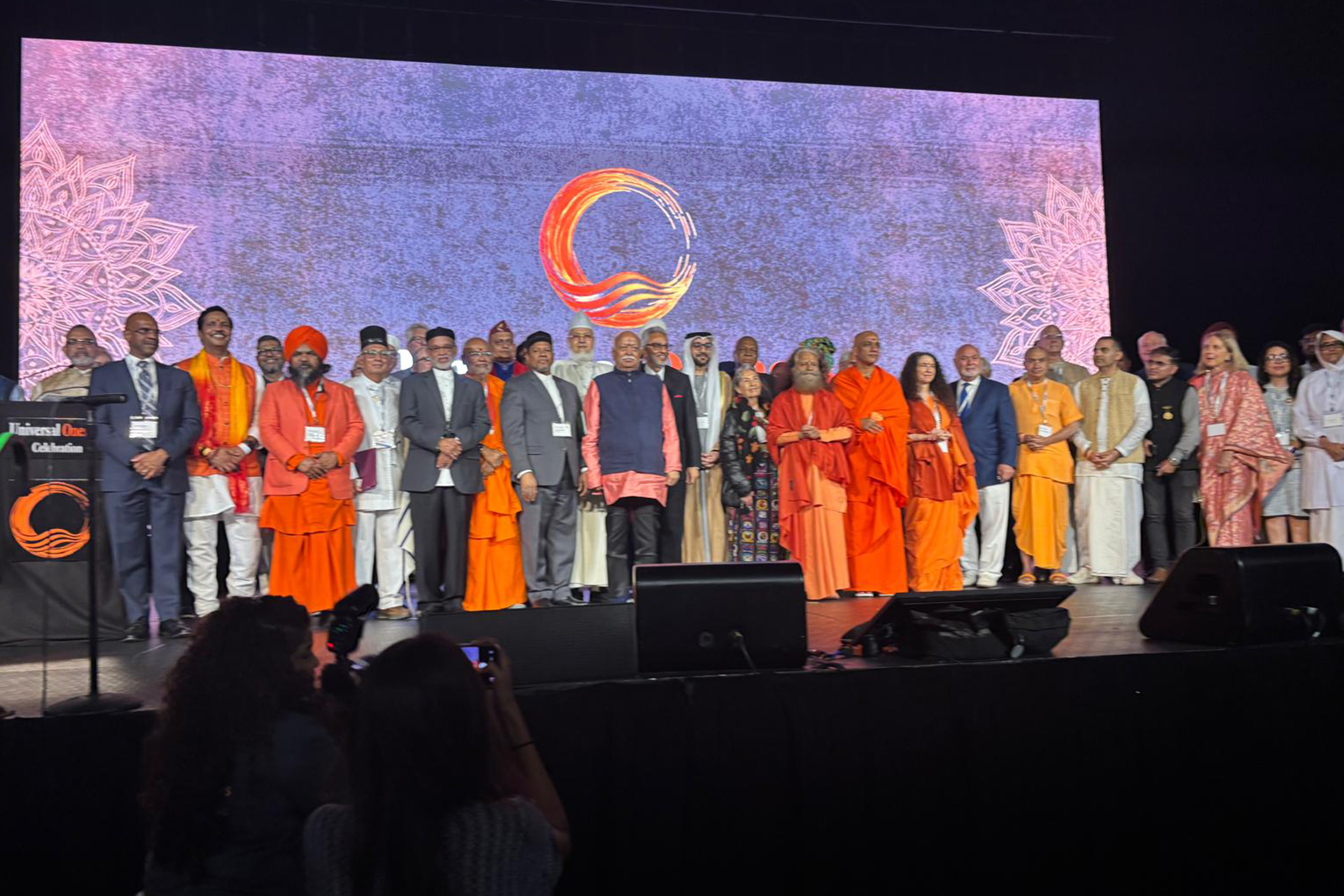
The official Rashtriya Swayamsevak Sangh (RSS) X account posted this group photo of Mohan Bhagwat with other faith leaders at Madison Square Garden on Aug. 29, 2026, in New York. (Photo via X/@RSSorg)


(RNS) — On Aug. 29, the chief of the Hindu nationalist organization Rashtriya Swayamsevak Sangh (RSS), Mohan Bhagwat, headlined the stage at Madison Square Garden for an event billed as a “Universal Oneness Celebration.” 

The RSS was founded in India in 1925 with the mission of creating a Hindu nation. Since then, the organization has promoted a militant form of Hindu nationalism that ties Hinduness to Indian identity. 

Bhagwat’s tour stop in New York exposed the RSS’s public relations attempt to present itself and its Hindu nationalist ideology in a way that would impress donors and followers in the Indian diaspora and also be palatable for Western (especially interfaith) audiences. Now a growing number of American political leaders and civil society groups are distancing themselves from the movement Bhagwat leads and rejecting the cynical and hypocritical instrumentalization of interfaith collaboration he attempted.

Before the event, a broad coalition argued that the RSS did not deserve the benefit of the doubt, given the organization’s record on violence against minorities. This begins with some of its founding members who drew inspiration from Nazi Germany’s repression of minorities. M.S. Golwalkar, an early RSS leader, praised aspects of Nazi Germany’s treatment of minorities and articulated an exclusionary, Hindu-first Indian state in his 1939 book, “We, or Our Nationhood Defined.”

The RSS’s ideology bred a century of violence against Muslims, Sikhs and Christians in India by its cadres and affiliates. International human rights groups documented the involvement of the RSS and its affiliates in the 2002 Gujarat pogroms that killed over 1,000 people, the majority Muslims. The RSS’s record surrounding the 1984 anti-Sikh massacres is equally troubling. Survivors have accused RSS members of helping organize and facilitate the violence, while a senior RSS ideologue defended the carnage in its aftermath. In its 2026 annual report, the U.S. Commission on International Religious Freedom named the RSS directly, recommending targeted sanctions, asset freezes and entry restrictions against some of its officials for their “responsibility and tolerance of severe violations of religious freedom.” In August, USCIRF separately called for Bhagwat’s U.S. visa to be revoked.


None of that record was addressed at Madison Square Garden (as a Christian leader demanded it should be). Instead, attendees heard Bhagwat speak in broad, milquetoast platitudes at odds with the RSS’s past and present records.

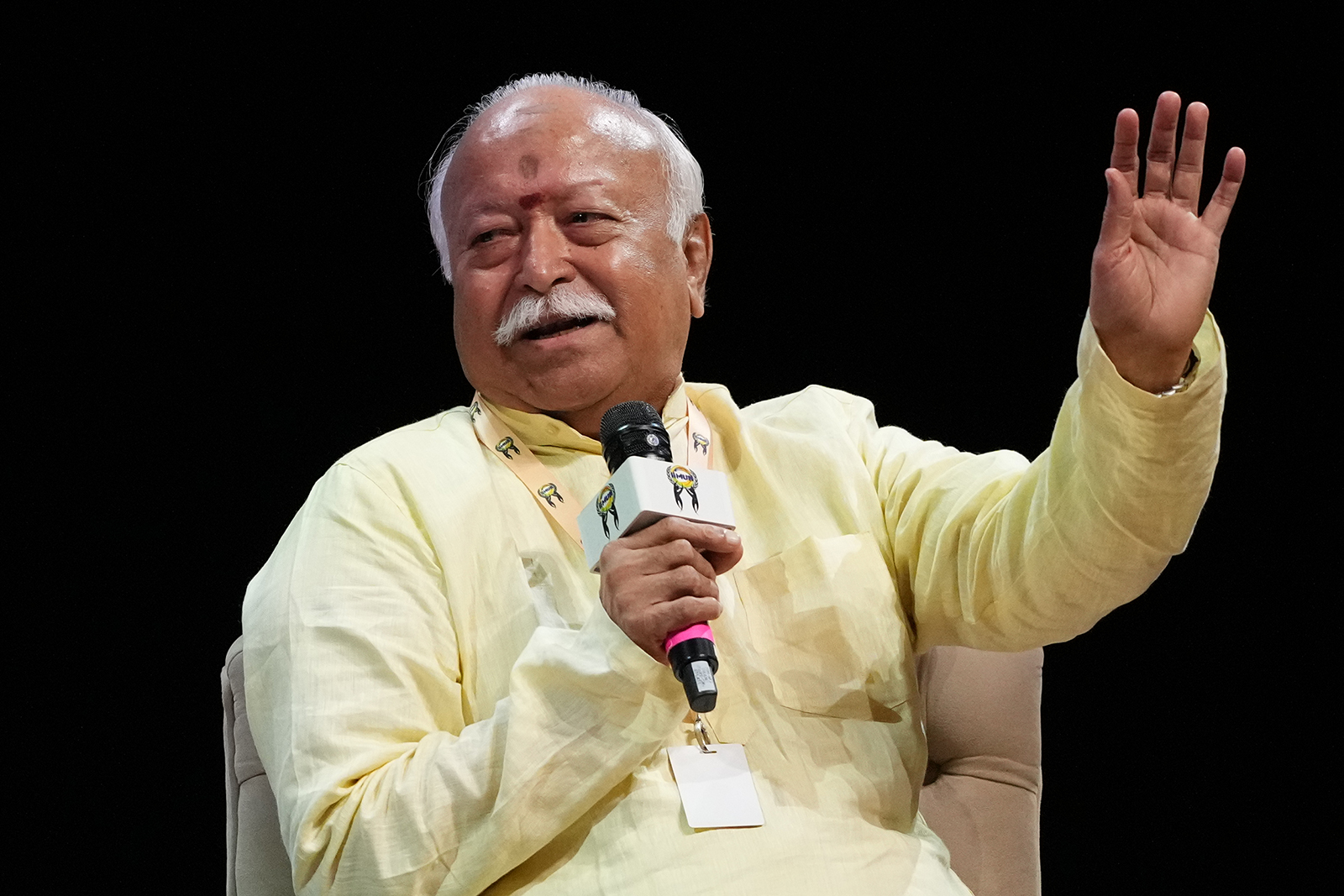
Rashtriya Swayamsevak Sangh (RSS) chief Mohan Bhagwat addresses students during an India International Movement to Unite Nations (IIMUN) event in Mumbai, India, Thursday, Aug. 6, 2026. (AP Photo/Rafiq Maqbool)

Moreover, the organization of this event should alarm anyone who cares about the integrity of interfaith work. In the days since, three interfaith leaders who attended the event have come forward with public statements explaining they were misled into appearing on that stage. They describe a pattern of omission and deception: At least a dozen email invitations were extended not by the RSS or its well-known affiliates but by innocuous-sounding entities like the “World Council of Religious Leaders” and the “Center for Responsible Leadership.” These invites reportedly left blank a section on the program that listed a “Guest of Honour” and repeatedly urged invitees to wear their “traditional attire” to the gathering — all pointing to the fact that the RSS was primarily out for a photo-op to confer interfaith legitimacy on themselves without confronting their own record against pluralism.

This cynical approach is precisely why the opposition to Bhagwat’s visit mattered, and why it should not be mistaken for the reflexive or tangentially related activism of any single aggrieved community. The coalition that convened to oppose the RSS visit in the lead-up was not improvised for the occasion: It was built over years of relationship-building and shared action across communities that do not always agree on everything but have worked to show up for one another. That is a truer expression of pluralism than anything spoken from the stage inside. 

The RSS and its affiliates can speak in as many Janus faces as ever, mount all the deceptions that their funding can sponsor and float all the front organizations they desire. But because they have no real interest in the fundamental tenets of pluralism and interfaith work, they will never grasp a basic truth: Oneness is not a word you say, but a record you build. An organization cannot claim the mantle of universal brotherhood while its cadres have been accused of organizing pogroms, while its American wings fan hate speech and while its political influence in India through the ruling BJP presides over the destruction of churches and impunity for anti-Muslim violence across India. 

The aftermath has been swift, and it has not been confined to activists and clergy. In the days following the rally, at least 90 elected officials and candidates across the United States publicly pledged to reject campaign donations tied to the RSS. This is a signal that the RSS’s American political project, built over decades through affiliated organizations that shape how U.S. institutions engage with South Asia, is colliding with people of all religious and ethnic backgrounds. The RSS came to Madison Square Garden to project strength and legitimacy on American soil. By doing so in a typically insidious but ham-fisted manner, it is instead leaving behind a widening circle of American political and religious leaders whose openness to engagement was misused, and who are now publicly explaining why they want nothing to do with it.

The State Department’s own history offers the clearest benchmark for what should come next. In 2005, it revoked Prime Minister Narendra Modi’s visa for nine years, holding him responsible, as Gujarat’s chief minister, for the 2002 anti-Muslim violence in the state. Modi, like Bhagwat, spent years as a full-time RSS organizer. The same scrutiny that was once applied to Modi should now be applied to Bhagwat — and to the broader network of American organizations that lent the RSS chief’s tour its interfaith cover and conjured its air of legitimacy by hook and by crook

In 1939, Madison Square Garden hosted a rally organized by the pro-Nazi German American Bund, drawing thousands under a banner of racial supremacy. Eighty-seven years later, the same arena hosted the leader of a movement whose own founding drew on that same ideology. 

The difference this time is that the deception used to dress the event in the language of unity did not survive contact with public scrutiny. The work to fight Hindu supremacy, build real interfaith ties and strengthen a multi-racial democracy does not end with Bhagwat’s departure: It demands continued due diligence, not the deference and whitewashing his tour was designed to manufacture.

(Harman Singh is the executive director of the Sikh Coalition and Sunita Viswanath is the executive director of Hindus for Human Rights. The views expressed in this commentary do not necessarily reflect those of RNS.)

SEE   Hinduism Is Fascism

As the far-right in Germany aims to take power, churches are fighting back

BURG near Magdeburg, Germany (RNS) — The AfD may gain power on Sept. 6 in Saxony-Anhalt, posing a direct threat to refugees and the German churches that serve them. Inspired by past resistance in East Germany, faith leaders are doing everything they can to stand in the way of the far-right group.


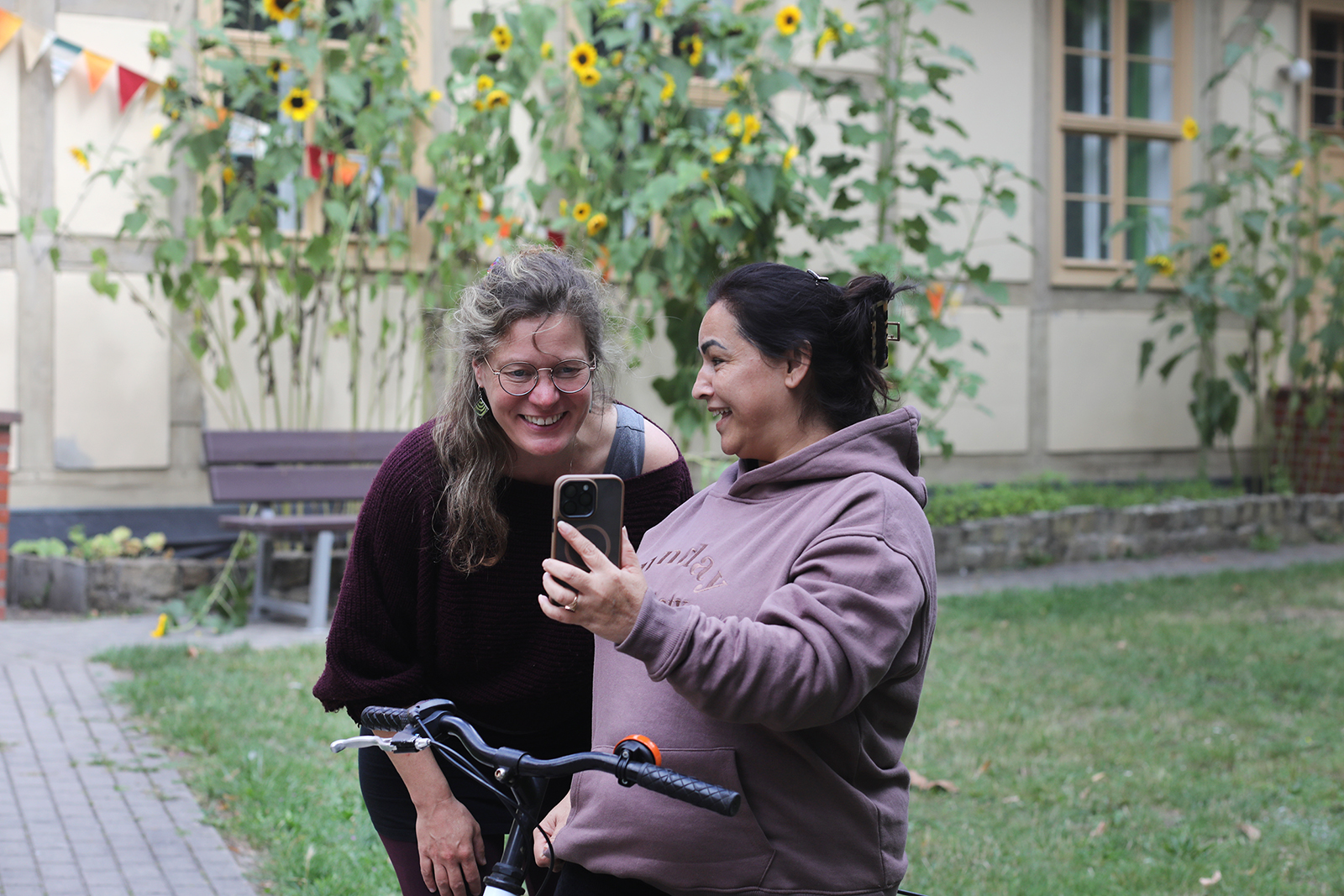
The Rev. Ulrike Bischoff, left, pastor of St. Petri Kirche in Burg near Magdeburg, and Zholia Parsi, a women's rights activist from Afghanistan who has been living at St. Petri as part of the church's asylum program, video chat with Parsi's family on August 26, 2026. (RNS photo/Liam Adams)

Liam Adams
September 3, 2026
RNS


BURG near Magdeburg, Germany (RNS) — Zholia Parsi bounced on a blue-and-white Noxon mountain bike as she rode laps around the fieldstone sanctuary of St. Petri Kirche, speaking to family on the phone and laughing.

Parsi, who led a women’s rights movement in Afghanistan and fled after imprisonment and death threats from the Taliban, is known internationally for her work on human rights. But in her past three months living at St. Petri as part of its church asylum program, she’s careful not to venture beyond the cement wall that encloses the congregation’s chapel and parish house.

But the bike, which she’d never ridden before coming to St. Petri, is enough freedom for now.

“Believe me, learning was not easy. I fell many times,” Parsi said in an interview, using a translation app on her phone.

She rolled up her corduroy pant leg to reveal a scar on her shin as proof of her practice. “Now, whenever I get on my bicycle … I forget all my sadness and worries. Cycling is not just a hobby for me.”

Under the leadership of the Rev. Ulrike Bischoff, pastor of St. Petri since 2023, the church dedicated the parish house to church asylum. As many as 20 people stay there every year, Bischoff said.

She tells the refugees that beyond the church’s campus, they risk run-ins with law enforcement and might be detained. Refugees in church asylum have suffered a particular hardship and are waiting for immigration officials to review their cases more carefully. The outcome of that review determines whether the person is eligible to work and rent an apartment elsewhere, allowing them to leave church asylum.

The day before RNS visited, a family of five who are also refugees from Afghanistan had moved in.

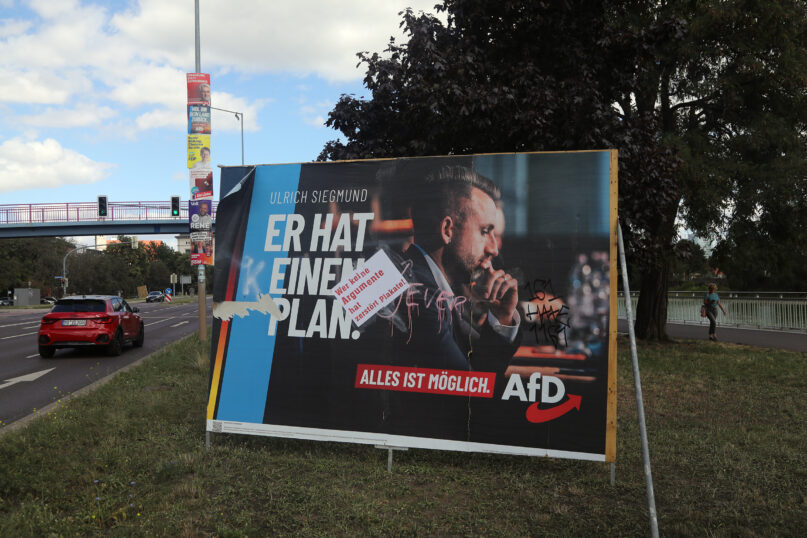
A campaign sign for Ulrich Siegmund, lead candidate for the Alternative für Deutschland (AfD) party in Saxony-Anhalt, near Magdeburg, August 11, 2026. (RNS photo/Liam Adams)

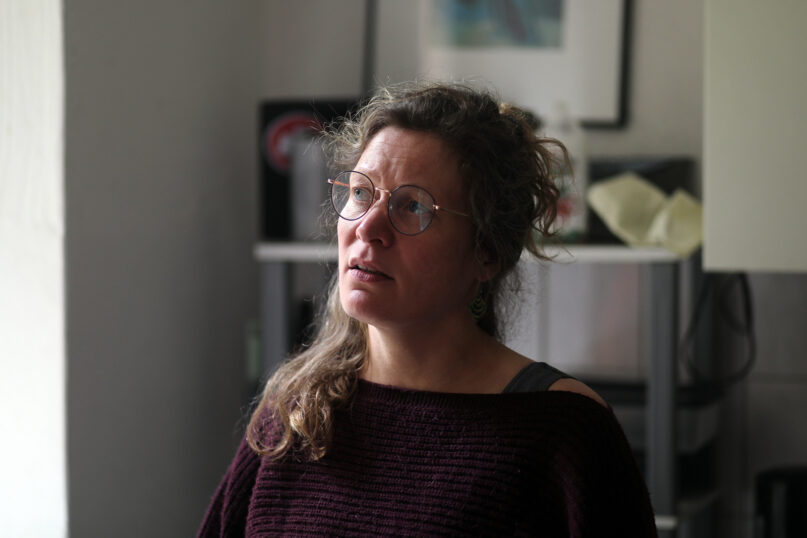
The Rev. Ulrike Bischoff in her office at St. Petri Kirche in Burg near Magdeburg, Germany, on August 26, 2026. (RNS photo/Liam Adams)

But on Sunday, this could all change if the far-right Alternative für Deutschland (AfD) party has its way. The AfD could gain power in state elections for Saxony-Anhalt on Sept. 6, which would be the first time a right-wing party in Germany has done that since World War II.

If that happens, the AfD has vowed to send police into churches to detain refugees and initiate deportation proceedings.

“We are an open sport right now,” Bischoff said.
RELATED: As Germany’s far right builds ties with US conservatives, churches push back

The proposed attack on church asylum is one part of the AfD’s larger plan to oust refugees from Saxony-Anhalt. But it’s also a blow to churches, which criticize the AfD as antithetical to their Christian values.

Amid this conflict, the AfD wants to strip funding from “state churches” — Catholics and a Protestant, or Lutheran, body known as the Evangelische Kirche — that they claim are too liberal and have veered from their core mission.


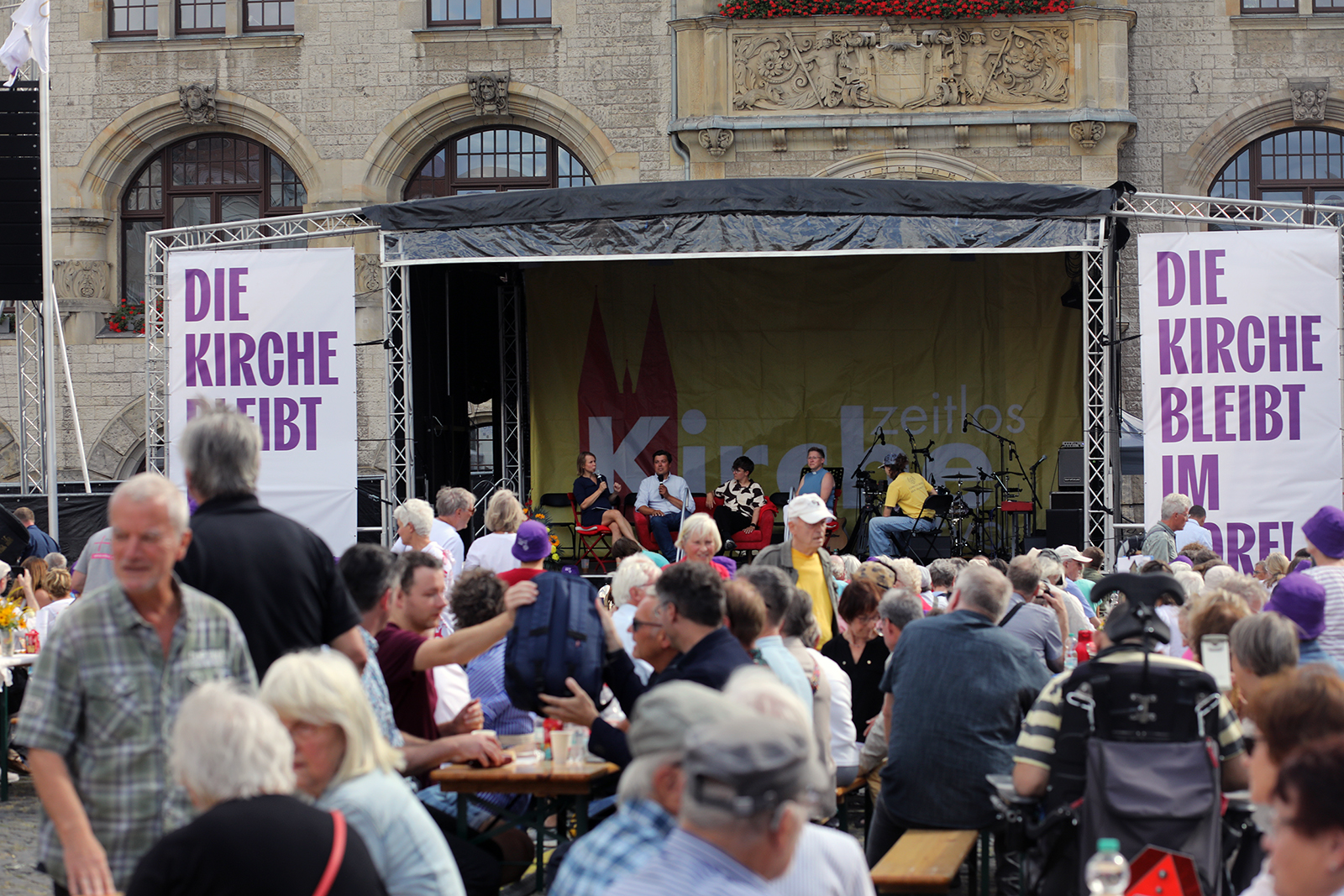
Clergy participate in a panel about the upcoming elections in Saxony-Anhalt during the “Festival of Hope” in Dessau Market Square, August 30, 2026. (RNS photo/Liam Adams)

But the churches are fighting back, and fiercer than ever. Local clergy have arranged counterdemonstrations, hosted town halls on defending democracy and, in at least one instance, run for office with the main purpose of unseating a powerful AfD politician in the state parliament.

The Catholic Diocese of Magdeburg, which is the capital of Saxony-Anhalt, and the regional Evangelische Kirche in Mitteldeutschland, or the regional Protestant authority, each coordinated public awareness campaigns, with banners, podcasts and video interviews, and participation in anti-AfD rallies and festivals.

One of those festivals was a week before an election in Dessau on Aug. 30.

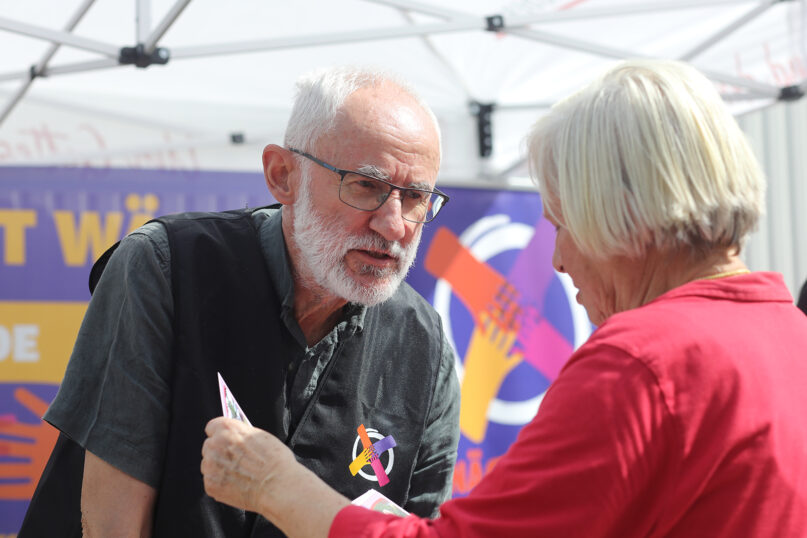
Norbert Weiß, left, a volunteer with the Catholic Diocese of Magdeburg, talks to patrons about upcoming elections in Saxony-Anhalt as part of the Magdeburg diocese's “Vote Consciously” campaign during the “Festival of Hope” in Dessau Market Square, August 30, 2026. (RNS photo/Liam Adams)

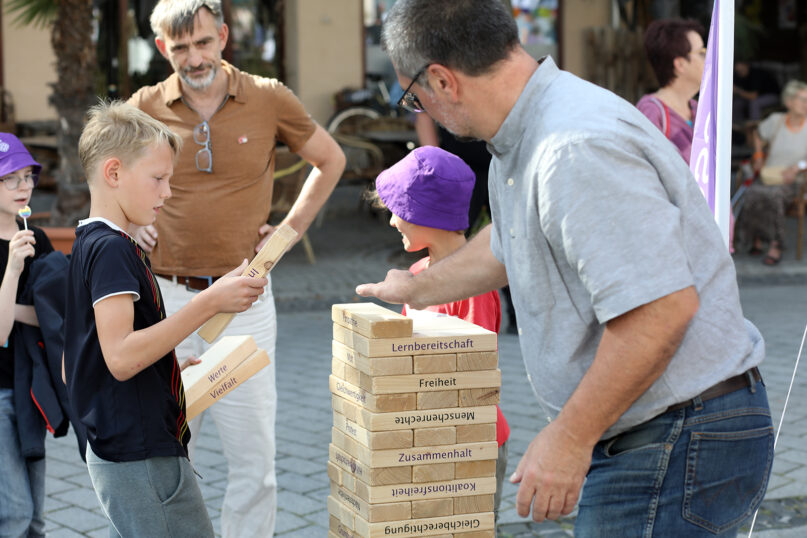
Udo Israel, rear left, and Frieder Weigmann help kids stack a “democracy Jenga tower” at the “Festival of Hope” in Dessau Market Square, August 30, 2026. (RNS photo/Liam Adams)

As thousands of parishioners and clergy enjoyed bratwursts, musical acts and panels with top church leaders addressed the election. As this mostly older crowd listened or danced, kids climbed a rock wall, took selfies with a famous influencer who briefly showed up and stacked a “democracy Jenga tower.”

Klemens Schubert said the tower, imprinted with phrases like “solidarity and human rights,” is a fitting metaphor, whether it stands or falls.

Bishop Friedrich Kramer, the top administrative leader for the Protestant church in most of Saxony-Anhalt, said all this activity is unprecedented for churches, but it wasn’t their choice.

“The churches are not the motor of escalation. In this case, it’s the AfD,” he said in an interview, which a colleague translated from German. “We have to say something against them, and we have to defend the people or the groups that are affected by the AfD.”

The person within the AfD who’s most responsible for the proposals and messaging that’s stirring this outcry among churches is Hans-Thomas Tillschneider.


Hans-Thomas Tillschneider, third from right, a top politician within the AfD in Saxony-Anhalt, participates in a “Christians ask politicians” candidate forum on August 17, 2026, in Magdeburg, Germany. (RNS photo/Liam Adams)

Tillschneider, deputy state chairman for the AfD in Saxony-Anhalt, walked with determination through the state parliament building in Magdeburg, his footsteps reverberating through the halls.

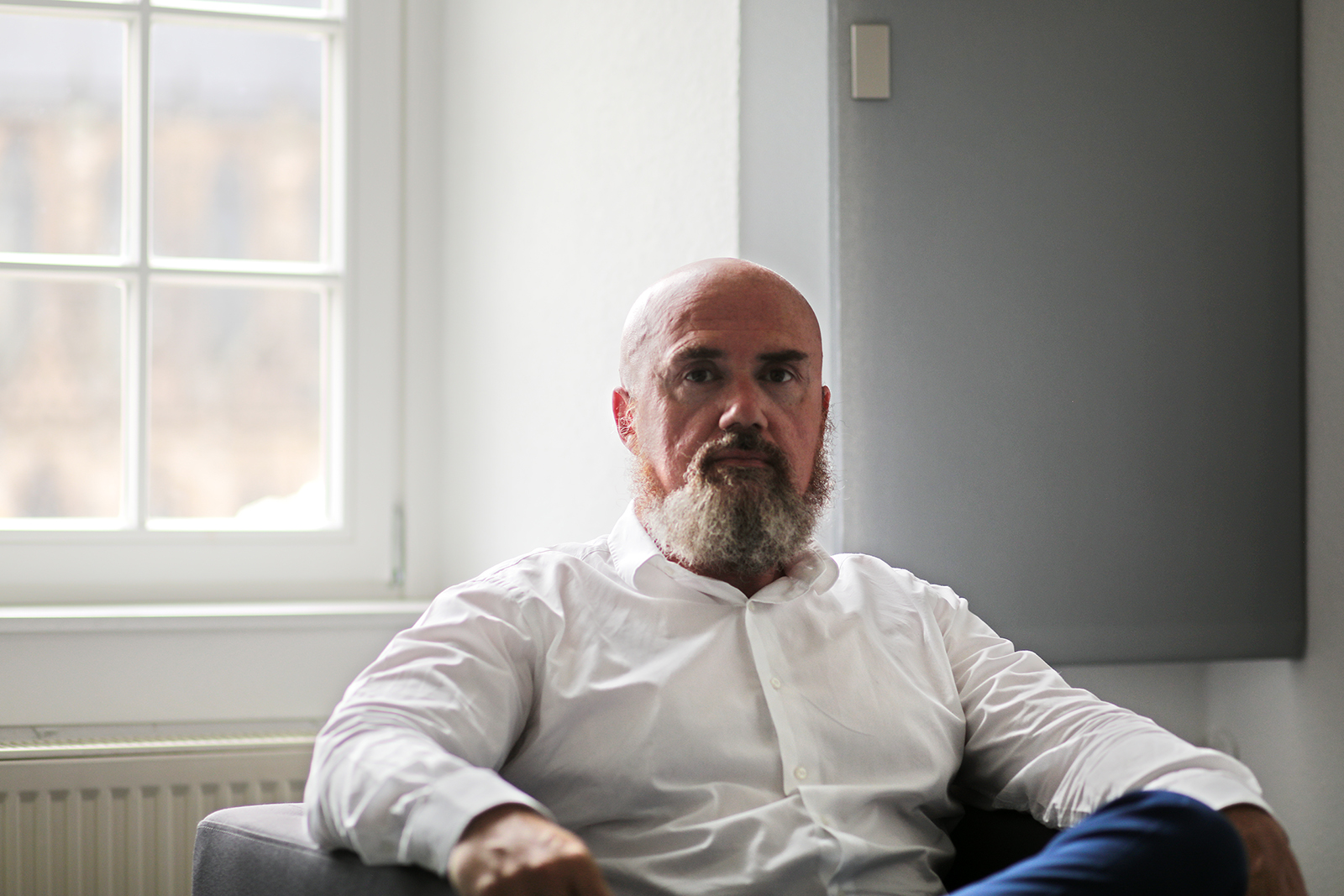
He’s balding but sports a scruffy beard and thick-rimmed glasses, which Tillschneider removed to pause and think of an answer to a question about whether the AfD serves only white, Christian Germans.

“We make politics in the interest of our citizens, and our citizens are mostly German. Whiteness, I am not interested in this race question. And if there’s a Black German voting for AfD, no problem” Tillschneider said. “Muslims of course can practice their religion. But this doesn’t alter the fact that Germany is a Christian country. Hundreds and hundreds of years of German history is influenced deeply by Christianity.”

The Office for the Protection of the Constitution classifies this AfD state branch as a confirmed “right-wing extremist” organization.

Known within and beyond Saxony-Anhalt for his inflammatory comments about LGBTQ+ people and immigrants, Tillschneider was the key figure behind an election manifesto that drew international attention for controversial policy proposals.


Hans-Thomas Tillschneider, deputy state chairman for the Alternative für Deutschland (AfD) party in Saxony-Anhalt, at his office on August 17, 2026. Tillschneider has been a top strategist behind the party’s most controversial police proposals in advance of upcoming elections in the state of Saxony-Anhalt. (RNS photo/Liam Adams)

One proposal that drew attention was a tax incentive for families to have more children. Another is ending inclusive classroom programs for for children with disabilities and restricting some immigrant children to continue attending class.

Tillschneider was in the middle of a firestorm the week before the election after a media interview aired that showed a mug he owns with the insignia of the Russian army ­— a reminder of his controversial visit with others in the AfD to the Russian-occupied Donbas region in Ukraine in 2022.

When he spoke to RNS, he showed off a different mug: It was bright red and emblazoned, “Donald Trump 45-47 USA President.”

Tillschneider has also led the charge on proposals that aim to weaken the Catholic and Protestant churches, which would strip them of two public funding sources and even redirect some of that income to so-called free churches.

This is partly motivated by Tillschneider’s ongoing conversion to Orthodoxy, inspired by a visit last year to a monastery that infuses German language and cultural customs with Greek Orthodox liturgy.

“In the church, prayer should do no more than this. Not talking about parties, not talking about political tendencies, not talking about political agenda,” Tillschneider said. “Only praying for our country.”


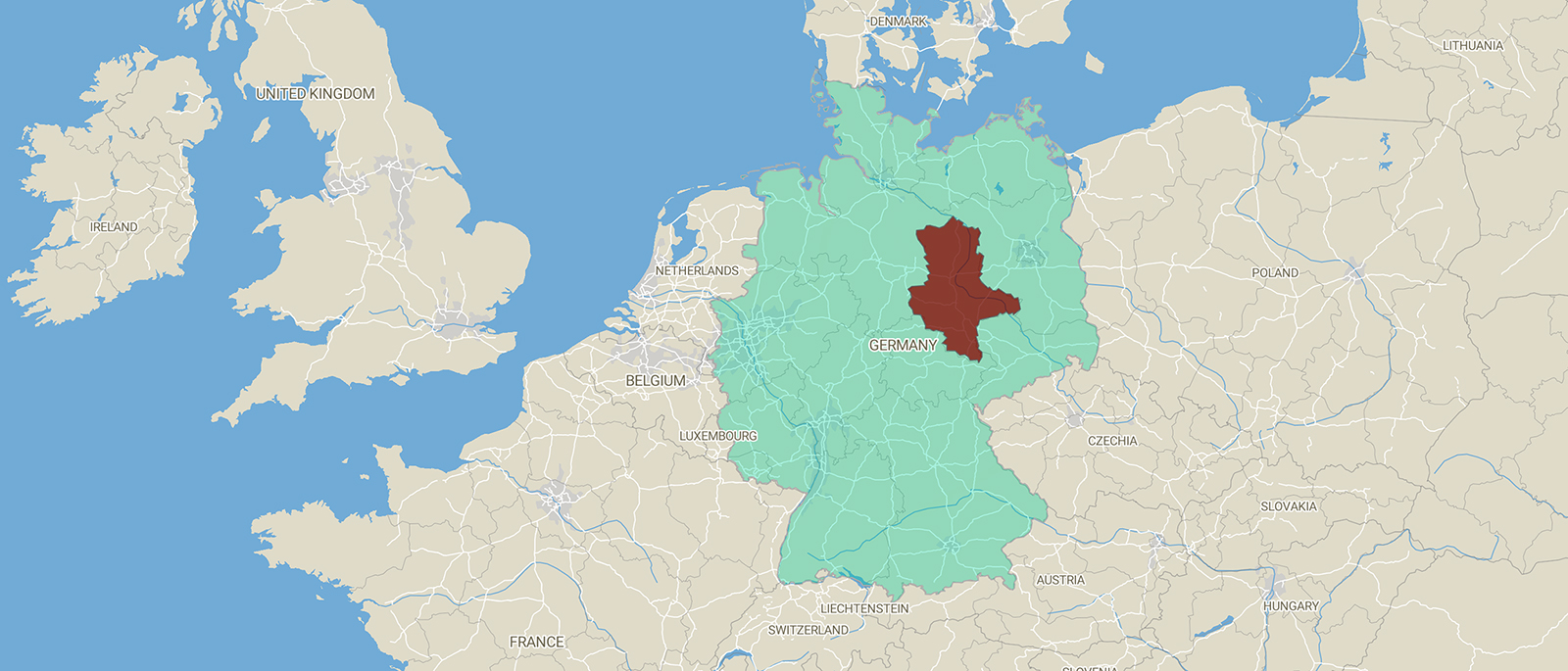
The state of Saxony-Anhalt, red, in Germany. (RNS graphic/Kit Doyle/Datawrapper)

Saxony-Anhalt is home to the birthplace of the Protestant Reformation. Ironically, it’s now one of the most irreligious parts of an already secularized country. This is because it was one of five states that comprised the former German Democratic Republic, which was part of the Soviet bloc and functionally atheist. Today only about 10% of the total population identifies as Protestant and just 3% as Catholic.

Conflict between churches and the AfD has been growing since 2017, when the Catholic and Protestant churches barred AfD politicians from speaking at the largest Christian gatherings in Germany.

Then, the German Catholic Bishop’s Conference denounced the far-right party in 2024. That same year, the Protestant church demoted a pastor in Saxony-Anhalt who ran for city council as an AfD candidate.

In August, a nursing home operated by the Protestant church’s social welfare agency fired an employee who is running for city council as an AfD candidate.


The Rev. Kate Harris Weishaupt, pastor of EmK-Gemeinde Halle, a United Methodist Church in Halle, a city in Saxony-Anhalt, Germany, on August 30, 2026. (RNS photo/Liam Adams)

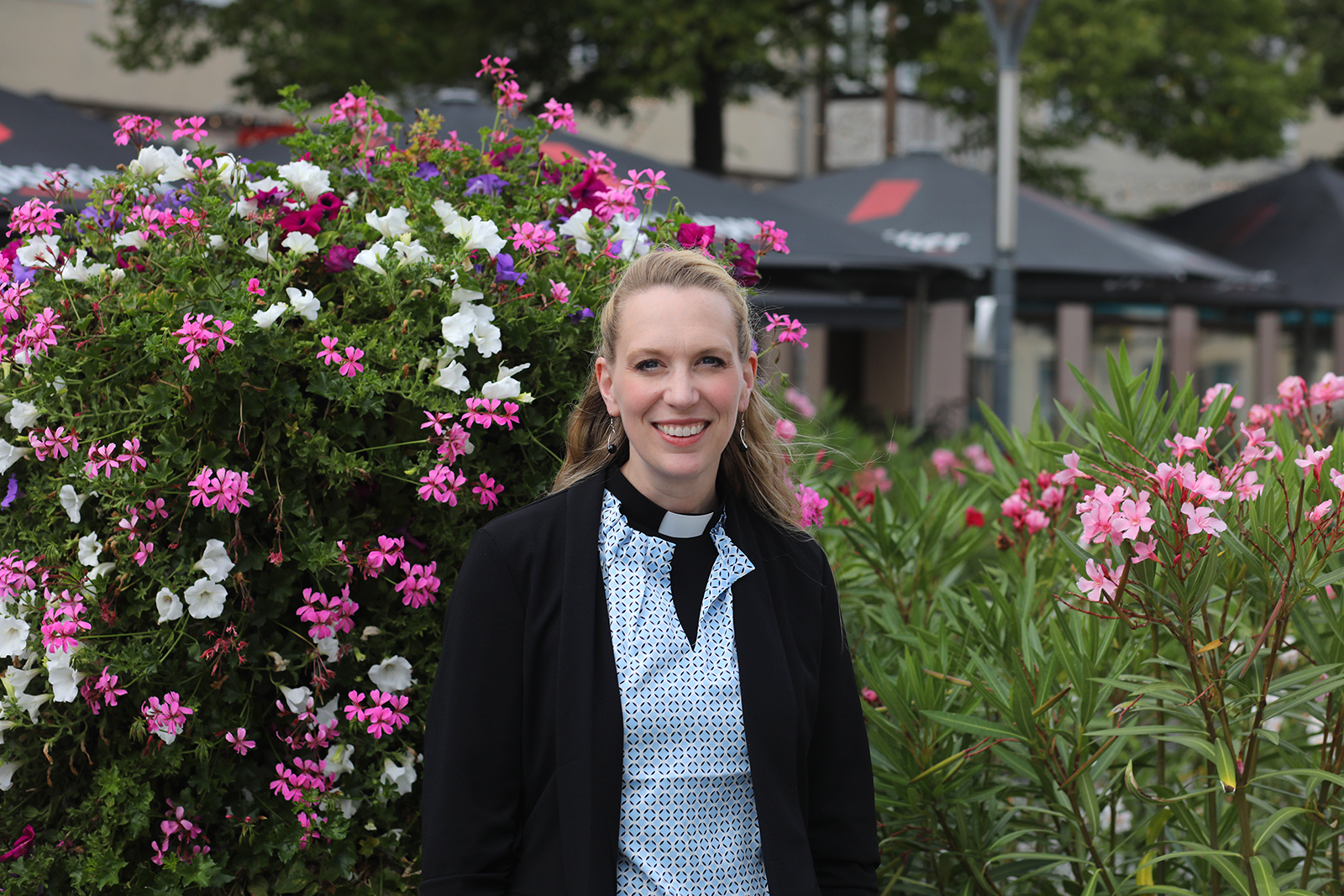
“I’m really proud the church is taking a stand and, for example, not allowing people to continue in workplaces if they run for the AfD,” said the Rev. Kate Harris Weishaupt, an American pastor who has lived in Germany since 2015. “I’m hoping we can prevent it before it gets too far.”

This past June, a regional United Methodist Church assembly declared it was “incompatible” to be associated with the AfD and part of the UMC in Germany, based on a paper from Harris Weishaupt, who leads a United Methodist congregation in Halle, a city in Saxony-Anhalt.

Pastors in more rural parts of the state are resisting as well.


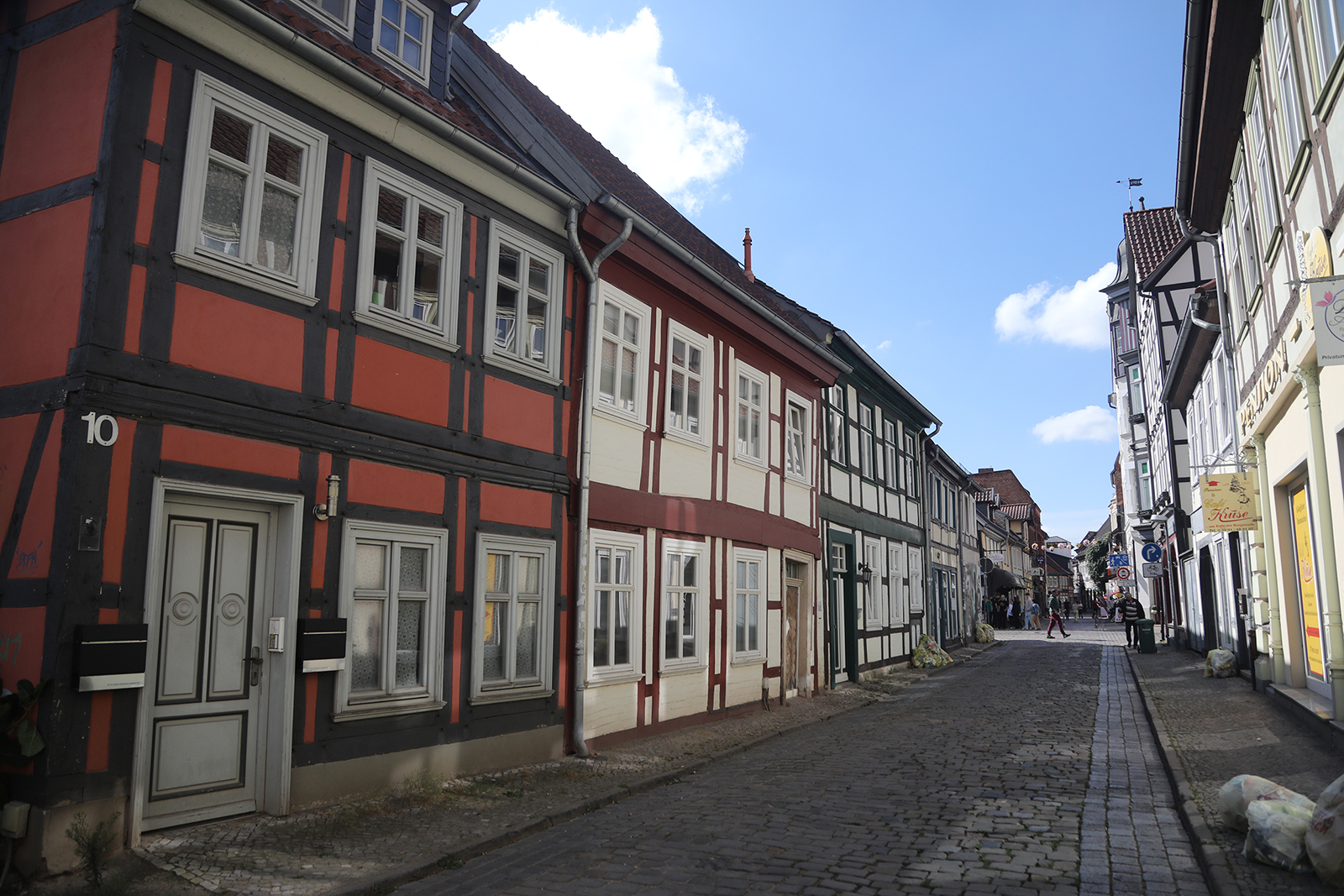
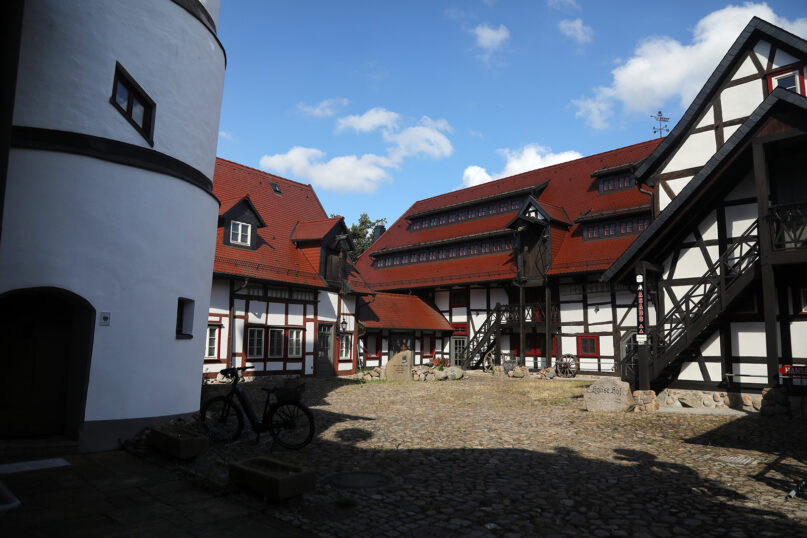
The medieval city of Salzwedel, pictured on August 25, 2026, is located in the heart of a region in northern Saxony-Anhalt that is geographically isolated from major economic hubs in Germany. It was once the heart of commerce in Prussia. (RNS photo/Liam Adams)

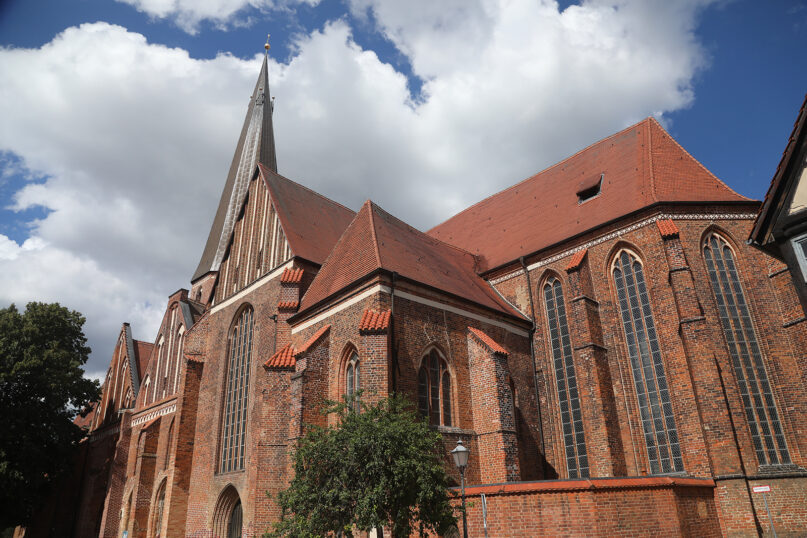
In Salzwedel in northern Saxony-Anhalt, the red-brick Marienkirche towers over a medieval village with hidden courtyards and buildings that slouch and slump under the pressure of sinking foundations.

The region, known as the Altmark, was the center of commerce in Prussia centuries ago, and its share of church buildings per capita reportedly outnumbers other parts of the country. But today, its job market and churchgoing culture struggle.

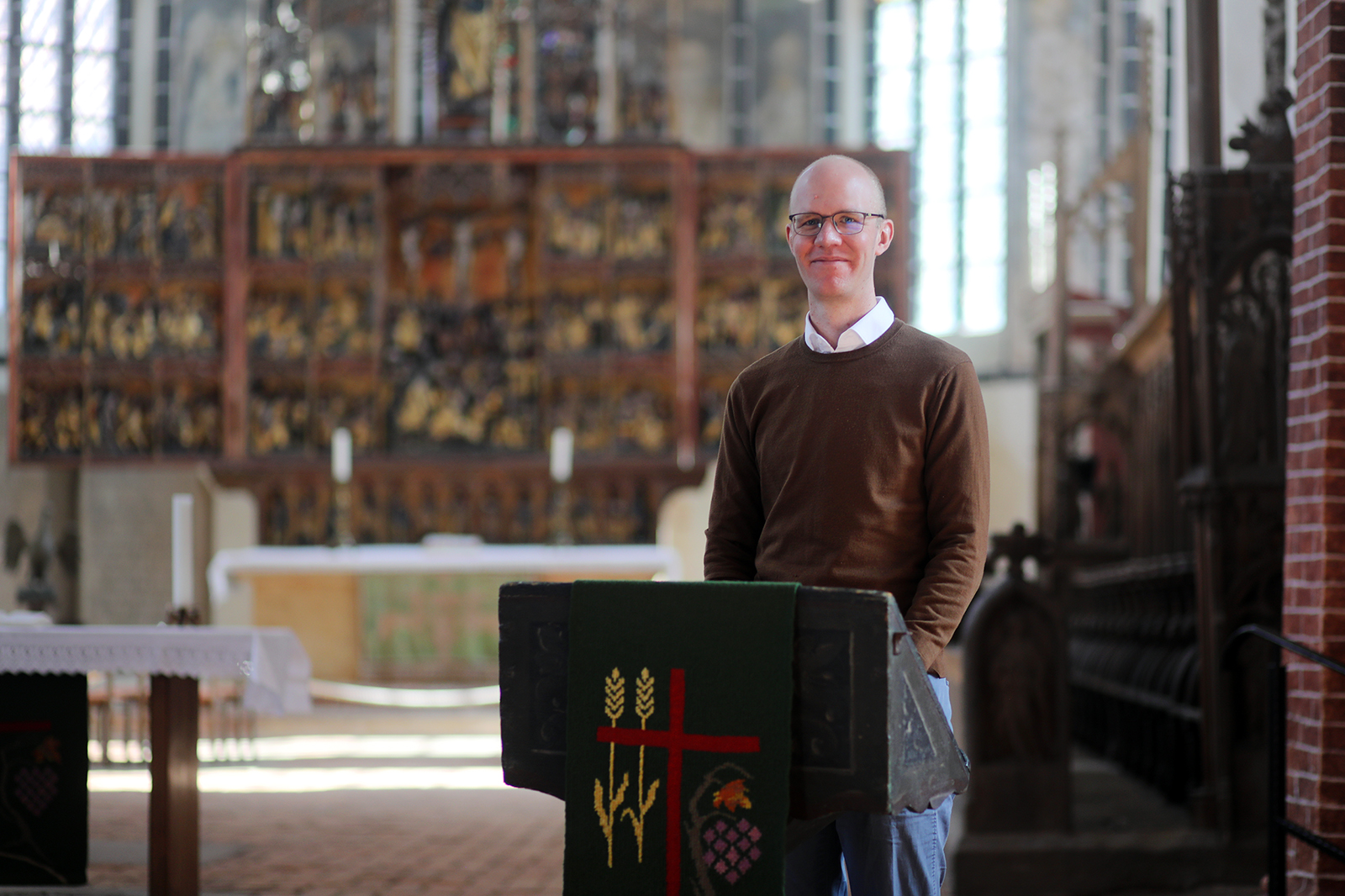
“It’s in the middle of nowhere, and the people have it in their minds they are forgotten by everyone,” said the Rev. Alexander Tiedemann, pastor of Marienkirche.


The Rev. Alexander Tiedemann, pastor of Marienkirche in Salzwedel, a city in northern Saxony-Anhalt, Germany, on August 25, 2026. (RNS photo/Liam Adams)

Tiedemann said he’s trying to follow the example of his father and grandfather, who were Protestant pastors in the German Democratic Republic when churches were being repressed. He has sought to embody the tradition of preachers finding clever ways to resist from the pulpit using “parables,” rather than outright denunciations.

The so-called Peaceful Revolution that led to the fall of the Berlin Wall began with protests in 1989 that sprang from churches where demonstrators gathered for Monday morning prayer meetings. That history is on the minds of many faith leaders in their recent advocacy against the AfD.

“Especially when I look at a historic place like this, there are so many difficult times the church went through,” Tiedemann said. “The message nevertheless found a way.”

Marienkirche, a Protestant congregation in Salzwedel, a city in northern Saxony-Anhalt, Germany, on August 25, 2026. (RNS photo/Liam Adams)

The medieval city of Salzwedel, pictured on August 25, 2026, is located in the heart of a region in northern Saxony-Anhalt that is geographically isolated from major economic hubs in Germany.(RNS photo/Liam Adams)

Back in Burg near Magdeburg, Bischoff confronted the current heated political climate when vandals spray-painted a pro-Nazi reference and other divisive phrases on the wall surrounding St. Petri. In response, she organized a party to repaint the wall and focus on “election empowerment,” she said.

Now, the façade is more uplifting, but the refugees inside still struggle as the election nears. Parsi had expected an update on her asylum case by early August, but she was still waiting in church asylum just a few days before the election.

“I don’t know what is going to happen with my case, and the upcoming elections in Sachsen-Anhalt make me even more anxious,” she said in a message. “I just want to know what my future will be and whether I can stay safe.”


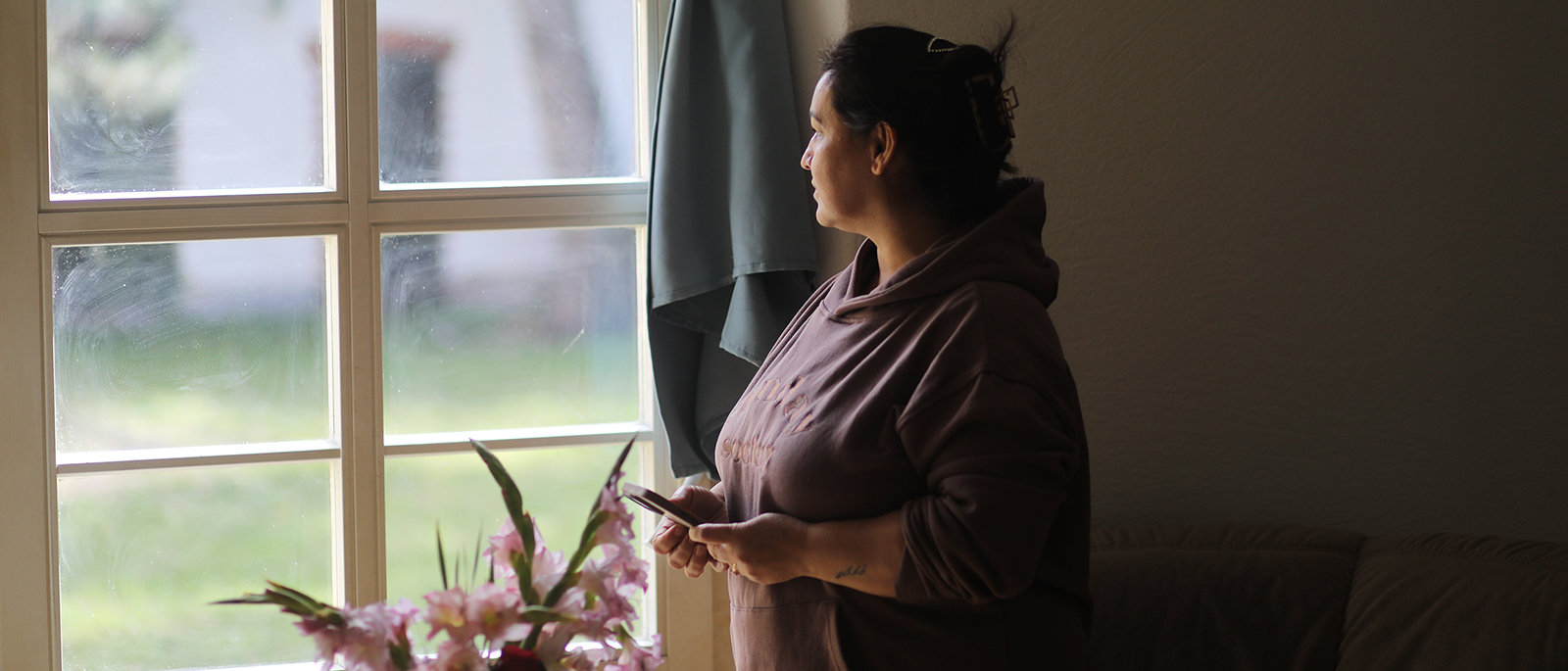
Zholia Parsi looks out the window of the St. Petri parish house on August 26, 2026, in Burg near Magdeburg, Germany. (RNS photo/Liam Adams)
 

Liam Adams is a journalist from Nashville, Tennessee, and is currently based in Berlin, Germany, as part of the Arthur F. Burns Fellowship 2026 class.

In direct appeal to Trump, Catholic bishops' president urges end of mass deportations of Haitians


(RNS) — The letter marks a shift toward a more direct and pointed tone in challenging President Donald Trump’s immigration policy.
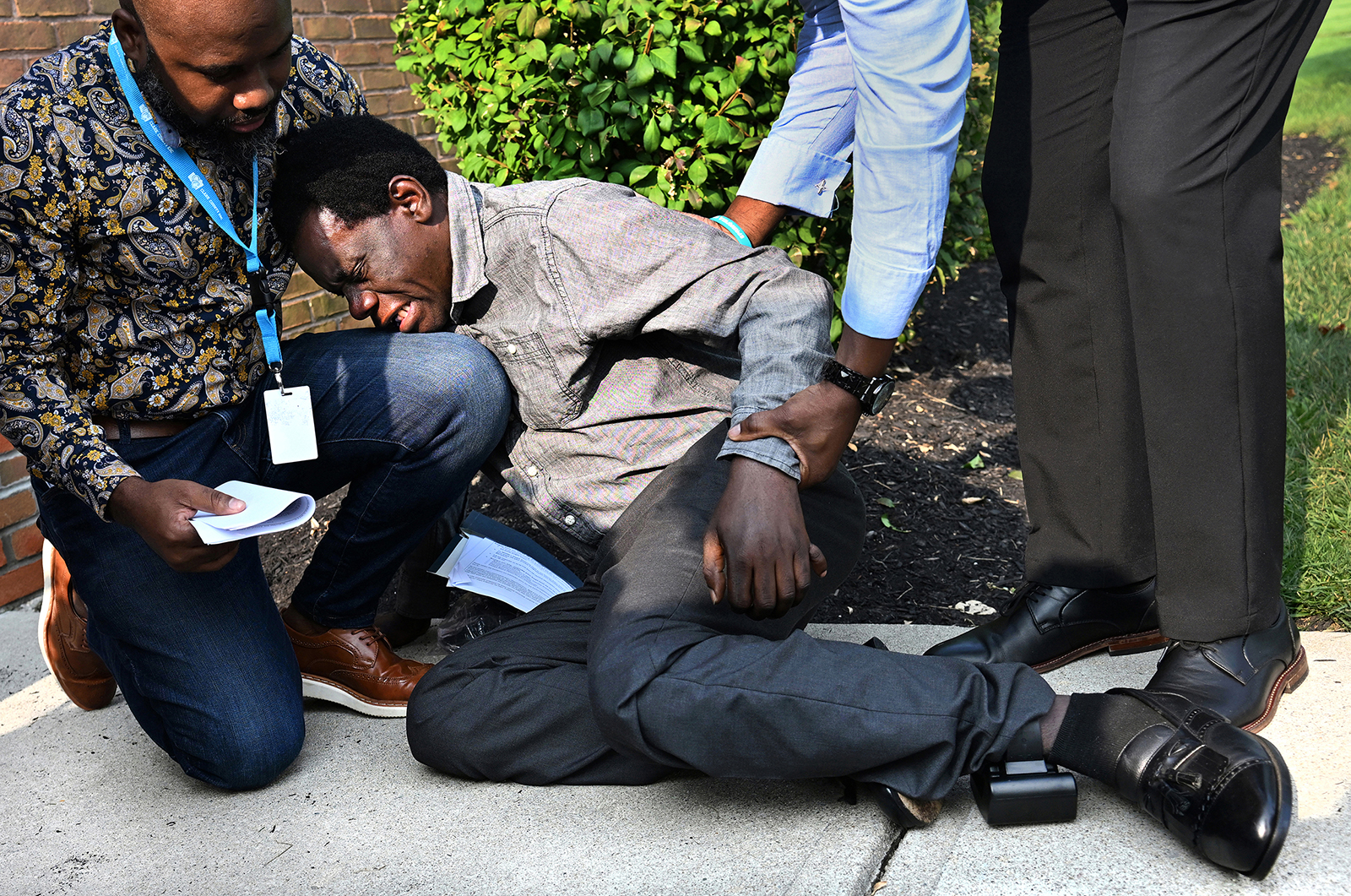
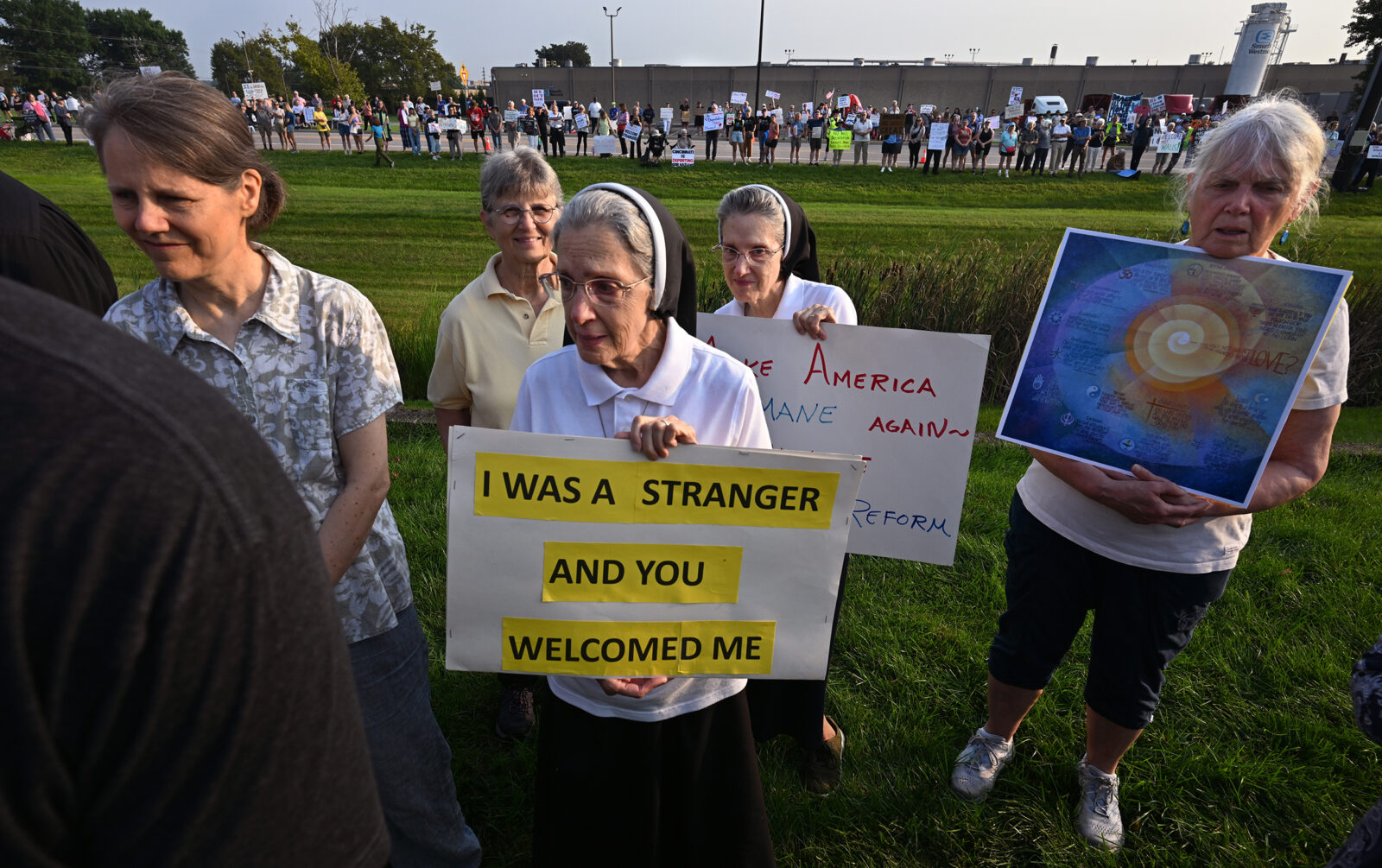
Community members hold a protest rally as immigrants enter an ICE facility at a Department of Homeland Security field office during a mandatory check in where most received ankle monitors, after thousands of Haitians lost Temporary Protected Status (TPS), in Blue Ash, Ohio on Aug. 9, 2026. (RNS photo/Carol Guzy)

(RNS) — Archbishop Paul Coakley of Oklahoma City, the U.S. Catholic bishops’ conference president, sent a letter on Tuesday (Sept. 8), urging President Donald Trump to cease the deportation of “large numbers” of Haitian immigrants. 

Citing the violence in Haiti, Coakley wrote: “As citizens of this great country, we have been entrusted with a tremendous moral responsibility, and this is true most of all for you as our head of state, Mr. President. To this end, I respectfully ask: What good is the immense wealth, prosperity, and influence with which we have been blessed as a nation if not used in service of our humanity?”

The letter’s language marked a notable hardening in tone from the U.S. bishops’ conference, though Coakley also wrote that he was “humbly” appealing for Trump’s assistance. 

Last November, the U.S. bishops’ conference released a special pastoral message calling for an end to “indiscriminate mass deportation,” a sign of how seriously the conference is taking deportation policies that could impact nearly 1 in 5 U.S. Catholics directly or through their family. But that message did not name Trump.

In his letter this week, Coakley wrote that he was inspired by the massacre of 47 people in Haiti’s Kenscoff farming community to write. Some of the people killed had been taking refuge in a church, and some of those killed were children. Coakley called the violence “unconscionable.”

“I very much wish this recent and tragic example of human life being extinguished, virtually with impunity, was an irregularity in Haiti. Unfortunately, it is not,” Coakley wrote. He told Trump that deportations endanger “innocent human life” and “contribute to the country’s already deepening crisis.”

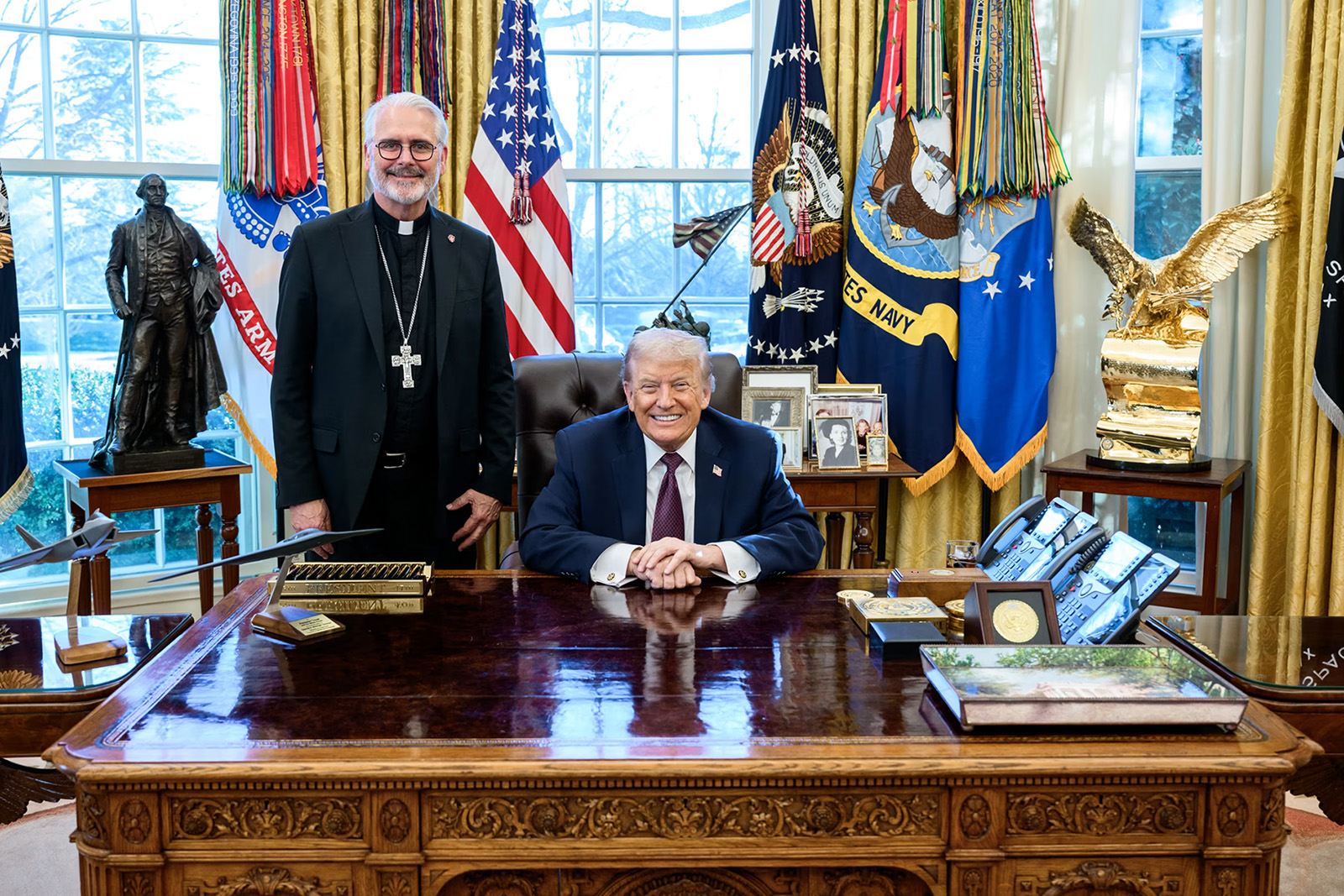
Archbishop Paul Coakley of Oklahoma City, president of the U.S. Conference of Catholic Bishops, meets with President Donald Trump at the White House on Jan. 12, 2026. (Official White House Photo)

Since the Trump administration revoked temporary protected status for Haitians in late July, an estimated 350,000 Haitians have been vulnerable to detention and deportation.  

Coakley did acknowledge that the administration could move forward with individual deportations “to advance justice and public safety.”


The Oklahoma City archbishop has often been seen as a conservative, particularly because he is ecclesiastical adviser to the Napa Institute, which unites wealthy Catholics around conservative causes. Coakley’s letter to Trump indicated that he has spoken to the president about immigration before, referencing a previous conversation in which Coakley recognized “the importance of regulating immigration and enforcing federal immigration law.” 

Coakley met with Trump in January, the first time that the bishops’ conference president had met with the U.S. president in nearly a decade. Shortly afterward, the administration announced a change to the visa requirement that had forced foreign priests and other religious workers to exit the U.S. for a year between religious visas, which the conference had long sought.

Haitian immigrant Monsanto Maler, center, cries and collapses after receiving an ankle monitor at a Department of Homeland Security field office during a mandatory check in, on Aug. 9, 2026, in Blue Ash, Ohio. (RNS photo/Carol Guzy)

In this Tuesday letter, Coakley wrote, “the Catholic Church is sensitive to the fact that many families, especially mixed-status families, would benefit from ceasing the deportations. The strength of our communities depends, in large part, on the well-being of such families.” He also highlighted Haitian contributions to the economy and health care and invoked religious and patriotic ideals about the right to life. “I know you understand the essential role the United States plays in promoting the inherent value of human life,” he wrote to Trump.

He said that the U.S. bishops would continue to pray for and support immigration reform.

Other faith leaders have also expressed concerns about Haitians facing deportation, including more than 100 Pentecostal leaders who gathered in Washington earlier this week and a separate letter organized by the National Latino Evangelical Coalition and the National Association of Evangelicals urging an extension of Temporary Protected Status for Haitians.


 Opinion

25 years after 9/11, war is still not the answer


(RNS) — It pains me to consider how much harm my government has inflicted abroad and within our own communities since 9/11.
The twin towers of the World Trade Center burn behind the Empire State Building, Sept. 11, 2001, in New York. (AP Photo/Marty Lederhandler, File)


(RNS) — I was 27 years old, living in New York City and early in my career as a Quaker peace advocate, when the attacks of Sept. 11, 2001, shook our country and the world. Days later, the Friends Committee on National Legislation (FCNL) — where I began my career and which I now run — issued a statement mourning the thousands of lives lost and calling for those responsible to be brought to justice through the rule of law.  

FCNL also warned against backlash targeting innocent Muslim and Middle Eastern communities and urged the U.S. government not to “commit the same sin by compounding the hatred, violence, and injustice of these attacks with its own acts of terror and war against another people.” Even amid profound national grief and uncertainty, FCNL offered a clear and steadfast witness: “War is not the answer.”  

Sadly, many of the concerns we raised after 9/11 became reality — and then became normalized through the Global War on Terror. While the U.S. has a long history of military interventions abroad and racialized oppression at home, our government’s response to 9/11 ushered in decades of endless war and entrenched discrimination, codified through the 2001 and 2002 Authorizations for the Use of Military Force, the Patriot Act and other shortsighted policies. We also saw this war-first approach take root domestically with the creation of the Department of Homeland Security, which folded immigration enforcement into the post-9/11 national security apparatus and helped bring the tools and logic of wars abroad to immigrant communities here at home.    

Rather than making us safer, these laws deepened the militarization of U.S. policy. The result has been decades of failed wars and military interventions far beyond the countries connected to the 9/11 attacks, alongside increasingly punitive treatment of immigrants within our own borders. A recent FCNL Education Fund report, for example, documents how U.S. military-first approaches since 9/11 have undermined stability and fueled violent conflict in Somalia. Meanwhile, Somali communities in Minnesota, many of whose members came to the U.S. seeking safety, have come under direct attack recently as part of the administration’s campaign against immigrant — particularly Muslim — communities. 


The Trump administration’s reckless use of military force, cruel mass deportation campaign, erosion of core democratic protections and blatant disregard for the rule of law demand unequivocal opposition. But these abuses did not begin with President Trump. For decades, Democratic and Republican administrations alike have invoked the “war on terror” and national security to justify expanding military action abroad and curtailing immigrant rights at home.  

Friends have long rejected the premise that we must choose between protecting our communities and upholding the rights and dignity of people seeking safety; instead, we have called for policies that advance security for all. For 25 years, fear and violence have too often driven U.S. policy. We need not allow them to dictate what comes next. 

A fully armed MQ-9 Reaper drone taxis down an Afghanistan runway Nov. 4, 2007. (Photo by Staff Sgt. Brian Ferguson/U.S. Air Force/Creative Commons)

It can be difficult to remember that it did not have to be this way. A different response was possible. Rather than invading Afghanistan and Iraq and launching military operations across the globe, the United States could have pursued accountability for the 9/11 attacks through U.S. and international law. It could have strengthened human rights at home while investing in diplomacy, development and peacebuilding abroad. And it could have honored the victims of 9/11 and their loved ones by choosing a path that upheld human dignity and protected innocent lives from further violence.  

Research and experience show that such alternatives are not simply aspirational. The landmark 2008 RAND study, “How Terrorist Groups End,” found that terrorist groups were most often brought to an end through the work of local police and intelligence agencies or through negotiated political settlements—not military force. In other words, the tools most effective at reducing terrorism have often been those that treat it as a matter of law enforcement or political conflict rather than war. 

We have seen that approach work around the world. From the peace agreement between the Colombian government and the Revolutionary Armed Forces of Colombia (FARC) to the Good Friday Agreement in Northern Ireland, negotiation and diplomacy have helped end or dramatically reduce decades of violence involving non-state armed groups. These examples are reminders that pursuing security does not require defaulting to war.

At 52, I still remember the attacks vividly. It was a defining moment for my generation, our country and the world — one that ushered in dangerous and costly changes to U.S. policy, along with new restrictions on our civil liberties and everyday freedoms. I remember a time before security lines and metal detectors became routine at airports, and before the prospect of deployment to war loomed over so many young people.   

It pains me to consider how much harm my government has inflicted abroad and within our own communities since 9/11. Yet when I look back over these 25 years, I am also reminded that the story is not only one of violence and loss. We have made meaningful progress toward peace — and that progress offers both a lesson and a reason for hope.  

Our world is more connected, and civil society has found new ways to organize and advance change across borders and in our own communities. Nonviolent movements have toppled long-standing dictators, more people are challenging racism, sexism and ableism; and our own Congress has grown more diverse than ever before. Younger generations, too, are building movements for greater justice. Even as the promise of a more peaceful, just and sustainable world has sometimes seemed to recede, the work of creating it has grown. 

We have seen that persistence translate into policy change. Last October, Congress repealed the 2002 Authorization for the Use of Military Force, ending the Iraq War authorization after decades of advocacy and bipartisan cooperation. And this year, growing public outcry — including from faith leaders standing with their immigrant neighbors — helped stall funding for the administration’s cruel mass deportation campaign for months.   

In 2001, Rep. Barbara Lee stood alone in Congress in voting against the authorization that opened the door to the Global War on Terror. Today, more lawmakers recognize the danger of leaving that law on the books, and momentum for repeal is building. The House recently passed a resolution to end U.S. military action against Iran, which narrowly failed in the Senate. Slowly but surely, Congress is beginning to reclaim its constitutional authority over war. 


It is also long past time to reject an immigration system that treats migrants, families, asylum seekers and entire communities as threats. That fear-driven framework has helped enable the indiscriminate mass deportation campaign we see today. Armed federal agents have no place roaming our streets masked, detaining people without cause or accountability. Congress must confront these abuses, hold Immigrations and Customs Enforcement and Border Patrol accountable and ensure that armed federal agents are not used to intimidate communities — including at or near polling places.  

Twenty-five years after 9/11, another world is still possible. Congress can honor this anniversary by rejecting policies rooted in fear and violence, reasserting constitutional authority over war and protecting the rights and dignity of all people in this country. We do not have to choose between security and justice; lasting security depends on pursuing both.   

At FCNL, our advocacy for a better world continues, just as it did in the grief and uncertainty following 9/11. After 25 years, our conviction remains unchanged: War is not the answer — at home or abroad. 

(Bridget Moix is the general secretary of the Friends Committee on National Legislation and leads two other Quaker organizations, Friends Place on Capitol Hill and the FCNL Education Fund. The views expressed in this commentary do not necessarily reflect those of Religion News Service.)