Tuesday, October 27, 2026

World Is on Track for Up to 2.8 Degrees of Warming Despite Clean Energy Boom

  • UNEP’s new Emissions Gap Report says the 1.5 degree target is out of reach, with current policies pointing to about 2.8 degrees of warming by 2100 and 2.6 degrees if every national pledge is met.

  • Renewables overtook coal in global power generation and EVs hit one in four new car sales, yet fossil fuel emissions rose last year and demand growth from AI and developing economies is eating into the gains.

  • Energy security, not climate, is driving the buildout, which could leave the Paris targets without a political engine once the price and supply shocks fade.

The United Nations says that it is now an inevitability that the world will fail to meet the legally binding goals set forth by the Paris climate accord as a result of “decades of insufficient climate action”. The Paris Agreement, ratified in 2015, targeted limiting global warming to 1.5 degrees Celsius above pre-industrial averages, with a fallback target of 2?, with the understanding that this looser allowance would lead to far more devastating consequences for global ecosystems, human health, the economy, and future generations. As it stands today, not only are we on track to blow past 2 degrees, but will likely reach 2.6? and 2.8? by the end of the century.

A new bombshell report from the United Nations Environmental Program (UNEP) is a call to action, finding that while the 1.5? target is no longer in reach, there is still plenty that global leaders can do to avoid the worst impacts of climate change. The annual report, optimistically titled The Point of Return, finds that there is “ample opportunity to accelerate action”, and concludes that “countries can still limit peak warming, shorten the duration of overshoot and keep the goals of the Paris Agreement within reach”.

This report is coming out against the backdrop of the fastest buildout of clean energy resources in human history. Catalyzed by back-to-back oil and gas affordability crises stemming from the wars in Ukraine and Iran, the global clean energy transition is going gangbusters as we speak. Renewable energy sources now have a larger share of the global energy mix than coal, and one in  four new cars sold last year was an electric vehicle, avoiding the consumption of 1.2 million barrels of oil a day. 

The problem is that while this is all great news for climate change mitigation, it may very well be too little, too late. “The scale and speed of the transition has been far too slow to arrest global warming as climate pollution continues to build up in the atmosphere,” Politico wrote this week in a report entitled “Clean Energy Isn’t Fixing Climate Change”. The report goes on to highlight that, based on figures from the UNEP report, “emissions from fossil fuel use increased last year and methane remained stagnant, despite commitments by countries and companies to quickly curb the potent pollutant.”

Plus all the clean energy we can add may not be enough without also improving energy efficiency and creating tighter regulations for consumption. While clean energy production capacity is expanding rapidly, so too is energy demand, driven by the artificial intelligence boom in the Global North and economic and human development in the Global South. 

What is more, the proliferation of clean energy as an energy security strategy has become a double-edged sword. Renewables are growing faster than ever before, even in the poorest parts of the world, because countries see them as the cheapest and most secure pathway to energy independence in an era of extreme geopolitical turmoil and out-of-control fossilflation. In short, clean energy development is no longer about climate; it’s about security. 

“Wind and solar cannot be embargoed, blockaded, or shut off by a foreign power,” David Frykman, General Partner at Stockholm-based venture capital group Norrsken, wrote in an op-ed for Fortune earlier this year. “Every terawatt-hour of domestic renewable generation is a terawatt-hour that no adversary can weaponize.”

While this is great for the growth of the global renewable energy sector, it means that clean energy goals have become completely divested from climate goals – and that could be a major issue for the Paris Agreement targets, which will require enormous global effort and investment for the future and the greater good, not the here and now and the bottom line.

“For years, clean energy has been sold as a moral imperative. Now it is simply an economic and geopolitical necessity,” Forbes reported earlier this year. “It’s not about emissions. It’s about resilience and price stability.” But in order to seize the point of return, it needs to be about both.

By Haley Zaremba for Oilprice.com 

Is Wall Street Getting It All Wrong About AI, Oil, and Bonds?


  • Magazine covers reflecting widespread market pessimism can sometimes coincide with major turning points.

  • A recession triggered by an AI investment downturn and high energy costs could push interest rates lower and bond prices higher.

  • A contrarian warning that an AI crash could contribute to an economic downturn more severe than the 2008 financial crisis.

It seems that everywhere you look in the financial media these days, there is persistent hype about artificial intelligence (AI) and the companies developing it. Right alongside this great investment boom is doom and gloom about the future value of bonds. Oil, too, is frequently covered for two reasons: the inability of oil futures prices—which seem suspiciously low—to reflect the long-term effects of what is happening in the Persian Gulf, and the high prices of refined products such as gasoline and diesel, where the real squeeze seems to be right now.

It's hard to resist the constant din of such news in order to arrive at an independent assessment. But that is precisely what we should strive to do in the face of what seems like the overwhelming consensus. However, I am not writing to give you financial advice, which often requires precise timing to be of much value. In the financial markets—as I have learned again and again—being early is almost always the equivalent of being wrong. What I hope to do is to help you understand the financial news better. First, let me declare that I have no financial interest in anything mentioned in this piece, lest you think I am "talking my book."

To be a contrarian with a long view requires a lot of mental armor, as near-term events almost always contradict your prognostications. Trends in financial markets tend to go on longer than any skeptic can conceive. As famed economist John Maynard Keynes is quoted as saying, "Markets can remain irrational longer than you can remain solvent." Taking the long view, not surprisingly, requires not only patience but also fortitude.

It turns out that one of the best indicators for contrarians like me are covers of The Economist magazine, which historically have signaled an important inflection point in the market. This is not because the magazine's editors believe an inflection point is near. On the contrary, they believe the trend is intact and will persist for much longer, if not indefinitely. But history suggests that when the conventional wisdom has penetrated the editorial offices of The Economist and specifically those in charge of covers, that wisdom is about to be proved obsolete.

My favorite example is the March 6, 1999 cover of The Economist, which shows two oil workers covered in crude oil that is gushing upwards from a valve they are desperately trying to close. The headline is "Drowning in oil." At the time, the spot price for the world benchmark Brent Crude, that is, the price for immediate delivery, was hovering around $10 per barrel. This is after Brent Crude registered the unfathomably (by today's standards) low price of $9.44 per barrel during the second week of the previous December. The markets really were drowning in oil.

What's more is that The Economist suggested in the same edition that prices might settle around $5 per barrel given the incentive of producers to produce more to generate sufficient income to meet their obligations and given the presumed surfeit of oil available to be exploited.

As it turns out, that edition very closely marked the nadir of oil prices, which by the second week of March 2000 had reached $30 per barrel and were on their way to over $140 per barrel by mid-2008, the all-time top. (Prices never did decline to the aforementioned $5 per barrel.)

And so, much more recently, The Economist opined about the direction of bond prices. (For anyone who doesn't keep track of such things, bonds are simply financial instruments that allow you to lend money to a government or corporation at a specified interest rate with a promise to repay what you originally lent by a specific date. For example, a 10-year bond will be repaid in 10 years.) The magazine believes a government bond crisis is in the offing, something it announced on its cover on October 8. Interest rates have catapulted worldwide from historic lows, meaning governments now have to pay much more to borrow. To understand what this means to bondholders, that is, those lending to governments, you need to do a little math. If you buy a bond for $1,000 which pays 2.5 percent interest for 5 years, you almost certainly will not be able to sell that bond to someone else for what you paid if interest rates go up.

Let's assume that interest rates have risen to 5 percent. An investor can now buy a $1,000 bond directly from the government and get 5 percent interest per year (50), twice what your bond pays ($25). Since your bond pays interest that is only half of what any investor can now get by buying from the government directly, if you want to sell, you'll have to discount the price of your bond considerably. You'd have to sell your bond for half of what you bought it for to match the interest payments on the new 5-percent bonds. (I'm simplifying the situation a bit to make the example easy to understand.) Those bonds pay $50 in interest per year and yours only pay $25, so an investor would need two of your bonds to equal the $50 in interest, which means that investor will only offer you $500 for your bond. The $25 per year interest now equals 5 percent for the new owner.

In its cover piece, The Economist is offering a double warning, one for governments and their citizens and one for investors. High interest rates tend to slow down the economy while making it more expensive for governments to pay interest on their debt. Investors become gun-shy about investing in government bonds if they believe interest rates will shoot up, undermining the value of the bonds—which in turn forces governments to offer higher interest payments to attract bond buyers. This can become a vicious circle that threatens a loss of confidence in the government and its currency.

I'm inclined to think that because this looming crisis has hit the front cover of The Economist, it will shortly dissipate and interest rates will head down, pushing bond prices up. (Reversing my example above, a 5 percent bond fetches a much higher price when new bonds only yield 2.5 percent.) The likely cause of this reversal will be an economic recession that shrinks economic activity, thereby lowering the demand for credit and thus reducing its price, that is, the interest rate charged. I'm not prophesying the kind of bull market in bonds that lasted 40 years from 1980 to 2020 and took the 30-year U.S. Treasury bond from nearly 15 percent down to 1 percent during the COVID pandemic. But I do think a medium-term reversal might be in the offing.

What might cause that recession? Now we circle back to AI. The AI industry is in what is almost certainly a financial bubble. The bubble will inevitably burst one day, bringing down stock prices and investment in the economy. Another thing pushing down on the economy: high oil prices and the prices of oil products such as gasoline and diesel. I happen to think the resulting recession will be worse than 2008. Back then, high oil prices also played an important part in creating the financial crash.

The financial headlines today do, in fact, presage tomorrow, just not in the way most people think. They often signal an important top or bottom in the prevailing trend, which is just the opposite of what those headlines are saying or implying. I'm reminded of Stein's Law, the amusingly obvious observation made by economist Herbert Stein: "If something cannot go on forever, it will stop." It's easy to forget that in the frenzy that is now gripping world markets which are in thrall to the AI industry's hype machine.

P.S. For a short tour of magazine covers that got it wrong while inadvertently giving fodder to the contrarian readers, see this summary.

By Kurt Cobb via Resource Insights

Russia's Arctic Oil Shortcut Runs Into a Wall of Ice


  • Russian oil shipments through the Northern Sea Route reached approximately 20 million barrels by mid-October 2026, nearly 50% above last year's total.

  • Difficult ice conditions, shortages of suitable tankers, and Western sanctions continue to undermine Russia's Arctic shipping ambitions.

  • Growing Russian and Chinese activity in the Arctic is raising geopolitical tensions and environmental concerns over potential oil spills.

A group of sanctioned Russian tankers dropped anchor some 1,300 kilometers north of the Arctic Circle in July after getting stuck and hunkered down for a long wait in the frozen waters at the top of the world. Help from two nuclear-powered icebreakers was several days' voyage away.

The ships were stuck near the Vilkitsky Strait, a 55-kilometer-wide choke point between the coast of northern Siberia and Bolshevik Island, on Russia's Northern Sea Route (NSR) to China.

The Kremlin has heavily invested in the promise that retreating Arctic sea ice opens up a previously impassable route -- one that is farther from the reach of Ukrainian drone attacks or European naval interdiction of shadow fleet vessels.

The NSR saw Russian exports of crude oil and liquefied natural gas (LNG) moving in record volumes this year. But, as the Arctic traffic jam underlines, it isn't always plain sailing.

"That is a good example of one of our main messages: that less ice doesn't mean easier navigation," Ksenia Vakhrusheva, head of the Arctic project at Lithuania-based environmental group Bellona, told RFE/RL.

"When the ice is melting, some parts are breaking and floating, and sometimes it happens that in certain places, especially in narrow straits, this ice gets packed, and a ship without an ice class cannot go through," she added.

Vakhrusheva was referring to a classification for the degree (if any) to which a ship is capable of dealing with sea ice. Russia's lack of such ships is one of several factors holding back development of the NSR, despite bullish rhetoric from President Vladimir Putin and other Russian officials about the route.

'A Safe Path'

The NSR "is crucially important in the current challenging international situation -- a reliable and safe path to the world's largest markets," Putin said last month, speaking at the launch of the flagship Vostok Oil project on the Taimyr Peninsula just south of the Vilkitsky Strait.

Putin said that 37 million tons of cargo had moved along the route (though not its entire length) in 2025 and predicted this would "almost double" by 2030. In fact, back in 2019, Kremlin officials were chasing Putin's target of 80 million tons by 2024.

This is just one way the numbers tell a more nuanced story about the NSR.

By end of last month, the Norway-funded Center for High North Logistics (CHNL) reported Russia had shipped some 2 million tons of primarily crude-oil cargoes, or about 15 million barrels, along the entire length of the NSR to China and other Asian destinations, mostly departing from the Barents Sea port of Murmansk.

By mid-October, the figure had increased to some 20 million barrels, Reuters reported, citing traders and shipping data. This is already a 50 percent increase on 2025. Yet, at the same time, it still represents around just 1 percent of Russia's total seaborne oil exports.

"There is definitely a surge of developments there. However, it's from a relatively low base," Tomas Alexa, a senior analyst at maritime security consultancy Ambrey, told RFE/RL.

"The messaging largely is internal, but also toward India and China. Russia is trying to reassert itself as a reliable partner that can deliver the volumes contracted or projected."

Alexa added that while Russia had launched a number of new, Arctic-capable vessels, it's ability to build and maintain these and other infrastructure in the region was seriously hampered by Western sanctions.

"Any spare parts, any construction materials often have to go through third parties to avoid the sanctions regimes because they could be only procured from the United States, Japan, South Korea, or Europe," he said, adding that maintenance and repairs had previously been handled by Norwegian, Danish, and Dutch companies that would no longer do so.

A New Front Line

While the lion's share of shipping along the route is Russian energy exports, other nations are also dipping their toes in the chilly waters.

On October 22, the South Korean government reported that the country's first container ship had used the route, praising it as a shortcut to Europe but noting difficult conditions including large ice flows in the Bering and Vilkitsky straits.

This year China, for the first time, ran a scheduled container service to Europe along the NSR that completed several voyages.

Catherine Sendak, head of the Transatlantic Defense and Security program at the Center for European Policy Analysis (CEPA), said there were big questions about how Russia might manage the route.

"Russia feels ownership of a lot of the Arctic -- the majority of it -- and feels that…it's an inner waterway," she told RFE/RL.

"There have been discussions about tolls…about what Russian authorities would provide commercial vessels transiting through the route," she added.

"I don't think there are good answers to that right now. I will be interested to see in a year from now if Russia still thinks it's in their best interest to use this route, but perhaps not open it up as much to other actors."

A CEPA report in September said, "Russia is turning the Arctic into a fortress." Officials in Washington, Brussels, and elsewhere have used similar language.

"With Russia and China increasing their footprint and ambition, the Arctic has become a front line of global power competition," European Union foreign affairs chief Kaja Kallas said while outlining a new EU strategy on the Arctic on October 21. "Access to Arctic sea lanes and natural resources is of strategic interest to the EU."

NATO launched its new Arctic Sentry mission to boost its presence in February, and last month the United States announced plans for expanding its military footprint in Greenland, as part of a deal that also aims to overcome a bruising battle within the alliance over US President Donald Trump's call for US sovereignty of the island.

Alongside these security concerns, groups such as Bellona continue to bang the drum about environmental risks from increased shipping in the region, particularly by aging, poorly maintained shadow fleet tankers like some of those that got stuck at the Vilkitsky Strait.

Only one made it through, while others eventually found a different route after waiting up to two weeks for the icebreakers and still being unable to navigate the strait.

"An oil spill in the Arctic environment is more dangerous for the environment than elsewhere in the world because natural degradation of oil in cold weather is way slower than in warmer regions, and then it also can spill over the ice, which can accelerate climate change effects," said Vakhrusheva.

"Russia doesn't publish any information about incidents or accidents along the Northern Sea Route, and the area is so big and remote that there are no independent organizations or activists who can report anything," she warned.

By RFE/RL

Brussels Takes Aim at Chinese Imports as Europe's Industrial Crisis Deepens

Europe's political elite is belatedly confronting the electoral cost of deindustrialization, as right-wing gains in local elections expose surging voter anger over globalist policies that have crushed the industrial base. The push to curb cheap Chinese imports suggests Brussels is scrambling for political survival, as Nomura analysts recently said elections across the continent over the next year and a half are expected to shift right.

Bloomberg reports that the EU is preparing restrictions on imports of chemicals, furniture, and machinery from China, expanding efforts to shield domestic manufacturers and narrow the massive trade deficit with China, which stands at $404 billion. The report cited people familiar with the matter.

"Our industries have called for action and we have heard them, and we will respond, including some more safeguards," Commission President Ursula von der Leyen said earlier this month.

The proposed safeguards build on earlier news that Brussels aims to implement the Chinese hybrid vehicle cap in December to shield the EU's crumbling automotive industry, as cheap overseas cars gain market share and leave domestic companies like VW laying off tens of thousands of workers.

Brussels has finally chosen to move up the "escalation ladder" with China, risking retaliation from Beijing as its own political power appears to be eroding across Europe after decades of backfiring globalist policies that have left the continent with a hollowed-out industrial base.

EU trade chief Maroš Šef?ovi? is expected to discuss trade with Chinese counterparts early next year, as Brussels must perform a delicate balancing act to avoid provoking Beijing into imposing export restrictions on critical materials and permanent magnets.

Earlier this month, we first reported "Better Late Than Never?" and our verdict was "just 10 years too late." The more interesting question is how far Brussels is willing to climb up the escalation ladder with Beijing.

Deutsche Bank's Marion Muehlberger answered that in a ten-question Q&A published earlier this month, ahead of Å ef?ovi?'s trip to Beijing, titled "Crunch time for EU-China trade relations" (available to Pro subscribers). The centerpiece is a single table, which may be the most useful cheat sheet on EU-China trade policy we have seen: every tool Brussels could deploy against Beijing, ranked from most to least likely, with the precedent and the catch for each one.

So far Brussels is willing to raise tariffs and cap imports. But the higher it climbs up the escalation ladder, the greater the risk that Beijing pulls the rare earth supplies, starving the very factories European elites are scrambling to save.

By Zerohedge.com

Why Saudi Just Abandoned Its Core Oil Rule

  • Saudi Arabia is rethinking its energy security strategy, expanding overseas oil storage and alternative export routes to reduce exposure to Iranian and Houthi attacks.

  • Repeated strikes on Gulf energy infrastructure have shaken confidence in U.S. protection, despite billions spent on American defense systems.

  • China could gain influence as Saudi Arabia diversifies its security partnerships, potentially weakening Washington's regional position and complicating the Abraham Accords.

Few could argue with U.S. President Donald Trump’s key objective in launching ‘Operation Epic Fury’ against Iran on 28 February -- to prevent Iran from ever being able to develop a nuclear weapon. All members of his Cabinet fully backed this aim at the time, as they did the other three: to effect regime change, to critically degrade Iran’s ballistic missile capability, and to neutralise the ability of its proxies, especially Hamas and Hezbollah, to cause mayhem across the Middle East and the world. The degree to which these objectives have been achieved so far is a matter for debate, but what is not is that Washington’s closest Arab allies now harbour deep misgivings over America’s ability to shield them from the Iranian hornet’s nest that U.S. attacks have provoked. This has again made them more susceptible to the soothing assurances from Beijing that it can keep them safe from the terror of Tehran over the long term. This situation, in turn, threatens Trump’s ‘Abraham Accords’ plan that lay at the heart of his Middle East foreign policy, as fully examined in my latest book on the new global oil market order. Several recent moves by leading Middle East power Saudi Arabia underline this threat.

The most recent was the announcement from Saudi oil and gas flagship Aramco that it and the Kingdom are seeking to partner with other countries to expand their strategic oil stockpile. Despite the perennial taking up of its crude production capabilities to boost its global profile over the years, Saudi Arabia’s average oil output from 1973 to yesterday is 8.295 million barrels per day (bpd), and it is currently around 8 million bpd. That said, Saudi expects oil demand to bounce when the war ends and is also working on alternative export routes to circumvent the likely ongoing Iranian threat around the Strait of Hormuz, Bab al-Mandab Strait and Suez Canal. Perhaps the single-most strategically important component of this effort to reduce dependence on the Strait of Hormuz remains the long-planned but now dynamically expedited India–Middle East–Europe Economic Corridor (IMEC). Originally launched at the 2023 G20 Summit but stalled by regional conflict, the project has been turbocharged by the Strait of Hormuz blockade, with planners now estimating it could eventually divert around 60 percent of container traffic that historically has transited the Strait of Hormuz. Its architecture is built around two integrated corridors: an eastern maritime leg linking India’s western ports to the Arabian Gulf, and a northern overland rail network running through Saudi Arabia and Jordan to Israel’s Port of Haifa, from where short?sea shipping connects directly to Europe. Crucially, the 2026 wartime redesign anchors the eastern maritime leg in Oman rather than the UAE, allowing ships from India to unload entirely outside the Strait of Hormuz before transferring cargo onto the Arabian Peninsula rail grid. Additional ‘IMEC Plus’ nodes through Egypt and Syria are under discussion to create a wider lattice of land?based alternatives, while new legal frameworks -- including the India–European Union (EU) free trade agreement and the U.S. Senate’s ‘Eastern Mediterranean Gateway Act’ -- have formally designated Greece as Europe’s entry hub, a very senior source inside the EU’s security complex exclusively told OilPrice.com. Meanwhile, Saudi Arabia is eyeing the expansion of its East-West Pipeline (1,200 km long, moving crude from eastern oil fields across the Arabian Peninsula to the Red Sea port of Yanbu) to 10 million bpd within the next two to three years.

Saudi Arabia’s desire to partner with other countries to expand its strategic oil stockpile marks a seismic shift in policy. Historically, the Kingdom responded to oil demand spikes by simply pumping more crude from its domestic oilfields, drawing down from its own domestic storage, or securing barrels in the international spot and forward markets. However, this announcement signals that Saudi Arabia can no longer rely solely on its own geography and security to guarantee oil delivery. By seeking access to the strategic, government-owned stockpiles of foreign nations -- particularly in Asia -- Aramco wants to double its overseas storage capacity. That necessitates moving enormous volumes of Saudi oil out of the volatile Gulf region ahead of time and placing it directly into the backyards of its biggest customers. In other words, the Saudis are saying that the physical infrastructure inside the Middle East is too exposed to rely on exclusively, and to ensure seamless supplies in the future, they are transitioning from a model of ‘we will get it when you need it’ to ‘we will store millions of barrels in your country so a local drone strike cannot trigger a global economic collapse.’ In fact, the first such deal was quickly struck by Saudi Arabia on 26 October to store crude oil at Singapore’s Jurong Rock Caverns from the second half of 2027. The caverns can store up to 1.47 million cubic metres of liquid hydrocarbons such as crude oil and condensate.

Whilst sensibly pragmatic on Saudi Arabia’s part, given recent events, this general strategy is disastrous for the U.S.’s image in the Middle East. In recent years, Saudi Arabia has consistently spent tens of billions of dollars annually on American-sourced defence systems, with historical and recent baseline arms agreements valued at roughly USD75 billion a year. While Riyadh has recently allocated roughly USD83 billion per year to its total national defence budget, the U.S. remains its primary provider, accounting for nearly 80 percent of all Saudi weapons imports. However, none of this has counted for much in the face of sustained attacks from Iran. Worse still was that back in September 2019, Iran had already signalled it had no qualms about authorising its Yemen-based Houthi terrorist proxy to attack key Saudi Arabian oil targets, with drone and missile strikes against the Abqaiq and Khurais oil processing facilities. At the time, these two facilities represented around 50 percent of Saudi Arabia’s oil production, or about 5 percent of the global oil supply, so the attacks caused an immediate spike of up to 20 percent in global oil prices and were considered one of the most strategically significant energy-infrastructure strikes ever recorded. Riyadh consequently increased its investment in U.S. defence technology aimed at nullifying these threats, including Terminal High Altitude Area Defense (THAAD) interceptors, Patriot defences, and early-warning radars. Despite this, Iranian proxy forces in Iraq and the Tehran-backed Houthis launched repeated successful drone strikes targeting the East-West Pipeline. Meanwhile, waves of Houthi ballistic missiles and explosive drones struck deep inside the Saudi homeland, with the primary targets being vital energy nodes, including an Aramco facility and the major Rabigh refinery. A similar pattern manifested itself with other U.S. allies in the region. Having bought vast amounts of American defence equipment beforehand, Iranian strikes destroyed or disabled the AN/FPS-132 early-warning radar in Qatar, multiple AN/TPY-2 THAAD radars across the region, the AN/TPS-59 radar in Bahrain, and a string of MQ-9 Reapers. This exposed the uncomfortable truth that the U.S. could not adequately defend these states, either directly with its own forces or indirectly through the systems it had sold them.

A tell-tale sign of Saudi Arabia’s increasing lack of trust in being reliant on the U.S. for its security came in on 7 August when it announced the formation of the ‘Makkah Defence Alliance’, together with Turkey, and Pakistan. It is modelled around the core collective defence principle enshrined in NATO’s Article 5 -- that is, that an armed attack on one member shall be considered an attack against them all. Saudi Arabia brings deep financing ability and a vast network of regional intelligence contacts to the grouping. Turkey -- itself a member of NATO and tied into the U.S. and its key Western allies -- has advanced military hardware, high-tech defence equipment, and a well-established production line for artillery and drones to the alliance. And Pakistan provides a huge frontline military and nuclear weapons. Pakistan’s Defence Minister Khawaja Asif stated that its ‘full military capabilities’ would be available under their defence agreements. Subsequently, it was clarified that the Alliance pact is strictly defensive and conventional -- but it still has the weapons.

So far, the Alliance has not achieved much, and its future effectiveness looks uncertain at best. What is not uncertain is that China could stop any attacks on all these Arab states with a few words to Iran: such as, ‘stop doing all this, or we will immediately cease buying oil and gas from you, and will stop supplying you with critical materials, equipment, and expertise that you need to keep fighting the U.S. and its allies’. Up until recently, as analysed in full in my latest book on the new global oil market order, Saudi Arabia, the UAE, and Iraq -- among others -- had all heavily leaned into Beijing’s sphere of global influence, and the situation looks ripe for the same to happen again.

By Simon Watkins for Oilprice.com

The Iran War Just Added $39 Billion to the World's LNG Bill


  • Global LNG importers face $39 billion in additional costs in 2026, despite buying 60.7 million tonnes less LNG due to Middle Eastern supply disruptions.

  • Europe faces the biggest financial hit, with LNG costs rising at least $12 billion as heavy reliance on spot markets exposes buyers to soaring prices.

  • East Asia is better insulated from the crisis, thanks to oil-indexed long-term contracts and diversified supplies, limiting its LNG cost increase to 9.7%.

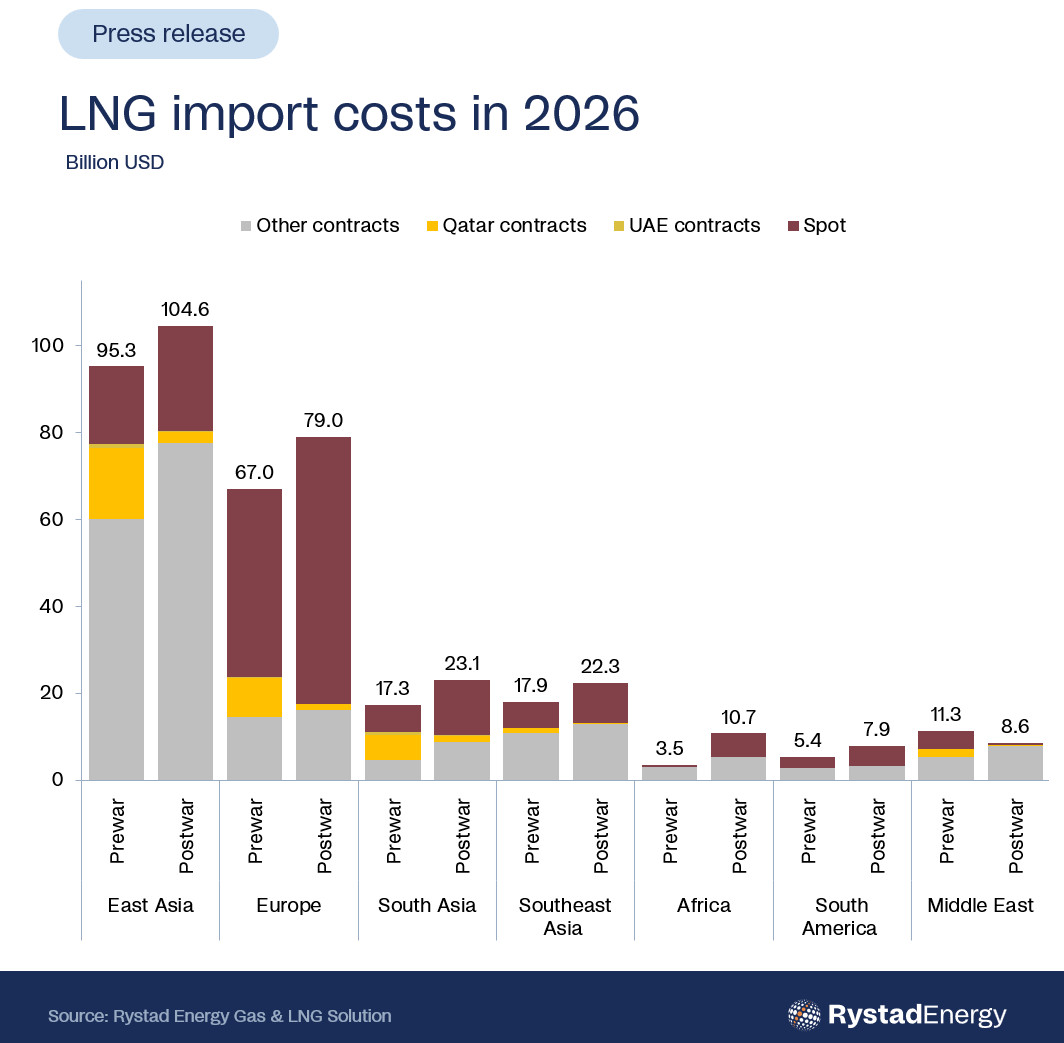
The Middle East conflict has disrupted global energy flows, forcing countries to rethink supply routes and strengthen energy security. As more buyers turn to the spot market to replace disrupted volumes, Rystad Energy estimates that global LNG importers will spend at least $39 billion more on contracted and spot supplies in 2026, despite purchasing 60.7 million tonnes less. Disruptions to Qatari and UAE exports through the Strait of Hormuz are forcing buyers to secure replacement volume at higher prices. Total portfolio costs are expected to reach $256 billion, up 18% from a pre-war estimate, underscoring how importers face different levels of exposure depending on their contract coverage, pricing benchmarks and ability to reduce demand.

Rystad Energy’s modeling assumes that Qatari and UAE LNG deliveries will be unavailable from March through the end of 2026. Under this scenario, global LNG portfolio costs rise from $217.8 billion to at least $256.3 billion. Europe faces the largest increase, with its LNG bill rising by a minimum of $12 billion, or 18%, even as demand falls by 24 million tonnes. Europe entered the crisis already heavily reliant on spot purchases, leaving less room to further boost that share further. As a result, its share of spot imports is projected to rise by just 5.49%, after factoring in demand destruction, compared with pre-war estimates. At the same time, Europe is set to lose 20.6 million tonnes of the 24.7 million tonnes of Qatari LNG scheduled for delivery in 2026, before the conflict began.

East Asia is better positioned to weather the disruption, with spot purchases accounting for just 14.5% of imports. A broader portfolio of supply contracts outside the Middle East and lower LNG demand help limit the region’s exposure to disrupted Qatari and UAE deliveries. Despite having the largest nominal exposure to Gulf contracts, East Asia faces the smallest relative increase in LNG costs among the regions outside the Middle East, at 9.7%. South Asia, meanwhile, is adjusting primarily through lower imports, with Pakistan cutting purchases more sharply than India. In Africa and South America, Egypt and Brazil, respectively, are driving the rise in prices and import volumes, while the Middle East is adjusting through demand destruction.

“This conflict has affected every player in the gas market to some degree, but not every economy is equally equipped to absorb the shock. Some importers are better positioned to manage rising costs, while others have had little choice but to cut volumes and absorb the economic consequences. The crisis exposes a fundamental weakness in gas security: diversifying pricing benchmarks can help manage costs, but it does not guarantee physical supply. Importers need to assess their exposure to supply disruptions alongside price risk, building contract portfolios around reliable delivery routes and demand that cannot easily be replaced. Ultimately, when cargoes can disappear overnight, the resilience of supply matters as much as the price paid for it," says Christoph Halser, Senior Analyst, Gas & LNG Research, Rystad Energy

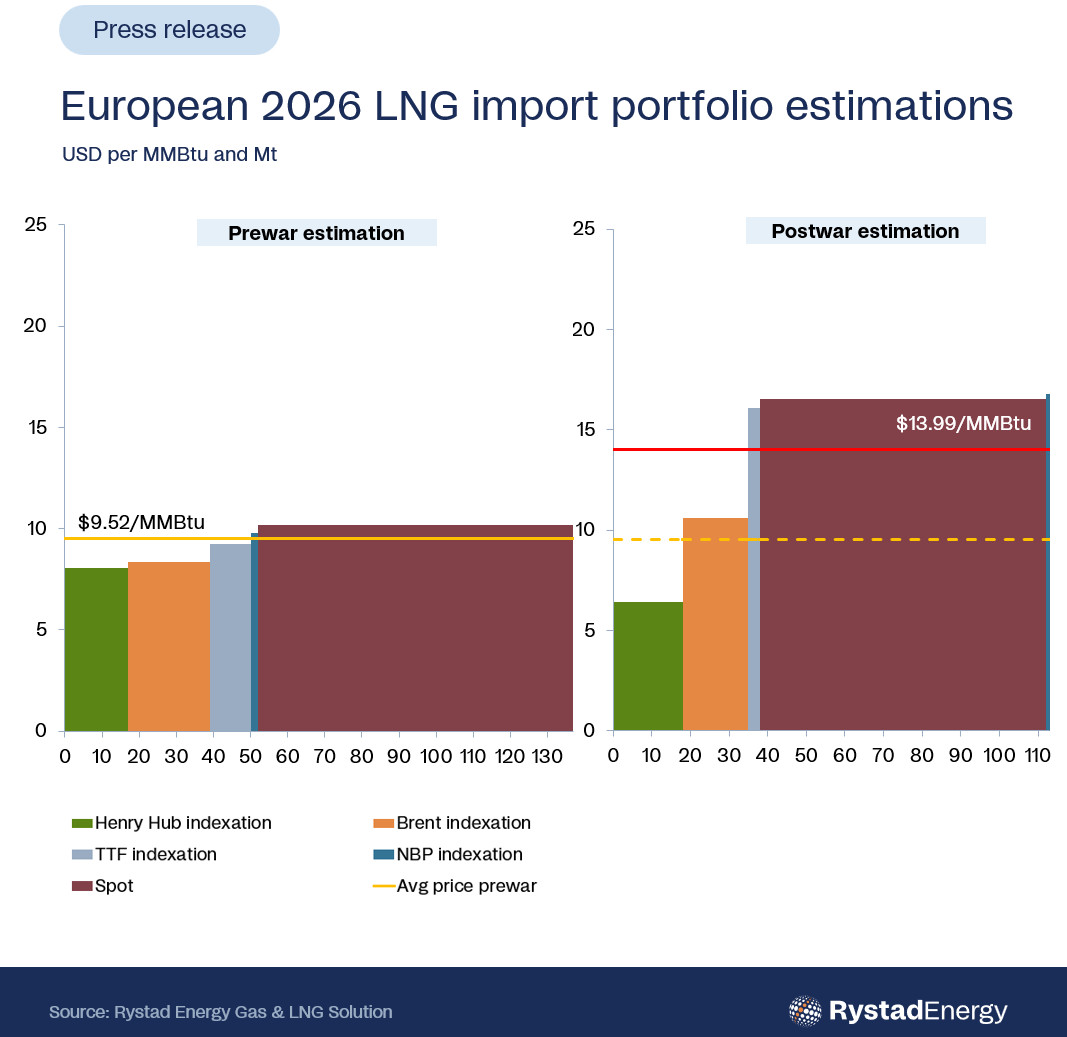
East Asia is coping with the disruption better than Europe, and the contract pricing terms are a key factor driving the divergence. Rystad Energy research shows that 82% of East Asia’s long-term LNG contracts are linked to oil, the price of which has risen far less than spot LNG. Those LNG contracts are up about 28% compared with 72% for those tied to hub and spot price benchmarks. In contrast, the average price in Europe is up 47%. Europe buys around 65% of its LNG on the spot market, while about a quarter of its long-term contracts are tied to gas price indexes, leaving it far more vulnerable to the full force of market volatility.

In terms of implications for importers, Europe’s result exposes a strategic shortcoming in relying on spot liquidity to secure residual gas demand. Treating gas as transitional does not remove the need to procure volumes still consumed. Deferring term procurement before substitutes are available leaves importers exposed to replacement-cost shocks. Contract tenor and volume flexibility should match residual demand, with supply origins and routes diversified.

Henry Hub indexation and supply routes address different risks, with our geostrategic analysis highlighting the value of ‘unchokeable’ supply that avoids maritime chokepoints or disputed waters. US Gulf Coast deliveries to Europe bypass the Strait of Hormuz, while deliveries to Asia may face Panama Canal constraints or require longer alternative voyages, making Australian and Canadian Pacific supply important alternatives. Importers should also scrutinize portfolio contracts for replacement obligations and sourcing flexibility when contracted cargoes cannot be delivered as planned.

Expanding US liquefaction capacity creates further opportunities for importers to secure Henry Hub-indexed supply and diversify their exposure to global gas benchmarks, but it also strengthens the link between global LNG demand and the US gas market. Rising feedgas requirements from LNG terminals, alongside power-sector demand, could support Henry Hub prices even as new global liquefaction capacity eases spot prices in Asia and at the Dutch TTF benchmark. Importers should therefore assess whether the current cost advantage of Henry Hub-indexed contracts is likely to persist over the full contract term, rather than assuming today’s price advantage will endure.

By Rystad Energy

Iran War Pushes Trump's Average Gasoline Prices Above Biden's

  • Average U.S. gasoline prices under Trump have overtaken Biden-era levels, reaching $3.472 per gallon versus $3.471 under Biden.

  • Gasoline now costs around $4.29 per gallon, as the Iran war disrupts global fuel supplies and squeezes refining capacity.

  • Record diesel prices and soaring fuel costs are adding to affordability concerns, increasing political pressure ahead of the November 3 midterm elections.

The average price Americans have paid for gasoline during President Donald Trump's second term has now surpassed the average recorded during Joe Biden's presidency, marking a politically significant milestone just days before the November 3 midterm elections.

According to AAA data cited by Reuters, regular gasoline has averaged $3.472 per gallon since Trump returned to office in January 2025, compared with $3.471 during Biden's four-year presidency.

The difference is marginal, but it represents a striking reversal for a president who campaigned on promises to bring gasoline prices below $2 per gallon.

As of Monday, October 26, AAA reported a national average of approximately $4.29 per gallon, compared with just $3.05 a year earlier.

The increase has been driven largely by the U.S.-Israeli war with Iran, which began in February and has severely disrupted global crude oil shipments, refining operations and fuel exports from the Middle East.

Gasoline prices have risen roughly 43% since the conflict began, despite the United States remaining the world's largest oil producer.

Meanwhile, diesel prices have climbed even more sharply. AAA data show diesel averaging approximately $6.35 per gallon, after reaching an all-time high of $6.53 in September.

As previously reported by Oilprice.com, shortages of refined products and the disruption of Middle Eastern energy supplies have placed extraordinary pressure on global fuel markets.

And significant relief before the midterms appears unlikely.

In his October 26 market update, Patrick De Haan, head of petroleum analysis at GasBuddy, reported that gasoline prices averaged $4.24 per gallon, down 22 cents from a month earlier but $1.24 higher than a year ago.

De Haan expects gasoline to remain above $4 per gallon and diesel above $6 through Election Day, despite government efforts to reduce prices.

While motorists have seen modest relief from September's highs, continued uncertainty surrounding the Strait of Hormuz and limited global refining capacity are keeping fuel markets under pressure.

The Trump administration has pursued several measures to ease the crisis, including efforts to increase domestic refining and secure additional diesel supplies.

However, industry executives have warned that restarting idle refineries or expanding processing capacity cannot provide immediate relief.

The latest gasoline milestone adds another challenge for the White House as Americans prepare to vote, with elevated fuel costs continuing to weigh on household budgets and broader inflation concerns.

By Charles Kennedy for Oilprice.com