Democratic Senators Warn U.S. Seaports Not to Handle Russian Diesel

Senior Democrats in the House and Senate are warning American banks, ports and energy companies to steer clear of any cargoes of Russian diesel that may be headed towards U.S. shores.
On October 9, the Trump administration announced a deal with Russian President Vladimir Putin to lift sanctions on Russian diesel, a long-shot bid to reduce prices for fuel ahead of midterm elections. The U.S. Treasury says that the cargo import arrangements are legal - but in a letter obtained by Axios and Bloomberg, six senior Democratic lawmakers (and one departing Republican senator) have warned ports that the activity "may be subject to legal action, as well as congressional investigation."
The letter was sent to the ports of Houston, Beaumont, Corpus Christi and New York/New Jersey, as well as six of the largest Wall Street banks. It warns them all to avoid touching any Russian diesel cargoes arriving in the U.S. market or headed to any markets overseas.
The letter cites the Ending Importation of Russian Oil Act of 2022, which banned all Russian energy products from the United States. Waiving the Act would require the consent of Congress and the president's certification that the war in Ukraine is over - circumstances which have not yet occurred. Critics of the diesel deal suggest that the Act has not been waived, and that Russian fuel imports are therefore against the law.
In the letter, the lawmakers requested ports and financiers to confirm that they will preserve records and correspondence related to Russian diesel transactions, anticipating future investigation or litigation.
Signatories included Senators Jeanne Shaheen (D-NH), Chris Coons (D-DE), Elizabeth Warren (D-MA), Ron Wyden (D-OR), Sheldon Whitehouse (D-RI) and Thom Tillis (R-NC), plus Rep. Gregory Meeks (D-NY). The list of sponsors overlaps with a similar bipartisan letter sent to the Trump administration earlier this month. Some of the signatories may soon be well-positioned to initiate public investigations: Rep. Meeks would inherit chairmanship of the House Foreign Affairs Committee if the House transitions to Democratic control, and he would have the power to hold hearings and issue subpoenas.
Similarly, Rep. Jamie Raskin (D-MD) - who is in line to take over the chairmanship of the House Judiciary committee - has warned the American Petroleum Institute, the U.S. Chamber of Commerce and the American Fuel and Petrochemical Manufacturers that the cargoes are unlawful.
"Your members are now on notice that taking part in any effort to help President Putin hawk Russian diesel in the U.S. is a clear and dangerous violation of federal law," Rep. Raskin wrote. "[Importers] may therefore have to face both civil and criminal penalties, including up to 20 years’ imprisonment."
Reuters has identified one cargo that is likely under way for an American port, but the extent of any further scale-up may be limited. The rationale for importing the physical fuel into the U.S. is unclear: the United States already produces more diesel than it can consume, and exports about 1.6 million barrels each day to foreign buyers. By contrast, Russia has a diesel shortage, and until recently it did not export the fuel at all. Its war-damaged refineries are operating an estimated 40-50 percent below capacity due to Ukrainian drone strikes, leading to shortages and long queues for fuel in some Russian regions.
Nonetheless, tracking data suggests that three tankers are full of Russian diesel fuel and under way for North America, and the Kremlin predicts that the deal's exports will amount to about 3.5 million barrels per month - equivalent to roughly three percent of U.S. consumption.
Sanctioned Tanker Bound for US Passes Through UK Waters
Russia has used the lifting of U.S. sanctions on the purchase of diesel to resume exports both to the United States but also other countries, in what President Vladimir Putin will regard as a diplomatic victory and a weakening of solidarity in support for Ukraine. Not only will the Russians earn revenue from the diesel sales to fund their war effort, but they will also drive a wedge between the United States on the one hand, and the UK and the EU on the other, because both the UK and EU have declared that their sanctions will remain in place.
The identity and destinations of ships involved in the resumption of Russian diesel exports are not absolutely clear, depending as it does on announcements from the Russian government and changing AIS signals being broadcast from the ships potentially involved.
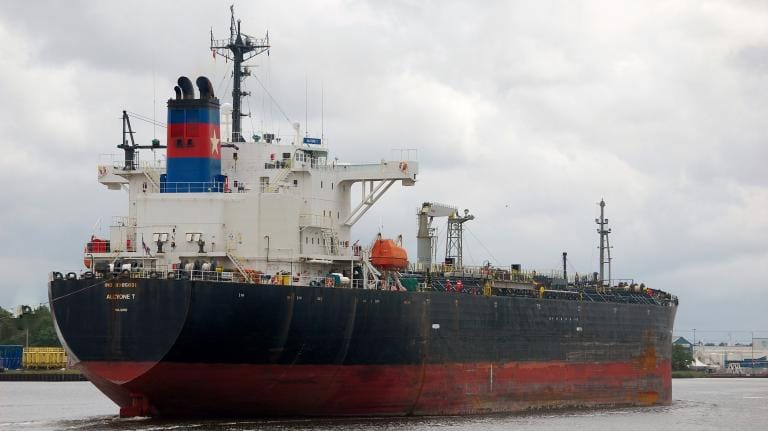
But the divisions that the resumption of exports has created are well-illustrated by the course of Sierra Leone-flagged oil products tanker Leruo (IMO 9385831), which remains on both UK and EU sanctions lists. This vessel, loaded with about 40,000 tons of diesel oil at Primorsk on October 16, is indicating on AIS that it is heading for the Atlantic coast “for orders,” but is expected to dock in New York on about November 7. Its exact course through waters around the Shetland Islands is not yet clear, but if not through territorial waters, then the ship is likely to have passed through the UK’s Exclusive Economic Zone – and has done so without being intercepted, despite its flag of convenience and UK/EU sanctioned status. There may have been an intent to intercept the ship, but simply a lack of any available Royal Navy frigates to undertake the operation.
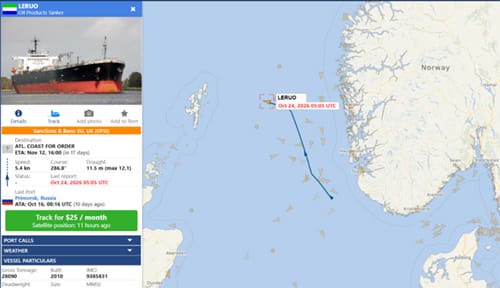
Track of the sanctioned diesel tanker Leruo as she approaches Shetland Island waters on October 24 (VesselFinder)
Two other product tankers, but both unsanctioned, have also recently loaded at Primorsk. The Maltese-flagged tanker Agioi Fanendes (IMO 9798375) was on October 26 passing through the Skagerrak, also with about 40,000 tons of diesel on board, declaring it is operating “For Orders.” It had earlier indicated it was bound for New York, due to arrive November 7, but now with its actual destination undeclared. It could also be heading for the Atlantic seaboard, although industry sources suggest that Morocco may also be resuming imports of Russian diesel.
The Palau-flagged product tanker Dolunay (IMO 9327463) completed loading on October 16, and is signaling its arrival at Alanya in Turkey on November 1. The Turkish government has indicated that it is about to resume imports of Russian diesel, on the back of the Trump deal, and has already begun to reduce production of diesel from its own domestic refineries so as to exploit the price differential on cheaper Russian imports.
Russian exploitation of the Trump-Putin deal to pry open the sanctions regime has been clearly indicated by the Russian Deputy Prime Minister Alexander Novak, who has said that Russian exports could reach 3.5 million tons per ?month (875,000 bpd) by the end of the year, well above the 1.8 million tons of diesel covered by the initial Trump-Putin deal.

No comments:
Post a Comment