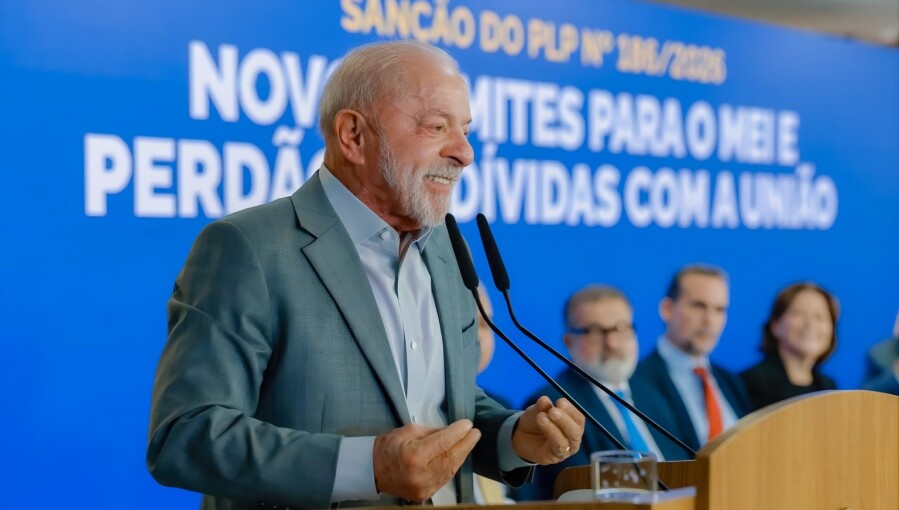
Luiz Inácio Lula da Silva received congratulations from Brussels, Beijing, Moscow and Washington’s closest allies in South America on October 26 after winning a fourth term as Brazil’s president. Few leaders can command such broad international goodwill. Yet Donald Trump, Argentina’s Javier Milei and Israel’s Benjamin Netanyahu were conspicuous by their silence.
Lula beat right-wing senator Flávio Bolsonaro with 51.78% of valid votes to 48.22% in the October 25 run-off, according to Brazil’s Superior Electoral Court, with 99.98% of ballots counted. He had trailed Bolsonaro 45% to 47% in the first round on October 4. The unexpected result broke a run of seven straight presidential victories for conservative candidates across the region over the past 18 months. Washington has actively backed right-wing contenders under what Trump has dubbed the “Donroe doctrine”, a reassertion of US dominance in the Western Hemisphere.
Bolsonaro, the eldest son of jailed former president Jair Bolsonaro, said he would not recognise the result. He said he would seek to annul the election because Supreme Court justice Cristiano Zanin had extended voting by two hours in polling stations that were still open. His own campaign had asked for longer voting hours in some municipalities after reports of disruption to public transport, and he presented no evidence that the extension changed the outcome.
European leaders cast the result as a win for the multilateral order Lula has long championed. “Europe’s partnership with Brazil is thriving. We will remain by your side for the years to come,” European Commission president Ursula von der Leyen, who called Lula her “friend,” wrote on X. She added that democracy and multilateralism “have won” in Brazil, and pledged to keep working with Lula on “free and open trade. A rules-based global order. And strong ambitions for our climate.”
French President Emmanuel Macron said “France and Brazil have much to build together,” while German Chancellor Friedrich Merz and Italian Prime Minister Giorgia Meloni sent greetings to the seasoned Brazilian leader. Spain’s Pedro Sánchez hailed a “global progressive comeback”. Canada’s Mark Carney credited Lula with advancing bilateral ties and called for new “commercial prospects”.
Beijing and Moscow were just as warm. Chinese foreign ministry spokesperson Guo Jiakun said China was “willing to work with Brazil to continue advancing the building of a China-Brazil community with a shared future”. Asked about Bolsonaro’s challenge, Guo said China respected the choice of the Brazilian people.
Russian President Vladimir Putin praised Lula’s personal role in strengthening the two countries’ strategic partnership. He pledged to deepen co-operation within the UN, the BRICS group and the G20, according to a Kremlin statement. Putin also wished Lula a happy birthday ahead of his upcoming 81st. Kremlin spokesman Dmitry Peskov said Lula had done much for bilateral ties and for the development of BRICS.
Ukraine’s President Volodymyr Zelensky congratulated Lula, thanked him for his "unwavering support for Ukraine's sovereignty and territorial integrity," and spoke of expanding co-operation, hours after Putin’s telegram reached Brasília.
The rest of BRICS followed. Indian Prime Minister Narendra Modi, whose country chairs the bloc this year, sent his “heartiest congratulations to my dear friend, President Lula”. He pledged to deepen the India-Brazil strategic partnership and “advance the shared priorities of the Global South”. South Africa’s Cyril Ramaphosa said the result “will echo beyond the shores of Brazil. It is a victory for the Global South and progressive forces throughout the world.”
The sharpest contrast with the Bolsonaro camp, which has refused to concede, came from Latin America’s right. Chile’s José Antonio Kast, a Trump ally who praised Jair Bolsonaro during his own campaign, phoned Lula to congratulate him. “Chile and Brazil have a lot of shared future ahead,” Kast wrote, citing economic integration and the fight against organised crime. Paraguay’s Santiago Peña, Bolivia’s Rodrigo Paz, Ecuador’s Daniel Noboa, Peru’s Keiko Fujimori and Panama’s José Raúl Mulino also sent congratulations.
Colombia’s Abelardo de la Espriella acknowledged “great and deep political and ideological differences” with Lula but said that “Brazil and Colombia need each other”. He called for closer co-operation against drug-trafficking groups and illegal mining, and on protecting the Amazon.
On the left, Mexico’s Claudia Sheinbaum hailed the result as “a breath of fresh air for Latin America and the Caribbean”. Venezuelan foreign minister Félix Plasencia González said Brazilians had given “a resounding demonstration of civic and democratic participation”. He pledged to maintain ties based on sovereignty and regional solidarity. Cuba’s Miguel Díaz-Canel hailed a “historic victory” and said Brazil could count on Havana in building regional unity and integration. Uruguay’s Yamandú Orsi also congratulated Lula, as did former Bolivian president Evo Morales, who called the result a “beautiful and heroic victory”.
Milei was the lone holdout among South America’s right-wing presidents. By the morning of October 26 neither he nor foreign minister Pablo Quirno had issued a statement. The firebrand libertarian leader had openly backed Bolsonaro during the campaign. Last week he called Lula a “leftist thief” and said he hoped Lula would not “steal” the election, which Brazil’s foreign ministry condemned as an “unacceptable attempt at foreign interference”. On election night, Milei shared posts questioning the extension of voting hours. An official told Noticias Argentinas that the strength of the vote against Bolsonaro had stunned the government. Brazil is Argentina’s largest trading partner.
In contrast, Argentina’s Peronist opposition celebrated. Former president Cristina Fernández de Kirchner praised Lula for knowing how “to awaken among your fellow citizens the feelings and sense of purpose needed to win this battle”. She, Axel Kicillof and Sergio Massa each linked the result to Argentina’s 2027 elections.
Trump, meanwhile, has neither congratulated Lula nor publicly acknowledged his victory. Before the vote he said he was monitoring the election but declined to endorse either candidate, although he had met Flávio Bolsonaro in May. That restraint contrasts with 2022, when Trump openly urged Brazilians to vote for Jair Bolsonaro. Joe Biden, then US president, was among the first leaders to recognise Lula’s victory that year.
Trump’s son Donald Trump Jr criticised the extension of voting hours. “If a conservative government in Brazil did this, everyone in the mainstream press in America would lose their minds,” he wrote on X. US progressives took the opposite view. Independent leftist Senator Bernie Sanders praised an “extraordinary re-election victory”, and New York City Mayor Zohran Mamdani wrote on X: “The people united will never be defeated!”
Israel’s PM Benjamin Netanyahu, who faces his own election on October 27, was another notable absentee. He had openly backed Bolsonaro, posting after the first round that he looked forward to “restoring the extraordinary friendship between Israel and Brazil”. Ties between Netanyahu and Lula have been frozen since 2024, when Israel declared the Brazilian leader persona non grata after he compared the Gaza offensive to the Holocaust.
A diplomat for all seasons
The breadth of the response reflects a foreign policy built on keeping doors open on all sides. During his third term, Lula positioned Brazil as a bridge between the West and the Global South, insisting on dialogue even with ideological opponents.
He used Brazil’s rotating presidency of Mercosur to push for the trade agreement with the EU, which European member states approved in January after 25 years of negotiations. Lula called it “a historic day for multilateralism”. The deal links two blocs with a combined population of 718mn.
He also hosted the BRICS summit in Rio de Janeiro in July 2025, where he described the expanded bloc as “the heir to the Non-Aligned Movement”. Despite growing pressure from the US, he has deepened ties with China, Brazil’s largest trading partner since 2009.
The same pragmatism has softened regional rivalries. After meeting Lula in Panama in January, Kast said ties between Chile and Brazil were “a relationship between states, which transcends any ideological differences”.
That balancing act extended to Washington. In 2025, the Trump administration imposed tariffs of up to 50% on Brazilian goods and sanctions on officials over the prosecution of Jair Bolsonaro, who was later sentenced to 27 years in prison for plotting to overturn his 2022 election defeat. Lula denounced the measures as an attack on Brazilian sovereignty but kept talking, and Trump eased the tariffs and lifted the sanctions. “If I managed to make Trump laugh, I can achieve other things too,” Lula told the Washington Post after visiting the White House in May.
The truce proved short-lived, however. In July, the Trump administration slapped a fresh 25% tariff on most Brazilian goods following an investigation into Brazil’s digital trade and electronic payments practices. Many exports now face a combined 37.5% once a separate levy linked to forced labour is added, although crude oil and coffee are exempt.
Yet Washington’s pressure has done little to dent Lula’s standing elsewhere. More than 30 countries had recognised his victory by October 26. In a rare display, Moscow and Kyiv, Beijing and the European capitals, and the US-aligned nations of South America all lined up to congratulate the Brazilian leader on the same day.
Brazilian financial markets suffered sharp losses on October 26 after President Luiz Inácio Lula da Silva unexpectedly won re-election, reversing a rally driven by investor expectations that right-wing challenger Flávio Bolsonaro would prevail.
Lula, who lost the first round with 45.16% of the vote, took the runoff with 51.79% against 48.21% for the right-wing senator, according to the official count from the Superior Electoral Court. No candidate in Brazil’s post-dictatorship history had previously recovered from a first-round defeat to win the presidency. At the time of writing, Bolsonaro has not recognised the result.
The Brazilian real weakened sharply against the US dollar, falling more than 8% at the opening of trading. It later lost around 12% at its weakest point, with the dollar reaching BRL5.60, according to Reuters. The currency’s decline reflected concerns over the incoming administration’s fiscal policy and the outlook for public finances.
The benchmark Ibovespa index also came under heavy pressure. Futures contracts fell 15%, triggering a temporary trading halt shortly after the market opened. The interruption was the first such suspension since March 2020, when the Covid-19 pandemic sparked widespread financial volatility. By around 11am local time the index was down 15.9% at 172,479.84 points, having touched a low of 169,516.43, with rate-sensitive stocks among the worst hit; retailer C&A lost half its value.
The sell-off unwound a rally that had gathered pace after the first round. Investors had positioned themselves for a Bolsonaro victory, anticipating tighter spending controls and economic reforms. On October 5, the day after Bolsonaro’s surprise first-place finish, the Ibovespa closed above 200,000 points for the first time, rising 7.7% in its strongest session since March 2020, while the dollar fell 4.12% to BRL5.00. Robin Brooks, a senior fellow at the Brookings Institution, had argued in September that a Bolsonaro win would quickly take the dollar to BRL4.80, attributing the real’s underperformance against emerging market peers to what he called “a Lula risk premium”.
Pollsters and prediction markets reinforced that conviction. The final CNT/MDA survey, released on October 24, put Bolsonaro on 50.7% of valid votes against 49.3% for Lula, a lead within the margin of error. On Polymarket, traders gave Bolsonaro an 80% chance of victory on the morning of the vote. His odds slipped below 70% only once counting was under way and fell to 35% by Sunday evening, as Lula overtook him in the tally.
Lula’s win has renewed questions about how his next administration will balance social programmes with efforts to stabilise Brazil’s public debt, which exceeds 80% of gross domestic product. The president made no commitment to fiscal cuts during the campaign and expanded welfare spending in its final weeks, including a 15% rise in Bolsa Família cash transfers. The central bank had cut the Selic rate five times in a row, to 13.75%, by early October, and investors had begun to price in deeper easing on the assumption of a more austere government.
The market reaction also prompted Brazil’s Treasury to cancel government debt auctions scheduled for October 27 and 29. It is the second such intervention this year. In March, after a week of heavy stress in rates and government bond markets, the Treasury scrapped its regular auctions of fixed-rate and inflation-linked paper and announced direct buy-and-sell operations, as the surge in oil prices from the war in Iran pushed up inflation and the yield curve.
Investors are now watching for signals on the composition of Lula’s economic team and his commitment to fiscal targets. The government’s ability to negotiate with a right-wing dominated Congress will also shape expectations for economic policy and financial markets. The first round pointed to a broader rightward shift in Brazilian politics, with the Bolsonaro camp performing strongly across the country, leaving Lula to face a legislature less hospitable than the one he worked with in his third term.

No comments:
Post a Comment