By The Canadian Press
Published: October 26, 2026
PM Carney on abolishing the Indian Act: ‘I’m very open to that’

‘This is Canada at its best’: AFN National Chief on historic First Nations-First Ministers meeting

Alberta First Nations chiefs criticize Smith’s absence from meeting
Prime Minister Mark Carney says he will instruct his ministers to work with First Nations to move Canada beyond the Indian Act — which he said could mean reforming it or abolishing it altogether.
Speaking to reporters after a meeting with First Nations chiefs and premiers in Ottawa today, Carney said the elimination of the Indian Act has been sought by many First Nations leaders, including Manitoba Premier Wab Kinew.
Earlier in the day, Kinew told reporters during a break in the meeting that Canada needs a relationship between First Nations and the government “that reflects who Indigenous people are as Canadians.”
Carney said “moving beyond” the Indian Act could involve abolition or reform. But he said it would only happen in partnership with First Nations leadership.
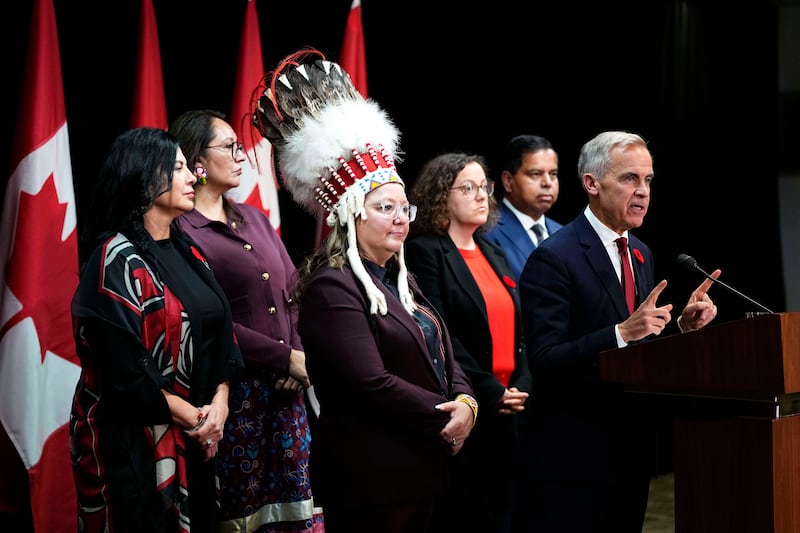
Prime Minister Mark Carney is joined by National Chief of the Assembly of First Nations Cindy Woodhouse Nepinak and cabinet ministers as he speaks at a news conference at the conclusion of a First Nations and First Ministers' meeting in Ottawa, on Monday, Oct. 26, 2026. THE CANADIAN PRESS/Justin Tang
“The suggestion of reforming, potentially abolishing and fully modernizing governance, is that a process, co-developed, needs to be put in place, and the federal government is open to that process,” Carney said.
Carney said the idea of abolishing or modernizing the Indian Act was discussed openly in the room.
“Not everybody, but other participants raised the desirability. So it’s already starting from the right place in that it’s not the federal government deciding something should be done. It’s responding to a request,” Carney said.
“I think this was the spirit of this meeting — certainly the spirit I took — the ability to sit down together and develop that co-development, gives me hope that we can we can finally move forward from this.”
The Indian Act has been in effect since 1876 to govern First Nations status in Canada. It has been amended several times to reflect changes in how status is conferred.
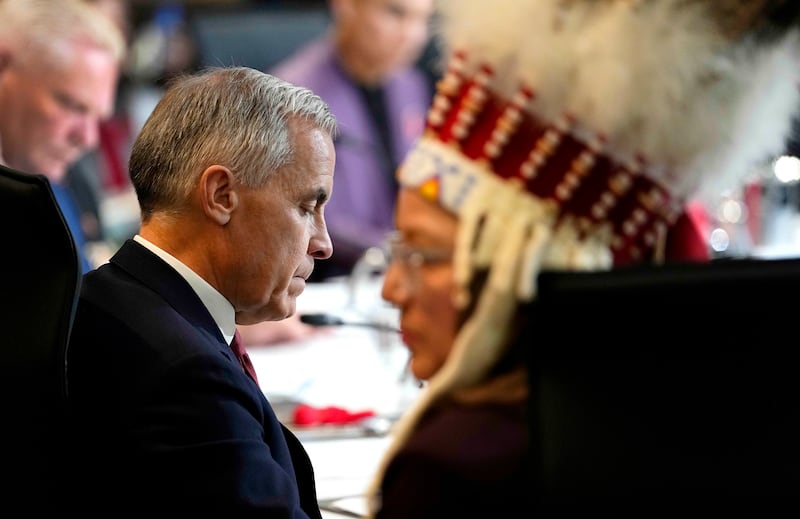
Prime Minister Mark Carney and National Chief of the Assembly of First Nations Cindy Woodhouse Nepinak participate in a First Nations and First Ministers Meeting in Ottawa, on Monday, Oct. 26, 2026. THE CANADIAN PRESS/Justin Tang
Assembly of First Nations National Chief Cindy Woodhouse Nepinak said there are some protections in the act for First Nations, and First Nations should be able to decide how to move forward.
“Look, that’s a question that was just posed today in the room among First Nations. Some First Nations; others would be very reserved,” Woodhouse Nepinak.
“But there is, you know, a diversity of First Nations from coast to coast to coast, where in every province and territory in this beautiful country that we all share. And that question is going to be up to them to decide.”
Kinew said he feels the Indian Act should be abolished altogether. He held up his First Nations status card, which he said identifies him as an “Indian within the meaning of the Indian Act.”
“It’s time to abolish the Indian Act,” Kinew said. “It’s long overdue that we have a relationship with Indigenous Peoples in Canada that reflects who we are as Canadians today.”
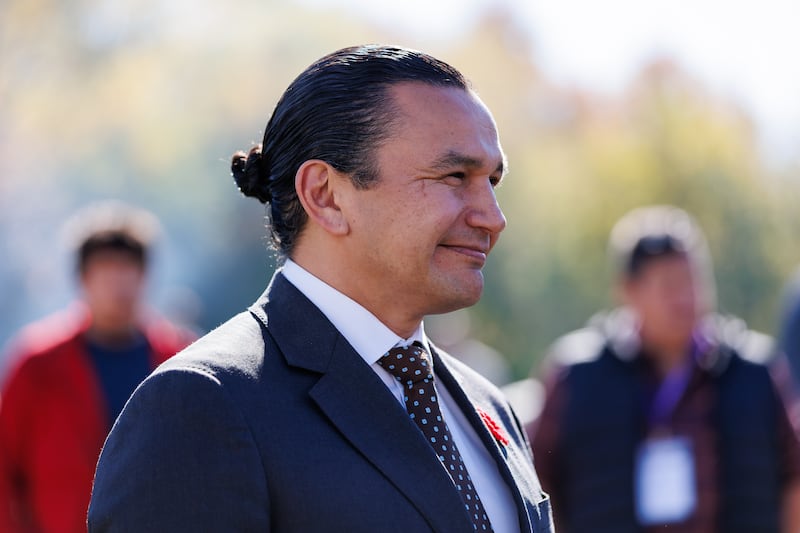
Premier of Manitoba Wab Kinew is seen at the AFN First Nations - First Ministers Meeting Day of Ceremony in Ottawa, on Sunday, Oct. 25, 2026. THE CANADIAN PRESS/Keito Newman
Carney and most of the premiers sat down with chiefs from the Assembly of First Nations in Ottawa for a discussion Woodhouse Nepinak said is intended to help build prosperity for coming generations.
Monday’s closed-door meeting is the first such gathering since the Kelowna Accord talks of 2005, which brought premiers and then-prime minister Paul Martin together with Indigenous leaders to discuss ways to close the socioeconomic gaps in Indigenous communities.
The Kelowna agreement was not implemented after the Conservative government under former prime minister Stephen Harper took office just a few months later.
This meeting comes as Carney’s government works to speed up major project approvals and development — efforts some First Nations chiefs say threaten their rights.
Jeronimo Kataquapit, who was protesting the major projects push outside the meeting venue in Ottawa, chided the federal government and the Assembly of First Nations over the lack of youth representation at the meeting.
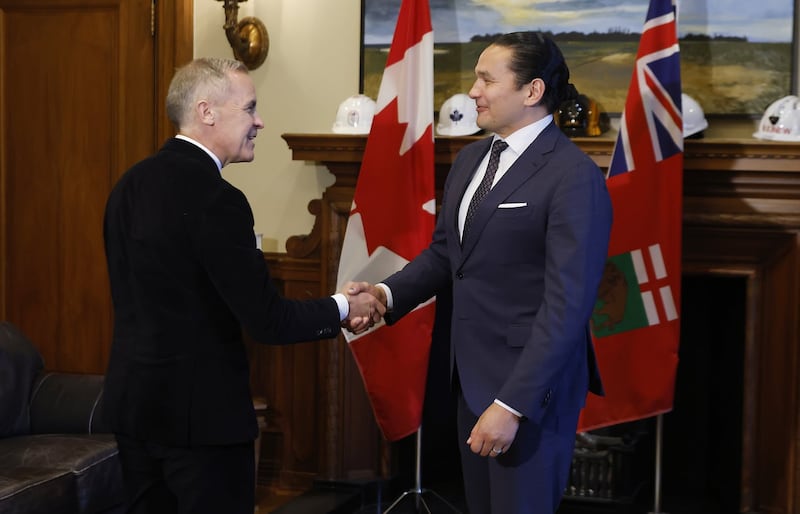
Prime Minister Mark Carney meets with Manitoba Premier Wab Kinew at the Manitoba Legislature in Winnipeg, Sunday, November 16, 2025. THE CANADIAN PRESS/John Woods
“These major projects cannot move forward without our free, prior and informed consent, and it’s the youth that stand to be the most impacted by the decisions made today by all leadership, both Indigenous and non-Indigenous alike,” Kataquapit said from the sidewalk in front of the Diefenbaker Building.
Protester Katisha Paul, an advocate for youth and women, questioned the Assembly of First Nations’ mandate to negotiate on First Nations’ behalf.
“I’m not in that room today but I can imagine and speculate that the voices of our ancestors are not being heard, they’re not being voiced and they’re not being amplified because many of those elected band council chiefs have lost their ways,” Paul said.
Tensions between Ottawa and First Nations spiked soon after Carney was elected in 2025 when his government passed legislation to create a new office tasked with streamlining major project developments and approving projects within one year.
First Nations leaders warned the compressed timelines would interfere with their rights and lead to court challenges. Provincial governments have enacted similar legislation.
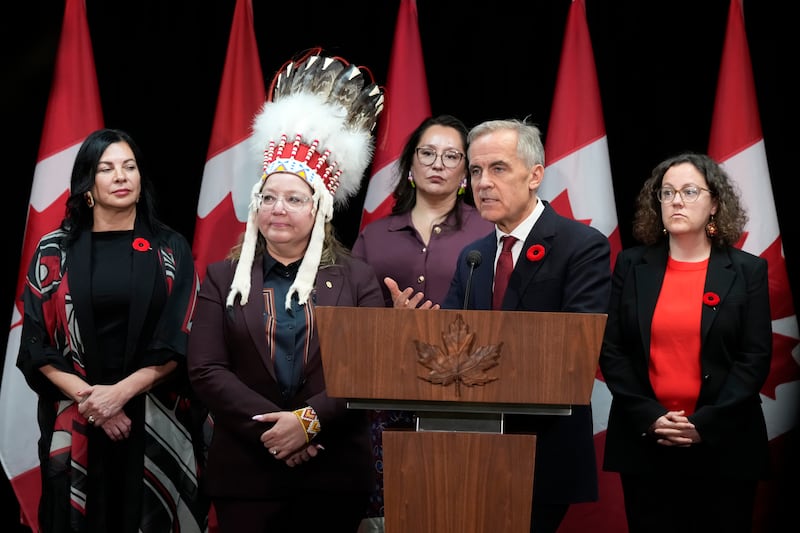
Minister of Northern and Arctic Affairs Rebecca Chartrand, left to right, AFN National Chief Cindy Woodhouse Nepinak, Indigenous Services Minister Mandy Gull-Masty and Crown-Indigenous Relations Minister Rebecca Alty, right, look on as Prime Minister Mark Carney speaks with media following the First Nations and First Ministers' meeting in Ottawa, Monday, Oct. 26, 2026. THE CANADIAN PRESS/Adrian Wyld
But tensions are boiling over for a number of other reasons as well, including the lands claim process in British Columbia, the newly announced Pacific Link pipeline project in Alberta and development of the mineral-rich Ring of Fire in Ontario. In many cases, it’s youth who are pushing back on First Nations leaders, the premiers and prime minister.
Carney said Monday it’s “sobering” to consider that this is the first meeting to bring together federal, provincial and First Nations leaders in two decades.
“Our task is twofold. First is to work together to create opportunities for all our peoples, while building a country that is stronger, more sovereign and more independent,” he said.
“And secondly, our task is to live our values fully of a fair and inclusive Canada.”
While some First Nations are opposed to Carney’s development agenda and those of the provinces, others are open to the idea of increasing economic activity in their territories.
Nisga’a Nation President Eva Clayton told reporters ahead of the meeting she supports Carney’s plans and that she and other modern treaty holders are at the meeting to support Canada.
By Alessia Passafiume and Kyle Duggan
With files from Nick Murray