Wednesday, November 04, 2026


Japan's autumn salmon catch hits lowest level since 1989

Japan's autumn salmon catch hits lowest level since 1989
/ Sas Kia - UnsplashFacebook
By IntelliNews - Tokyo Bureau November 4, 2026

Japan landed fewer autumn salmon between August 1 and September 30 than in any comparable period since at least 1989, with the haul down by roughly 30% year on year, The Yomiuri Shimbun reported on November 4. Prices for the fish and its roe have climbed sharply, alarming seafood retailers and restaurants.

Hokkaido normally supplies 90% or more of the national catch. A research body there now expects this season's northern haul to come in at about half of last year's level. Shops, restaurants and department stores in Tokyo have begun turning to imported salmon and roe, and the shortfall is pushing up prices of traditional New Year dishes.

Data from the Japan Fisheries Research and Education Agency show that 2.39mn salmon were caught in coastal waters and rivers nationwide over the two months, compared with 3.53mn a year earlier, a fall of around 32%. Toyosu Market in Tokyo handled about 130 tonnes of Hokkaido salmon in September, close to half the volume traded a year before.

The Salmon and Freshwater Fisheries Research Institute of the Hokkaido Research Organization projects a Hokkaido catch of 3.64mn fish this season, against 6.86mn last year. Elevated sea temperatures are thought to be among the reasons for the decline.

Marumo Shoten, a seafood seller and distributor in Tokyo's Taito Ward, usually displays whole Hokkaido salmon at its storefront through the winter because they are popular as gifts. Its wholesale cost for the fish has risen by around 40%, and the shop has so far held back from buying.

"I'm wondering whether we should stock whole salmons, as they're so expensive that there's a big risk they remain unsold," the shop's operator said.

Wholesale prices of domestic salmon roe have doubled from a year earlier to JPY30,000 to JPY40,000 ($189 to $253) per kilogramme, so the shop is offering roe from Russia instead.


Serbia's institutions spring into action after SNS election defeat

Serbia's institutions spring into action after SNS election defeat
General election seems to have changed the political climate in Serbia overnight. / K via Pexels
By Tatyana Kekic in Belgrade November 3, 2026

It has been a remarkable week in Serbia. Senior police officials have been arrested, court documents have revealed controversial presidential pardons, investigations into alleged abuses of power are gathering pace and senior media executives have resigned. 

All this is happening before the country's new parliament and government have even been formed.

The developments follow the October 25 parliamentary election, in which a student-backed opposition movement defeated the Serbian Progressive Party (SNS), ending its 14 years in power.

For a country where critics have long accused the police, prosecutors and judiciary of being politically controlled or unwilling to investigate those close to the ruling establishment, the sudden flurry of activity is striking.

It is as if institutions that had been dormant for years have suddenly woken up.

One of the most significant developments came on November 1, when two senior police officials were arrested: Marko Kricak, head of the Criminal Police Directorate, and Bosko Sekulovic, head of the Crime Suppression Service.

Both are suspected of abuse of official position in connection with a murder at a restaurant in Belgrade's Senjak neighbourhood in May. Kricak also faces suspicion of abuse and torture of a man questioned at police headquarters.

Kricak became a notorious figure during last year's student protests. He was accused by student Nikolina Sindelic of physically abusing her and threatening to rape her while she was detained in August 2025. 

The two officials have been ordered into custody for up to 30 days to prevent them from influencing witnesses.

Another development concerns former president Aleksandar Vucic's decision to pardon 49 people on September 27, the day he ended his presidential mandate.

Vucic said at the time that 23 of those pardoned were connected to the events surrounding the student protests.

The names of several beneficiaries became public on November 2, when the Higher Courts in Belgrade and Novi Sad published their lists.

Among them were people accused of attacking students and citizens during protests, including a man accused of ramming his car into student Sonja Ponjavic in Belgrade and four men accused of attacking protesters in Novi Sad.

The list also included Dijana Hrkalovic, a former senior Interior Ministry official facing charges of influence peddling.

The publication of the names followed a request by the organised crime prosecutor's office for information about the pardons, suggesting that prosecutors are now urgently seeking to investigate decisions taken by the previous administration.

There are also signs of renewed activity in investigations into the November 2024 collapse of the railway station canopy in Novi Sad, which killed 16 people. That trial has effectively been on hold for the last two years. 

Investigations are also under way into the alleged wiretapping of protest activists. Furthermore, a review of all 87 prosecutor's offices across Serbia has been initiated, partly to prevent the possible destruction of official documents.

Critics of the SNS’s 14-year rule have long accused state institutions of failing to pursue allegations involving politically connected figures.

The new parliament and government have yet to be formed, but prosecutors and courts are already moving on cases involving senior officials and alleged abuses under the outgoing administration.

The election seems to have changed the political climate overnight. After years of alleged political interference and accusations of institutional complicity, state institutions are now under pressure to do their jobs. 


Serbia’s elections: 'Tracking fraud for sure had an impact on the results'

On October 25, Serbia's student-led protest movement won a historic victory in parliamentary ⁠elections, defeating outgoing President Aleksandar Vucic's party. Supporters of the student list explained to FRANCE 24 how they mounted a massive mobilisation to fight electoral fraud and monitor the electoral process inside and outside the polling stations.


Issued on: 26/10/2026
Marguerite MARAMICI/The FRANCE 24 Observers


Student list supporters celebrate their victory in the legislative election in Slavija, Belgrade, Serbia, October 25, 2026. © Instagram/ @gavriloandric


Serbia’s parliamentary elections on Sunday, October 25 delivered a political earthquake. The Student List movement challenged the Serbian Progressive Party (SNS) which had dominated Serbian politics for 14 years, led by outgoing president Aleksandar Vucic.

The result marked a historic turning point: the Student List won 52.45 percent of the vote, securing 138 seats in the National Assembly, while the Aleksandar Vucic – United Serbia list received 39.2 , earning 103 seats.

The student movement emerged in the aftermath of the collapse of a railway station canopy in Novi Sad on November 1, 2024, a tragedy that claimed 16 lives and triggered nationwide protests against corruption. Initially non-partisan, the movement gradually gained widespread public support before deciding to field its own electoral list. Rather than running for office themselves, the students chose to nominate highly qualified individuals with no prior political experience, selected through a democratic process organised within universities.
Student list supporters dance in front of the National Assembly in Belgrade in the evening of October 25, 2026 to celebrate their win at the legislative elections. Instagram/ ©bukamagazin


'We trained at least 16,000 people to become official controllers'

Petar Botoski, an agricultural student supporting the Student List, was in Novi Sad, a city located in the northern part of the country, when Aleksandar Vucic acknowledged the defeat of his party.


"It was the most challenging moment. We expected to win, but we did not know what would happen next. When the announcement came, I was in shock, everyone was cheering. At that time, the votes were still being transferred and being counted."

He explained that the student movement prevented much electoral fraud during the day.


“The whole day we reported to authorities incidents such as the finding of parallel lists or the detection of carousel votes.”

Both are practices that can facilitate voter pressure or manipulation of the voting process. The parallel list is an unofficial list of voters used alongside the official register to manipulate or falsify voting records, while carousel voting is a form of electoral fraud in which a voter is given a ballot that has already been marked, takes it into the polling station and deposits it in the ballot box. The voter then brings the unmarked ballot they received as proof that he or she voted as “required”.

Petar Botoski goes on:


“For a year and half, since we decided to propose a student list for the legislative elections, the student movement spent a lot of time and resources to create connections between people and to teach them how to prevent electoral fraud.

We trained at least 16,000 people to become official controllers, two for each polling station. Then we trained about five people per polling station to be part of mobile teams. Their mission was to detect fraud outside the polling stations, such as the use of parallel lists, carousel vote, pay[ing] for voters and intimidations. [Tracking] fraud had for sure an impact on the results.”

Turnout reached 69 percent, with more than 4.4 million citizens casting their ballots. This represents a significant increase compared with the 55.5 percent turnout recorded in Serbia’s December 2023 parliamentary elections.


A video showing a huge queue outside a polling station in Novi Sad on October 25, 2026. ©Instagram/ @moj_pogled

'We ensured that it was harder for them to fraud'

Janko Sikosek, a member of the movement “Bikers with Students”, was among the volunteers that assisted in monitoring polling stations and helping to ensure a fair and transparent electoral process.


“I went out to vote early in the morning; the line was already forming before the polling station opened. At this moment, I felt very optimistic. People were looking at each other and smiling. The line was so long, I waited for an hour and a half to vote.

Then I joined my mobile team. Only in my municipality (Vozdovac), there were 14 mobile teams, each one composed of 3 people.

We were there to record, to observe, to be present. We ensured that it was harder for them (SNS supporters) to fraud.

The job of my team of bikers was to help mobile teams that got in trouble. One mobile team discovered vote-buying headquarters in Ovca, in the north of Belgrade. A guy of the mobile team was hit on the head, the other two escaped, but their car was trapped. When we intervened, a couple of our guys got hurt. One received a strike on the head with a rock and the other had his arm broken. But we managed to get the mobile team out of there.”


Cover image: Video after the incident shared by Janko Sikošek. 
25 October, 2026, Ovča, Belgrade, Serbia. © Janko Sikošek
00:12

The incident involving Sikosek’s team was not isolated. Several other incidents were reported throughout election day, both inside and outside polling stations. For example, a group of masked men attacked election monitors from the Student List in Pancevo using pyrotechnic devices. Several of them were struck in the head.

Voir cette publication sur Instagram


Une publication partagée par Pančevo Si Ti (@pancevo.city)An attack against controllers of the mobile teams of the student list in Pančevo on October 25, 2026. ©Instagram/ @pancevo.city

Moreover, an observer from CRTA, a Serbian democracy watchdog, was harassed by a group of people in Zemur.

There were also reportedly some tensions inside the polling stations.

Marko, a student in Novi Sad, was an official controller. He reported some tensions between the controllers from SNS and the ones from supporting the Student List. He said the SNS controllers tried to obstruct some people from voting, notably younger ones, pretending “they don't look like their ID photo".

In some places, there were tensions about voting booths. Voting booths with curtains were introduced in Serbian elections for the first time in this election. According to the student supporters, this increases the risk of taking pictures of ballots. This is reportedly done by people who were paid to vote to support the ruling party or who received pressure over their vote because they work in public administrations.

Voir cette publication sur Instagram

Une publication partagée par taktinfo (@takt.info)A verbal dispute broke out at a polling place during the morning hours over curtains installed in the voting booths in Serbia in October 2025. Representatives of the student list believe that such an arrangement could facilitate the photographing of ballots, which is illegal. ©Instagram/ @takt.info

According to CRTA, the most frequently observed irregularity was the photographing of ballot papers, reported at as many as 50 percent of the polling stations monitored. Voters take pictures of their ballots when they are paid for or when they receive pressure from their employers.

An investigation published by Balkan Insight on October 20, based on more than 150 testimonies, describes pressure exerted on public sector employees to give their electoral support to the ruling party and to participate in its political rallies.

A few days before the election, Rasa Nedeljkov, the program director of CRTA, told the FRANCE 24 Observers team about some worrying observations:


“The CRTA found that 7 out of 18 lists that were going to be on the ballot were basically completely unexisting phantom fake lists. Through these fake lists, the ruling political party had the additional votes in the electoral commissions at local and national level.

We also noted that in the past 90 days, there were 14,100 new voters. This is something which is again strange and odd. We had addresses with a high number of completely new voters and multiple voters registered in one address.”
'The polling boards were filled with well-prepared representatives for the very first time'

Nedeljkov said at a press conference the day following the elections:


“Manipulation was prevented by the fact that a large number of Serbian citizens attached importance to election rule and got involved in the implementation and the control of election at polling stations. The polling boards were filled with well-prepared representatives for the very first time.”
'It was a historical moment'

Until Vucic announced his defeat, many student list supporters were quite worried about possible tensions and clashes with SNS supporters.

Sikosek, from Bikers with Students, reported his concerns a few minutes before the announcement:


“When the dark came, the police were fortifying the center of the city, there were some incidents. We were thinking that he is going to come out and say that he won. Suddenly he said that he got defeated. We were all euphoric. It was a historical moment.”

Botoski, the agricultural student, said that students will continue to monitor their elected representatives:


“We expect that the people we’ve chosen to represent the student list in parliament will do their job with care and dignity. We expect them to work on reforming the institutions and eradicate corruption from this country.”

In less than two years, Serbian students built a grassroots movement that won widespread public support and defeated a party that had been in power for 14 years. Through peaceful and democratic means, they turned public discontent into political change. The next challenge for the students and their supporters will be the presidential elections which will be held in December 2026.

Bangladeshi protests turn violent as inflation erodes pay - IntelliNews Lambda

Bangladeshi protests turn violent as inflation erodes pay - IntelliNews Lambda
Police fired tear gas at Dhaka garment workers demanding a minimum wage of BDT30,000, as a new wage board failed to end protests over pay eroded by inflation. / Shanjir H | Photo4life AU - Unsplash
By Mark Buckton in New Taipei November 3, 2026

Police have fired tear gas and sound grenades at garment workers around Dhaka, just hours after Bangladesh's government set up a wage board it hoped would end the protests.

Thousands of workers stayed on the streets after Labour and Employment Minister Ariful Haque Chowdhury announced the six-member board, Al Jazeera reported following the protests. They want the industry's monthly minimum lifted to BDT30,000 ($241) from BDT12,500. The walkouts began on October 31, and workers say the cost of food, rent, transport and healthcare has left the current wage far short of what a family needs.

Clashes in Ashulia, the factory belt north-west of the capital, left several people hurt, police officers among them. About 30 factories on Dhaka's outskirts declared holidays, said Mohammad Mominul Islam Bhuiyan, superintendent of the Ashulia Industrial Police.

"The issue of forming the wage board has been resolved. There will be no more problems now," said M Sakhawat Hossain Chowdhury, an adviser at the labour ministry. "The workers should return to work and work smoothly."

Few in the industry's workforce of about 4mn appear to share his confidence, and the arithmetic behind their anger is hard to dispute. Garments earn about four of every five export dollars Bangladesh brings in, so a wage fight on the factory floor quickly becomes a question for the central bank, the budget and the new government of Prime Minister Tarique Rahman, which took office in February promising price stability and a revival of the sector. Owners, battered by an energy crisis and soft orders, say they cannot pay much more.

The board brings together a judge as chair, an independent academic and two representatives each for owners and workers, among them ABM Shamsuddin, a director of the Bangladesh Garment Manufacturers and Exporters Association (BGMEA), and union leader Babul Akhtar, bdnews24.com reported. The government had been preparing a review since early October. An amendment to the Labour Act in late 2025 cut the maximum gap between wage reviews to three years from five, and unions read that as requiring a new rate by December. Setting one usually takes about six months.

Labour groups want the figure fixed in time for January pay packets. Kalpona Akter, executive director of the Bangladesh Centre for Workers Solidarity, said in October that the review should have begun sooner under the three-year rule, and that a higher minimum alone would not ease the squeeze unless the government held down the price of food and housing and exporters won better prices from foreign buyers.

The current floor was itself won in the streets. A government panel announced a 56% rise to BDT12,500 in November 2023, payable from December, after weeks of strikes in which at least three workers died, Al Jazeera reported at the time. Unions had sought BDT23,000, and the then prime minister, Sheikh Hasina, refused to go further.
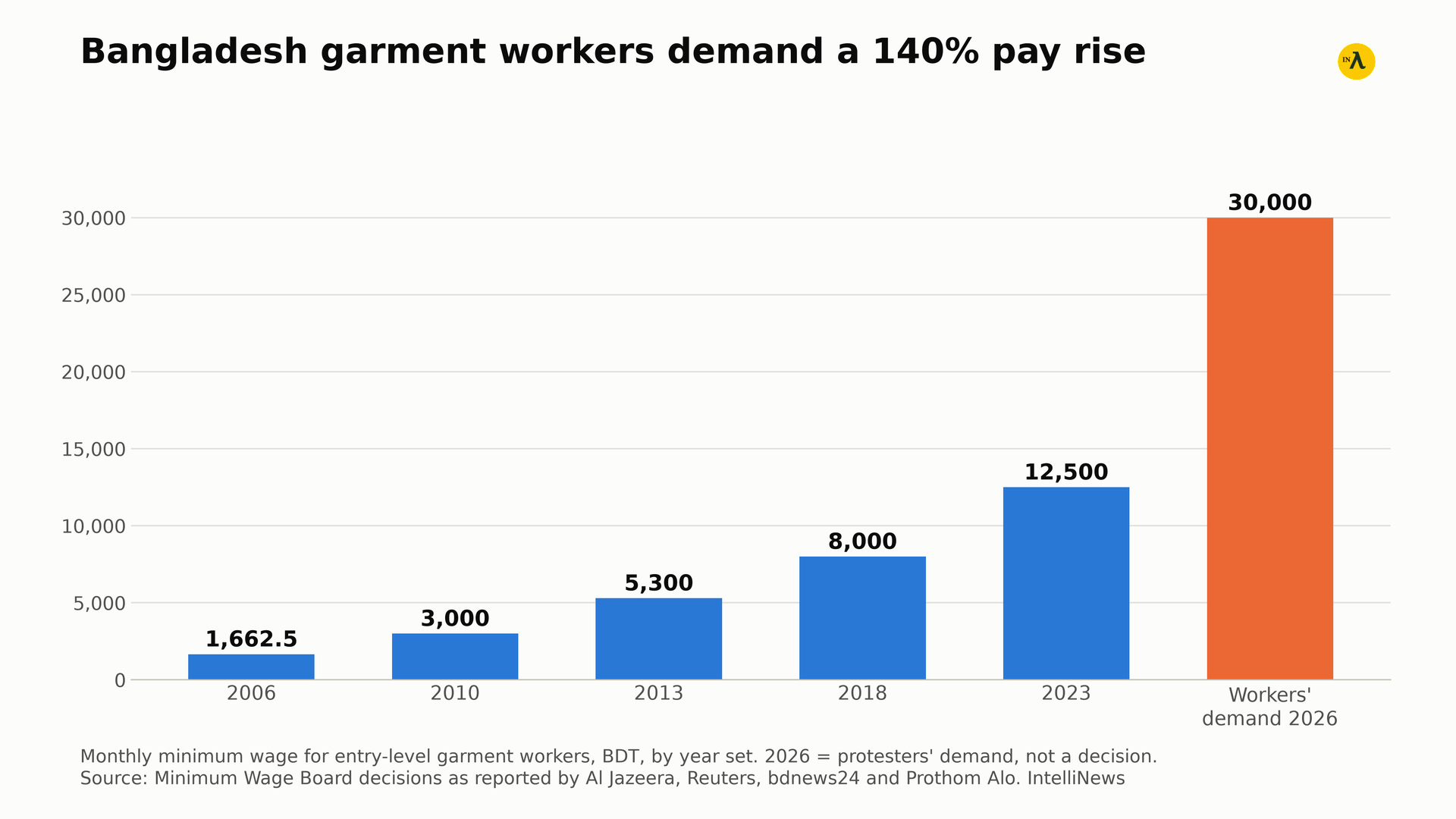
Monthly minimum wage for entry-level garment workers, BDT, by year set; 2026 is the protesters' demand. Source: Minimum Wage Board decisions as reported by Al Jazeera, Reuters, bdnews24 and Prothom Alo. IntelliNews.

Consumer prices have outrun that award, rising 28.7% between November 2023 and September 2026 [2] on a calculation from official monthly data, so BDT12,500 now buys roughly what BDT9,700 bought when the rate was set. Annual inflation has not fallen below 8% in that time and stood at 8.34% in September [2]. The 9% annual increment ordered from December 2024 softened the blow for longer-serving staff without closing the gap.
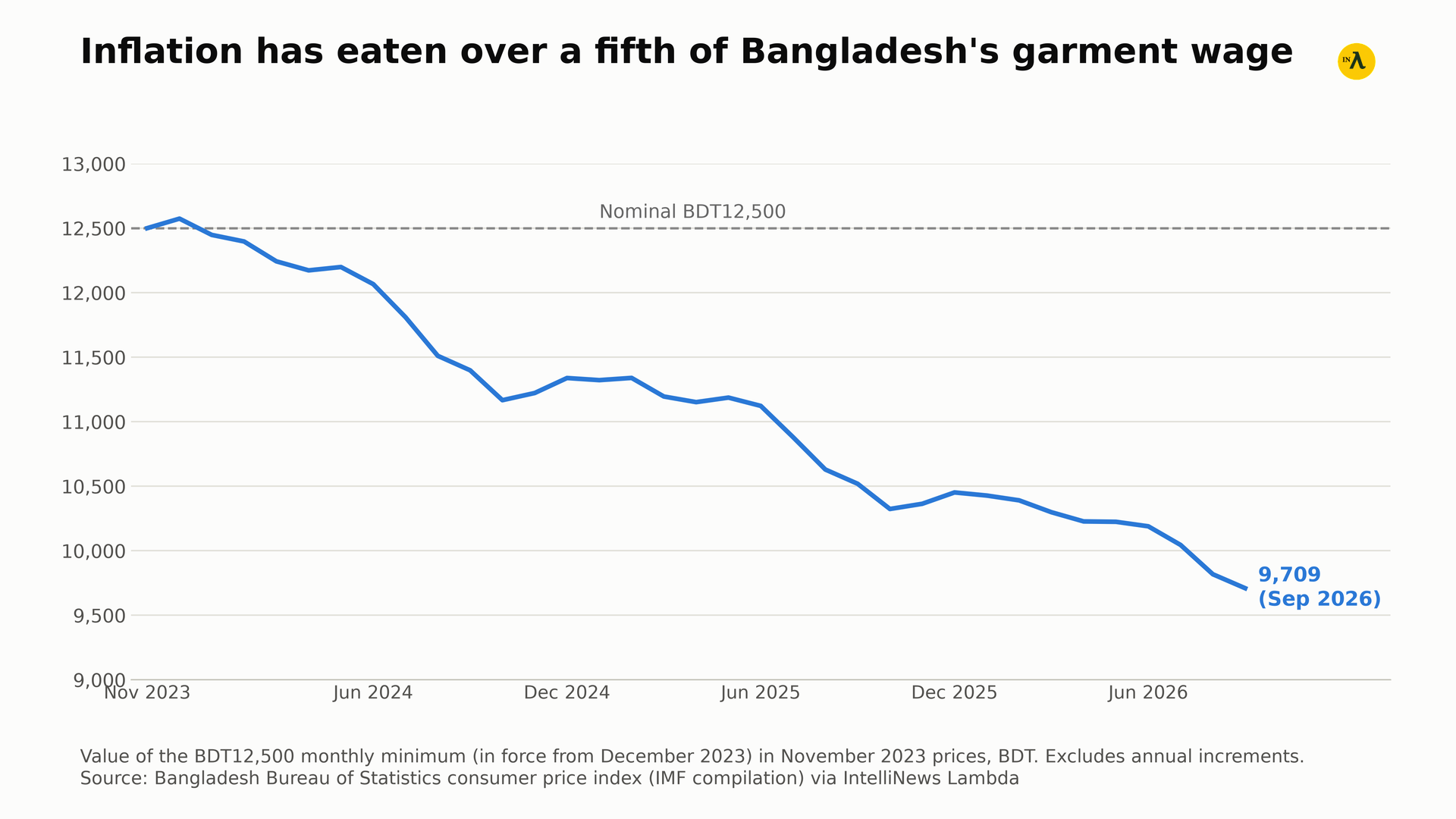
Value of the BDT12,500 monthly minimum in November 2023 prices, BDT, excluding annual increments. Source: Bangladesh Bureau of Statistics consumer price index (IMF compilation) via IntelliNews Lambda.

Factory owners argue that the sums no longer add up on their side either. Mohammad Hatem, president of the Bangladesh Knitwear Manufacturers and Exporters Association, warned in October that orders were shrinking while buyers refused to pay more, and that a bigger wage bill could close more plants. Over the summer a gas shortage cut output in the main industrial districts by 30-40%. QatarEnergy, which supplied close to 60% of Bangladesh's liquefied natural gas before the Gulf war, has pushed back cargoes month after month since declaring force majeure in March.

The export numbers show an industry treading water. Garment shipments slipped 1.64% to $38.7bn in the year to June [1], about 80.6% of total merchandise exports of $48.0bn [1], as demand from the EU weakened. The EU still buys about half of those garments. Shipments recovered by 6.1% to $10.58bn in July-September [1], but in the US market China moved back ahead of Bangladesh in January-August, $5.63bn to $5.39bn [3], even after Washington cut its tariff on Bangladeshi goods to 19% in February.
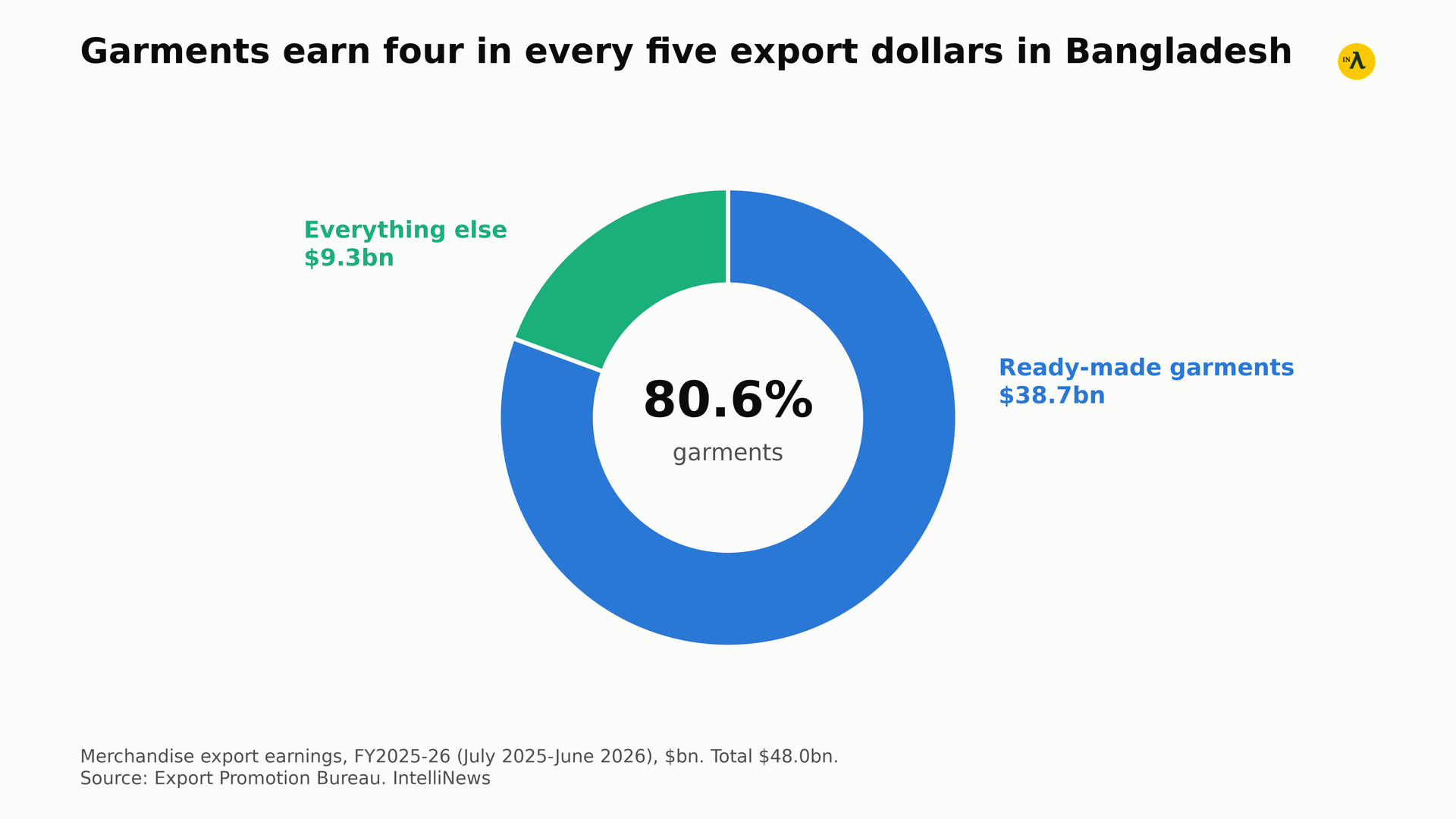
Merchandise export earnings, FY2025-26, $bn. Source: Export Promotion Bureau. IntelliNews.

Chowdhury cautioned that if factories stayed shut for long, export consignments and the money owed by foreign buyers could both be held up, just as Dhaka is trying to win those buyers back. Rahman was in Tokyo on October 28 pressing Uniqlo owner Fast Retailing to invest more in Bangladeshi clothing. The government also secured a reprieve at the UN in late October, when the General Assembly agreed to push the country's graduation from least developed country status back three years to November 24, 2029, bdnews24.com reported. That keeps the trade preferences that come with LDC status in place for longer.

Delay has a price of its own though. Unrest in September and October 2024, after the uprising that toppled Hasina, closed about 100 factories and cost the sector almost $400mn in lost production, by the BGMEA's estimate. A board that may not report until the spring is offering workers a timetable; what they are asking for is a pay packet worth what it was three years ago.

Sources

[1] Export Promotion Bureau, merchandise export data, FY2025-26 (published July 2026) and July-September 2026, published October 1, 2026

[2] Bangladesh Bureau of Statistics, consumer price index, November 2023-September 2026, latest published October 2026

[3] US Department of Commerce, Office of Textiles and Apparel, US apparel imports by country, January-August 2026, published October 2026

This article was produced with the help of IntelliNews Lambda analytical tool

Tuesday, November 03, 2026

Trump says US will halt $4 billion in aid to Israel after end of the year

President Donald Trump on Tuesday said that the United States will stop $4 billion in funding to Israel after the end of this year. While speaking to Fox News' Fox and Friends, the US president added that Israel no longer needed the aid from Washington, and that some politicians were using the funding to criticise Republicans.


Issued on: 03/11/2026
By: FRANCE 24

A file image of President Donald Trump and Israel's Prime Minister Benjamin Netanyahu at Trump's Mar-a-Lago club in Palm Beach, Florida, on December 29, 2025. © Alex Brandon, AP

US President Donald Trump on Tuesday said he made a deal with Israeli Prime ​Minister Benjamin Netanyahu that Washington would stop $4 billion in funding to Israel after the end of this year.

Speaking to Fox News' Fox and Friends, Trump said Israel no longer needed the funding and that some Democrats ​and left-wing politicians ‌were using the US financial support to Israel as a talking point ⁠to criticise Republicans.

"Now, as far as paying Israel, Bibi Netanyahu and I have made a deal that we give Israel $4 billion a year, ‌and we made a deal months ago that we're stopping," Trump told Fox ⁠News' Fox and Friends.

"We've already agreed that by the end of this year we won't be paying Israel. Now we'll help Israel if they need it," he said.

There was no ​immediate comment from Netanyahu's office on Trump's remarks.

It was not immediately clear which ‌exact funding Trump meant.

A memorandum of understanding that provides $3.8 billion annual US military aid to Israel is approaching its expiration date in 2028 and conversations have been under way on how Washington's assistance to Israel would evolve ‌beyond that date.

"They can buy whatever they want. They can buy whatever they want. So can Europe. We make the greatest weapons ​in the world," Trump added on Tuesday.

Netanyahu said in a May interview with CBS that he hoped to wean Israel off US military support within a decade.

In a June letter to a US ​congressman he wrote that the time had come for Israel "to move from aid recipient to ​partner".

US public support for Israel has fallen since the Gaza war began ​in 2023, particularly among Democrats.

A June Quinnipiac University poll found 48 percent of voters and 66 percent of Democrats believe the United States is too ​supportive of Israel, up from 16 percent and 20 percent when the question was first asked in 2017.

Support for Israel among Democratic voters has plummeted, candidates critical of Israel are winning Democratic primaries and even moderate lawmakers are increasingly willing to challenge decades of US support for Israel.


"The left uses the $4 billion payment that ⁠everybody knows about, well it's no secret, as a signal of unfairness, and we can't allow that to happen," Trump said.

"We ⁠were giving them ​$4 billion, we are, but it gets cut off at the end of the year," he said. "Why? Because they don't need it."

(FRANCE 24 with Reuters)


Trump cuts Israeli military aid: $3.8 billion in security assistance slashed


Issued on: 03/11/2026 - FRANCE24


US President Donald Trump on Tuesday, November 3, said he made a deal with Israeli Prime Minister Benjamin Netanyahu for Washington to stop providing $3.8 billion in funding to Israel after the end of this year. 

FRANCE 24's Jerusalem correspondent, Noga Tarnopolsky, has more.


Nations commit to get nature goals back on track at COP17 summit

Yerevan (AFP) – Nearly 200 nations struck hard-fought agreements Friday at a UN biodiversity summit, but the outcome was accompanied by disappointment over missed opportunities to address humanity's destructive toll on nature.


Issued on:  31/10/2026 -  RFI

Delegates cheered as the crucial texts were approved in overtime
 © Karen MINASYAN / AFP


Delegates cheered as crucial texts were approved in overtime but the celebrations were tempered by acrimonious debates and regret over limited progress on some of the most contentious issues.

The COP17 summit in Armenia sought to revive a landmark commitment to halt and reverse the destruction of nature by 2030 after global efforts to meet that goal fell short.

Over two bruising weeks in Yerevan, nations were urged to correct course to keep the pact alive and protect the plants, animals and ecosystems that sustain life on Earth.

The United Nations had warned that progress was insufficient to meet the goals of the 2030 target including protecting 30 percent of Earth's land and oceans, tackling pollution and invasive species, and boosting money for conservation.

"And that's it. Perfect," said COP17 president Hambardzum Matevosyan in Armenia as he brought down the gavel on two major texts, the final versions of which were still not available early Saturday.

But the outcome was "not commensurate" with the crisis engulfing the natural world, said French Ecological Transition Minister Monique Barbut on Saturday.

"The progress we failed to achieve here is a series of missed opportunities to speed up our response to the loss of biodiversity," Barbut said in a lengthy statement sent to AFP, stressing that "nature will not wait for the pace of our negotiations."


'Step forward'

The final plenary stretched through Friday night and well into the next morning, with negotiations turning sour as the hours dragged on.

Even as some delegates left to catch flights, others stayed behind to argue technical points.

Veteran COP observer Juliette Landry from the IDDRI think tank told AFP "there was a lot of push and pull in every direction" throughout the summit and "in that context, it's hard to get things accepted".

UN biodiversity chief Astrid Schomaker said the summit had achieved some "quite remarkable things at a moment when multilateralism is supposedly not functioning."

"Some of these more difficult subjects, we could not expect to have strong negotiated commitments. That was never the plan," she told reporters after the summit's close.

In a draft agreement of one closely watched text, nations were urged to "accelerate" their efforts and warned that "increased action" was needed to tackle the forces driving biodiversity loss.

This "represents a positive outcome... and though there are weaknesses, particularly on harmful subsidies, it does represent a step forward," Guido Broekhoven from WWF International told AFP.

Tackling subsidies and other incentives that encourage activities harmful to nature – such as fossil fuels, intensive agriculture and overfishing – was one of the most politically fraught agenda items at the summit.

"Even though the agreed decision text expresses it in weak terms, COP17 saw important political momentum to address harmful financial incentives, including subsidies," An Lambrechts from Greenpeace International told AFP.

A rare fight over science cast a pall over the summit, with a number of countries accused of undermining efforts to approve key reports in scenes that shocked even seasoned negotiators.

"We regret the increasing instances in which scientific evidence and its uptake has been challenged or constrained" by politics, said Swiss negotiator Gabriela Blatter in a statement on behalf of dozens of countries.

"Our delegations fully respect every state's right to safeguard national interest but science is not negotiable".

Nations accused of undermining science at UN nature talks


The final, agreed, version of the document was not immediately available
 © STRINGER / AFP


Finance feud

A separate row revolved around finding new cash sources to fund conservation efforts – another hot-button issue with public budgets under strain amid an energy crisis and conflicts in Ukraine and the Middle East.

The European Union led a charge for wealthy emerging economies such as China to contribute to global conservation efforts, a contentious issue at COP17.

In a sign of possible compromise, another draft text that circulated Friday invited countries outside the developed-country donors to voluntarily join the group.

Outstanding questions over the design of the Cali Fund – a UN mechanism that hoped to attract billions of dollars in corporate contributions but is close to empty – were left unresolved.

"By punting essential decisions to two years from now, parties have all but ensured the fund remains empty until then," said Pakhi Das from the nonprofit organisation Plant-for-the-Planet.

The COP17 summit decided early Saturday that Ecuador would host the next biodiversity talks in 2028 after the South American nation defeated rival candidate Panama in a secret vote.


US and Russia block competing UN resolutions on Western Sahara

The mandate for a UN-led peacekeeping mission in Western Sahara is set to end on Saturday after Russia and the United States vetoed each other's draft resolutions on extending the 35-year-old mission.


Issued on: 31/10/2026 - RFI

MINURSO personnel, seen here in 2020, are now in limbo since their mandate to continue a peacekeeping mission in Western Sahara expired on 31 October. © Fadel Senna / AFP

The peacekeeping force, known by the acronym MINURSO, was established in 1991 to oversee a ceasefire and settlement plan between Morocco and the pro-independence Polisario Front.

The two sides have disputed control of Western Sahara for 50 years.

Morocco claims sovereignty over the former Spanish colony; Polisario Front separatists, supported by Algeria and who represent the indigenous Sahrawi people, are seeking to establish an independent state called the Sahrawi Republic.

As of June this year MINURSO comprised 359 civilian and military personnel, according to its website.

US and Russia vetoes

On Friday, the United States tabled a draft resolution a the UN Security Council to extend the mission until 30 April, 2027. It would have put a Moroccan autonomy plan at the centre of efforts to settle the conflict and cut the mission's military component.

It would also have changed the name of the force from MINURSO to MINUSO, dropping the "R" that refers to a referendum on the territory's self-determination.

Eleven of the council's 15 members voted in favour, and three countries including China and Pakistan abstained.

However Russia, a permament council member, used its veto to block the US proposal, slamming it as a "unilateral approach". Moscow proposed the mission's mandate be renewed under the same terms as before.

"We stress the fact that the Security Council cannot automatically pre-determine matters relating to sovereignty," Russia's permanent representative to the UN, Vassily Nebenzia, said.

"The Security Council must not give a blessing to such a one-sided approach. Therefore we were compelled to block the adoption of ⁠the draft."

The US then vetoed the Russian proposal, and the countries that supported the American resolution abstained.

"Some members of this council have used their veto to preserve the letter 'R' – for the referendum – and the name that the United Nations hasn't even been preparing to hold for decades," said US Ambassador Mike Waltz.

The representative of France, Jerome Bonnafont, denounced "Russia's obstruction".

Ceuta and Western Sahara at heart of US-Morocco rapprochement


Satisfaction

Morocco's Royal Cabinet on Friday welcomed the nonrenewal of the peacekeeping mandate and said this "should mark the end of the Security Council's involvement and the removal of this issue from its agenda".

Algeria's representative to the UN, Amar Bendjama, thanked Russia "as well as all the countries that chose not to be associated with such a blatant injustice".

Bendjama affirmed that Algeria would continue to promote "a solution that guarantees the Sahrawi people's right to self-determination".

The Polisario Front's representative in New York, Sidi Omar, also expressed his "satisfaction" following the rejection of the US resolution.

Last year, the Security Council under US leadership gave unprecedented support to Morocco's autonomy plan for Western Sahara, deeming it the "most feasible" solution, despite Algeria's hostility.

A Spanish colony until 1975, mineral-rich Western Sahara is largely controlled by Morocco but is considered a non-self-governing territory by the UN.
INTERVIEW


'Working in Russia is like being a deep-sea diver', BBC's man in Moscow tells RFI

How does one report, from its capital, on the reality of Russia at war? Based in Moscow for more than 30 years, the BBC's Russia correspondent Steve Rosenberg is one of the few Western journalists still working in the country. He spoke to RFI about his daily life as a reporter in Russia and why he has chosen to stay, despite the Kremlin's increasing hostility to foreign media.


Issued on:  02/11/2026 - RFI

Steve Rosenberg, the BBC's Russia correspondent since 2003, is one of the few Western journalists still working in the country. © BBC

Rosenberg is well known in Russia. The fame he has gained asking Russia's political leaders, including President Vladimir Putin, direct and unflinching questions during televised press conferences means he is often approached in the street – encounters he says are overwhelmingly positive.

"Very often, people come up to shake my hand or ask for a selfie... it says a lot about what's happening in the country," he said. "In my view, it shows that the massive wave of anti-Western propaganda disseminated by state media hasn't reached the entire population."

On a recent visit to France to attend the Bayeux Calvados-Normandy Award for War Correspondents – which held a screening of the BBC documentary Our Man in Moscow, following a year in Rosenberg's life reporting from Russia – he sat down with RFI.

RFI: How has it felt being out of Russia in Western Europe, in France?

Steve Rosenberg: Every time I leave Russia, which isn't very often, and arrive in Europe or go back home to the UK, I initially find it strange to step out of this bubble I live and work in. But I think it's important to leave Russia every few months, take a step back, and look at what's happening there from a distance before going back.

In a way, working in Russia today is a bit like being a deep-sea diver. You descend below the surface, into a very strange environment where the pressure is intense. After the full-scale Russian invasion of Ukraine, I felt as if a huge wave had engulfed the Russia I knew.

And so, from time to time, it's important to surface – remove your regulator, if you like – and breathe before diving again. When I leave the country, I want to return because it fascinates me and I want to know what will happen. But it's important to release the pressure from time to time.

France ‘dismayed’ over Russia’s ban on Reporters Without Borders

RFI: You first arrived in Russia in 1991, initially to teach English, later becoming a BBC correspondent. Do you remember a moment when the Russia you knew truly changed? Was there a turning point, or was it something that unfolded gradually?

SR: When you're in the midst of a tornado, it's difficult to see everything that's happening. It's only in retrospect that you realise, "ah, that was the precise moment when something changed".

Looking back, I feel like I've known four different Russias. I saw the end of Soviet Russia – I spent a year studying in Moscow in 1990. So I experienced the last gasps of the Soviet Union. Then I witnessed its collapse in 1991.

And I saw 1990's Russia, the first decade of independent Russia, which was full of chaos, full of hope, as well, that Russia and the West were going to be friends, and this would be a new era of peace, but also an era of chaos, many Russians get impoverished, the wars in Chechnya..."

Then there was Putin's Russia, the first version. His rise to power in 2000 marked a different Russia. There were worrying signs from the start, but it seemed Putin wanted to improve relations with Europe and the West. The economy was growing. Oil prices were high. Then, gradually, the country became more authoritarian.

Finally, I've experienced post-2022 Russia, which I often call Z-Russia. The Z is one of the symbols of what the Kremlin calls the "special military operation" in Ukraine. It's a very different Russia, much more authoritarian, with more repressive laws. A country at war with its neighbour and with ever-increasing internal repression.

RFI: Were you surprised that Putin went so far as to invade Ukraine?

SR: Yes, absolutely. I didn't think he would make that decision. It was a belligerent show of force by the Kremlin. That day I was on air all day, until late into the night. When I finished my last live broadcast, I sat down and, for the first time, I truly grasped the magnitude of what had just happened. I understood that life would never be the same again. Not only for Russia, but also for Europe, for the West.

And I'm certain Putin didn't think it would be a war. I'm certain he must have been convinced that in a matter of days, or weeks at most, the Ukrainian government would collapse in Kyiv, a pro-Moscow regime would be installed and the whole thing would remain a military operation. But the authorities clearly miscalculated.

On a street in Moscow, a screen shows an image of Russian President Vladimir Putin behind an electronic board promoting contract military service in the Russian army, 19 December 2024. © Shamil Zhumatov / Reuters

RFI: Let's talk about how you do your job in Moscow for the BBC. You have to renew your visas and accreditations every three months, how does that affect the way you work?

SR: Previously, we received one-year visas and accreditations, multiple-entry visas... But since the invasion of Ukraine, journalists from so-called "unfriendly countries" only receive three-month visas. And the UK is on that list. So we have to renew our visas and accreditations every three months.

At first, as the expiration date approaches, you inevitably wonder if they will renew it or not. I imagine that's exactly how the authorities want us to feel. But I've come to understand that there's no point in worrying. I can't do anything if one day they decide not to renew my visa, I won't be able to influence their decision. So there's no point in worrying or keeping a suitcase packed.

RFI: Since 2022, you also have to think differently about the people you meet, where you meet them and how you interact with them. Tell us about that.

SR: We obviously have to think very carefully about who we talk to and who we put on air or show. After February 2022, a whole series of repressive laws were passed in Russia to silence dissenting voices and punish those critical of the authorities and the war. So we have an obligation to ensure the safety of the people we put on air.

When I conduct [interviews with ordinary people in the streets] I don't directly ask people: "are you for the war or are you against the war?", because that could get them into trouble. But there are many other questions that allow us to gauge public opinion and understand what's happening.

There are also places we can no longer go that we used to. For example, for the past two or three years, the BBC hasn't been granted permission to go to the Belgorod, Kursk, and Bryansk regions bordering Ukraine – where bombings and drone attacks obviously generate a lot of stories. Now you need special permission to go to these regions, which isn't being granted. We keep applying, but for now we can't go.

I read the Russian press and regularly publish a review of it, because the newspapers say a lot about what's happening in the country. Even in a highly controlled media environment, they reflect the developments taking place in Moscow. And the authorities can't accuse me of spreading propaganda if I report what's in the newspapers.

Headlines in Russia media on 22 February 2022, as Putin announced the full-scale invasion of Ukraine. © AP - Alexander Zemlianichenko Jr

RFI: Is it difficult now trying to convince people to talk to you?

SR: We used to have a very long list of contributors, experts and commentators we could contact to talk about all sorts of topics: culture, music, politics, economics. And then after 2022 – actually, this had started before the full-scale invasion – some people began refusing our interview requests. That long list became extremely short.

Some people are afraid to speak to the BBC. They don't want to risk being accused of associating with a major Western media outlet. Others have left the country.

What surprises me is that ordinary people always agree to talk to us in the street. Wherever we go, in cities, small towns or villages, we stop passersby. I always introduce myself, specifying that I work for the BBC. Of course, not everyone agrees to talk, but if you stop people on Oxford Street in London, not everyone will answer your questions either. Many people agree to talk to us, and that's encouraging.

RFI: Freedom of the press is virtually non-existent in Russia today. When you ask Putin a question during his annual December press conference, is the question sometimes more important than the answer?

SR: First of all, there's no guarantee I'll get the floor. But when I do have the opportunity, I know it's a huge responsibility. I have to think about the question I'm going to ask, and what the Russians watching live across the country will hear.

It's not easy because you rarely get a follow-up question – once the question is asked, they take the microphone away. But even a single question to Putin and a single answer can shed light on his way of thinking.

One time [after I had asked a question], the next day the security guard in our building said: "Steve, the question you asked our president yesterday is a question we're all asking ourselves." It teaches you something about what people are thinking.

I would love to be able to conduct a real interview with Putin. So far, my attempts have failed. I've interviewed [Belarusian President Aleksandr] Lukashenko twice, in lengthy sessions. He's a very different character from Putin. He answers everything and seems to enjoy a kind of duel during the interview.
Russia's President Vladimir Putin holds his annual end-of-year press conference in Moscow on 19 December 2025. © AFP - ALEXANDER KAZAKOV/POOL

RFI: Why do you think it's important to be there on the ground?

SR: Being there in person has real value. If you're not there, if there are no more foreign correspondents, everything becomes black or white. All Russians seem black, and the whole country too. But when you're there, we can see the nuances.

I'll give you an example. I was returning to Moscow after a reporting trip and we stopped at a petrol station about 200 kilometres from the city. I wanted to buy some biscuits. As I was approaching to pay, another customer recognised me. He came up to me and asked if I was a reporter. I replied yes. He told me: "I saw your reports somewhere, maybe on YouTube." And he said he wanted to pay for my biscuits. I told him he didn't have to, that it was very kind but not necessary. He insisted, and he paid. Then he came to shake my hand with a big smile before leaving. It's these small interactions that teach us a lot about what's going on.

It's not just about knowing what the president says and thinks, but also what ordinary Russians say and think.

RFI: You've been reporting from Russia for more than 25 years now. In Our Man in Moscow, you say you want to stay to tell the end of this story. Is it important for you to see it through to the end?

SR: Yes, I tell myself that all the time, but is it realistic? When will this story end? In a way, Russia resembles a vast Tolstoy novel – it's War and Peace. Unfortunately, more war than peace in this moment. We turn the pages wondering how the novel will end, but it seems to go on forever. It just keeps going. One Russia replaces another, then another.

This interview has been adapted from the original version by RFI's French service and edited for length and clarity.


INTERVIEW

'African leaders are not naive, they will partner with whoever makes the best offer’


The third Russia-Africa Summit took place in Moscow this week, with 48 African nations sending delegations. It comes as Moscow grapples with sanctions and isolation over its Ukraine offensive, while African governments turn to it for security assistance. However, geopolitical analyst Priyal Singh tells RFI that despite this, Russia still lags behind China in its influence on the continent.


Issued on: 31/10/2026 - RFI

Vladimir Putin with, to his right, Evariste Ndayishimiye, president of Burundi and African Union chair, at a meeting with leaders of African organisations at the 2026 Russia-Africa Summit in Moscow. © Reuters/Maxim Shipenkov


By: Zeenat Hansrod


Addressing African leaders in Moscow, Russia's President Vladimir Putin described a partnership with Russia as an alternative to traditional allies – who he referred to as a "narrow bloc of states" which determine "the destinies of entire continents".

This narrative of breaking away from old allies or former colonial powers is one that has also been deployed by China. However, Chinese trade with African countries dwarfs Russia's – at $348 billion recorded in 2025 compared to $27 billion.

Priyal Singh, a geopolitical analyst at risk advisory firm Signal Risk and senior research consultant at the Institute for Security Studies in South Africa, told RFI why the two powers cannot be compared in terms of their relationships with African countries, and how Africa leverages these for its own gain.

RFI: Do China and Russia have rival interests in Africa?

Priyal Singh: China and Russia structurally are two very different international actors and represent two very different types of partners for most African countries.

China, of course, has incredibly deep pockets. It has an incredibly extensive network of commercial engagements with many African states that go back many years. Whereas the story of Russia is quite different because following the fall of the Soviet Union, Russia largely retreated from the African continent to focus on its more immediate pressing political, security and strategic interests closer to home.

And during much of that period, a whole set of other global actors and global powers kind of stepped into that void and made considerable headway. Russia then pivoted back towards the African continent. It began in earnest in the late 2000s amongst a handful of African countries, but we saw a much more acute and targeted engagement with African countries in very recent years, particularly in the wake of its 2022 invasion of Ukraine.

I think Moscow looks towards the African continent as a critical theatre for it to reestablish its presence and to deepen its engagements, as a concerted effort to circumvent Western isolation and Western sanctions. But materially, Russia is still very, very much playing catch-up to the likes of China. I mean, let alone the likes of China – other global powers like India, for example, you'd often find have far more substantial and deeper commercial engagements across the African continent.

Vladimir Putin pictured with African leaders at the third Russia-Africa Summit in Moscow on 29 October. © Reuters/Anastasia Barashkova

And one clear distinction I'd make is that Russia's game plan for strategic influence and engagements across the African continent is quite distinct in different parts of the continent.

In the Sahel region, Russia plays a far more overt security role, working with those governments in the Sahel, providing arms, military support, technical training and, of course, the role and influence of its state-backed private security providers are also very pronounced in those regions. In Southern Africa, however, Russia maintains far more longstanding liberation-era ties to many of the ruling parties in this part of the world, and its engagements are far less security-orientated. It's far more commercially orientated.

Nevertheless, those engagements lag far behind the likes of China.

RFI: So Russia and China are not in competition, trying to carve up Africa between them?

PS: Not at all. I don't think there is that kind of overt competition between China and Russia in Africa. I think the competition is much more centred around Russian competition with Western actors, particularly the European Union, individual European member states, and, of course, the United States. But China, I would not see as being a major competitor for Russia, for it to try and displace and win influence across the African continent.

RFI: Russia uses language where it seems to be seeking to identify with the Global South. But the African leaders at this summit are not naive. What do they seek to gain from Russia?

PS: African leaders are not naive. For most African leaders, it's very clear that Russia is very much a major world power that has a seat at the United Nations Security Council, just like China does, and they are not a developing nation.

So, what do African countries want from Russia? Well, African countries want investment. They want partnerships that will spur on their own industrialisation. And most African countries will take that investment and will take that partnership from whoever is making the best offer. So whether it's coming from the United States or it's coming from Europe or China or Russia or India or Brazil, African countries are open to that kind of partnership.

And an additional factor is that all of these competing offers to help African countries develop their local industries, to diversify their critical mineral supply chains and so on, all ultimately work in favour of African countries because they can play one offer against the other.

Leaked files reveal Russia's blueprint to expand African Sahel alliance

RFI: Is Russia succeeding in extending its influence beyond the Sahel region, where it is firmly established?

PS: You're correct in saying that the real centre of Russia's security influence across the continent is centred in the Sahel region. I think Russia has found it quite difficult to expand beyond this hard security focus through arms sales, through technical cooperation.

But we have seen Russia attempt to branch out, especially in the provision of nuclear energy and infrastructure through Rosatom, a state nuclear energy corporation. And we've seen a lot of commitments around energy development.

But a lot of these remain largely framed as broad commitments. We haven't seen these commitments translate into firm agreements that have taken off on the ground. So there's still a large implementation gap in terms of what Russia can do outside of its security focus in the Sahel.

Russian President Vladimir Putin during the plenary session of the third Russia-Africa summit, an event first held in 2019. © AP/Ivan Sekretarev

RFI: Russia has been weakened by the Ukraine war. On the economic front, does it have the means to invest significantly in Africa?

PS: Russia often is able to extract greater dividends from a relatively more meagre investment, be it diplomatic investments or economic investments. And this is because Russia has pursued a very kind of targeted strategy to gain access and influence, particularly in the Sahel, particularly across West Africa and into Central Africa and into East Africa and the Horn of Africa.

Those kinds of very targeted engagements in which Russia doesn't necessarily play by the same playbook as most Western actors have allowed it to basically gain access and influence with a much smaller cheque book. And it doesn't necessarily need to make the massive multi-million or multi-billion dollar infrastructural investments that its larger peers are able to do in Africa.

RFI: In that context, what appeal does Russia have for African nations?

PS: Maybe not looking towards African nations as a whole but political elites within a very select handful of certain African countries, Russia can bring those political elites into the fold. It can put very attractive offers on the table, providing security cooperation in exchange for access to critical minerals, to energy and so on.

And this is something that not many Western actors are able to do because Western actors have to abide by their own normative commitments. So Russia is able to provide an alternative avenue for political elites in Africa to engage with.

RFI: Can Russia's relations with some African states be summarised as military support in exchange for access to natural resources?

PS: Absolutely. I think a defining feature of Russia's security engagements – with most Sahel countries, with most West African and Central African countries – is largely transactional in nature. It's tit-for-tat security deals that allow African countries to barter influence and access to their critical minerals, their gold, their energy resources in exchange for regime security and support.

RFI: And with little regard for human rights?

PS: Absolutely.

RFI: This is the third Russia-Africa summit, held this year in Moscow. What is different this time round?

PS: During the time of the first summit [in 2019] much of the Western world still believed that its efforts to diplomatically isolate Moscow could work, and that African states would largely lend their support to Western actors in cutting off ties from Russia. I think where we are in 2026, it's a very different story.

That hope that many Western actors had has clearly proven [unfounded]. African countries are willing to work with all actors from all corners of the world – be it China, Russia, Gulf actors, Turkey, India and so on – so long as they are able to get the best possible deal, and then leverage all of these competing offers against one another.

African states really have no qualms about choosing one partner to displace another, so long as it is more attractive and it leads to perhaps more expeditious outcomes on the ground. So, I think that has been the fundamental change.

And the second fundamental change has, of course, been the United States and the second Trump administration, which has taken a very different approach in engaging with Russia. And again, that kind of isolation that Western Europe was perhaps hoping for is no longer seen as a very viable option in light of the fact that you have Washington and you have most of the global South not playing by the same playbook.