Thursday, November 26, 2026

A Massive Test Awaits the Progressive Left After Blue Tsunami Soaks the Right

It’s not just that more progressives are entering Congress. It’s that the Democratic Party as a whole has become more progressive across the board. But that only means the real battles have only just begun.
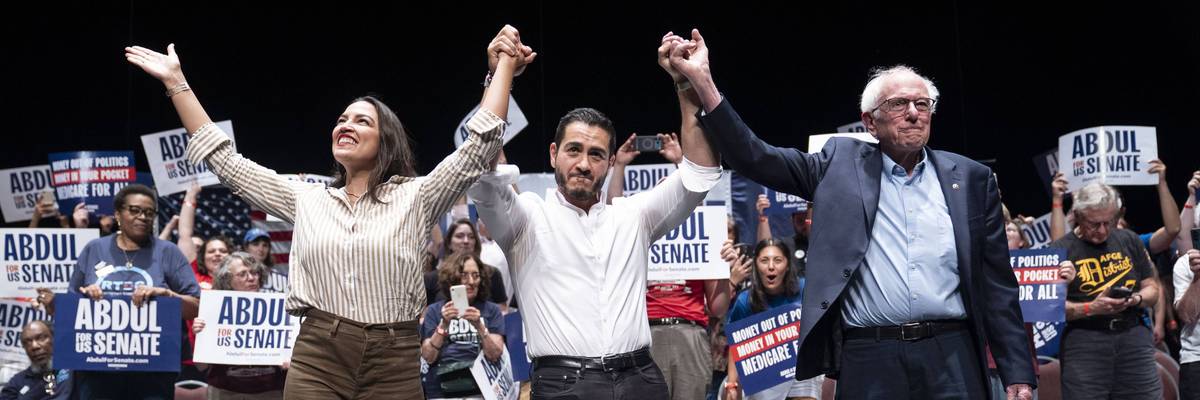

U.S. Rep. Alexandria Ocasio-Cortez (D-NY), Michigan Democratic candidate for Senate Abdul El-Sayed and U.S. Sen. Bernie Sanders (I-VT) greet the crowd after El-Sayed spoke at The People V. The Powerful rally at the Detroit Opera House on July 18, 2026 in Detroit, Michigan.
(Photo by Sarah Rice/Getty Images)

Branko Marcetic
Nov 26, 2026
In These Times

Two days after President Donald Trump and the GOP’s historic drubbing in the midterms, Corbin Trent, in the midst of a post-election media blitz, admits, “I feel terrified.”

It’s not the reaction you’d expect from someone like Trent, a campaign staffer on both of Sen. Bernie Sanders’ (I-Vt.) presidential runs and a co-founder of Justice Democrats, the progressive group that saw eight of its candidates swept into Congress on the blue wave that crashed across the United States on Nov. 3.

And yet for Trent and many on the Left, winning the election was the easy part. Trump and his authoritarian administration are still in the White House, and the Left now needs to prove that Democrats can deliver for the working class.

In the week following the midterms, the historic scale of Democrats’ rout of Republicans came into sharper focus: the largest Congressional majority in nearly two decades, secured by the widest popular-vote margin in 50 years and the biggest single-election flip in the Senate in nearly 70 years.

And at the state level, more than 500 legislative seats flipped to give the party six additional trifectas and a majority of governorships for the first time since 2010. Roughly 75% of U.S. residents will have Democratic governors, including residents of Texas, where a 24-year Republican trifecta has come to an end.

Democrats will now control the U.S. House of Representatives and the Senate, and the party plans to make use of its newfound electoral power.

It’s a loss for the U.S. Right that has left the movement and the Republican Party shell-shocked. After the presidential election two years ago, Republicans believed they had forged a new, lasting working-class majority after big swings toward Trump from nearly every demographic group, even those the party had previously struggled with: youth, Latinos and Black voters.

Two years later, those voters swung back. Other than white evangelicals, every single voter group saw a major shift towards the Democrats, nearly all of them by double digits — including Trump’s stalwart base of white voters without a college degree, who swung 14 points towards the Democrats, a trend seen across nearly every state. The Republican politicians ousted by the blue wave included decades-long incumbents, such as Ohio Rep. Mike Turner, who had been in office for 24 years, and GOP leaders including National Republican Congressional Committee chair Rep. Richard Hudson (R-N.C.).


The outcome wasn’t just good for Democrats — it was the best electoral result for the U.S. Left in more than a century. Eight years after Congress gave Trump a standing ovation for saying the United States “will never be a socialist country,” the House will include eight members of the Democratic Socialists of America (DSA), along with at least 12 other progressives who ran on agendas and campaigns in the style of “the Squad” — the Sanders-inspired progressive bloc. The Democrats’ Senate majority will feature one socialist in Sanders, 18 others who co-sponsored his Medicare for All bill, and three incoming, Sanders-backed progressives who campaigned on universal, single-payer healthcare.

Progressive organizations like the Working Families Party (WFP), whose candidate endorsements often overlapped with those of DSA, saw their best-ever results, with the WFP claiming 16 new members of Congress and two senators, as well as more than a hundred new state legislators, 38 of whom flipped GOP-held districts. By contrast, the American Israel Public Affairs Committee (AIPAC) fell flat on its face, blowing 66% of the estimated $84 million it spent in the midterms on losing races.

“Breaking from Israel was way out of the mainstream of political discourse just a few years ago,” says Joe Dinkin, WFP’s national campaigns director.

The Left may have finally put to bed the perennial charge made by its critics: that progressives and socialists can only win in deeply blue states and even bluer districts, and are a risk to run anywhere else.

Instead, progressives won in red and purple areas across the country. Two separate union leaders and firefighters endorsed by Sanders flipped red districts: Bob Brooks in Pennsylvania’s 7th District, and Sam Forstag in Montana’s solidly red 1st District, who will now be the first Democrat to represent the state in the U.S. House in more than 30 years. Another Sanders endorsee, Rebecca Cooke, a waitress with a background as a Democratic consultant, flipped Wisconsin’s mostly rural, Trump-voting 3rd District. They are just three of what will be a contingent of at least 21 Democrats in the next Congress with working-class backgrounds, ten of whom won their elections for the first time this cycle.

After California redistricting turned the 22nd District from deeply red to a toss-up, Sanders-endorsed candidate Randy Villegas knocked out a six-term incumbent by more than 35 points in a race that focused on Trump’s Medicaid cuts. With next to no national help, badly outspent DSA member Angie Nixon came within three points of taking a Senate seat in Florida, outperforming her Republican opponent in Miami-Dade County — an assumed anti-socialist stronghold in a state known for its hostility to left-wing candidates.

And progressive epidemiologist Abdul El-Sayed won his Senate race in the battleground state of Michigan by seven points, the same state where Sunrise Movement co-founder Will Lawrence flipped what former Michigan Rep. Andy Levin calls “the purplest district in a super important purple state.”

“Quit this line that you have to have a centrist to win,” Levin tells In These Times. “People don’t care about left and right, they care about top and bottom.”

Despite the historic results, there is a reason that some on the Left, such as Corbin Trent, aren’t celebrating just yet. Over the last 20 years, the U.S. voting public has ricocheted from one party to the other in a desperate search for fundamental political change. Progressives are keenly aware that they could just as easily be thrown out in a few years’ time.

“If the new crop of Democrats who just got elected and others don’t understand that this was a rebuke of the status quo, and not an embrace of the Democratic Party,” Trent tells In These Times, “then we’re not going to be able to take advantage of what I think is a generational opportunity.”

Moving left

It’s not just that more progressives are entering Congress. It’s that the Democratic Party as a whole has become more progressive across the board. Perhaps nothing illustrates this shift better than Texas, where four-term state representative and Presbyterian minister-in-training James Talarico became the first Democrat to win a Senate seat in 38 years.

Talarico, a progressive viewed by nearly half of all Texas voters as “very liberal,” ran a campaign railing against billionaires, vowing to end the “reckless war” in Iran, framing America’s true divide as “top versus bottom,” and touting a public health insurance option and universal pre-K. He won by 12 points.


In red state after red state, winning candidates publicly refused corporate PAC money and framed their races around rhetoric that once saw Sanders condemned by Congressional Democrats for waging “class warfare.”

Talarico’s messaging wasn’t unique. This year, the two issues Democrats spent the most on— $732 million, or 47% of the party’s ad spending — were affordability and healthcare.

In red state after red state, winning candidates publicly refused corporate PAC money and framed their races around rhetoric that once saw Sanders condemned by Congressional Democrats for waging “class warfare.”

In Iowa, Democrat Josh Turek won a Senate seat after repeatedly linking his opponent to “billionaires and large corporations.” In Mississippi, Scott Colom, the first Democrat to win a Senate race in the state since 1982, pilloried his opponent for voting to strip Mississippians of health insurance in order to send money to the “millionaires and billionaires.” In South Carolina, Senate winner Annie Andrews promised she would “not sell out to big money or take any corporate PAC money.” And in Ohio, populist Sherrod Brown won his Senate seat by leaning into rhetoric around “workers” versus “billionaires,” and running multiple ads hitting his opponent for taking money from one of convicted sex trafficker Jeffrey Epstein’s ultrarich associates.

Five different Democrats have failed to unseat “moderate” Maine Republican Senator Susan Collins over the past three decades, including the former Maine House speaker Sara Gideon, who outraised Collins more than two-to-one, only to lose to her by nine points in 2020. The Democrat who finally beat her was Troy Jackson, a fifth-generation logger who ran ads highlighting his modest, working-class roots and attacked Collins over her alleged corruption and support for both Trump and the Iran war. Collins, meanwhile, garnered backlash for a personal attack on Jackson’s family and for running an ill-advised ad suggesting his background as a woodworker meant he wasn’t up to the job of senator.

But arguably no race had bigger stakes than the mini intraparty civil war that played out in Michigan, a key swing state in the Trump era, where El-Sayed became the first left-wing candidate to win a statewide general election with a purple electorate.

Sanders’ upset win in Michigan’s 2016 primary was written off by many pundits as simply a product of anti-Hillary Clinton sentiment, a narrative pushed by establishment voices who insisted it was too risky to nominate progressives and socialists outside of coastal, deep-blue strongholds. “The factor that actually explains 2016,” moderate commentator Jonathan Chait wrote in 2020, pointing to the Michigan result, “was Hillary Clinton’s idiosyncratic personal unpopularity.”

Every Michigan election that followed seemed to bear that belief out: El-Sayed’s own first, failed 2018 gubernatorial run; Sanders’ dramatic underperformance in the 2020 primary; and CIA analyst Elissa Slotkin’s knife’s-edge, 0.3-point win over former U.S. Rep. Mike Rogers in the state’s 2024 Senate race.

El-Sayed’s 2026 race against Rogers didn’t just seek to keep the Trump loyalist out of the Senate a second time; it was also a challenge to the narrative about what kind of Democrat could win. And it came at a time when the Israeli government’s genocide in Gaza had transformed the politics of U.S.-Israeli relations nationwide, particularly within the Democratic Party.

“Being able to call it what it is, and to have the moral courage to stand up for that, was a litmus test for people,” Adam Hamawy, a doctor who served in Gaza and saw the horrors of U.S. weapons first-hand, tells In These Times. Hamawy won a heated Democratic primary for a New Jersey House seat in June, and went on to win the general election on Nov. 3.

In addition to campaigning on Medicare for All and taxing the rich, El-Sayed ran as an outspoken critic of Israel. As a result, his campaign served as a test case for AIPAC’s claim that unconditional U.S. support for Israel was politically necessary.

“I don’t think anyone has ever run as a major party nominee for the U.S. Senate and said, ‘Not only am I against offensive aid to Israel, I’m against defensive aid like Iron Dome and related programs,’” says Levin.

With so much on the line, the forces traditionally arrayed against the Left went into overdrive to sink El-Sayed. First, he had to overcome $32 million of AIPAC spending in the primary. Once he won the primary in a squeaker and moved on to the general election, Rogers ran a smear campaign focusing on El-Sayed’s background and identity.

“The fearmongering that you heard wasn’t, ‘Oh my god, he’s going to give healthcare to everyone,’” Rep. Delia Ramirez (D-Ill.), who entered Congress on an earlier wave of Left insurgency in 2022, tells In These Times. “It was the fact that he was Muslim. They used bigotry against him.”

With public support for Medicare for All now standing as high as 65%, the Trump camp made El-Sayed’s faith and Arab ethnicity the overwhelming target of their attacks. They were joined in the effort by a small but vocal group of Democratic saboteurs, including his defeated primary opponent, Rep. Haley Stevens (D-Mich.), and her backers. One of those supporters openly admitted he aimed to sink the Democratic nominee to “show that anti-Israel candidates like El-Sayed can’t win, thus bringing the Democratic Party back to its more traditional and pro-Israel stance” and preventing the party’s “hostile takeover” by left-wing forces come 2028.

Bend the Arc, a progressive Jewish organization that deployed to Michigan to talk to voters about antisemitism, encountered Jewish residents both excited to be represented by a Muslim senator and genuinely conflicted over El-Sayed’s views on Israel. “We tried to frame the conversation around our priorities,” says Bend the Arc CEO Jamie Beran.

“We were asking them to consider what would actually protect Jewish safety, and what empowering Christian nationalism would mean for Jews,” Beran tells In These Times.

In the end, it wasn’t even close. El-Sayed outperformed Kamala Harris in several key counties, decisively won back the Arab-majority city of Dearborn that Trump had poached in 2024, won young men back from the president with a 55-point swing, and won 92% of the vote in Detroit, deflating claims made, in the wake of the primary, that he struggled with Black voters.

Most strikingly, despite fearmongering about the supposed danger El-Sayed’s candidacy posed for Jewish residents, both exit polls and analysis of county- and municipality-level voting patterns showed that, at worst, he had lost roughly a fifth of Jewish voters while still comfortably winning the vast majority of them.

For most Jewish voters, “the most important issue in voting is not Israel-Palestine,” says Levin. “Overwhelmingly, they care a lot about reproductive rights, immigrant rights, LGBTQ rights, economic justice and racial justice. Abdul lines up with them on every issue.”

DSA on the rise

The midterm wins for the Left and its policy positions also solidified a major trend of this election cycle: what Politico has described as “DSA’s improbable rise to a power center in the Democratic Party.”

In the space of a decade, DSA has transformed from an obscure organization of some 6,000 members, with barely a footprint on the nation’s political landscape, to one of more than 130,000 members — making it the largest socialist organization in U.S. history. And, when the winners of these midterms are inaugurated, more than 400 DSA endorsees will serve as elected officials at virtually every level of government across the country, according to DSA press coordinator Rachel Monk.

One of the most high-profile members to take office is Zohran Mamdani, who last year upset disgraced former governor and Democratic establishment choice Andrew Cuomo to become mayor of New York City.

That upset was just the first spark of a chain reaction that saw New York City-DSA candidates achieve a near-total sweep in June primary elections, knocking out powerful and years-long incumbents.


“Over the years, we’ve been building a political operation, political machinery” in the city, says Claire Valdez, a Mamdani ally elected to represent New York’s 7th Congressional District after winning her primary in June. “That came to a head last year in the mayoral election, and that sense of optimism and the belief in the political power of the working class carried over into this year as well.”

During this year’s primaries, DSA candidates took out more incumbents at the federal level than the Tea Party did during its famous 2010 wave of victories. Across the country, DSA recorded more than three times as many wins than last year, for a total of 158. Even in races where DSA didn’t endorse a candidate, it still played a role.

For instance, while El-Sayed doesn’t identify as a socialist, he openly welcomed DSA members into his coalition and benefited from the organization’s local ground game. Likewise, while no DSA chapters formally endorsed Talarico, his campaign benefited from the volunteer power of Texas DSA members in the state’s large metro areas.

In Maine, Troy Jackson had the backing of the state’s DSA chapter when he ran for governor earlier this year. When the Democratic Party was left scrambling this summer to find a replacement for former Senate nominee Graham Platner, who dropped out in July following sexual assault allegations, socialists quickly coalesced around Jackson for a second time.

DSA candidates, meanwhile, continued the organization’s patient build-up of power downballot, expanding the political pipeline that has helped elect a record number of socialists to the next Congress. As of the time of this writing, DSA candidates notched 136 state, county and municipal wins, including the mayorships of Washington, D.C., Los Angeles, and Providence, Rhode Island.

“It’s not surprising that all these wins for mayors and federal candidates came from DSA chapters who were already building the bench and developing the experience to not just elect people, but to work with them once they were in office,” Ashik Siddique, DSA National Co-Chair, tells In These Times. “That took many years of work.”

Many of those wins came in surprising places.

“Until this year, the narrative has often been, ‘DSA is winning all these races, but they’re mostly in already blue districts and all mostly in a Democratic city. Talk to us when you win a swing seat,’” says Siddique. “That’s actually happening now.”

One such surprise was DSA member Ashley Herrmann flipping a swing Florida county in Tampa to become the second socialist ever elected to office at any level in the state. Another is David Chappell, who cinched Utah’s State House District 62, beating a six-term Republican incumbent. Kentucky and Georgia, where Trump won in 2024, now have their first and second socialist state legislators in the modern era, respectively, albeit elected in blue areas.

As DSA and its political fortunes have transformed, so have the public’s attitudes toward socialism. Associated less today with long-extinct Soviet authoritarianism than with popular figures like Mamdani, Sanders, and Rep. Alexandria Ocasio-Cortez (D-N.Y.), socialism is now viewed more positively than ever by U.S. residents, especially non-white voters and those earning less than six figures.

Increasingly, U.S. voters themselves are identifying as democratic socialists — with the largest share in states like Hawai’i, Oregon, and California, where exit polls show they made up roughly a quarter of all midterm voters. Yet even in Texas, nearly a fifth of voters call themselves democratic socialists. In Denver, where DSA member Melat Kiros unseated a 15-term incumbent in her June primary, a greater share of voters describe themselves as socialists than Republicans, and hold a more favorable view of socialism than capitalism.

“I think it was really powerful for our campaign that I wasn’t identifying the incumbent or any person as a problem, but rather the systematic way we’ve organized our economy and government around protecting the interests of the ultrawealthy,” Kiros tells In These Times. “We were able to pull in a lot of voters who weren’t necessarily regular Democratic voters: we had a lot of unaffiliated supporters, we had a lot of new voters and young voters.”

You don’t have to be a socialist to recognize the organization’s growing clout. In New York, Gov. Kathy Hochul has embraced the socialist mayor of her largest city and provided support to his agenda. Ocasio-Cortez, meanwhile, was in high demand this election season, transferring money to, and barnstorming on behalf of, battleground candidates in the final stretch, with even some Republican operatives begrudgingly acknowledging her popular appeal. This midterm blitz and her “race-changing endorsements” of a host of progressives were conspicuously detailed in a post-election memo by her team, as the congresswoman weighs a possible 2028 run for president.

“A responsibility to deliver”

Following this Democratic romp, the next battle will be deciding what the party will do with its majority.

Already, divisions are emerging in the Democratic camp. The agenda laid out before the election by House Leader Hakeem Jeffries (D-N.Y.) primarily consisted of reversing recent Trump policies rather than pursuing more aggressive plans. Sen. Brian Schatz (D-HI), for his part, has urged Democrats not to pass bills that Trump is likely to veto, and to save the “more aspirational” and “bold policy changes” for 2028. Even once the enormous scale of Democrats’ victory became clear, centrists such as centrist Blue Dog Coalition leader Rep. Adam Gray warned progressive colleagues not to “yell and scream about your ideas that aren’t gonna get done.”

That’s not how everyone sees it.

“We have a responsibility to deliver,” says Kiros.

While many Democrats are breathing a sigh of relief, progressives are experiencing flashbacks to 2008, when hopes of a permanent Democratic majority curdled thanks to promises that were either broken or fell short, culminating in a Democratic wipeout at the state and federal levels two years later.

“Absent really tangible results, I think people are going to feel like they were duped,” Valdez tells In These Times.

“We have to ensure that we can prove to them that their vote mattered,” says Ramirez.


Progressives don’t seem phased by arguments that the massive size of the Democratic majority has eroded their leverage.

In a post-election statement posted on X, Rep. Greg Casar, who chairs the Congressional Progressive Caucus and just won his third term to a Texas House seat, cautioned Democrats not to spend the next two years being “the party of nervous lawyers who just tinker around the edges.” Other high-profile progressives such as Rep. Ro Khanna (D-Calif.), have similarly advocated an ambitious approach, daring Trump to veto popular ideas like Medicare for All or cutting off weapons to Israel.

“Fuck the press when they say, ‘These are show bills, the president’s going to veto them, this is all just messaging,’” says Levin. “I don’t care. Let Trump veto them all, and say to the American people, ‘Okay, so if you get a Democratic president and Congress, this is what you’ll get.’”

WFP’s Dinkin agrees, adding, “If that means Trump vetoes healthcare for all, that would actually be advantageous.”

Those sentiments may be more widely shared within the party. Longtime Rep. Debbie Dingell (D-Mich.) echoed progressives on the eve of the election when she said Democrats “have to deliver” when they win and not simply “look like Republicans.”

Sanders himself has proposed lowering the eligibility age of Medicare to 55; adding dental, vision, and hearing to its coverage; and ensuring it covers all kids. These are measures partly resurrected from negotiations over the never-passed Build Back Better bill during Joe Biden’s presidency, which had overwhelming approval from both the public and the party caucus. Even moderate, pro-Israel Democrats who flipped red districts have publicly signaled an openness to restricting weapons to Israel, including Eileen Laubacher, an alumn of Biden’s National Security Council and retired Navy rear admiral who defeated far-right Rep. Lauren Boebert (R-Colo.). Another issue that ties together progressives and other Democrats is restrictions on data center construction, a hugely popular demand that made for potent campaign fodder.

Progressives don’t seem phased by arguments that the massive size of the Democratic majority has eroded their leverage.

“I actually make the argument that it’s the opposite,” says Ramirez. “Most of my frontline colleagues just won by major numbers. So if, in fact, all we need is 218 votes for Medicare for All, then we just gave Hakeem Jeffries a very big gift. He can lose eight or 10 people, maybe, and the majority of us can center ourselves around the American people and get this stuff done.

“There’s always strength in numbers,” says Hamawy, who believes that the number of elected Democrats who back Medicare for All is larger than publicly known. “We have more candidates now who are standing up for issues that people want.”

They’ll be assisted by left-wing political groups like DSA and WFP that have seen their own ranks grow alongside progressives in Congress, and who view their task as continuing to organize long past the election season.

“Once people are in office, they have a big membership group like DSA to work with, to have an outside-inside strategy,” says Siddique. “While they’re haggling over bills and taking votes, we’re doing stuff on the outside to make things even more possible.”

With the Democratic electorate spoiling for a fight with the Trump administration (and to some extent hostile to its own existing party leadership), progressives and socialists aren’t worried they’ll end up in the vulnerable position that left insurgents found themselves in during the Biden era. At the time, former Sanders ally Nina Turner was defeated in her Ohio House race after facing accusations of party disloyalty over her criticism of the Democratic establishment, while “Squad” members found themselves fending off charges of sabotaging Biden’s agenda by withholding their votes to secure progressive concessions.

“Any appetite for that kind of narrative among the American people is entirely gone,” says Kiros. “I look at what Summer Lee and Ro Khanna and Thomas Massie did to make sure the Epstein files were finally released, and that annoyed a lot of people in the way they were doing it, but the American people were pleased to see it. During the government shutdown, we held the line for quite awhile until Chuck Schumer and a handful of senators decided to concede. Voters want to see us fight for the betterment of the American people.”

Valdez, who previously served in the New York State Assembly, says that working in Albany has shown her the power of “operating as a bloc that can withstand a lot of attacks.”

“When we can move together, we give each other protection, we can take bigger swings, bigger risks,” she says.

The stakes are unimaginably high. If the Democratic failures of the Obama era helped lead to Trump’s presidencies, the onus may now fall on progressives and socialists in power to bring about a political transformation.

“People are desperate for systematic, long-lasting change,” says Trent. “Until that’s delivered, voters are going to continue swaying back and forth desperately.”

“This is the most hopeful political time I’ve ever had in my life,” Trent says. “But the problem with hope is that any conditions that make transformational change possible for the better are the ones that make it possible for the worse — that make it possible to take a darker, more sinister turn.”

This story was produced in partnership with the Rosa Luxemburg Foundation.


© 2023 In These Times


Branko Marcetic
Branko Marcetic is a staff writer at Jacobin magazine and a 2019-2020 Leonard C. Goodman Institute for Investigative Reporting fellow. He hails from Auckland, New Zealand, where he received his Masters in American history, a fact that continues to puzzle everyone who meets him. You can follow him on Twitter at @BMarchetich.
Full Bio >
53 Newly Elected House Democrats Threaten to Boycott Harvard Orientation in Solidarity With Student Worker Strike

“I’ve never crossed a picket line, and I don’t intend to start,” said incoming Rep. Sam Forstag, a former Montana labor leader.


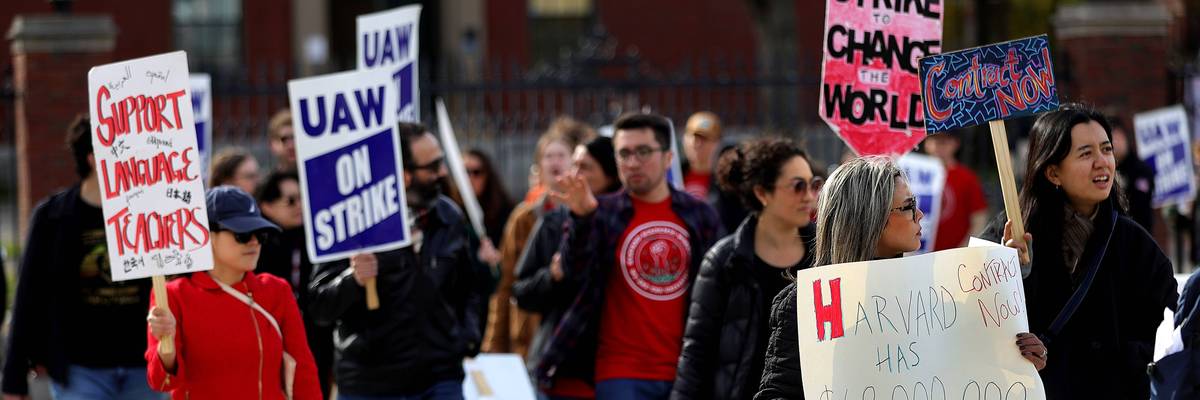
Members of Harvard Academic Workers picket on November 10, 2026.
(Photo by David L. Ryan/The Boston Globe via Getty Images)

Stephen Prager
Nov 25, 2026
COMMON DREAMS

Fifty-three Democrats newly elected to the US House of Representatives said Tuesday that they plan to skip Harvard University’s orientation for incoming lawmakers in December unless the school reaches a “fair contract” with striking student workers.

In a letter sent Tuesday, the lawmakers—who make up about three-quarters of the 73 new House Democrats elected this cycle—said the biennial program, which Harvard has hosted since 1972, “seems like a truly fantastic bipartisan opportunity” to learn from the prestigious university.

“However, as much as we would like to attend, we have been informed that to attend your event, we would be required to cross a union picket line,” they wrote to university president Alan Garber, Harvard Kennedy School director of programs and events Jacob Watts, and provost John Manning.

The Harvard Graduate Students Union-United Auto Workers (HGSU-UAW), which represents more than 4,000 graduate and undergraduate student workers, has been on strike since October 27.

After more than 20 months of contract negotiations, thousands of teaching fellows, research assistants, and other hourly student workers walked out for the second time this year because Harvard had failed to meet the union’s demands for higher wages and benefits, protections for noncitizen workers, and an independent process for handling harassment and discrimination complaints, according to The Harvard Crimson.

“As newly elected members of the 120th Congress, we were elected because of our commitments to helping working people, and we remain steadfast in our support for unions and collective bargaining,” the lawmakers wrote. “So long as these workers are on strike, any trip we take to Harvard would be to stand in solidarity with our striking union siblings.”


Support from union members was a critical factor in Democratic victories across the map in November. According to the AFL-CIO, the nation’s largest labor federation, a record 639 card-carrying union members were elected in federal, state, and local races around the country.

Three longtime union organizers and leaders elected to the House this month spearheaded the Harvard boycott: Montana smokejumper Sam Forstag, former vice president of National Federation of Federal Employees Local 60; New York UAW organizer Claire Valdez; and Bob Brooks, president of the Pennsylvania Professional Fire Fighters Association.

“I’ve never crossed a picket line, and I don’t intend to start,” Forstag said in a video posted Tuesday. “Harvard has an endowment of $68 billion. They can afford to pay people a living wage.”

The union has asked for annual pay of at least $53,800 for salaried graduate workers, $45,000 for graduate teaching fellows, and for hourly workers to make at least $24 per hour. It also wants pay to increase by 4.5% each year.

According to the UAW, some graduate teaching fellows currently earn just $26,000 annually, low enough to qualify for food assistance in Massachusetts in some cases. The school’s endowment, meanwhile, increased by $11 billion this year.

“Elite universities are unimaginably wealthy, and they massively underpay their graduate students, substituting real compensation for the hope of eventually landing an elite faculty job,” said Rep.-elect Daniel Biss (D-Ill.), another incoming lawmaker who signed the letter. “They even often insist grad students aren’t workers, even though they give their labor (teaching and research) in exchange for money.”

In the letter, the lawmakers said they’d reconsider attending the orientation, scheduled for December 6-8, if the university agreed to a fair contract with the workers.

Forstag told the school’s administrators, “If me and so many other members of Congress are going to be making a trip out there in December, it’s going to be to join our brothers and sisters on the picket line until and unless you engage in good faith in contract negotiations and give those workers a fair deal.”


Harvard receives hundreds of millions of dollars from the federal government each year to support scientific and medical research.

“The richest university in the world should be able to pay its workers a fair wage,” said Denish Jaswal, the president of HGSU-UAW. “It is not too much to ask for Harvard to protect noncitizen workers and to create a workplace free from harassment and discrimination. If Harvard is going to be asking newly elected members of Congress for funding, Harvard shouldn’t be surprised when those same members demand that Harvard treats its workers with dignity.”

Jaswal told The Boston Globe that the support from newly elected Democrats was “incredibly telling, and it really sets a strong tone that is positive for labor that they reached out to us, and that this is their first act to support us.”

Other Massachusetts Democrats have also expressed support for the picketers, including Sens. Elizabeth Warren and Ed Markey, incoming House Majority Leader Katherine Clark, and Rep. Ayanna Pressley.

“We stand with the Harvard Graduate Students Union and the Harvard Academic Workers as they strike and fight for good wages, workplaces free of harassment, and a university that works for all,” they said in a joint statement last week.

Rep. Chris Deluzio (D-Pa.), who helped to organize faculty at the University of Pittsburgh with the United Steelworkers before being elected to Congress in 2022, praised his incoming colleagues’ unapologetic stand with organized labor.

“Being pro-worker means knowing which side of a picket line to stand on,” he said, adding that it was “great to see” Forstag, Brooks, and Valdez “leading so many new members in solidarity.”

Rep.-elect Brad Lander (D-NY), who also signed the letter, congratulated his colleagues on their pro-union leadership. Democrats plan to prioritize passing the landmark Protecting the Right to Organize Act, or PRO Act, after retaking Congress in January.

Lander said, “Let’s make this the most pro-labor Democratic majority in generations.”

The other Democrats who signed the letter are Darializa Avila Chevalier (NY), Mitchell Berman (Wis.), Adrian Boafo (Md.), Victoria Broderick (Tenn.), Luke Bronin (Conn.), Jasmine Clark (Ga.), Paige Cognetti (Pa.), Cait Conley (NY), Pia Dandiya (Fla.), Zach Dembo (Ky.), J.D. Ford (Ind.), La Shawn Ford (Ill.), Patty Garcia (Ill.), Oliver Gilbert (Fla.), Angela Gonzales-Torres (Calif.), Adam Hamawy (NJ), Frederick Haynes III (Texas), Christina Hines (Mich.), Jacqui Irwin (Calif.), Lindsay James (Iowa), Cyril Jefferson (NC), Jake Johnson (Minn.), Eric Jones (Calif.), Melat Kiros (Colo.), Kristina Knickerbocker (Ohio), Dan Koh (Mass.), Brad Lander (NY), Micah Lasher (NY), William Lawrence (Mich.), Don Leonard (Ohio), Ben McAdams (Utah), Mike McGuire (Calif.), Donavan McKinney (Mich.), Donna Miller (Ill.), Jeremy Moss (Mich.), Katy Padilla Stout (Texas), Richard Pan (Calif.), Brian Poindexter (Ohio), Denise Powell (Neb.), Chris Rabb (Pa.), Janelle Sarauw (US Virgin Islands), Hilda Solis (Calif.), Sarah Trone Garriott (Iowa), Randy Villegas (Calif.), Marni von Wilpert (Calif.), Fred Wellman (Mo.), Robert White (DC), Scott Wiener (Calif.), and LaKesha Womack (NC).

Sweden tops global media freedom support rankings as international funding declines


University of East Anglia


Sweden has been ranked the world's leading supporter of intern
ational media freedom, according to a new index published today.

The index also highlights a decline in funding from 30 leading donor countries, despite growing threats to independent journalism worldwide.

The Index on International Media Freedom Support (IMFS) evaluates countries on how actively they support media freedom beyond their borders through diplomatic, funding and safety efforts.

It is published annually by an independent team of academics at the University of East Anglia (UEA) and City St George’s, University of London.

Sweden topped the 2026 Index - moving up one place from 2025 - largely due to its significant financial support for international media development.

In 2024, Sweden spent 1.01 per cent of its total aid budget on supporting independent journalism around the world.

However, Sweden is an outlier. Across all 30 countries in the Index, just 0.15 per cent of official development assistance (ODA) was allocated to media support in 2024, down from 0.16 per cent in 2023.

Three countries gave no money at all to international media development – despite having pledged to support promote media freedom internationally: Latvia (18th), Greece (24th) and Slovenia (29th).

Report author Prof Martin Scott, from UEA’s School of Global Development, said: “At a time of growing geopolitical instability and mounting pressure on independent media, international support should be increasing, not declining.”

Prof Mel Bunce, another of the report's authors at City St George's, highlighted the progress made by some countries, adding: “Finland recorded the largest improvement in the rankings between 2025 and 2026, climbing nine places from 19th to 10th.

“This was largely driven by its increased leadership role in international efforts to support media freedom, including taking on the role of co-chair of the Media Freedom Coalition, an international coalition of 50 states.”

The United Kingdom, the Media Freedom Coalition’s other co-chair, maintained its 12th-place ranking, reflecting its continued diplomatic engagement on media freedom.

UN Special Rapporteur on freedom of opinion and expression, Leopoldo Maldonado Gutiérrez urged states to “use these findings as an opportunity to strengthen cooperation, protection and sustainable support for independent journalism”.

Sweden’s Ambassador to the UK, Stefan Gullgren, said that “freedom of expression and the right to information are pillars in our democratic global community and the media workers are at the forefront. We would be delighted if we could share first place with many more nations; this is not a race to win, but a shared endeavour”. 

The Index was launched last night at an event in Westminster hosted by the All-Party Parliamentary Group (APPG) on Media Freedom, in partnership with Reporters Without Borders (RSF), which serves as the APPG's secretariat.

The IMFS is the only index to evaluate countries' foreign policy support for media freedom. It includes all 30 countries that are members of both the OECD Development Assistance Committee and the Media Freedom Coalition.

The Index draws on 2025 data for diplomatic and safety measures, with financial data from 2024 due to reporting lags.

It is published by the Centre for Journalism and Democracy at City St George’s, which investigates the threats facing journalism, the impact of these on civil life, and designs interventions to help address them.

The centre partners with journalists, thinktanks, NGOs, and policymakers to explore how ethical, public interest news can be reimagined and protected for future generations.

Free Speech Advocates Say Ruling Against FCC Carries Lesson for Media Outlets: ‘Don’t Cave’ to Trump Attacks

“This is not a close case,” a federal judge wrote. “Defendants may not retaliate against or punish plaintiffs and other broadcast license holders for disfavored speech.”


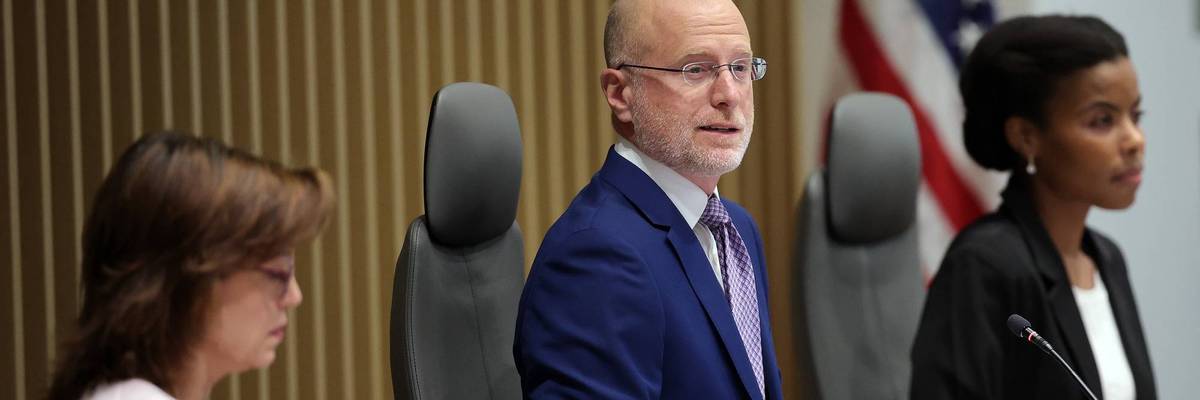
Federal Communications Commission (FCC) Commissioner Anna Gomez, Chairman Brendan Carr, and Commissioner Olivia Trusty participate in a FCC meeting on February 18, 2026 in Washington, DC.
(Photo by Kevin Dietsch/Getty Images)


Julia Conley
Nov 26, 2026
COMMON DREAMS

A federal judge’s ruling against the Federal Communications Commission was applauded late Wednesday by one of the FCC’s own commissioners, Democrat Anna Gomez, who has been critical of Chairman Brendan Carr’s threats against media companies during the Trump administration and who said the decision in a case regarding ABC’s broadcast licenses would bring “badly needed accountability to the commission.”

US District Judge Loren AliKhan ordered the FCC to halt its review of ABC’s licenses, which the commission ordered the network to file a renewal request for in April—even though its current licenses don’t expire until 2028.


‘A Defining Test’: Press Freedom Group Urges New Democratic Majority to Impeach Trump’s FCC Chair

That demand from the FCC came after President Donald Trump accused ABC of giving him “negative coverage” and a day after the president attacked late-night host Jimmy Kimmel over jokes he made about First Lady Melania Trump.

AliKhan said Wednesday that all evidence showed “Chairman Carr has taken President Trump’s rhetoric as his marching orders.”

“Against the backdrop of President Trump and Chairman Carr’s call-and-response, it is no coincidence that President Trump criticized Mr. Kimmel’s skit on social media and the very next day defendants initiated the early license renewal proceedings,” wrote the judge.


AliKhan ruled in the case three months after ABC filed a First Amendment lawsuit against the FCC, arguing that the commission’s early review of its broadcast licenses was part of a “deeply un-American” attack on media companies’ speech.

The judge, who was appointed by former President Joe Biden, expressed strong agreement with ABC.

“This is not a close case,” she wrote. “No one doubts that the commission may enforce the law in the manner it sees fit. But in doing so, defendants may not retaliate against or punish plaintiffs and other broadcast license holders for disfavored speech.”

“Given the extreme, indeed existential, nature of the possible penalty plaintiffs face—loss of their broadcast licenses—the court concludes that early license renewal proceedings create a risk sufficient to chill a broadcaster of ordinary firmness,” she added.

The network argued in court that the threat to ABC’s ability to continue broadcasting was already chilling speech, causing executives to question how they should cover the recent midterm elections and who could appear as a guest on the daytime talk show “The View” without angering the president.

“We sit with our head on the guillotine,” said Beth Wilkinson, a lawyer for ABC, at a hearing. “We are watching everything we do.”

AliKhan wrote that “these alterations to plaintiffs’ editorial decision-making showcase how the commission’s early license renewal proceedings have already curtailed plaintiffs’ protected activity. That an objectively reasonable broadcaster faced with the same existential threat would follow suit is beyond debate.”

Seth Stern, chief of advocacy for the Freedom of the Press Foundation, said AliKhan had seen the FCC’s threats against ABC “for what they are: a campaign of intimidation and retaliation against speech that displeases Donald Trump.”

“The First Amendment does not allow government officials to appoint themselves the journalism or comedy police. The Constitution recognizes that even good-faith government actors cannot adjudicate journalistic merits without letting political agendas cloud their judgment, and Brendan Carr is far from a good-faith actor,” said Stern.

“The impact of the FCC’s censorship spree has not been limited to ABC or other outlets Carr has pursued directly—he has put broadcasters on notice that if their coverage provokes a Truth Social tantrum, the FCC may deem hurting the president’s feelings contrary to the ‘public interest’ and come after them with bogus investigations,” he added. “Outlets that Carr has intimidated can breathe a little easier. The lesson to learn from this ruling is don’t cave to Carr or any other anti-speech bullies in this administration. Instead, take them to court—the judiciary is on to them, and they lose regularly.”

The ruling follows Trump’s attempt to ban reporters from CNN, MS NOW, and Politico from the White House. A federal judge struck down the ban in September.

In the case of the FCC and ABC, Gomez, the lone Democrat on the commission, said AliKhan’s ruling had shown “that this FCC is a paper tiger whose threats crumble when challenged by those willing to defend their rights.”

“Every broadcaster facing this pressure should take note,” said Gomez, “and choose courage over capitulation because, as I’ve said from the beginning, the First Amendment is on their side.”

'Not a close case': Judge finds dark motive in Trump ally's threats to ABC's license


By:Matthew Chapman
Nov 25, 2026
RAW STORY


A federal judge paused the Federal Communications Commission's early license renewal proceedings against ABC's eight stations, finding they were likely retaliation for ABC's speech.

U.S. District Judge Loren AliKhan ruled Nov. 25 that ABC and Disney were likely to succeed on a First Amendment retaliation claim. She denied the FCC's motion to dismiss and rejected its argument that only appeals courts could hear it. She granted an injunction limited to the early renewal proceedings.

She denied a broader request to bar all threats, because plaintiffs hadn't specified what those actions "are or might be."

The opinion counted eleven calls by President Donald Trump over two years for ABC's licenses to be revoked and found his rhetoric showed animosity toward protected speech. AliKhan also noted FCC Chairman Brendan Carr echoed those calls. The Media Bureau ordered early renewals on April 28, 2026, the day after Trump demanded Jimmy Kimmel's firing, and Carr said of the move, "If you didn't take us seriously, now you should."

The judge started with a presumption of good faith but wrote that she did not find the FCC's explanation, that early renewal aided a Disney employment investigation, credible "on the record before the court." She noted the order didn't explain Disney's alleged deficiencies, that the explanation came weeks later, and that the FCC had other tools.

Carr said the tool hadn't been used in 50 or 60 years.

She credited evidence of chilling, including ABC livestreaming a Trump address it otherwise wouldn't have and no candidates appearing on "The View" for months. The proceedings could last two to five years.

"This is not a close case," she wrote.

Coalition Challenges Trump FCC Repeal Intended to Further Entrench Corporate Media Consolidation

“The FCC is attacking American democracy by allowing corporations and billionaires to cannibalize local TV stations,” said one union leader.


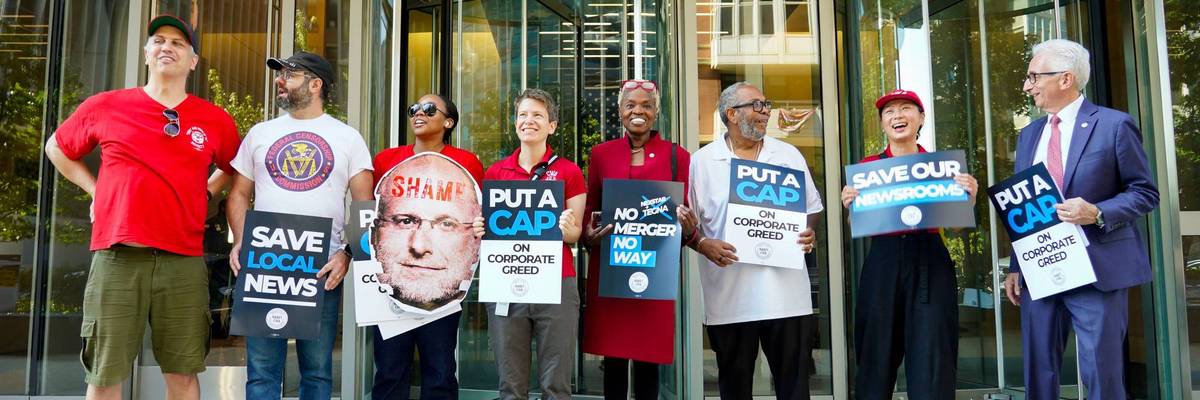
Free press advocates protest Federal Communications Commission Chair Brendan Carr on August 6, 2026 in Washington, DC.
(Photo by Leigh Vogel/Getty Images for Free Press)


Jessica Corbett
Nov 25, 2026
COMMON DREAMS

Nonprofits and media unions this week filed a petition urging a US appellate court to stop the Republican-controlled Federal Communications Commission from repealing a policy put in place over two decades ago to limit corporate consolidation in broadcast television.

In 2004, Congress passed the Consolidated Appropriations Act, directing the FCC to ensure that no TV station owners reached more than 39% of the national broadcast audience. From that came the National Television Multiple Ownership Rule.

“Congress set the ownership cap so no one company could control too much of what Americans see on TV,” explained John Bergmayer, legal director of Public Knowledge, which is part of the coalition behind the petition. “It’s still needed. When one company buys stations in city after city, it can replace the local reporting that local TV still uniquely provides with programming beamed in from a distant city. Viewers are left with fewer reporters covering their schools, police departments, and city halls.”

Led by President Donald Trump’s FCC Chair, Brendan Carr, the commission voted in August to roll back the rule and replace it with one that allows for decisions made on a case-by-case basis.

The new rule “will decimate the broadcast news industry as we know it,” warned Carrie Biggs-Adams, president of the National Association of Broadcast Employees and Technicians-Communications Workers of America (NABET-CWA) Local 51, another coalition member.

“We will see more and more mergers like Nexstar-TEGNA until the landscape is unrecognizable,” she predicted. “NABET-CWA Local 51 members know that local news is the lifeblood of a functioning democracy. Independent journalism and local news will become things of the past unless we stop these media conglomerates.”

Matt Wood, vice president of policy at Free Press, another group behind the legal challenge, said that “no FCC chairman, including President Trump’s favorite attack dog, Brendan Carr, can ignore the will of Congress—no matter how much he wants to. With this brazen and unlawful move to erase a statute, Carr is continuing to hand out favors to media conglomerates in exchange for friendly coverage of President Trump.”

“The agency cannot overturn this vital media-ownership limit,” he argued. “It has no authority to eliminate laws like this. Carr’s goal is to spur more media consolidation involving companies Trump views as ideological allies, but he cannot rewrite congressional mandates.”


After notifying the FCC of the plans to launch a legal challenge last month, the coalition—which also includes the Future Film Coalition, the NewsGuild-CWA, Reporters Without Borders, the United Church of Christ Media Justice Ministry, Writers Guild of America East, and WGA West—filed the petition for review and a stay motion with the 9th Circuit Court of Appeals this week.

“Reporters Without Borders believes that the FCC’s illegitimate dismantling of the national television ownership cap is a brazen concession to powerful media conglomerates and a direct assault on media pluralism,” said the group’s executive director in the United States, Clayton Weimers.

“When fewer corporations control more of the country’s news outlets, local newsrooms, journalists, and ultimately the public pay the price,” he stressed. “Congress established clear limits to prevent this concentration of power, and the FCC cannot simply disregard them. The court must intervene before irreversible damage is done to an already fragile media landscape.”

Trump and his cronies have been accused of degrading US democracy during both of his nonconsecutive terms, and coalition members framed this rollback as a continuation of that. NewsGuild-CWA president Jon Schleuss declared that “the FCC is attacking American democracy by allowing corporations and billionaires to cannibalize local TV stations.”

“The pillaging of local news must stop,” said Schleuss, whose union is the largest for journalists in the United States. “We’re urging a federal appeals court to protect our communities and journalists by blocking the FCC’s illegal decision.”

The coalition’s lawyers include Simon Brewer from Democracy Forward, who emphasized that “democracy thrives when localism, viewpoint diversity, and competition in the media are protected, and people have access to the information they need to engage in civic life.”

“We are hopeful that the court of appeals will see the harm that will come to our democracy if the FCC is allowed to abandon its long-standing rules preventing harmful corporate consolidations,” he added, “and we are honored to work with this impressive and expansive coalition to fight for the current limits regarding media consolidation.”

Despite the legal challenge from this coalition—and another recently launched by the Broadband Communications Association of Pennsylvania—Carr has shown no signs of slowing down, announcing Monday that the FCC “will be voting next month to modernize its local ownership rules for radio and TV broadcasters.”


WHO Chief Cites Cuban Toddler Awaiting Heart Surgery in Plea for US to Lift Embargo

“Her doctors know exactly how to help her. They just lack the resources. I cannot stop thinking about her, and about every child like her.”


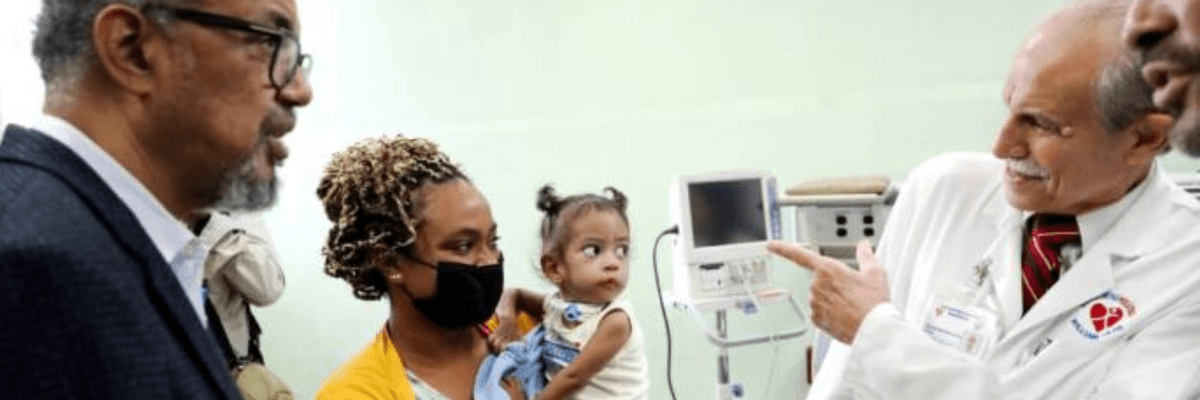
World Health Organization Director-General Tedros Adhanom Ghebreyesus (left) meets a 1-year-old girl waiting for open-heart surgery, along with Dr. Eugenio Selma Husein Sosa (right), director of the William Soler Paediatric Cardiology Centre in Havana on November 24, 2026.
(Photo by Tedros Adhanom Ghebreyesus/X)


Brett Wilkins
Nov 25, 2026
COMMON DREAMS


A toddler awaiting open-heart surgery is among thousands of Cuban children whose lives are imperiled by critical shortages caused or exacerbated by the Trump administration’s tightened embargo, the head of the World Health Organization said Wednesday from the island as he called on the United States to immediately lift its illegal economic and fuel blockade.

WHO Director-General Tedros Adhanom Ghebreyesus—who did not mention US President Donald Trump by name in his remarks—described meeting the 1-year-old and her mother during a visit to Havana’s William Soler Pediatric Hospital and Cardiocenter.

“Her mother was by her side, holding on to hope,” Tedros said of the child. “Her doctors know exactly how to help her. They just lack the resources.”

“I cannot stop thinking about her, and about every child like her,” he continued. “Fuel restrictions and sanctions are straining Cuba’s health system. Almost 100,000 surgeries are backlogged, including 12,000 for children. Some 34,000 pregnant women cannot access the care they need. Behind every number is a child, a mother, a family waiting.”


“Health must never be a casualty of politics,” Tedros added. “For these children and their mothers, I call for these sanctions to be lifted immediately. Their lives depend on it.”

The WHO chief’s appeal came amid mounting reports of Cuban children enduring potentially life-threatening delays for operations and other essential medical treatment.

Some children have not survived. In June, an Associated Press report on Cuban pediatric cancer patients featured an interview with one doctor who said that “we’ve had dead children.”

The AP also interviewed Adriana Felipe, whose daughter’s cancer treatment was at risk, and who said US officials “must soften their hearts.”

While the Trump administration maintains that food and medicine are exempt from its sanctions and argues that the policy is intended to pressure Cuba’s government into political and economic reform, the restrictions on financial transactions, energy supplies, and third-country businesses have made it increasingly difficult for the island to obtain critical goods.

Earlier this month, CBS News reported that foreign companies are increasingly fearful of US penalties and are reluctant to sell food and medical supplies to Cuba. The report also described hospitals struggling with shortages of cancer drugs, anesthetics, and laboratory equipment.

Cuba’s once-vaunted public health system has deteriorated to the point where life expectancy has decreased for the first time since the country began keeping records in 1950, nearly a decade before the revolution that led to socialist rule.

On October 28, the United Nations General Assembly voted 130-17, with 25 abstentions, in favor of a nonbinding resolution calling for an end to the US embargo—the 34th consecutive time that the world body’s member states have done so.

Former British Labour Party Leader Jeremy Corbyn condemned the blockade in a Wednesday interview with Novara Media.

“What is Cuba’s crime? Developing public services, building universal healthcare, and raising life expectancy,” said Corbyn, who now leads the socialist Your Party. “Somehow, this means the people of Cuba are deserving of being put under the most intense, severe, and cruel sanctions imaginable.”

“Let’s be clear what this blockade is: a crime against humanity,” he added. “The US’ criminal blockade is literally killing people—and our own government is standing idly by. Enough. Lift the blockade now. Viva Cuba.”