Saturday, November 28, 2026


EU seeks temporary flexibility for plug-in hybrid electric vehicles

28.11.2026

Photo: Hauke-Christian Dittrich/dpa

Just before stricter rules for calculating the carbon dioxide emissions of certain hybrid cars are due to come into force, the European Commission has proposed that the so-called utility factor for plug-in hybrid electric vehicles (PHEVs) should not be adjusted until January 1, 2030.

The stricter calculation factor was originally due to come into force on Sunday.

PHEVs are cars that have both an internal combustion engine and an electric motor. Their battery can also be charged from a mains socket or a charging station. Put simply, the utility factor indicates what proportion of a plug-in hybrid's mileage is assumed to be electric. The higher this proportion, the lower the officially reported CO₂ emissions tend to be.

Hybrids often still run on their internal combustion engines 

Until now, type approval for cars has been based on the assumption that plug-in hybrids cover a relatively high proportion of their journey in the electric mode. 

However, usage data shows that many of them are charged less frequently and run on their internal combustion engine more often than assumed. For this reason, the calculation factor is to be adjusted - initially for new vehicle types, and later for all relevant new cars.

Manufacturers have to meet an average CO₂ target for their new car fleets. The adjustment means that, in mathematical terms, plug-in hybrids will offset the emissions from internal combustion engines to a lesser extent. This will make it more difficult for manufacturers to meet the 2030 CO₂ target. To do so, they would, for example, have to sell more electric cars.


UK pupils to learn how to ‘disagree agreeably’ in curriculum overhaul

29.11.2026

Photo: Anthony Upton/PA Wire/dpa

Schoolchildren in the UK will be taught to spot misinformation and “disagree agreeably” as part of a major overhaul of the national curriculum.

The changes, due to be formally announced on Monday, will include compulsory citizenship lessons introduced from primary school, along with digital and media literacy to help children spot bias and misleading content.

Pupils will also be taught more financial literacy, while an updated computing General Certificate of Secondary Education (GCSE) will include lessons on data and artificial intelligence.

Education Secretary Lucy Powell said the curriculum had failed to keep pace with changes in the wider world since it was last reformed.

She said: “We are modernising the curriculum, to equip young people for their fast-changing future, not some bygone past.

“Every child will build strong foundations in maths, reading, writing and speaking enabling them to access the full breadth of the curriculum, develop their talents, expand their horizons and become resilient, confident and adaptable life-long learners.”

Officials said the reforms would be based on strengthened reading and communication skills, including a new “oracy” assessment at the end of primary school to test children’s speaking and listening skills.

Geoff Barton, chairman of the Oracy Education Commission said the changes would better prepare children to “understand ideas, to be able to explain, analyse and justify their views, to know how to disagree agreeably, and, in due course, to be able to take their place as active, engaged and informed citizens”.

On Saturday, the Government announced the new curriculum would also require schools to set aside time for pupils to read for pleasure in an effort to combat a decline in daily reading levels amid a battle for attention with screens.

It will be mandatory in primary schools, while secondary schools will have more flexibility.

Proposals for compulsory financial literacy lessons were welcomed by consumer rights campaigner Martin Lewis, who said it was “a chance to stop young people being sent out into a world of scams, dodgy deals and debt without the tools to cope”.

Shadow education secretary Laura Trott said the curriculum overhaul was “a shopping list of things that sound nice but erodes the core knowledge that has put English pupils in the world’s top ten for reading, maths and science”.

She added: “Oracy has been tried and tested before and it failed.

“Core subjects will lose out as more citizenship at primary will become a dumping ground for nonsense.

“We need education policy that follows what has worked, not policy based on vibes.”


Swiss voters to decide on arms exports restrictions and fireworks ban

29.11.2026

Photo: Patrick Pleul/dpa-Zentralbild/dpa

Swiss voters head to the polls on Sunday to decide whether to change arms export rules and whether fireworks will be banned.

In one referendum, voters will decide whether to ease restrictions on military equipment exports. Currently, Switzerland's legislation does not allow arms exports to countries involved in armed conflicts, among other restrictions.

Under the proposed changes, exports to partner countries involved in conflicts would be allowed, provided they remain compatible with Swiss neutrality and its foreign or security policy interests.

It would also allow the federal government not to follow the authorization criteria if exceptional circumstances applied, and it was necessary to safeguard Switzerland's interests. 

Exports would remain subject to neutrality law, human rights requirements and other international obligations. 

Voters will also decide whether to ban the sale and private use of "noisy" fireworks. 

The proposal will see loud pyrotechnics banned to reduce noise, air pollution, accidents and fire risks as well as to protect people and animals.

If passed, the ban would have to be implemented within two years. Opinion polls suggest there is broad support for the measure.

Professional firework displays would be exempt from the restrictions.

Similar restrictions are in place in Ireland and the Netherlands. Environmental organizations have called for a nationwide ban in Germany too, with the issue to be discussed again next week by the interior ministers of the federal states.


UN's Guterres: Two-state solution only viable path to peace

29.11.2026

Photo: Michael Kappeler/dpa

UN Secretary General António Guterres renewed his calls for a two-state solution in the Middle East on Sunday.

"The only viable path to peace in the Middle East is the two-State solution, with Israel and Palestine living side-by-side in peace and security," Guterres wrote on X.

His comments came as the UN observed the International Day of Solidarity with the Palestinian People.

"The Palestinian people have a right to dignity, justice and self-determination," Guterres wrote.

The UN would "not waver in its commitment to the only viable path forward: the two-State solution, with two independent, sovereign, democratic States - Israel and Palestine - living side-by-side in peace and security," he said.

Meanwhile, a Palestinian was killed in Madama in the West Bank overnight after stones were thrown at the Israeli military, according to Israeli media reports. An IDF officer was wounded during the altercation, it was reported.

The situation in the West Bank has sharply deteriorated since the Hamas-led attacks on Israel on October 7, 2023, and the ensuing Gaza war. 

More than 1,100 Palestinians have been killed since in Israeli military operations, armed clashes and attacks, according to the Palestinian Health Ministry.

Violence by radical Israeli settlers against Palestinians and their property has also increased significantly.

Western Sahara

The Sahrawi people sacrificed to imperialist alliances

Saturday 21 November 2026, by Louis Harel


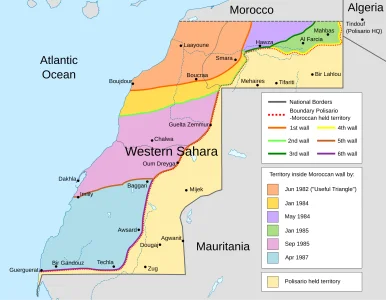
The UN Security Council has ended the United Nations Mission for the Referendum in Western Sahara (MINURSO), which is 80% occupied by Morocco. The democratic right of the Sahrawi people to self-determination and independence continues to be violated by the Sherifian kingdom and the imperialist powers, including France, who support it.

The issue of Western Sahara has just been discussed again at the UN, regarding the renewal of MINURSO’s mandate, which ended on 31 October. A renewal demanded by the Polisario Front, which, after fighting against the Spanish occupation, has been fighting since 1975 against Morocco’s annexation of Sahrawi territory. A territory listed as a United Nations non-self-governing territory, yet to be decolonized.

MINURSO was created in 1991 to monitor the ceasefire concluded at that time and to contribute to organizing the self-determination referendum provided for by the settlement plan approved at that time by the UN Security Council, as well as by the Polisario and Morocco. But Rabat did everything to prevent this referendum from taking place: diplomatic manoeuvres, the “Moroccanization” of Western Sahara, expulsions and brutal repression of the Sahrawi people, a large part of whom (more than 170,000 people) had to find refuge in camps in Algeria.

Diplomatic impotence and imperialist complicity

Due to lack of consensus in the Security Council, MINURSO was not extended this year. The renewal resolution proposed by the United States — supported notably by France — removed any mention of the referendum and transformed the UN mission into an instrument for implementing Morocco’s so-called autonomy plan for Western Sahara: an “autonomy” under Moroccan sovereignty! A veto from Russia, which proposed an alternative solution to renew MINURSO, was met with a US veto.

Although the resolution favourable to it could not be adopted, Rabat, backed by Western imperialisms, intends to use the departure of UN observers and military personnel to its advantage. The royal cabinet immediately reacted by declaring that “the UN process [... ] no longer has any reason to be” and that MINURSO, “inherited from an anachronistic and reconstructed context,” must leave as soon as possible. With the barely concealed intention of taking its place and continuing and consolidating its colonization. In its 5 November article, Jeune Afrique, which recalls that the Royal Armed Forces (FAR) have never ceased operations in the 20% of Western Sahara controlled by the Polisario, no longer rules out — citing sources close to the FAR — “a sustainable redeployment [of the Moroccan army], with new military positions beyond the wall” that divides Western Sahara in two.

International solidarity, a matter of life or death

The Polisario, given the military balance of power, is now betting on the diplomatic front. But even on this front the balance of power is unfavourable to it. After the United States, it was the Spanish state and then France, in 2024, that supported the Moroccan so-called autonomy plan, even advocating it on the Security Council, which last year adopted it, without any votes against, as a basis for resolving the conflict.

The Sahrawi people nevertheless resist, tirelessly. But their resistance needs a powerful mobilization of international solidarity, which they sorely lack today, to wrest their right to exist.

13 November 2026

Translated by International Viewpoint from l’Anticapitaliste.


Africa's Sahara is greening and absorbing more carbon, scientists find

Africa's Sahara is greening and absorbing more carbon, scientists find
Wet-season rain over the desert is rising along with plant cover, a US study finds. Climate models project far more summer rain by late century, though from a very low base. / bne IntelliNewsFacebook
By Ben Aris in Berlin November 28, 2026

The Sahara is getting greener and soaking up more carbon dioxide during its wet season, US scientists have found, as rare deluges refill desert lakes across north Africa.

Rain over the desert between August and October is more than 17 times heavier than between January and March, and plant photosynthesis, tracked by satellites, is twice as high, according to the study Greener Southern Sahara: An Enhanced Carbon Sink, published in the Journal of Geophysical Research: Atmospheres on July 21. The extra growth pulls enough CO2 from the air to leave its concentration over the Sahara about four parts per million lower in the wet season than at the start of the year.

The researchers, from the University of Houston, Stanford, the University of California, Riverside and Caltech, found rising long-term trends in both rainfall and vegetation during the wet season. The desert "is becoming greener and evolving into a stronger carbon sink", they concluded.

On the desert's northern edge, Morocco expects a grain harvest of 9mn tonnes this year after floods in February ended a seven-year drought. Yet the trend is far from even: desertification now affects 84% of Mauritania's territory. The Sahara covers about 9.2mn square kilometres, so if only 5% of it turned green for good, that would be 460,000 square kilometres of potential grazing and farmland, about 11 times the size of the Netherlands.

Summer rainfall over the Sahara could rise by 75% in 2050-2099 compared with 1965-2014 under a high-emissions scenario, according to a University of Illinois Chicago study that ran 40 climate models and was published in npj Climate and Atmospheric Science in June 2025. It projects increases of 24% for southeastern Africa and 17% for south-central Africa, and a fall of up to 5% in the west of southern Africa. Warmer air carries more moisture, and more of it converges over the region.

Even so, the Sahara gets only about three inches (76 mm) of rain a year, a tenth of what falls on Chicago, according to the university, and differences between the models account for more than 85% of the uncertainty in the projections. "We have to start planning to face these changes, from flood management to drought-resistant crops," said lead author Thierry Ndetatsin Taguela.

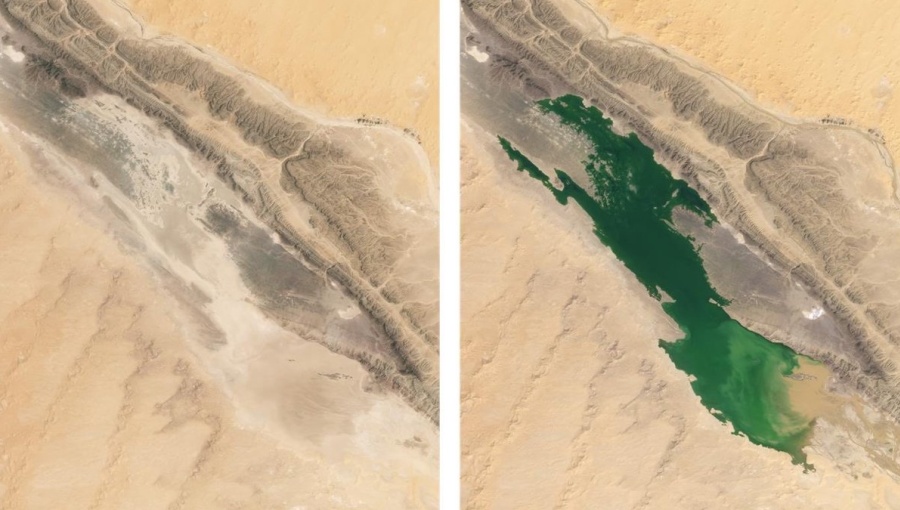
An extratropical cyclone dropped up to 20 centimetres of rain on parts of Morocco, Algeria, Tunisia and Libya on September 7-8, 2024, about a year's worth in two days. Algeria's Sebkha el Melah, a lake that only six storms since 2000 have managed to start filling, covered 191 square kilometres to a depth of 2.2 metres by mid-October, NASA's Earth Observatory reported. A year earlier Storm Daniel, which killed thousands in Derna, left temporary lakes and rivers across the Libyan desert in Copernicus satellite images.

The Sahara has been green before. During the African Humid Period, which ended about 5,000 years ago, much of today's desert was savannah, wetland and lake, home to hippos, elephants, giraffes and herding communities.


China and Russia lose Venezuela oil foothold and may never see their $22bn

China and Russia lose Venezuela oil foothold and may never see their $22bn
Beijing lent against oil, and under Maduro Venezuela repaid by shipping discounted crude to Chinese buyers, a route now closed.Facebook
By Latin America bureau November 27, 2026

IntelliNews summary:

  • Caracas lists $16.87bn of bilateral debt to China and $5.08bn to Russia in its Venezuela Renace plan.
  • In August five fields run by Chinese companies, and one Russian-linked project, were reassigned to the US-backed NABEP.
  • US Energy Secretary Chris Wright said China would have no claim on revenue from Venezuela's new oil production.
  • Rodriguez defended Russia at a Moscow gas summit by video, with no public US objection reported.

____________________

China and Russia barely grumbled when US forces seized Nicolás Maduro in January and whisked him to New York in the dead of night to face narcoterrorism charges. Ten months on, they have lost their grip on Venezuela's oil and are owed $22bn by Caracas.

The US-China Economic and Security Review Commission, an advisory body to Congress, hails the January capture as an "unprecedented setback" for Beijing in the Latin America chapter of its 2026 annual report, released on November 18. US forces snatched Maduro a few hours after he had met a Chinese envoy, and Chinese-made anti-aircraft radars reportedly failed to help the Venezuelan military, the commission said. Beijing slammed the raid and demanded Maduro's release, but did not intervene militarily or offer significant new assistance. Meanwhile, Chinese regulators immediately began reviewing their banks' exposure to Venezuela.

The envoy was Qiu Xiaoqi, Beijing's special representative for Latin America, who met Maduro at Miraflores Palace on January 2, ABC, the Spanish daily that first reported the chapter, said on November 24.

What Beijing and Moscow have left is a creditor's claim on a country whose oil money now passes through Washington's hands, in a debt restructuring where the US carries the loudest voice. Neither came to Maduro's defence beyond diplomatic condemnation, and neither has yet found a way back in under Delcy Rodriguez, the former vice-president who now governs as acting president with US backing.

The fields change hands

In August, Rodriguez's government reassigned five oilfields from Chinese companies to North American Blue Energy Partners (NABEP), a company controlled by controversial Venezuelan businessman Alejandro Betancourt in which the Pentagon holds rights equivalent to a 35% stake. The Chinese operators were Sinopec, China National Petroleum Corp (CNPC) and China Concord Resources, which Washington sanctioned in 2019 over alleged dealings with Iran, and the package also took in a project tied to a Russian operator, according to US officials. Washington gets preferential access to 20% of NABEP's output at cost and first refusal on the rest.

"China's legitimate rights and interests in Venezuela must be safeguarded," foreign ministry spokesman Guo Jiakun said on August 31. A week later his colleague Mao Ning insisted that "China-Venezuela cooperation has no connection whatsoever to third parties". US Secretary of State Marco Rubio answered that "Chinese and Russian companies held these fields but never developed them into anything".

NABEP now produces about 230,000 barrels per day (bpd), Betancourt said on November 19, and targets more than 250,000 bpd by the end of the year from Lake Maracaibo in the west and the Orinoco belt in the east. Its 17 fields come with 100-year development rights and equipment shipped mainly from the US.

Outside oil, the US Treasury licences that let American companies supply Venezuela's telecoms sector from August exclude any entity in or controlled from China or Russia, a blow to state operator CANTV, which runs on Huawei and ZTE equipment and owes Huawei about $600mn, according to local journalist William Pena. The commission's report also singles out ZTE's role in the Carnet de la Patria, the biometric ID card the Chavez and Maduro governments used to ration benefits.

Who pays Beijing

The Venezuela Renace plan published this week by the finance ministry lists $16.87bn of bilateral debt to China and $5.08bn to Russia, most of it run up under the late Hugo Chávez, against $1.13bn to Brazil, within public-sector liabilities of $237.5bn, or 242% of GDP. The Chinese figure sits above outside estimates: the commission put outstanding Chinese loans at $10bn or more in January, and other estimates ran at $10bn-12bn.

Beijing lent against oil, and under Maduro Venezuela repaid by shipping discounted crude to Chinese buyers, a route now closed. Such resource-backed loans "gave Chinese lenders priority over important revenue streams", the commission's report says. Since January, Washington has supervised Venezuela's oil sales and revenues, and US Energy Secretary Chris Wright told Bloomberg Television in Caracas on September 2 that China would have no claim on revenue from the country's new oil production.

That leaves Beijing as one creditor among many in a process it does not run. US investment bank Centerview Partners, not the IMF, is coordinating the restructuring, which could allow talks to move ahead even if China declines to take part, Rachel Lyngaas, a former chief sanctions economist at the US Treasury now at RAND, told Venezuelan site Guacamaya in August. She expects Beijing to push for longer maturities rather than accept writedowns, as it did in Zambia and Sri Lanka.

ABC reported that the restructuring Washington backs envisages Chinese claims being paid in full, without saying where the money would come from. The process itself has stalled: Caracas put it on hold in September to concentrate on oil contracts, and consultancy Signum Global warned in November that verifying bilateral claims, "particularly China", could push recognised liabilities past $200bn and cut recoveries for every creditor.

Moscow's smaller bet

Russia's exposure is smaller, but its oil position is no stronger. State-owned Roszarubezhneft took over Rosneft's Venezuelan assets in 2020, after US sanctions on two Rosneft subsidiaries, and said in January, right after Maduro's ouster, that those assets belong to Russia and that it intended to keep operating them, RFE/RL reported. In October Deputy Foreign Minister Alexander Alimov sought guarantees that Venezuela's new hydrocarbons law, which lets foreign companies take majority stakes once reserved for state oil firm PDVSA, would not dilute Russian projects. However, Roszarubezhneft remains under US restrictions, and the White House threatens secondary sanctions on anyone trading Venezuelan oil with it.

Vladimir Putin told the Gas Exporting Countries Forum summit in Moscow on October 27 that Russian companies had invested billions of dollars in Venezuela and that Moscow was ready to keep working with "the official authorities of Venezuela" and with companies from third countries. The Kremlin, perhaps sensing an opportunity for sanctions relief tied to the Ukraine negotiations, seems to have resigned itself to the idea that a joint venture with outsiders is the only realistic route back for Russian capital, since US licences now govern who can lift and sell Venezuelan crude.

The much-vaunted military relationship Moscow built over two decades did not deliver either. In October 2025 Maduro asked Putin for missile units, repairs to Venezuela's Sukhoi Su-30 fighters and financing from Rostec, according to US government documents. Yet when the US raid came three months later, the fighting was left largely to Maduro's Cuban guards, who made up most of the 50 dead. Since then Rodríguez has bowed to Washington's will and opened the country's oil and mining industries to foreign investors, earning praise from Donald Trump, who called her a "terrific person" who is "doing a great job." After meeting Trump on the sidelines of the UNGA in New York in September and posting a beaming selfie with him, Rodríguez rolled out the red carpet in Caracas earlier this month for US Secretary of War Pete Hegseth to sign a military cooperation agreement, sounding the death knell for Venezuela's place in the so-called anti-imperialist axis.

Rodriguez's Moscow flashback

Despite governing under de facto US tutelage, Rodriguez still gives the Kremlin the occasional public gesture. Speaking by video to the same gas summit, she said excluding Russia from the international gas trade had been a mistake.

"Attempting to exclude, for instance, Russia from the international gas framework has proven to be a grave error - one for which the peoples of the world are now paying the price," she said.

Venezuela is a founding member of the forum, but she did not travel to Moscow, and her gas plans run through Chevron, Shell, Eni and Repsol rather than Gazprom. No public objection from Washington was reported, although the Trump administration has demanded that Caracas cut economic ties with China, Russia, Iran and Cuba. A fortnight after her speech, Trump declared that China and Russia had left Venezuela after he phoned them and told them to go.

Rodríguez, who received Russia's Order of Friendship from Putin in 2024 and once called the partnership with China "all-weather", now sporadically harks back to the old alliances while contracts go elsewhere, in what looks like licensed rhetoric rather than real autonomy. The US commission cites Xi Jinping's solidarity message to her after the June earthquakes as a sign that Beijing is adapting pragmatically to the new government.

Little room left

"We are doing tremendous business in Venezuela," Trump told the Asia-Pacific Economic Cooperation forum in Shenzhen on November 19,  shortly before he met Xi and Putin together and signed a three-way declaration on energy supply and nuclear risk.

Opposition leader María Corina Machado, who has just returned home after nearly a year in exile, has promised to review the oil deals struck with the Trump administration since Maduro's removal, including NABEP's. Although the White House sidelined her in favour of Rodríguez after the raid, she is seen as the frontrunner in an election expected next year. But her programme leans even more openly towards the US and private capital than Rodríguez's, so a change of government in Caracas would certainly not reopen the door for sanctions-hit Moscow, though Beijing might eventually find a way back in through partnerships with Western oil majors —  a pragmatic route it has taken across most of Latin America, even where the right governs. Even so, the most likely outcome for both is a long wait for their $22bn, on terms written in Washington.

Russia, China lead new nuclear age as Rosatom closes the fuel cycle


A fast reactor in the Urals is now burning plutonium it bred itself, as Moscow and Beijing pull ahead in reactor technology. / bne IntelliNewsFacebook
By Ben Aris in Berlin November 28, 2026

IntelliNews summary:

  • Russia plans about 30 GW of new nuclear capacity, with the BREST-OD-300 fast reactor due in 2029 and the BN-1200M in 2035.
  • Rooppur 1 in Bangladesh and Tianwan 7 in China are already on the grid, and Akkuyu in Turkey is due to deliver power from 2027.
  • China's nuclear capacity has overtaken France's at 63.98 GW, and it builds at about a third of the French cost.
  • Chinese labs have unveiled a thorium molten salt reactor, a pebble-bed reactor and the Linglong One SMR.

____________________

Russia's Rosatom has run a commercial reactor on fuel made from plutonium bred in that same reactor, a first step towards nuclear power that makes its own fuel and needs far less mined uranium.

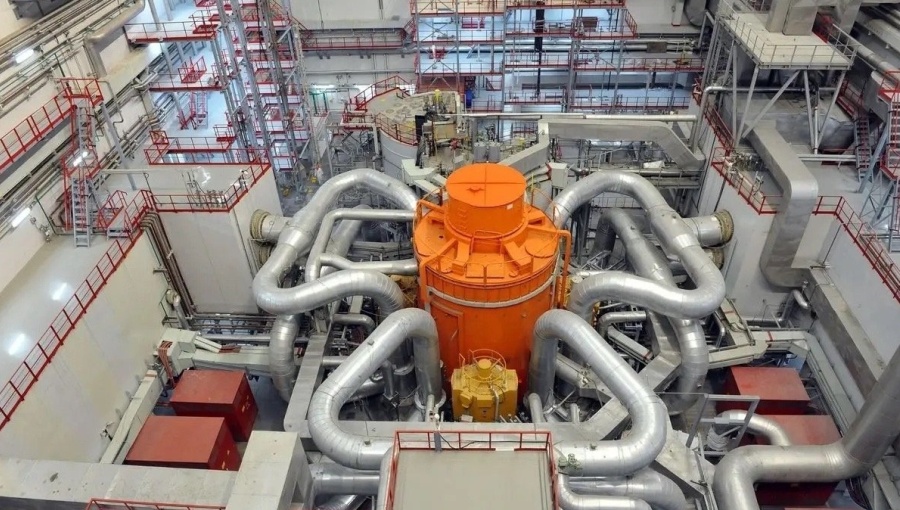
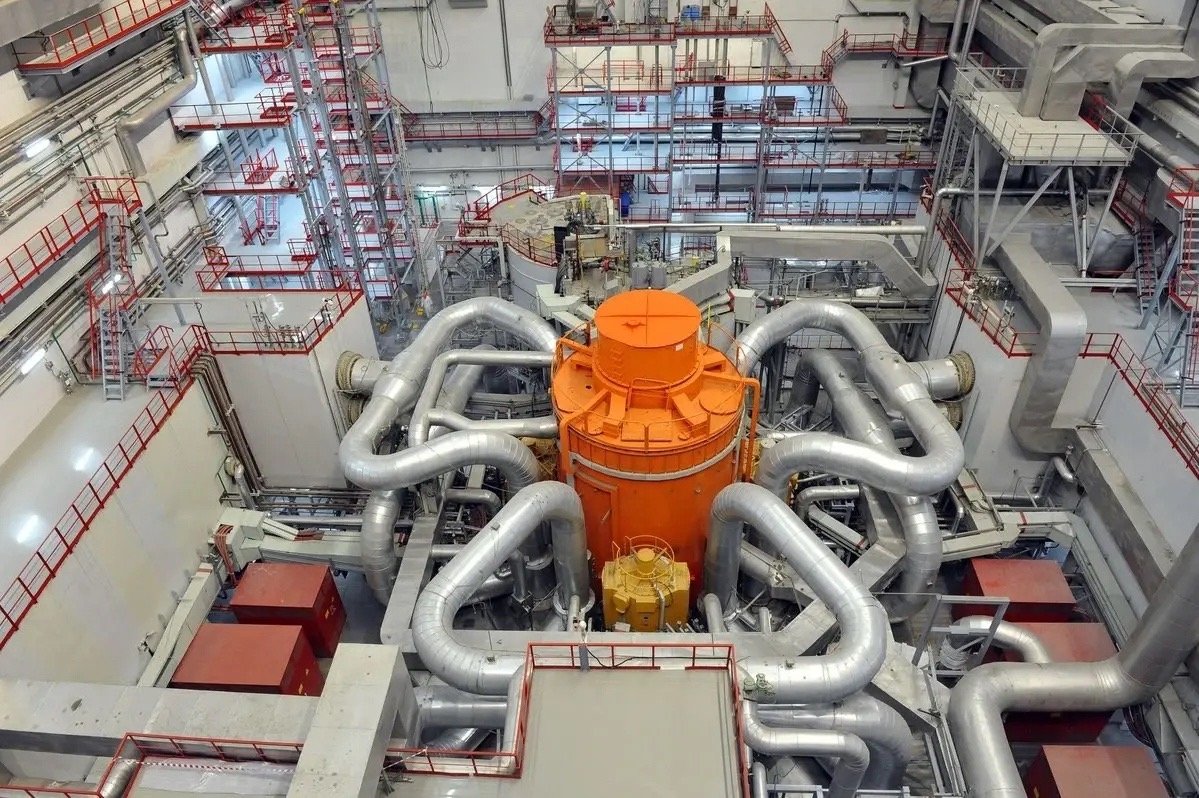
The BN-800 fast-neutron reactor at unit 4 of the Beloyarsk nuclear power plant in the Urals. Source: Rosatom

Engineers at unit 4 of the Beloyarsk nuclear power plant in the Urals have loaded an experimental assembly of twice-recycled mixed-oxide (MOX) fuel into the 880 MW BN-800 sodium-cooled fast-neutron reactor, the state nuclear corporation said on November 27. The plutonium in it was extracted from a MOX assembly that had already completed a full cycle inside the BN-800 itself. Until now the reactor ran on MOX made with plutonium recovered from the spent fuel of conventional thermal reactors, Nuclear Engineering International reported.

"Today, we have moved from theory to practice in closing the nuclear fuel cycle at fast reactors," said Rosatom Director General Alexei Likhachev. "Having overcome another technological milestone, we are proving the viability of the very model of 'renewable' nuclear energy. It will provide for the growing demand for electricity without proportionally increasing the burden on natural resources and increasing the volume of radioactive waste."

Today's light-water reactors burn less than 1% of the energy in the uranium they are fed, and the rest ends up as waste. A fast reactor that breeds plutonium and gets it back as fresh fuel can keep recycling the same material, which in theory frees nuclear power from the limits of the world's uranium reserves and cuts the volume and life of its most dangerous waste. Scientists have chased the closed fuel cycle since the dawn of the nuclear age; Rosatom says this is the first time it has been shown on a large commercial reactor rather than a prototype, a claim no independent body has yet confirmed.

Russia and China pioneers

Russia is not alone at the frontier. China has spent the last two years unveiling one new reactor technology after another, from a thorium molten salt reactor that breeds its own uranium to the world's first commercial fourth-generation pebble-bed reactor. Between them the two countries now hold most of the cutting-edge nuclear technology in commercial use, while the West's builders struggle to finish conventional plants on time and on budget.

The Beloyarsk assembly is a single test unit, not a full core, and the work is being done under licence from the regulator Rostechnadzor. Its real job is to feed operating data into the next generation of Russian fast reactors: the BN-1200M planned as Beloyarsk unit 5, which Likhachev says will be operating in the next decade, and the lead-cooled BREST-OD-300 being built at Seversk in Siberia's Tomsk region.

A domestic build programme

BREST is the centrepiece of Rosatom's Proryv (Breakthrough) programme and the reason Moscow talks of a revolutionary closed fuel cycle reactor. The 300 MW unit sits on the same site as its own fuel plant: a fabrication and refabrication module that began working in December 2024, and a reprocessing module that will take spent fuel straight back out of the reactor and recycle it. BREST is due to start in 2029. Beloyarsk received a siting licence for the BN-1200M in April 2025, and first concrete is expected around 2027 with commissioning in 2035, according to the World Nuclear Association.

Russia plans to commission about 30 GW of new nuclear capacity over the long term, mostly conventional reactors but including small modular ones, President Vladimir Putin said in August, enough to replace the ageing Soviet-era units and add net capacity. Nuclear already supplies roughly a fifth of Russia's electricity.

The first VVER-TOI unit at Kursk II was connected to the grid in December 2025 and two more are under construction there, while units 3 and 4 at Leningrad II, both VVER-1200s, started construction in March 2024 and March 2025. Preparations for first concrete at Smolensk II, which will replace the RBMK reactors of the Chernobyl type still running there, are scheduled for 2027. Much of the new capacity is aimed at Siberia and the Far East, where mining, data centres and the China trade are outrunning the grid.

The export order book

The domestic programme is also the shop window for Rosatom's exports, which have kept booming through four years of sanctions. No Western government has sanctioned Rosatom outright, because too many of their own reactors run on its fuel, and each VVER sold abroad comes with a fuel contract that can last 60 years, the lock-in that has made uranium the new gas in Moscow's dealings with the Global South.

Several of the big projects are now close to producing power:

  • Bangladesh: Rooppur 1 sent its first electricity to the grid on November 17, on a trial basis at 350 MWe; fuel for the second 1,200 MWe unit is being flown in. The two-unit plant is being built under a $12.65bn contract.
  • China: the Russian-designed VVER-1200 at Tianwan 7 was connected in October, with its twin, unit 8, due in 2027.
  • Turkey: Ankara aimed to load the first fuel at Akkuyu within weeks of late October and to use its power from 2027.
  • Egypt: El Dabaa's four VVER-1200 units are under construction, with grid connection of unit 1 targeted for 2028, although Egypt's nuclear authority has accused Rosatom of defects in the foundation slabs.
  • Iran: unit 2 at Bushehr is more than 60% complete and targeted for 2029, with unit 3 also under way.
  • Uzbekistan: two small modular reactors are already under construction in Jizzakh, where two larger units are due to start in 2027.
  • Hungary: Paks II, Rosatom's only live project in the EU, is a €12.5bn build now under audit by Prime Minister Peter Magyar's new government.

Behind those sits a longer list of deals that have been announced but not started:

  • Iran: Rosatom has signed for eight more units and for small reactors, on top of a 2025 deal for a plant at Sirik near the Strait of Hormuz that state news agency IRNA valued at $25bn.
  • Kazakhstan: the main contract for two VVER-1200s at Balkhash was signed on September 3, at a preliminary $16.4bn, with the first reactor due in 2034.
  • Egypt: talks on two more El Dabaa units that would lift the plant to 7.2 GW, and a proposed 110 MW floating plant at Port Said.
  • Indonesia: two floating FPU-100 units with 200 MW between them for Halmahera island, signed in October as the first export deal for power from a floating plant.
  • Myanmar: a 110 MW plant built around two small reactors, with construction due to start in 2027.
  • Ghana, Armenia, Turkmenistan and Brunei: early-stage talks or pitches, from Ghana's first plant to a 1,000 MW unit offered to Yerevan.

China's atomic electrostate

China is building more reactors, faster and more cheaply, than any other country. Its installed nuclear capacity reached 63.98 GW this summer, overtaking France's 63 GW for the first time and leaving only the US ahead, according to World Nuclear Association figures, after the State Council approved eight more reactors at the end of July. State-owned CNNC counts 10 of its home-grown Hualong One reactors in commercial operation and another 37 approved; a fourth unit at San'ao in Zhejiang, the first Chinese nuclear project with private capital, broke ground on November 10. China accounts for roughly half of the new nuclear capacity coming online worldwide and builds it at around $63 per megawatt-hour, against $190 in France, nearly triple the Chinese cost, according to the McKinsey Global Institute.

Nuclear is one leg of Beijing's plan to become the first electrostate, an economy run on electricity rather than oil. It is growing alongside renewables, not instead of them. China is already the world's green energy champion, building two-thirds of the world's new wind and solar plants, and the fossil-fuel share is falling.

In October nuclear generation rose 17.4% year on year, solar 33.3% and wind 11.4%, while coal-fired power fell 8.9%, its steepest drop since the 2022 lockdowns and the fourth monthly fall in a row, according to the Centre for Research on Energy and Clean Air (CREA).

Beyond the production line, Chinese labs have unveiled a string of new nuclear technologies:

  • Thorium molten salt reactor: the 2 MW thermal TMSR-LF1 at Wuwei in the Gobi converted thorium into usable uranium fuel for the first time in 2025. Its fuel is dissolved in liquid salt, so it can be refuelled without shutting down; a 100 MW demonstration plant is planned by 2035.
  • Pebble-bed reactor: the HTR-PM at Shidao Bay in Shandong, the first fourth-generation reactor in commercial operation, uses fuel particles sealed in ceramic and graphite that withstand more than 1,600°C, and cooled itself in tests with no pumps or human intervention.
  • Small modular reactor: the 125 MWe ACP100 Linglong One on Hainan, the first SMR design to clear an IAEA safety review, started hot functional tests in October with fuel loading targeted before the end of the year.
  • Standardised large reactors: the Hualong One, now moving to an upgraded Hualong One 2.0, and the CAP1400-based Guohe One, approved for the new Laiyang plant.
  • Thorium at sea: the design of KUN, a container ship powered by a thorium molten salt reactor.
  • Fusion: the HL-3 tokamak in Chengdu reached ion temperatures of 120mn°C and electron temperatures of 160mn°C in 2025, and the BEST burning-plasma tokamak in Hefei is due to be finished by end-2027, with a deuterium-tritium power demonstration around 2030. Beijing aims to commercialise fusion by 2050.

Russia still leads on fast reactors and on selling plants abroad; China leads on volume, cost and the breadth of its experiments. They are partners as well as rivals: China's newest units at Tianwan are Russian VVERs, and Kazakhstan has given Rosatom its first nuclear plant and CNNC its second.