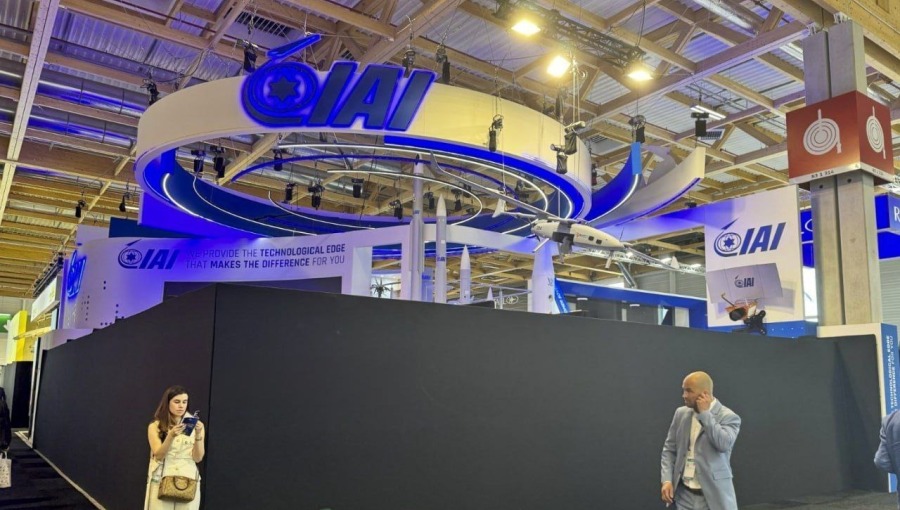
French exhibition authorities have blocked access to Israeli defence industry displays at the Paris Air Show on June 16, prompting strong condemnation from Israeli officials as "outrageous" discrimination following its attacks on Iran and Gaza, LCI reported.
France, unlike the United States and the United Kingdom a day earlier on June 15 remained on the fence whether it would support Israel in its attacks on Iran, which began on June 13, which Israel said was a pre-emptive strike on nuclear research centres.
Black barriers were erected around five Israeli defence companies' stands at Le Bourget airfield following concerns the exhibits featured "offensive weapons" potentially used in Gaza operations, according to a French government source.
The affected companies are Israel Aerospace Industries, Rafael Uvision, Elbit and Aeronautics, all manufacturers of drones, guided bombs and missiles which are believed to be currently used in both Gaza and Iran.
Speaking from Jerusalem Israel’s President Isaac Herzog described the French organisers decision as creating an "Israeli ghetto" and demanded immediate correction of the situation during an appearance on French television channel LCI.
"Israeli companies have signed contracts with the organisers," Herzog said, expressing shock at what he termed the "outrageous" decision.
The Israeli Defence Ministry accused France of hiding behind political considerations to exclude Israeli weapons that compete with French industries, particularly noting Israeli technologies' "impressive and precise performance in Iran."
An Israeli exhibitor wrote in yellow chalk on one barrier that the concealed defence systems "are protecting the state of Israel these days" whilst alleging French discrimination.
The controversy overshadowed the major aerospace industry gathering, which typically focuses on aircraft displays and major orders for manufacturers, including Airbus and Boeing.
Local lawmakers from Seine-Saint-Denis department boycotted French Prime Minister François Bayrou's opening visit in protest over Israeli participation.
"Never has the world been so disrupted and destabilised," Bayrou said during a roundtable event, urging nations to tackle challenges "together, not against each other."
Earlier, Gila Gamlil, Israeli cabinet member said "We firmly call on the United States to join the war against Iran" as the two countries continue to attack each others' infrastructure. .
Drones take center stage as Europe races to catch up at Paris Air Show
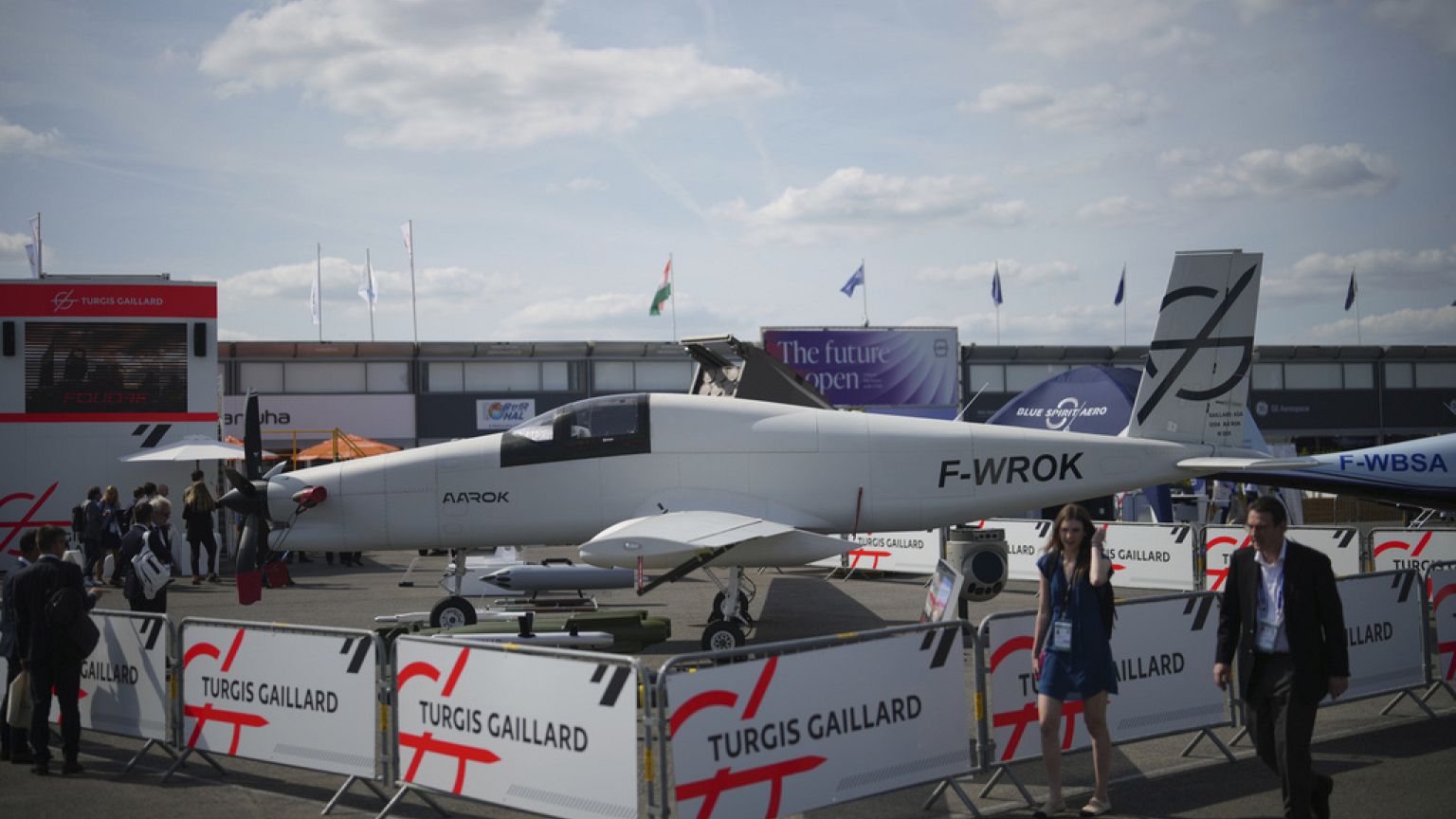 Copyright Thibault Camus/Copyright 2025 The AP. All rights reserved.By Sophia KhatsenkovPublished on 17/06/2025
 Europe is attempting to close the gap with the U.S. and adapt to a new era of high-intensity warfare.
At this year’s Paris Air Show, fighter jets are taking a backseat. Unmanned and autonomous technologies are driving the future of defence and dominating the conversation at Le Bourget airport in northern Paris.
With 2,400 exhibitors from 48 countries and 300,000 visitors expected, the world’s biggest aerospace event opened against an intense backdrop of global tensions.
As Russia's full-scale invasion of Ukraine enters its fourth year and tensions are soaring between Israel and Iran, it has become urgent for Europe to modernise its defence capabilities.
On Monday, Italian giant Leonardo and Turkey’s Baykar Technologies announced a joint venture to co-develop a new generation of unmanned systems, with the first drones expected to be delivered in 2026.
“When it comes to unmanned systems, Europe is quite behind,” said Leonardo CEO Roberto Cingolani.
“First of all, I think the target is to fill the gap… We need to develop different platforms with different payloads... and offer them to different countries. That will already be a very important target in the short to mid-term," explained Cingolani to a group of reporters.
Cingolani stressed that Europe will soon need not just drones, but also land and sea-based systems. “The Ukrainian war has completely changed the landscape,” he said. “We know that we have to be ready.”
For defence consultant Xavier Tytelman, the turning point for this edition of the fair is the industrialisation of high-intensity warfare.
"In the past, we said 'We are going to make drones'. Now, we are actually offering drones with well-defined prices, which shows a very strong trend of military industrialisation," he told Euronews.
Europe’s previous lag on large drone platforms may no longer matter. Smaller, more agile systems that are cheaper to produce and easier to deploy are now proving decisive on the battlefield.
Beyond strategy and scale, sovereignty has become a defining theme aduringt this year’s edition.
The push to develop “ITAR-free” (International Traffic in Arms Regulations) equipment -free from U.S. export restrictions - is visible across the exhibition area.
“There’s one fundamental element here, and that’s the return of sovereignty. You see it everywhere with many booths labelled ‘ITAR Free.’ That means there are no American components, so the U.S. can’t prevent them from using their own equipment, like they did in Ukraine, where we supplied missiles that couldn’t be used because they contained U.S. parts," explained Tytelman.
"Now, all around us, Europeans are organising themselves to be more sovereign, independent, to work together, to complement each other’s technological capabilities, and to achieve 100% European industrialisation. That’s another major deep, structural trend.”

No comments:
Post a Comment