Iberdrola and Masdar Complete Largest Offshore Wind Financing in a Decade
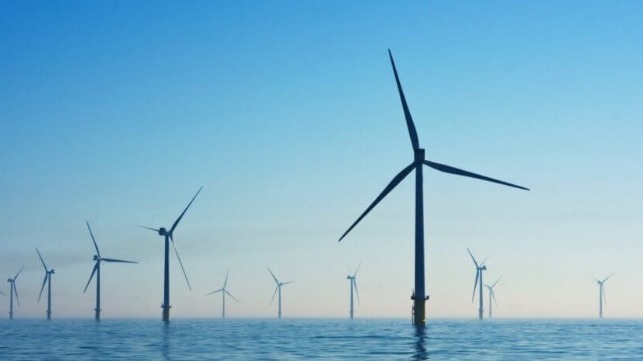
Iberdrola, one of the world’s largest energy companies, and Masdar, Abu Dhabi's state-owned renewable energy company, marked key milestones in their partnership, which was launched in 2023 to invest in renewable energy. The companies reported they completed the largest offshore wind transaction in a decade for the financing of the UK’s East Anglia Three Project, while they also reached full energization of their first joint project.
The alliance was launched for a planned investment of up to €15 billion in projects across the UK, Germany, and the U.S.. The company called it one of the largest bilateral alliances in the global clean energy sector.
Advancing their goals, they reported signing the project financing for the UK project. A consortium of 24 international banks will provide approximately €4.1 billion ($4.8 billion) for the East Anglia Three project, which is projected to have a total cost of €5.2 billion ($6 billion). The project financing round was 40 percent oversubscribed by the banks, making it one of the largest transactions of its kind.
Located off the Suffolk coast in the UK, East Anglia Three will become one of the world’s two largest offshore wind farms when it comes into initial operation in Q4 2026. The plan calls for 1.4 GW of power, with Iberdrola and Masdar each owning 50 percent of the joint venture. It will provide the power equivalent of 1.3 million homes. East Anglia Three is a critical component of the UK’s plan to reach 50 GW of offshore wind capacity by 2030, up from its current approximate 15 GW capacity.
The project is supported by a 15-year CPI-linked Contract for Difference awarded by the UK government in rounds four and six. Further, the partners entered into a power purchase agreement in 2024 with Amazon.
“Masdar and Iberdrola are continuing to forge one of the largest and most powerful strategic clean energy partnerships to accelerate capacity growth in Europe and worldwide,” said HE Dr. Sultan Al Jaber, UAE Minister of Industry and Advanced Technology and Chairman of Masdar. “With demand surging due to exponential AI growth and the rise of emerging markets, projects such as these have never been more critical."
The partnership also reported that on July 9, its inaugural project, Baltic Eagle in Germany, reached full energization with a capacity of 476 MW. While it is the first for the JV, it is the second for Iberdrola in Germany. The company is developing three projects, with the others being with Wikinger (350MW, in operation) and Windanker (315MW, in planning). Collectively, these offshore wind farms form Iberdrola's Baltic Hub.
The companies report they continue to explore other opportunities aligned with the growing global demand for power.
Masdar-Iberdrola Clean Energy Pact Reaches Major UK and Germany Milestones

Masdar and Iberdrola have hit two major milestones in their €15 billion clean energy alliance, announcing a €5.2 billion joint investment in the UK’s East Anglia THREE offshore wind farm and the full energization of their 476 MW Baltic Eagle project in Germany.
The East Anglia THREE deal marks one of the largest offshore wind transactions of the decade. Each company will hold a 50% stake in the 1.4 GW wind farm, located off the Suffolk coast. With all conditions precedent now satisfied, the transaction is set to close soon. The project is backed by a 15-year Contract for Difference (CfD) and a long-term power purchase agreement (PPA) with Amazon. Expected online in late 2026, East Anglia THREE will generate enough electricity to power 1.3 million UK homes and create more than 2,300 construction jobs, with 100 permanent roles supported during its operational life.
Project financing for East Anglia THREE was secured on July 9, totaling £3.5 billion (~€4.1 billion) from 24 international banks in an oversubscribed deal. The financing structure ensures that the debt is not consolidated into either partner’s balance sheet.
Meanwhile, the partners have successfully completed their first joint project, the Baltic Eagle wind farm in the German Baltic Sea. With a capacity of 476 MW, the wind farm will supply clean power to approximately 475,000 households and avoid around 800,000 tons of CO? emissions annually. It is part of Iberdrola’s growing Baltic Hub, alongside the Wikinger and planned Windanker wind farms.
Masdar and Iberdrola’s partnership—formed in late 2023—is aimed at accelerating offshore wind and green hydrogen deployment in Europe and the U.S., with further joint investments already under consideration. Masdar, targeting 100 GW of global clean energy capacity by 2030, has expanded rapidly in Europe with major acquisitions in Spain and Greece. Iberdrola, for its part, invested €17 billion in 2024, adding 2.6 GW of renewable capacity and strengthening its leadership in long-term green PPAs.
GE Vernova to Pay Nantucket $10.5M for Offshore Wind Turbine Blade Failure
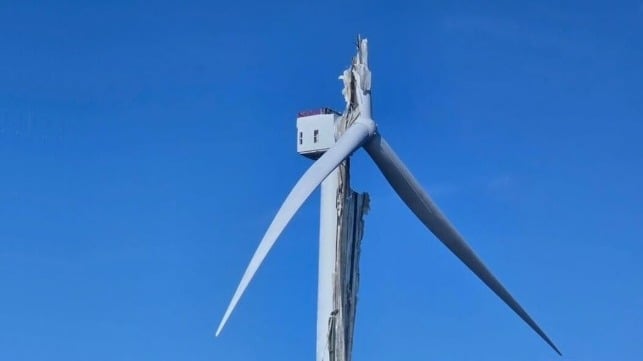
Nantucket’s city government has reached a $10.5 million definitive settlement agreement with GE Vernova, the manufacturer of the offshore wind turbine blade that failed in 2024 and littered the coastline with debris. The Town of Nantucket commended GE Vernova for its leadership in reaching the agreement, while it was noted by observers that the developer of the Vineyard Wind farm is not a direct party to the settlement.
A portion of the settlement money will be placed in a third-party administered Community Claims Fund to provide compensation for claims of economic harm made by residents and local businesses. The administrator will accept claims for the next six months but will require proof of the expenses or losses.
The settlement relates to the failure of a turbine blade on one of the GE Vernova Haliade-X turbines that had been installed at the site, which is about 15 miles southwest of Nantucket. The wind farm developed had highlighted that first power was coming from the project early in 2024, and by mid-year, it reported that 10 turbines had been commissioned and that a total of 21 of the planned 62 turbines were in place and preparing for commissioning.
One of the approximately 350-foot blades malfunctioned on the night of July 13. The turbine was taken offline, but debris from the blade was spotted floating in the ocean and began washing up on Nantucket beaches. Some pieces of the blade were resting on the foundation and others dangled from the turbine. Later reports indicated that additional debris had fallen into the ocean.
Nantucket says in the settlement announcement that when the blade failed, debris settled on the ocean floor, entered the water table, and littered Nantucket’s beaches for months, requiring an extensive cleanup effort. It says the incident scattered foam, fiberglass, and other debris along Nantucket’s shores during the height of the summer tourist season.
GE Vernova quickly identified a deviation in the manufacturing process at its plant in Quebec. It said the adhesion was improper and should have been caught in the quality control process.
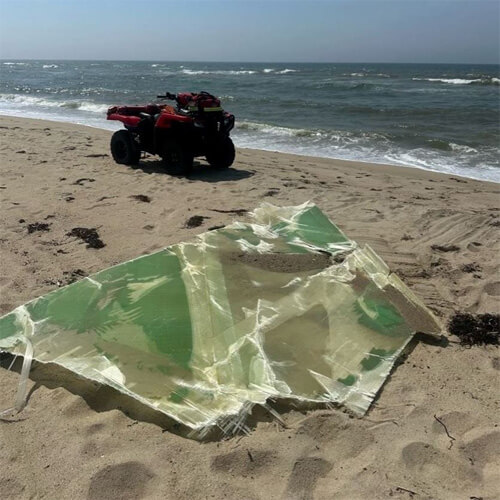
Nantucket reported fining pieces of debris for months (Government of Nantucket photo)
Installation at the Massachusetts offshore wind farm was suspended for months with GE Vernova using high-tech crawlers and other inspections of the approximately 60 blades that had already been installed. The company agreed to remove blades from up to 22 wind turbines that showed manufacturing deviations and substitute blades from a plant in Europe. U.S. regulators permitted the foundation work to resume in the fall and full installation to resume in 2025.
Vineyard Wind, which is a joint venture between Avangrid and Copenhagen Infrastructure Partners, has said it remains committed to the project. Vineyard Wind commissioned one turbine at the beginning of 2025 but has not given an updated timeline for when the project will be completed.
Critics of the sector pounced on the failure saying that it demonstrated some of the risks of offshore wind power. They have continued to oppose the industry while the Trump administration has taken steps to stop future offshore wind power developments. While Vineyard Wind and the nearby Revolution Wind are proceeding, the zone, which was viewed with promise, has seen most of the planned projects put on hold due to the current uncertainties.
Research Reveals Hidden Fatigue Risks in Offshore Wind Turbine Structures

[By: Lloyd's Register]
The case study demonstrates how reliability-based inspection can help manage fatigue-driven risks in offshore wind turbine support structures.
Some offshore wind turbine (OWT) support structures may fall short of required fatigue life expectations, according to a new Lloyd’s Register (LR) report.
The case study evaluated a North Atlantic offshore wind farm of 60–70 turbines (500–600 MW capacity). Offshore wind turbines are typically designed for 25 years of service, using a fatigue design factor of three—implying a minimum required fatigue life of 75 years. However, the study found that a critical joint in the jacket foundation would reach the end of its fatigue life after just 52 years, falling short of this design requirement.
Instead of redesigning the joint, the study took a reliability-based inspection (RBI) approach to identify and mitigate potential failure through targeted, risk-based maintenance.
The study combined a S-N (Stress vs. Number of cycles) model, to estimate when structural safety drops below acceptable thresholds, with Fracture Mechanics (FM) crack growth analysis, to predict the probability of failure over time and inform inspection intervals. This approach incorporates inspection results via Probability of Detection (PoD) curves to allow inspection schedules to be dynamically updated, responding to real-world conditions and inspection findings.
The results suggest that the first inspection should be carried out around year nine. After that, depending on the inspection method, further inspections might be needed every year to maintain acceptable safety margins.
However, the case study highlights the limitations of current inspection methods. Visual and ultrasonic inspections were found to be less effective for fatigue-critical components. More advanced techniques, such as Eddy Current or ACFM, offer greater reliability and allow for longer inspection intervals, but only when operators were willing to adopt slightly lower safety thresholds.
While RBI planning is effective in reducing in-service life costs and ensuring the longevity and safety for OWT structures, it requires expert input, reliable models, and software tools that can handle complex calculations. Ongoing research aims to refine the models and address the challenges during their application. Reliability updating, especially when integrating PoD curves, requires complex modelling and precise calibration of parameters such as initial crack size and stress intensity factors, areas often underdeveloped in practice.
The study calls for wider industry collaboration to refine inspection standards, share real-time monitoring data to refine fatigue predictions, and adopt more flexible definitions of acceptable reliability where appropriate.
Kourosh Parsa, Global Head of Technology - Offshore and Subsea, LR, said: “Many offshore wind assets are designed to a standard fatigue factor, but real-world conditions often expose critical vulnerabilities. Our findings show that using reliability-based methods allows operators to focus inspections where the risks are greatest. By integrating sophisticated models and real-world inspection data, we can extend asset life, reduce costs and, most importantly, maintain safety.”
Manuel Ruiz, Head of Offshore Renewable Solutions, LR, added: “By focusing on the areas with the greatest risk, we can not only help to manage fatigue-related issues more effectively — we’re also enabling developers and operators to make better-informed decisions that optimise asset life and performance. This proactive, risk-based approach is exactly how we support our clients in navigating complexity, controlling costs, and ensuring the long-term viability of their offshore wind investments.”
Download the full case study at Fatigue reliability of offshore wind turbine structures | LR
The products and services herein described in this press release are not endorsed by The Maritime Executive.

No comments:
Post a Comment