Pope Leo calls for end to 'barbarity of war' after strike on Gaza church

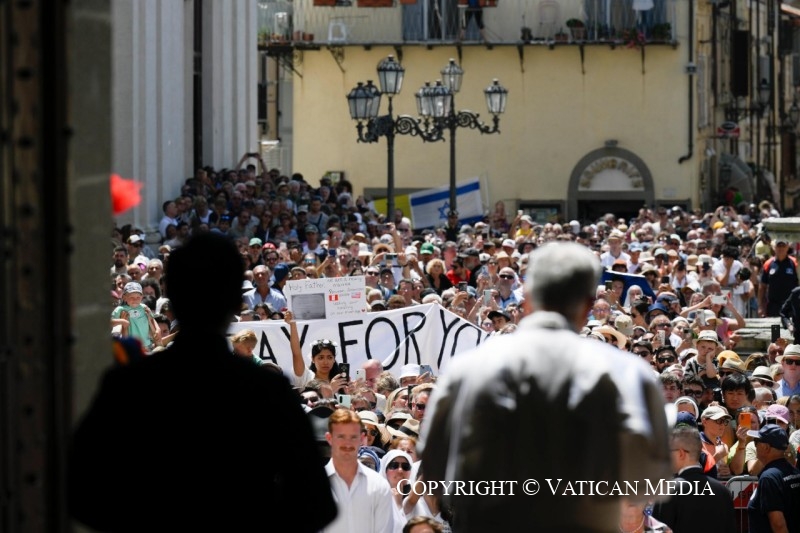
Pope Leo XIV leads the Angelus prayer in Castel Gandolfo, Italy on July 20.
PHOTO: Reuters
July 20, 2025
CASTEL GANDOLFO, Italy — Pope Leo called for an end to the 'barbarity of war' on Sunday (July 20) as he spoke of his profound pain over an Israeli strike on the sole Catholic church in Gaza.
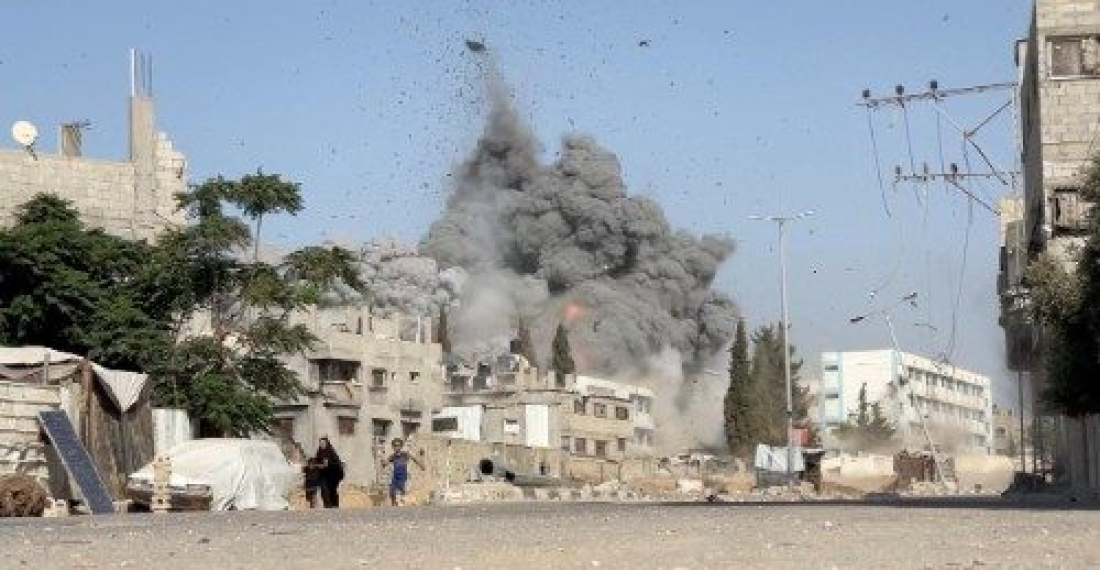
Three people died and several were injured, including the parish priest, in the strike on the Holy Family Church compound in Gaza City on Thursday. Photos show its roof has been hit close to the main cross, scorching the stone facade, and shattering windows.
Speaking after his Angelus prayer, Leo read out the names of those killed in the incident.
"I appeal to the international community to observe humanitarian law and respect the obligation to protect civilians as well as the prohibition of collective punishment, of indiscriminate use of force and forced displacement of the population," he said.
Pope calls out Gaza parish victims by name, demands ‘humanitarian law’ be observedPope Leo XIV leads the Angelus prayer in Castel Gandolfo, Italy on July 20.
PHOTO: Reuters
July 20, 2025
CASTEL GANDOLFO, Italy — Pope Leo called for an end to the 'barbarity of war' on Sunday (July 20) as he spoke of his profound pain over an Israeli strike on the sole Catholic church in Gaza.
Three people died and several were injured, including the parish priest, in the strike on the Holy Family Church compound in Gaza City on Thursday. Photos show its roof has been hit close to the main cross, scorching the stone facade, and shattering windows.
Speaking after his Angelus prayer, Leo read out the names of those killed in the incident.
"I appeal to the international community to observe humanitarian law and respect the obligation to protect civilians as well as the prohibition of collective punishment, of indiscriminate use of force and forced displacement of the population," he said.
Leo XIV's sorrow over the tragic news from Gaza runs "deep". In his Angelus appeal in Castel Gandolfo, he calls for the “prohibition of collective punishment" and “forced displacement of the population.”
July 20, 2025
Rome (AsiaNews) – This morning, at the Angelus in Piazza della Libertà, Castel Gandolfo, Pope Leo XIV focused on the “Tragic news [that] continues to arrive [. . .] from the Middle East”, his sorrow running “deep" over Israel's attack on the Holy Family Parish in Gaza City, which Bishop William Shomali described to AsiaNews as "terrible and scandalous."
“I am particularly close to their families and to all the parishioners,” said Pope Leo repeating the name of the three victims: “Saad Issa Kostandi Salameh, Foumia Issa Latif Ayyad, Najwa Ibrahim Latif Abu Daoud”.
“Sadly, this act adds to the continuous military attacks against the civilian population and places of worship in Gaza,” he said. “I again call for an immediate halt to the barbarism of the war and for a peaceful resolution of the conflict.”
The pontiff renewed his appeal to the international community that the parties “observe humanitarian law and to respect the obligation to protect civilians, as well as the prohibition of collective punishment, the indiscriminate use of force and the forced displacement of the population.”
In an address to the Christian communities of the Middle East, he said: “I deeply sympathise with your feeling that you can do little in the face of this grave situation. You are in the heart of the Pope and of the whole Church. Thank you for your witness of faith.” Calling on the Virgin Mary, may she “protect you always and accompany the world towards the dawn of peace.”
Before the Angelus, the pontiff greeted the faithful in the streets as he made his way from the Pontifical Villas in Castel Gandolfo, where he has been staying for the past two weeks resting, to the Cathedral of Albano Laziale, dedicated to Saint Pancras the Martyr, where he celebrated Mass at 9:30 am.
Speaking to reporters present, he stated: “The world can no longer tolerate this; there is so much conflict, so many wars; we must truly work for peace.” Like last Sunday, he described the current situation as “a significant moment of ecclesial communion and encounter with the diocesan community.”
Today's readings focused on “hospitality, service, and listening," the pope said at the start of his homily. In Luke (10:38-42), where Jesus is a guest in the home of the sisters Martha and Mary, one "welcomes him by serving him, while the other sits at his feet, listening to him”.
Here, “Jesus responds to the first sister’s complaints [. . .] by inviting her to recognize the value of listening”. At the same time, the attitudes of the two women are not to be seen as "mutually exclusive," but as “twin dimensions of hospitality.” First and foremost, toward God.
“Although it is true that we must live out our faith through concrete actions, faithfully carrying out our duties [...] it is essential that we do so only after meditating,” the pontiff explained. This is one aspect that “we particularly need to reclaim today.”
Indeed, the summer months are a “providential time” for this; hence, “Let us make good use of this, by leaving behind the whirlwind of commitments and worries in order to savour a few moments of peace, of reflection, taking time as well to visit other places and share in the joy of seeing others.”
A “culture of peace” can be promoted helping us “overcome divisions and hostility and to build communion between individuals, peoples and religions,” Leo said in his homily.
He also cited Pope Francis, who at the Angelus on 21 July 2019, stressed two key attitudes for “savoring life with joy.” A few months into the pandemic, Francis highlighted “‘being at the feet of Jesus’, in order to listen to him as he reveals to us the secret of everything,” and “being attentive and ready in hospitality, when he passes and knocks at our door”.
Sucha actions certainly require a certain “effort”, Leo XIV emphasised. “But it is precisely by making an effort that something worthwhile can be built in life; it is the only way to form and nurture strong and genuine relationships between people. Thus, with the foundations of everyday life, the Kingdom of God grows and manifests its presence.”
In the end, like Abraham in the first reading (Gen 18:1-10a), Mary and Martha remind us that “listening and service are two complementary attitudes that enable us to open ourselves and our lives to the blessings of the Lord.”
“I am particularly close to their families and to all the parishioners,” said Pope Leo repeating the name of the three victims: “Saad Issa Kostandi Salameh, Foumia Issa Latif Ayyad, Najwa Ibrahim Latif Abu Daoud”.
“Sadly, this act adds to the continuous military attacks against the civilian population and places of worship in Gaza,” he said. “I again call for an immediate halt to the barbarism of the war and for a peaceful resolution of the conflict.”
The pontiff renewed his appeal to the international community that the parties “observe humanitarian law and to respect the obligation to protect civilians, as well as the prohibition of collective punishment, the indiscriminate use of force and the forced displacement of the population.”
In an address to the Christian communities of the Middle East, he said: “I deeply sympathise with your feeling that you can do little in the face of this grave situation. You are in the heart of the Pope and of the whole Church. Thank you for your witness of faith.” Calling on the Virgin Mary, may she “protect you always and accompany the world towards the dawn of peace.”
Before the Angelus, the pontiff greeted the faithful in the streets as he made his way from the Pontifical Villas in Castel Gandolfo, where he has been staying for the past two weeks resting, to the Cathedral of Albano Laziale, dedicated to Saint Pancras the Martyr, where he celebrated Mass at 9:30 am.
Speaking to reporters present, he stated: “The world can no longer tolerate this; there is so much conflict, so many wars; we must truly work for peace.” Like last Sunday, he described the current situation as “a significant moment of ecclesial communion and encounter with the diocesan community.”
Today's readings focused on “hospitality, service, and listening," the pope said at the start of his homily. In Luke (10:38-42), where Jesus is a guest in the home of the sisters Martha and Mary, one "welcomes him by serving him, while the other sits at his feet, listening to him”.
Here, “Jesus responds to the first sister’s complaints [. . .] by inviting her to recognize the value of listening”. At the same time, the attitudes of the two women are not to be seen as "mutually exclusive," but as “twin dimensions of hospitality.” First and foremost, toward God.
“Although it is true that we must live out our faith through concrete actions, faithfully carrying out our duties [...] it is essential that we do so only after meditating,” the pontiff explained. This is one aspect that “we particularly need to reclaim today.”
Indeed, the summer months are a “providential time” for this; hence, “Let us make good use of this, by leaving behind the whirlwind of commitments and worries in order to savour a few moments of peace, of reflection, taking time as well to visit other places and share in the joy of seeing others.”
A “culture of peace” can be promoted helping us “overcome divisions and hostility and to build communion between individuals, peoples and religions,” Leo said in his homily.
He also cited Pope Francis, who at the Angelus on 21 July 2019, stressed two key attitudes for “savoring life with joy.” A few months into the pandemic, Francis highlighted “‘being at the feet of Jesus’, in order to listen to him as he reveals to us the secret of everything,” and “being attentive and ready in hospitality, when he passes and knocks at our door”.
Sucha actions certainly require a certain “effort”, Leo XIV emphasised. “But it is precisely by making an effort that something worthwhile can be built in life; it is the only way to form and nurture strong and genuine relationships between people. Thus, with the foundations of everyday life, the Kingdom of God grows and manifests its presence.”
In the end, like Abraham in the first reading (Gen 18:1-10a), Mary and Martha remind us that “listening and service are two complementary attitudes that enable us to open ourselves and our lives to the blessings of the Lord.”
Vatican loosing patience with Israel
Source: commonspace.eu with Radio Vaticana (Vatican City)
20 July 2025
The Vatican appears to be loosing patience with Israel. On Saturday (19 July), Pope Leo spoke to Israel prime minister Benyamin Netanyahu on the phone, but the Pope used strong language when referring to Gaza in his speech after the Angelus on Sunday.
Pope Leo XIV expressed his “deep sorrow” over the recent Israeli attack on the Catholic parish in Gaza, and called for “an immediate halt to the barbarity” in the Strip.
After the Holy Family church was struck on Thursday morning, three of the approximately 600 Gazans sheltering there were killed, and several others, including the parish priest Fr Gabriel Romanelli, were injured.
Speaking on Sunday after reciting the Angelus prayer at his summer residence in Castel Gandolfo, the Pope named the three victims – Saad Issa Kostandi Salameh, Foumia Issa Latif Ayyad, and Najwa Ibrahim Latif Abu Daoud – and said he was “close” to them and their families.
Pope Leo then stressed that the attack “is just one of the continuous military attacks against the civilian population and places of worship in Gaza”.
The Pope appealed for “an immediate halt to the barbarity of the war” and for “a peaceful resolution of the conflict”. He urged the international community to observe humanitarian law and respect the obligation to protect civilians, “as well as the prohibition of collective punishment, indiscriminate use of force and forced displacement of the population”.
Pope Leo brought his appeal to a close with a message to “our beloved” Christian communities in the Middle East, saying he understood they felt they could “do little, in the face of this tragic situation”.
The head of Vatican diplomacy, Cardinal Pietro Pasolin, in an interview with RAI 2 described Gaza as a war without limits.
Radio Vaticana said in editorial by its director Andrea Tornieeli, that the images of the strike's aftermath speak volumes: a shell fired from an Israeli army tank directly hit the Holy Family Church, the only Catholic parish in Gaza.
"Five hundred people—families who have lost their homes—have taken refuge in the compound comprising two churches and a school for almost two years.
Three people lost their lives, and another ten are injured. One of those injured, Suhail, contributes to L’Osservatore Romano with his small column: “I write to you from Gaza.”
The most recent, on July 8, was titled “Love Is Stronger Than War” and concluded as follows: “Let us pray that not only Gaza, but the whole world may one day live in peace, through mutual forgiveness and reconciliation. A day when there will be no more wars, because love is stronger than war.”
Israeli authorities have apologized, stating that it was a mistake, that Israel respects places of worship, and that an investigation will be conducted into the incident.
Such statements can hardly be reassuring. Not only because they are contradicted by the images of mosques reduced to rubble and churches attacked—the raid on the Orthodox church of Saint Porphyrius cost dozens of lives, for example—but also because, after a year and a half, there are still no results from the investigation into the killing of two Christian women shot by a sniper in the Gaza parish.
Particularly significant in this regard are the words spoken by the Israeli Ambassador to Italy, Jonathan Peled: "We have no intention of endangering civilian institutions. But the terrorists are everywhere, even in public buildings like schools and, unfortunately, places of worship."
These statements are striking because, in some way, they provide the context for what has been described as a "mistake." Five hundred unarmed people—many of whom regularly gather to pray the rosary—unwittingly became collateral targets because, as Ambassador Peled says, "these are sometimes the consequences of war."
As readers and listeners of Vatican News know well, we did not wait for Christian deaths to talk about the daily massacres in Gaza, where dozens of innocent children, women, and men are killed every week as collateral victims of raids or strikes by those who are supposed to ensure the safe distribution of food.
We do not report on the victims in Gaza only now that they are Christians or because Suhail was injured.
All innocent victims cry out for vengeance in the sight of God, every life is sacred, and Christians of every denomination in Gaza share in all things the fate of their people, the martyred Palestinian people.
The inhumane massacre against Israel perpetrated by Hamas terrorists on October 7, 2023, was condemned by the Holy See with unambiguous words, while calling for the release of all hostages and recognizing Israel's right to defend itself.
However, that inhuman massacre—to the detriment of so many innocent civilians—cannot justify 60,000 dead and cities razed to the ground. It cannot justify the silence and inanity of so many who pretend not to see.
This is why we will never tire of denouncing the absurdity of this war by repeating the words Pope Leo XIV addressed to the Reunion of Aid Agencies for the Oriental Churches (ROACO) on June 26. “All of us, by virtue of our humanity, are called upon to examine the causes of these conflicts, to identify those that are real, and to attempt to resolve them. But also to reject those that are false, the result of emotional manipulation and rhetoric, and to make every effort to bring them to light. People must not die because of fake news.”
We are called to overcome that globalization of alternating stages of indifference, which makes us rightly indignant about some victims while overlooking others.
We are called to look realistically at the situation in the Middle East and the absurd escalation of war. New fronts are continuously opened, as if the survival of the ruling leaders, both in terrorist organizations and in states, depended on the endless perpetuation of wars instead of peace.
It is time for the international community to finally regain the courage to intervene with all the tools that the law makes available: to silence weapons, to stop the massacres, and to put an end to power games whose price is paid by thousands of innocent victims.
The Vatican appears to be loosing patience with Israel. On Saturday (19 July), Pope Leo spoke to Israel prime minister Benyamin Netanyahu on the phone, but the Pope used strong language when referring to Gaza in his speech after the Angelus on Sunday.
Pope Leo XIV expressed his “deep sorrow” over the recent Israeli attack on the Catholic parish in Gaza, and called for “an immediate halt to the barbarity” in the Strip.
After the Holy Family church was struck on Thursday morning, three of the approximately 600 Gazans sheltering there were killed, and several others, including the parish priest Fr Gabriel Romanelli, were injured.
Speaking on Sunday after reciting the Angelus prayer at his summer residence in Castel Gandolfo, the Pope named the three victims – Saad Issa Kostandi Salameh, Foumia Issa Latif Ayyad, and Najwa Ibrahim Latif Abu Daoud – and said he was “close” to them and their families.
Pope Leo then stressed that the attack “is just one of the continuous military attacks against the civilian population and places of worship in Gaza”.
The Pope appealed for “an immediate halt to the barbarity of the war” and for “a peaceful resolution of the conflict”. He urged the international community to observe humanitarian law and respect the obligation to protect civilians, “as well as the prohibition of collective punishment, indiscriminate use of force and forced displacement of the population”.
Pope Leo brought his appeal to a close with a message to “our beloved” Christian communities in the Middle East, saying he understood they felt they could “do little, in the face of this tragic situation”.
The head of Vatican diplomacy, Cardinal Pietro Pasolin, in an interview with RAI 2 described Gaza as a war without limits.
Radio Vaticana said in editorial by its director Andrea Tornieeli, that the images of the strike's aftermath speak volumes: a shell fired from an Israeli army tank directly hit the Holy Family Church, the only Catholic parish in Gaza.
"Five hundred people—families who have lost their homes—have taken refuge in the compound comprising two churches and a school for almost two years.
Three people lost their lives, and another ten are injured. One of those injured, Suhail, contributes to L’Osservatore Romano with his small column: “I write to you from Gaza.”
The most recent, on July 8, was titled “Love Is Stronger Than War” and concluded as follows: “Let us pray that not only Gaza, but the whole world may one day live in peace, through mutual forgiveness and reconciliation. A day when there will be no more wars, because love is stronger than war.”
Israeli authorities have apologized, stating that it was a mistake, that Israel respects places of worship, and that an investigation will be conducted into the incident.
Such statements can hardly be reassuring. Not only because they are contradicted by the images of mosques reduced to rubble and churches attacked—the raid on the Orthodox church of Saint Porphyrius cost dozens of lives, for example—but also because, after a year and a half, there are still no results from the investigation into the killing of two Christian women shot by a sniper in the Gaza parish.
Particularly significant in this regard are the words spoken by the Israeli Ambassador to Italy, Jonathan Peled: "We have no intention of endangering civilian institutions. But the terrorists are everywhere, even in public buildings like schools and, unfortunately, places of worship."
These statements are striking because, in some way, they provide the context for what has been described as a "mistake." Five hundred unarmed people—many of whom regularly gather to pray the rosary—unwittingly became collateral targets because, as Ambassador Peled says, "these are sometimes the consequences of war."
As readers and listeners of Vatican News know well, we did not wait for Christian deaths to talk about the daily massacres in Gaza, where dozens of innocent children, women, and men are killed every week as collateral victims of raids or strikes by those who are supposed to ensure the safe distribution of food.
We do not report on the victims in Gaza only now that they are Christians or because Suhail was injured.
All innocent victims cry out for vengeance in the sight of God, every life is sacred, and Christians of every denomination in Gaza share in all things the fate of their people, the martyred Palestinian people.
The inhumane massacre against Israel perpetrated by Hamas terrorists on October 7, 2023, was condemned by the Holy See with unambiguous words, while calling for the release of all hostages and recognizing Israel's right to defend itself.
However, that inhuman massacre—to the detriment of so many innocent civilians—cannot justify 60,000 dead and cities razed to the ground. It cannot justify the silence and inanity of so many who pretend not to see.
This is why we will never tire of denouncing the absurdity of this war by repeating the words Pope Leo XIV addressed to the Reunion of Aid Agencies for the Oriental Churches (ROACO) on June 26. “All of us, by virtue of our humanity, are called upon to examine the causes of these conflicts, to identify those that are real, and to attempt to resolve them. But also to reject those that are false, the result of emotional manipulation and rhetoric, and to make every effort to bring them to light. People must not die because of fake news.”
We are called to overcome that globalization of alternating stages of indifference, which makes us rightly indignant about some victims while overlooking others.
We are called to look realistically at the situation in the Middle East and the absurd escalation of war. New fronts are continuously opened, as if the survival of the ruling leaders, both in terrorist organizations and in states, depended on the endless perpetuation of wars instead of peace.
It is time for the international community to finally regain the courage to intervene with all the tools that the law makes available: to silence weapons, to stop the massacres, and to put an end to power games whose price is paid by thousands of innocent victims.
By Fr. Ibrahim Faltas
20 July 2025
20 July 2025
COMMONSPACE EU
Following weeks of settler attacks on the last entirely Christian village in Palestine, the Vicar of the Custody of the Holy Land, Fr. Ibrahim Faltas, makes an impassioned plea for peace.
In Arabic, Taybeh means “good”. But lately, nothing good has been happening in this Palestinian village, entirely inhabited by Christians.
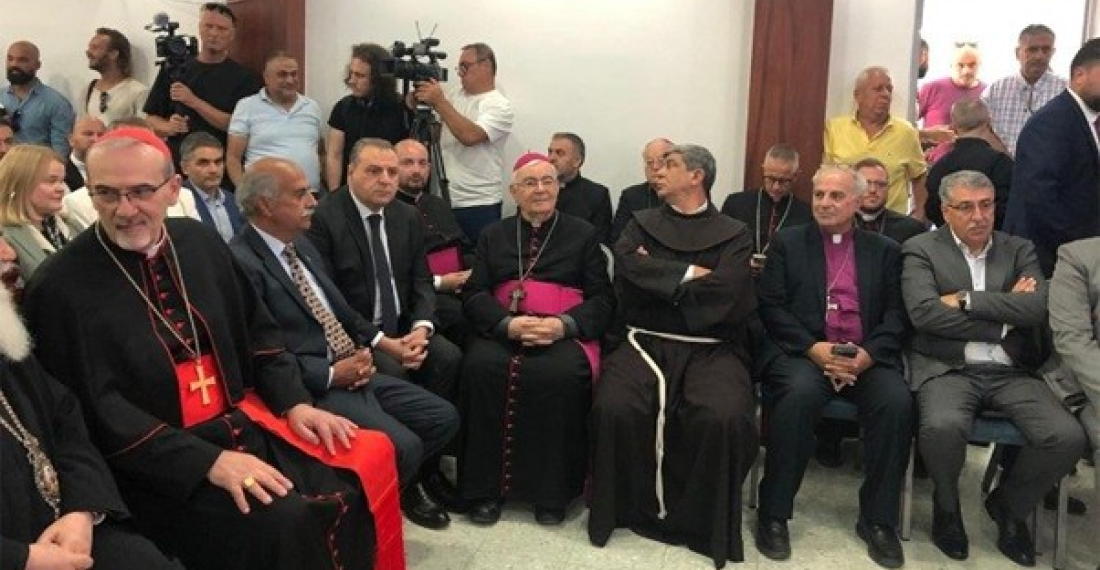
On Monday, July 14, the heads of the Christian Churches of the Holy Land, together with ambassadors and consuls, came to express their closeness and solidarity with the residents and clergy of Taybeh, who for weeks have been facing severe attacks by hundreds of Israeli settlers. These settlers are violently trying to seize their homes and lands.
Taybeh has around 1,500 residents, all belonging to different Christian denominations: Latin, Greek Orthodox, and Melkite. Yesterday morning, everyone was there—religious leaders, residents, and even people from neighboring villages—grateful for the fraternal support from those who truly understand their suffering.
As you approach Taybeh from the north of Jerusalem, the village presents a familiar and welcoming sight: the bell towers of the three churches rise above the landscape, watching over a peaceful and united community. And from the voices of the people—adults, elders, and children—you could hear their fear, their pain, and the tension of the past weeks.
There have been deaths in the area. Many have been injured. People have been forced from their homes. Buildings have been demolished. Fields set on fire. These are cowardly attacks against unarmed civilians—people who for hundreds of years have remained faithful to the religion of their ancestors in a land that still holds the traditions of Jesus’ time.
And yet, not a single word of hatred or revenge has been spoken—only a heartfelt plea for help, to be allowed to live in peace on their land.
source: This article was prepared by Fr Ibrahim Faltas, Vicar of the Custody of the Holy Land, and was published by the website of Radio Vaticana (Vatican City).
photo: Christian leaders meet in Taybeh on 15 July 2025 (picture courtesy of Radio Vaticana (Vatican City)
Following weeks of settler attacks on the last entirely Christian village in Palestine, the Vicar of the Custody of the Holy Land, Fr. Ibrahim Faltas, makes an impassioned plea for peace.
In Arabic, Taybeh means “good”. But lately, nothing good has been happening in this Palestinian village, entirely inhabited by Christians.
On Monday, July 14, the heads of the Christian Churches of the Holy Land, together with ambassadors and consuls, came to express their closeness and solidarity with the residents and clergy of Taybeh, who for weeks have been facing severe attacks by hundreds of Israeli settlers. These settlers are violently trying to seize their homes and lands.
Taybeh has around 1,500 residents, all belonging to different Christian denominations: Latin, Greek Orthodox, and Melkite. Yesterday morning, everyone was there—religious leaders, residents, and even people from neighboring villages—grateful for the fraternal support from those who truly understand their suffering.
As you approach Taybeh from the north of Jerusalem, the village presents a familiar and welcoming sight: the bell towers of the three churches rise above the landscape, watching over a peaceful and united community. And from the voices of the people—adults, elders, and children—you could hear their fear, their pain, and the tension of the past weeks.
There have been deaths in the area. Many have been injured. People have been forced from their homes. Buildings have been demolished. Fields set on fire. These are cowardly attacks against unarmed civilians—people who for hundreds of years have remained faithful to the religion of their ancestors in a land that still holds the traditions of Jesus’ time.
And yet, not a single word of hatred or revenge has been spoken—only a heartfelt plea for help, to be allowed to live in peace on their land.
source: This article was prepared by Fr Ibrahim Faltas, Vicar of the Custody of the Holy Land, and was published by the website of Radio Vaticana (Vatican City).
photo: Christian leaders meet in Taybeh on 15 July 2025 (picture courtesy of Radio Vaticana (Vatican City)

No comments:
Post a Comment