From our special envoy in Syria – Six months after his first trip through Syria, Wassim Nasr, a specialist in jihadist movements at France 24, once again travelled the country for ten days. From Damascus to Aleppo, via Homs, Manbij, and even Deir Ezzor, a region that has long remained inaccessible to journalists since Bashar al-Assad's flight, this travel diary plunges us into a country in full transformation, faced with the challenge of reconstruction and national unity.
Published : 10/07/2025 -
By:FRANCE24
Video by: Wassim NASR
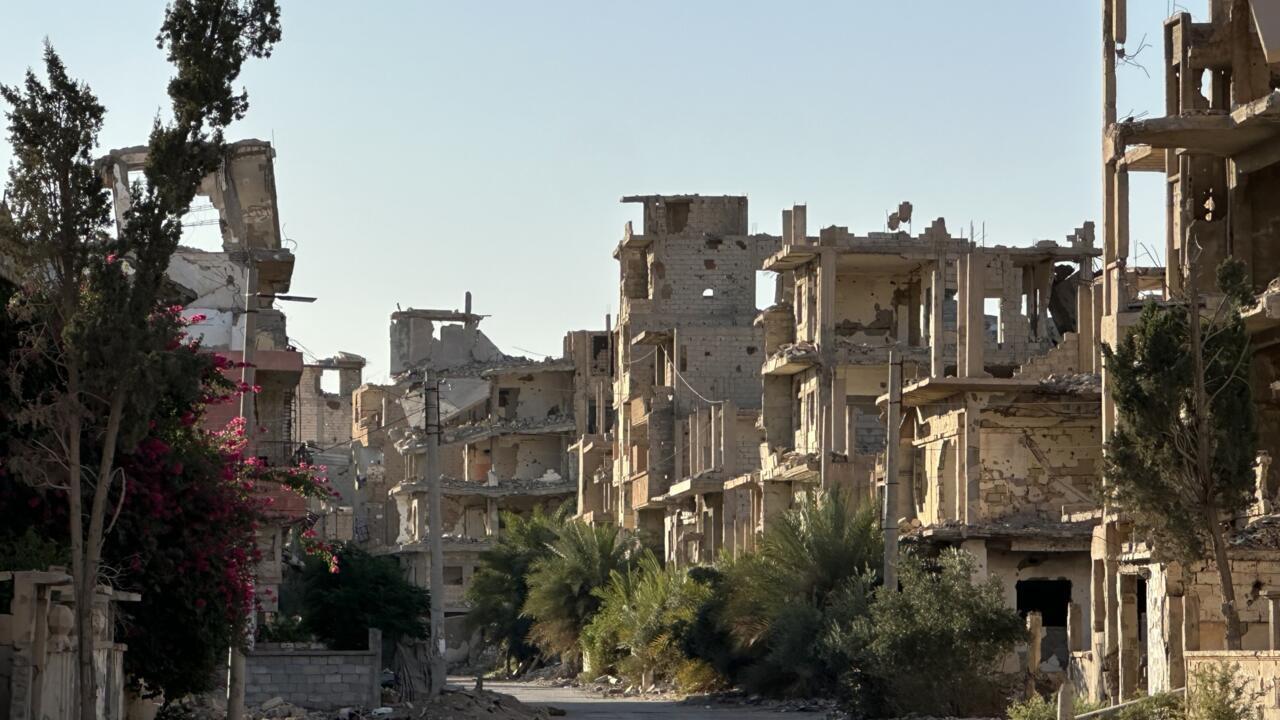
Une vue de la ville de Deir Ezzor, dans l'est de la Syrie, presque entièrement détruite après une décennie de combats.
© Wassim Nasr, France 24
1 - In the ruins of Aleppo
1 - In the ruins of Aleppo

The itinerary of our journalist Wassim Nasr through Syria. © Graphic Studio France Médias Monde
This journey was supposed to start at Damascus airport, but the Israel-Iran war decided otherwise. The North was therefore chosen as the starting point for a ten-day journey through Syria.
On the road leading to Aleppo, a city devastated by fourteen years of war, a landscape of destruction passes as far as the eye can see. But here and there, cinder blocks placed in front of ruined buildings indicate that reconstruction has begun. This is the hope of a new era for Syria, as Washington has just eased most of its sanctions to facilitate Damascus' return to the international financial system and encourage foreign investment.
This journey was supposed to start at Damascus airport, but the Israel-Iran war decided otherwise. The North was therefore chosen as the starting point for a ten-day journey through Syria.
On the road leading to Aleppo, a city devastated by fourteen years of war, a landscape of destruction passes as far as the eye can see. But here and there, cinder blocks placed in front of ruined buildings indicate that reconstruction has begun. This is the hope of a new era for Syria, as Washington has just eased most of its sanctions to facilitate Damascus' return to the international financial system and encourage foreign investment.

A collapsed building in the city of Aleppo in Syria.
© Wassim Nasr, France 24
As elsewhere in the country, the new government of Ahmed al-Sharaa offers guarantees of protection to religious minorities after the March massacres in the Alawite community and clashes between Druze and armed groups. But in the Aleppo region, the authorities also have to deal with a Sunni majority fractured between supporters of the revolution and former pro-Assad supporters.
A symbol of this fragile balance is the tense relations with former members of the armed group Liwa al-Baqir, which, after supporting the Assad regime, has turned around to join the rebel coalition. This allowed the capture of the city of Aleppo, a decisive step on the road to Damascus. Seven months after the fall of Bashar al-Assad, the Bakara clan to which the group belongs believes that it has not sufficiently reaped the fruits of its alliance with the new masters of Syria.
In the Aleppo mosaic, the Kurds of the YPG maintain their control over the districts of Ashrafieh and Sheikh Maqsoud. These two neighbourhoods are to gradually return to government control while retaining some autonomy under the agreements signed in March to integrate the Kurds into the Syrian state. For the moment, according to various sources involved in the case, these agreements remain without decisive effects.
As elsewhere in the country, the new government of Ahmed al-Sharaa offers guarantees of protection to religious minorities after the March massacres in the Alawite community and clashes between Druze and armed groups. But in the Aleppo region, the authorities also have to deal with a Sunni majority fractured between supporters of the revolution and former pro-Assad supporters.
A symbol of this fragile balance is the tense relations with former members of the armed group Liwa al-Baqir, which, after supporting the Assad regime, has turned around to join the rebel coalition. This allowed the capture of the city of Aleppo, a decisive step on the road to Damascus. Seven months after the fall of Bashar al-Assad, the Bakara clan to which the group belongs believes that it has not sufficiently reaped the fruits of its alliance with the new masters of Syria.
In the Aleppo mosaic, the Kurds of the YPG maintain their control over the districts of Ashrafieh and Sheikh Maqsoud. These two neighbourhoods are to gradually return to government control while retaining some autonomy under the agreements signed in March to integrate the Kurds into the Syrian state. For the moment, according to various sources involved in the case, these agreements remain without decisive effects.
2 - The Manbij Tunnels
To the east, still in the governorate of Aleppo, are the fortifications of Manbij, a former stronghold of the Islamic State organisation that passed into the hands of Kurdish forces, supported by the United States, then retaken last December by the Syrian National Army (SNA) supported by the Turkish army.
Beneath the city winds a network of tunnels, some of which are large enough to carry vehicles. In the military hospital, the former headquarters of the YPG, tunnel entrances are hidden behind simple doors. On the heights, the private university is in ruins. But clearing work has begun, a sign that the population is ready to return to the site.

The entrance to a tunnel in the military hospital in Manbij, Aleppo governorate.
© Wassim Nasr, France 24
However, there are still many challenges in this locality undermined by drug trafficking and facing a series of attacks. In February, a car bomb explosion killed at least 15 people, mostly women. The eighth attack since the fall of Bashar al-Assad.
All the interlocutors interviewed point the finger at the YPG, whose hardline wing is said to be ready to do anything to derail the resumption of control of the city. Manbij is a foretaste of the problems that await the Syrian government in the north-east of the country, if a political agreement is not reached and respected.
However, there are still many challenges in this locality undermined by drug trafficking and facing a series of attacks. In February, a car bomb explosion killed at least 15 people, mostly women. The eighth attack since the fall of Bashar al-Assad.
All the interlocutors interviewed point the finger at the YPG, whose hardline wing is said to be ready to do anything to derail the resumption of control of the city. Manbij is a foretaste of the problems that await the Syrian government in the north-east of the country, if a political agreement is not reached and respected.
3 - Homs and Damascus under tension
Now it's off to southern Syria and the city of Homs, which is also facing major security challenges amid communal tensions. On the spot, kidnappings have become commonplace. According to our information, about sixty Alawite women have been kidnapped in recent months between the Homs region and the Syrian coast.
Homs also has a high number of killings linked to campaigns orchestrated on social networks: former soldiers or militiamen are found to be handed over to popular vindictiveness. The Syrian state responds to these acts of expeditious justice by carrying out campaigns of arrests of former regime members, to try them and try as best it can to prevent blood feuds and maintain social cohesion.
On the day of our arrival in Damascus, June 22, a suicide bombing hit the Church of St. Elijah in the Dwelaa neighborhood. An attack claimed two days later by a small Sunni extremist group, linked to the Islamic State group according to the authorities, which sowed terror in the Christian community and weakened the bonds of trust with the new authorities.

This photo shows the damage caused by the explosion set off by a suicide bomber in the Church of St. Elijah in Damascus.
© Wassim Nasr, France 24
At the funeral of nine of the victims, the Greek Orthodox Patriarch of Antioch and All the East, John X, denounced an "unacceptable massacre" and criticized the authorities, calling on them to "assume their responsibilities." These words were broadcast uncensored on Syrian television.
At the funeral of nine of the victims, the Greek Orthodox Patriarch of Antioch and All the East, John X, denounced an "unacceptable massacre" and criticized the authorities, calling on them to "assume their responsibilities." These words were broadcast uncensored on Syrian television.
4 - Palmyra, the devastated jewel
Under 45 degrees, on a road in a pitiful state, the Syrian desert opens its arms. On the side of the road, the carcass of a Russian-made T-72 tank, a vestige of the fighting between rebels and loyalist forces. On the way, we see a railway line, a crucial infrastructure for transporting the region's abundant mineral resources, especially phosphate.
But here again, danger lurks. The Islamic State organization is still active in the region. According to our information, many of its members went to the surrounding towns as soon as the regime fell to better blend in with the crowd and, for some, to prepare attacks.
Finally, the desert gives way to the green oasis of Palmyra and its famous ancient city damaged by the Islamic State group and Russian strikes. Until 2011 and the beginning of the Syrian civil war, more than 150,000 visitors came to admire this UNESCO World Heritage Site.

The Greco-Roman temple of Baalshamin destroyed by the Islamic State organization in Palmyra. © Wassim Nasr, France 24
Nearby, the modern city, which houses the Tadmor prison, is in ruins. One cannot help but note the propensity of the former regime to build its most sinister prisons in tourist regions, such as Saydnaya. As if the Assad clan wanted to make all the tourists who flocked to these places complicit in its crimes.
Nearby, the modern city, which houses the Tadmor prison, is in ruins. One cannot help but note the propensity of the former regime to build its most sinister prisons in tourist regions, such as Saydnaya. As if the Assad clan wanted to make all the tourists who flocked to these places complicit in its crimes.
5 - Deir Ezzor, life despite the war
Since the fall of Bashar al-Assad, no foreign journalist has set foot in Deir Ezzor, in Syria's far east. On the road, the line of humanitarian aid trucks from neighbouring Iraq is impressive. After a decade of deadly fighting that has led to the destruction of nearly 90% of buildings, the city on the banks of the Euphrates is now a shadow of its former self.
The fall of the regime also led to three days of looting and a brief occupation by Kurdish forces. Today, the former prosperous agricultural town has only 154,000 inhabitants compared to more than 280,000 fifteen years ago. Paradoxically, rents are very high due to the shortage of habitable housing.
While the city was once famous for its bridges over the Euphrates, including the suspension bridge built in the late 1920s under the French Mandate, nothing remains of these structures bombed during the Syrian civil war. To be able to move between the two banks, the inhabitants have improvised a single rubble bridge or use barges.

A barge on the banks of the Euphrates River in Deir Ezzor, eastern Syria.
© Wassim Nasr, France 24
At the end of the day, when the heat becomes less stifling, many enjoy a refreshing swim by the river, where floating cafes play music. A sign that life continues in Syria, despite the gaping scars of the war.
At the end of the day, when the heat becomes less stifling, many enjoy a refreshing swim by the river, where floating cafes play music. A sign that life continues in Syria, despite the gaping scars of the war.
A travel diary by Wassim Nasr, story by Grégoire Sauvage.

No comments:
Post a Comment