SPACE/COSMOS
Trump eases commercial rocket launch regulations in win for Musk's SpaceX
US President Donald Trump on Wednesday signed an executive order easing regulations for the country's private space industry, including stripping away some environmental restrictions around rocket launches. The move, which was slammed by one environmental group as "reckless", will likely be a boon for Trump's former advisor Elon Musk, whose SpaceX company dominates the US space industry.
Issued on: 14/08/2025 -
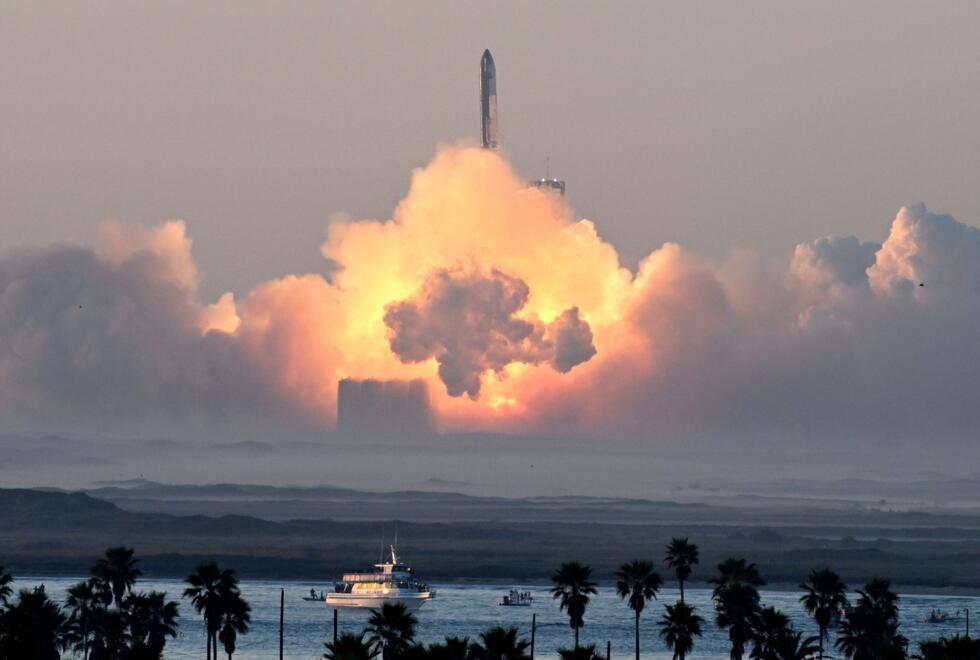
US President Donald Trump signed an executive order on Wednesday to streamline federal regulation governing commercial rocket launches, a move that could benefit billionaire Elon Musk's SpaceX and other private space ventures.
Trump's order, among other things, directs the US transportation secretary to eliminate or expedite environmental reviews for launch licenses administered by the Federal Aviation Administration (FAA), the White House said in a statement.
The declaration also calls on the secretary to do away with "outdated, redundant or overly restrictive rules for launch and reentry vehicles".
"Inefficient permitting processes discourage investment and innovation, limiting the ability of US companies to lead in global space markets," the executive order states.
The executive order, which said it aimed to "substantially" increase the number of space launches in the United States, was described by an environmental group as "reckless".
Since returning to the White House in January, Trump has talked up several space missions including sending humans to the Moon and Mars.
The Moon and Mars missions are planned to get a ride on the massive Starship rocket of Musk's private firm SpaceX.
SpaceX, though not mentioned by name in Trump's order, easily leads all US space industry entities, including NASA, in the sheer number of launches it routinely conducts for its own satellite network, the US space agency, the Pentagon, and other enterprises.
Its various-sized rockets blasted off more than 130 times last year – a number that will likely rise following Trump's executive order.
But Starship has had a series of setbacks, with its latest routine test ending in a fiery explosion in June.
"It is the policy of the United States to enhance American greatness in space by enabling a competitive launch marketplace and substantially increasing commercial space launch cadence" by 2030, the order read.
The change could well benefit Musk, who has long advocated for deregulation of the space industry. The world's richest man was previously a close advisor to Trump before the pair had a dramatic, public falling out in July.
Musk has viewed FAA oversight as a hindrance to his company's engineering culture, considered more risk-tolerant than many of the aerospace industry's more established players.
SpaceX's flight-test strategy is known for pushing spacecraft prototypes to the point of failure, then fine-tuning improvements through frequent repetition.
This has appeared to run afoul at times with the FAA's mission of safeguarding the public and the environment as it exercises its regulatory jurisdiction over commercial spaceflight.
SpaceX has been repeatedly criticised over the environmental impact at the sites where Starship, the largest and most powerful rocket in history, blasts off.
Earlier this year, the FAA grounded Starship test flights for nearly two months after back-to-back post-launch explosions rained debris over Caribbean islands and forced dozens of airliners to change course. The FAA ended up expanding the aircraft hazard zone along Starship's launch trajectories before licensing future flights.
The US-based nonprofit Center for Biological Diversity said Trump's new executive order "paves the way for the massive destruction of protected plants and animals".
"This reckless order puts people and wildlife at risk from private companies launching giant rockets that often explode and wreak devastation on surrounding areas," the center's Jared Margolis said in a statement.
Musk's dreams of colonising Mars rely on the success of Starship, and SpaceX has been betting that its "fail fast, learn fast" ethos will eventually pay off.
The FAA approved an increase in annual Starship rocket launches from five to 25 in early May, stating that the increased frequency would not adversely affect the environment.
(FRANCE 24 with AFP and Reuters)
iSpace Launches China's First Rocket Landing Barge, Copying SpaceX

Chinese rocket company iSpace has ambitions to run a high-volume commercial launch service, and to get there, it is taking a page from Elon Musk-owned SpaceX: an autonomous landing barge.
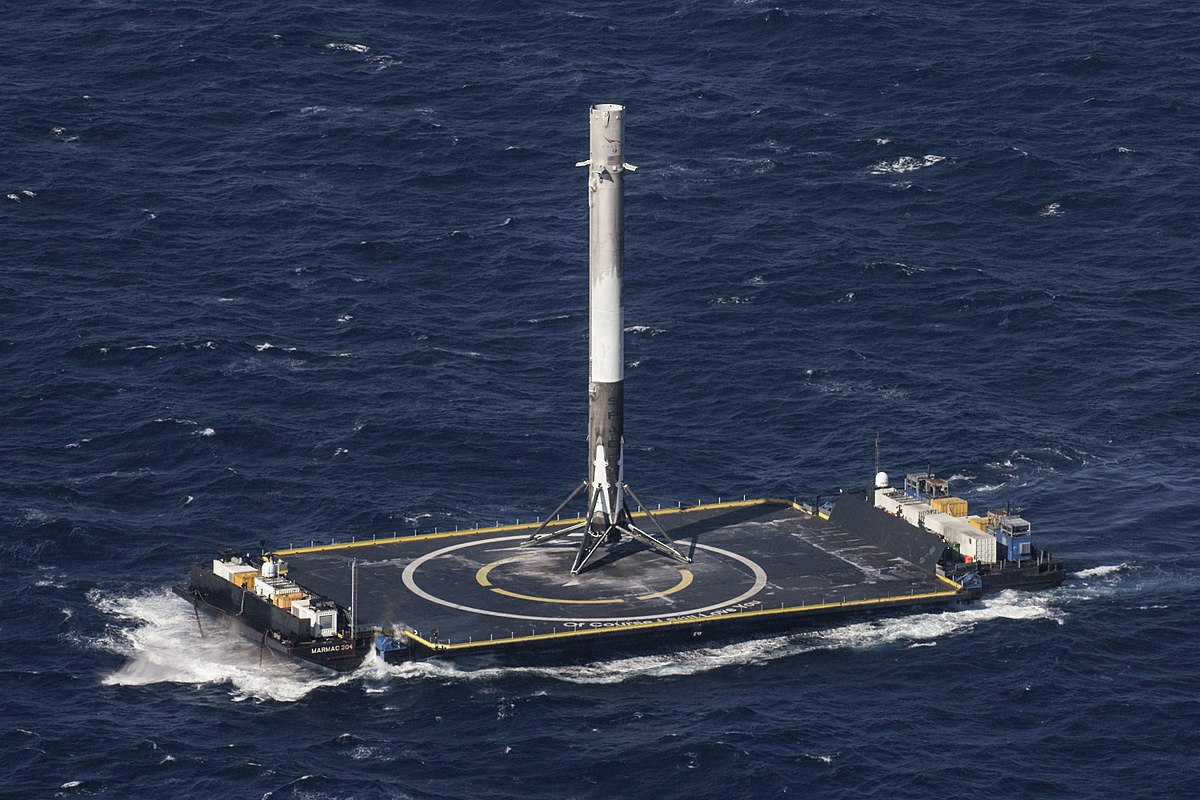
Interstellar Glory Aerospace Technology Group (iSpace, not to be confused with Japanese firm iSpace Inc.) has developed a reusable, natural gas-fueled booster rocket in order to keep down launch costs. This parallels SpaceX's successful technology, which has come to dominate the commercial launch industry in the U.S. market. But to reuse the booster, iSpace needs a place to land it. Enter the Xingji Guihang ("Interstellar Return"), a large landing vessel designed to accommodate the iSpace SQX-3 rocket on its return to Earth. The vessel bears resemblance to a deck barge adaptation that SpaceX developed for the same purpose.
 Courtesy SpaceX
 Courtesy iSpace
Jiangsu Runyang Shipbuilding constructed the DP-capable, unmanned-ready barge for iSpace. With a deck measuring about 130 feet by 200 feet and a displacement of 17,000 tonnes, it is large enough to catch a returning booster. It is the fifth vessel of its kind in the world, after SpaceX's deck barges, and it is the first in China. Peng Xiaobo, Chairman of Interstellar Glory, said at the launch ceremony that it would not be the last.
"The 'Interstellar Return' has explored and established a new standard for the integration of my country's aerospace and shipbuilding industries, and has played a . . . leading role in the construction of subsequent carrier rocket recovery ships," he said. "Starting today, my country's offshore engineering ships have added the carrier rocket recovery ship type; the 'Interstellar Return' is the concrete embodiment of our pursuit of dreams of the stars and the sea, which gives us confidence and strength."
After sea trials, the Xingji Guihang will transit to Hainan for comprehensive exercises, followed by entry into commercial service.
Gaia’s variable stars: a new map of the stellar life cycle
Ecole Polytechnique Fédérale de Lausanne
One of the best places to study stars is inside “open clusters”, which are groups of stars that formed together from the same material and are bound together through gravity.
Open clusters act as laboratories, showing how stars of different masses and ages behave. At the same time, some stars known as “variable stars”, regularly change in brightness, and their flickers and pulses help scientists learn about the physics inside stars and about the wider galaxy.
Until now, astronomers studied clusters and variable stars separately, and usually one cluster at a time. But that approach missed the bigger picture, leaving gaps in our understanding of how the lives of stars unfold across the galaxy.
Now, Richard I. Anderson, head of the Standard Candles and Distances Laboratory at EPFL and Emily Hunt at the Max Planck Institute for Astronomy, have combined these two approaches for the first time. Using data from the European Space Agency’s Gaia mission, they mapped nearly 35,000 variable stars inside 1,200 open clusters across the Milky Way. This “bird’s eye view” gives researchers an unprecedented map of how stars live, age, and die as part of their communities.
The findings are published as a Letter to the Editor in the journal Astronomy & Astrophysics.
New patterns in the stellar life cycle
“It is a scientific first in the way that large samples of star clusters and variable stars are analyzed together,” says Anderson. “This creates synergies because the two approaches provide complementary insights.”
The team built their map using the third data release from Gaia, a satellite that precisely measures the positions, brightness, and colors of more than a billion stars. They focused on clusters within 6,500 light-years away to make sure their results were reliable.
The researchers matched Gaia’s catalog of variable stars to the stars in these clusters and checked the ages, distances, and brightness of each one. By tracking where each type of variable star appears in a cluster and how their numbers change with cluster age, the team pieced together new patterns in the stellar life cycle.
The results show that at least one in five stars in these clusters changes brightness over time. Young clusters host the greatest variety of variable stars, while older clusters show more stars with slow, Sun-like cycles. The study also shows that certain types of variable stars serve as markers for a cluster’s age, providing a new tool for measuring how old a group of stars is without having to build complicated models.
“We are made of stardust”
The team made their catalog public, sharing the positions, types, and properties of all 35,000 variable stars in these clusters. The study also offers the cleanest diagram yet showing how different types of variable stars are distributed across the key map astronomers use to track stellar evolution (the Hertzsprung Russell Diagram).
The Gaia mission is now entering its most exciting scientific phase even though the satellite was recently turned off. Over the coming years, Gaia’s vast archive of observations, which cover nearly 2 billion stars, will be processed and analyzed by scientists across Europe.
“Our work is a teaser for what is to come with Gaia [data releases 4 and 5], which will revolutionize the study of stellar populations by their light variations,” says Anderson.
By showing how variable stars can be used as “clocks” and “markers” in stellar evolution, the team has opened up new ways to explore the story of the universe. “We are made of stardust,” says Anderson. “Understanding the lives of stars and the physics that govern stars is crucial to understanding our origins and place in the cosmos.”
Other contributors
Heidelberg University
Reference
Richard I. Anderson, Emily L. Hunt. A birds-eye view of stellar evolution through populations of variable stars in Galactic open clusters. Astronomy & Astrophysics 13 August 2025. DOI: 10.1051/0004-6361/20255511110.1051/0004-6361/202555111
Journal
Astronomy and Astrophysics
Article Title
A bird's eye view of stellar evolution through populations of variable stars in Galactic open clusters
Article Publication Date
13-Aug-2025
A new window into Earth’s upper atmosphere
Small devices can loft into mesosphere for climate sensing
image:
An illustration of the devices' use cases.
view moreCredit: Ben Schafer and Jong-Hyoung Kim
Key takeaways
- Harvard SEAS researchers have tested and validated lightweight nanofabricated structures that can passively float in the mesophere, which is about 45 miles above Earth’s surface.
- The devices levitate via photophoresis, or sunlight-driven propulsion, which occurs in the low-pressure conditions of the upper atmosphere.
- Such structures could be used for sensing and communication in an area of the atmosphere that’s been difficult to monitor with existing technology.
Between 50 and 100 kilometers (30-60 miles) above Earth’s surface lies a largely unstudied stretch of the atmosphere, called the mesosphere. It’s too high for airplanes and weather balloons, too low for satellites, and nearly impossible to monitor with existing technology. But understanding this layer of the atmosphere could improve the accuracy of weather forecasts and climate models.
A new study published in Nature by researchers at the Harvard John A. Paulson School of Engineering and Applied Sciences (SEAS), University of Chicago, and others introduces a novel way to reach this unexplored near-space zone: lightweight flying structures that can float using nothing but sunlight.
“We are studying this strange physics mechanism called photophoresis and its ability to levitate very lightweight objects when you shine light on them,” said Ben Schafer, lead author of the paper and a former Harvard graduate student in the research groups of Joost Vlassak, the Abbott and James Lawrence Professor of Materials Engineering at SEAS, and David Keith, now a professor at the University of Chicago.
How photophoresis works
Photophoresis occurs when gas molecules bounce more forcefully off the warm side of an object than the cool side, creating continuous momentum and lift. This effect only happens in extreme low-pressure environments, which are exactly the conditions found in the mesosphere.
The researchers built thin, centimeter-scale membranes from ceramic alumina, with a layer of chromium on the bottom to absorb sunlight. When light hits this structure, the heat difference between the top and bottom surfaces initiates a photophoretic lifting force, which exceeds the structure’s weight.
“This phenomenon is usually so weak relative to the size and weight of the object it’s acting on that we usually don’t notice it,” Schafer said. “However, we are able to make our structures so lightweight that the photophoretic force is bigger than their weight, so they fly.
The concept originated more than a decade ago when Keith hypothesized different uses of photophoretic particles, including their potential to reduce climate warming. A collaboration began with then-graduate student Schafer, and Vlassak, an expert in nanofabrication and experimental mechanics, in order to help move the concepts from theory to reality.
The collaboration became feasible through recent advances in nanofabrication technology, which allow researchers to build low-mass, nanoscale devices with greater precision.
“We developed a nanofabrication process that can be scaled to tens of centimeters,” Vlassak said. “These devices are quite resilient and have unusual mechanical behavior for sandwich structures. We are currently working on methods to incorporate functional payloads into the devices.”
Testing devices in the lab
Using these fabrication methods, the research team created centimeter-scale structures and directly measured the photophoretic forces acting on them inside a low-pressure chamber Schafer and former Harvard postdoctoral fellow Jong-hyoung Kim built in Vlassak’s lab. They compared those results to predictions of how such structures would behave in the upper atmosphere. Device design and fabrication were led by Kim, who is now a professor at Pukyong National University in South Korea.
“This paper is both theoretical and experimental in the sense that we reimagined how this force is calculated on real devices and then validated those forces by applying measurements to real-world conditions,” Schafer said.
A key experiment detailed in the paper shows a 1-centimeter-wide structure levitating at an air pressure of 26.7 Pascals when exposed to light at just 55% the intensity of sunlight. This pressure condition models what’s found 60 kilometers above the Earth’s surface.
“This is the first time anyone has shown that you can build larger photophoretic structures and actually make them fly in the atmosphere,” said Keith. “It opens up an entirely new class of device: one that’s passive, sunlight-powered, and uniquely suited to explore our upper atmosphere. Later they might fly on Mars or other planets.”
Possible applications: Sensing, communication, Martian exploration
The team envisions a range of possible applications for their new device, especially in climate science. If equipped with lightweight sensors, this device could collect key data like wind speed, pressure, and temperature from a region of the atmosphere that has long remained a blind spot. This data is critical for calibrating the climate models that build the foundation of weather forecasting and climate change projections.
Other potential applications include telecommunications for defense and emergency response scenarios. Using a fleet of these devices could enable a floating array of antennas with data transmission capabilities comparable to low orbit satellites like Starlink, but with lower latency due to their closer proximity to the ground.
Since Earth’s upper atmosphere shares key characteristics with the thin atmosphere of Mars, the device could facilitate new modes of planetary exploration and communication in that environment as well.
The team’s next step is to integrate onboard communications payloads that would allow the device to transmit real-time data during flight.
“I think what makes this research fun is that the technology could be used to explore an entirely unexplored region of the atmosphere. Previously, nothing could sustainably fly up there,” Schafer said. “It’s a bit like the Wild West in terms of applied physics."
Research described in the paper formed the building blocks of a Harvard spinoff company, Rarefied Technologies, that Schafer and co-founder Angela Feldhaus launched in 2024. Harvard Office of Technology Development provided business development support to the research team and licensed the innovations to Rarefied Technologies for further development.
The research was supported by the Star-Friedman Challenge for Promising Scientific Research at Harvard. It had federal support from the Harvard University Materials Research Science and Engineering Centers (DMR-2011754), funded by the National Science Foundation. The devices were fabricated at the Harvard Center for Nanoscale Systems, also supported by NSF (ECCS Grant No. 1541959).
An illustration of air flow around a flying device.
Credit
Ben Schafer and Jong-hyoung Kim
Journal
Nature
Method of Research
Experimental study
Subject of Research
Not applicable
Article Title
Photophoretic flight of perforated structures in near-space conditions
Article Publication Date
13-Aug-2025

No comments:
Post a Comment