ZIONIST ETHNIC CLEANSING IS FASCISM
Israeli minister announces settlement plan to 'bury the idea of a Palestinian state'
Israel’s far-right finance minister on Thursday announced plans to revive a contentious settlement plan in the occupied West Bank, which Palestinians and rights groups fear will scuttle plans for a future Palestinian state. The so-called E1 scheme linking Jerusalem and the Maale Adumim settlement has been frozen for decades amid international opposition, including from the US.
Issued on: 14/08/2025
By: FRANCE 24
Video by: Noga TARNOPOLSKY

04:30
Israeli far-right Finance Minister Bezalel Smotrich has approved plans for a settlement that would split East Jerusalem from the occupied West Bank, a move his office said would bury the idea of a Palestinian state.
It was not immediately clear if Prime Minister Benjamin Netanyahu backed the plan to revive the long-frozen E1 scheme, which Palestinians and world powers have said would effectively lop the West Bank in two and will likely draw international ire.
In a statement headlined "Burying the idea of a Palestinian state," Smotrich's spokesperson announced the decision and said the development would build 3,401 houses for Israeli settlers between an existing settlement in the West Bank and Jerusalem.

07:00
Israel had frozen construction plans there since 2012 because of objections from the United States, European allies and other world powers who considered the project a threat to any future peace deal with the Palestinians.
Palestinians fear the settlement building in the West Bank – which has sharply intensified since the 2023 Hamas attack on Israel that led to the Gaza war – will rob them of any chance to build a state of their own in the area.
Settler violence has skyrocketed, from destruction of olive groves and cutting water and electricity in communities like Susiya, to incendiary attacks on Christian holy sites.
There was no immediate statement from Netanyahu or the broader government. Smotrich's popularity has fallen in recent months with polls showing his party would not win a single seat if parliamentary elections were held today.
The Palestinian foreign ministry called the new settlement plan an extension of crimes of genocide, displacement and annexation, and an echo of Netanyahu's statements regarding what he called 'Greater Israel'. Israel has long rejected accusations of genocide and rights abuses and said it is acting in its own defence.
The E1 project would connect the Maale Adumim settlement in the West Bank with Jerusalem. Most of the international community views Israeli settlements in the West Bank, and its military occupation over the region since 1967, as illegal.
Peace Now, which tracks settlement activity in the West Bank, said that the housing ministry had approved the construction of 3,300 homes in Maale Adumim.
“The E1 plan is deadly for the future of Israel and for any chance of achieving a peaceful two-state solution. We are standing at the edge of an abyss, and the government is driving us forward at full speed," Peace Now said in a statement.
House building 'in a year'
Peace Now said there were still steps needed before construction, including the approval of Israel's High Planning Council. But if all went through, infrastructure work could begin within a few months, and house building in about a year.
Palestinians were already demoralised by the Israeli military campaign which has killed more than 61,000 people in Gaza, according to local health authorities, and fear Netanyahu will ultimately push them out of that territory.
President Donald Trump added to their anxiety by proposing the United States will take over Gaza, build an international beach resort and displace its residents to countries such as Egypt and Jordan.
About 700,000 Israeli settlers live among 2.7 million Palestinians in the West Bank and East Jerusalem. Israel annexed East Jerusalem in a move not recognised by most countries but has not formally extended sovereignty over the West Bank.
The UN and most world powers say settlement expansion has eroded the viability of a two-state solution by fragmenting Palestinian territory.
Israel disputes this, citing historical and biblical ties to the area, which it calls Judea and Samaria, and says the settlements provide strategic depth and security.
Most of the international community considers all settlements illegal under international law, a position backed by numerous UN Security Council resolutions, including one which called on Israel to halt all settlement activity.
Israel rejects this interpretation, saying the West Bank is "disputed" rather than occupied territory.
Britain, Canada, Australia and New Zealand imposed sanctions in June on Smotrich and another far-right minister who advocates for settlement expansion, accusing both of them of repeatedly inciting violence against Palestinians in the West Bank
Britain and other states have said that Israel must stop expanding settlements in the West Bank. Over the past 22 months, as Israel has waged war in Gaza, rights groups have said settler attacks and settlement expansion in the West Bank have risen sharply.
(FRANCE 24 with Reuters)
'More important than our hostages': Israeli settlers back new Gaza plan
As Israeli Prime Minister Benjamin Netanyahu’s new military plan for Gaza faces growing criticism abroad, opposition is also building in Israel, with hostage families calling for a nationwide shutdown on Sunday.
But in the Israeli settlement of Itamar, in the occupied West Bank, support for the war remains firm.
Issued on:
From Jerusalem, Route 60 heads north through a landscape that tells the story of more than half a century of occupation of the West Bank – with its Israeli military presence and smooth roads for Israeli settlers, dotted with checkpoints on the roads serving Palestinian localities.
The hills are gradually being covered with "outposts" – prefabricated structures set up on the outskirts of Israeli settlements to gradually expand their boundaries.
While settlements are recognised by the Israeli government, outposts are illegal under Israeli law. Both the settlements and the outposts are illegal under international law.
Arriving at a yellow metal barrier, we are in Itamar, where small houses with light-coloured walls line the streets that wind their way along the hillside.
In Itamar, as in most Israeli settlements in the occupied West Bank, the majority of residents identify with the religious nationalist movement – and in particular with the Religious Zionist Party of Finance Minister Bezalel Smotrich, whose portrait is seen on posters lining the roads in the region.
Residents refer to it as Judea and Samaria, the biblical name for this region and the one used for the West Bank by Israeli authorities. According to these settlers, this land belongs to Israel, even though United Nations resolutions say otherwise.
France leads global appeal to recognise Palestinian state after UN talks
'Reaching an agreement won't work'
In recent days, the streets of Israel have echoed with cries of anger over the government's plan to take control of densely populated areas of the Gaza Strip.
The Israeli military said on Wednesday it had approved the framework for a new offensive in Gaza, as Hamas condemned what it called "aggressive" Israeli ground incursions in Gaza City. The approval for the expanded offensive comes days after Israel’s security cabinet called for the seizure of Gaza’s largest city.
The families of the remaining 50 hostages still being held by Hamas in Gaza – 22 of whom are currently presumed to be alive – have called for a nationwide general strike on Sunday, in protest at the expansion of the Gaza offensive.
They are urging Israelis not to go to work that day, in order to pressurise the government into prioritising the rescue of the hostages. "We are shutting down the country to save the soldiers and the hostages," they said in a statement.
But there is no such dissent in Itamar, and the desire to continue the war prevails.
"What happened on 7 October [2023] must not happen again," explains Yaacov Cohen, a rabbi and religious teacher who has lived in Itamar for four decades.
"That is the most important thing, more important than the fate of our unfortunate hostages. On the other side, we have the terrorists of Hamas, who have no faith and no law. Stopping the war and reaching an agreement will not work."
This rhetoric highlights a profound division within Israeli society, contrasting sharply with the slogans seen at weekly rallies, from Tel Aviv to Jerusalem, calling for an end to the war to allow for the release of the hostages.
Hunger, disease and no escape: Gaza aid worker’s account of life under siege
Netanyahu insists the aim of his plan is to "put an end to Hamas". Ultra-nationalist ministers Smotrich and Itamar Ben Gvir say this plan is insufficient to achieve that.
"I agree with Bezalel Smotrich," says Moshe Goldschmidt, a former mayor of the Itamar settlement, who believes that his country is still exercising too much restraint in its war on Gaza, particularly the army.
"Some officers exercise command with old ideas: fearing international pressure, being cautious," he says. "But there is a new mindset in Israel. We will no longer be sheep going to the slaughterhouse. We must be strong, fight for good, defeat evil and when that is done, there will be peace and the world will be a much better place."
Goldschmidt categorically rejects the idea that there is a genocide taking place in the Gaza Strip, even though Israeli human rights organisations have recently joined the list of NGOs now using this term.
Macron warns Israel that Gaza occupation plan risks ‘war without end’
Recognition of the State of Palestine
On Monday, Australia became the latest country to announce that it would recognise the State of Palestine – joining France, the United Kingdom and Canada, among others.
While this diplomatic gesture will have no impact on the ground, the settlers of Itamar are outraged.
"Gaza was a sample of a Palestinian state, with Hamas at its head," says Goldschmidt. "This is what happens when you create a Palestinian state. Their goal is to eliminate Israel. There is no difference between Hamas and Mahmoud Abbas's Palestinian Authority, if you listen to them – they have the same mindset, that of radical Islam."
Leaders who are preparing to recognise a Palestinian state "should be ashamed", he added.
In Itamar, the settlers are convinced that Western countries are beholden to the Muslim communities living in them, and that this explains why they are recognising Palestinian statehood.
As for Israel's growing isolation on the world stage: "yes, it's a problem," admits Cohen. "But we have the Americans with us, which helps a lot."
This article was adapted from the original version in French by RFI's correspondent in Itamar.
International aid groups say new Israeli rules stop them delivering supplies to Gaza
More than 100 international non-government organisations released a joint statement Thursday saying that the Israeli government was increasingly using new regulations to prevent them bringing much-needed humanitarian aid into the devastated Gaza Strip.
Issued on: 14/08/2025 -
By: FRANCE 24
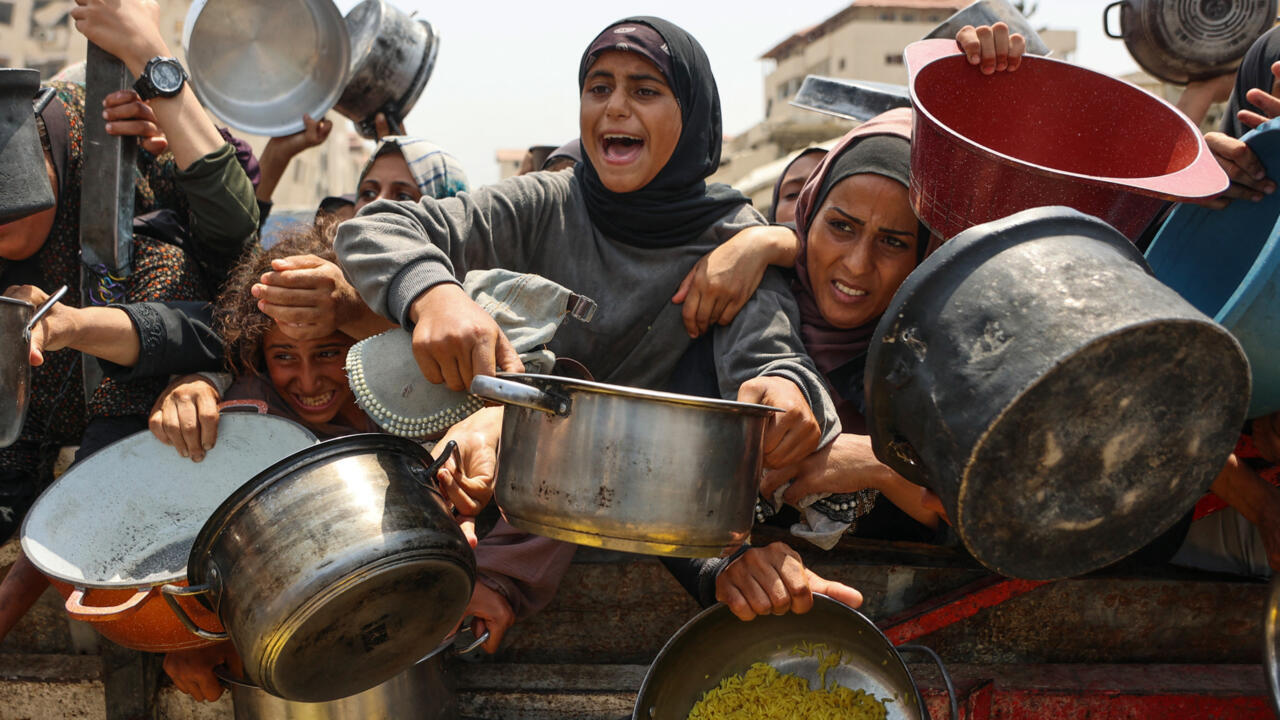
New Israeli legislation regulating foreign aid groups has been increasingly used to deny their requests to bring supplies into Gaza, according to a joint letter signed by more than 100 groups published Thursday.
"Israeli authorities have rejected requests from dozens of NGOs to bring in lifesaving goods, citing that these organisations are 'not authorised to deliver aid'," the joint statement reads.
According to the letter, whose signatories include Oxfam and Doctors Without Borders (MSF), at least 60 requests to bring aid into Gaza were rejected in July alone.
In March, Israel's government approved a new set of rules for foreign non-governmental organisations (NGOs) working with Palestinians.
Gaza: families struggle to procure food as the humanitarian disaster worsens

01:22
The law updates the framework for how aid groups must register to maintain their status within Israel, along with provisions that outline how their applications can be denied or registration revoked.
Registration can be rejected if Israeli authorities deem that a group denies the "democratic character" of Israel or "promotes delegitimisation campaigns" against the country.
"Unfortunately, many aid organisations serve as a cover for hostile and sometimes violent activity," Israel's Diaspora Minister Amichai Chikli alleged to AFP.
"Organisations that have no connection to hostile or violent activity and no ties to the boycott movement will be granted permission to operate," added Chikli, whose ministry directed an effort to produce the new guideline.
Aid groups say, however, that the new rules are leaving Gazans without help.
"Our mandate is to save lives, but due to the registration restrictions civilians are being left without the food, medicine and protection they urgently need," said Jolien Veldwijk, director of the charity CARE in the Palestinian territories.
Eight more people, including three children, have died of starvation and malnutrition in Gaza in the past 24 hours, the territory's health ministry said Wednesday. The number of people who have died from hunger in the besieged enclave since the war began now stands at 235, including 106 children.
Veldwijk said that CARE has not been able to deliver any aid to Gaza since Israel imposed a full blockade on the Palestinian territory in March, despite partially easing it in May.
EXCLUSIVE: Former Gaza Humanitarian Foundation contractor speaks out to FRANCE 24

05:13
An internal US government analysis seen by Reuters found no evidence of systematic theft by the Palestinian militant group of US-funded humanitarian supplies, and Israeli military officials have told the New York Times that they had no evidence to substantiate these allegations.
Since May, the government has relied on the US-backed Gaza Humanitarian Foundation to manage food distribution centres. Israeli troops have shot dead hundreds of Palestinians trying to reach the aid hubs since they first opened, including at least 25 people on Wednesday.
(FRANCE 24 with AFP and Reuters)

No comments:
Post a Comment