Inside the mine that feeds the tech world – and funds Congo’s rebels
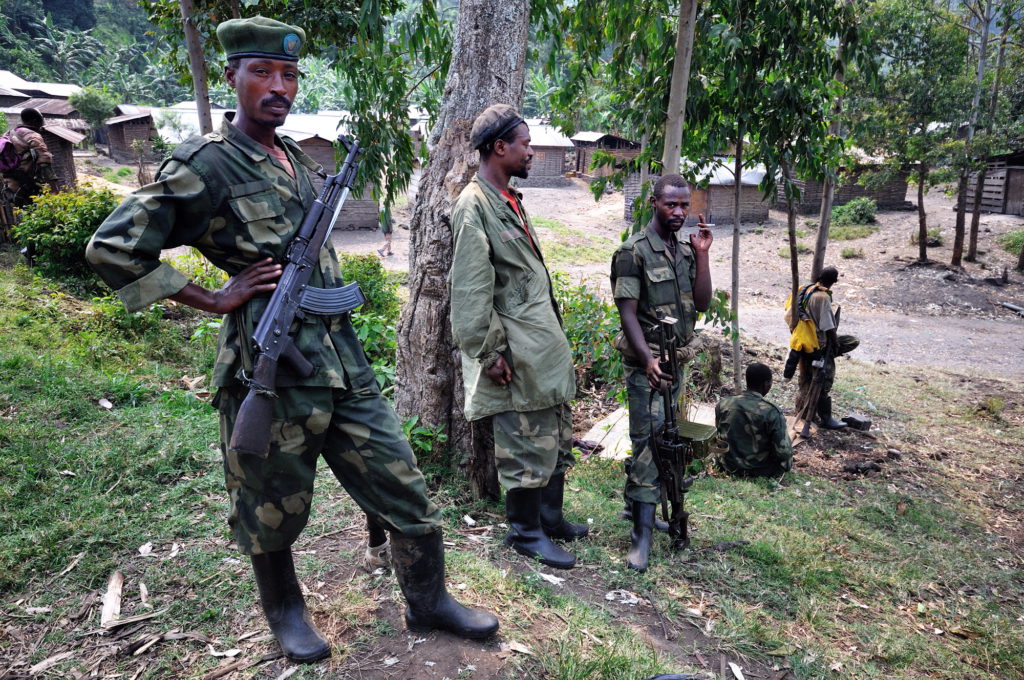
Under the watchful eye of M23 rebels in the hills around the Congolese town of Rubaya, a line of men in rubber boots ferry sacks full of crushed rocks up winding paths cut into the slopes.

The laborers are hauling coltan ore, a mineral that powers the modern world. The ore will be loaded onto motorbikes and eventually shipped thousands of kilometers away to Asia. There it’s processed into tantalum, a heat-resistant metal that fetches more than $300 a kilogram and is in high demand by makers of mobile phones, computers, aerospace components and gas turbines.
Rubaya produces around 15% of the world’s coltan, all dug manually by impoverished locals who earn a few dollars per day. Control of this mine is the biggest prize in a long-running conflict in this central African nation.
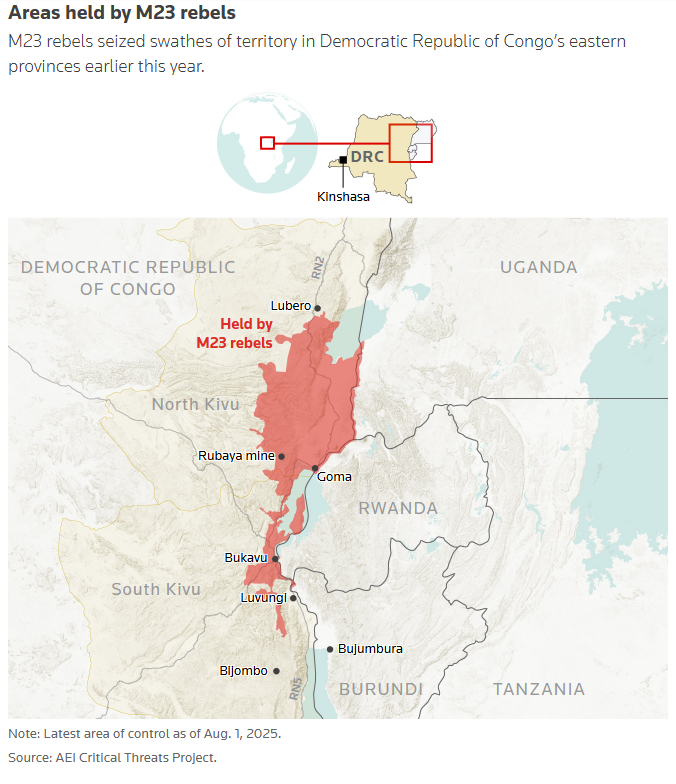
The area was seized in April 2024 by M23, a rebel group the United Nations says has plundered Rubaya’s riches to help fund its insurgency, backed by the government of neighboring Rwanda. The heavily-armed rebels, whose stated aim is to overthrow the government in Kinshasa and ensure the safety of the Congolese Tutsi minority, captured even more mineral-rich territory in eastern Democratic Republic of Congo (DRC) this year.
The region and its mineral wealth are in the spotlight as M23 and the DRC have pledged to sign a peace deal at a ceremony in Qatar’s capital, Doha, this month. The United States is mediating parallel talks between Congo and Rwanda, dangling potentially billions of dollars in investment if hostilities cease.
The United States Treasury on Tuesday sanctioned other alleged participants in minerals smuggling in Congo, including PARECO-FF, a pro-government Congolese militia that the US said controlled the Rubaya mining site from 2022 to early 2024, prior to M23’s takeover.
PARECO-FF could not be reached for comment.
Asked at a press briefing why Washington was targeting PARECO-FF rather than M23, a senior US government official noted that M23 has been under US sanctions since 2013 for fueling conflict in the region.
“The Treasury Department will not hesitate to take action against groups that deny the United States and our allies access to the critical minerals vital for our national defense,” John K. Hurley, undersecretary of the Treasury for terrorism and financial intelligence, said in a separate statement.
Jason Stearns, a former UN investigator in Congo, said the fact that M23 was not targeted by the new mining-related sanctions was surprising, adding the move might be aimed at keeping the Doha talks on track.
M23’s advance poses the most serious threat to the Kinshasa government in at least two decades of conflict rooted in Rwanda’s 1994 genocide, which saw around 1 million of Rwanda’s Tutsi ethnic group killed by Hutu militias.
Rwanda’s government has long denied that it traffics in coltan looted from its neighbor or that it backs M23. But Rwanda’s ruling party, mainly headed by Tutsis, shares the same concerns as the Tutsi-dominated M23 insurgents over the purported threat posed by rival Hutu groups operating in eastern Congo. A July 3 UN report, reviewed by Reuters, says that as of April, Rwanda had placed at least 1,000 to 1,500 troops in Congo’s rebel-controlled areas.
M23 now controls two key Congolese cities – Goma and Bukavu – on the border with Rwanda. UN investigators say that it is through these cities that Congolese minerals are illegally trucked to Rwanda, often at night, where the ore is mixed with Rwandan coltan production in a bid to disguise its provenance before export.
M23 and the Rwandan and Congolese governments did not respond to requests for comment. Congolese officials have repeatedly accused Rwanda of fomenting the conflict to plunder Congo’s mineral wealth.
According to a December UN report, the scale of the trade reached new heights after the capture of Rubaya by M23. The rebels went on to establish a parallel administration controlling mining activities, trade, transport and the taxation of the minerals produced there, the UN reported.
Reuters reporters visited Rubaya in March this year and were told by M23 officials that the rebels had imposed a tax on mineral traders of 15% on the value of coltan they purchase from the informal miners who work the area. M23 was taking in $800,000 monthly from levies collected from coltan mining in eastern Congo, according to the December UN report.
Mud and motorbikes
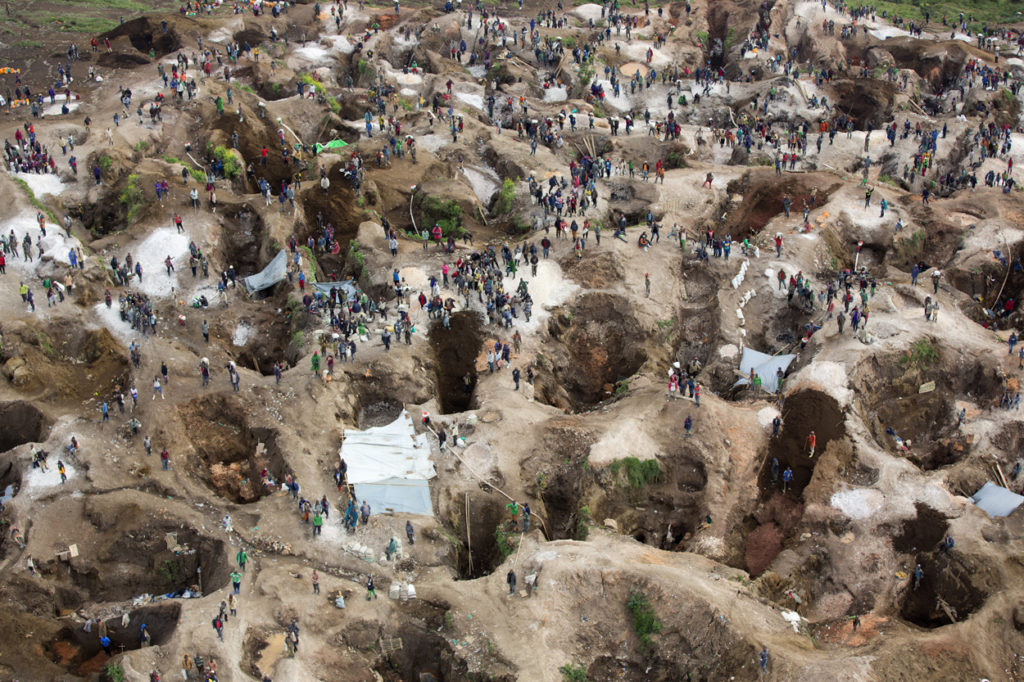
Simply reaching Rubaya’s sprawling, beehive-like maze of pits is a major undertaking. Reuters journalists who visited the mining sites in March had to abandon their four-wheel-drive Land Cruisers after the vehicles became stuck on the muddy road from Goma. They walked 5 kilometers (3 miles) to reach the town and then hopped on the back of motorcycles with rebel officials to reach the pits.
Activity in Rubaya begins before dawn, when thousands of miners descend on the pits cut into the rolling hills of Congo’s North Kivu province, where many toil in 12-hour shifts.
The tunnels can be as deep as 15 meters (49 feet) underground. Once fragments of ore are dislodged, porters carry sacks of the rubble to the surface where laborers have dug shallow basins that are filled with water. There, other workers, including women and children, wash the ore and separate it from sand and other debris before laying it into the sun to dry.
The journalists were supervised by unarmed M23 personnel throughout their visit to the mining area. A reporter saw a rebel official jotting down in a notebook how many sacks each porter – covered in a fine white dust – carted to each collection point. Once the ore is dry, it is stacked on the backs of motorbikes that carry it to one of several depots in the nearby town of Rubaya, where it is sold to traders.
With a M23 chaperone listening, Pascal Mugisha Nsabimana, a 32-year-old miner, told Reuters that working under rebel occupation was preferable to toiling under the supervision of Congo’s military and its allies, who fled when M23 moved in on the area last year.
Previously “there was too much harassment, there were many different taxes, and often we, the diggers, were not paid. And even if we got something, it was poorly paid,” the miner said. He added that his current day rate had at least tripled to 15,000 Congolese francs ($5.15) with M23 in charge.
In the early months following M23’s takeover of Rubaya in April 2024, smugglers used motorcycles to sneak the ore into Rwanda via backroads to avoid scrutiny by Congolese forces remaining along the border, according to more than a dozen people familiar with the situation, including current and former smugglers, miners and local businessmen. The journey could take an entire day, according to two ex-smugglers who transported coltan this way until last year. They said they loaded their bikes each trip with three 50-kilogram bags and were paid about $34 for delivering it to coltan traders.
But alterations implemented by M23 have proven a game changer in terms of efficiency, nine of those people said. Motorcycles are no longer the primary means of transport and are used only to ferry the coltan from the mine to the town of Rubaya. From there, the ore is loaded into four-wheel drive SUVs, pickups and other vehicles capable of hauling anywhere from two tons to 20 tons each, according to the people and the July UN report. The system is faster, too. Since M23 drove Congolese troops from Goma and took control of that border city, coltan trucks can now pass freely through it on paved roads into Rwanda, slashing transport times, the people said.
UN experts and human rights activists have long warned that profits from illegal mining are funding conflict. They say the trade has brought little wealth to local people and that child labor is common. Reuters witnessed at least a dozen children working at the Rubaya mine: Young boys entered the shafts to haul out ore and carry it to the basins where girls worked alongside adults washing and drying the coltan.
Gregory Mthembu-Salter, a former UN expert on Congo who now does consulting on conflict minerals, said broad efforts by the mining industry, UN agencies and non-government organizations that began around 2010 to clean up the region’s supply chain and prevent human rights abuses have largely failed.
“Here we are, 15 years later, (and) the same thing is happening,” said Mthembu-Salter, director of Phuzumoya Consulting.
US investors eye Rubaya’s riches
Some US entrepreneurs have also set their sights on Rubaya’s coltan treasure as President Donald Trump seeks to broker a peace deal to end the conflict and promote development of the region’s mineral wealth. In Congo, those riches include huge reserves of cobalt, gold, copper, lithium and diamonds in addition to coltan. The country’s formal mining sector at present is dominated by Chinese companies.
Texas hedge fund manager Gentry Beach, who is chairman of investment firm America First Global and helped raise funds for Trump’s election campaign in 2016, was part of a consortium looking to negotiate rights to the Rubaya mine, according to a person with direct knowledge of the matter. The Financial Times earlier reported Gentry’s interest in Congo’s coltan.
The source told Reuters that Beach’s group had proposed to the Congolese government taking a majority stake in the mine, with Kinshasa retaining a 30% interest.
Beach confirmed his interest in the project to Reuters but declined to provide additional details.
Some US lawmakers are pushing back. In an Aug. 8 letter to Trump and US Secretary of State Marco Rubio, more than 50 Democratic congress members criticized what they said was the administration’s lack of transparency in its negotiations with the DRC. They also raised concerns about a potential conflict of interest in a Trump ally angling for rights to develop the Rubaya mine.
White House Deputy Press Secretary Anna Kelly said in an Aug. 5 emailed statement that the agreement between Congo and Rwanda arranged by Trump has the potential to lead to lasting peace and stability in the region. The president’s vision is a “win-win outcome where all parties benefit—economically and politically—through cooperation and shared prosperity,” the statement said. She did not respond to a follow-up query about the letter from congressional Democrats.
The US State Department did not comment. On Aug. 1, the State Department said in a statement that it was committed to supporting efforts being made by Rwanda and Congo to advance security and economic cooperation. Heads of state would soon be invited to Washington for a summit, according to the statement, which did not elaborate.
The US-backed accord does not include M23. The rebel group is part of a separate, parallel mediation led by Qatar that seeks to end hostilities. The success of those talks in Doha is key to any lasting peace – and in making Rubaya safe for investment and development by Western mining interests.
Some diplomats and analysts are dubious about the prospects for a speedy resolution.
Congo and M23 rebels pledged in Doha to reach a peace deal by August 18. But progress has been jeopardized by the killing of at least 319 civilians in eastern Congo last month, according to the UN, which says the attacks were carried out by M23.
Reuters could not independently confirm those killings. M23 leader Bertrand Bisimwa told the news agency last month that it would investigate, but he said reports of atrocities could be a “smear campaign” against the insurgent group.
Meanwhile, the US-brokered deal calls for Rwandan troops to pull out of Congo. But Rwandan President Paul Kagame said last month he was not sure the agreement would hold.
Kagame said Congo first must live up to its promises to subdue the Democratic Forces for the Liberation of Rwanda (FDLR), an eastern Congo-based ethnic Hutu militia linked to the Rwandan genocide, which Kigali sees as an existential threat.
Josaphat Musamba, a Congolese researcher and PhD student at Ghent University in Belgium, said suppressing the militia would be a tall order for the DRC’s military, which is no longer present in large swathes of M23-controlled territory.
“It’s difficult to neutralize the FDLR as long as M23 are there and the Congolese army has not redeployed,” Musamba said. He described both peace initiatives as “piecemeal” efforts that aren’t dealing with “the reality on the ground.”
Another formidable undertaking would be transforming Rubaya’s current crude system of coltan extraction into a modern operation, said a senior diplomat who is closely following events.
“No one talks about the feasibility of giving out these mining concessions and running these concessions, especially since the whole mine is artisanal mining,” done almost entirely by hand, the diplomat said.
(By Giulia Paravicini, David Lewis, Sonia Rolley and Jarrett Renshaw; Editing by Marla Dickerson and Silvia Aloisi)
Congolese mining company rejects US allegations following sanctions
The Congolese mining company sanctioned by the United States this week has said it “categorically rejects” allegations linking it to armed groups and mineral smuggling in turbulent eastern Democratic Republic of Congo.
The US Treasury Department on Tuesday announced sanctions against the Cooperative des Artisanaux Miniers du Congo (CDMC) over what it called the illicit sale of critical minerals smuggled from the mineral-rich region of Rubaya.
The US also sanctioned the Coalition des Patriotes Resistants Congolais-Forces de Frappe (PARECO-FF) – an armed group aligned with Congo’s military which Washington said controlled mining sites in Rubaya from 2022 to 2024 – and two Hong Kong-based exporters.
CDMC said control of its sites by armed groups meant the company could not operate legally.
“We are not the perpetrators – but the primary victims — of the armed conflict and pillage that have destabilized this region,” CDMC said in a statement received by Reuters late on Wednesday.
“The presence and taxation of mining activity by armed groups such as PARECO-FF and, more recently, the M23 rebels have prevented CDMC from exercising lawful control over its concession,” it said.
The sanctions are the latest measures taken by the administration of US President Donald Trump to try to bring peace to eastern Congo, where Rwanda-backed M23 rebels staged a lightning advance earlier this year, spurring violence that has killed thousands of people.
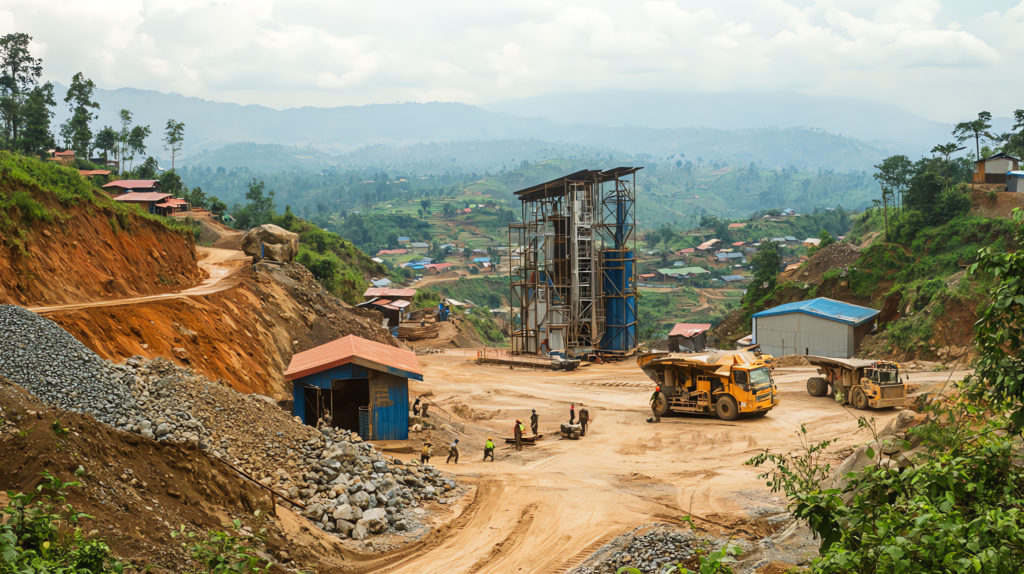
Rubaya, controlled by the M23 rebel group since April 2024, produces 15% of the world’s coltan, which is processed into a heat-resistant metal called tantalum used in mobile phones and other electronics and prized by the aerospace and medical industries among others.
(Reporting by David Lewis and Congo newsroom; Writing by Portia Crowe; Editing by Philippa Fletcher)
US sanctions armed group, Hong Kong firms over Congo mining
The US sanctioned an armed group and two Hong Kong-based firms allegedly linked to violence and illegal mining in the Democratic Republic of Congo, part of what officials said was an effort to combat the trade of conflict minerals from the region.
The Treasury Department’s Office of Foreign Assets Control imposed penalties on PARECO-FF, a successor movement to what it said was an armed group with a history of “destabilizing activities in the DRC,” according to a statement. The group “imposed forced labor and executed civilians in mining areas under its control,” the Treasury said.
Also sanctioned were East Rise Corporation Ltd. and Star Dragon Corporation Ltd., both based in Hong Kong, which the US said purchased illicitly procured minerals. Congolese mining company Cooperative des Artisanaux Miniers du Congo, or CDMC, was penalized too for allegedly selling material “sourced and smuggled from PARECO-FF areas of control” to the two foreign firms.
CDMC “categorically rejects the allegations linking our cooperative to any form of armed group activity or mineral smuggling,” the company said in a statement. East Rise and Star Dragon didn’t respond to requests for comment.
The sanctions focus on Rubaya, a mining area in eastern Congo that contains one of the world’s largest sources of tantalum ore, which is used in electronics. CDMC said it’s the “legal and registered holder” of the concession that includes the Rubaya area, but suspended all purchases in 2023 because of the insecurity in the region.
“We are not the perpetrators but the primary victims,” the company said.
The sanctions follow Congo and Rwanda signing a peace deal in Washington in June that’s meant to stop years of deadly conflict and promote development in Congo’s volatile east. The US helped broker the agreement, which seeks to end the occupation of a large swath of mineral-rich eastern Congo by the Rwanda-backed M23 rebel group.
US investment
The US and Congo are working on a separate partnership that may result in American investment in the central African nation’s world-class reserves of metals, including copper, cobalt and lithium.
Congo and neighboring Rwanda accounted for almost 60% of the world’s tantalum output last year, according to the US Geological Survey. Although a small market of about 2,500 tons a year, demand for the metal is driven by capacitators used in electronic products including smartphones and electric vehicles.
The allegations in the new sanctions relate to a period before the M23 occupied Rubaya in April 2024, when instead — according to the Treasury — PARECO-FF was in command of mining sites in the area, raising revenue by “collecting illegal fees and taxes from miners and engaging in minerals smuggling.”
The M23 itself is now overseeing the smuggling of Rubaya’s minerals, including tantalum and tin ores, to Rwanda, according to reports by United Nations experts published in January and July. The group was generating at least $800,000 a month from taxing the trade and had caused the “largest contamination of mineral supply chains” in the region to date, the earlier report said.
The US sanctioned the M23 in 2013 during the group’s initial rebellion and more recently has designated senior figures within the organization, along with several Rwandan officials accused of supporting the group. Rwanda denies backing the rebels.
Certain Congolese officials “backed by opaque diplomatic and financial channels” are waging “a coordinated effort to undermine” CDMC’s ownership of the large mining permit in the Rubaya area, the company said in a statement signed by CMDC President Serge Mulumba.
“The Treasury Department will not hesitate to take action against groups that deny the US and our allies access to the critical minerals vital for our national defense,” Under Secretary of the Treasury for Terrorism and Financial Intelligence John K. Hurley said in Tuesday’s statement.
(By Magdalena Del Valle and William Clowes)

No comments:
Post a Comment