Published Sep 19, 2025 12:44 PM by The Maritime Executive
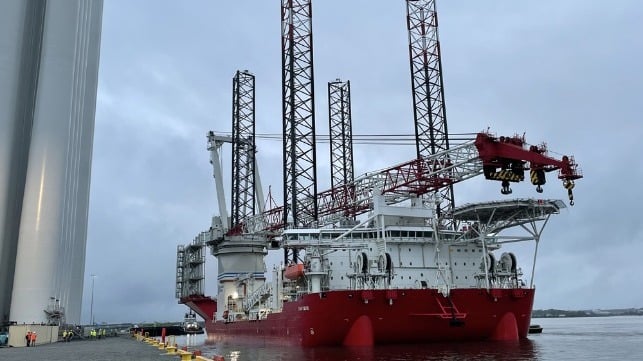
Charybdis, the massive wind turbine installation vessel built for Dominion Energy, has reached its home in Virginia after nearly five years of construction. The vessel, which is the first for the U.S. registry and one of the biggest vessels of its kind, remains on track to begin installations for the Coastal Virginia Offshore Wind (CVOW) project later this month, a spokesperson for Dominion Energy told The Maritime Executive.
Dominion confirmed that the vessel docked on Wednesday, September 17, at Portsmouth Marine Terminal in the Hampton Bays area of Virginia. It had departed Texas on August 22, according to its AIS signal.
Built by Seatrium’s AmFELS shipyard in Brownsville, Texas, Charybdis is 472 feet by 184 feet (144 x 56 meters) with accommodations for up to 119 people. The 426-foot crane is capable of lifting up to 2,200 tons, including next-generation turbines up to 12 megawatts or larger.
Work on the ship began in December 2020, and it was launched in April 2024. Jack-up and sea trials began early this year, and Dominion reports delivery occurred earlier this month. Built and registered in the U.S., the vessel is Jones Act compliant, giving it greater flexibility in its operations versus the international vessels that have been employed for the installation of the other U.S. wind farms.
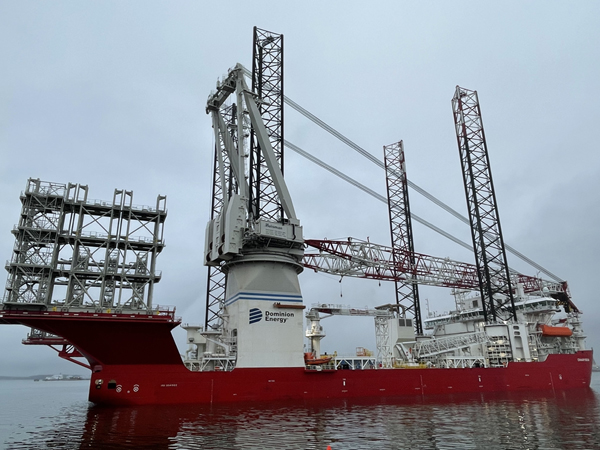
Charybdis is one of the largest vessels of its kind (Dominion Energy)
With the arrival of the ship in Virginia, CVOW moves into its next phase and is anticipated to begin delivering its first electrons to the grid in just a few months, early 2026. The company reports the project is at approximately the 60 percent mark in its installation.
Work has been completed for the installation of 168 of the monopile foundations, as well as 59 of the transition pieces, for a total of 176 turbines. The first of three offshore substations has also been installed, while the deepwater offshore export cables have also been installed. Work is currently underway on the near shore offshore export cables and the inter-array cables. Onshore, work is 93 percent complete for the electric transmission installation.
Construction of the offshore wind farm remains on schedule for completion in late 2026. It will be the largest U.S. offshore wind farm with a total of 176 Siemens Gamesa 14 MW turbines and a total capacity of 2.6 GW.
Connecticut and Rhode Island Seek Injunction to Restart Revolution Wind
The attorneys general from Connecticut and Rhode Island asked a court on Wednesday for a preliminary injunction against the stop work order imposed on Ørsted’s Revolution Wind offshore wind project. They called the actions by the Trump administration “abrupt and arbitrary,” saying that the states would face “immediate and irreparable harm” if the work did not resume immediately.
Nearly two weeks ago, the states also filed suit in Rhode Island against the stop work order, which was issued on August 22. Their actions are in addition to a suit filed in Washington, D.C. by the project developers. The states are arguing for a preliminary injunction while the legal cases are resolved. They highlight that work has now been stopped for nearly a month on a project that is 80 percent complete.
The target date for completion of the project was November 2026. A project engineer for Ørsted, however, has said that if the delays continue, completion would be delayed at least till January 2027. The states highlight that Revolution Wind has contracts and obligations to the utility companies in Rhode Island and Connecticut. They said the first deadline is December 31, 2026.
“We have no time to waste in getting Revolution Wind back online, which is why we’re asking the Court to put a stop to this in short order,” said Rhode Island Attorney General Neronha. He highlights union workers who have been sidelined, as well as saying that companies are now reluctant to pursue economic ventures due to the uncertainty created by the stop work order. He also cites rising and increasingly unstable energy costs.
Connecticut Attorney General Tong also said the “nonsensical stop work order” is causing both immediate and irreparable economic and environmental harm to Connecticut. “Every day that Revolution Wind sits mothballed in the ocean is another day of unemployment, another day of unaffordable energy costs, and another day burning fossil fuels when clean, affordable, American-made energy is within our sights,” said Tong.
Rhode Island Governor Dan McKee reports that he wrote to the Interior Secretary Doug Burgum on September 3 to outline the status of the project and issues for the states. He requested a face-to-face meeting with Donald Trump to negotiate a resolution. The governor said he does not think the administration “fully understands the consequences of what they are doing here.” He has not received a response to the meeting request.
The U.S. Department of Justice, on September 16, made its first court filing responding to the legal challenges to the stop work order. It contends that the project “failed to reach an agreement with the Defense Department on measures to mitigate impacts from electromagnetic emissions and fiber-optic sensors.”
A report in the Rhode Island Current newspaper highlights that the project received its final federal approvals in November 2023 after years of federal review. However, it was given an extension and a further delay till July 2025 to submit a plan for minimizing interference with federal marine fisheries surveys. It was also working with the Department of Defense on a 2024 agreement to deconflict the project with national defense interests. However, they were not required to submit additional documents to DoD, and it is pointed out that DoD in 2020 had no objections to the project.
After imposing the stop work order, the administration has said it would also seek to challenge other permits issued during the Biden administration. It has filed court challenges to Maryland’s first offshore wind farm and a planned future project for Massachusetts. It permitted New York’s Empire Wind to restart after stopping work for a month in April, leaving Revolution Wind as the only largely installed (or operational) offshore wind farm that the administration is challenging.
New Zealand to Clarify Conflict Between Offshore Wind and Seabe Mining
The government of New Zealand reports that it will be taking steps to encourage the development of its offshore energy and natural resources. It plans to revise legislation to resolve potential conflicts between offshore wind energy development and seabed mining as a key step to permit both sectors to proceed.
“New Zealand has some of the world’s greatest offshore wind potential, offering a significant opportunity to generate economic growth while powering our homes and businesses," said Energy Minister Simon Watts. “Offshore wind requires a significant upfront investment. That’s why we are establishing a clear regulatory regime through the Offshore Renewable Energy Bill that was introduced last year, to give developers the certainty they need to invest and kickstart the sector.”
The industry has been calling for action by the government while the development of key projects has been stalled. BlueFloat Energy, which was seeking opportunities in New Zealand, reportedly wrote the ministers last year saying the country needed to choose between offshore wind and seabed mining. BlueFloat later pulled out of New Zealand.
A partnership between Copenhagen Infrastructure Partners and the government-owned NZ Super Fund, however, has an ambitious project saying it would commit approximately US$3 billion for a wind farm consisting of up to 70 wind turbines to be located 15 to 25 miles off the coast of South Taranaki, at the southwestern side of the North Island, and on the Tasman Sea. The company has set an initial goal of 1 GW while noting the project could be scaled to 2 GW.
New Zealand’s cabinet has agreed to amend draft legislation. According to the minister, the changes will create greater investment certainty for both offshore wind and seabed mining. The reports said it would only impact seabed mining and not the oil and gas sector or existing mineral projects.
“The amendments will enable the government to use secondary legislation to designate specific marine space where permits could be invited for offshore renewable projects while there is a pause on granting new permits for seabed mining under the Crown Minerals Act,” explained Watts. “This is a pragmatic step to address a key concern raised by the industry.”
While the amendments and legislative steps will remove a key hurdle, New Zealand has not yet designated its first areas. Watts, however, said that it is likely to be somewhere in South Taranaki.
The CIP-led partnership, known as Taranaki Offshore Partnership, reports it has already invested heavily in the project. It has undertaken wind measurements and surveys. It anticipates that the wind farm could be in the construction and commissioning phase by 2030. It anticipates it will take three to four years to complete.

No comments:
Post a Comment