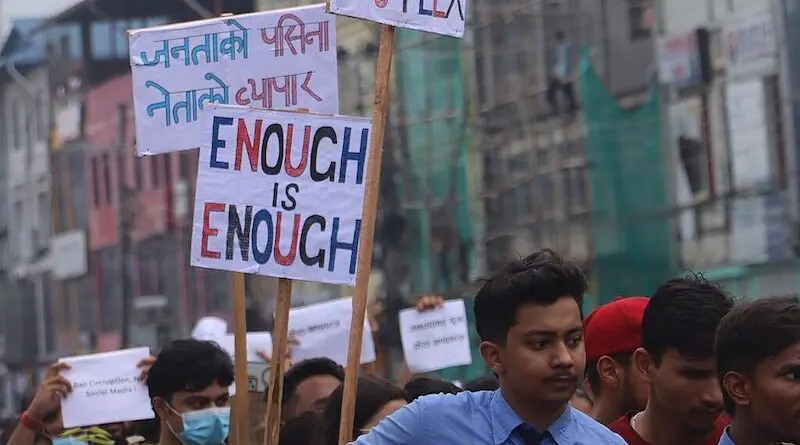
Protest in Nepal. Photo Credit: हिमाल सुवेदी, Wikipedia Commons
October 17, 2025
By Jumel Gabilan Estrañero, Chinalexi Khyle M. Tejada, Ritchel G. Pasadas, Stephanie Louise M. Acedera, Meryxine Kyle P. Zabala and Lian Alistair A. Cordova
For several decades, corruption has existed as a force undermining the economy, depleting the legitimacy of trust and governance, and thus, fueling public resistance movements. This is depicted in the recent protests in Nepal, Indonesia, Bangladesh, and the Philippines, where government failures and economic grievances induce social upheaval to urge for reform and accountability. The commonality across these nations lies in their deep history of corruption within structural, institutional, and cultural frameworks.
Despite several reforms such as decentralization and anti-corruption establishments, corruption remains a tremendous issue, making it far more than an issue of “a few bad apples.” In Nepal, protests initiated by Generation Z[1] activists erupted in mid-July 2025, who are deeply frustrated over the long-standing corruption, inflation, and, particularly, the government-imposed ban on social media. The non-stop rallies and confrontations compelled the resignation of Prime Minister Pushpa Kamal Dahal weeks later in August.
The corruption in Nepal‘s Political Economy is ignited by the instability and fragile governance. They have weak institutional frameworks, political instability, and entrenched patronages when it comes to networks—which causes misuse of resources. The CPI (Corruption Perceptions Index)[2] has consistently ranked Nepal as one of the corrupt countries in South Asia. Nepal’s common forms of corruption include bribery, misuse of development funds, and collisions between the politicians and businessmen. On the other hand, in India, they met with a widespread systemic corruption at multiple levels of government even though they have vigorous democratic institutions and a strong framework[3]. High-profile scams are common in India, and this is where the scale of political corruption has been exposed. In the Philippines, the root cause of corruption in political economy is rooted to political dynasties[4]. It also remained a common practice for vote-buying, nepotism, and misuse of public funds remain common. It hinders the growth of the economy and but harnesses further the weaknesses of the government and economy. All these countries lack transparency, consistency, patronage, and transparency.
Meanwhile, mass gatherings and rallies broke out in Indonesia throughout the beginning of August due to the exposed corruption scandals, including the 2025 Pertamina corruption case, also referred to as “Pertamina Gate,” wherein an oil import embezzlement scheme caused a massive loss of over twelve billion dollars. The Parliamentary Allowances also triggered Indonesian citizens because it was revealed that the House of Representatives (DPR) members were set to receive monthly housing with a stipend of Rp 50 million (around $3,000 USD), which was extremely higher than the average minimum wage in Jakarta. The candidacy of the son of former President Joko Widodo (Jokowi) also sparked controversy because his son was allowed to run for regional office despite not meeting the age requirements for candidates. The public viewed this as nepotism in an attempt at democratic backsliding, where political elites abuse their power for dynastic and personal gain. The Philippines also attains its fair share of ongoing political controversies over the misallocation of funds.
The current notable issue revolving around this is the Flood Control Projects Corruption Scandal, also known as “ghost projects,” wherein hundreds and billions of pesos were washed down the drain by contractors, public officials, including legislators, for personal consumption. Similarly, in the Philippines large-scale protests over anti-corruption and flood control projects with billions allegedly stolen from the Filipino people’s taxes, have majorly led and organized by Filipino youth groups. The public outrage was further enraged due to “nepo-babies” and political elites flaunting their ill-gotten wealth.
These protests have common themes, such as it being majorly youth-led protests and fighting the systemic issue of corruption in their respective governments. It not only echoes the cry for a better system but also exposes the deep-rooted failures of political institutions that have long prioritized elite interests over public welfare. The convergence of youth activism, digital mobilization, and economic frustration marks a pivotal moment in the political economy of South and Southeast Asia—one that demands urgent attention and transformative reform.
Although contexts differ, these protests share a common denominator: systemic corruption[5] and this protest is being led by Gen Z.[6] Their politics does not primarily take place in parliaments or traditional party structures, but in hashtags, memes, livestreams, and decentralized networks that can mobilize thousands within hours.[7] Additionally, according to Hilotin (2025), the further grievance uniting these movements is the glaring persistence of “nepo politics” — the rise of second- and third-generation heirs of corrupt families who continue to dominate public office despite decades of promises of reform, Khan (2025)[8]. Yet while corruption is entrenched, Gen Z movements are reshaping how resistance is organized. In Nepal, 2025 saw a wave of Gen Z-led protests coordinated through Discord and Instagram after revelations of elite enrichment amid economic downturns, Subedi (2025). In Indonesia, students and Gen Z mobilized against attempts to weaken the Corruption Eradication Commission (KPK) and the rollback of democratic safeguards, Harvey (2025). In the Philippines, as revealed by Ratcliffe (2025), on September 21, around tens of thousands of Gen Z Filipinos took to the streets on Sunday to protest versus government corruption after it was alleged that taxpayers have lost billions of dollars to bogus flood control projects.[9]
These protests have common themes, such as it being majorly youth-led protests and fighting the systemic issue of corruption in their respective governments. It not only echoes the cry for a better system but also exposes the deep-rooted failures of political institutions that have long prioritized elite interests over public welfare. The convergence of youth activism, digital mobilization, and economic frustration marks a pivotal moment in the political economy of South and Southeast Asia—one that demands urgent attention and transformative reform.
Analysis, Implications and Some Recommendations
1. Power: Structural Legacies and Weak Institutional.
The structural causes of corruption are rooted in the failure of governments to disseminate reform institutions and allocate funds effectively. There is an apparent parallelism with corruption in Nepal, Indonesia, and the Philippines, wherein it is centralized around the occurrence on the powerful elite controlling the entirety of their government. One should not question “who is in charge,” but “how the system is built to let them keep getting away with it.” The wealthiest and most influential families have historically controlled key positions in the government, and it has been a destructive tool to create laws and policies that only benefit them and unfairly profit from national resources or public money. For instance, in the Philippines, the elite historically used political power, exemplified by the late Ferdinand Marcos, through the plunder of crony capitalism (“cryonism”), granting “behest loans” using public funds to establish numerous empires. While in Indonesia, powerful networks under the Suharto regime persist in controlling access to the natural resources of the country, wherein they also manipulate the government subsidies and agreements for private profit. Besides the power elite playing games, the problem also lies in the weak structure of many local district-level government institutions.
Moreover, the persistence of corruption in countries of Nepal, Indonesia, and the Philippines cannot be separated from the entrenched political dynasties and oligarchic structures that dominate state institutions. From a political economy lens, these elites treat governance as a marketplace of rents, where political power is used to extract resources, distribute patronage, and preserve family wealth. For Generation Z[10], the visible rise of “nepo babies” or the heirs of established political clans, has become a symbol of systemic injustice. The anger is fueled by the contrast between inherited privilege and the lived reality of precarity among the citizens where access to decent jobs, affordable education, and housing remains limited. This structural imbalance explains why protests are not just reactive to scandals but are expressions of generational disillusionment against a state captured by dynastic and oligarchic interests.
From here, we can learn that the corrupt environment is fostered by highly regulated economies that create monopolies, weak legal institutions, and easily manipulated laws, where the benefits of corruption outweigh the risks. Politics is often treated as a business, leading to the normalization of corrupt practices. Specific examples include collusion in the Philippines to secure funds for overpriced or non-existent “ghost” projects, and the appointment of individuals to government posts in which the perceived closeness to power becomes an “invaluable asset” for securing business contracts and preferential treatment.
At this juncture, anti-corruption reform must move beyond slogans and ad hoc investigations. In Nepal, Indonesia, and the Philippines, this means enforcing genuine checks on dynastic succession (through enforceable anti-dynasty provisions, campaign finance transparency, and stricter wealth disclosure laws), while simultaneously professionalizing bureaucracies through merit-based recruitment and career protections. These reforms ensure that state institutions are not permanently captured by family networks and partisan loyalties. Long-term sustainability depends on embedding accountability mechanisms in everyday governance rather than episodic “clean-up” drives.
2. Profits: Rent-Seeking and Natural Resources.
The operation for illegal profits, transforming state power into private gain, is often through “rent-seeking” in sectors that are rich in resources, an ongoing circumstance that is manifested in Nepal, Indonesia, and the Philippines. One case perfectly exemplifies this, which is Nepal’s “AAR Corporation Bribery Case”. Between 2015 and 2020, AAR Corp., an American aviation firm, paid bribes to high-ranking Nepali officials via intermediaries in order to secure a fraudulent commercial deal for the sale of two Airbus A330-200 aircraft to the state-owned Nepal Airlines firm. Furthermore, in Indonesia, politically inclined networks also extract wealth from public funds generated by natural resources like gas, mining, timber, and oil. In the Philippines, illicit profit is also measured by a major economic cost, with the country losing at least twenty (20) percent of its national budget every year through graft and corruption, including disposition of public assets, bribery, and extortion.
3. Protests: Dialectic of Anti-Corruption Mobilization.
3. Protests: Dialectic of Anti-Corruption Mobilization.
Mass rallies or protests are not merely reactions to corruption but are substantial to the political pavement to a promising and effective change. In retrospect on the political history of the Philippines, it is heavily characterized by a constant dialectic, where most corruption scandals are encountered by powerful anti-corruption movements that strive for political change, making citizens less and less tolerant of corruption over time.
However, this moral progress carries a hidden risk: the rise to popularity of anti-corruption “fundamentalism,” a reform agenda often led by the elite that perceives corruption in legalistic terms, where it is disconnected from the day-to-day economic struggles and structural realities of the Filipino society. When this idealistic “politics-as-it-should-be” fails to deliver tangible improvements to ordinary individuals, it induces deep cynicism about the entire democratic process. This mistrust creates an abyss that is swiftly filled by populist strong leaders (a trend seen with figures like Duterte and Marcos Jr.) who promise “strong governance”, rapid, effective results, over the slow, transparent process of “clean and genuine good governance,” ultimately leading to the rejection of democratic norms, hence risking the very democratic foundations the anti-corruption fight was meant to protect in the first place.
Recognize Gen Z as long-term partners in governance by granting them formal roles in oversight councils, participatory budgeting, and youth commissions with decision-making powers. At the same time, governments must address youth precarity through job creation, education reforms, and support for youth-driven industries. This dual approach transforms protest energy into constructive engagement while tackling the structural inequalities that fuel disillusionment.
4. Digital Transparency and Civic Accountability Ecosystems.
However, this moral progress carries a hidden risk: the rise to popularity of anti-corruption “fundamentalism,” a reform agenda often led by the elite that perceives corruption in legalistic terms, where it is disconnected from the day-to-day economic struggles and structural realities of the Filipino society. When this idealistic “politics-as-it-should-be” fails to deliver tangible improvements to ordinary individuals, it induces deep cynicism about the entire democratic process. This mistrust creates an abyss that is swiftly filled by populist strong leaders (a trend seen with figures like Duterte and Marcos Jr.) who promise “strong governance”, rapid, effective results, over the slow, transparent process of “clean and genuine good governance,” ultimately leading to the rejection of democratic norms, hence risking the very democratic foundations the anti-corruption fight was meant to protect in the first place.
Recognize Gen Z as long-term partners in governance by granting them formal roles in oversight councils, participatory budgeting, and youth commissions with decision-making powers. At the same time, governments must address youth precarity through job creation, education reforms, and support for youth-driven industries. This dual approach transforms protest energy into constructive engagement while tackling the structural inequalities that fuel disillusionment.
4. Digital Transparency and Civic Accountability Ecosystems.
Given Gen Z’s digital activism, governments should harness technology to institutionalize transparency, for instance, even though existing but REQUIRED AND UPDATED e-governance platforms that make public budgets, procurement, and contracts fully accessible. At the same time, states must protect online freedoms and resist the temptation to weaponize disinformation against young activists. On a broader scale, regional bodies like ASEAN and SAARC should promote harmonized anti-corruption frameworks, share best practices, and include youth voices in regional policymaking. By embedding reforms in both domestic and regional political economies, governments can demonstrate genuine commitment to accountability and inclusivity, addressing not only the anger of the present but also the sustainability of democratic legitimacy in the future.
5. Credentials and Furtherance of Fangs of Law and Order.
5. Credentials and Furtherance of Fangs of Law and Order.
The requirements in joining the government or obtaining a political position should be changed. Strict implementation of specific requirements should be done to avoid leaders who are incapable of running the country. This is also to avoid corruptions and political dynasties—which is already in the constitution but failed to establish.
Also, the Philippine government can create citizen-led oversight councils, including youth representatives, to monitor public spending and corruption investigations. These councils should review audit findings and procurement data, recommend policy changes and flag irregularities, and serve as liaisons between civil society and anti-corruption bodies.
On one hand, we can push for the implementation of a Robust (Influence Peddling) Law. This policy is to specifically target and dismantle the informal yet powerful system where being influential or close to the powerful is an “invaluable asset” that facilitates corruption. Introduce a new law that criminalizes influence peddling. This legislation would make it illegal for any individual to leverage their perceived closeness to power to secure “contracts, licenses, tax cuts and other forms of preferential treatment”. This policy directly targets the normalized behavior where “politics is treated as business,” making it riskier for politicians and their ‘nepo babies’ to shamelessly use their positions for personal enrichment.
Also, the Philippine government can create citizen-led oversight councils, including youth representatives, to monitor public spending and corruption investigations. These councils should review audit findings and procurement data, recommend policy changes and flag irregularities, and serve as liaisons between civil society and anti-corruption bodies.
On one hand, we can push for the implementation of a Robust (Influence Peddling) Law. This policy is to specifically target and dismantle the informal yet powerful system where being influential or close to the powerful is an “invaluable asset” that facilitates corruption. Introduce a new law that criminalizes influence peddling. This legislation would make it illegal for any individual to leverage their perceived closeness to power to secure “contracts, licenses, tax cuts and other forms of preferential treatment”. This policy directly targets the normalized behavior where “politics is treated as business,” making it riskier for politicians and their ‘nepo babies’ to shamelessly use their positions for personal enrichment.
Conclusion and Way Ahead
In a nutshell, if corruption committed by the politicians that the public trusts to serve them is equated to business and protests their action is considered as violence, is it still a society that the people should dream of living in? And when the same is happening to neighboring countries but they manage to overturn it step-by-step, yet ours remain in the same position we were years ago– what does that say about the people? Justice that caters to one group of people alone is not justice; it is a self-serving policy that protects those who commit injustice.
The political economy nexus of corruption in Nepal, Indonesia, and the Philippines exemplified cycle where weak institutional Power facilitates massive Profits through illicit rent-seeking, fueling mass Protests. While these protests demonstrate a catalyst for change, accountability in office and effective reforms shall be implemented. The ultimate challenge is to bridge the border between the moral demands of clean government and the practical, daily needs of the people.
Indeed, these substantive protests reflect a broader crisis in the political economy, where the youth are excluded from decision-making, economic opportunities are monopolized by elites, and institutions lack accountability. At larger end, the convergence of economic despair and digital mobilization has transformed youth from passive observers to active agents of change.
*Ideas and/or views expressed here are entirely independent and not in any form represent author’s organization and affiliation.
About the author:
Jumel G. Estrañerois a defense, security, & political analyst and a university lecturer in the Philippines. He worked in the Armed Forces of the Philippines, Office of Civil Defense, National Security Council-Office of the President, and currently in the Department of the National Defense. He is currently teaching in De La Salle University Philippines while in the government and formerly taught at Lyceum of the Philippines as part-time lecturer.
Chinalexi Khyle M. Tejada is a Political Science major in De La Salle University, and Senior Officer of Pre-Law Debate Society. She is specializing in international relations, Cross Strait relations, and regionalism.
Chinalexi Khyle M. Tejada is a Political Science major in De La Salle University, and Senior Officer of Pre-Law Debate Society. She is specializing in international relations, Cross Strait relations, and regionalism.
Ritchel G. Pasadas is a Political Science major in De La Salle University, and President of the Political Science Program Council. She is specializing in Southeast and MENA Region area studies as well as human rights.
Stephanie Louise M. Acedera is an International Development Studies major in De La Salle University, Senior Diplomat in Lasallian Student Ambassadors and specializing in post-structural feminism and power politics, gender and development, pop culture, and diplomacy.
Meryxine Kyle P. Zabala is a International Development Studies major in De La Salle University, Senior Committee Officer in Lasallian Student Ambassadors and specializing in international law, migration studies, and diplomacy.
Lian Alistair A. Cordova is Political Science major in in De La Salle University, Deputy Executive Secretary in University Student Government (8th Congress), international law debater while being the OIC-Executive Director of Pre-Law Debate Society. She is specializing in American and European politics and gender issues. She also represented the university in Xi Global Leadership Program with other international student leaders across the region.
Endnotes:
[1] Generation Z (born between 1996 to 2012) has often been described as the “digital native” generation. Unlike earlier cohorts, they came of age in an era dominated by smartphones, social media, and online platforms. This technologically adept generation has emerged as a formidable force, challenging authoritarianism, corruption, and economic inequality.
And recently, across Asia, Gen Z has been taken to the streets and digital platforms to demand political accountability, economic opportunities, and an end to entrenched corruption. From stormed palaces in anti-corruption marches in Jakarta and Kathmandu, a growing wave of youth activism, and now in Philippines, is reshaping the political landscape. In Nepal and Indonesia, Gen Z has mobilized against weakening democratic safeguards and elite enrichment, while in the Philippines they have spearheaded online activism against dynastic rule, disinformation, and human rights abuses specially with the funds from the taxes of the Filipinos being use for personal gained.
Due to the influence of Generation Z, a big consumer generation born between the mid-1990s and the early 2010s, marketing techniques have gotten more complex in the current digital landscape. Because of their proficiency with technology and distinctive purchasing habits, this generation, known as “digital natives,” offers marketers both special chances and challenges.
[2] Corruption Perceptions Index is an index that keeps track of the scores and ranks of each country by their perceived levels of public sector corruption. It defines corruption as and “abuse of entrusted power for private gain.”. It is annually published by the Transparency International ever since 1995.
[3] Central Vigilance Commission is and Indian governmental body which was created in 1964 to address corruption, and Lokpal Act is an anti-corruption in India to provide for greater transparency and accountability when it comes to governance.
[4] Political Dynasty is when multiple members of a family is involved in politics—particularly electoral politics. Despite having the Article II Section 26 of the 1987 Constitution, also known as the anti-political dynasty law, it is still a common practice and the bill itself is ignored by politicians.
[5] These countries are facing similar crises, rooted in the same issues: growing economic hardship, the decline of democratic and civic rights, and the failure of governments to hold themselves accountable to their people. Farmers are denied decent living, young people are denied a voice, and everyday communities are left to bear the weight of corruption, increasing costs, and oppressive measures.
[6] Aggrawal, Bhojwani and Ganglani (2025) states that the driving force of young people who are furious over a lack of jobs, rampant corruption and rising economic inequality as they are being forced into precarious types of employment, including young people with education, and they are now angry and feel unprotected or feel that their futures are not secure.
[7] In September 2025, Nepal was rocked by its most intense political unrest in decades. What began as a government-imposed ban on 26 social media platforms quickly ignited a nationwide movement, with thousands of young Nepalis – proudly calling themselves Gen Z – pouring into the streets of Kathmandu, Pokhara, and other major cities.1 Their anger was not just about the ban; it reflected years of frustration over corruption, nepotism, shrinking opportunities, and an unresponsive political class.
[8] As stated by Ahmer Khan (2025), “everybody wanted a change. We knew the country was ruined by corruption and governance.
[9] “I feel bad that we wallow in poverty and we lose our homes, our lives and our future while they rake in a big fortune from our taxes that pay for their luxury cars, foreign trips and bigger corporate transactions,” student activist Althea Trinidad told The Associated Press news agency.
[10] Gen Z’s mobilization reflects a deeper critique of how the political economy systematically excludes them from decision-making while expecting them to bear the economic burdens of misgovernance. High youth unemployment in Nepal, the rollback of anti-corruption institutions in Indonesia, and the consolidation of dynasties in the Philippines all feed into a shared narrative of betrayal by leaders who inherited power rather than earned it. Yet, unlike past generations, Gen Z leverages digital platforms to create decentralized networks of resistance, circumventing traditional gatekeepers like political parties and mainstream media. Their protests highlight how corruption is not only an economic drain but also a generational theft of opportunities, intensifying the sense of political alienation. Thus, Gen Z experiences the political economy of corruption both materially, through shrinking opportunities, and symbolically, through the domination of elites who pass power within their families.

Jumel Gabilan Estrañero
Jumel Gabilan Estrañero is a defense, security, & political analyst and a university lecturer in the Philippines. He has completed the Executive Course in National Security at the National Defense College of the Philippines and has participated in NADI Track II discussions in Singapore (an ASEAN-led security forum on terrorism). His articles have appeared in Global Security Review, Geopolitical Monitor, Global Village Space, Philippine Daily Inquirer, Philippine Star, Manila Times, Malaya Business Insights, Asia Maritime Review, The Nation (Thailand), Southeast Asian Times, and Global Politics and Social Science Research Network. He worked in the Armed Forces of the Philippines, Office of Civil Defense, National Security Council-Office of the President, and currently in the Department of the National Defense. He is currently teaching lectures in De La Salle University Philippines while in the government and formerly taught at Lyceum of the Philippines as part-time lecturer. He is the co-author of the books titled: Disruptive Innovations, Transnational Organized Crime and Terrorism: A Philippine Terrorism Handbook, and Global Security Studies Journal (Springer Link, United States). He is an alumnus of ASEAN Law Academy Advanced Program in Center for International Law, National University Singapore and Geneva Centre for Security Policy, Switzerland. He is also a Juris Doctor student.


No comments:
Post a Comment