US sinks international plan to cut shipping emission's
An international vote to approve a global plan to cut maritime emissions was postponed for a year Friday, marking a win for the United States, which opposed the carbon-cutting scheme amid sharp divisions among member countries.
Issued on: 17/10/2025 -
By: FRANCE 24
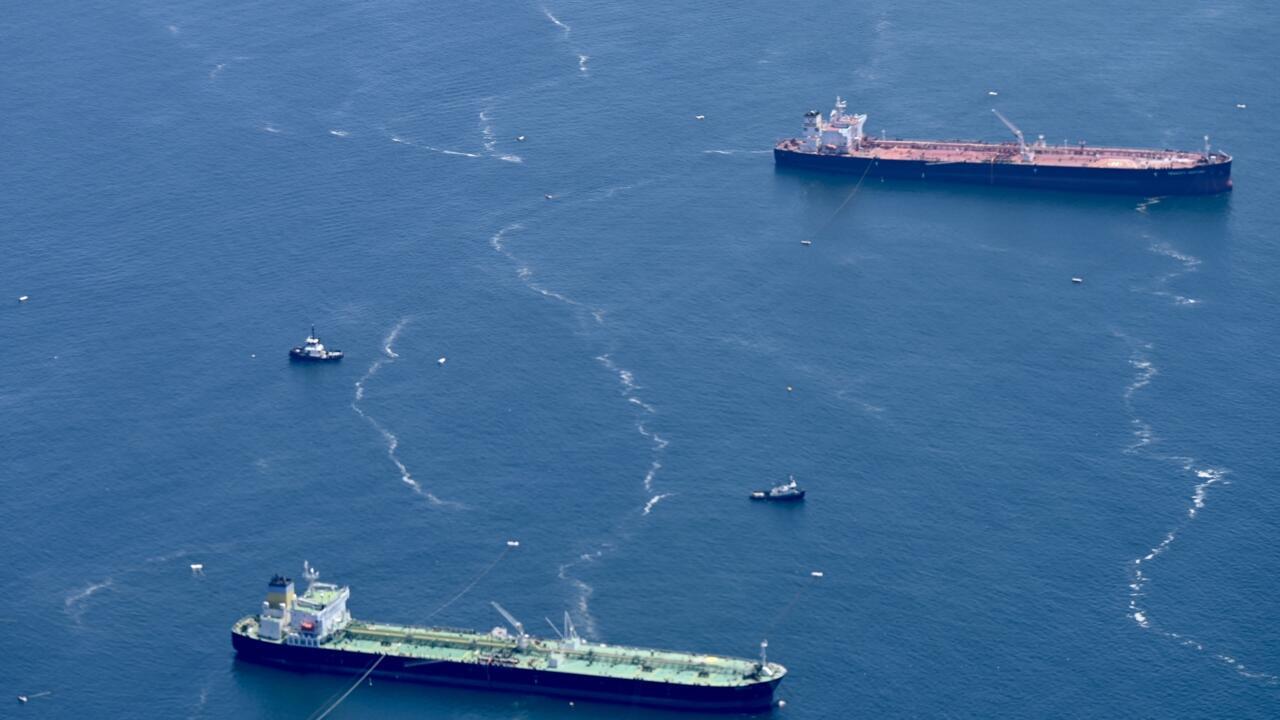
An international vote to formally approve cutting maritime emissions was delayed by a year Friday, in a victory for the United States which opposes the carbon-cutting plan.
The London-based International Maritime Organization (IMO), which is the shipping body of the United Nations, voted in April for a global pricing system to help curb greenhouse gases.
But a vote on whether to formally approve the deal was cancelled on Friday until next year after US President Donald Trump threatened sanctions against countries backing the plan.
Increased divisions, notably between oil producing nations and non-oil producers, emerged this week at meetings leading up to Friday's planned follow-up vote to approve the scheme.
Delegates instead voted on a hastily-arranged resolution to postpone proceedings, which passed by 57 votes to 49.
Trump on Thursday said the proposed global carbon tax on shipping was a "scam" after the United States withdrew from IMO negotiations in April.
A Russian delegate described proceedings as "chaos" as he addressed the plenary Friday after talks had lasted until the early hours.
Russia joined major oil producers Saudi Arabia and the United Arab Emirates in voting against the carbon-reduction measure in April, arguing it would harm the economy and food security.
IMO Secretary-General Arsenio Dominguez, representing 176 member states, pleaded Friday that he hoped there would be no repeat of how the week's discussions had gone.
"It doesn't help your organisation, it doesn't help yourself," he told delegates.
Trump 'outraged'
Since returning to power in January, Trump has reversed Washington's course on climate change and encouraged fossil fuel use by deregulation.
"I am outraged that the International Maritime Organization is voting in London this week to pass a global Carbon Tax," Trump wrote on his Truth Social platform Thursday.
"The United States will NOT stand for this Global Green New Scam Tax on Shipping," he added, urging countries to vote against it.
Washington threatened to impose sanctions, visa restrictions and port levies on those supporting the Net Zero Framework (NZF), the first global carbon-pricing system.
Liberia and Saudi Arabia called for Friday's vote to be postponed.
"We agree with the United States that it's important that these conversations are brought to light," a Saudi representative said.
Ahead of this week's London gathering, a majority 63 IMO members that in April voted for the plan had been expected to maintain their support and to be joined by others to formally approve the NZF.
Argentina, which in April abstained from the vote, now opposes the deal.
Leading up to Friday's decision – China, the European Union, Brazil, Britain and several other members of the IMO – reaffirmed their support.
The NZF requires ships to progressively reduce carbon emissions from 2028, or face financial penalties.
Shipping accounts for nearly three percent of global greenhouse gas emissions, according to the IMO, while the CO2 pricing plan should encourage the sector to use less polluting fuels.
The Philippines, which provides the most seafarers of any country, and Caribbean islands focused on the cruise industry, would be particularly impacted by visa restrictions and sanctions.
The plan would charge ships for emissions exceeding a certain threshold, with proceeds used to reward low-emission vessels and support countries vulnerable to climate change.
Pacific Island states, which abstained in the initial vote over concerns the proposal was not ambitious enough, had been expected to support it this time around.
If the global emissions pricing system was adopted, it would become difficult to evade, even for the United States.
IMO conventions allow signatories to inspect foreign ships during stopovers and even detain non-compliant vessels.
(FRANCE 24 with AFP)
Trump’s Policy Pivot Could Leave the Energy Transition Dead in the Water
.png)
Since President Trump took office, the U.S. has rolled back subsidies and support for renewables, leading to over $19 billion in canceled wind and solar projects.
- Analysts at DNV say Trump’s policies will only delay, not derail, global decarbonization.
- Despite global efforts, net-zero progress is stalling.
Since President Trump took office, several associations set up to advance the agenda of net-zero in the financial world have dissolved, and wind and solar developers have pleaded for help to survive. Even carmakers have quietly revised their plans for an electric future—not only in the U.S.
This policy shift has led to massive project cancellations, with a staggering $22 billion worth of clean energy projects being nixed in the first half of 2025 alone, according to analysts.
Additionally, the Department of Energy (DOE) recently terminated $7.56 billion in financial awards for hundreds of clean energy projects, citing a lack of economic viability. Despite this dramatic reversal in federal support, many still believe Trump’s presidency cannot stop the shift to alternative energy sources and emission-cutting.
Subsidies Pulled From Renewable Projects
Many have, in fact, been saying that whatever happens in the United States, the rest of the world would remain firmly on the path to decarbonisation because it is the only path that makes sense and ensures affordable and reliable energy, at some point in the distant future. For the time being, the alternative energy intended to replace hydrocarbons still requires significant support from governments in the form of subsidies and special legislation aimed at encouraging its growth.
Related: Saudi Aramco: Underinvestment Could Lead to Oil Supply Crunch
What Trump has done in the U.S. is remove a lot of that support, essentially leaving industries such as wind and solar power, and electric vehicles, to try and survive on their own, without the crutches of government help. It seems this is not the easiest thing. Indeed, since Trump took office, some $19 billion worth of wind and solar projects have been canceled, consultancy Atlas Public Policy reported in August.
The China Paradox and DNV's Optimism
Norwegian consultancy DNV, however, says that what the U.S. does with its energy policy would only have a marginal effect on the rest of the world in terms of transition progress. All that Trump’s second term in office would do is delay the emission decline that would have otherwise taken less, DNV said in a report this week. Meanwhile, China continues breaking records in wind and solar deployment, the consultancy went on to say, noting that it has this year accounted for 56% of new solar capacity additions and 60% of new wind capacity globally.
It may be interesting to note here that China’s emissions have been surging since the start of the new millennium, with the annual total of 2001 at 2.92 tons per capita, rising to 8.37 tons per capita by 2023. What’s more, China’s emissions continued rising strongly while it was deploying record amounts of wind and solar capacity and only stopped growing this year, at least according to Carbon Brief. The net-zero advocacy reported earlier this year that China’s emissions of carbon dioxide fell by 1.6% on the year over the first quarter of 2025 and by 1% over the 12 months to May 2025.
DNV sounded a note of confidence in its report, with the company’s group CEO saying that “The global energy transition is not stalling — it is evolving, with momentum shifting to regions that are doubling down on clean technologies. Security has become the dominant driver of energy policy, and as our forecast shows, this is in sum accelerating the shift to renewables.”
Global Targets Slip Off Course
The progress of the transition in one of the most pro-transition parts of the world—Europe—is stalling, despite the doubling down on net-zero targets and priorities. Some have blamed the effect of the U.S. tariffs, others point to supply chain problems, and many blame insufficient grid upgrade investments and red tape but the fact remains that the shift from oil and gas to wind and solar is slowing down—not only in Europe.
The International Renewable Energy Agency reported earlier this month that global net-zero progress has stalled. Global renewable capacity additions hit 582 GW in 2024, but the so-called UAE Consensus goal of 11.2 TW of renewable capacity by 2030 now implies that annual additions must reach 1.122 TW per year from 2025 onward, which would be a sustained growth rate of 16.6% annually. It would also be impossible to do, based on current wind and solar progress.
So, it seems that the United States’ pivot away from decarbonisation has had something of a ripple effect across the world. But more than that, it seems that those transition critics who called decarbonisation targets unrealistic were right.
By Irina Slav for Oilprice.com

No comments:
Post a Comment