US Expands Sanctions on Iran’s Energy Trade Snaring Wide Array of Companies
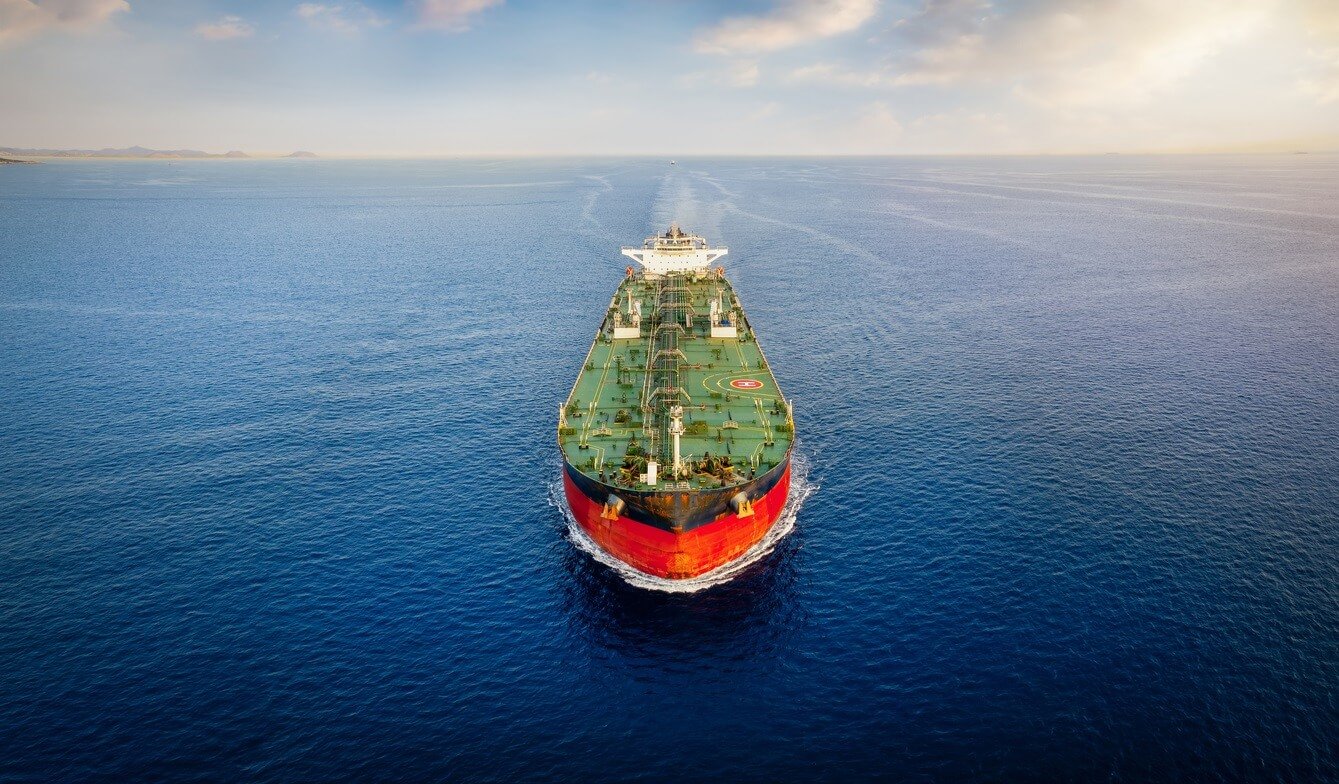
The United States expanded its sanctions against Iran’s energy trade with coordinated actions by both the State Department and the Treasury. The efforts continue to increase the reach beyond Iranian operations to target the front companies and enablers of the energy trade, as well as tankers being used for the shipments.
The Trump administration highlights that it has sanctioned over 170 vessels responsible for shipping Iranian crude and petroleum products. In addition to going after international companies, it also expanded the sanctions to increase the actions against Iranian airline Mahan Air. It says the airline has been used to arm and supply Iran’s proxy groups.
The Treasury’s Office of Foreign Assets Control (OFAC) said its focus was on a network of front companies and shipping facilitators that bankroll the Iranian armed forces by selling crude oil. It contends that Iran has increasingly come to rely on the sale of its crude oil to supplement its annual budget and finance the rebuilding of its “depleted forces” after the war with Israel and the U.S. bombing earlier this year.
OFAC listed six additional vessels, some of which it says have been chartered by the various front companies to deliver the oil or conduct ship-to-ship transfers. It included vessels registered in Palau, Gambia, and Panama, used both for crude shipments and petroleum products, including liquified petroleum gas (LPG).
One vessel alone, Palau-registered Pioneer Sam (69,629 dwt), they allege has transported more than 30 shipments over the past two years, moving over 10 million barrels of Iranian fuel oil. They contend these tankers are moving crude and LPG to customers in East and South Asia, including Pakistan and Bangladesh.
At the center of the network, they said, is a company, Sepehr Energy Jahan, that is linked to the Armed Forces General Staff. Treasury associated the company to charterers and others in the UAE, a Panama-based shipping company, and others. Expanding the efforts, it also listed Germany-based trading company BPT Berlin Petroleum Trading, which is alleged to have arranged shipments via STS near Malaysia, and a Greek shipping company, Altomare, which it says chartered the Panama-flagged tanker Kallista to the front companies. They contend this vessel transported nearly four million barrels of oil on behalf of Sepehr Energy Jahan.
Concurrently, the State Department designated 17 entities, individuals, and vessels, which it said were all linked to the Iranian energy trade. It said that the previously listed Iranian Ministry of Petroleum, Iranian Oil Company, and National Iranian Tanker Company continue to rely on third-country service providers. State listed a maritime service provider in Singapore, ANBO Shipping also based in Singapore, and individuals in Singapore. It also designated a Marshall Islands-based shipping company and manager, and another company based in Vietnam, which manages two vessels. Another company is a commercial manager based in the UAE.
Among the vessels included by the State Department are two crude tankers flagged in Vietnam and a Comoros-flagged vessel.
The announcement of the sanctions came as Bloomberg reported that the U.S. Navy has used one of its destroyers deployed to the Caribbean to block the route of a sanctioned tanker bound for Venezuela. That tanker has been linked in the past to the Iranian trade and supplying Venezuela, as well as carrying products from Russia.
Since returning to the presidency in January 2025, Donald Trump has moved aggressively against the Iranian oil trade. The administration launched sanction packages against Iran in February and again in May.
Iranian Navy Loitering in Bandar Abbas Harbor
On a visit earlier this month to the headquarters of the IRGC Navy's 2nd Naval District in Bushehr, Deputy Chief of the Armed Forces Brigadier General Ahmad Vahidi stated that the presence of Iranian naval forces on Iran's maritime borders “instills such fear in enemies that they do not even dare to look sideways at these waters and lands.” During his visit, Brigadier Vahidi inspected some speedboats and a gallery of IRGC Navy martyrs who have fallen on operations this year.
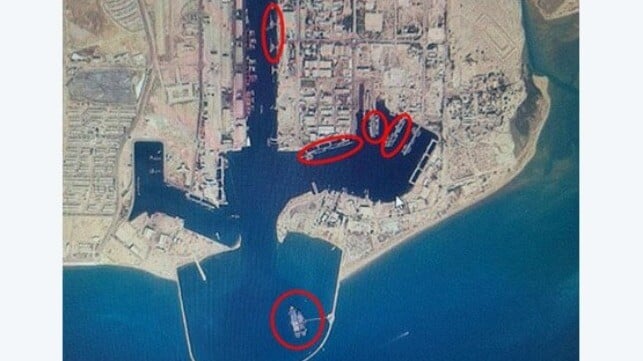
However, satellite imagery of Bandar Abbas Naval Harbor, taken on November 21, shows that most of the principal ships of the Regular Iranian Navy (Nedaja) are tied up in the harbor. All five of the Nedaja’s five operational Alvand and Moudge Class frigates are on dockside berths, as well as the intelligence collection frigate IRINS Zagros (H313).
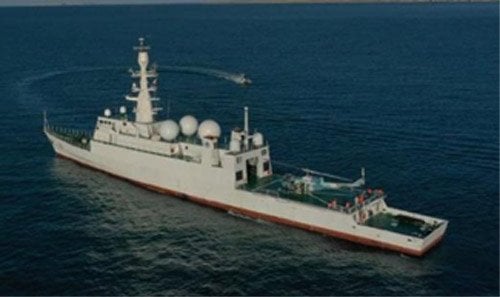
IRINS Zagros (IRNA/Iranian Navy)
Both long-range fleet resupply ships vessel IRINS Makran (K441) and IRINS Kurdestan (K442), are on their permanent pier in the outer basin. Two of the larger logistics vessels often used to support Nedaja deployments, for example to the Red Sea and Gulf of Aden, namely the Hengam Class landing ships (IRINS Tonb (L513) and Lavan (L514) are alongside, with a third vessel of the class, IRINS Larak (L512), still under refurbishment in the floating dry dock close by. Unfortunately, the imagery available is not of sufficient resolution to determine how many of the Nedaja's submarines are in the harbor.
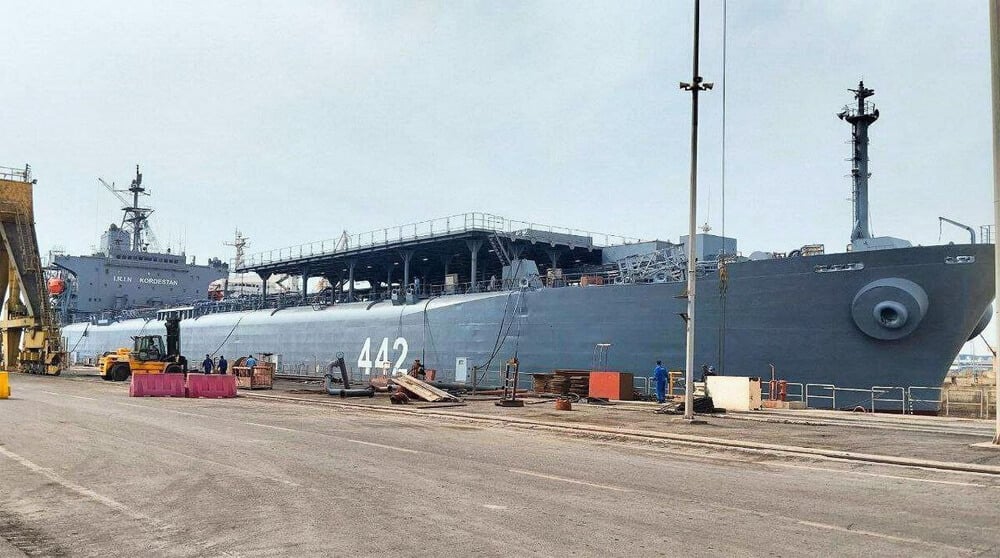
IRINS Kurdestan (K442)(@mhmiranusa)
Since the 12-Day War, the Nedaja has, like this morning, been largely tied up in Bandar Abbas. The permanent presence in the Red Sea and Gulf of Aden, maintained since 2008, has been allowed to lapse, and Maritime Executive has not seen evidence of naval deployments into international waters for many months. With the exception of a small-scale drone and missile firing in August this year, as part of Exercise Sustainable Power 1404, exercise activity has appeared to have ceased, and it remains to be seen if Exercise Maritime Security Belt, the annual joint exercise with Russia and China, takes place during its regular slot in March every year. At a bare minimum, one might expect to see the long-range two-ship training cruise for naval cadets set out, which normally takes place in February.
Such an extended period of inactivity is likely to affect the operational training standards and perhaps sap the morale of the Nedaja commanders and sailors. The inactivity could indeed be a consequence of poor morale within the fleet.
In two unusual recent incidents, uniformed members of Iran's regular armed forces have made public demonstrations against the current regime in Iran, displaying the national flag of Iran as it was before the Islamic Revolution in 1979. One of these demonstrations took place at a Tehran metro station, with a colonel and lieutenant in uniform seen being arrested within 5 minutes of unfurling a pre-1979 flag on the station platform. IRGC Basij internal security forces were also seen rehearsing riot drills in Mashhad on November 15, as authorities prepare for possible internal disturbances likely in the wake of general unrest and nationwide shortages of water in particular.
Iran's President Masoud Pezeshkian's warning that in two weeks Tehran would run out of water has since passed without any rainfall to alleviate the situation, and the President is now saying that moving the capital is essential. On top of shortages of drinking water, the drop in the water table is threatening land subsidence in Tehran - in an area where buildings are already vulnerable to earthquake damage. Without indicating that any finance is available to fulfil such a plan, officials say the intention is to move the capital to the port city of Chah Bahar on the Indian Ocean.

No comments:
Post a Comment