'The enemy within': Donald Trump just launched a new era of witch hunts
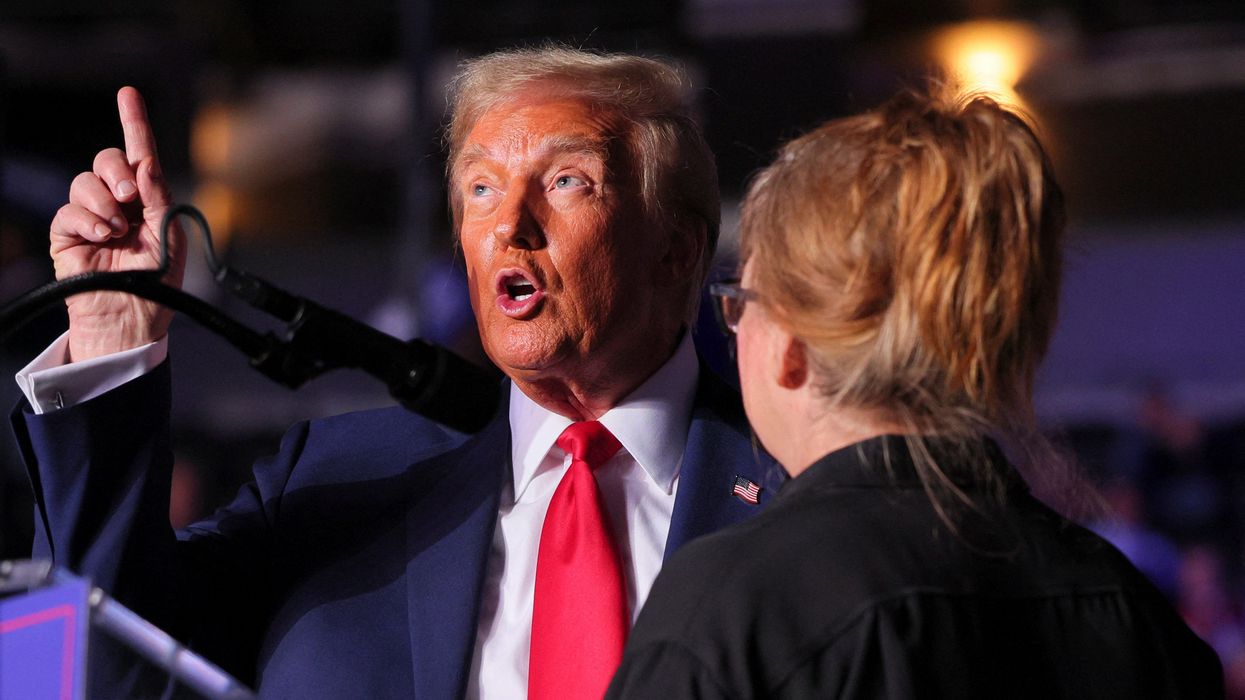
Donald Trump gestures next to Patty Morin, whose daughter Rachel was killed in Maryland last year, during a campaign rally at Santander Arena in Reading, Pennsylvania, U.S., November 4, 2024. REUTERS/Brian Snyder
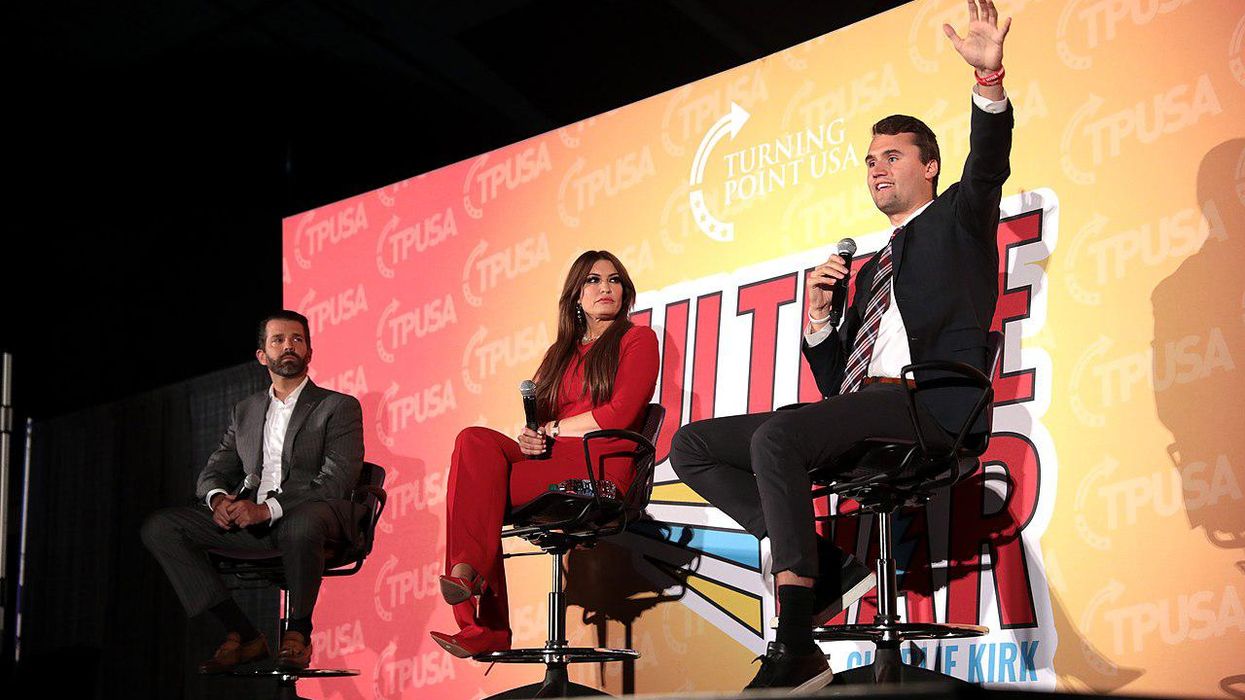
Donald Trump, Jr., Kimberly Guilfoyle and Turning Point USA's Charlie Kirk speaking at Antelope Gymnasium at Grand Canyon University in Phoenix, Arizona in 2019,
Donald Trump gestures next to Patty Morin, whose daughter Rachel was killed in Maryland last year, during a campaign rally at Santander Arena in Reading, Pennsylvania, U.S., November 4, 2024. REUTERS/Brian Snyder
September 20, 2025
A modern-day political inquisition is unfolding in “digital town squares” across the United States. The slain far-right activist Charlie Kirk has become a focal point for a coordinated campaign of silencing critics that chillingly echoes one of the darkest chapters in American history.
Individuals who have publicly criticized Kirk or made perceived insensitive comments regarding his death are being threatened, fired or doxed.
Teachers and professors have been fired or disciplined, one for posting that Kirk was racist, misogynistic and a neo-Nazi, another for calling Kirk a “hate-spreading Nazi”.
Journalists have also lost their jobs after making comments about Kirk’s assassination, as has the late-night television host Jimmy Kimmel.
A website called “Expose Charlie’s Murderers” had been posting the names, locations and employers of people saying critical things about Kirk before it was reportedly taken down. Vice President JD Vance has pushed for this public response, urging supporters to “call them out … hell, call their employer”.
This is far-right “cancel culture”, the likes of which the US hasn’t seen since the McCarthy era in the 1950s.
The birth of McCarthyism
The McCarthy era may well have faded in our collective memory, but it’s important to understand how it unfolded and the impact it had on America. As the philosopher George Santayana once said, “Those who cannot remember the past are condemned to repeat it.”
Since the 1950s, “McCarthyism” has become shorthand for the practice of making unsubstantiated accusations of disloyalty against political opponents, often through fear-mongering and public humiliation.
The term gets its name from Senator Joseph McCarthy, a Republican who was the leading architect of a ruthless witch hunt in the US to root out alleged Communists and subversives across American institutions.
The campaign included both public and private persecutions from the late 1940s to early 1950s, involving hearings before the House Un-American Activities Committee and the Senate’s Permanent Subcommittee on Investigations.
Millions of federal employees had to fill out loyalty investigation forms during this time, while hundreds of employees were either fired or not hired. Hundreds of Hollywood figures were also blacklisted.
The campaign also involved the parallel targeting of the LGBTQI+ community working in government – known as the Lavender Scare.
And similar to doxing today, witnesses in government hearings were asked to provide the names of communist sympathisers, and investigators gave lists of prospective witnesses to the media. Major corporations told employees who invoked the Fifth Amendment and refused to testify they would be fired.
The greatest toll of McCarthyism was perhaps on public discourse. A deep chill settled over US politics, with people afraid to voice any opinion that could be construed as dissenting.
When the congressional records were finally unsealed in the early 2000s, the Permanent Subcommittee on Investigations said the hearings “are a part of our national past that we can neither afford to forget nor permit to reoccur”.
Another witch hunt under Trump
Today, however, a similar campaign is being waged by the Trump administration and others on the right, who are stoking fears of the “the enemy within”.
This new campaign to blacklist government critics is following a similar pattern to the McCarthy era, but is spreading much more quickly, thanks to social media, and is arguably targeting far more regular Americans.
Even before Kirk’s killing, there were worrying signs of a McCarthyist revival in the early days of the second Trump administration.
After Trump ordered the dismantling of public Diversity, Equity and Inclusion (DEI) programs, civil institutions, universities, corporations and law firms were pressured to do the same. Some were threatened with investigation or freezing of federal funds.
In Texas, a teacher was accused of guiding Immigration and Customs Enforcement (ICE) squads to suspected non-citizens at a high school. A group called the Canary Mission identified pro-Palestinian green-card holders for deportation. And just this week, the University of California at Berkeley admitted to handing over the names of staff accused of antisemitism.
Supporters of the push to expose those criticising Kirk have framed their actions as protecting the country from “un-American”, woke ideologies. This narrative only deepens polarisation by simplifying everything into a Manichean world view: the “good people” versus the corrupt “leftist elite”.
The fact the political assassination of Democratic lawmaker Melissa Hortman did not garner the same reaction from the right reveals a gross double standard at play.
Another double standard: attempts to silence anyone criticising Kirk’s divisive ideology, while being permissive of his more odious claims. For example, he once called George Floyd, a Black man killed by police, a “scumbag”.
In the current climate, empathy is not a “made-up, new age term”, as Kirk once said, but appears to be highly selective.
This brings an increased danger, too. When neighbours become enemies and dialogue is shut down, the possibilities for conflict and violence are exacerbated.
Many are openly discussing the parallels with the rise of fascism in Germany, and even the possibility of another civil war.
A sense of decency?
The parallels between McCarthyism and Trumpism are stark and unsettling. In both eras, dissent has been conflated with disloyalty.
How far could this go? Like the McCarthy era, it partly depends on the public reaction to Trump’s tactics.
McCarthy’s influence began to wane when he charged the army with being soft on communism in 1954. The hearings, broadcast to the nation, did not go well. At one point, the army’s lawyer delivered a line that would become infamous:
Until this moment, Senator, I think I never really gauged your cruelty or your recklessness […] Have you no sense of decency?
Without concerted, collective societal pushback against this new McCarthyism and a return to democratic norms, we risk a further coarsening of public life.
The lifeblood of democracy is dialogue; its safeguard is dissent. To abandon these tenets is to pave the road towards authoritarianism.
Shannon Brincat, Senior Lecturer in Politics and International Relations, University of the Sunshine Coast; Frank Mols, Senior Lecturer in Political Science, The University of Queensland, and Gail Crimmins, Associate professor, University of the Sunshine Coast
This article is republished from The Conversation under a Creative Commons license. Read the original article.
A modern-day political inquisition is unfolding in “digital town squares” across the United States. The slain far-right activist Charlie Kirk has become a focal point for a coordinated campaign of silencing critics that chillingly echoes one of the darkest chapters in American history.
Individuals who have publicly criticized Kirk or made perceived insensitive comments regarding his death are being threatened, fired or doxed.
Teachers and professors have been fired or disciplined, one for posting that Kirk was racist, misogynistic and a neo-Nazi, another for calling Kirk a “hate-spreading Nazi”.
Journalists have also lost their jobs after making comments about Kirk’s assassination, as has the late-night television host Jimmy Kimmel.
A website called “Expose Charlie’s Murderers” had been posting the names, locations and employers of people saying critical things about Kirk before it was reportedly taken down. Vice President JD Vance has pushed for this public response, urging supporters to “call them out … hell, call their employer”.
This is far-right “cancel culture”, the likes of which the US hasn’t seen since the McCarthy era in the 1950s.
The birth of McCarthyism
The McCarthy era may well have faded in our collective memory, but it’s important to understand how it unfolded and the impact it had on America. As the philosopher George Santayana once said, “Those who cannot remember the past are condemned to repeat it.”
Since the 1950s, “McCarthyism” has become shorthand for the practice of making unsubstantiated accusations of disloyalty against political opponents, often through fear-mongering and public humiliation.
The term gets its name from Senator Joseph McCarthy, a Republican who was the leading architect of a ruthless witch hunt in the US to root out alleged Communists and subversives across American institutions.
The campaign included both public and private persecutions from the late 1940s to early 1950s, involving hearings before the House Un-American Activities Committee and the Senate’s Permanent Subcommittee on Investigations.
Millions of federal employees had to fill out loyalty investigation forms during this time, while hundreds of employees were either fired or not hired. Hundreds of Hollywood figures were also blacklisted.
The campaign also involved the parallel targeting of the LGBTQI+ community working in government – known as the Lavender Scare.
And similar to doxing today, witnesses in government hearings were asked to provide the names of communist sympathisers, and investigators gave lists of prospective witnesses to the media. Major corporations told employees who invoked the Fifth Amendment and refused to testify they would be fired.
The greatest toll of McCarthyism was perhaps on public discourse. A deep chill settled over US politics, with people afraid to voice any opinion that could be construed as dissenting.
When the congressional records were finally unsealed in the early 2000s, the Permanent Subcommittee on Investigations said the hearings “are a part of our national past that we can neither afford to forget nor permit to reoccur”.
Another witch hunt under Trump
Today, however, a similar campaign is being waged by the Trump administration and others on the right, who are stoking fears of the “the enemy within”.
This new campaign to blacklist government critics is following a similar pattern to the McCarthy era, but is spreading much more quickly, thanks to social media, and is arguably targeting far more regular Americans.
Even before Kirk’s killing, there were worrying signs of a McCarthyist revival in the early days of the second Trump administration.
After Trump ordered the dismantling of public Diversity, Equity and Inclusion (DEI) programs, civil institutions, universities, corporations and law firms were pressured to do the same. Some were threatened with investigation or freezing of federal funds.
In Texas, a teacher was accused of guiding Immigration and Customs Enforcement (ICE) squads to suspected non-citizens at a high school. A group called the Canary Mission identified pro-Palestinian green-card holders for deportation. And just this week, the University of California at Berkeley admitted to handing over the names of staff accused of antisemitism.
Supporters of the push to expose those criticising Kirk have framed their actions as protecting the country from “un-American”, woke ideologies. This narrative only deepens polarisation by simplifying everything into a Manichean world view: the “good people” versus the corrupt “leftist elite”.
The fact the political assassination of Democratic lawmaker Melissa Hortman did not garner the same reaction from the right reveals a gross double standard at play.
Another double standard: attempts to silence anyone criticising Kirk’s divisive ideology, while being permissive of his more odious claims. For example, he once called George Floyd, a Black man killed by police, a “scumbag”.
In the current climate, empathy is not a “made-up, new age term”, as Kirk once said, but appears to be highly selective.
This brings an increased danger, too. When neighbours become enemies and dialogue is shut down, the possibilities for conflict and violence are exacerbated.
Many are openly discussing the parallels with the rise of fascism in Germany, and even the possibility of another civil war.
A sense of decency?
The parallels between McCarthyism and Trumpism are stark and unsettling. In both eras, dissent has been conflated with disloyalty.
How far could this go? Like the McCarthy era, it partly depends on the public reaction to Trump’s tactics.
McCarthy’s influence began to wane when he charged the army with being soft on communism in 1954. The hearings, broadcast to the nation, did not go well. At one point, the army’s lawyer delivered a line that would become infamous:
Until this moment, Senator, I think I never really gauged your cruelty or your recklessness […] Have you no sense of decency?
Without concerted, collective societal pushback against this new McCarthyism and a return to democratic norms, we risk a further coarsening of public life.
The lifeblood of democracy is dialogue; its safeguard is dissent. To abandon these tenets is to pave the road towards authoritarianism.
Shannon Brincat, Senior Lecturer in Politics and International Relations, University of the Sunshine Coast; Frank Mols, Senior Lecturer in Political Science, The University of Queensland, and Gail Crimmins, Associate professor, University of the Sunshine Coast
This article is republished from The Conversation under a Creative Commons license. Read the original article.
This isn't about Charlie Kirk
Donald Trump, Jr., Kimberly Guilfoyle and Turning Point USA's Charlie Kirk speaking at Antelope Gymnasium at Grand Canyon University in Phoenix, Arizona in 2019,
Gage Skidmore
In yesterday’s edition, I explained how telling the truth about a propagandist and liar has been deemed a radical act worthy of punishment. I used the case of novelist Stephen King to illustrate.
King had said Charlie Kirk, who was murdered last week, “advocated for stoning gays to death.” King was speaking the spirit of the truth, if not the precise letter of it, but was nevertheless hounded and harassed into apologizing by rightwingers who not only want to police speech by compel it. You shall honor the saintly demagogue or pay a price.
Unsurprisingly, the dragnet is widening. I woke up this morning to news about late-night television host Jimmy Kimmel being “suspended indefinitely.” (That probably means his show is canceled.) According to the AP, it’s because comments he “made about Charlie Kirk’s killing led a group of ABC-affiliated stations to say it would not air the show and provoked some ominous comments from a top federal regulator.”
What comments?
Before I tell you what Jimmy Kimmel said, it’s important to tell you what other people are saying he said. Why? Because it’s like a sinister game of telephone, and the farther we get from the facts of what he said, the more chances there are for the totalitarians among us to replace reality with lies, making us all liars (not to mention insane).
First, a voice from the right, Piers Morgan: “Jimmy Kimmel lied about Charlie Kirk’s assassin being MAGA. This caused understandable outrage all over America, prompted TV station owners to say they wouldn’t air him, and he’s now been suspended by his employers. Why is he being heralded as some kind of free speech martyr?”
Second, a voice from the left, MSNBC’s Chris Hayes: The ABC affiliates said they would refuse “to air Kimmel’s show, they say, because the comments the late night host made on Monday night relating to the motives of the man who shot and killed Charlie Kirk wrongly suggest[ed] the killer was part of the maga movement. He was not.”
Morgan is wrong. Kimmel didn’t lie. Hayes is wrong, too. Jimmy Kimmel did not suggest “the killer was part of the maga movement.”
Here’s what he said, per the AP:
“The MAGA Gang [is] desperately trying to characterize this kid who murdered Charlie Kirk as anything other than one of them and doing everything they can to score political points from it. In between the finger-pointing, there was grieving.” Also: “Many in MAGA land are working very hard to capitalize on the murder of Charlie Kirk.”
See anything wrong here? I don’t.
Indeed, neither did “multiple executives” at ABC, who, according to Rolling Stone, “felt that Kimmel had not actually said anything over the line.” What they did feel, however, was fear of an unfavorable interpretation of Kimmel’s words. Rolling Stone reported that two sources said “the threat of Trump administration retaliation loomed.”
What retaliation? Hayes reported on it, as did the AP. Just before the Kimmel news broke, the chairman of the Federal Communications Commission, Brendan Carr, issued an open threat to ABC, which is owned by the Walt Disney Company: get rid of Jimmy Kimmel or else.
“This is a very, very serious issue right now for Disney,” Brendan Carr told maga propagandist Benny Johnson. “We can do this the easy way or the hard way. These companies can find ways to take action on Kimmel or there is going to be additional work for the FCC ahead.”
And with that, it’s clear this is no longer about a dead demagogue. It’s about exploiting the memory of a dead demagogue to advance the totalitarian project: to not only police speech but compel it. I expect Kimmel to follow Stephen King’s lead and apologize in time for doing something he did not do, affirming the lie and undermining the truth.
I think the union representing Kimmel’s musicians is right.
“This is not complicated,” said Tino Gagliardi, the president of the American Federation of Musicians. “Trump’s FCC identified speech it did not like and threatened ABC with extreme reprisals. This is state censorship. It’s now happening in the United States of America, not some far-off country. … This act by the Trump Administration represents a direct attack on free speech and artistic expression. These are fundamental rights that we must protect in a free society.”
But I think it’s wrong too. This is complicated.
What’s happening is not just a consequence of government thugs attacking free speech and artistic expression. It’s also the consequences of three decades of corporate consolidation and the near-total lack of antitrust law enforcement. A handful of companies now own media outlets tens of millions use. In the case of the ABC affiliates, two firms – Nexstar and Sinclair – own nearly all of them.
This results in not only an artificially narrow range of information and views, but also a vulnerability on the part of media owners faced with a belligerent government such as the current one. They can stand on free press and free speech grounds and risk the wrath of a criminal FCC, or they can play along. ABC could have chosen to interpret Kimmel’s words in his favor – he didn’t say what critics said he said. Instead, it chose to interpret his words in maga’s favor. It sacrificed Kimmel in the misbegotten hope that doing so will appease them.
It won’t.
I don’t mean ABC won’t get something for failing to take its own side in a fight. (I have no idea what it might gain.) I mean surrendering in advance won’t end well, as we have seen in countries like Hungary and Turkey, where “autocratic carrots and sticks,” as Brian Stelter put it, have led to their respective governments having near-total control of the media. No one in Hungary mocks Viktor Orban. No one in Turkey jokes about Tayyip Erdogan. And that’s what Donald Trump wants.
Jimmy Kimmel isn’t just a comedian. To the president and maga faithful, he represents “the left,” which is to say, anyone who has enough independence of mind to laugh. Indeed, that might be the biggest obstacle to their hostile takeover attempt. If you have the courage to laugh at the reality of the human condition, you don’t need a strongman like Donald Trump to save you from the truth about it.
But courage, like the enforcement of antitrust law, is lacking. It’s one thing for the state to bully private enterprise. It’s another for private enterprise to roll over, because it believes rolling over is its interest.
I’ll end by quoting Dan Le Batard. “Once you’re a coward who is extorted, the bully’s gonna keep extorting” you, the sportswriter and podcaster said today. “When [ABC] gave Trump $16 million on something that [ABC News anchor George] Stephanopoulos said, they opened the doors now to all of media feeling like it needs to capitulate to a threat – and now you get dangerously close to state-run media.”
He added: “I’ve never seen, in my lifetime, America in the position it’s presently in where the media is running this kind of scared from power, as if we’re not a place where one of the chief principles is free speech.”
September 20, 2025
ALTERNET
In yesterday’s edition, I explained how telling the truth about a propagandist and liar has been deemed a radical act worthy of punishment. I used the case of novelist Stephen King to illustrate.
King had said Charlie Kirk, who was murdered last week, “advocated for stoning gays to death.” King was speaking the spirit of the truth, if not the precise letter of it, but was nevertheless hounded and harassed into apologizing by rightwingers who not only want to police speech by compel it. You shall honor the saintly demagogue or pay a price.
Unsurprisingly, the dragnet is widening. I woke up this morning to news about late-night television host Jimmy Kimmel being “suspended indefinitely.” (That probably means his show is canceled.) According to the AP, it’s because comments he “made about Charlie Kirk’s killing led a group of ABC-affiliated stations to say it would not air the show and provoked some ominous comments from a top federal regulator.”
What comments?
Before I tell you what Jimmy Kimmel said, it’s important to tell you what other people are saying he said. Why? Because it’s like a sinister game of telephone, and the farther we get from the facts of what he said, the more chances there are for the totalitarians among us to replace reality with lies, making us all liars (not to mention insane).
First, a voice from the right, Piers Morgan: “Jimmy Kimmel lied about Charlie Kirk’s assassin being MAGA. This caused understandable outrage all over America, prompted TV station owners to say they wouldn’t air him, and he’s now been suspended by his employers. Why is he being heralded as some kind of free speech martyr?”
Second, a voice from the left, MSNBC’s Chris Hayes: The ABC affiliates said they would refuse “to air Kimmel’s show, they say, because the comments the late night host made on Monday night relating to the motives of the man who shot and killed Charlie Kirk wrongly suggest[ed] the killer was part of the maga movement. He was not.”
Morgan is wrong. Kimmel didn’t lie. Hayes is wrong, too. Jimmy Kimmel did not suggest “the killer was part of the maga movement.”
Here’s what he said, per the AP:
“The MAGA Gang [is] desperately trying to characterize this kid who murdered Charlie Kirk as anything other than one of them and doing everything they can to score political points from it. In between the finger-pointing, there was grieving.” Also: “Many in MAGA land are working very hard to capitalize on the murder of Charlie Kirk.”
See anything wrong here? I don’t.
Indeed, neither did “multiple executives” at ABC, who, according to Rolling Stone, “felt that Kimmel had not actually said anything over the line.” What they did feel, however, was fear of an unfavorable interpretation of Kimmel’s words. Rolling Stone reported that two sources said “the threat of Trump administration retaliation loomed.”
What retaliation? Hayes reported on it, as did the AP. Just before the Kimmel news broke, the chairman of the Federal Communications Commission, Brendan Carr, issued an open threat to ABC, which is owned by the Walt Disney Company: get rid of Jimmy Kimmel or else.
“This is a very, very serious issue right now for Disney,” Brendan Carr told maga propagandist Benny Johnson. “We can do this the easy way or the hard way. These companies can find ways to take action on Kimmel or there is going to be additional work for the FCC ahead.”
And with that, it’s clear this is no longer about a dead demagogue. It’s about exploiting the memory of a dead demagogue to advance the totalitarian project: to not only police speech but compel it. I expect Kimmel to follow Stephen King’s lead and apologize in time for doing something he did not do, affirming the lie and undermining the truth.
I think the union representing Kimmel’s musicians is right.
“This is not complicated,” said Tino Gagliardi, the president of the American Federation of Musicians. “Trump’s FCC identified speech it did not like and threatened ABC with extreme reprisals. This is state censorship. It’s now happening in the United States of America, not some far-off country. … This act by the Trump Administration represents a direct attack on free speech and artistic expression. These are fundamental rights that we must protect in a free society.”
But I think it’s wrong too. This is complicated.
What’s happening is not just a consequence of government thugs attacking free speech and artistic expression. It’s also the consequences of three decades of corporate consolidation and the near-total lack of antitrust law enforcement. A handful of companies now own media outlets tens of millions use. In the case of the ABC affiliates, two firms – Nexstar and Sinclair – own nearly all of them.
This results in not only an artificially narrow range of information and views, but also a vulnerability on the part of media owners faced with a belligerent government such as the current one. They can stand on free press and free speech grounds and risk the wrath of a criminal FCC, or they can play along. ABC could have chosen to interpret Kimmel’s words in his favor – he didn’t say what critics said he said. Instead, it chose to interpret his words in maga’s favor. It sacrificed Kimmel in the misbegotten hope that doing so will appease them.
It won’t.
I don’t mean ABC won’t get something for failing to take its own side in a fight. (I have no idea what it might gain.) I mean surrendering in advance won’t end well, as we have seen in countries like Hungary and Turkey, where “autocratic carrots and sticks,” as Brian Stelter put it, have led to their respective governments having near-total control of the media. No one in Hungary mocks Viktor Orban. No one in Turkey jokes about Tayyip Erdogan. And that’s what Donald Trump wants.
Jimmy Kimmel isn’t just a comedian. To the president and maga faithful, he represents “the left,” which is to say, anyone who has enough independence of mind to laugh. Indeed, that might be the biggest obstacle to their hostile takeover attempt. If you have the courage to laugh at the reality of the human condition, you don’t need a strongman like Donald Trump to save you from the truth about it.
But courage, like the enforcement of antitrust law, is lacking. It’s one thing for the state to bully private enterprise. It’s another for private enterprise to roll over, because it believes rolling over is its interest.
I’ll end by quoting Dan Le Batard. “Once you’re a coward who is extorted, the bully’s gonna keep extorting” you, the sportswriter and podcaster said today. “When [ABC] gave Trump $16 million on something that [ABC News anchor George] Stephanopoulos said, they opened the doors now to all of media feeling like it needs to capitulate to a threat – and now you get dangerously close to state-run media.”
He added: “I’ve never seen, in my lifetime, America in the position it’s presently in where the media is running this kind of scared from power, as if we’re not a place where one of the chief principles is free speech.”
Jimmy Kimmel’s Suspension Is Shocking, But the Worst Could Be Yet to Come
The ouster of comedian Jimmy Kimmel signals a broader crackdown on media. Let’s double down, not back off in response.
By Negin Owliaei & Maya Schenwar ,
The Right Has a 150-Page Battle Plan to Shut Down Progressive Civil Society
Attacks on Palestine solidarity are the opening salvo in the right’s stated plan to suppress social justice groups. By Negin Owliaei & Maya Schenwar , Truthout November 27, 2024
The comments were meant to terrify, and they did just that. They were shocking, but they were not unexpected.
Last year, as the world began to come to terms with the potential implications of another Donald Trump presidency, we wrote about the playbook we anticipated his administration and its allies would use to clamp down on dissent. Drawing on detailed plans and documents published by two right-wing think tanks, we anticipated a wide variety of attacks. In the documents, the Heritage Foundation and Capital Research Center identified a litany of tools in their arsenal to suppress the left. Those range from attacks on the immigration status of people who speak out, to threats to strip nonprofits of their tax-exempt status.
They also include frivolous lawsuits that could weigh organizers down, including sweeping RICO charges, which are famously easy to abuse; under them, prosecutors can lump together wide varieties of activity under the umbrella of a conspiracy and make criminal charges simply by association.
In our analysis of those right-wing plans, we perceived that the right seemed poised for a broader attack, unlikely to stop at setting up a few specific scapegoats and relying on a climate of fear to do the rest of their work. While certain activists and movements — especially people working in solidarity with Palestine — would surely have bigger targets on their backs, we warned, the broader progressive movement could easily be ensnared.
We see now how the language Vance is using — both the specific threats and the references to nebulously defined “networks” — echoes what we read in those documents last year. Back then, we voiced our fear that the new administration would use the battering ram of the state to target a broad range of left movement infrastructure: activists, of course, but also independent media, as well as the legal groups that serve as a crucial avenue of defense, and the foundations that provide financial support.
As Vance and White House Deputy Chief of Staff Stephen Miller made clear on Monday, the administration is indeed preparing to identify how to take out the entire progressive civil society ecosystem. Kirk’s killing may offer them the opportunity to attempt that with a few forceful knocks — unless we act.
As JD Vance and Stephen Miller made clear, the administration is indeed preparing to identify how to take out the entire progressive civil society ecosystem.
While speaking with Miller on Kirk’s podcast, Vance acknowledged the blowback he anticipates receiving for the wide-ranging crackdown they have in store. “You have the crazies on the far left who are saying, oh, Stephen Miller and JD Vance, they’re going to go after constitutionally protected speech,” Vance said. “No, no, no, we’re going to go after the NGO network that foments, facilitates, and engages in violence.”
What does violence look like to them? According to Miller, it is “the organized doxing campaigns, the organized riots, the organized street violence, the organized campaigns of dehumanization, vilification, posting people’s addresses, combining that with messaging that’s designed to trigger, incite violence, and the actual organized cells that carry out and facilitate the violence. It is a vast domestic terror movement.”
These are no off-the-cuff remarks. That same day, Trump himself said he would be willing to classify “Antifa,” short for anti-fascists, as a domestic terrorism group, despite the fact that there is famously no single antifa group. Trump followed that up on September 17 with a social media post announcing he would do just that, stating that he would be “designating ANTIFA” as a “MAJOR TERRORIST ORGANIZATION.”
“I will also be strongly recommending that those funding Antifa be thoroughly investigated in accordance with the highest legal standards and practices,” Trump wrote.
There is no actual system for slapping the terrorism label on a domestic group. The State Department can add groups to its own classification of foreign terrorist organizations, but no such official list exists for domestic groups. But while Trump didn’t explain how he might enact this classification of “Antifa” from a legal or logistical standpoint, the threat of the terror label alone is enough to cause concern.
Once a set of accusations has been marked by the “terror” label, it’s no surprise when declarations of “war” follow. As Kay Whitlock and Michael Bronski wrote a decade ago in urging progressives to disavow the “terror” framing, “The ‘terrorism’ frame offers only intensified surveillance, policing, and deployment of military force as its preferred strategies for creating safety and justice.”
After Kirk’s killing, like clockwork, the “terrorism” label has been deployed hand in hand with the war label. “Civil war” mentions surged on social media, and far right figureheads from Andrew Tate to Steve Bannon to Alex Jones and many more announced that a war had arrived, with some explicitly calling for escalated violence.
During his interview with Vance on Kirk’s podcast, Stephen Miller declared something of a holy war, with state violence as the primary weapon: “With God as my witness, we are going to use every resource we have at the Department of Justice, Homeland Security and throughout this government to identify, disrupt, dismantle and destroy these [leftist] networks and make America safe again for the American people,” he said. “It will happen, and we will do it in Charlie’s name.”
Calling the current moment a “war” is not simply a provocation; it’s a strategic move. In wartime, many rules fall away. Crying “war” is the public-discourse equivalent of declaring martial law; “war” means the norms and laws change. State-sanctioned murder — including mechanisms like an increased use of the death penalty and state-justified police-perpetrated killings, as well as jailing and confinement without due process — become not only admissible, but normalized practices.
Indeed, the right’s calls for indiscriminate criminalization have been rampant — as have enthusiastic calls to abandon the usual limits on state power. Far right influencer Laura Loomer, who has a history of concretely impacting Trump’s decisions, suggested, “It’s time for the Trump administration to shut down, defund, & prosecute every single Leftist organization.”
Calling the current moment a “war” is not simply a provocation; it’s a strategic move. In wartime, many rules fall away.
The administration itself has hit similar notes: Speaking to NBC News, White House spokesperson Abigail Jackson unleashed a torrent of allegations against left-wing organizations writ large, from fueling “violent riots” to coordinating doxing attacks.
“The Trump administration will get to the bottom of this vast network inciting violence in American communities,” Jackson said. “This effort will target those committing criminal acts and hold them accountable.”
The administration has considered using RICO charges to do this. Trump himself has repeatedly suggested going after Hungarian-American billionaire George Soros using such racketeering and conspiracy charges. Supposedly intended for targeting organized crime, RICO laws have long been controversial due to the expansive powers they can give prosecutors and their ability to capture people in their dragnet. Republican lawmakers are seeking to add more powers to that list. This summer, Sen. Ted Cruz (R-Texas) proposed a bill that would add rioting to the list of potential RICO offenses. This would allow prosecutors to conduct sweeping investigations of foundations and people, such as Soros, that they allege are funding “riots.”
Beyond organizations, the threats of prosecution are also being leveled against noncompliant individuals: Pam Bondi is currently threatening to criminally prosecute an Office Depot employee who refused to print a customer’s flyers for a Charlie Kirk vigil.
As Trump and his lackeys use the aftermath of Kirk’s killing to quash leftist speech and organizing, we must be clear about the fact that plenty of these tactics are not new; this sweeping crackdown is not simply a reaction to an instance of violence. It is an exploitation of Kirk’s killing to further the ultimate goal of a right-wing movement hell-bent on winning more power.
Vance’s threat to strip nonprofits of their tax-exempt status, for example, is clearly reminiscent of the infamous “nonprofit killer bill,” which would have given the Treasury secretary the authority to strip tax-exempt status from nonprofits they unilaterally deemed to be “terrorist-supporting organizations.” After failing to pass the standalone bill in Congress in November, Republicans attempted to stick the provisions of the nonprofit killer bill into their massive budget bill this summer, though it was eventually removed. It is not law.
The absence of such a law has not stopped those on the right from trying to use other mechanisms to further the nonprofit killer bill’s goal of suppressing progressive civil society. And the attempt to investigate left groups does not come from the Trump administration. Sen. Tom Cotton (R-Arkansas) is perhaps most famous for demanding in The New York Times that the Trump administration send the military to cities to quell uprisings for racial justice in 2020. Now, he has moved on to demand that the Internal Revenue Service investigate groups he does not like, including the Palestinian Youth Movement and the Council on American-Islamic Relations.
The use of RICO charges to go after the left, too, does not begin or end with the Trump administration. In Georgia, the state’s attorney general stuck those charges on dozens of Stop Cop City organizers who were fighting the construction of a massive police training facility in Atlanta. While a judge eventually dropped the charges, fighting those charges still sucked up crucial time and resources from abolitionist organizing. And in 2017, Energy Transfer Partners, the company behind the Dakota Access Pipeline, filed a RICO suit that accused environmental groups like Greenpeace of a racketeering conspiracy over the pipeline protests. When that was thrown out, the pipeline company filed a similar suit in a North Dakota court and won a staggering $660 million from the environmental organization.
And, of course, it is critical to point out how the bipartisan targeting of the Palestine movement for the past two years has made much of this specific moment possible. While the assault on free speech has certainly escalated in the last week, it is impossible not to look at the precedent set by college administrators, private employers, Congress, and both the Trump and Biden administrations for their sweeping crackdown on people who have spoken out against Israel’s genocidal war on Gaza.
That crackdown intensified with the Trump administration’s attempts to deport scholars based on their speech, activism, or family ties. While the courts have stopped the deportations of academics like Badar Khan Suri and Rümeysa Öztürk for their speech for now, an immigration judge has ordered Mahmoud Khalil, a green card holder, to be deported to Algeria or Syria, unless Khalil is successful in an appeal.
Those cases were likely top of mind for Florida Republican Rep. Brian Mast when he put forth a provision this month that, as The Intercept reported, would allow Secretary of State Marco Rubio to strip American citizens of their passports if he unilaterally determines they “knowingly aided, assisted, abetted, or otherwise provided material support to an organization the Secretary has designated as a foreign terrorist organization.” The vagueness is surely intentional, and could include lawyers who provide legal advice, for example, or people who speak out against genocidal policies like Öztürk did. Fortunately, thanks to overwhelming backlash from civil rights groups, Mast backtracked on the provision.
What examples like this do show, though, is that pushback can help stem the fascistic tide. The right is loud. Its actors have a terrifying amount of power and the machinery of the state at their disposal. Nothing about their playbook, though, is inevitable. And we in the media have a specific responsibility in acting as a bulwark.
Media organizations have been quick to point out the various inconsistencies that Vance pushed in his address on the podcast, honing in on the cherrypicked statistics he used to imply that political violence is a bigger issue on the left, and pointing to Vance’s omission of recent violence aimed at notable Democrats, including the assassination of Minnesota State Rep. Melissa Hortman in June.
It’s critical for the media to jump in and correct the record — it’s a core responsibility. But calling out hypocrisy and inaccuracy alone won’t save us. We must also shed light on the various mechanisms the administration and its allies have at their disposal to enforce its terrifying agenda, as well as the complicity of organizations willing to do their dirty work.
For example, we must be clear about what Carr meant when he said the FCC could deal with Kimmel’s speech “the easy way or the hard way.”
“These companies can find ways to change conduct and take actions on Kimmel, or there’s going to be additional work for the FCC ahead,” Carr added. FCC approval is key for networks to maintain their broadcast licenses; it’s even more crucial for networks undergoing potential corporate mergers. That includes Nexstar Media Group, one of the country’s largest TV operators, which runs programming from ABC. The FCC famously approved a controversial merger between CBS parent company Paramount and media company Skydance earlier this year. Even before this week, we already had serious indications that the Trump administration was turning the agency into a political weapon, as Carr started investigations into diversity, equity, and inclusion practices at ABC and NBC.
Those of us in the media must call out these power plays for what they are. We must continue to highlight threats of censorship wherever they spring up — from the administration, from corporations, and from college administrators. By persistently investigating and exposing these threats, we can provide the media equivalent of pushback in the streets, and let the administration and its allies know that their attempts at repression won’t come easy.
Finally, funders supporting left and progressive organizations, including movement media, should recognize their power — and refuse to retreat. In fact, now is the time to recognize that left and progressive movements and journalism organizations need more resources, in order to face down threats from the right and keep building a transformed world for us all.
For those of us in the movement media space, the coming months and years will necessitate resources to cover the intensifying mechanisms by which fascism is tightening its hold, from criminalization to fear campaigns to the erosion of democratic systems. And as the administration’s recent threats against media outlets attest, journalism organizations will also need resources to legally defend ourselves against powerful forces, simply in order to maintain our platforms to speak out.
Vance’s erroneous assertion that the Open Society Foundations and the Ford Foundation fund The Nation demonstrate that the right will attack progressive and mainstream funders whether or not they support social justice-driven organizations. While some may be tempted to fund less in order to avoid being targeted, there’s no “safety” in pulling back. So, why not go ahead and throw support behind the wide range of organizations struggling against fascism, which urgently need resources?
As right-wing leaders and influencers wield the “terror” label and threaten to wage war on left organizations, those of us within those organizations need to ground ourselves in our own power. As Vance promises to dismantle progressive networks and the White House compiles its ominous list of left organizations to target, let’s reconnect with our own left lists — strengthening our relationships with each other, deepening our cross-organizational partnerships, and reminding ourselves to have each other’s backs.
As the administration carries out the strategies in its fascist playbook, we can remember we, too, have strategy. Where are we in our own playbooks? Those of us in media can keep seeking new, wider-ranging, and creative ways to raise our voices to counter the vicious rhetoric-turned-policy erupting around us. And instead of heeding the threats of warmongering bullies, we can start each day by rooting ourselves in our solidarities, and in our commitment to a more just, interdependent, and liberatory collective future.
This article is licensed under Creative Commons (CC BY-NC-ND 4.0), and you are free to share and republish under the terms of the license.
Negin Owliaei is Truthout‘s editor-in-chief. An award-winning journalist, she previously worked at Al Jazeera‘s flagship daily news podcast, The Take. She lives in Washington, D.C.

Maya Schenwar is director of the Truthout Center for Grassroots Journalism. She is also Truthout‘s board president and editor at large. She is the co-editor of We Grow the World Together: Parenting Toward Abolition; co-author of Prison by Any Other Name: The Harmful Consequences of Popular Reforms; author of Locked Down, Locked Out: Why Prison Doesn’t Work and How We Can Do Better; and co-editor of the Truthout anthology Who Do You Serve, Who Do You Protect? Police Violence and Resistance in the United States. In addition to Truthout, Maya’s work has appeared in many publications including The New York Times, The Guardian, NBC News and The Nation, and she has appeared on Democracy Now!, MSNBC, C-SPAN, NPR, and other television and radio programs. Maya is a cofounder of the Movement Media Alliance (MMA) and Media Against Apartheid and Displacement (MAAD). She lives in Chicago.
'Out of Stalin’s playbook': Massive new Trump banners on DC buildings sets off concernThe ouster of comedian Jimmy Kimmel signals a broader crackdown on media. Let’s double down, not back off in response.
By Negin Owliaei & Maya Schenwar ,
September 18, 2025
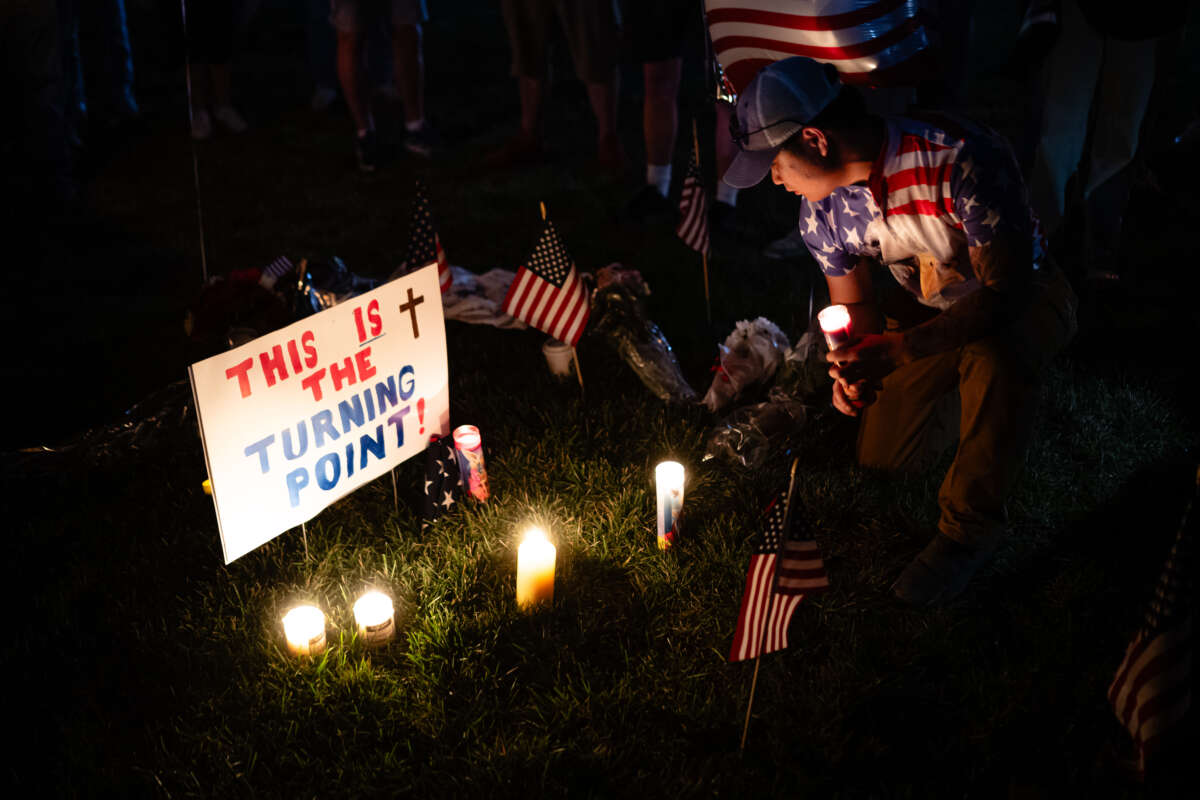
A person holds a candle in the memorial space during a Charlie Kirk vigil at Burlington Commons on September 17, 2025, in Burlington, Kentucky.Jon Cherry / Getty Images
A person holds a candle in the memorial space during a Charlie Kirk vigil at Burlington Commons on September 17, 2025, in Burlington, Kentucky.
A person holds a candle in the memorial space during a Charlie Kirk vigil at Burlington Commons on September 17, 2025, in Burlington, Kentucky.
Jon Cherry / Getty Images
In the week since Charlie Kirk was killed, members of the Trump administration have been honoring him by using one of his favorite platforms — the right-wing podcast — to continue his tradition of threatening people who say things he did not like.
“We can do this the easy way or the hard way,” Brendan Carr, head of the Federal Communications Commission (FCC) said while speaking on pundit Benny Johnson’s podcast on September 17. Carr was responding to a question from Johnson about comedian Jimmy Kimmel, who suggested on his late-night show that members of the MAGA movement were trying to “score political points” on Kirk’s death, comments Carr called “truly sick,” adding, “these companies can find ways to change conduct and take action, frankly, on Kimmel or there’s going to be additional work for the FCC ahead.”
A few hours later, ABC announced that it had indefinitely suspended Kimmel’s show.
The Kimmel suspension happened just days after Vice President JD Vance criticized an op-ed in The Nation while hosting Kirk’s own podcast on September 15, erroneously accusing the piece’s author of celebrating Kirk’s death. Vance also falsely claimed that George Soros’s Open Society Foundations and the Ford Foundation fund The Nation. (Neither foundation currently funds the outlet, and Open Society never has.)
“There is no unity with the people who celebrate Charlie Kirk’s assassination. And there is no unity with the people who fund these articles, who pay the salaries of these terrorist sympathizers,” Vance said, vowing “to dismantle the institutions that promote violence and terrorism in our own country.”
Related Story
In the week since Charlie Kirk was killed, members of the Trump administration have been honoring him by using one of his favorite platforms — the right-wing podcast — to continue his tradition of threatening people who say things he did not like.
“We can do this the easy way or the hard way,” Brendan Carr, head of the Federal Communications Commission (FCC) said while speaking on pundit Benny Johnson’s podcast on September 17. Carr was responding to a question from Johnson about comedian Jimmy Kimmel, who suggested on his late-night show that members of the MAGA movement were trying to “score political points” on Kirk’s death, comments Carr called “truly sick,” adding, “these companies can find ways to change conduct and take action, frankly, on Kimmel or there’s going to be additional work for the FCC ahead.”
A few hours later, ABC announced that it had indefinitely suspended Kimmel’s show.
The Kimmel suspension happened just days after Vice President JD Vance criticized an op-ed in The Nation while hosting Kirk’s own podcast on September 15, erroneously accusing the piece’s author of celebrating Kirk’s death. Vance also falsely claimed that George Soros’s Open Society Foundations and the Ford Foundation fund The Nation. (Neither foundation currently funds the outlet, and Open Society never has.)
“There is no unity with the people who celebrate Charlie Kirk’s assassination. And there is no unity with the people who fund these articles, who pay the salaries of these terrorist sympathizers,” Vance said, vowing “to dismantle the institutions that promote violence and terrorism in our own country.”
Related Story
The Right Has a 150-Page Battle Plan to Shut Down Progressive Civil Society
Attacks on Palestine solidarity are the opening salvo in the right’s stated plan to suppress social justice groups. By Negin Owliaei & Maya Schenwar , Truthout November 27, 2024
The comments were meant to terrify, and they did just that. They were shocking, but they were not unexpected.
Last year, as the world began to come to terms with the potential implications of another Donald Trump presidency, we wrote about the playbook we anticipated his administration and its allies would use to clamp down on dissent. Drawing on detailed plans and documents published by two right-wing think tanks, we anticipated a wide variety of attacks. In the documents, the Heritage Foundation and Capital Research Center identified a litany of tools in their arsenal to suppress the left. Those range from attacks on the immigration status of people who speak out, to threats to strip nonprofits of their tax-exempt status.
They also include frivolous lawsuits that could weigh organizers down, including sweeping RICO charges, which are famously easy to abuse; under them, prosecutors can lump together wide varieties of activity under the umbrella of a conspiracy and make criminal charges simply by association.
In our analysis of those right-wing plans, we perceived that the right seemed poised for a broader attack, unlikely to stop at setting up a few specific scapegoats and relying on a climate of fear to do the rest of their work. While certain activists and movements — especially people working in solidarity with Palestine — would surely have bigger targets on their backs, we warned, the broader progressive movement could easily be ensnared.
We see now how the language Vance is using — both the specific threats and the references to nebulously defined “networks” — echoes what we read in those documents last year. Back then, we voiced our fear that the new administration would use the battering ram of the state to target a broad range of left movement infrastructure: activists, of course, but also independent media, as well as the legal groups that serve as a crucial avenue of defense, and the foundations that provide financial support.
As Vance and White House Deputy Chief of Staff Stephen Miller made clear on Monday, the administration is indeed preparing to identify how to take out the entire progressive civil society ecosystem. Kirk’s killing may offer them the opportunity to attempt that with a few forceful knocks — unless we act.
As JD Vance and Stephen Miller made clear, the administration is indeed preparing to identify how to take out the entire progressive civil society ecosystem.
While speaking with Miller on Kirk’s podcast, Vance acknowledged the blowback he anticipates receiving for the wide-ranging crackdown they have in store. “You have the crazies on the far left who are saying, oh, Stephen Miller and JD Vance, they’re going to go after constitutionally protected speech,” Vance said. “No, no, no, we’re going to go after the NGO network that foments, facilitates, and engages in violence.”
What does violence look like to them? According to Miller, it is “the organized doxing campaigns, the organized riots, the organized street violence, the organized campaigns of dehumanization, vilification, posting people’s addresses, combining that with messaging that’s designed to trigger, incite violence, and the actual organized cells that carry out and facilitate the violence. It is a vast domestic terror movement.”
These are no off-the-cuff remarks. That same day, Trump himself said he would be willing to classify “Antifa,” short for anti-fascists, as a domestic terrorism group, despite the fact that there is famously no single antifa group. Trump followed that up on September 17 with a social media post announcing he would do just that, stating that he would be “designating ANTIFA” as a “MAJOR TERRORIST ORGANIZATION.”
“I will also be strongly recommending that those funding Antifa be thoroughly investigated in accordance with the highest legal standards and practices,” Trump wrote.
There is no actual system for slapping the terrorism label on a domestic group. The State Department can add groups to its own classification of foreign terrorist organizations, but no such official list exists for domestic groups. But while Trump didn’t explain how he might enact this classification of “Antifa” from a legal or logistical standpoint, the threat of the terror label alone is enough to cause concern.
Once a set of accusations has been marked by the “terror” label, it’s no surprise when declarations of “war” follow. As Kay Whitlock and Michael Bronski wrote a decade ago in urging progressives to disavow the “terror” framing, “The ‘terrorism’ frame offers only intensified surveillance, policing, and deployment of military force as its preferred strategies for creating safety and justice.”
After Kirk’s killing, like clockwork, the “terrorism” label has been deployed hand in hand with the war label. “Civil war” mentions surged on social media, and far right figureheads from Andrew Tate to Steve Bannon to Alex Jones and many more announced that a war had arrived, with some explicitly calling for escalated violence.
During his interview with Vance on Kirk’s podcast, Stephen Miller declared something of a holy war, with state violence as the primary weapon: “With God as my witness, we are going to use every resource we have at the Department of Justice, Homeland Security and throughout this government to identify, disrupt, dismantle and destroy these [leftist] networks and make America safe again for the American people,” he said. “It will happen, and we will do it in Charlie’s name.”
Calling the current moment a “war” is not simply a provocation; it’s a strategic move. In wartime, many rules fall away. Crying “war” is the public-discourse equivalent of declaring martial law; “war” means the norms and laws change. State-sanctioned murder — including mechanisms like an increased use of the death penalty and state-justified police-perpetrated killings, as well as jailing and confinement without due process — become not only admissible, but normalized practices.
Indeed, the right’s calls for indiscriminate criminalization have been rampant — as have enthusiastic calls to abandon the usual limits on state power. Far right influencer Laura Loomer, who has a history of concretely impacting Trump’s decisions, suggested, “It’s time for the Trump administration to shut down, defund, & prosecute every single Leftist organization.”
Calling the current moment a “war” is not simply a provocation; it’s a strategic move. In wartime, many rules fall away.
The administration itself has hit similar notes: Speaking to NBC News, White House spokesperson Abigail Jackson unleashed a torrent of allegations against left-wing organizations writ large, from fueling “violent riots” to coordinating doxing attacks.
“The Trump administration will get to the bottom of this vast network inciting violence in American communities,” Jackson said. “This effort will target those committing criminal acts and hold them accountable.”
The administration has considered using RICO charges to do this. Trump himself has repeatedly suggested going after Hungarian-American billionaire George Soros using such racketeering and conspiracy charges. Supposedly intended for targeting organized crime, RICO laws have long been controversial due to the expansive powers they can give prosecutors and their ability to capture people in their dragnet. Republican lawmakers are seeking to add more powers to that list. This summer, Sen. Ted Cruz (R-Texas) proposed a bill that would add rioting to the list of potential RICO offenses. This would allow prosecutors to conduct sweeping investigations of foundations and people, such as Soros, that they allege are funding “riots.”
Beyond organizations, the threats of prosecution are also being leveled against noncompliant individuals: Pam Bondi is currently threatening to criminally prosecute an Office Depot employee who refused to print a customer’s flyers for a Charlie Kirk vigil.
As Trump and his lackeys use the aftermath of Kirk’s killing to quash leftist speech and organizing, we must be clear about the fact that plenty of these tactics are not new; this sweeping crackdown is not simply a reaction to an instance of violence. It is an exploitation of Kirk’s killing to further the ultimate goal of a right-wing movement hell-bent on winning more power.
Vance’s threat to strip nonprofits of their tax-exempt status, for example, is clearly reminiscent of the infamous “nonprofit killer bill,” which would have given the Treasury secretary the authority to strip tax-exempt status from nonprofits they unilaterally deemed to be “terrorist-supporting organizations.” After failing to pass the standalone bill in Congress in November, Republicans attempted to stick the provisions of the nonprofit killer bill into their massive budget bill this summer, though it was eventually removed. It is not law.
The absence of such a law has not stopped those on the right from trying to use other mechanisms to further the nonprofit killer bill’s goal of suppressing progressive civil society. And the attempt to investigate left groups does not come from the Trump administration. Sen. Tom Cotton (R-Arkansas) is perhaps most famous for demanding in The New York Times that the Trump administration send the military to cities to quell uprisings for racial justice in 2020. Now, he has moved on to demand that the Internal Revenue Service investigate groups he does not like, including the Palestinian Youth Movement and the Council on American-Islamic Relations.
The use of RICO charges to go after the left, too, does not begin or end with the Trump administration. In Georgia, the state’s attorney general stuck those charges on dozens of Stop Cop City organizers who were fighting the construction of a massive police training facility in Atlanta. While a judge eventually dropped the charges, fighting those charges still sucked up crucial time and resources from abolitionist organizing. And in 2017, Energy Transfer Partners, the company behind the Dakota Access Pipeline, filed a RICO suit that accused environmental groups like Greenpeace of a racketeering conspiracy over the pipeline protests. When that was thrown out, the pipeline company filed a similar suit in a North Dakota court and won a staggering $660 million from the environmental organization.
And, of course, it is critical to point out how the bipartisan targeting of the Palestine movement for the past two years has made much of this specific moment possible. While the assault on free speech has certainly escalated in the last week, it is impossible not to look at the precedent set by college administrators, private employers, Congress, and both the Trump and Biden administrations for their sweeping crackdown on people who have spoken out against Israel’s genocidal war on Gaza.
That crackdown intensified with the Trump administration’s attempts to deport scholars based on their speech, activism, or family ties. While the courts have stopped the deportations of academics like Badar Khan Suri and Rümeysa Öztürk for their speech for now, an immigration judge has ordered Mahmoud Khalil, a green card holder, to be deported to Algeria or Syria, unless Khalil is successful in an appeal.
Those cases were likely top of mind for Florida Republican Rep. Brian Mast when he put forth a provision this month that, as The Intercept reported, would allow Secretary of State Marco Rubio to strip American citizens of their passports if he unilaterally determines they “knowingly aided, assisted, abetted, or otherwise provided material support to an organization the Secretary has designated as a foreign terrorist organization.” The vagueness is surely intentional, and could include lawyers who provide legal advice, for example, or people who speak out against genocidal policies like Öztürk did. Fortunately, thanks to overwhelming backlash from civil rights groups, Mast backtracked on the provision.
What examples like this do show, though, is that pushback can help stem the fascistic tide. The right is loud. Its actors have a terrifying amount of power and the machinery of the state at their disposal. Nothing about their playbook, though, is inevitable. And we in the media have a specific responsibility in acting as a bulwark.
Media organizations have been quick to point out the various inconsistencies that Vance pushed in his address on the podcast, honing in on the cherrypicked statistics he used to imply that political violence is a bigger issue on the left, and pointing to Vance’s omission of recent violence aimed at notable Democrats, including the assassination of Minnesota State Rep. Melissa Hortman in June.
It’s critical for the media to jump in and correct the record — it’s a core responsibility. But calling out hypocrisy and inaccuracy alone won’t save us. We must also shed light on the various mechanisms the administration and its allies have at their disposal to enforce its terrifying agenda, as well as the complicity of organizations willing to do their dirty work.
For example, we must be clear about what Carr meant when he said the FCC could deal with Kimmel’s speech “the easy way or the hard way.”
“These companies can find ways to change conduct and take actions on Kimmel, or there’s going to be additional work for the FCC ahead,” Carr added. FCC approval is key for networks to maintain their broadcast licenses; it’s even more crucial for networks undergoing potential corporate mergers. That includes Nexstar Media Group, one of the country’s largest TV operators, which runs programming from ABC. The FCC famously approved a controversial merger between CBS parent company Paramount and media company Skydance earlier this year. Even before this week, we already had serious indications that the Trump administration was turning the agency into a political weapon, as Carr started investigations into diversity, equity, and inclusion practices at ABC and NBC.
Those of us in the media must call out these power plays for what they are. We must continue to highlight threats of censorship wherever they spring up — from the administration, from corporations, and from college administrators. By persistently investigating and exposing these threats, we can provide the media equivalent of pushback in the streets, and let the administration and its allies know that their attempts at repression won’t come easy.
Finally, funders supporting left and progressive organizations, including movement media, should recognize their power — and refuse to retreat. In fact, now is the time to recognize that left and progressive movements and journalism organizations need more resources, in order to face down threats from the right and keep building a transformed world for us all.
For those of us in the movement media space, the coming months and years will necessitate resources to cover the intensifying mechanisms by which fascism is tightening its hold, from criminalization to fear campaigns to the erosion of democratic systems. And as the administration’s recent threats against media outlets attest, journalism organizations will also need resources to legally defend ourselves against powerful forces, simply in order to maintain our platforms to speak out.
Vance’s erroneous assertion that the Open Society Foundations and the Ford Foundation fund The Nation demonstrate that the right will attack progressive and mainstream funders whether or not they support social justice-driven organizations. While some may be tempted to fund less in order to avoid being targeted, there’s no “safety” in pulling back. So, why not go ahead and throw support behind the wide range of organizations struggling against fascism, which urgently need resources?
As right-wing leaders and influencers wield the “terror” label and threaten to wage war on left organizations, those of us within those organizations need to ground ourselves in our own power. As Vance promises to dismantle progressive networks and the White House compiles its ominous list of left organizations to target, let’s reconnect with our own left lists — strengthening our relationships with each other, deepening our cross-organizational partnerships, and reminding ourselves to have each other’s backs.
As the administration carries out the strategies in its fascist playbook, we can remember we, too, have strategy. Where are we in our own playbooks? Those of us in media can keep seeking new, wider-ranging, and creative ways to raise our voices to counter the vicious rhetoric-turned-policy erupting around us. And instead of heeding the threats of warmongering bullies, we can start each day by rooting ourselves in our solidarities, and in our commitment to a more just, interdependent, and liberatory collective future.
This article is licensed under Creative Commons (CC BY-NC-ND 4.0), and you are free to share and republish under the terms of the license.
Negin Owliaei is Truthout‘s editor-in-chief. An award-winning journalist, she previously worked at Al Jazeera‘s flagship daily news podcast, The Take. She lives in Washington, D.C.
Maya Schenwar is director of the Truthout Center for Grassroots Journalism. She is also Truthout‘s board president and editor at large. She is the co-editor of We Grow the World Together: Parenting Toward Abolition; co-author of Prison by Any Other Name: The Harmful Consequences of Popular Reforms; author of Locked Down, Locked Out: Why Prison Doesn’t Work and How We Can Do Better; and co-editor of the Truthout anthology Who Do You Serve, Who Do You Protect? Police Violence and Resistance in the United States. In addition to Truthout, Maya’s work has appeared in many publications including The New York Times, The Guardian, NBC News and The Nation, and she has appeared on Democracy Now!, MSNBC, C-SPAN, NPR, and other television and radio programs. Maya is a cofounder of the Movement Media Alliance (MMA) and Media Against Apartheid and Displacement (MAAD). She lives in Chicago.
Charlie Kirk, His Assassin, and the Dark Soul of US Politics
The real terrorism is inflicted by a bipartisan US political establishment that cares only for its own enrichment, and is ready to use whatever violence is needed to protect its position and wealth.
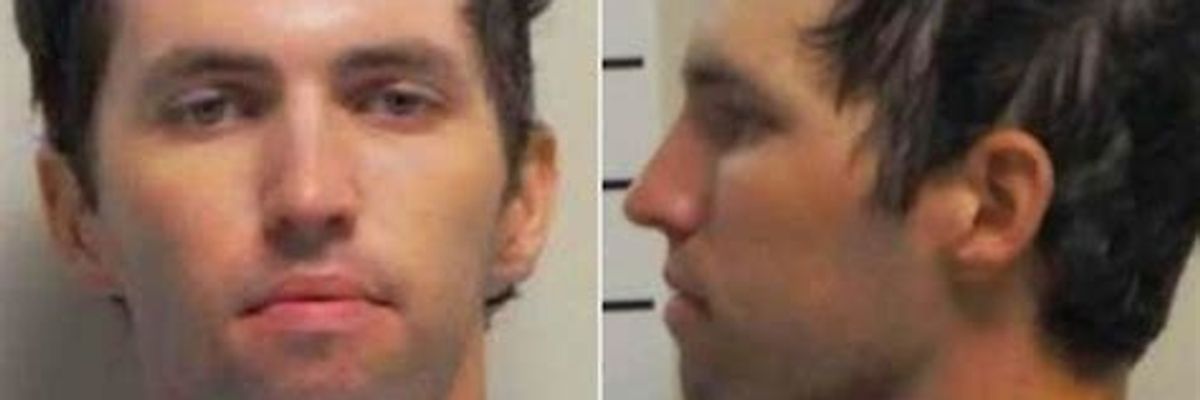
Tyler Robinson, the 22-year-old man accused of assassinating far-right activist Charlie Kirk, is facing multiple charges including first-degree murder.
(Photos by Utah County Sheriff’s Office)
Jonathan Cook
Sep 20, 2025
Draconian response
Early targets of this “war,” as former Trump aide Steve Bannon calls it, have already been selected.
Those who refuse to canonise Kirk—and his Christian white nationalism and bigotry towards women and minorities—are being sought out and punished.
A leading right—wing analyst, Matthew Dowd, was sacked from his post at MSNBC for noting the obvious: that Kirk’s own vocal intolerance of others contributed to the politically charged mood that led to his killing.
More draconian measures are clearly in the pipeline. The direction of travel is highlighted by a new legislative proposal to strip US citizens of their passports over political speech disliked by the administration.
This week, Trump’s attorney general, Pam Bondi, vowed to make a First Amendment exception for “hate speech”—which is certain to open the door to prosecutions of any speech, such as criticisms of Kirk, that the administration objects to.
And after a popular TV show host, Jimmy Kimmel, was summarily sacked for noting that free speech was being curtailed in the wake of Kirk’s killing—reportedly following huge pressure from the Trump appointee heading the Federal Communications Commission—Trump himself warned that networks could be punished for covering him “negatively.”
In death, Kirk is being moulded into a saint for the right, largely by suppressing the things he actually said, to foment the right’s sense of grievance and anger. His presumed assassin, 22—year—old Tyler Robinson, is being similarly turned into a caricature.
Robinson’s backstory is barely known, though the one clear thing is that he was raised in a strictly Mormon, and Republican, family. Instead there is a scramble to find any connections that can paint him as a “leftist” hate figure, one useful in crafting a revenge narrative for the right.
Utah’s Republican governor, Spencer Cox, has been central to shaping the narrative about Kirk’s killing so far.
He was among those “asking” where Kirk’s assassination leads next: “The question is, what kind of watershed? That chapter remains to be written. Is this the end of a dark chapter in our history or the beginning of a darker chapter in our history?”
This is really a non—question posing as a question. The MAGA right views Kirk’s death as the firing of a starting pistol: it will legitimate a rapid escalation of more political violence from the emerging US fascist right for whom Trump is the figurehead.
It will provide the far right with the grounds to rationalise for itself ever greater legal and social repression of its opponents—repression it wanted from the outset.
Bubble of denial
Kirk’s killing is an alibi for the fascist right to tell itself its own political violence is nothing more than “self—defence”.
This is a tried—and—tested formula.
Israel has been flogging this strategy to death these past two years by claiming that its slaughter and maiming of hundreds of thousands of Palestinian civilians in Gaza is “self—defence”.
Kirk’s killing is neither the opening nor closing of a ‘dark chapter’ of domestic political violence. It is a continuation of a violence baked into the US political system
That makes sense to Israelis only because their political and media class have erased the preceding decades of Israeli state violence—apartheid, ethnic cleansing and a brutal 17—year siege of Gaza—that directly led to the attack on 7 October 2023.
Israelis inhabited that same bubble of denial this week as the United Nations concluded unequivocally that Israel has committed genocide in Gaza.
Trump’s MAGA movement has been busy doing much the same in the US, erasing its own forms of violence that preceded Kirk’s assassination. It has, of course, lost no time in scrubbing from the record the right’s January 2021 insurrection at the US Capitol that marked the end of Trump’s first term as president.
In power for less than a year, the second Trump administration has also been chipping away rhetorically and materially at the bedrock of the country’s constitutional and legal safeguards to smooth the way to more heavy—handed repression.
That includes disappearances into detention by ICE immigration officials of domestic opponents vocal about Palestinian rights. It includes the deportation of immigrants and asylum seekers to third countries, often in defiance of court rulings.
It includes a move to end birthright citizenship for children born in the US to undocumented immigrants. And it includes savage funding cuts to universities to incentivise them to further crack down on students protesting Israel’s genocide in Gaza.
These forms of structural oppression are far more politically dangerous and violent than anything a gunman could achieve with a single bullet.
Surface narrative
Perhaps understandably, those trying to counter the push for harsher legal and social repression are keen to find plot holes in the administration’s narrative.
That task is being made significantly easier by the way the FBI is publicly putting together its case.
Robinson supposedly wrote a note confessing to the crime—one that FBI head Kash Patel has quoted from—even though Patel also says the note was destroyed. He has not explained how it was destroyed or how he is able to quote from a document that no longer exists.
The FBI’s account of how Robinson prepared for and carried out the killing is so unnecessarily labyrinthine it beggars belief that anyone would behave that way unless they wanted to be caught.
And yet Robinson not only carried out a remarkably precise assassination from 200 yards away, but also successfully evaded law enforcement until his family reportedly turned him in.
All of this smacks either of gross incompetence by a highly politicised FBI under Patel, or a convenient, manufactured narrative produced by a highly politicised FBI under Patel keen to implicate “the left” and trigger a further, more violent round of culture wars.
In such circumstances, it is not surprising that some observers—looking to a spate of assassinations of political leaders identified with the left in the 1960s, such as President John F Kennedy, his brother Robert Kennedy and civil rights leader Martin Luther King—are less than ready to believe the official narratives being promoted.
But there is one thing that the mainstream left and right do seem able to agree on. They readily blame the ”dark corners” of the internet—a dehumanised, video—gaming culture, and faceless, polarising interactions on social media—that appear to be especially harmful to disaffected, aimless young men often seemingly with poor mental health.
Certainly, it is satisfying to ascribe a deteriorating civic fabric to this group’s increasing flight from the real world into online seclusion or anonymised exchanges. But even this way of understanding the rise of social and political disharmony serves to skate over deeper truths, and to prioritise another surface narrative.
Violence baked in
Overshadowed by Kirk’s killing, there was yet another school shooting in Denver, Colorado, on the same day. A 16—year—old, reportedly known for espousing neo—Nazi views, critically injured two fellow students with a handgun before turning the gun on himself.
The data show that gun violence is a uniquely US phenomenon, not replicated in other countries that have a similar or even greater video—gaming culture to which these young, lone gunmen are so often drawn.
Conveniently, our gaze is directed at these damaged individuals, not the wider political context they and we inhabit.
Some wish to argue that the reasons for their violence can be found in their individual behaviours. Others seek to attribute guilt along largely meaningless, partisan dividing lines—political divisions manufactured for us by a state apparatus equally served by the two main parties that control Congress.
Kirk’s killing is neither the opening nor the closing of a “dark chapter” of domestic political violence. It is a continuation of a violence baked into the US political system.
Most obviously, violence has long been normalised in Washington’s bipartisan “shock and awe” foreign policy.
In just the past few years, the US has materially supported Saudi Arabia in its years—long bombing of Yemen into the dark ages. The US has denied aid to Afghanistan, still reeling from a recently ended, two—decade US military occupation, that is now producing mass starvation among the country’s children. And the US has supplied the bombs and diplomatic cover for Israel to erase Gaza and engineer the starvation of its people.
The impact of this relentless, all—too—visible violence inflicted by Washington on large parts of the globe, and a media coverage that so readily celebrates and sanctifies it, cannot be ring—fenced from a watching US public.
Where would Robinson have gotten the idea of etching meme—like hate messages on to his bullet casings? Could it have been from seeing former Republican governor and failed US presidential candidate Nikki Haley scrawl “Finish them” on artillery shells to be used in Israel’s genocide on Gaza?
Such depraved glorification of mass violence by the US political establishment barely raises an eyebrow. And yet our focus is firmly directed at Tyler Robinson, as though his suspected lone act of violence is some sort of watershed moment that only now requires serious soul—searching—and, predictably, only from “leftists.”
Fuel on the fire
Our real focus ought not to be on damaged individuals so much as the political, social and economic systems that damaged them, and that provided them with the means and motives to carry out their twisted agendas.
Video gaming and social media aren’t the cause of the problem. They are the fuel being poured on to a fire that was already raging among a section of alienated, nihilistic youth across the US.
That nihilism—a sense that the world and its values are utterly meaningless and our lives without purpose—cannot be explained simply by the escape into a world of video games. Such addictions are where the nihilist seeks solace, fleeing from a reality that has become too much of a burden.
The cauldron for the nihilistic worldview of these lone gunmen is the unique role the US has taken for itself in shaping the world over the past 80 years—both as an imperial hub for the reinvention of western colonialism and as the chief exporter, and rule—enforcer, of a turbo—charged neoliberal capitalism.
Exemplified by the current genocide in Gaza, US foreign policy not only requires a constant campaign of racist intimidation and violence towards the Global South, but celebrates this violence as a moral value and as a duty, one championed by the right and figures like Charlie Kirk.
US foreign policy not only requires a constant campaign of racist intimidation and violence towards the Global South but celebrates this violence as a moral value
Meanwhile at home, the MAGA right extols the excesses of neoliberal capitalism while ignoring the exploitative abuses of the weakest and most marginalised, the ravaging of the planet’s health, and the resulting threats to the future of the human species.
None of this is a sane political environment in which to grow up.
Charlie Kirk’s Christian nationalism took as its premise—against all evidence—that America was doing God’s work in promoting “values” at home and abroad that serve only the narrow interests of a billionaire class represented by Donald Trump.
Although it is impossible to yet know Tyler Robinson’s reasoning, it seems likely he had lost that kind of unthinking faith.
Who is to say which of them harboured a darker vision of reality?
Raised as a devout Christian no less than Kirk, maybe Robinson could no longer buy into the narrative sold by Kirk’s Christian nationalism of God’s will, Trump’s will and Israel’s will being identical.
All guns blazing
What is much clearer is that a growing section of disaffected youth in the US are ever less ready to stomach a system of bipartisan values that require permanent wars and genocidal starvation abroad, their own impoverishment and marginalisation at home, and a bleak future in which a suicidal neoliberal capitalism, premised on infinite growth on a finite planet, runs out of quick fixes.
If those are the only values on offer, some—like the school shooters and Kirk’s killer—choose no values at all. They choose to go down all guns blazing.
Why was Charlie Kirk selected by his killer? Because most likely they were not very different.
Kirk’s flight from reality into a world of violent American exceptionalism, supposedly justified by the Bible, was every bit as nihilistic as his killer’s flight into the world of memes and video games.
A declining US superpower needs to rationalise its failures—its monstrous crimes abroad, and economic collapse at home—as a war against homegrown ‘terrorists’
Both were tied to a system where meaning derives chiefly from the ability to inflict violence on others. Kirk through existing, oppressive power structures; his killer through the barrel of a gun.
Kirk exercised his influence through the internet, stoking resentment and anger online. His killer’s nihilism and alienation were fed by screens where a dark, life—is—cheap world of video games merged with a dark, real world where starving babies to death has become normal.
That kind of parallel—drawing, of course, is not one the MAGA right can abide. Because it indicts not some imagined “left” but the right’s own vision of an ultimate dog-eat-dog America, one in which models of solidarity and shared values have been stripped out. One where might alone is right.
“The left” will be blamed for Kirk’s killing, whatever the truth. Because the logic of a US political system predicated on structural violence towards others at home and abroad, long predating Trump’s arrival in the White House, necessarily excludes real soul—searching.
A US empire, one rapidly running out of steam and legitimacy, needs its scapegoats. For decades, those have been supplied on foreign fields, where the US has chosen to export its violence in a supposed war against the “terrorists.”
Now, a declining US superpower needs to rationalize its failures—its glaring, monstrous crimes abroad, and economic collapse at home—in similar terms, as a war against homegrown terrorists.
The real terrorism is inflicted by a bipartisan US political establishment that cares only for its own enrichment, and is ready to use whatever violence is needed to protect its position and wealth.
Make no mistake, that means a lot more political violence—precisely from those claiming to be bringing it to an end.
© 2023 Middle East Eye
Jonathan Cook won the 2011 Martha Gellhorn Special Prize for Journalism. His books include: "Israel and the Clash of Civilisations: Iraq, Iran and the Plan to Remake the Middle East" (2008). His website is www.jonathan-cook.net.
Full Bio >
The real terrorism is inflicted by a bipartisan US political establishment that cares only for its own enrichment, and is ready to use whatever violence is needed to protect its position and wealth.
Tyler Robinson, the 22-year-old man accused of assassinating far-right activist Charlie Kirk, is facing multiple charges including first-degree murder.
(Photos by Utah County Sheriff’s Office)
Jonathan Cook
Sep 20, 2025
Middle East Eye
Predictably, the killing of the right—wing activist Charlie Kirk last week has sparked a wave of commentary about the growing dangers of political violence in the United States—debate that is itself bound to stoke yet more political violence.
The Trump administration has made clear it wants to weaponise Kirk’s killing, making the case that his assassination reflects something inherently violent about what it calls “leftist” ideology.
That just happens to be the exact reverse of what the statistics show: the right is historically far more prone to using political violence than the left.
Even the two men alleged to have tried to assassinate Donald Trump last year, before the presidential elections, had at best confused political agendas. Neither could realistically be described as “leftists.”
But nuance is not what this administration in interested in, as it prepares to ratchet up other forms of political violence against anyone it labels as “the left”: critics, opponents of Israel’s genocide in Gaza, the transgender community, Muslims, non—white immigrants and asylum seekers.
On Monday Vice—President J D Vance and a senior Trump aide, Stephen Miller, both vowed vengeance against this amorphous group they are characterising as a left—wing “domestic terror movement.”
Hosting Kirk’s podcast in his stead, Vance said the administration would “work to dismantle the institutions that promote violence and terrorism in our own country”.
On the same podcast, Miller promised “to use every resource we have at the Department of Justice, Homeland Security and throughout this government to identify, disrupt, dismantle and destroy these networks.”
Meanwhile, social media tycoon Elon Musk framed the future in more graphically apocalyptic terms as he rallied crowds of Tommy Robinson—led, flag—waving white nationalists in London at the weekend. Speaking to them via video link, he warned: “Whether you choose violence or not, violence is coming to you. You either fight back or you die.”
Predictably, the killing of the right—wing activist Charlie Kirk last week has sparked a wave of commentary about the growing dangers of political violence in the United States—debate that is itself bound to stoke yet more political violence.
The Trump administration has made clear it wants to weaponise Kirk’s killing, making the case that his assassination reflects something inherently violent about what it calls “leftist” ideology.
That just happens to be the exact reverse of what the statistics show: the right is historically far more prone to using political violence than the left.
Even the two men alleged to have tried to assassinate Donald Trump last year, before the presidential elections, had at best confused political agendas. Neither could realistically be described as “leftists.”
But nuance is not what this administration in interested in, as it prepares to ratchet up other forms of political violence against anyone it labels as “the left”: critics, opponents of Israel’s genocide in Gaza, the transgender community, Muslims, non—white immigrants and asylum seekers.
On Monday Vice—President J D Vance and a senior Trump aide, Stephen Miller, both vowed vengeance against this amorphous group they are characterising as a left—wing “domestic terror movement.”
Hosting Kirk’s podcast in his stead, Vance said the administration would “work to dismantle the institutions that promote violence and terrorism in our own country”.
On the same podcast, Miller promised “to use every resource we have at the Department of Justice, Homeland Security and throughout this government to identify, disrupt, dismantle and destroy these networks.”
Meanwhile, social media tycoon Elon Musk framed the future in more graphically apocalyptic terms as he rallied crowds of Tommy Robinson—led, flag—waving white nationalists in London at the weekend. Speaking to them via video link, he warned: “Whether you choose violence or not, violence is coming to you. You either fight back or you die.”
Draconian response
Early targets of this “war,” as former Trump aide Steve Bannon calls it, have already been selected.
Those who refuse to canonise Kirk—and his Christian white nationalism and bigotry towards women and minorities—are being sought out and punished.
A leading right—wing analyst, Matthew Dowd, was sacked from his post at MSNBC for noting the obvious: that Kirk’s own vocal intolerance of others contributed to the politically charged mood that led to his killing.
More draconian measures are clearly in the pipeline. The direction of travel is highlighted by a new legislative proposal to strip US citizens of their passports over political speech disliked by the administration.
This week, Trump’s attorney general, Pam Bondi, vowed to make a First Amendment exception for “hate speech”—which is certain to open the door to prosecutions of any speech, such as criticisms of Kirk, that the administration objects to.
And after a popular TV show host, Jimmy Kimmel, was summarily sacked for noting that free speech was being curtailed in the wake of Kirk’s killing—reportedly following huge pressure from the Trump appointee heading the Federal Communications Commission—Trump himself warned that networks could be punished for covering him “negatively.”
In death, Kirk is being moulded into a saint for the right, largely by suppressing the things he actually said, to foment the right’s sense of grievance and anger. His presumed assassin, 22—year—old Tyler Robinson, is being similarly turned into a caricature.
Robinson’s backstory is barely known, though the one clear thing is that he was raised in a strictly Mormon, and Republican, family. Instead there is a scramble to find any connections that can paint him as a “leftist” hate figure, one useful in crafting a revenge narrative for the right.
Utah’s Republican governor, Spencer Cox, has been central to shaping the narrative about Kirk’s killing so far.
He was among those “asking” where Kirk’s assassination leads next: “The question is, what kind of watershed? That chapter remains to be written. Is this the end of a dark chapter in our history or the beginning of a darker chapter in our history?”
This is really a non—question posing as a question. The MAGA right views Kirk’s death as the firing of a starting pistol: it will legitimate a rapid escalation of more political violence from the emerging US fascist right for whom Trump is the figurehead.
It will provide the far right with the grounds to rationalise for itself ever greater legal and social repression of its opponents—repression it wanted from the outset.
Bubble of denial
Kirk’s killing is an alibi for the fascist right to tell itself its own political violence is nothing more than “self—defence”.
This is a tried—and—tested formula.
Israel has been flogging this strategy to death these past two years by claiming that its slaughter and maiming of hundreds of thousands of Palestinian civilians in Gaza is “self—defence”.
Kirk’s killing is neither the opening nor closing of a ‘dark chapter’ of domestic political violence. It is a continuation of a violence baked into the US political system
That makes sense to Israelis only because their political and media class have erased the preceding decades of Israeli state violence—apartheid, ethnic cleansing and a brutal 17—year siege of Gaza—that directly led to the attack on 7 October 2023.
Israelis inhabited that same bubble of denial this week as the United Nations concluded unequivocally that Israel has committed genocide in Gaza.
Trump’s MAGA movement has been busy doing much the same in the US, erasing its own forms of violence that preceded Kirk’s assassination. It has, of course, lost no time in scrubbing from the record the right’s January 2021 insurrection at the US Capitol that marked the end of Trump’s first term as president.
In power for less than a year, the second Trump administration has also been chipping away rhetorically and materially at the bedrock of the country’s constitutional and legal safeguards to smooth the way to more heavy—handed repression.
That includes disappearances into detention by ICE immigration officials of domestic opponents vocal about Palestinian rights. It includes the deportation of immigrants and asylum seekers to third countries, often in defiance of court rulings.
It includes a move to end birthright citizenship for children born in the US to undocumented immigrants. And it includes savage funding cuts to universities to incentivise them to further crack down on students protesting Israel’s genocide in Gaza.
These forms of structural oppression are far more politically dangerous and violent than anything a gunman could achieve with a single bullet.
Surface narrative
Perhaps understandably, those trying to counter the push for harsher legal and social repression are keen to find plot holes in the administration’s narrative.
That task is being made significantly easier by the way the FBI is publicly putting together its case.
Robinson supposedly wrote a note confessing to the crime—one that FBI head Kash Patel has quoted from—even though Patel also says the note was destroyed. He has not explained how it was destroyed or how he is able to quote from a document that no longer exists.
The FBI’s account of how Robinson prepared for and carried out the killing is so unnecessarily labyrinthine it beggars belief that anyone would behave that way unless they wanted to be caught.
And yet Robinson not only carried out a remarkably precise assassination from 200 yards away, but also successfully evaded law enforcement until his family reportedly turned him in.
All of this smacks either of gross incompetence by a highly politicised FBI under Patel, or a convenient, manufactured narrative produced by a highly politicised FBI under Patel keen to implicate “the left” and trigger a further, more violent round of culture wars.
In such circumstances, it is not surprising that some observers—looking to a spate of assassinations of political leaders identified with the left in the 1960s, such as President John F Kennedy, his brother Robert Kennedy and civil rights leader Martin Luther King—are less than ready to believe the official narratives being promoted.
But there is one thing that the mainstream left and right do seem able to agree on. They readily blame the ”dark corners” of the internet—a dehumanised, video—gaming culture, and faceless, polarising interactions on social media—that appear to be especially harmful to disaffected, aimless young men often seemingly with poor mental health.
Certainly, it is satisfying to ascribe a deteriorating civic fabric to this group’s increasing flight from the real world into online seclusion or anonymised exchanges. But even this way of understanding the rise of social and political disharmony serves to skate over deeper truths, and to prioritise another surface narrative.
Violence baked in
Overshadowed by Kirk’s killing, there was yet another school shooting in Denver, Colorado, on the same day. A 16—year—old, reportedly known for espousing neo—Nazi views, critically injured two fellow students with a handgun before turning the gun on himself.
The data show that gun violence is a uniquely US phenomenon, not replicated in other countries that have a similar or even greater video—gaming culture to which these young, lone gunmen are so often drawn.
Conveniently, our gaze is directed at these damaged individuals, not the wider political context they and we inhabit.
Some wish to argue that the reasons for their violence can be found in their individual behaviours. Others seek to attribute guilt along largely meaningless, partisan dividing lines—political divisions manufactured for us by a state apparatus equally served by the two main parties that control Congress.
Kirk’s killing is neither the opening nor the closing of a “dark chapter” of domestic political violence. It is a continuation of a violence baked into the US political system.
Most obviously, violence has long been normalised in Washington’s bipartisan “shock and awe” foreign policy.
In just the past few years, the US has materially supported Saudi Arabia in its years—long bombing of Yemen into the dark ages. The US has denied aid to Afghanistan, still reeling from a recently ended, two—decade US military occupation, that is now producing mass starvation among the country’s children. And the US has supplied the bombs and diplomatic cover for Israel to erase Gaza and engineer the starvation of its people.
The impact of this relentless, all—too—visible violence inflicted by Washington on large parts of the globe, and a media coverage that so readily celebrates and sanctifies it, cannot be ring—fenced from a watching US public.
Where would Robinson have gotten the idea of etching meme—like hate messages on to his bullet casings? Could it have been from seeing former Republican governor and failed US presidential candidate Nikki Haley scrawl “Finish them” on artillery shells to be used in Israel’s genocide on Gaza?
Such depraved glorification of mass violence by the US political establishment barely raises an eyebrow. And yet our focus is firmly directed at Tyler Robinson, as though his suspected lone act of violence is some sort of watershed moment that only now requires serious soul—searching—and, predictably, only from “leftists.”
Fuel on the fire
Our real focus ought not to be on damaged individuals so much as the political, social and economic systems that damaged them, and that provided them with the means and motives to carry out their twisted agendas.
Video gaming and social media aren’t the cause of the problem. They are the fuel being poured on to a fire that was already raging among a section of alienated, nihilistic youth across the US.
That nihilism—a sense that the world and its values are utterly meaningless and our lives without purpose—cannot be explained simply by the escape into a world of video games. Such addictions are where the nihilist seeks solace, fleeing from a reality that has become too much of a burden.
The cauldron for the nihilistic worldview of these lone gunmen is the unique role the US has taken for itself in shaping the world over the past 80 years—both as an imperial hub for the reinvention of western colonialism and as the chief exporter, and rule—enforcer, of a turbo—charged neoliberal capitalism.
Exemplified by the current genocide in Gaza, US foreign policy not only requires a constant campaign of racist intimidation and violence towards the Global South, but celebrates this violence as a moral value and as a duty, one championed by the right and figures like Charlie Kirk.
US foreign policy not only requires a constant campaign of racist intimidation and violence towards the Global South but celebrates this violence as a moral value
Meanwhile at home, the MAGA right extols the excesses of neoliberal capitalism while ignoring the exploitative abuses of the weakest and most marginalised, the ravaging of the planet’s health, and the resulting threats to the future of the human species.
None of this is a sane political environment in which to grow up.
Charlie Kirk’s Christian nationalism took as its premise—against all evidence—that America was doing God’s work in promoting “values” at home and abroad that serve only the narrow interests of a billionaire class represented by Donald Trump.
Although it is impossible to yet know Tyler Robinson’s reasoning, it seems likely he had lost that kind of unthinking faith.
Who is to say which of them harboured a darker vision of reality?
Raised as a devout Christian no less than Kirk, maybe Robinson could no longer buy into the narrative sold by Kirk’s Christian nationalism of God’s will, Trump’s will and Israel’s will being identical.
All guns blazing
What is much clearer is that a growing section of disaffected youth in the US are ever less ready to stomach a system of bipartisan values that require permanent wars and genocidal starvation abroad, their own impoverishment and marginalisation at home, and a bleak future in which a suicidal neoliberal capitalism, premised on infinite growth on a finite planet, runs out of quick fixes.
If those are the only values on offer, some—like the school shooters and Kirk’s killer—choose no values at all. They choose to go down all guns blazing.
Why was Charlie Kirk selected by his killer? Because most likely they were not very different.
Kirk’s flight from reality into a world of violent American exceptionalism, supposedly justified by the Bible, was every bit as nihilistic as his killer’s flight into the world of memes and video games.
A declining US superpower needs to rationalise its failures—its monstrous crimes abroad, and economic collapse at home—as a war against homegrown ‘terrorists’
Both were tied to a system where meaning derives chiefly from the ability to inflict violence on others. Kirk through existing, oppressive power structures; his killer through the barrel of a gun.
Kirk exercised his influence through the internet, stoking resentment and anger online. His killer’s nihilism and alienation were fed by screens where a dark, life—is—cheap world of video games merged with a dark, real world where starving babies to death has become normal.
That kind of parallel—drawing, of course, is not one the MAGA right can abide. Because it indicts not some imagined “left” but the right’s own vision of an ultimate dog-eat-dog America, one in which models of solidarity and shared values have been stripped out. One where might alone is right.
“The left” will be blamed for Kirk’s killing, whatever the truth. Because the logic of a US political system predicated on structural violence towards others at home and abroad, long predating Trump’s arrival in the White House, necessarily excludes real soul—searching.
A US empire, one rapidly running out of steam and legitimacy, needs its scapegoats. For decades, those have been supplied on foreign fields, where the US has chosen to export its violence in a supposed war against the “terrorists.”
Now, a declining US superpower needs to rationalize its failures—its glaring, monstrous crimes abroad, and economic collapse at home—in similar terms, as a war against homegrown terrorists.
The real terrorism is inflicted by a bipartisan US political establishment that cares only for its own enrichment, and is ready to use whatever violence is needed to protect its position and wealth.
Make no mistake, that means a lot more political violence—precisely from those claiming to be bringing it to an end.
© 2023 Middle East Eye
Jonathan Cook won the 2011 Martha Gellhorn Special Prize for Journalism. His books include: "Israel and the Clash of Civilisations: Iraq, Iran and the Plan to Remake the Middle East" (2008). His website is www.jonathan-cook.net.
Full Bio >
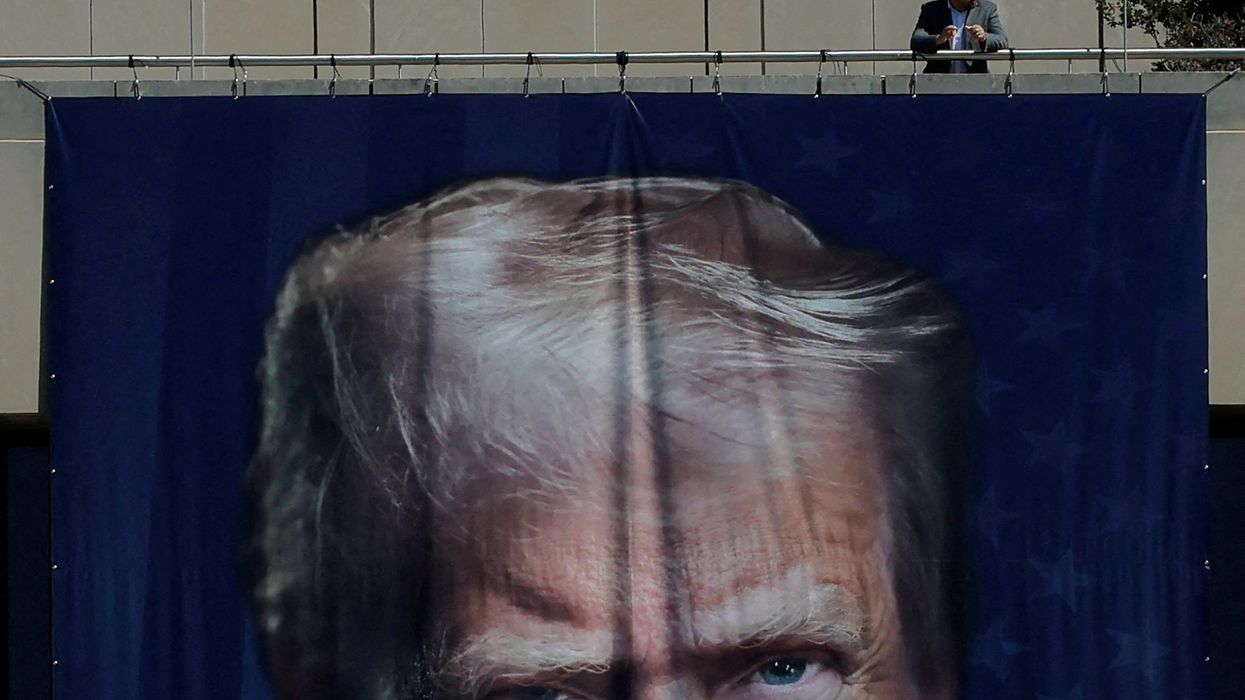
A large banner featuring U.S. President Donald Trump hangs on the Department of Labor building in Washington, D.C., U.S., in Washington, D.C., U.S., August 26, 2025. REUTERS/Brian Snyder TPX IMAGES OF THE DAY
September 20, 2025
ALTERNET
In parts of the United States where President Donald Trump's hardcore MAGA base is especially strong — including rural areas of deep red states like Idaho, West Virginia, Montana, Alabama and Arkansas — many residents welcome images of him. But Washington, D.C. is another matter.
Like other Northeastern Corridor cities — New York, Philadelphia, Boston, Baltimore, Hartford — Washington is overwhelmingly Democratic. And according to CNN reporter Camila DeChalus, Democrats are complaining about large banners showing Trump's face on three federal government buildings.
DeChalus, in an article published on September 20, reports, "The controversy underscores deepening tensions in Washington over the extent of Trump's use of executive power. The banners in question have large portraits of the sitting president with the caption 'American Workers First'…. The Department of Labor confirmed it spent roughly $6000 on the banners and noted that they were created in conjunction with Labor Day and the department's America250 celebrations."
DeChalus adds, "The Departments of Agriculture and Health and Human services did not immediately respond to CNN's requests for comment."
The banners are generating a lot of comments on X, formerly Twitter.
Sen. Adam Schiff (D-California) tweeted, "This is not only a waste of taxpayer dollars. It's also an authoritarian tactic. Dictators from Stalin to Saddam plastered their images on government buildings to demonstrate power. Now, the Trump Administration is doing the same in Washington."
Schiff also wrote, "Democracy doesn't disappear overnight — it is vanishes day by day, one lawless act after another. Oversized portraits on government buildings may look like vanity. But they are also a warning. We must take it seriously."
X user Pramod Sharma wrote, "These grotesque Trump banners on federal buildings, like the Dept of Labor eyesore, reek of dictator vibes — straight out of Stalin's playbook! They scream illegal under the Smith-Mundt Act, banning domestic propaganda. Trump's wasting our tax dollars to stroke his ego while crushing workers' rights — disgraceful! Your thread better expose this tyrant's sham. #Trump #Propaganda."
The L.A. Unity Project posted, "LA Unity Project - Shantel Daniels @LAUnityProject Sep 18 Why are giant Trump banners popping up across DC, the same tactic dictators use worldwide? Who’s paying? Not Trump. Not billionaires. Taxpayers. Congress banned propaganda with public money in 1951. Schiff’s new report shows Trump ignored the law, $50,000+ in banners that glorify him, not inform the public."
Read the full CNN article at this link.

No comments:
Post a Comment