From domination to extermination: Israel’s military industry and strategy since 1948
First published at Phenomenal World.
Israel is one of the most militarized countries in the world. The Israel Defense Forces, and the broader landscape of Israeli security forces, are the core around which the country’s institutions, financial structures, and economy have been developed since David Ben-Gurion ordered the founding of the IDF on May 26,1948. Across the intervening decades, the country’s political economy has developed around this central organizing principle of war, evolving as the nature of war has changed with US foreign policy in the Middle East.
In the 1940s, decentralized settler-colonial militias consolidated into a state-owned and publicly managed enterprise for the production of military goods. The Israeli state limited this industry’s exports, a pattern that continued after independence as state-owned weapons manufacturers produced arms for expansionary aims. During the early Cold War and post-colonial period, Israeli military strategy reflected this economic model. Rather than pursuing conventional warfare, settlement was promoted through small military units carrying out ethnic cleansing campaigns with light weaponry. While Israel did import weapons, mainly from France, it equipped these militias primarily through domestic production.
It was in the aftermath of the 1973 Arab-Israeli War, with the surge in US military financing, that the Israeli military’s procurement practices changed. The new phase in the global Cold War initiated a period of sectoral change inside Israel’s defense industry. The war exposed grave weaknesses in Israeli defense, which had struggled against the Soviet-armed militaries of the Arab countries. Israel’s response was a rapid and steep increase in imports of US weapons systems. But this decision required structural adjustment: in order to strengthen its links with the US defense industry, Israel privatized and liberalized its domestic military apparatus. Throughout the latter decades of the twentieth century, the Israel Defense Forces (IDF) transformed into a high-tech colonial police force, managing the Palestinian populations of Gaza and the West Bank by means of surveillance and control. As weapons imports from the US kept apace, Israel re-oriented its own production towards new specialized technologies of surveillance and incarceration. A new global division of labor in the production of military equipment came into being, one shaped by the War on Terror and the US-led global defense industry until 2023.
The genocidal campaign Israel is waging in the Gaza Strip marks a disruption to the decades-long status quo. Since October 7, Israel’s military industry has increasingly sought to supplement its overwhelming dependence on military imports with its own domestic production — a return to its origins in militia-nation mobilized for constant hostilities. The shift has been qualitative and quantitative. In producing for domestic consumption, the Israeli military-industrial complex has begun to recompose its production profile around low-tech arms designed for brute destruction and displacement, for products and practices more akin to its founding strategy.
A settler-colonial state
The roots of Israel’s arms industry predate the founding of the state itself. Israel Military Industries — the company behind the Desert Eagle and the Uzi — was established in 1933 as a small arms manufacturer to supply early Zionist militias. Its weapons were produced in secret, smuggled, and stashed illegally for use by these armed Zionist groups. The militias that later formed the IDF were armed primarily with Sten submachine guns, mortars, and light armored vehicles — weapons well-suited for intimidating civilians and ultimately effective in the ethnic cleansing of Palestine. These weapons favored small-unit tactics and irregular warfare in rough terrain, aligning with Israel’s early doctrine of high mobility and decentralized command, and exemplifying what Israeli generals often described as the ideal of “a small and smart army.”
The collectivist settler mentality was essential in shaping the Zionist movement’s militarism, armament strategies, and relationship to the indigenous Palestinian population. Under the leadership of former Israeli Prime Minister David Ben Gurion, leader of the Labor Party and the trade unions, the state monopolized Israeli arms manufacturing. That monopoly over arms production advanced the country’s public sector, with proceeds channeled back into R&D.1 This kind of warmaking also influenced military recruitment policy. To maintain unit cohesion and loyalty, Israel exempted large segments of the population from conscription — Palestinians, Ultra-Orthodox Jews, and later, growing numbers of secular Jews. The strategy proved successful in 1948, 1956, and 1967, when lightly armed, agile units could outmaneuver less organized Arab forces. With the outbreak of war in 1973, however, the limitations of this strategy were quickly exposed.
The infrastructure of domination
While Israel’s military success against Egypt, Syria, and Jordan in the 1967 Six-Day War generated overconfidence among Israeli military elites, the 1973 Yom-Kippur war shattered this conception of self-sufficiency, including in arms manufacturing. Large purchases of Russian military equipment by the governments of Iraq and Syria, as well as the explosion of Arab oil revenues and the influx of weapons these purchased, signaled the arrival of a regional weapons build up across many different axes of conflict. When the war began in October, Israeli small units and even air superiority failed to halt the advance of Syrian and Egyptian divisions. Mid-war, Israel turned to imports of US-made arms, necessitating new tactics — and ultimately, a new strategy.
Dependency on US military financing began in the middle of the Yom-Kippur war and quickly became a key feature of the Israeli arms industry. Israel’s structural hostility to the Soviet-funded Arab socialist governments made it a natural proxy for US Cold War interests. By rescuing Israel from the brink of destruction, the US gained a new state asset for projecting its own power in the Middle East, and a ready opportunity to restructure Israel’s military industry around its own economic and geostrategic priorities.
In the years that followed, the US used military financing to exert pressure on the sort of technologies and equipment that Israel could produce at home. The Pentagon identified Israeli military research projects that could potentially create competition with American defense companies and negotiated their eventual termination. These included work on an anti-tank missile to compete with the US-made LAU missile, as well as Israel’s flagship arms project — the Lavi jet fighter, developed in the 1980s and designed to surpass the F-16 Lockheed Martin fighter.2 The Pentagon also monitored Israeli arms exports of systems containing US technology, forbidding their sale to countries like Russia and China.
Since 1973, Israel has become the largest recipient of US foreign military assistance in the world — and since the 1979 Iranian Revolution the region’s largest buyer of US military equipment by far. Since the Yom-Kippur War began, the US has given to Israel a total sum of over $171 billion in military assistance , not adjusted for inflation and without interest.3 This shift in the basis of Israeli military procurement has profoundly reoriented the role of Israel’s own home-grown weapons manufacturers. While the US is the world’s largest arms exporter by a wide margin, Israel has become a major arms exporter in its own right, with the highest rate of per-capita arms exports in the world. While US weapons exports emphasize North Atlantic Treaty Organization (NATO) members, however, most of Israel’s arms export is directed at non-NATO members.
The marriage between US and Israeli military interests would have two outcomes. First, under US influence, private arms companies gained prominence over state-owned enterprises in IDF procurement as the country underwent a broader period of intense privatization. Pressures for privatization were heightened as a result of the painful adjustments imposed by the US on arms production as well as military spending cuts reflecting the end of the Cold War. In 1993, a governmental committee headed by Professor Israel Sadan convened to study the future of Israeli military procurement, recommending the privatization of “peripheral” functions, from storage and distribution to logistical acquisitions and even base security itself. Competition among privatized vendors was presented as a cost-saving measure that, Israelis were assured, would not compromise security. Efficiency was the watchword of the day, a principle captured by then IDF head Ehud Barak, who declared, “everything that doesn’t shoot or directly help to shoot will be cut.”4
Privatization was not limited to the arms industry. With the 1985 Structural Stabilization Plan, Israel embarked on a large-scale privatization process of its telecommunication infrastructure and services, Israel’s national airline, the banking sector, and partial privatization in the water, health, and ports.5 In addition to appealing to US preferences, privatization provided members of the Israeli security elite with lucrative opportunities in the management of private arms companies.
Second, these private companies would become increasingly embedded with the US-led Global War on Terror. Privatization went hand in hand with specialization in technologies used in cyber-warfare, attack drones and advanced electronic systems for military vehicles.6 Following the Second Intifada and the attacks of September 11, 2001, Israel and the US shared an interest in developing high-tech systems for surveillance, regulation, and control.
Since 2001, between 70 and 80 percent of Israeli made weapons have been sold as exports. Israeli arms companies have developed a reputation for selling weapons to customers otherwise on the margins: countries under military embargo, rebel groups, militias, states without diplomatic ties to other major weapons’ producers, and even customers who later turned these weapons against Israel.7 Israel developed this reputation during the 1960s-height of the global Cold War, exporting weapons to Uganda, Angola, Chile, South Africa, Singapore, Taiwan, Nicaragua, Guatemala, and pre-revolution Iran. Later, as the geography of hot wars shifted, its exports shifted to Rwanda, Yugoslavia, Turkey, Azerbaijan, and India. In recent decades, the Gulf States increasingly began to import Israeli weapons. While Israel lags behind the scale of leading global arms exporters such as the US, Russia, the UK, France, and Germany, it achieved the status of the world’s largest per-capita arms exporter in around 2009, after the 2008 invasion of the Gaza Strip killed about 1,400 Palestinians.8
In 2003, US President George Bush created the Department of Homeland Security (DHS) with a budget exceeding $59 billion. The DHS and the climate of the GWOT presented the perfect opportunity for Israeli military and security companies to capitalize on their experience in the occupied territories. Israeli companies presented the occupied Palestinian territories as a testing ground for developing products fit for an evolving US Homeland Security project, and Tel Aviv soon became the world capital of the weapons industry’s security sector.9 The string of Israeli military operations inside Gaza, Lebanon, and elsewhere have been boons for the country’s arms companies, allowing them to market their products as “battle-tested” at the various arms fairs that follow on the heels of each operation.10 By now, these military products have become big business and a key sector of the Israeli economy. In 2012, Israel brought in $7.5 billion thanks to military exports; that same year, former Israeli Defense Minister Ehud Barak reported that 150,000 Israeli households rely on the weapons industry for income.
The special relationship between Israel and the US is key to all of this. A fundamentally military relationship, the exchange of money and weaponry plays a structuring role in the Israeli economy. While about 75 percent of the $3.1 billion of US military aid to Israel must be spent on American weapons, the rest can be spent on domestically produced arms. This strengthening diplomatic alignment has facilitated industrial integration, as when the US-based Magnum Research shifted production of its Magnum and Desert Eagle pistols to Israel. Today, even when Israel buys US-made weapons, they are often built with Israeli components. Government allocated research funds and joint university research programs have lent an air of scientific legitimacy to technologies of repression.11 In 2018, the wave of privatization and new export demand culminated in the purchase of the state-owned Israel Military Industries by the privately-owned Elbit Systems; the latter, consequently, became Israel’s largest arms company and the twenty-eighth largest arms company in the world by 2019. It supplies militaries not only directly but indirectly as a subcontractor to larger firms such as General Dynamics and Airbus.12 Elbit Systems clearly embodies the new face of Israel’s arms industry: technologies of oppression, product lines complementary to rather than competitive with US weapons, and global exports that capitalize on the value governments across the globe place on Israel’s experience with occupation.
In the five decades following the 1973 war, Israel’s state-backed settler-colonial militias had been transformed into a high-tech system for Palestinian oppression. In its now capital-intensive military, weapons firms demonstrate their advanced technology through military assaults on Palestinians and the daily surveillance and control of the occupation.13, 14
Specializing in surveillance systems, riot gear, and incarceration infrastructure, the “laboratory” produced tools ideal for maintaining the occupation but ill-suited for conventional warfare. No longer a combat force, the IDF was transformed into a colonial police army — prioritizing deterrence, humiliation, and the suppression of Palestinian resistance over battlefield supremacy. Tens of thousands of private security guards have been trained in the development and maintenance of these technologies.
The strategy of extermination
Israel’s decades-long dependence on this model of high-tech policing of enclosed Palestinian populations was thrown into crisis by the October 7 attacks. Leaked internal investigations from March 2025 reveal that officers dismissed the possibility of a Palestinian attack, believing their deterrence regime to be unbreakable. When Hamas shattered this illusion, Israel’s far-right government reverted to what had seemed until then an outdated form of warfare: US-supplied heavy weapons — artillery, tanks, armed drones, naval bombardment and fighter jets — to use in a prolonged siege of an entire population.
The genocide being carried out by Israel in Gaza, along with the invasion of Lebanon and airstrikes in Syria, Yemen, and Iran, share one significant feature: they are conducted primarily with imported weapons. The majority of these are subsidized by US taxpayers, though Israel pays a premium on weapons from Germany, Serbia, and increasingly “countries with which we have no diplomatic relations, including Muslim states on all continents,” an Israeli defense establishment official told Ynet in November 2024. As the IDF depleted munitions and equipment in its post-October 7 campaign, Israeli arms dealers have been converted into scavengers among a global arms trade whose prices are inflated by the demand for weapons in Ukraine — trading high-tech weapons systems such as UAVs and computerized equipment in exchange for the basic materiel of shells, gunpowder, and other explosives.15 According to the Wall Street Journal, by December 2023, the US had delivered to Israel over 5,000 Mk82 unguided bombs, 5,400 Mk84 2,000-pound unguided bombs, 1,000 GBU-39 1,000-pound bombs, and approximately 3,000 JDAM kits. Since October 7, the US provided an estimated $17.9 billion in weapons and ammunition to Israel, in addition to the annual foreign military funding of $3.8 billion and the paid imports of $8.2 billion from US arms companies.16
The transition to a strategy of maximizing destruction has also triggered a return to domestic weapons manufacturing. In the Elbit Systems shareholder conference of 2025, the trend was clear: Israel remains dependent on arms imports, but is attempting to procure as much as possible from domestic companies in order to evade the impact of the growing military embargo against it. Elbit Systems’ share of exports dropped from 79 percent in the first quarter of 2023 to 58 percent in the fourth quarter of 2024. But this recomposition of demand around the company’s founding domestic buyer has not reduced sales. Elbit Systems’ recent financial reports reveal that the company’s revenue and operating profit had surged not due to exports but thanks to “a material increase in the demand for its products and solutions from the Israel Ministry of Defense (IMOD) compared to the demand levels prior to the war.” For the year ended December 2024, the company realized $1.6 billion in profits on $6.8 billion in revenues — compared to $1.5 billion in profits on $6 billion in revenues for 2023. Its order backlog has increased from $17.8 to $23.8 billion. Across the board, Israeli arms companies have seen a flood of orders from the national military.17 In May 2025, Elbit issued $588 million of new equity, underwritten by Bank of America Securities, J.P. Morgan, Jefferies, and Morgan Stanley.
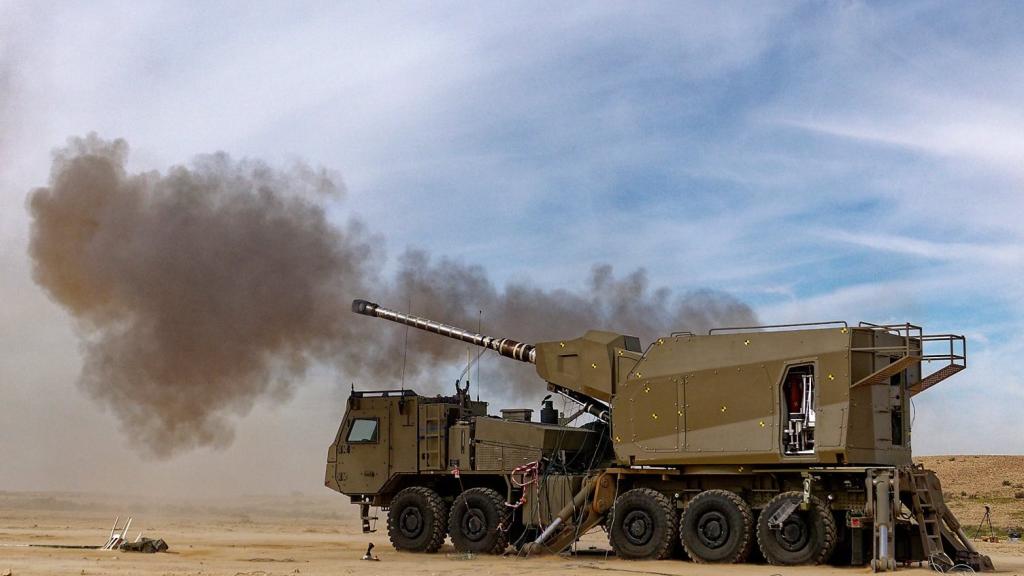
As in earlier periods, this economic shift has accompanied changes to military strategy. One telling example is Elbit Systems’ new 155mm Sigma (Ro’em) cannon. At first glance, its development seems paradoxical: Israel faces a critical shortage of 155mm shells, so why invest in a cannon that doubles the rate of fire? The Sigma’s innovations reveal the IDF’s deeper priorities: its robotic autoloader reduces crew requirements from seven soldiers to just two, enabling smaller units to operate with minimal coordination or discipline. With US bombs continuing to flow, and US aid financing Israeli purchases of shells from across the globe, the new equipment can facilitate a reorganization of IDF strategy.
The Sigma is a weapon for militia-style bombardment — maximizing destruction per soldier while institutionalizing the very lack of discipline that has characterized Israel’s Gaza campaign. It embodies the IDF’s transformation: a technologically advanced army returning to artillery, where firepower substitutes for strategy, and annihilation replaces occupation.
These tools are being wielded with the mentality of settler militias. “Artillery and direct tank fire are more effective than expensive precision weapons,” an IDF officer said in November. “Killing a terrorist using a tank shell or sniper, rather than a missile fired from a UAV, is regarded as more ‘professional.’”18 Tanks shell refugee camps point-blank; airstrikes flatten entire blocks to kill single militants. The US doctrine of combined arms and precision strikes is ignored, replaced by indiscriminate annihilation. The weapons industry created to police occupation zones across the global South in the late Cold War has turned inward, to supplement a modern fleet of US-made equipment of maximum destruction.
- 1
Ya’akov Lifshitz, Security Economy, the General Theory and the Case of Israel, Jerusalem: Ministry of Defense Publishing and the Jerusalem Center for Israel Studies (2000).
- 2
Sharon Sadeh, “Israel’s Beleaguered Defense Industry,” Middle East Review of International Affairs Journal, Vol. 5, No. 1, March 2001, pp. 64–77.
- 3
Jeremy Sharp, “US Foreign Aid to Israel: Overview and Developments since October 7, 2023,” https://www.congress.gov/crs-product/RL33222, accessed August 2025.
- 4
Nadir Tzur, “The Third Lebanon War,” Reshet Bet, July 17th, 2011 http://www.iba.org.il/bet/?entity=748995&type=297, accessed December 2013.
- 5
Yael Hason, Three Decades of Privatization [Shlosha Asorim Shel Hafrata], Tel-Aviv: Adva Center (November 2006).
- 6
Sadeh, 2001.
- 7
Jonathan Cook, “Israel Maintains Robust Arms Trade with Rogue Regimes,” Al-Jazeera, October, 2017 https://www.aljazeera.com/news/2017/10/23/israel-maintains-robust-arms-trade-with-rogue-regimes, accessed December 2024.
- 8
United Nations, “5. Estimates of Mid-Year Population: 2002–2011,” Demographic Yearbook, 2013 http://unstats.un.org/unsd/demographic/products/dyb/dyb2011.htm, accessed December 2024; Richard F. Grimmett and Paul K. Kerr, “Conventional Arms Transfers to Developing Nations, 2004–2011, “Congressional Research Service, 7–5700, August 24, 2012; Amnesty International, “Israel/Gaza: Operation ‘Cast Lead’ – 22 Days of Death and Destruction, Facts and Figures,” July, 2009 https://www.amnesty.org/en/wp-content/uploads/2021/07/mde150212009eng.pdf, accessed December 2024.
- 9
Jonathan Cook, “Israel’s Booming Secretive Arms Trade,” Al-Jazeera, August, 2013 https://www.aljazeera.com/features/2013/8/16/israels-booming-secretive-arms-trade, accessed December 2024. Neve Gordon, “The Political Economy of Israel’s Homeland Security/Surveillance Industry,” The New Transparency, Working Paper (April 28, 2009).
- 10
Sophia Goodfriend, “Gaza War Offers the Ultimate Marketing Tool for Israeli Arms Companies,” +972 Magazine, January, 2024 https://www.972mag.com/gaza-war-arms-companies/, accessed December 2024.
- 11
Maya Wind, Towers of Ivory and Steel: how Israeli Universities Deny Palestinian Freedom, Verso (2023).
- 12
Stockholm International Peace Research Institute (SIPRI) “The SIPRI top 100 Arms-Producing and Military Service Companies, 2020,” SIPRI, December, 2020 https://www.sipri.org/sites/default/files/2021-12/fs_2112_top_100_2020.pdf, accessed December 2024.
- 13
Yagil Levy, Israel’s Death Hierarchy: Casualty Aversion in a Militarized Democracy, New York: NYU Press (2012).
- 14
This is widely referred to as the Palestinian “laboratory”—a term used in the critical literature as well as by Israeli arms companies themselves.
- 15
Hussein, 2024. Yoav Zitun, “From deals in the Third World to dubious brokers: a glimpse into the IDF arms race,” Ynet, November 22nd, 2024, https://www.ynetnews.com/article/h1tefly71g; Cf. https://www.haaretz.com/israel-news/2024-09-27/ty-article-magazine/.highlight/retired-israeli-general-giora-eiland-called-for-starving-gaza-does-he-regret-it/00000192-33f5-dc91-a1df-bffff4930000, accessed January 2025.
- 16
Ellen Knickmeyer, “US spends a record $17.9 billion on military aid to Israel since last Oct. 7,” AP, October 9th, 2024, https://www.ap.org/news-highlights/spotlights/2024/us-spends-a-record-17-9-billion-on-military-aid-to-israel-since-last-oct-7/, accessed August 2025; Hagai Amit, “89 Billion NIS in two years: the numbers behind the buying binge of the IDF in the war,” The Marker, July 27, 2025. https://www.themarker.com/allnews/2025-07-27/ty-article/.highlight/00000198-4735-deec-ab9e-e73f8bc40000, accessed August 2025.
- 17
Yuval Azulay, “Israel’s Arms Industry Profits Soar as Wars Fuel Billion-Dollar Contracts,” Calcalist, August, 2024 https://www.calcalistech.com/ctechnews/article/hkuwdfkic, accessed December 2024.
- 18
Zitun, “From deals in the Third World to dubious brokers: a glimpse into the IDF arms race,” Ynet, November 22nd, 2024, https://www.ynetnews.com/article/h1tefly71g
Interview with Salah Hamouri
Saturday 20 September 2025, by Salah Hamouri
Faced with the threat of dissolution of the Urgence Palestine movement in France, French-Palestinian activist Salah Hamouri spoke to Antoine Larrache on 8 July 2025.
Why does Interior Minister Retailleau want to dissolve Urgence Palestine and the Jeune garde organisation?
I think that Urgence Palestine and the Jeune garde, each in its own struggle, have built a fairly strong activist dynamic. These organizations brought another dimension, another way of thinking, a new political analysis and a new political commitment. They have recruited new people, a new generation of activists, and thus have been able to reach a part of French society. Urgence Palestine has succeeded in influencing political life in France in relation to Palestine.
I think that Retailleau is not alone, that there is pressure from the Israelis behind this offensive. Concretely, this followed a request from right-wing MPs who are linked to Israel, and who asked him to dissolve Urgence Palestine. [1] The same is true for Palestine Action in Britain, which lost its appeal on 5 July. [2]
There is pressure to remain in humanitarian solidarity, without commitment on political bases linked to the resistance and an international struggle.
What is the specificity of Urgence Palestine in relation to the traditional pro-Palestinian movement?
I think that its specificity is the place that some Palestinians have taken, and the role they have been able to play. In France as elsewhere, it is a place that had disappeared for some time. We believe that the Palestinian diaspora will have a very important political role to play in the future in the fight and in the resistance.
It is a role that must be organised, strengthened politically, because it is a role that the Oslo Accords wanted to eliminate. Since 1994, for 30 years, the aim has been to eliminate the role of the Palestinian diaspora. So today, everywhere, in France but also in the United States, in London, in Barcelona, a Palestinian generation has awakened. This Palestinian generation is the driving force behind all events from October 7 until today.
In London, several Palestinian movements play a key role. There is a Palestinian generation in France, with Beitna in Belgium, with the Palestinians of Barcelona who played a very important role even before October 7. There is an awakening in the diaspora to play a role and regain control on the political level.
There is currently a change of position in the movement regarding the assessment of the Oslo Accords.
In general, many Palestinians have said that Oslo is a catastrophe, the third catastrophe, this time signed by Palestinian hands. At the time, people didn’t believe it, above all those who saw Arafat and Rabin shaking hands. But everywhere it was said that this would be the end of the conflict, that Israelis and Palestinians would live in peace, without seeing the fundamental issues – colonization, occupation – and without analysing the agreements signed. The second agreement, the Paris Agreement in 1996, which addresses economic issues, is the worst.
It was therefore an agreement claiming to be a peace agreement without giving back any rights to the occupied people. With Oslo, no fundamental rights were restored to the Palestinians.
Not to mention the nature of the Palestinian Authority...
Yes. When you accept the situation, there are two possibilities: either you are politically naïve, or you want to relieve yourself of a political commitment that can be expensive.
But today, no one can be naïve and not see reality. The people who remain stuck on the two-state issue and the Oslo Accords are therefore people who want to politically absolve themselves of the responsibility of really saying things as they are, both about the Palestinian Authority and about the reality of the genocide that is taking place.
Do you have any information on how people are trying to act, to resist, especially in the West Bank?
There are several issues, which are linked. In recent months, we have seen a new phenomenon, the emergence of new armed groups linked to Israelis. They are implementing the same idea as the South Lebanon Army, they have created two militias in southern Gaza, those of Abu Shabaab, in Rafah and another in Khan Younis. [3] In an interview published in the Israeli newspaper Yedioth Ahronoth, Yasser Abu Shebab makes it clear that his collaborationist militias are supported by the Palestinian Authority, the Israeli army and the United Arab Emirates. They are coordinating to create armed militias linked to the occupier in Gaza. These are the same groups that have stolen humanitarian aid and are attacking the population.
But there is also a new phenomenon in the West Bank: even if the Palestinian Authority is weak, it wants to redefine the situation politically. There has been an attempt by personalities and large families who are linked to the occupier. They want to declare Hebron an independent state with direct ties to the Israeli occupier. This is not new. In 1978, there was an Israeli project, called Rawābit al-Qurā (“Village Leagues”), which aimed to bypass some mayors and work with others, especially the important mayors. They were collaborationists, the objective was to replace the PLO with these mayors, but some were killed by the organizations present in the West Bank. [4]
Today, we are experiencing the political end of the Palestinian Authority. It no longer has a social base. The Israelis are therefore looking for an alternative to control the Palestinian territories. They are well aware that the void can be filled. Or they manage to fill it with new collaborationists – so they look in different directions, big families, business. Resistance can be expressed, even if the political parties are weak. They know well that a popular movement can break out at any time in the West Bank. The Israelis are trying to avoid it because they know that the West Bank is the strategic area that must not be lost, because a move there can hurt them a thousand times more than Gaza. This is what we saw in the first and second intifadas.
We have also seen youth mobilizations in recent years, and new activist groups.
In 2021, when there was the attempt to destroy Sheikh Jarrah, a neighbourhood in Jerusalem, an offensive was launched, and this alerted the Israelis - the movement was unleashed everywhere in Palestine - in the territories of 1948, in Jerusalem, in the West Bank, in Gaza and in the diaspora. [5] It was the first time since 1948 that all five zones acted at the same time. I think 2021 brought the term “Palestinian people” back to the forefront. A political unity was formed around the resistance. This is what alerted Israelis, who understood the danger represented by the awakening of millions of Palestinians, in Israel, in Jerusalem, in the West Bank, which endangers all Israeli colonization.
What remains of this movement?
The Israelis suppressed this movement: thousands of arrests, years of imprisonment and the destruction that followed in the West Bank. I think that soon, something will happen again in the West Bank and in Jerusalem, that it will break out.
How will it work? What will be the trigger? We don’t know. But the enormous repression, the advance of colonization, the destruction became unbearable. We see the flight in the north of the West Bank, the refugee camps in the north, what the army called Plan X. [6]
I think that people see the moment coming when there is no future, no horizon, no solution, neither human nor political. The moment when there is nothing left. And I think that we are not far from the outbreak of a great revolt.
Do you have any information on how the resistance exists in Gaza?
We have entered a guerrilla war, that’s clear. But it does not have an organized, centralized command. There are resistance fighters everywhere, who have their experience, who are on their own ground, in the cities.
For example, yesterday there was an operation in Beit Hanoun, in the far north, near the border, a town that was razed to the ground at the beginning of the war 20 months ago. And yet there were 5 dead and 15 wounded on the side of the Israeli army. The Israelis know that the longer they stay in Gaza, the more casualties they will have.
Gaza is almost unliveable, two-thirds of the territory is occupied, only the centre is not. The Israelis; pretext for not occupying is that their prisoners would be in this area and that the risk of them being killed should not be taken. The reality is that they know that the longer they stay on the ground, the more casualties they will have.
Today, there are statements by Yair Lapid – candidate for prime minister – and former generals who say that the presence in Gaza will lead to many casualties in the Israeli army and that it is necessary to withdraw from Gaza, move towards a prisoner exchange – with Palestinian political prisoners – and try to find a solution.
I think that the resistance on the ground can continue for years, Gazans are well organized, they are resisting and there is popular support for this resistance.
But with a huge human impact. Some studies speak of hundreds of thousands of deaths. Do you have any echoes of what is happening in Jordan?
During the Israeli and US imperialist invasion of Iran, Jordan aided Israel. It hosts American, French and British bases. 3,000 American soldiers are stationed there.
They know that Jordan too, for the Palestinians, is a strategic place. The fall of the regime would create a huge political explosion in the region and in the world. It is the longest border with Palestine. The regime is weak, but it is held by the repression of the security forces. There have been thousands of arrests since October 7, in the population and also in the Palestinian refugee camps.
When the Red Sea was blocked by Houthi attacks, Jordan represented a crossing point, with the “land bridge” opened between Israel and Saudi Arabia. Jordan has therefore played an important role in unblocking the Israeli economic crisis. This has been its role for the past 20 months.
For the rest of the mobilization, how do you see things?
It is difficult to anticipate what will happen. There could be a 60-day ceasefire very soon. Trump says he is committed to stopping the war, so we will see what happens.
For my part, I think that the challenge is to renew the PLO, on a revolutionary basis, and by allowing the entry of all political parties. We need a long-term program of struggle because there is no political solution today, we must first create a balance of forces, and it is up to the Palestinians to do that. We must return to a commitment based on resistance and, from there, change everything.
And in terms of solidarity mobilization?
In the same way, we must change our political language, turn to resistance. And then everything around the Palestinians will also change.
On the side of Urgence Palestine, and of the Palestinians in general, we have a political role to play in strengthening militant commitment and deepening political analysis: on the importance of resistance, on the importance of a deep, politically committed solidarity. It must not be limited to humanitarian solidarity; it must be politically and militantly committed. This is our role for the coming months and years.
Firsr published 31 August 2025
Translated by International Viewpoint from Inprecor.
Attached documentsin-palestine-as-in-international-solidarity-we-must-turn-to_a9180.pdf (PDF - 904.4 KiB)
Extraction PDF [->article9180]
Footnotes
[1] On 22 October 2024 National Rally MP Julien Odoul called for the dissolution of Urgence Palestine. On 29 April 2025 Retailleau announced his intention to dissolve UP and the anti-fascist collective La Jeune Garde. On 12 June, the latter was dissolved. A solidarity mobilization with UP has garnered the support of 250,000 signatories and more than 800 organizations. The dissolution of UP has not been pronounced to date.
[2] Palestine Action in Britain was banned following an action at a Royal Air Force base that involved spraying paint on military aircraft.
[3] The South Lebanon Army was a Lebanese militia that operated with the support of the Israeli army during the Israeli invasion of southern Lebanon in 1978 and 1982. Founded in 1976-1977, it was dissolved when the Israeli army withdrew from southern Lebanon in 2000.
[4] The Palestine Liberation Organization (PLO), established on 28 May 1964 in Jerusalem, was the main Palestinian resistance organization. It is made up of several Palestinian organizations. The main one is Fatah, but there is also the Popular Front for the Liberation of Palestine (PFLP) and the Democratic Front for the Liberation of Palestine (DFLP). It was led by Yasser Arafat from 1969 until his death in 2004. It is currently headed by Mahmoud Abbas (Abu Mazen), who is also the president of the Palestinian Authority and the State of Palestine.
[5] The “Palestinians of 1948” are the Palestinians who, following the 1948 war that led to the creation of Israel, found themselves inside the Israeli state. There are about 1.7 to 2 million of them, or 20% of Israel’s population. There are also 3.2 million Palestinians in the West Bank and, before the genocide began, 2.2 million in Gaza. There are also 6.4 million in the surrounding Arab countries and 760,000 in the rest of the world. That is about 14 to 15 million in total.
[6] Far-right Israeli government minister Bezalel Smotrich’s Plan X aims to grab Palestinian land in the occupied West Bank. In 2024, 800 hectares were seized: according to the Israeli anti-settlement organization Peace Now, this is the largest seizure of land in Palestinian territory since the Oslo Accords.
Salah Hamouri is a French Palestinian lawyer, researcher, who has spent a total of over ten years as a political prisoner in Israeli prisons.
International Viewpoint is published under the responsibility of the Bureau of the Fourth International. Signed articles do not necessarily reflect editorial policy. Articles can be reprinted with acknowledgement, and a live link if possible.
They did not pass!
Thursday 18 September 2025, by Brian Anglo
This year’s three-week cycle race round the Spanish State, La Vuelta, has set numerous records. Not in terms of sporting prowess, but in regard to the popular mobilisations to stop it being used to whitewash Israel’s genocide in Palestine.
The image-cleaning product used in this case was a team called Israel-Premier Tech. It is owned by the Canadian-born, but Israeli resident, multimillionaire Sylvan Adams, who sees himself and the team as ambassadors for his country of adoption. In 2018, he was instrumental in getting the Giro d’Italia to start in Israel.
Pro-Palestinian solidarity in the Spanish State has a long history articulated mainly, but not exclusively, by the Solidarity Network against the Occupation of Palestine (Rescop). Over the past two years, there have been constant, massive mobilisations throughout the country involving even the smallest towns and villages.
Taking advantage of the momentum built up, the movement decided to target Israel-Premier Tech. This began in Catalonia on stage 5 when a relatively small group of demonstrators blocked the road and managed to hold the team up for a short while during a time trial.
As the race moved around the country, almost each stage saw an escalation of the disruption, in spite of a number of arrests, and the demand for Israel-Premier Tech to be thrown out of the competition became stronger. Although the race organisers ignored this, the team eventually dropped “Israel” from its name and put on new jerseys.
This was nowhere near enough for a movement that was having a real impact, not just on the race itself, with stages forced to end several kilometres before the scheduled finish line, but also in the media, on public opinion and even on the Spanish government.
By the time it came to the final stage, which was supposed to be little more than a placid ride round Madrid followed by a prize-giving ceremony with the local authorities enjoying a photo opportunity and publicity for the city, numerous points on the route were already swarming with protestors ready for action.
An attempt to avoid the demonstrators by re-routing the riders had little effect. The roads along which they were due to pass were overrun and the organisers had to call the whole thing off… 55 kilometres short of the programmed finish.
It’s true that Israel-Protech was not expelled from the race, but the disruption inflicted, the reputation damage caused and the political repercussions ensuing were rightly seen as a victory for the solidarity movement and hence as a springboard for further action, including around the Global Sumud Flotilla.
Adapting the “¡No pasarán!” (They shall not pass!) of Madrid’s defenders against the fascists during the Civil War, it was now possible to say “¡No pasaron!” (They did not pass!).
The next day, the Spanish government, under pressure also for failing to keep its promise to decree an arms embargo on Israel, was obliged to say it supported the actions taken during the Vuelta.
Members of Anticapitalistas (the Fourth International organisation in the Spanish State) played a considerable part, but this was above all a sustained, collective effort that drew its strength from the involvement of tens of thousands of people.
Next year’s Tour de France, with Israel-Premier Tech billed to take part, is due to begin in Barcelona. Plenty of time to prepare a hot reception if necessary.
Attached documentsthey-did-not-pass_a9178.pdf (PDF - 904.5 KiB)
Extraction PDF [->article9178]
Brian Anglo is an activist of Anticapitalistas in Catalonia.
International Viewpoint is published under the responsibility of the Bureau of the Fourth International. Signed articles do not necessarily reflect editorial policy. Articles can be reprinted with acknowledgement, and a live link if possible.
Clear Conclusions: A UN Commission Finds Israel Responsible for Genocide in Gaza
Yet another blistering addition to the ghoulish accounts of cruelty regarding the ongoing actions of Israel in Gaza made its appearance on September 16. It came in the form of a report by the United Nations Independent International Commission of Inquiry on the Occupied Palestinian Territory, a lashing publication finding Israel guilty of committing genocide on the Strip. Of the five elements outlined in the 1948 Genocide Convention, Israel was found guilty of four. (The state’s interest in transferring Palestinian children from one group to another is yet to show itself.)
The relevant acts outlined in the report include instances of killing, causing serious bodily or mental harm, the deliberate infliction of conditions of life calculated to bring about physical destruction, and imposing measures intended to prevent births, all conducted with the specific intent to destroy the Palestinian people as a group. “Today we witness in real time how the promise of ‘never again’ is broken and tested in the eyes of the world,” said the Commission’s chair Navi Pillay in a press conference following the report’s release.
This report finds itself in the adhesive if gruesome company of such publications as Amnesty International’s December 2024 effort, You Feel Like You are Subhuman to the August 2025 conclusions of the International Association of Genocide Scholars. The Special Rapporteur on the human rights situation in the Palestinian territories, occupied since 1967, Francesca Albanese, has also been admirably busy drumming up interest in the links between genocide and starvation. Such bountiful material has yet to convince the Israeli authorities to pause their efforts in Gaza, now culminating in the systematic destruction of Gaza City and the displacement of its population.
The Commission authors, all sound and weighty figures of international jurisprudence, also found that Israeli President Isaac Herzog, Prime Minister Benjamin Netanyahu and former Defence Minister Yoav Gallant “incited the commission of genocide and that Israeli authorities have failed to take action against them to punish this incitement.” More broadly, Israel’s political and military leaders responsible for prosecuting the war strategy “are ultimately responsible for the commission of the underlying acts of genocide by members of the Israeli security forces”, with such leaders being “agents of the State of Israel”.
The mental state for establishing genocide had been established by relevant statements made by members of the Israeli authorities. In addition to this, there was “circumstantial evidence of genocidal intent and that genocidal intent was the only reasonable inference that could be drawn from the totality of the evidence.” Israeli authorities and security forces “had and continue to have the genocidal intent to destroy, in whole or in part, the Palestinians in the Gaza Strip.”
The Commission also makes various recommendations, including the obvious one of ending the commission of genocide and Israel’s compliance with the three provisional orders of the International Court of Justice (ICJ) made in January, March and May last year; the immediate implementation of a permanent ceasefire in Gaza and conclusion of military operations in the occupied Palestinian territory that entail genocidal acts; the restoration of the United Nations aid model, unimpeded; and the investigation and punishment of acts of genocide and incitement to genocide against the Palestinians in the Strip.
Pointed words are also reserved for the international community, among them that all Member States pull their weight in insuring the prevention of genocidal acts in the Strip, cease the transfer of arms and equipment to Israel or third parties “where there is reason to suspect their use in military operations that have involved or could involve the commission of genocide”, ensure that corporations and individuals within their territories and jurisdiction are not part of the genocidal program, and facilitate necessary investigations and prosecutive proceedings against the State of Israel and corporations and individuals regarding genocide, its facilitation and incitement.
The Commission arose in 2021, when it was established by the UN Human Rights Council to investigate alleged violations of international law in the Occupied Palestinian Territory, including East Jerusalem, and in Israel. The September report makes much of three previous reports issued by the COI, and three papers relevant to international law violations committed by all the parties to the conflict.
To have reached findings of genocidal intent is a tall order indeed. The mental threshold needed to satisfy genocidal intent is a dizzyingly high bar to meet. The ICJ, even as it considers Israel’s own actions in Gaza at the litigious prodding of South Africa, has shown itself reluctant to identify the destructive intent (dolus specialis) against an identifiable group as protected by the UN Genocide Convention. In the Bosnia v Serbia case, Serbia was not found to be responsible for the commission of genocide, but for its failure in preventing it with respect to the killings of over 7,000 Bosnian Muslims at Srebrenica in July 1995. The Court imposed a giddy standard of proof: that the pattern of acts in destroying the identifiable group should “have to be such that it could only point to the existence of such intent”. It was a standard criticised by Judge Awn Al-Khasawneh in his dissenting opinion, feeling that such acts as “population transfers” and “evidence of massive killings systematically targeting the Bosnian Muslims” evidenced obvious genocidal intent.
In 2015, the ICJ also found that neither Serbia or Croatia had committed acts of genocide against each other’s populations during the disintegration of Yugoslavia, despite killings and the infliction of serious bodily or mental harm to both groups by virtue of them being members of an ethnic group.
Judge Antônio Augusto Cançado Trindade, in his dissenting opinion in Croatia v Serbia, proffers a salutary observation: “perpetrators of genocide will almost always allege that they were in armed conflict, and their actions were taken ‘pursuant to an ongoing military conflict’; yet, ‘genocide may be a means for achieving military objectives just as readily as military conflict may be a means for instigating a genocidal plan”.
There is certainly much to draw upon, be it the Commission’s findings, or the excoriating report by UN Special Rapporteur Albanese. The latter tartly exposes the misuse of international humanitarian law as an instrument of Israeli advancement, making a mockery of aid to the very people the state seeks to dislocate, kill and humble.
The response from Israel is also instructive in terms of how that state fits within the law of nations, which it has sought to reinterpret with postmodern elasticity. A statement from the Israeli Ministry of Foreign Affairs makes short work of the report as “distorted” and “false”, accusing the authors as “Hamas proxies, notorious for their antisemitic positions” and demanding the “immediate abolition of this Commission of Inquiry.” That would be all too convenient.

No comments:
Post a Comment