Landmark WTO deal shifts course in global effort to curb overfishing
A global deal to protect fish stocks that billions of people rely on for food and jobs came into force this week after more than 20 years of talks. Governments have agreed to stop giving subsidies to boats that break rules against overfishing – but the agreement does not yet cover subsidies that build ever larger fleets.
Issued on: 20/09/2025 - RFI
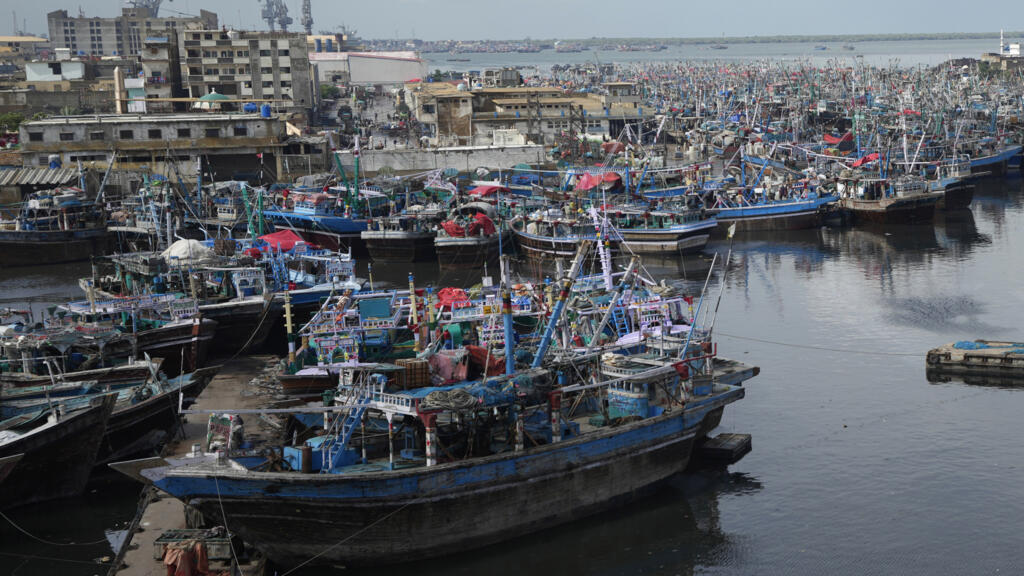
Under negotiation since 2001, the World Trade Organisation (WTO) Agreement on Fisheries Subsidies was adopted in June 2022, and enough countries ratified it for it to officially come into force on Monday, 15 September.
Subsidies to fishing fleets are a key factor in the depletion of fish stocks around the world. Critics have long argued that they incentivise boats to catch fish faster than stocks can replenish.
Around 35 percent of global fish stocks are overfished, compared to just 10 percent in 1974, according to the United Nations Food and Agriculture Organisation, and almost all stocks are fished at their maximum sustainable level.
'Game changer'
The WTO deal, the first to address an environmental issue, is a “game changer”, according to Tristan Irschlinger, an expert on the issue at the International Institute for Sustainable Development, a Canada-based think tank.
“States will no longer implement their subsidy policies in a legal vacuum – they will need to keep sustainability in mind,” he told RFI.
In 2018, states granted fisheries €30.1 billion ($35.4 billion) in public subsidies, according to one study, with China, the European Union, the United States, South Korea and Japan in the lead.
Of that sum, “governments spend around €18.7 billion ($22 billion) on harmful subsidies that contribute to overfishing and the depletion of marine resources”, said WTO Director-General Ngozi Okonjo-Iweala.
The new rules aim to address both environmental concerns and the well-being of fishing communities.
“No one has an interest in financially supporting illegal fishing, or harvesting of already overfished stocks,” Irschlinger said. But there needed to be a mechanism for countries to stop doing so, he suggested, “without losing face in front of other states”.
France defends tuna policy as critics warn of overfishing in the Indian Ocean
The first part of the WTO agreement, called Fish 1, targets illegal, unreported and unregulated (IUU) fishing practices, whether carried out deliberately or not.
“The agreement specifically targets industrial fishing activities that profit illegally because they know the risks are generally quite low,” explains Irschlinger.
IUU practices include vessels operating without authorisation or in violation of the law, such as fishing in protected waters, catching protected species, or using banned gear like dynamite.
Quantifying the effects of IUU fishing is difficult.
A 2009 study determined the practice accounted for between 11 and 19 percent of all fish caught globally in the 2000s — between 11 and 26 million tonnes of fish. The numbers are almost certainly much higher today.
Beyond its environmental impact and the effects on food security, IUU fishing also intersects with crime, according to French ocean conservation organisation Fondation de la Mer.
IUU is “linked to corruption, mafia practices, modern slavery and organised crime”, it said in a report on the practice last year.
Help for developing countries
The WTO agreement prohibits states from granting subsidies to vessels and operators in three cases: when fishing activities are illegal; when fish stocks are overexploited; or when fishing takes place on the high seas, which are not regulated by any single state.
The UN's High Seas Treaty, which is expected to come into force next week, will reinforce the WTO agreement, particularly through the creation of marine protected areas where some or all forms of fishing would be banned.
French Polynesia unveils world's largest marine protected zone
Developing countries are given a two-year grace period to comply with the agreement, and 17 members have pledged more than €15 million ($18 million) to a fund to help fisheries transition to more sustainable practices.
In theory the agreement would be enforced through the WTO’s Dispute Settlement Body, which resolves conflicts between states – but because the United States has blocked the appointment of judges, it has remained unable to handle new cases since 2019.
The agreement also does not specify the kinds of sanctions that could be imposed.
Aiming to avoid the need for penalties, a fisheries subsidies committee will be tasked with monitoring implementation, while states are also expected to scrutinise each other.
Looking ahead to Fish 2
There is hope that the first part of the agreement will build momentum for the second part, Fish 2, currently under negotiation, to be finalised within four years.
Fish 2 focuses specifically on fishing fleets themselves, which Irschlinger says is “the root of the problem”.
The Fondation de la Mer says that even when fishing fleets are not fishing illegally, or when stocks are not yet overfished, subsidies can still be harmful: “They often promote the development of oversized fishing fleets and encourage excessive fishing pressure, which can ultimately lead to overexploitation or even stock collapse.”
The second part of the agreement sets out a general list of prohibited subsidies, and removes the need to detect illegal fishing or assess fish stocks in order to enforce the rules. Instead it is up to states to prove that they have put management measures in place.
Fish 2 depends on ratification by the United States, which ratified Fish 1 under the previous administration.
The new administration is taking a more ambitious and hardline stance in negotiations, aligned with India and Indonesia, which argue that the text is not strict enough on states that subsidise the most.
Negotiations will likely restart in earnest in March of next year at a WTO meeting in Yaoundé, Cameroon.
Ghana Expands Inshore Exclusion Zone To Curb IUU Fishing – Analysis
Ghana has adopted a new fisheries act aimed at stemming illegal, unreported and unregulated (IUU) fishing. Among other new regulations, the Ghanaian government expanded the country’s inshore exclusion zone (IEZ) from 6 to 12 nautical miles from shore.
Industrial and large-scale vessels are prohibited from fishing in a country’s IEZ, but trawlers from China and other foreign fishing trawlers routinely invade waters meant for Ghana’s artisanal fishermen.
“When the trawlers come close to the area marked solely for our men, they tend to catch a lot of the fish meant for artisanal fishers, and we end up making huge losses,” Regina Solomon, president of the National Fish Processors and Traders Association, told the Environmental Justice Foundation (EJF). “If these fishes had been left for our men to catch, we would have made much more profits buying from them and selling, thereby securing the livelihoods of both our local fishermen and we the fish processors.”
IUU fishing costs Ghana an estimated $14.4 million to $23.7 million annually. Signed into law by President John Mahama on August 19, the act aims to restore stocks of small pelagic fish — such as anchovies, sardines and mackerel, which are near collapse — stimulate the blue economy, and sustain the livelihoods of more than 200,000 artisanal fishermen and 500,000 fish processors and traders.
Addressing ‘Yellow Card’
The new law also is expected to help Ghana shed a 5-year-old European Union (EU) “yellow card” sanction over IUU fishing and address weaknesses in monitoring and enforcement.
“We need to work to immediately get the yellow card lifted, otherwise we risk getting a red card, which means fish from Ghana cannot be exported to the EU market that happens to be the largest market for the fisheries sector,” Emelia Arthur, Ghana’s minister for fisheries and aquaculture, told the Ghanaian newspaper Business and Financial Times.
Exports of tuna contribute nearly $400 million annually to the nation’s economy, Arthur told the Fisheries Committee for the West Central Gulf of Guinea. Lifting the EU warning would restore full market access and demonstrate international recognition of improved fisheries management.
Analysts lauded Ghana’s new law.
“Ghana’s approach could influence other West African nations facing similar challenges with EU trade warnings over fishing practices,” the News Ghana website wrote in an editorial. “Regional coordination may be necessary to address transboundary fishing issues and industrial vessel movements.”
The EJF said that monitoring systems and hefty penalty structures will determine whether the legislation can truly rebuild Ghana’s fisheries.
“This new law marks a turning point for Ghana’s fisheries and coastal communities,” Steve Trent, the EJF’s chief executive officer and founder, said in a statement. “It sends a clear signal of leadership, vision, and commitment to the millions of people who rely on a healthy ocean.”
Beijing’s Bad Actors
Chinese trawlers have pillaged Ghanaian waters for decades, causing the near collapse of some species and driving up prices. China is the world’s worst illegal fishing offender, according to the IUU Fishing Risk Index. In April, Ghana’s Fisheries Commission and Ministry of Fisheries and Aquaculture suspended the fishing licenses of four Chinese trawlers for fishing in restricted areas; harvesting juvenile fish; dumping unwanted fish; and saiko, the unauthorized transshipment of fish at sea.
The Chinese vessels are all flagged to Ghana but are owned by three Chinese companies, the Ghana Business News website reported. Chinese trawlers are notorious for using this practice, known as “flagging in,” in which they abuse local rules to flag a foreign-owned and -operated fishing vessel into an African registry to fish in local waters. Flagging in is a common sign that vessels engage in illegal fishing. According to the EJF, Chinese corporations own at least 90% of the industrial trawlers operating in Ghana.
IUU fishing is often linked to other sea crimes, including human trafficking, drug smuggling and piracy.
Earlier this year, Ghana suspended the fishing licenses of four Chinese vessels. The vessels were accused of saiko – the unauthorized transshipment at sea among other violations. The four vessels include Meng Xin 10, Florence 2, Long Xiang 607 and Long Xiang 608. The fishing ban will last for one year.

Africa Defense Forum
The Africa Defense Forum (ADF) magazine is a security affairs journal that focuses on all issues affecting peace, stability, and good governance in Africa. ADF is published by the U.S. Africa Command.

No comments:
Post a Comment