20/09/2025 -
By: FRANCE 24
Video by: Peter O'BRIEN
Venezuela on Friday accused the United States of waging an "undeclared war" in the Caribbean and called for a UN probe of American strikes that have killed over a dozen alleged drug traffickers on boats in recent weeks.
Washington has deployed warships to international waters off Venezuela's coast, backed by F-35 fighters sent to Puerto Rico in what it calls an anti-drug operation.
"It is an undeclared war, and you can already see how people, whether or not they are drug traffickers, have been executed in the Caribbean Sea. Executed without the right to a defence," Defense Minister Vladimir Padrino Lopez said as he attended a military exercise in response to the US "threat".
US forces strike third alleged drug vessel killing three, Trump says
His remarks came just hours before US President Donald Trump announced another military strike on a boat, claiming three more alleged "narcoterrorists" were killed, bringing the total number of deaths in recent weeks to 17.
He did not say when the attack took place, and only specified that it occurred in the US Southern Command area of responsibility, which includes Central and South America, as well as the Caribbean.
The strikes have prompted debate over the legality of the killings, with drug trafficking itself not a capital offence under US law.
Read more‘A show of strength’: Trump’s war on drugs with Venezuela
Washington has also not provided specific details to back up its claims that the boats targeted have actually been trafficking drugs.
Venezuelan Attorney General Tarek William Saab claimed that "the use of missiles and nuclear weapons to murder defenceless fishermen on a small boat are crimes against humanity that must be investigated by the UN".
The biggest US naval deployment in the Caribbean in decades has stoked fears the United States is planning to attack Venezuelan territory.
On Wednesday, Venezuela launched three days of military exercises on its Caribbean island of La Orchila in response to the perceived threat from a US flotilla of seven ships and a nuclear-powered submarine.
La Orchila is close to the area where the United States intercepted and held a Venezuelan fishing vessel for eight hours over the weekend.
Venezuela: Trump says US struck another alleged drug vessel
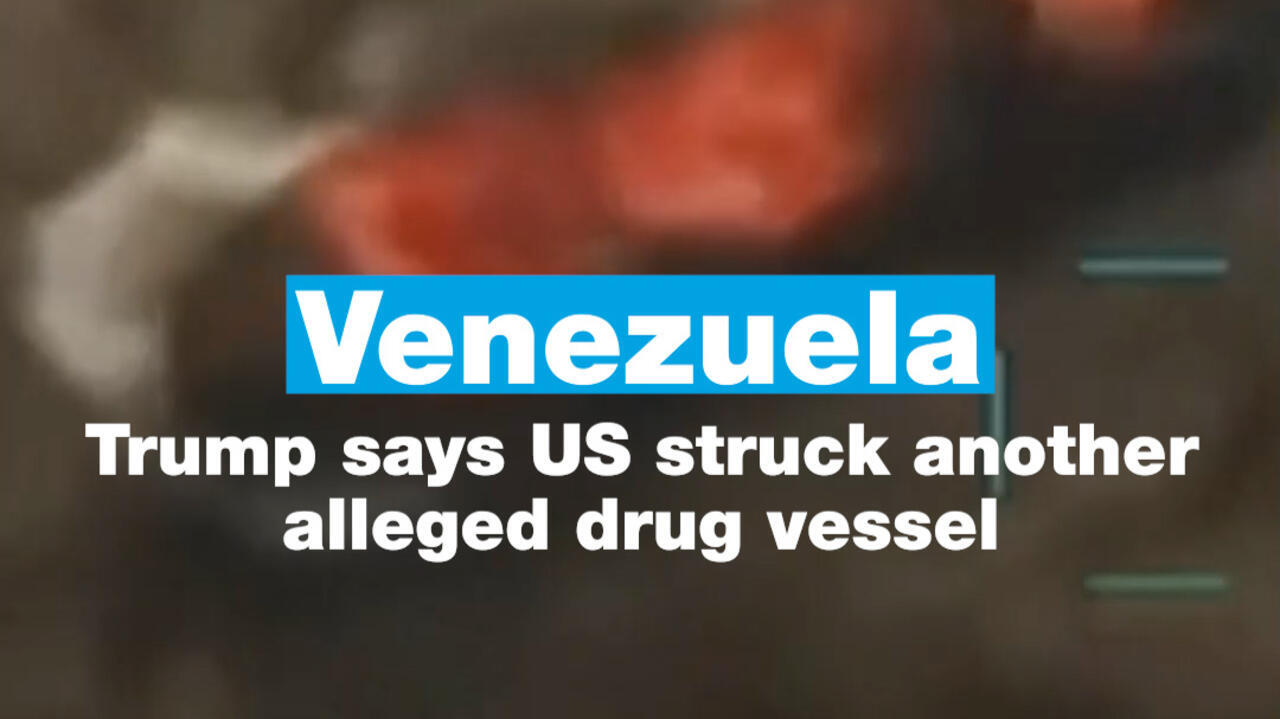
00:51
Venezuelan President Nicolas Maduro, whom the United States does not recognise as legitimate and accuses of running a drug cartel, has urged citizens to join militia training to "defend the homeland".
Late Thursday, he announced that troops will provide residents of low-income neighbourhoods with weapons training.
Maduro, for whom Washington has issued a $50 million bounty on drug trafficking charges, suspects the Trump administration of planning an invasion in pursuit.
Trump had said on Tuesday that US forces "knocked off" three boats crossing the Caribbean, but Washington only provided details and video footage of two of the strikes.
Maduro accused the United States of hatching "an imperial plan for regime change and to impose a US puppet government... to come and steal our oil".
He has repeatedly vowed Caracas will exercise its "legitimate right to defend itself" against US aggression.
Opposition figure Henrique Capriles, a two-time presidential candidate and staunch Maduro critic, said Friday he would not support any US invasion.
"I continue to believe that the solution is not military, but political," he said, adding that Trump's actions were counterproductive and "entrenching those in power".
He called for the release of nearly a thousand dissidents locked up under Maduro, and for the Venezuelan government to show goodwill in foreign relations.
(FRANCE 24 with AFP)
“President Trump has no legal authority to launch strikes or use military force in the Caribbean or elsewhere in the Western Hemisphere,” said Sen. Tim Kaine.

The USS Sampson, a US Navy missile destroyer, docks at the Amador International Cruise Terminal in Panama City, Panama, on September 2, 2025. The deployment comes amid a broader US naval presence in Latin American and Caribbean waters following President Donald Trump’s order last month to take action against Latin American drug cartels.
(Photo by Daniel Gonzalez/Anadolu via Getty Images)
Julia Conley
Sep 19, 2025
COMMON DREAMS
With 14 people killed in the Caribbean in recent days by US forces at the direction of President Donald Trump, two Democratic senators on Friday moved to stop the Trump administration from continuing military strikes against boats that it claims are involved in drug trafficking.
Sens. Tim Kaine (D-Va.) and Adam Schiff (D-Calif.) introduced a joint resolution calling for the US to stop engaging in military hostilities that have not been authorized by Congress, days after Trump announced that US forces had killed three people whom the president claimed were part of “extraordinarily violent drug trafficking cartels” based in Venezuela.
Senator Says New Details of Venezuela Bombing Reveal ‘Trump’s Growing Lawlessness’
Omar Brings War Powers Resolution After Trump Bombed Boat in Caribbean With ‘No Legal Justification’
“President Trump has no legal authority to launch strikes or use military force in the Caribbean or elsewhere in the Western Hemisphere,” said Kaine in a statement, adding that the administration has refused to release basic information showing it was necessary to attack the vessels.
The strikes have been condemned by legal and human rights experts as ”murder” and ”extrajudicial executions” of civilians—people who, if they were in fact bringing drugs to the US as the White House has claimed, would typically be confronted by law enforcement agencies instead of struck by the military
The US Coast Guard has in the past intercepted boats and searched them to confirm suspected drug smuggling, and arrested their crews.
As Sen. Chris Murphy (D-Conn.) said last week, Trump’s claim that boats are carrying fentanyl, which caused roughly 48,000 drug overdoses in the US last year, is likely inaccurate. Fentanyl is primarily trafficked from Mexico and Central America into the US, he noted, not from Venezuela.
Secretary of State Marco Rubio said earlier this month that the United Nations Office on Drugs and Crime’s assessment that Venezuela is also not a major source of cocaine was of no importance to the administration.
“I don’t care what the UN says,” Rubio told reporters after the first military strike in the Caribbean.
The White House has not released evidence showing that the boats were carrying drugs; after the first bombing, the president said the administration had “tapes of [the victims] speaking” that showed they were members of the Venezuelan gang Tren de Aragua, which it has designated a terrorist organization that works directly with the South American country’s government—despite US intelligence agencies’ finding that the group does not work with President Nicolás Maduro.
Even if the president’s suspicions were correct, said Sarah Yager, Washington director at Human Rights Watch, “US officials cannot summarily kill people they accuse of smuggling drugs.”
“The problem of narcotics entering the United States is not an armed conflict, and US officials cannot circumvent their human rights obligations by pretending otherwise,” Yager said Thursday.
While claiming the military is targeting drug traffickers, Vice President JD Vance suggested this week that the US could mistakenly kill civilians who are not involved in drug activity, joking, “I wouldn’t go fishing right now in that area of the world.”
The administration has not disclosed a legal analysis of why it believes the strikes, which it has said will continue, are lawful.
Congress has not authorized any military conflict with drug cartels, and at a Senate Armed Services Committee hearing on Thursday, a nominee for a position at the Pentagon was unable to answer Democratic lawmakers’ questions about the legality of the administration’s strikes.
On Friday, reporting by The New York Times suggested that Republican lawmakers and the White House are working to grant the administration the legal authority to continue the strikes.
A draft bill is circulating around the White House and Congress to grant the president the power to order military strikes to carry out “the drug trafficking war.”
The authority would last for five years, and longer if renewed by Congress, and would cover groups that the administration has designated terrorist organizations as well as nations that harbor those groups.
Jack Goldsmith, a former George W. Bush administration official and a Harvard Law School professor, told the Times that the legislation is “insanely broad.”
“This is an open-ended war authorization against an untold number of countries, organizations, and persons that the president could deem within its scope,” said Goldsmith.
Introducing their resolution on Friday, Kaine and Schiff said they do not want to prevent the US from carrying out strikes in self-defense against an “armed attack.”
But, they emphasized, “the trafficking of illegal drugs does not itself constitute such an armed attack or threat.”
Yager called on Congress to also “open a prompt and transparent investigation into the decision-making process behind these attacks, including the legal rationale and chain of command.”
“The US military should immediately halt any plans for future unlawful strikes,” she said, “and ensure that all military operations comply with international human rights and humanitarian law.”
The Return of Drug War Imperialism
The Trump administration is escalating U.S. drug wars in Latin America as a cover for imperialism.
While the administration directs a military buildup in the Caribbean, killing people who it claims are drug smugglers, it is preparing to intervene in Latin American countries for the purpose of opening their markets to U.S. businesses. The administration’s priority is gaining access to Latin American resources, a main focus of its foreign policy, just as the highest-level officials have indicated.
“Increasingly, on geopolitical issue after geopolitical issue, it is access to raw material and industrial capacity that is at the core both of the decisions that we’re making and the areas that we’re prioritizing,” Secretary of State Marco Rubio said in June.
Drug War Imperialism
One of the major contributions of the United States to imperial history is drug war imperialism. Developed as part of the so-called “war on drugs,” which the Nixon administration began in the 1970s and the Reagan administration expanded in the 1980s, drug war imperialism has been one of the primary means by which the United States has intervened in Latin America.
During the late 1980s, the United States set the standard for drug war imperialism in Panama. After discrediting Manuel Noriega with drug charges, officials in Washington organized a military intervention to remove the Panamanian ruler from power.
Under the direction of the George H. W. Bush administration, the U.S. military invaded Panama, captured Noriega, and brought him to the United States, where he was tried, convicted, and imprisoned on drug charges. U.S. officials framed the operation as part of the war on drugs, but their primary concern was bringing to power a friendly government that acted on behalf of U.S. interests. U.S. officials valued Panama for its location and for the Panama Canal, a critical node for U.S. trade.
In the following decades, the United States exercised other forms of drug war imperialism in Latin America. In 2000, the administration of Bill Clinton implemented Plan Colombia, a program of U.S. military support for the Colombian government. U.S. officials framed Plan Colombia as a counter-narcotics program, but their objective was to empower the Colombian military in its war against leftist revolutionaries, especially the Revolutionary Armed Forces of Colombia (FARC).
In 2007, the administration of George W. Bush pushed forward a similar program in Mexico. With the Mérida Initiative, the Bush administration empowered the Mexican government to intensify its war against drug cartels. U.S. officials saw the program as way to forge closer relations with the Mexican military and confront the country’s drug traffickers, who were making it difficult for U.S. businesses to operate in the country.
Multiple administrations faced strong criticisms over the programs, especially as drug-related violence increased in Colombia and Mexico. A Colombian truth commission estimated that 450,000 people were killed in Colombia from 1985 to 2018, with 80 percent of the deaths being civilians. There have been hundreds of thousands of drug-related deaths in Mexico, with the numbers still increasing by tens of thousands every year.
Although most U.S. officials insisted that criminal organizations in Latin America bore primary responsibility for drug-related violence, some began to question the U.S. approach. They wondered whether U.S.-backed drug wars were ignoring root causes of the drug problem, such as the U.S. demand for drugs.
“As Americans we should be ashamed of ourselves that we have done almost nothing to get our arms around drug demand,” Secretary of Homeland Security John Kelly said in 2017. “And we point fingers at people to the south and tell them they need to do more about drug production and drug trafficking.”
In recent years, some critics have even cast the drug wars as a failure. Decades of U.S.-backed military operations, they have noted, have brought terrible violence to Latin America while failing to stop the flow of drugs to the United States.
“Drugs have kept flowing, and Americans and Latin Americans have kept dying,” Shannon O’Neil, who chaired a congressionally-mandated drug policy commission, told Congress in 2020. “Something is not working.”
Trump’s Embrace of Drug War Imperialism
Despite the recognition in Washington that drug wars do not counter drugs, the Trump administration is using them to create a justification for military operations across Latin America.
The Trump administration laid the groundwork for an intensified version of drug war imperialism shortly after entering office. On day one, Trump issued an executive order to designate drug cartels as terrorist organizations, claiming they “present an unusual and extraordinary threat” and declaring a national emergency to deal with them. The State Department quickly followed by labelling drug cartels and other criminal organizations as terrorist organizations.
In July, Trump secretly ordered the Pentagon to start attacking drug cartels.
Earlier this month, the U.S. military began to implement Trump’s orders by launching a drone strike on a speedboat in the Caribbean that was carrying 11 people. Administration officials accused the people on board of being Venezuelan drug smugglers, but critics questioned the Trump administration’s claims and argued that its actions were illegal. Some accused the Trump administration of murder.
Trump and Rubio discredited the administration’s justification for the attack by making different claims about the destination of the speedboat. Whereas Rubio said that it was headed toward Trinidad, Trump said that it was destined for the United States. Wanting to be consistent with the president, Rubio then changed his story, claiming that the speedboat was going to the United States.
Critics have also questioned whether the administration has been acting over concerns about drugs. One of their main points has been that Venezuela’s involvement in the drug trade has been overstated.
When Rubio faced questions about the administration’s attack on the speedboat, he dismissed reports that attributed less importance to Venezuela, including those by the United Nations.
“I don’t care what the UN says,” Rubio said.
Trump displayed the same disregard when he announced on social media on Monday that he ordered another strike on a boat in the Caribbean, saying that it killed 3 people. “BE WARNED,” he wrote. “WE ARE HUNTING YOU!”
For many years, in fact, several of the highest-level officials in the Trump administration have been eager for the United States to play a more aggressive role in Latin America not for the purpose of countering drugs but with the goal of acquiring greater access to the region’s resources.
It has long been known that Trump values Venezuela because it is home to the largest known oil reserves in the world.
“That’s the country we should be going to war with,” Trump is alleged to have said in 2017, during his first year in office. “They have all that oil and they’re right on our back door.”
Several high-level officials in the first Trump administration shared the president’s views. In 2018, then-Secretary of Defense James Mattis commented that Venezuelan leaders “sit on enormous oil reserves.”
When the first Trump administration rallied Venezuelan opposition forces in 2019 in a failed attempt to overthrow the Venezuelan government, several high-level officials boasted about the potential riches of Venezuelan oil, suggesting that it would be a boon to U.S. investors.
“It is a country with this incredible resource of petroleum, the greatest in the world,” then-Special Representative for Venezuela Elliott Abrams told Congress. “So I think you will find that with a change of leadership and a change of economic policy, that there will be lots of people who are ready to invest, and I think the World Bank and the IMF in particular will be ready to help start that engine.”
Since the start of his second administration, Trump has continued to think about the country’s oil, even as he has brought different people into his administration.
“You’re going to have one guy sitting there with a lot of oil under his feet,” Trump said in February, referring to Venezuelan President Nicolás Maduro. “That’s not a good situation.”
Ulterior Motives
While the Trump administration has forged ahead with its expansion of U.S. military operations in the Caribbean, giving special attention to Venezuela, it has deployed a familiar argument. Just as past administrations have done, the Trump administration has claimed that it is going to war against drugs.
“On day one of the Trump administration, we declared an all-out war on the dealers, smugglers, traffickers, and cartels,” Trump said in July, referring to his executive order to target drug cartels as terrorist organizations.
Administration officials have supported the president’s approach. Leading the way, Rubio has repeatedly insisted on the need to take military action against drug traffickers.
“The president of the United States is going to wage war on narcoterrorist organizations,” Rubio said earlier this month.
Still, U.S. officials have gestured at ulterior motives. When Rubio has spoken about the administration’s drug wars, he has indicated that he is focused on creating conditions in Latin America that will enable U.S. businesses to operate there more effectively.
“It’s nearly impossible to attract foreign investment into a country unless you have security,” Rubio said during a recent visit to Ecuador, where he acknowledged ongoing negotiations over a trade deal and a military base.
In fact, the Trump administration has made it clear that it is focused on creating new opportunities for U.S. businesses and investors in Latin America. Concerned that Latin American countries have been growing close to China, the Trump administration has been using drugs as an excuse for a more aggressive U.S. role in the region.
What the Trump administration is doing in short, is going to war against drugs as a cover for opening Latin American markets to U.S. businesses. Turning to a familiar playbook, it is implementing drug war imperialism


No comments:
Post a Comment