Global Intellectuals Voice Solidarity With Palestine Action Hunger Strikers ‘At Death’s Door’
Angela Davis, Naomi Klein, Sally Rooney, Tariq Ali, and George Monbiot are among the signers of a statement of support for the proscribed anti-genocide protesters, who have refused food for over two months.
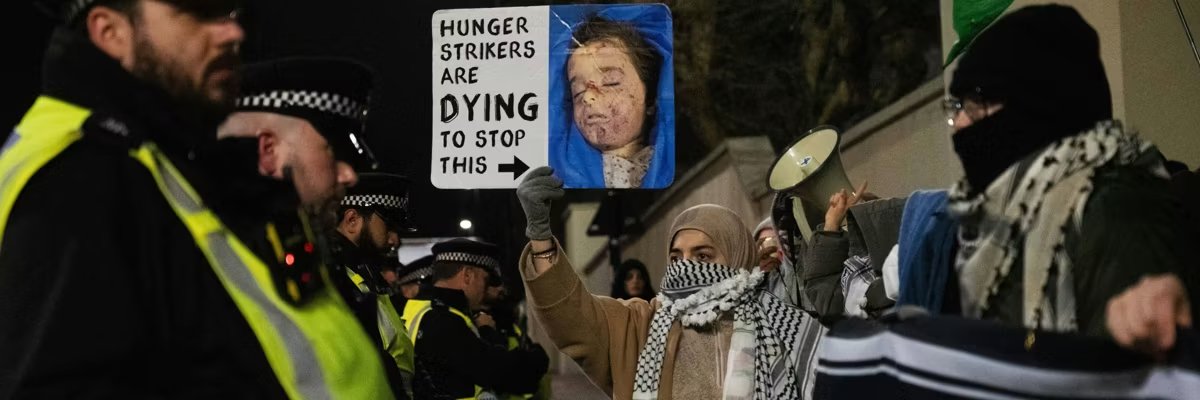
Protesters rally outside Pentonville Prison in London on January 11, 2026 in support of hunger-striking members of the banned anti-genocide group Palestine Action.
(Photo by Kristian Buus/In Pictures via Getty Images)
Brett Wilkins
Jan 12, 2026
COMMON DREAMS
More than 50 international authors and academics signed a declaration published Monday in support of hunger-striking activists allegedly linked to the banned Palestine Action movement, who are at imminent risk of death after refusing to eat for more than two months.
The brief statement—“We oppose genocide, we support the Palestine Action prisoners”—was signed by prominent figures including historian Tariq Ali; novelist Sally Rooney; former Guantánamo Bay prisoner Moazzam Begg; journalists Owen Jones and George Monbiot; and professors Angela Davis, Judith Butler, Naomi Klein, and Ilan Pappé.
UK Medical Professionals Warn Palestine Action Hunger Strikers ‘Will Die in Prison’
The declaration echoes the message on a placard held by Swedish climate campaigner Greta Thunberg when she was arrested last month in London protesting the imprisonment of people accused of being part of Palestine Action after the nonviolent direct action group was officially declared a terrorist organization in July by the UK government.
Since then, more than 2,000 people have been arrested for supporting Palestine Action, often while simply holding signs. Eight accused Palestine Action activists are awaiting trial for allegedly breaking into and damaging a British military base and a facility run by Israeli arms maker Elbit Systems. The defendants are facing at least 18 months behind bars before trial.
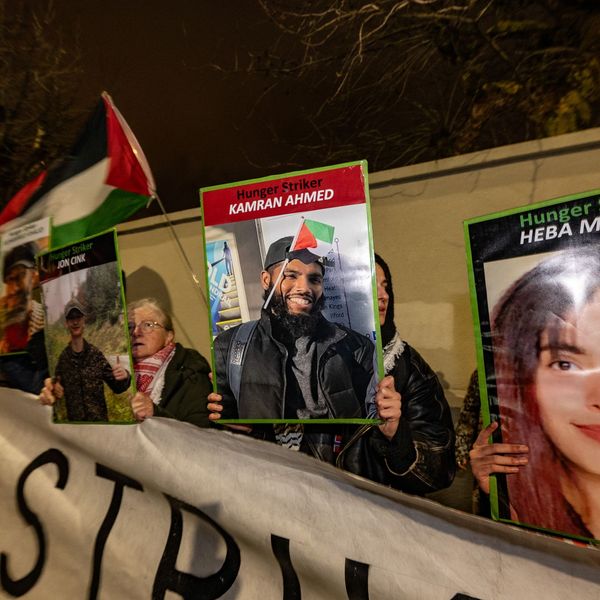
On November 2, a small group of imprisoned activists launched a hunger strike. Three people—Heba Muraisi, Kamran Ahmed, and Lewie Chiaramello—are still striking, despite imminent danger of death.
“She’s dying. She said it: ‘I’m dying,’” Francesca Nadin said of her friend Muraisi—who is on the 71st day of her strike—during a Monday interview with the Guardian.
Nadin said that the 31-year-old’s body is “shutting down.”
“I know mentally she’ll remain strong right to the last moment but she is dying,” she added. “The government, by putting her in prison and denying her all her rights, they’re not just letting her die, they’re actively killing her.”
Ahmed, 28, has been refusing food for 64 days. Doctors have informed him that his heart muscles are shrinking and he is at risk of sudden cardiac arrest.
“He’s skinny. I describe him a bit like a piece of paper,” Shahmina Alam, Ahmed’s sister, told Al Jazeera last week. “It feels like now every time you see him, it could be the last.”
Chiaramello, 22, has Type 1 diabetes and has been fasting every other day for 44 days.
A fourth person, Umar Khalid, has reportedly resumed his strike following a 13-day pause.
Despite her dire condition, Muraisi is “intent on carrying on until the demands are met,” according to friend Amareen Afzal.
The strikers are demanding immediate bail, an end to censorship of their communications, a fair trial, lifting of the ban on Palestine Action, and closure of Elbit Systems’ UK facilities.
“The hunger strikers’ demands seem reasonable to me,” Monbiot wrote last week. “All these things, I believe, should be happening anyway. And they are of course negotiating positions. Whether all would need to be met for the strike to end cannot be known until the government engages. Its refusal to talk could condemn the strikers to death.”
Standing in stark contrast with the US military’s torturous force-feeding of hunger striking Guantánamo Bay prisoners during the Obama administration, the UK follows recommendations in the World Medical Association’s Declaration of Malta, which advises doctors not to force-feed prisoners who choose to hunger strike and understand the consequences of their actions.
“Forcible feeding is never ethically acceptable,” the declaration states.
In 1981, UK authorities allowed 10 imprisoned Irish Republican Army members, including former Member of Parliament Bobby Sands, to starve themselves to death in Northern Ireland. Their deaths occurred after between 46 and 73 days of refusing food.
A group of former hunger strikers from Palestine, Ireland, and Guantánamo on Sunday issued an urgent appeal to the UK government to save the Palestine Action strikers’ lives, and condemning the terrorist designation.
Critics said that the government would be to blame should any of the hunger strikers die.
“The UK is now perilously close to full descent into authoritarian rule,” said professor Peter Hallward, who signed the intellectuals’ declaration. “Ministers won’t even meet with hunger strikers, who are now at death’s door.”
Hallward added that British Prime Minister Keir Starmer, Deputy Prime Minister David Lammy, Foreign Secretary Yvette Cooper, and Home Secretary Shabana Mahmood “seem perfectly ready to let this country’s most committed and courageous opponents of an ongoing genocide waste away and die.”
Israel’s US-backed war and siege on Gaza following the Hamas-led attack of October 7, 2023 has left more than 250,000 Palestinians dead, wounded, or missing in Gaza and most of the coastal strip in ruins. Around 2 million Gazans have been forcibly displaced, starved, or sickened.
Hundreds of Palestinians have been killed by Israeli forces since the current cease-fire took effect three months ago. Israeli authorities are still blocking or strictly limiting the entry of critical supplies into Gaza, where 2-month-old infant Mohammed Abu Harbid over the weekend became at least the fourth Palestinian baby to freeze to death since November.
More than a dozen Palestinians—including at least five children—have been killed by Israeli attacks in Gaza in recent days.
Israel is facing a genocide case filed by South Africa at the International Court of Justice, the principal judicial body of the United Nations, where a panel of experts found last year that Israel was committing genocide. Israeli Prime Minister Benjamin Netanyahu and former Defense Minister Yoav Gallant are also wanted by the International Criminal Court for alleged war crimes and crimes against humanity in Gaza.
On Monday, a court in Edinburgh held a hearing on a petition filed by human rights campaigner and former diplomat Craig Murray seeking to lift the ban on Palestine Action in Scotland, whose judiciary is independent from the rest of the UK.
“The impact of proscription of Palestine Action has been appalling,” attorney Joanna Cherry told the court. “Scores of peaceful people of entirely good character have been arrested under the absurd pretence of terrorism.”
“We are dealing with human rights and liberties—some of the most fundamental in our society,” Cherry added. “If people don’t have the right to express their views and assemble to express their views, they can’t really take part in civil society properly and adequately. It’s hard to imagine a more urgent situation.”

No comments:
Post a Comment