
Cuba Resists: an Interview With Journalist Boris Luis Cabrera
February 27, 2026
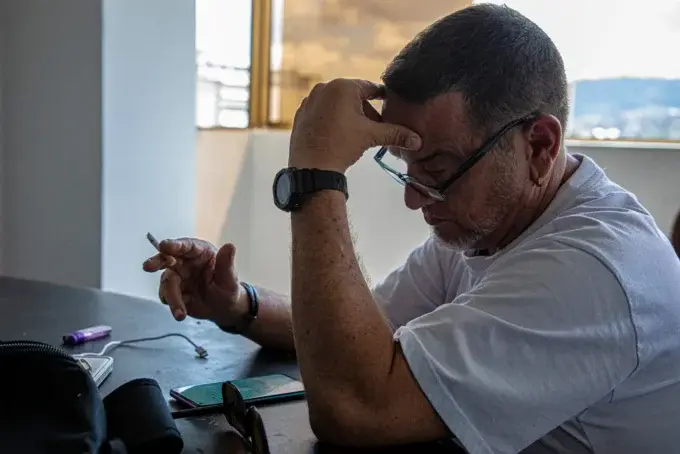
Cabrera in Caracas in February, 2026, speaking with friends back home. Photo by Panchito Gonzalez.
Boris Luis Cabrera, 53, is a veteran Cuban journalist who writes in a style clearly influenced by the cinematic, new journalism of the 1970s. He covers a wide range of topics and, for the last 10 years, has worked as a sports reporter for the Cuban press agency, Prensa Latina. I met him in February, 2026, when I arrived home from working for TeleSur in Caracas, Venezuela, to discover that two more beds had been placed in the journalists apartment I was staying in in the city’s Chacao quarter. Cabrera was in town covering the Latin American and Caribbean baseball championship. Like the other Cubans staying there, I noticed him having constant conversations with friends and family back home, to stay up to date on the effects of the US government’s criminal attempt to starve the island nation, who’s government it has been trying to depose for 65 years. A few days after he arrived back home, I got in touch to find out how things were going. The following interview is a result of that conversation.
Brian Mier: Can you describe what a typical day is like in Cuba right now?
Boris Luis Cabrera: An average day in Cuba today is marked by concrete material tensions: scheduled blackouts due to energy deficits, difficulties in obtaining certain foods and medicine, and limited public transportation due to shortages of fuel and spare parts. These problems cannot be analyzed in isolation from the structural impact of the economic, commercial, and financial blockade imposed by the United States, which limits access to credit, makes imports more expensive, and penalizes third countries that trade with the island. It is not just about internal shortages, but about systematic external pressure that shapes daily life. Nevertheless, education and healthcare remain universal and free, which makes a substantial difference compared to many countries in the Global South. So a typical day now revolves around material hardship, community support networks that we have set up to overcome them, and a strong culture of resistance.
Mier: What are your friends and family doing to cope with all of the difficulties?
The collective response has been diverse. Many resort to family cooperation strategies: sharing food, organizing joint purchases, exchanging services. Others have bet on local productive initiatives, private or cooperative ventures, within the margins allowed by the current economic model. These responses should not be interpreted as “adaptation to the market,” but as forms of popular resilience in the face of external economic aggression and a hostile international environment. There is also a growing internal debate on how to perfect the socialist model, make it more efficient, and combat distortions such as inflation and excessive bureaucracy.
Mier: For several years after the fall of the Soviet Union, Cubans faced food and fuel shortages. This time is now remembered as the “special period.” You seem old enough to remember those years. How do they compare to the period of US-imposed hardship that you are undergoing right now?
Cabrera: The so-called “Special Period” began after the collapse of the Soviet Union, when Cuba lost its main trading partner and source of energy supply. That era was marked by prolonged blackouts, severe food shortages, and a sharp drop in GDP.
The population weathered the crisis with a mix of extreme austerity, creativity, and social organization. There was widespread use of bicycles, urban agriculture, and solidarity networks in the neighborhoods and in workplaces.
Compared to today, many consider the psychological impact of the Special Period to have been more abrupt and profound. However, the current moment has created complex challenges due to a combination of factors including the tightening of the blockade, the post-pandemic global crisis, and internal economic tensions. The key difference is that back then there was a clear expectation of recovery supported by a different international environment; today the geopolitical landscape is more uncertain.
Mier: Over the last 6 decades, Cuba has developed the reputation as a country which has shown an impressive amount of solidarity with other peoples and nations in the Global South. During the Cold War, it also received support in its defense against US aggression from historic allies Russia and China. Now that Cuba is in a moment of need, why aren’t more countries reaching out to provide food and fuel?
Cuba has developed a recognized policy of international solidarity, sending medical brigades and technical support to dozens of countries. The limited current aid from some allies is not interpreted as abandonment, but as a result of their own economic limitations and geopolitical pressures.
Many countries face sanctions, energy crises, or financial dependence on multilateral institutions dominated by Western powers. Furthermore, the extraterritorial nature of U.S. sanctions discourages banks and companies from interacting with Cuba, even when there is political will.
Mier: What do you think is going to happen now? How is Cuba going to be able to survive this criminal blockade?
The international denunciation of the blockade as a violation of international law and the principle of peoples’ right to self-determination will continue. Every year, the UN General Assembly votes overwhelmingly against this policy. We expect that a combination of diplomatic pressure, international solidarity, and internal transformation, including greater economic efficiency, productive decentralization, and the fight against corruption, will enable Cuba to sustain its sovereign project. More than a passive waiting period until the end of the blockade, this vision emphasizes the need to strengthen Cuban socialism from within, diversify alliances, and maintain social cohesion as the country’s main political capital.
This first appeared on De-Linking Brazil.
Cabrera in Caracas in February, 2026, speaking with friends back home. Photo by Panchito Gonzalez.
Boris Luis Cabrera, 53, is a veteran Cuban journalist who writes in a style clearly influenced by the cinematic, new journalism of the 1970s. He covers a wide range of topics and, for the last 10 years, has worked as a sports reporter for the Cuban press agency, Prensa Latina. I met him in February, 2026, when I arrived home from working for TeleSur in Caracas, Venezuela, to discover that two more beds had been placed in the journalists apartment I was staying in in the city’s Chacao quarter. Cabrera was in town covering the Latin American and Caribbean baseball championship. Like the other Cubans staying there, I noticed him having constant conversations with friends and family back home, to stay up to date on the effects of the US government’s criminal attempt to starve the island nation, who’s government it has been trying to depose for 65 years. A few days after he arrived back home, I got in touch to find out how things were going. The following interview is a result of that conversation.
Brian Mier: Can you describe what a typical day is like in Cuba right now?
Boris Luis Cabrera: An average day in Cuba today is marked by concrete material tensions: scheduled blackouts due to energy deficits, difficulties in obtaining certain foods and medicine, and limited public transportation due to shortages of fuel and spare parts. These problems cannot be analyzed in isolation from the structural impact of the economic, commercial, and financial blockade imposed by the United States, which limits access to credit, makes imports more expensive, and penalizes third countries that trade with the island. It is not just about internal shortages, but about systematic external pressure that shapes daily life. Nevertheless, education and healthcare remain universal and free, which makes a substantial difference compared to many countries in the Global South. So a typical day now revolves around material hardship, community support networks that we have set up to overcome them, and a strong culture of resistance.
Mier: What are your friends and family doing to cope with all of the difficulties?
The collective response has been diverse. Many resort to family cooperation strategies: sharing food, organizing joint purchases, exchanging services. Others have bet on local productive initiatives, private or cooperative ventures, within the margins allowed by the current economic model. These responses should not be interpreted as “adaptation to the market,” but as forms of popular resilience in the face of external economic aggression and a hostile international environment. There is also a growing internal debate on how to perfect the socialist model, make it more efficient, and combat distortions such as inflation and excessive bureaucracy.
Mier: For several years after the fall of the Soviet Union, Cubans faced food and fuel shortages. This time is now remembered as the “special period.” You seem old enough to remember those years. How do they compare to the period of US-imposed hardship that you are undergoing right now?
Cabrera: The so-called “Special Period” began after the collapse of the Soviet Union, when Cuba lost its main trading partner and source of energy supply. That era was marked by prolonged blackouts, severe food shortages, and a sharp drop in GDP.
The population weathered the crisis with a mix of extreme austerity, creativity, and social organization. There was widespread use of bicycles, urban agriculture, and solidarity networks in the neighborhoods and in workplaces.
Compared to today, many consider the psychological impact of the Special Period to have been more abrupt and profound. However, the current moment has created complex challenges due to a combination of factors including the tightening of the blockade, the post-pandemic global crisis, and internal economic tensions. The key difference is that back then there was a clear expectation of recovery supported by a different international environment; today the geopolitical landscape is more uncertain.
Mier: Over the last 6 decades, Cuba has developed the reputation as a country which has shown an impressive amount of solidarity with other peoples and nations in the Global South. During the Cold War, it also received support in its defense against US aggression from historic allies Russia and China. Now that Cuba is in a moment of need, why aren’t more countries reaching out to provide food and fuel?
Cuba has developed a recognized policy of international solidarity, sending medical brigades and technical support to dozens of countries. The limited current aid from some allies is not interpreted as abandonment, but as a result of their own economic limitations and geopolitical pressures.
Many countries face sanctions, energy crises, or financial dependence on multilateral institutions dominated by Western powers. Furthermore, the extraterritorial nature of U.S. sanctions discourages banks and companies from interacting with Cuba, even when there is political will.
Mier: What do you think is going to happen now? How is Cuba going to be able to survive this criminal blockade?
The international denunciation of the blockade as a violation of international law and the principle of peoples’ right to self-determination will continue. Every year, the UN General Assembly votes overwhelmingly against this policy. We expect that a combination of diplomatic pressure, international solidarity, and internal transformation, including greater economic efficiency, productive decentralization, and the fight against corruption, will enable Cuba to sustain its sovereign project. More than a passive waiting period until the end of the blockade, this vision emphasizes the need to strengthen Cuban socialism from within, diversify alliances, and maintain social cohesion as the country’s main political capital.
This first appeared on De-Linking Brazil.
It’s Cuba’s Turn: Attacking US-Flagged Boats in the Caribbean
This time, the appropriately designated shoe had found itself on the other foot. While the Trump administration has been gorily killing personnel on alleged “narco-boats” and vessels supposedly heading to US shores laden with illicit drugs, Cuba had its turn at engaging a boat with “a known history of criminal and violent activity”.
On the morning of February 25, the speedboat in question was identified in Cuban territorial waters. Registered in Florida in the United States, it approached, according to the Cuban Ministry of the Interior, “up to 1 nautical mile northeast of the El Pino channel, in Cayo Falcones, Corralillo municipality in the Villa Clara province.” When encountered by Cuba’s Border Guard Troops, those on board are said to have opened fire, injuring a commander.
The Cuban ministry of the interior noted the killing of “four aggressors on the foreign vessel”. Six were also injured and remain in custody. “The injured individuals were evacuated and received medical assistance.” The latter remark was almost mocking in nature, given the tendency by the US Navy to kill all aboard the alleged narco-boats.
Necessary comments about defending the sovereign integrity of the island were also made. “In the face of the current challenge, Cuba reaffirms its determination to protect its territorial waters, based on the principle that national defense is a fundamental pillar of the Cuban State in safeguarding its sovereignty and ensuring stability in the region.”
The reaction from US authorities to this bit of medicine has been cagey and consistently hypocritical. Secretary of State Marco Rubio expressed a preference not to trust the Cuban account, as did Florida Attorney General James Uthmeir. “The Cuban government cannot be trusted,” he grumbled in a social media post, “and we will do everything in our power to hold these communists accountable.” Rick Scott, Republican Senator from Florida, similarly declared that, “The Communist Cuban regime must be held accountable!”
Florida Republican Rep. Carlos Gimenez complained about shifting narratives from Havana, a rich assertion given his government’s fable spinning tendencies on Caribbean drug boats, narco-terrorism and extra-judicial assassinations. “The original story was that they were transporting human smuggling and now they’re terrorists. They are changing their story and we need to get to the bottom of it.” He also questioned the nature of the vessel. “It is a 24-foot open fisherman with 1300 horsepower engine and ten people on it won’t go very fast.” In a post on X, Gimenez treated the armed boatmen as innocents “murdered” by the Cuban “dictatorship”.
Cuban suspicions are understandable and may prove plausible. As Cuban diplomat Bruno Rodríguez Parilla observed, his country had faced “numerous terrorist and aggressive infiltrations from the United States since 1959, with a high cost in lives, injuries, and material language.” Since the overthrow of the US-backed tyranny of Fulgencio Batista by Fidel Castro’s revolutionaries in 1959, the American military and political establishments have sought to meddle, isolate and starve the island population into submission. Attempts, none of which succeeded, were made on Castro’s life. (The staggering figure of 634 was suggested by retired agent Fabián Escalante.)
The old temptation towards regime change has never abated, despite the disastrous and failed effort by President John F. Kennedy to deploy CIA-trained exiled Cuban combatants at the Bay of Pigs in 1961. In sheer spite, he campaigned to have Cuba expelled from the Organisation of American States (OAS), something its members agreed to do in 1962.
Embargos became the norm, with the occasional hint at subversion and destabilisation. In 2003, for instance, the administration of George W. Bush created the Commission for Assistance to a Free Cuba (CAFC) which recommended a program to overthrow the Castro government. (The formula proved dully familiar: fund dissidents and malefactors under the cover of establishing civil society; encourage foreign governments to distance themselves from Havana.)
This latest naval encounter has taken place against the backdrop of a renewed campaign by Washington to impose change on Havana. Irrespective of what those killed and captured on the Florida-registered vessel were destined to do, the muscular thuggery of the Donroe Doctrine articulated by US President Donald J. Trump does not envisage a communist state in the hemisphere. On January 29, the President issued an Executive Order declaring with pathological hyperbole “that the policies, practices and actions of the Government of Cuba constitute an unusual and extraordinary threat, which has its source in whole or substantial part outside the United States, to the national security and foreign policy of the United States.” To carry out the order, tariffs would be “imposed on imports of goods that are products of a foreign country that directly or indirectly sells or otherwise provides any oil to Cuba.”
Most prominently targeted among those countries was Mexico. After the issuing of the order, Mexican President Claudia Sheinbaum warned that the measures “could trigger a far-reaching humanitarian crisis, directly affecting hospitals, food and other basic services for the Cuban people, a situation that must be avoided through respect for international law and dialogue between the parties.” Her particular concern was how oil could still be supplied under contract with Cuba via Pemex or continue as part of a humanitarian program. Over this month, a fleet-footed postponement strategy has taken shape, focusing on humanitarian emergency.
And a humanitarian emergency it most certainly is. On February 26, a bevy of international civil society organisations long present in Cuba, including Arci Culture Solidali, CARE Cuba and COSPE, released a statement “warning of a possible humanitarian collapse due to the lack of fuel supply to the country, placing the provision of essential services at risk.” Hospital services, emergency and intensive care, and “the cold chain for vaccines, blood, and medicines” had been compromised. The prices of goods had risen, production reduced, food security imperilled.
The United Nations Resident Coordinator in Cuba, Francisco Pichón, has also expressed concern about what will happen once the month-long contingency plan to cope with the fuel blockade ends. He offered a grim tale of vulnerability: the reliance of almost one million people on the water provided by tanker trunks; five million people living with chronic illness; thousands of cancer patients requiring continuous oncological care; the need for ongoing services for 32,000 pregnant women. “The risk to people’s lives is not rhetorical, those who suffer first and suffer most are ordinary people, especially the most vulnerable.”
On February 25, the US Department of Treasury slightly softened restrictions by announcing a “favourable licensing policy” that would permit companies seeking licenses to resell Venezuelan oil for use in Cuba. “This favourable licensing policy is directed towards transactions that support the Cuban people, including the Cuban private sector (e.g, exports for commercial and humanitarian use in Cuba).” This modest proposal will do little to distract the current administration from a goal it shares with every preceding government since Kennedy.

No comments:
Post a Comment