Workers Need More Paths to Join the Labor Movement
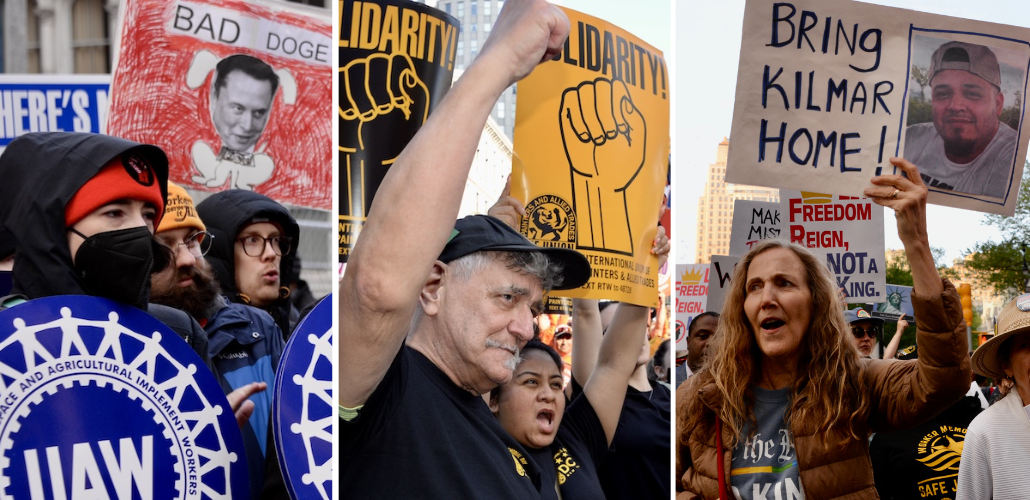
[This article is part of a Labor Notes roundtable series: How Can Unions Defend Worker Power Against Trump 2.0? We will be publishing more contributions here and in our magazine in the months ahead. Click here to read the rest of the series.]
It shouldn’t be so hard for workers to join a union. Nearly half of non-unionized workers in the U.S. say they would join a union if they could. Yet only 1 in 10 belongs to one, and that number continues to fall.
The main path to unionization, through a National Labor Relations Board election or the public sector equivalent, has long been broken and favors employers. While unionizing through the NLRB must remain a central strategy, alone it isn’t enough.
Imagine you’re a worker at Target who wants to organize, but none of the unions in your area is willing to support you. Unionizing Target isn’t part of their strategic plan, and organizing major retail outlets seems too difficult right now.
So you give up. You stop talking to your co-workers about organizing, because no one could offer you a way forward. This happens to thousands of motivated workers every year. The labor movement is losing potential leaders and organizers because it has no pathway for them to join and stay active.
If we want to build an organized working class capable of taking on the billionaires and defeating Trump-era policies like ICE’s reign of terror, we have to treat the labor movement more like a movement, one that brings more and more motivated people into its ranks.
Work has changed in fundamental ways, and people relate to it differently than previous generations did. Wages haven’t kept up with the cost of living. Automation means that workers must quickly learn new skills or change jobs. Increasingly concentrated corporate power and employer-friendly laws make winning union elections and first contracts difficult.
Our organizing strategies must account for the realities workers face today. We can win demands and advance material gains at work by putting direct, organized pressure on our bosses—not always relying on the NLRB election process or waiting for a contract before we start acting like a union.
We should create structures to support workers on this path when joining a union isn’t an option. This means focusing on developing more organizers and activists, which can grow the labor movement in the long term.
EWOC’S MODEL
The Emergency Workplace Organizing Committee, where we work, was created to support workers dealing with crises at their workplaces during the Covid-19 pandemic. It began as a group of volunteer organizers, many with decades of experience in the labor movement, offering one-on-one advice to workers seeking urgent support when they had nowhere else to turn.
The pandemic forced our organizers to respond quickly, creatively, and outside existing union structures at a time when workers could not afford to wait. Workers received organizing support and training whether or not their campaigns had a chance at recognition or certification. In hundreds of workplaces, they put direct pressure on their bosses and won demands like hazard pay, paid sick leave, and personal protective equipment.
EWOC’s lean and distributed model has endured beyond the pandemic. Workers kept reaching out to learn how to talk to co-workers, build organizing committees, and make demands. At any given time volunteers are supporting and training workers in hundreds of workplaces.
Over the years, EWOC has shown that workers and volunteers can organize and win even without the help of union staff—taking nearly 700 actions and winning over 250 demands on pay, safety, scheduling, and more. These wins spark excitement and renew a sense of possibility.
EWOC will back any organizing effort, in any industry, anywhere in the country. We have become part of the organizing ecosystem. In hundreds of cases, we’ve helped workers connect with unions to run union drives, including at Amazon-owned Whole Foods in Philadelphia, the National Cancer Institute, Grand Canyon National Park, and Austin’s Ascension Seton Medical Center.
INSIDE AND OUTSIDE THE NLRB
Each year, hundreds of campaigns end up in limbo even though workers are ready to unionize. Often employers manage to stall them out by challenging the bargaining unit size or firing key workers. Even when workers vote a union in, the boss has many tactics to slow momentum and avoid a first contract. Despite these well-recognized facts, the labor movement still relies almost exclusively on unionization through the NLRB.
There are also good reasons why unions say “no” to some new organizing campaigns and drop workers and organizing committees if they don’t pass certain tests. Unions understandably focus on organizing and fighting for the workers they already represent. But that doesn’t mean other workers shouldn’t be part of the labor movement. It just means unions aren’t currently in a position to support them.
That’s a problem our movement needs to solve if we want to increase unionization rates. To meet this moment, unions could play a critical role in building and supporting a coalition that experiments with non-NLRB strategies and gives workers in limbo the tools to build durable power.
The labor movement should be supporting pre-majority unions, workers who act like a union without one, and direct-join unions that unite workers across an industry rather than a single workplace. These workers will need resources like dues systems, steward networks, communications tools, informal bargaining resources, and democratic practices that enable campaigns to survive and grow.
And when workers are ready, labor should be providing support so campaigns can affiliate with existing unions, form their own independent unions, or formalize other long-term structures.
By experimenting with new models of non-NLRB organizing, the labor movement can also sharpen tactics to bargain over issues that the NLRA doesn’t compel employers to address—demands that make life better for all workers, their wider communities, and the world. This will strengthen us to confront the multiple crises of democracy, from authoritarianism to climate disaster to ICE terror.
RISK VS. REWARD
Even with robust support, non-NLRB organizing will remain challenging. Risky tactics like recognition strikes expose organizations to potential liabilities. When workers risk their jobs or paychecks, sustained participation may be difficult to impossible without significant external support. And there’s a steep learning curve, since these strategies are widely misunderstood or completely unfamiliar to workers.
While it’s essential for unions to take on strategic targets, the labor movement must be capable of pursuing multiple organizing priorities at the same time. Many EWOC campaigns will eventually bolster major strategic fights, and others won’t—yet all of them expand capacity, leadership, and confidence across the movement.
When bosses fear worker organization because workers have built real, durable power, contracts become easier to win, and many demands can be secured without the NLRB. The future of organizing demands a movement that can take risks, cultivate and multiply worker leadership, and experiment with new pathways to recognition.
To succeed in this political moment and meet what comes next, we must build a new coalition of unions, workers, and volunteers who are ready to experiment with new and old models, learn from mistakes, teach others the lessons, and try again and again, until we win.


No comments:
Post a Comment