
“We do everything with love to assist people, but the reality right now is that we don’t have enough resources,” said one Cuban doctor, who added that “the main cause of everything is the USA.”
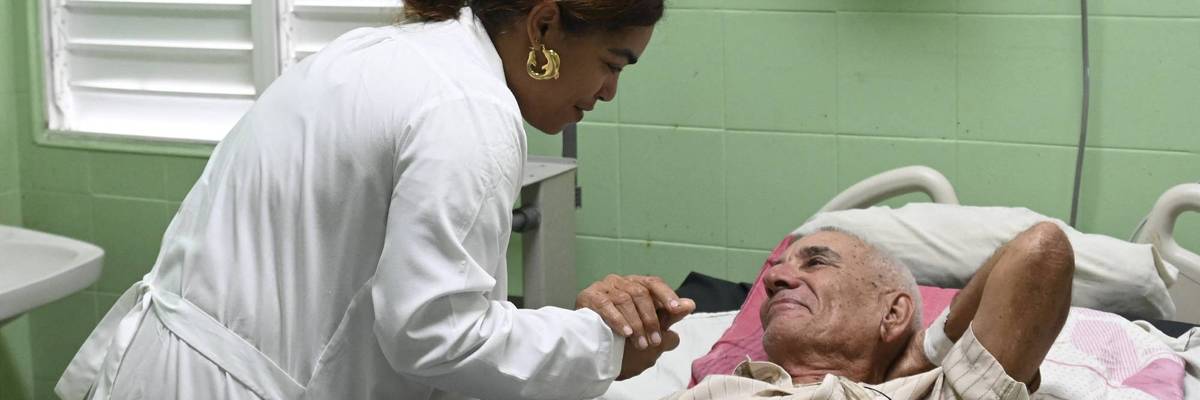
A doctor talks to a patient in the cardiology room of the Calixto Garcia Hospital in Havana on February 12, 2024.
(Photo by Yamil Lage/AFP via Getty Images)
Brett Wilkins
Mar 27, 2026
COMMON DREAMS
The Trump administration’s oil blockade of Cuba—an escalation of the 65-year US stranglehold on the socialist island’s economy—is killing Cubans amid a severe shortage of electricity and critical basic medical supplies, doctors and nurses there told reporters this week.
“I can’t tell you how many deaths, but I’m sure there are more than in the same period last year,” Dr. Alioth Fernandez, chief anesthesiologist at William Soler Pediatric Hospital in Havana, told The New York Times in an article published Friday. “I see it in shift handovers, in colleagues’ comments, and in children I’ve operated on.”
Cuba’s universal healthcare system is internationally known. Its “Army of White Coats” has been deployed around the world, both to provide routine and specialized care, as well as during emergencies such as the Haiti earthquake, Sierra Leone Ebola outbreak, and Covid-19 pandemic in Italy.
Despite decades of success under increasingly adverse conditions, Cuba’s vaunted health system is under tremendous strain, due in no small part to the cumulative effects of generations of US economic sanctions.
“Since I was born, this is the most difficult time, without any doubt,” José Carlos, a resident intern at Havana Cardiology Institute, told the Canadian Broadcasting Corporation on Thursday. “We do everything with love to assist people, but the reality right now is that we don’t have enough resources.”
The lack of fuel is limiting ambulance service and keeping many doctors and other medical professionals from commuting to hospitals that are canceling surgeries and discharging patients early. As Common Dreams reported earlier this week, more than 96,000 Cubans—including 11,000 children—are waiting for surgery due to the fuel shortage.
“Everything is hitting us—energy, resources, transportation,” Carlos told the CBC.
When the lights go out, neonatal nurses use hand-pumped ventilators to keep infants alive. Without power, hospitals and clinics can’t administer chemotherapy cycles or dialysis treatments.
“I don’t know how long we can keep going,” Xenia Álvarez, the mother of a 21-year-old man who suffers a rare genetic disease and requires full-time use of a ventilator, told The New York Times.
Shortages of basic medicines and supplies are forcing doctors to substitute medications, delay treatments, or even ask patients’ relatives to find supplies themselves. Antibiotics, painkillers, and medications to treat chronic diseases are scarce, as are gloves, syringes, and diagnostic equipment. Hospital staff also report difficulty maintaining sterile conditions.
While the US government claims that humanitarian goods like medicine are exempt from sanctions, critics counter that the fuel blockade, along with severe restrictions on banking and shipping, effectively block many medical supplies from reaching the island. The Trump administration has also been pressuring countries into expelling the lifesaving Cuban medical teams, sparking widespread outrage and condemnation.
After the Fidel Castro-led revolution that ousted the US-backed dictatorship of Fulgencio Batista, the United States imposed an economic embargo on the island that has been perennially condemned by an overwhelming majority of United Nations member states for 33 years. Cuba says US sanctions have cost its economy more than $200 billion in inflation-adjusted losses.
US Secretary of State Marco Rubio recently admitted that the economic chokehold is meant to force political change in Cuba while simultaneously disparaging the Cuban economy as “dysfunctional.”
Rubio also said that although President Donald Trump is currently focused on the US-Israeli war of choice on Iran—one of seven nations attacked since the self-proclaimed “president of peace” returned to the White House—he would “be doing something with Cuba very soon.”
Trump said earlier this month that he believes he’ll “be having the honor of taking Cuba,” language echoing the 19th century US imperialists who conquered the island along with Puerto Rico and the Philippines from Spain.
In addition to patients, the crisis in Cuba is also taking a physical and psychological toll on Cuban doctors—who, even with a recent raise earn just 100 pesos, or about $2.40, per 12-hour shift. This, in a country in which a dozen eggs cost nearly $10. Many doctors rely upon side hustles to get by.
“Doctors’ pay is just for basic things,” said Carlos. “It doesn’t allow you to buy many things in the supermarket or go to a restaurant or a hotel, or things like that.”
Breakdowns and burnout are on the rise.
“I’ve seen doctors cry,” one physician, who wished to remain anonymous for fear of retaliation, told Reuters. “With this crisis, they cry. They’ve stopped working, they’ve become depressed. You can see it on their faces.”
Despite the worsening situation, Carlos told the CBC that he does not want to leave Cuba, and blamed the US for the crisis.
“The main cause of everything is the USA,” he said. “I have no doubt about that.”
Some do want to leave, blaming their own government as well the US embargo for Cuba’s suffering. Others are taking things one day at a time.
“We don’t know what will happen,” a nurse who gave only her first name, Rita, told the CBC, “so we just keep working.”
The mounting—and preventable—deaths in Cuba are prompting renewed calls for the US to lift sanctions on Cuba.
“No patient deserves this. Trump’s cruel Cuban blockade is killing people unnecessarily,” National Nurses United, the largest US nurses’ union, said on social media Friday. “Depriving Cubans of essential resources needed to sustain life and health is an unconscionable violation of human rights. Nurses say: End the blockade now!”
Congresswoman Ilhan Omar (D-Minn.) also weighed in during a Thursday floor speech in which she said that “Cuba poses no threat to us, yet we are strangling an entire nation with economic warfare.”
“Families are going without food. Water systems are failing. Hospitals are struggling to stay open,” she continued. “These tactics are designed to suffocate an island into submission. Make no mistake: This unconscionable suffering is occurring because Trump is trying to force regime change.”
“Hands off Cuba,” Omar added. “End the blockade now.”

Regarding the ongoing situation on the Caribbean island, we interviewed Roberto Livi, correspondent for the newspaper Il Manifesto, who has a deep understanding of the country’s social and political dynamics, having lived there for several decades.
Can you give us a picture of the ongoing crisis?
The situation has long been dramatic, exacerbated by the lack of fuel. Electricity outages last for hours every day. Added to this are rising prices, making costs unsustainable for most of the population, the dollarisation of basic necessities, and the collapse of transportation, meaning Havana now relies on electric tricycles or bicycles.
This is a terrible picture. Many of my neighbours cook with coal or wood, and at the same time, there’s a general, unorganised political discontent, given that throughout the post-revolutionary era in Cuba there has never been a true civil society, because those so-called, like the Women’s Union and the Journalists’ Union, are actually the party’s transmission belts. Likewise, there’s a growing distrust of the state, incapable of solving people’s material problems.
There’s no organised civil society, but have there been moments of self-organisation in the working-class neighbourhoods or elsewhere?
These aren’t neighbourhood groups, but rather moments of protest, with some leaving their homes, taking to the streets, and starting to make “cacelorazos,” while others join in. In the more peripheral areas of Havana, there are genuine popular movements. But there’s no opposition capable of proposing a transitional program. So these are spontaneous outbreaks that, at best, are quelled by the intervention of party officials or “committees for the defence of the revolution” who try to convince people to hope for an improvement, or by police repression.
The situation is made even more problematic by the fact that there are essentially two opposing forces: the “contra” who are aiming to overthrow the government, and the state that resists, because it’s not true that it has failed.
You mentioned the energy issue. Dependence on oil has been a prerogative of the economic model. In recent weeks, renewables have been mentioned several times, which have gradually been chosen as an alternative in recent years. What can you tell us about this?
Regarding renewables, Díaz Canel reported that today—thanks to Chinese aid—solar energy covers about 50% of the energy required during the day. Problems arise at sunset because of a lack of batteries.
Storage, fuel for the power plants. Furthermore, the neighbourhood micro-power plants They don’t work due to the lack of diesel.
Regarding renewables, around 500 panels have already been installed in as many polyclinics and some hospitals. The same is true in areas where people in need of care live, or in isolated locations.
What are the reasons for this outcome? Are structural issues coming to a head? Has the post-Fidel era accelerated the crisis of a model that, beyond the mitigating circumstances of the historic US embargo, had chronic flaws of various kinds from the outset?
Regarding the crisis of the model, it’s clear that the bureaucratic structure hasn’t worked for some time: the country hasn’t produced, has been in recession for four years, and its per capita GDP is the lowest in Latin America. Much depends on the blockade, but there have been tragic planning errors such as the “Tarea ordenamiento,” that is, monetary unification, and excessive investment in hotels to the detriment of electricity generation, healthcare, and education.
For years, many friendly economists have been repeating that decentralisation and autonomy would be necessary, as well as encouraging greater grassroots participation. A law allowing for partnerships between the private and state sectors was recently passed.
How are the party and the government reacting? What could happen? Is a Venezuelan scenario possible?
It’s difficult to say, because, with no transparency and information from the media, the balance of power is unknown. Differences are known, and the crisis situation is highlighted by Díaz-Canel’s admission of ongoing negotiations with the US, a scenario that is changing the political landscape.
Furthermore, the ongoing negotiations appear to be under the control of Raúl’s entourage, and therefore the military. This suggests that the current leadership’s weeks, if not days, are numbered.
It is also expected that the first overtures toward the Cuban-American diaspora will begin soon.
In short, a transition period is possible, with economic openings and perhaps a new leadership linked to Raúl and the military.
However, it’s difficult to envision anything beyond an emergency phase: Cuba needs oil to survive, and the US can provide it for an interim period, but with the clear understanding that strategically, there must be a change of government. Raúl’s men can buy time.
I don’t think there will be a Venezuelan-style surrender; the two countries have different histories, but given the difficult situation, barring surprises in Iran and the US midterm elections, it will be difficult to negotiate with a straight face and defend sovereignty.
Mexico searches for missing boats ferrying aid to Cuba
By AFP
March 27, 2026

Since last week, activists have left Mexican ports on vessels loaded with food and other supplies for Cuba - Copyright AFP YURI CORTEZ
The Mexican Navy was searching on Friday for two boats that went missing while transporting humanitarian aid to crisis-hit Cuba, authorities and the convoy organizers said.
The vessels set sail last Friday from Isla Mujeres in Mexico’s southeastern state of Quintana Roo, with nine crew of different nationalities on board, Mexico’s navy said Thursday in a statement.
But communication with the crew was lost, it added.
The Nuestra America Convoy said earlier that it would use air, land and sea to deliver food, medicine and supplies to the communist island which has risked being plunged into darkness since US President Donald Trump vowed in January to starve it of oil.
“Mexican authorities have activated their search and rescue protocol for two sailboats en route to Havana as part of the Convoy, which have not yet arrived,” a spokesperson for the convoy told AFP.
“The captains and crews are experienced sailors, and both vessels are equipped with appropriate safety systems and signalling equipment,” the spokesperson said.
While the convoy appealed for information on sightings of the vessels, it said it remains “confident in the crews’ ability to reach Havana safely.”
“Based on the speed of the vessels reported to the Cuban maritime authorities, the window for arrival for the boats in Havana should be between the night of Friday 27 March and midday of Saturday 28 March,” they explained.
The Mexican Navy said on Thursday that there had been neither “communication nor confirmation of their arrival” in Cuba and that it had alerted naval commanders in the region and its search and rescue stations.
The navy said earlier that the boats were due to arrive between Tuesday and Wednesday.
– Cuba in crisis –
Since last week, activists from several countries have left Mexican ports on vessels loaded with food and other supplies for the communist-led island, which faces a humanitarian crisis in the face of a US-imposed fuel embargo.
The navy did not specify the identities or nationalities of the crew members on the missing boats, but said it was maintaining communication with rescue agencies in Poland, France, Cuba and the United States.
The navy is also in contact “with the diplomatic missions of the crew members’ countries of origin” to cooperate and exchange information in real time, the statement said.
It said it was using aircraft to search the route between Isla Mujeres and Havana.
It appealed to seafarers and maritime authorities in the Caribbean and the Gulf of Mexico to report any information or sightings of the missing vessels to the nearest naval authority.
Trump imposed a de facto oil blockade on Cuba in January after the US ouster of Venezuelan leader Nicolas Maduro, whose government had been its principal source Cuba’s fuel supplies

The Mexican Navy activated search and rescue efforts in the Caribbean on Thursday, in hopes to locate two missing sailboats which were carrying humanitarian aid to crisis-hit Cuba.
The boats left Isla Mujeres, in the Mexican state of Quintana Roo, last week and were bound for Havana.
With nine people of different nationalities on board, the boats did not arrive in the Cuban capital on March 24 and March 25, as scheduled.
In a statement, the Navy appealed to seafarers and maritime authorities in the region to report any information or sightings. It said it was also using an aircraft to search the route between Isla Mujeres and Havana.
Why were the boats sailing to Havana?
The aid-carrying boats were part of efforts to provide relief to Cuba as it faces a severe energy and economic crisis due to a tightened US embargo on oil and other goods.
The Trump administration has tightened its blockade on Cube in January following the capture and deposing of Venezuela's President Nicolas Maduro.
Volunteers in Mexico, last week, loaded boats with essentials like rice, beans, baby formula, wipes, and medicine as they prepared to set sail to Cuba. The vessels were a part of the "Nuestra America Convoy," a non-government initiative to deliver vital supplies to the struggling country.
One separate vessel from the convoy reached Havana on Tuesday.
"The captains and crews are experienced sailors, and both vessels are equipped with appropriate safety systems and signalling equipment," a spokesperson for the convoy said in a statement to Reuters.
"We are cooperating fully with the authorities and remain confident in the crews' ability to reach Havana safely."
Mexican authorities contacted maritime rescue coordination centers in several countries including Poland, France, Cuba and the US, the Navy said. They also contacted diplomatic representatives of the missing individuals' countries of origin, which have yet to be disclosed.
Edited by: Rana Taha
Mahima Kapoor Digital journalist based in New Delhi
Russian officials confirmed Wednesday that Moscow is sending fuel to Cuba as humanitarian aid, intensifying geopolitical tensions as a Russian oil tanker likely bound for the island approaches the Caribbean. Moscow’s announcement comes amid a US effort to choke off oil supplies to Havana that has led to a worsening energy crisis and an unfolding humanitarian disaster.
Issued on: 26/03/2026 -
FRANCE24
By: Sébastian SEIBT

Russian Energy Minister Sergei Tsivilev confirmed Wednesday that Russia is providing fuel shipments to Cuba, saying, “We are sending humanitarian aid. We are providing humanitarian support,” and that the move is intended to help the island cope with severe shortages caused by a US blockade. In January, the Trump administration halted the subsidised Venezuelan oil shipments that had kept the Cuban energy grid running.
The Anatoly Kolodkin oil tanker, which left the Russian port of Primorsk on March 8, is expected to reach its destination on Thursday. It initially listed “Atlantis” as its destination – likely a reference to a marina in Boston, according to the MarineTraffic website – but its current trajectory and increasingly patchy tracking data point elsewhere.
Earlier this month, maritime trackers indicated that a different Russian tanker likely delivered diesel to Cuba, suggesting that the Kolodkin is just the latest fuel shipment aimed at alleviating the island’s energy shortage.
Analysts note that the vessel is already under US sanctions, accused of being part of Russia’s network for bypassing restrictions on its energy exports. Earlier speculation suggested possible diversions to Trinidad and Tobago or Venezuela, but Cuba now appears to be the confirmed destination.
A limited cargo, a larger signal
A successful fuel delivery to Cuba would have geopolitical significance beyond its immediate impact. The tanker is transporting around 730,000 barrels of crude – enough to supply the island for several weeks – at a time when Washington is tightening efforts to restrict fuel flows to Havana.
Cuba, which previously relied on Venezuelan oil for roughly 60 percent of its energy needs, lost that supply after the US military raid on then president Nicolas Maduro.
The US strategy is clear: by limiting oil supplies, Washington aims to deepen Cuba’s economic crisis and increase pressure on its government. A fuel delivery would expose the limits of that approach.
Organised by international groups and activists, several aid shipments carrying solar panels, food, bicycles and medical supplies have also reached Cuba. The humanitarian aid deliveries highlight the breadth and severity of Cuba’s humanitarian crisis.
First flotilla boat arrives in Cuba to deliver aid amid crisis

01:51
“Cuba is in the midst of its worst fuel shortage in years. So this shipment of crude oil could buy Cuba a couple of weeks after refining,” said Basil Germond, a maritime security specialist at Lancaster University.
Germond noted, however, that the shipment “would not solve the structural, longer-term crisis” and noted that: “Russia’s motives look more geopolitical than altruistic.”
Moscow raises the stakes
Unlike earlier shipments routed through vessels flying flags of convenience, the Anatoly Kolodkin is openly Russian-flagged and was briefly escorted out of European waters by a Russian naval frigate, signalling a shift in Moscow’s tactics.
Such visibility appears deliberate.
“This seems to confirm that this vessel likely aims to deter or test [the] US interdiction. A Russian-flagged vessel with a naval escort (even if short-lived) acts as a ‘tripwire signal’: interfering with this vessel would escalate from sanctions enforcement to a direct confrontation with a Russian asset. This is state-to-state, not clandestine commerce. Thus, it becomes a strategic signalling operation, not simply an oil delivery,” Germond said.
Assistant professor Yevgeniy Golovchenko at the University of Copenhagen also noted that Moscow is trying to “send a signal”, perhaps looking to “poke at the US”.
“If the US boards this tanker while it has a Russian flag ... then the US would be blatantly and openly violating international agreements,” he said.
A difficult US response
That calculation complicates the US response. Interfering with a sanctioned vessel in international waters is legally and politically sensitive – particularly one openly linked to Russia.
“US sanctions (without a UN Security Council resolution) do not provide automatic authority to seize a foreign vessel in international waters or third-party waters ... this would be considered as an act of state-to-state aggression by Russia,” Germond said.
For Moscow, the mission carries limited downsides. If the oil reaches Cuba, it reinforces Russia’s image as a strong partner able to support allies and challenge US influence in the Western Hemisphere. If it does not, the tanker could still serve as leverage.
The Kremlin has reaffirmed its support for Havana while the US continues to apply political and economic pressure on the island amid reported talks with Havana.
“There's a good chance this [oil shipment] is some sort of bargaining position in order to put pressure on the US,” said Jeff Hawn, a Russia specialist at the London School of Economics.
Hawn noted that a “stark split” exists within the US administration among those focused on Cuba, those focused on Iran, and those “who want to make peace with Russia”.
For Moscow, he said, “This is most likely a way to try to extract some sort of accommodation from Washington by basically saying, ‘Look, we're going to give Cuba oil unless you do something we want.’”
Enforcement or Escalation
Washington has already moved to tighten its blockade, adding Cuba to the list of destinations where Russian oil deliveries are explicitly prohibited. But its options remain constrained.
'How long can any nation survive without oil?': Cuba faces repeated blackouts amid blockade

09:15
US forces could shadow the vessel to ramp up the pressure, analysts say, but stopping or seizing it outright lacks a legal basis and would risk escalating tensions with Moscow.
As the tanker nears the Caribbean, Washington is facing a familiar dilemma: a heavy-handed enforcement of its blockade that risks confrontation or allow Russia to breach it, thereby undermining the overall US strategy in the region.
This article was adapted from the original in French by Natasha Li.

No comments:
Post a Comment